
MarsTrip
Space Centre
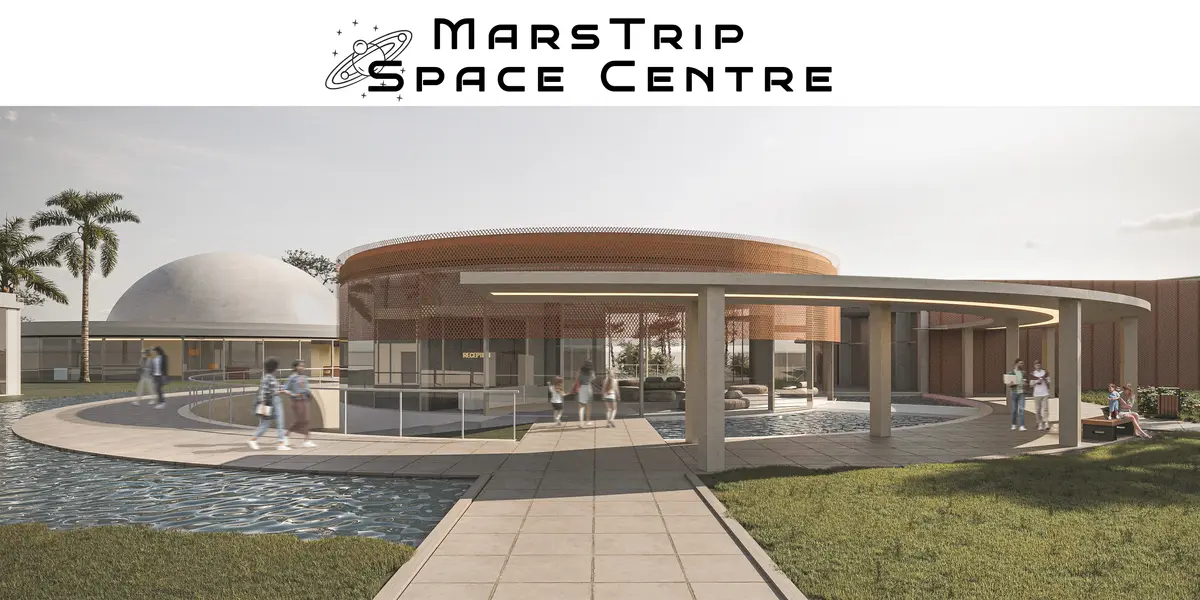
The main function of the facility is a science center for children and youth. This function encompasses exhibition halls, administration, a planetarium, and an educational section.
Exhibition Halls: These are the primary spaces where interactive exhibitions and presentations take place. They are equipped with various exhibits, interactive panels, models, simulations, and tools for experimentation. They function as educational spaces where children and young people can acquire knowledge and experience learning through practical activities and interactions.
Administration: This is the area where all necessary administrative activities related to the operation of the science center take place. It includes offices, a conference room, and a projection room for the planetarium. The administration ensures efficient visitor service, manages reservations, and provides information.
Planetarium: It is a crucial element of the science center where multimedia projections, astronomical presentations, and shows related to space take place. The planetarium space is equipped with a special dome and advanced projection systems that recreate realistic images of the sky, stars, planets, and other cosmic elements. This allows visitors to explore the cosmos and expand their knowledge of astronomy. In addition to the projection room, there are also designed technical rooms and a foyer with a shop for guests.
Educational Section: This section comprises an auditorium, lecture rooms, and laboratories where workshops, classes, and lessons on various scientific subjects occur. Children and young people have the opportunity to experiment, build models, conduct experiments, and deepen their knowledge in a practical manner. The educational section is tailored to the needs of different age groups and offers interactive tools and teaching materials.
The facility has been divided into several sections that harmoniously interact with each other. The entrance zone serves as the central point of the complex and has been designed in a circular layout. Radiating arcs extend from its center, forming the walls of the exhibition halls. This has created a cohesive structure that ensures a logical flow of visitors through the complex.
The educational zone, consisting of an auditorium and classrooms, has been designated as a separate building in a semi-circular layout. This part of the complex is dedicated to educational activities and presentations that take place at scheduled times. This provides visitors with a clearly delineated space for learning and deepening their knowledge.
The administration building, located at the northeast corner of the complex, also seamlessly integrates into the design. Its shape and layout have been planned to visually complement the central point, which is the entrance zone building. As a result, the entire complex presents a coherent and well-thought-out spatial arrangement.
The planetarium building is situated to the south of the site. The dome suggests the function of this facility and serves as a prominent feature due to its shape and height.
Such a layout helps visitors navigate the facility, providing intuitive navigation between different sections. Additionally, the geometric arrangement of the buildings emphasizes aesthetics and ensures user understanding, contributing to a positive experience during exploration and use of the complex.
At the main entrance, you'll find the reception area, which serves both informative and service functions. The furnishings are kept in understated, beige shades that don't overpower the entire space, but rather create a pleasant and professional atmosphere. Directly behind the reception is a shop where souvenirs are available.
Opposite the reception, there are seating areas that allow groups to gather or provide a moment of relaxation before heading to the exhibition halls. Large windows on the walls of the building blur the boundaries between the interior and the exterior, enabling users to enjoy views of the surrounding landscape.
In the exhibition halls, light colors such as white and beige dominate. They are intended to serve as a neutral backdrop for the presented exhibitions and innovative technologies. The interiors have been designed in a way that captures guests' attention while not diverting their focus from the exhibited content.
To ensure appropriate lighting conditions, the light intensity on Level 0 has been reduced. Blinds and polycarbonate material have been used to gently diffuse the light. As a result, the exhibition halls are well illuminated while avoiding excessive sunlight. On Level -1, only artificial light is available, which aligns with the thematic context of the exhibited displays.
The first hall, dedicated to temporary exhibitions, has been designed as a clean space, allowing flexible usage. The next hall, along the visitor's route, focuses on Earth and spacecraft themes. It is the tallest of all halls and features a mezzanine from which visitors can admire exhibits hanging from the ceiling. The entire space is equipped with interactive devices that enable guests to discover and delve into various aspects related to Earth and space travel.
On Level -1, there are two rooms with unique themes. The first is dedicated to a Mars base and is tailored to the needs of virtual reality (VR) technology. To avoid distracting the viewer, the room is dimly lit. Dark-colored walls, floors, and ceilings are illuminated by artificial light, guiding the way to the VR station. This approach to lighting and color scheme allows users to fully concentrate on their virtual journey to Mars. The dim lighting also enhances the sense of authenticity and space-like ambiance.
The second room, focused on the surface of Mars, stands out with its space. It is the largest space on Level -1. White walls, functioning as canvases, create an ideal backdrop for interactive images displayed on them. Through minimalist design, the room directs attention to the content and experiences presented on the walls. Viewers can immerse themselves in the fascinating world of cosmic discoveries, drawing the richness of experiences from the presented scenes. Comfortable seating provides an ideal place for relaxation and contemplation. From here, viewers can fully enjoy the visual spectacle unfolding before them.
The planetarium serves as the final stage of the tour, where guests have the opportunity to experience captivating cosmic views. The interior of the planetarium has been designed with the comfort of visitors in mind. They can take their seats on specially designed seats for viewing projections on the dome. Dark colors dominate the space, fostering focus on the spectacular images. Subtle lighting, emanating only from artificial sources, creates an intimate and mystical atmosphere in this place.

Popular Articles
Popular articles from the community


Temporary Home for Dogs: A Reversed Zoo Rethinks Animal Shelter Architecture
In Bucharest, a sinuous corridor and freed landscape flip the logic of containment, designing a shelter that works to make itself unnecessary.
Extended Shell: Retrofitting Kolkata's Balconies as Living Urban Thresholds
A modular retrofit system recovers the social and environmental intelligence of Kolkata's historic verandas for contemporary Park Street residents.

Opera on the Sea: Driftwood Logic Shapes a Timber Opera House on Estonia's Coast
Trevor Orgill's opera house translates the entangled drift of floating timber into a civic building where wood, water, and music converge.
Faces of the Soviet Avant-Garde: Turning Moscow's Street Names into an Open-Air Museum
A network of sculptural installations across a Moscow residential district transforms forgotten architect names into spatial encounters with cultural memor

Similar Reads
You might also enjoy these articles

The Amber Palace Opera: A Geological Fiction Surfaces on Tallinn's Baltic Waterfront
Pierre Brillard reimagines a Baltic legend as a public landscape, opera house, and waterfront promenade rooted in Tallinn's coastal identity.
Dynamic Modules Shelter: A Telescopic Ring for Mountain Pilgrimage
A circular modular framework of steel, bamboo, and fabric grows vertically with demand, wrapping communal ground in adaptable shelter.

Singing Woman: Contemporary Architecture Inspired by Estonia’s Voice and the Sea
Singing Woman turns Estonia’s song culture into flowing opera house architecture, blending public life, landscape, sea, and national memory.
HYPERBLOCK: Flexible Urban Design for Barcelona’s Future City
HYPERBLOCK reimagines Barcelona as flexible urban design, layering density, daylight, public space and adaptable housing above Cerdà’s grid.

Explore Space Centre Competitions
Discover active competitions in this discipline


Challenge to reimagine the Iron Throne

Photograph architecture without architects

Illustrate the lost glory of Angkor Wat - Render Challenge

Design challenge to reuse E-waste
Comments (0)
Please login or sign up to add comments
No comments yet. Be the first to comment!