

Maumstudio Carves an Undulating Wooden Playground for Seoul's Tokyo Toy Museum
A 413-square-meter play space in Gangdong-gu translates the warmth of handmade wooden toys into plywood topography.


There is a particular logic to wooden toys that adults tend to forget: they reward the hand before the eye. A block's weight tells you something. A wheel's grain catches your thumb. The Seoul outpost of Tokyo Toy Museum, designed by maumstudio and led by architect Lee Dalwoo, takes that tactile premise and scales it up to the room itself. Every surface, ramp, and partition is shaped from plywood, so the building does not merely contain wooden toys. It behaves like one.
Occupying 413 square meters in Gangdong-gu, the project straddles educational and commercial architecture. It is technically a museum, but the word conjures glass cases and labels, neither of which appear here. Instead, maumstudio produced a continuous landscape of curving platforms and gentle slopes where children move freely through zones dedicated to different kinds of play. The design argument is clear: if the first artwork a child encounters is a toy, then the first architecture they experience should be equally generous, warm, and inviting to touch.
A Topography Made of Plywood

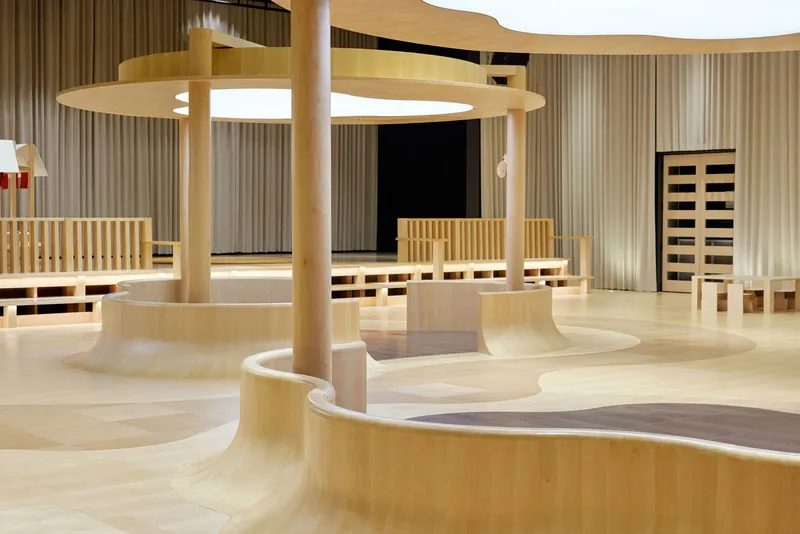

The defining gesture is the floor. Rather than dividing the plan into discrete rooms, maumstudio treats the ground plane as a continuous terrain that rises, dips, and wraps around cylindrical columns. Light and dark timber species alternate in sweeping curves, producing boundaries that feel organic rather than imposed. The effect is somewhere between a skateboard park and a Scandinavian nursery, scaled for bodies under a meter tall but legible to everyone.
Overhead, ring-shaped pendant lights echo the circular column footprints, casting an even glow that avoids the institutional harshness of fluorescent panels. The luminous rings create a soft rhythm across the ceiling, reinforcing the sense that the space is a single, breathing organism rather than a collection of separate enclosures.
Children as Active Agents
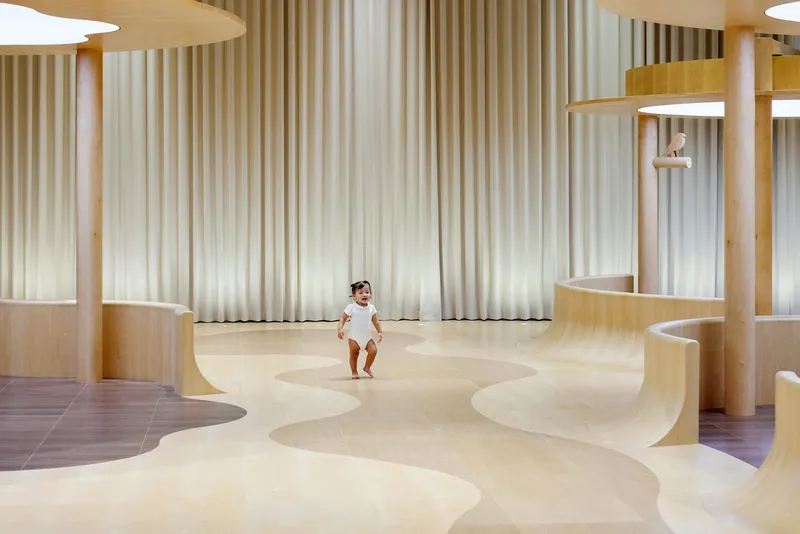
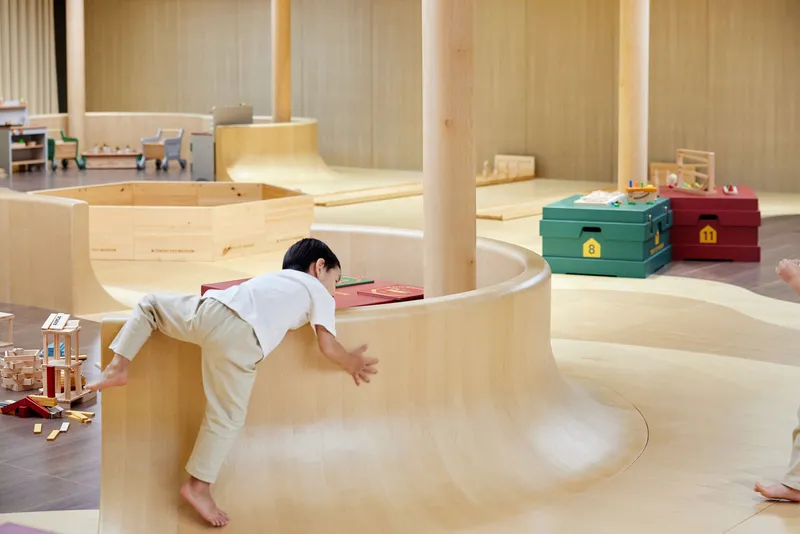
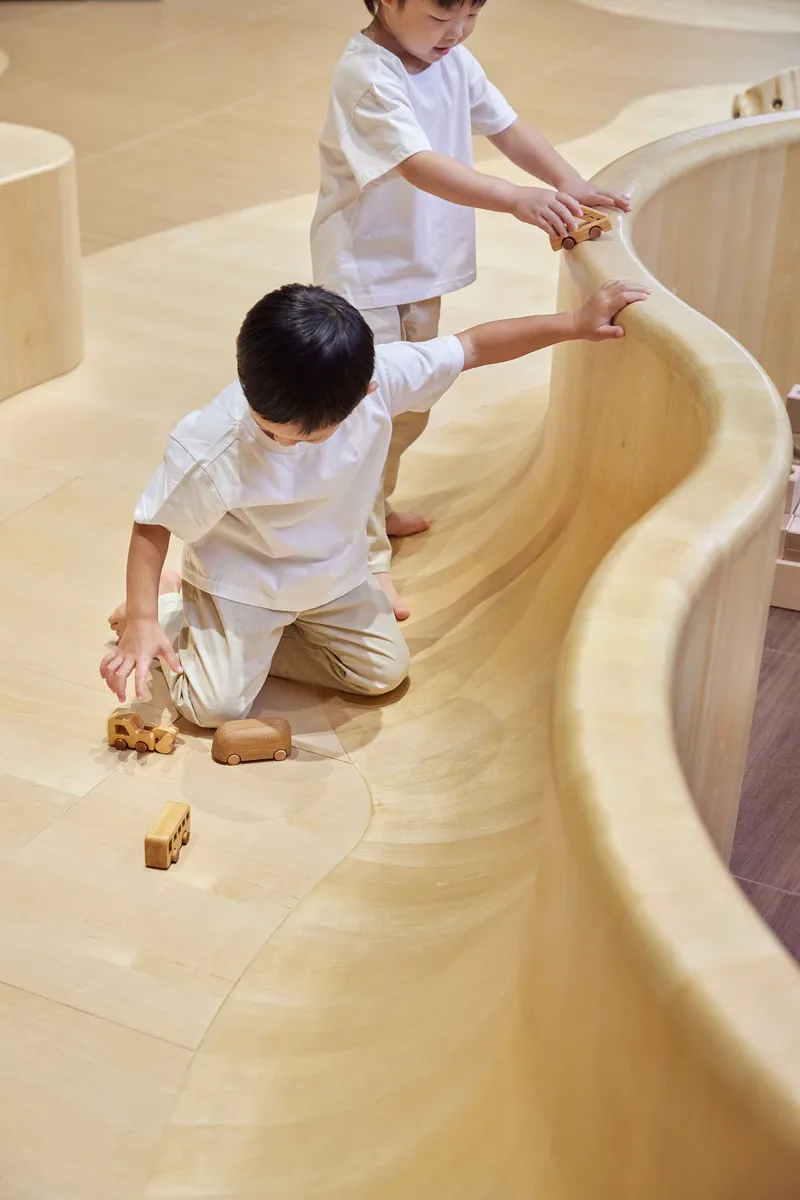
Design for children often defaults to one of two modes: the padded cell or the miniature adult room. Maumstudio avoids both. The undulating plywood surfaces invite climbing, sitting, running, and rolling without prescribing any single posture. A curved partition becomes a wall to peer over. A ramp becomes a slide or a stage, depending on the child. The architecture does not instruct; it offers.
What makes this work is the material continuity. Because every surface reads as the same family of warm wood, the transitions between floor, bench, barrier, and platform feel seamless. There is no moment where a child encounters an abrupt edge or a hostile material shift. Risk is managed through geometry, not signage.
Fabric, Curtains, and Soft Thresholds

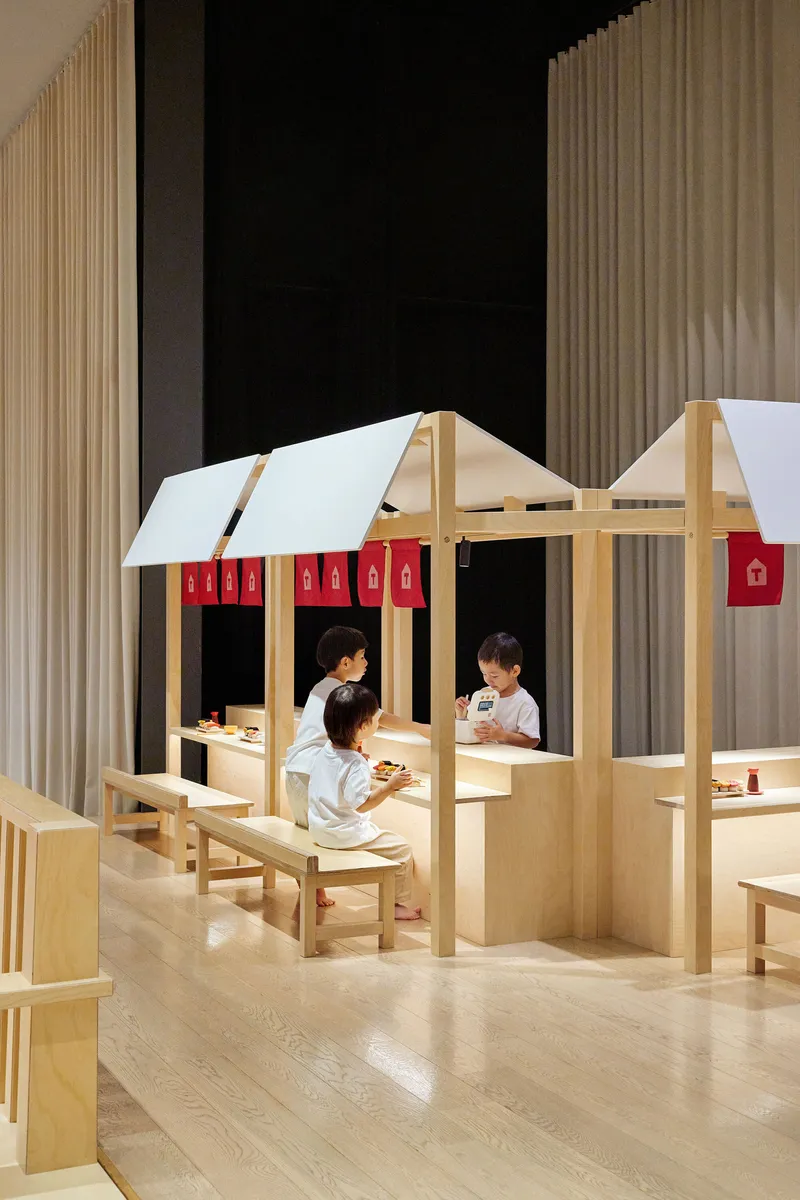

Vertical curtain panels in white and red fabric serve as the primary space dividers. They billow, gather, and part, turning each play zone into something more like a tent or a fort than a room. The textile interventions soften acoustics and introduce a second material language that contrasts the rigidity of plywood with the looseness of draped cloth.
Small playhouses with fabric roofs and red curtain walls appear at intervals, offering enclosure for children who want intimacy rather than openness. These structures read as oversized toys themselves, maintaining the conceit that everything in the museum belongs to the same playful universe. The curtains also provide practical flexibility: staff can reconfigure zones for different programs without touching the built fabric.
The Grain of Play
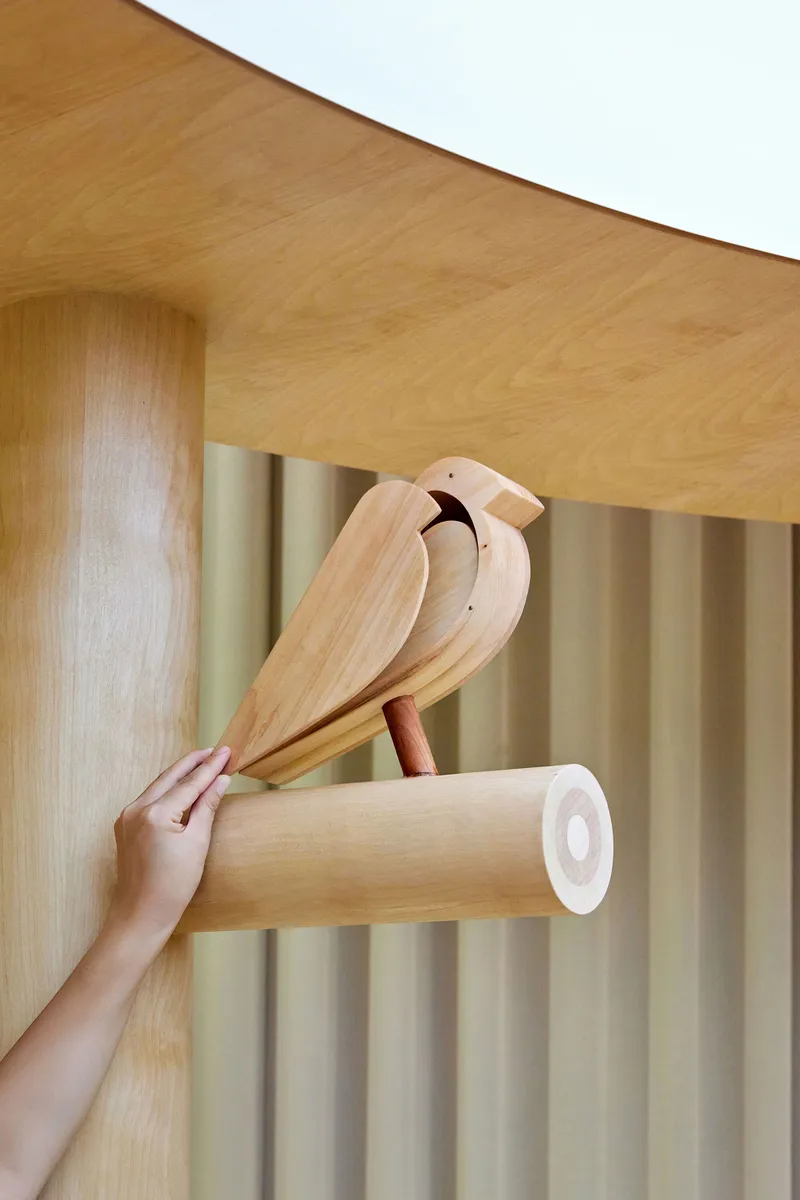
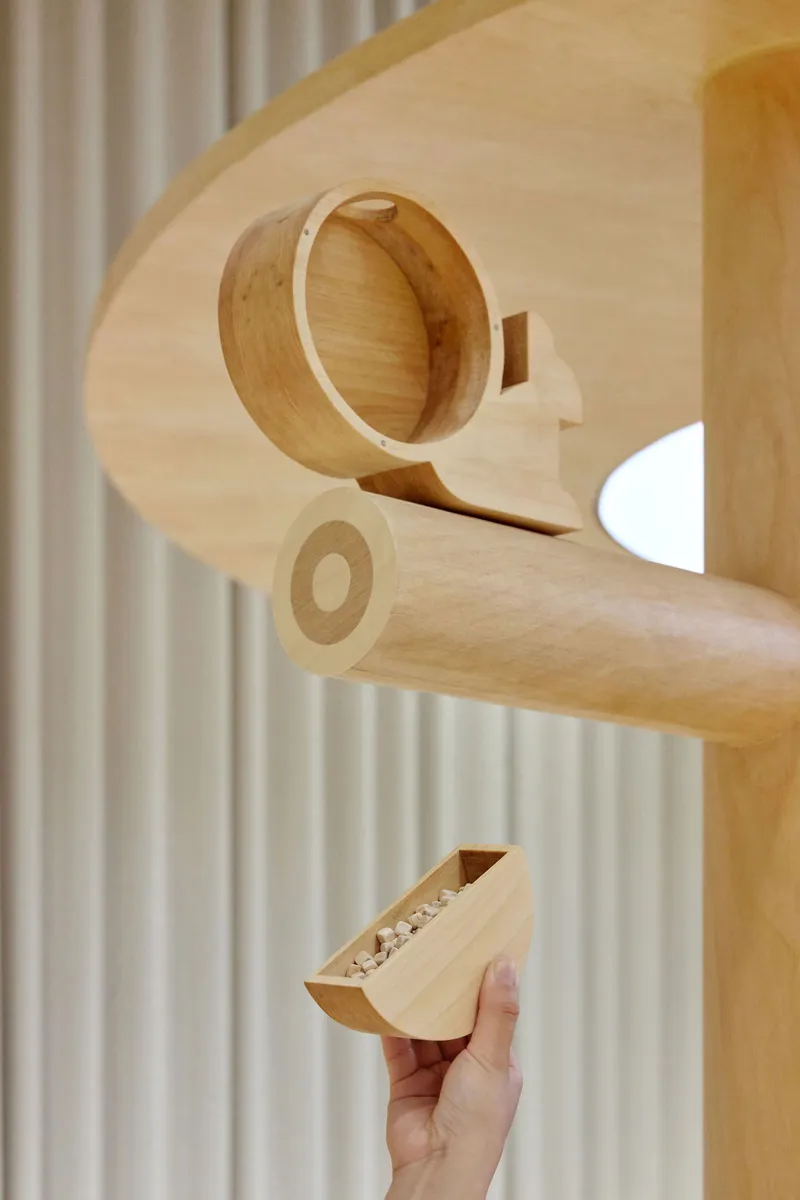
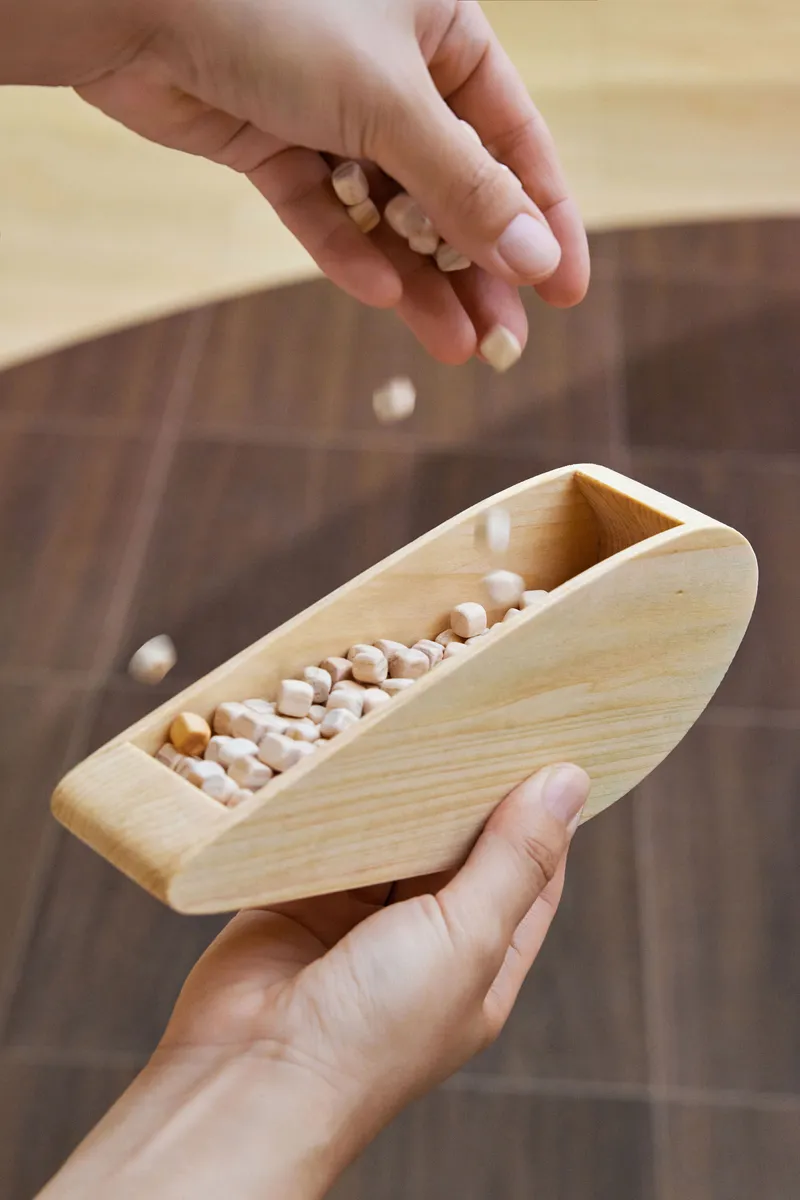
Close-up moments reveal the care taken at the object scale. Wooden bird sculptures perch on cylindrical pegs. Suspended timber drums invite a tap. Boat-shaped vessels catch falling beads. Each toy is simple enough for small hands yet visually sophisticated, and maumstudio clearly calibrated the surrounding architecture to serve as a neutral backdrop for these moments of discovery.
The connection between the architectural shell and the toy collection is not decorative but philosophical. Both prioritize natural materials, rounded edges, and open-ended interaction. The grain of the floorboard runs into the grain of the toy, collapsing the boundary between building and exhibit.
Detail and Threshold


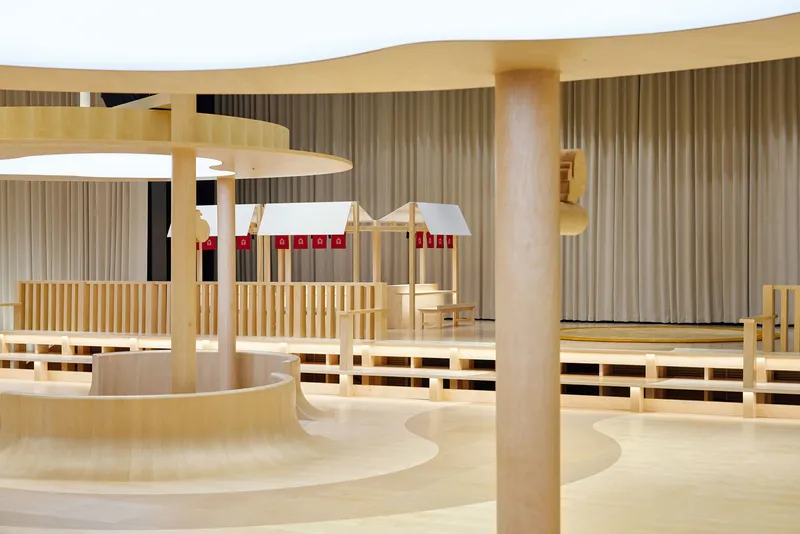
The junction between light and dark timber on the floor deserves attention. Seen from above, the organic boundary curves like a shoreline, and children seem drawn to trace it with their feet. That a floor joint can become a source of delight speaks to the level of craft at work. A seating area framed by horizontal timber slat screens and accented pendant lamps offers adults a calm retreat while remaining visually connected to the play zones, acknowledging that parents need architecture too.
Arrival and Exterior
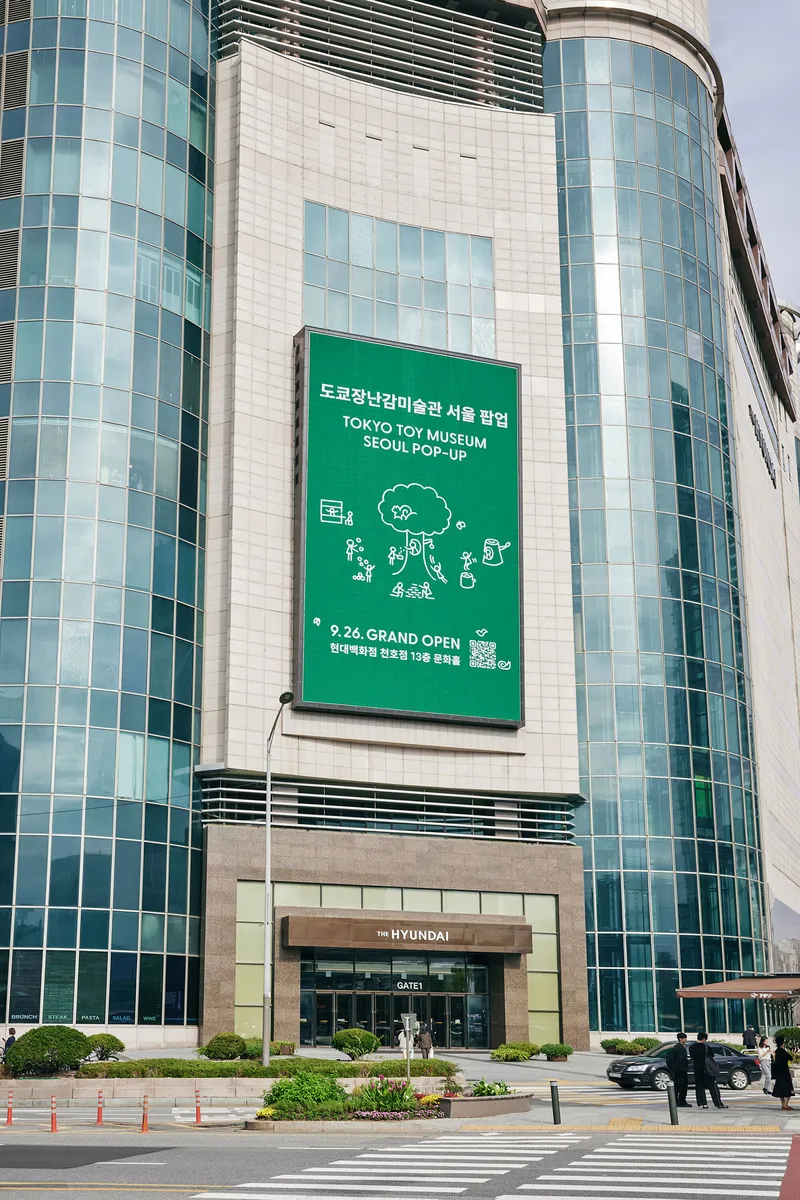
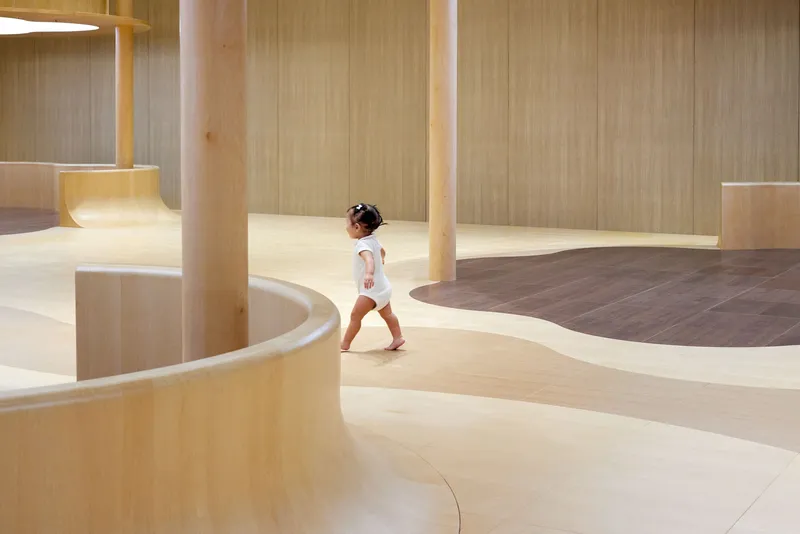
From the street, the museum announces itself modestly: a curved glass and tile facade with a large green banner. The restraint is deliberate. The real experience begins inside, and the entry sequence pivots quickly from urban concrete to enveloping timber warmth. Vertical paneling along interior corridors guides visitors deeper into the plan, where the undulating landscape opens up and the ceiling canopy descends.
Model and Process

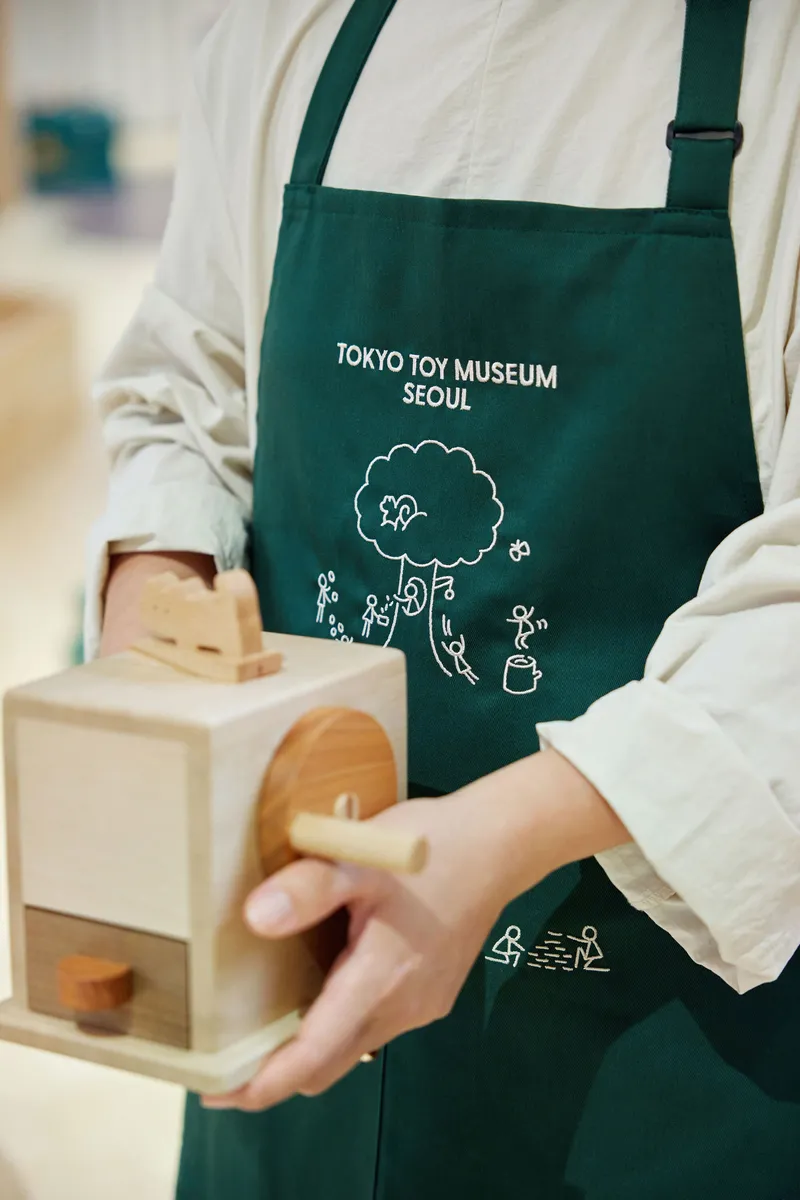

A physical study model reveals maumstudio's design process: integrated stepped seating units are cut directly into the plywood base of a table, testing how topographic moves can serve double duty as furniture and landscape. Branding details, from the wooden brochure holder to the embroidered apron, extend the material language beyond architecture into a coherent visitor experience. Nothing feels outsourced or generic.
Plans and Drawings
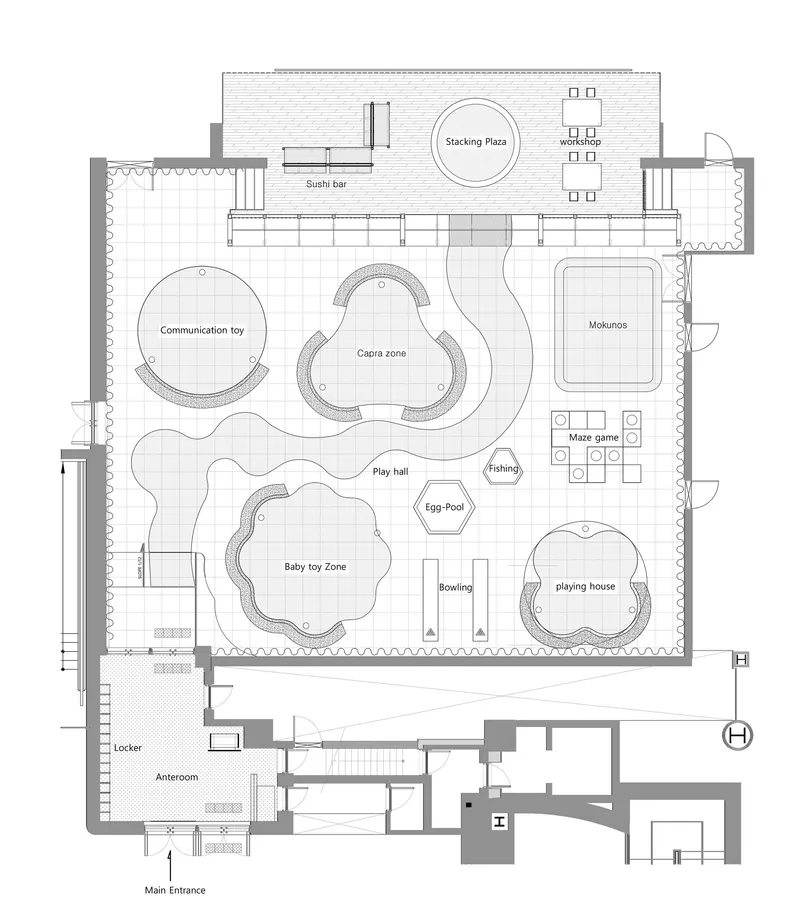
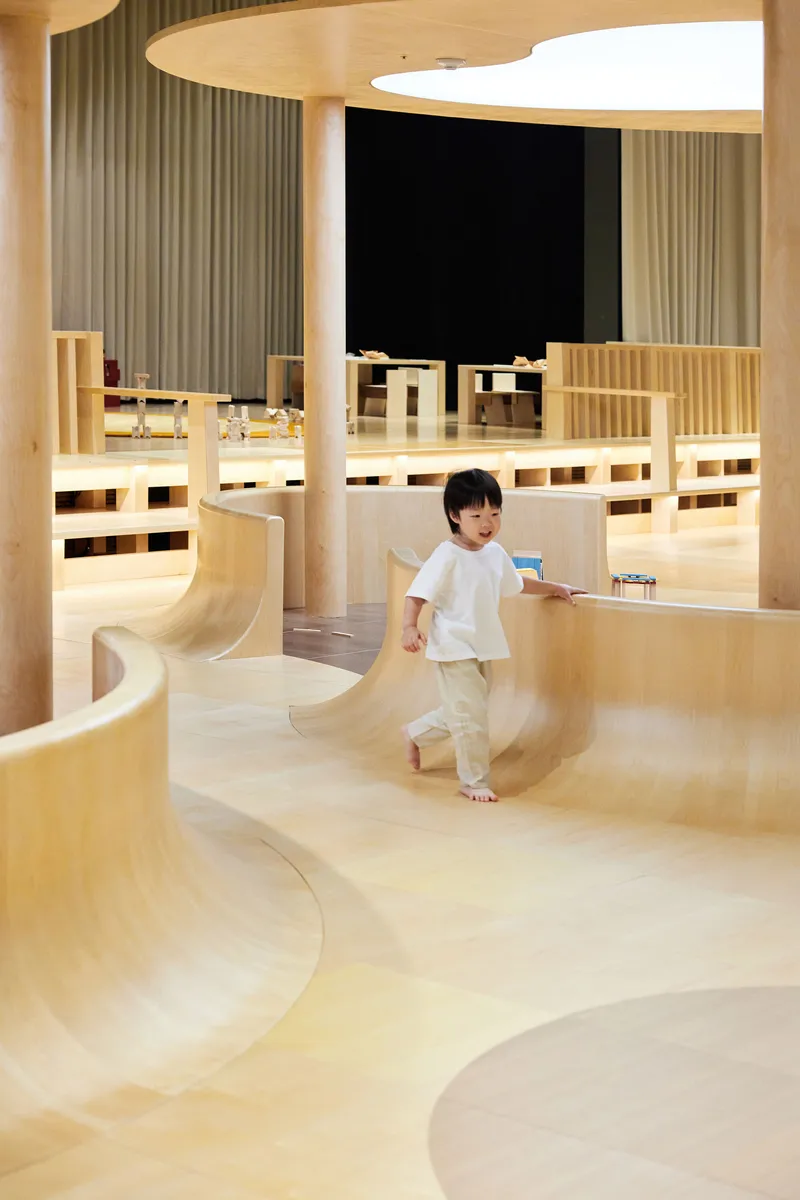
The floor plan confirms what the photographs suggest: curvilinear play zones radiate from a central hall, with no right angles governing the layout. Activity areas are differentiated by contour and material rather than by walls, producing a legible sequence that avoids corridors entirely. The plan reads like a topographic map, which is exactly the point. Circulation is not separate from program; moving through the space is the program.
Why This Project Matters
Architecture for children is often treated as a minor genre, valued more for its photogenic charm than for its ideas. Tokyo Toy Museum Seoul pushes back against that dismissal. Maumstudio demonstrates that a play space can be architecturally rigorous without resorting to primary-color clichés or patronizing miniatures. The building takes children seriously as spatial thinkers, offering complexity through material and topography rather than graphic decoration.
More broadly, the project makes a case for sensory architecture in an era dominated by screens. Every surface here invites contact. The warmth of wood, the give of fabric, the slope underfoot: these are not nostalgic gestures but deliberate design decisions rooted in how young bodies learn about the world. If the first artwork we encounter is a toy, maumstudio has ensured that the room holding it is worthy of the same attention.
Tokyo Toy Museum Seoul, designed by maumstudio (lead architect Lee Dalwoo), Gangdong-gu, South Korea. 413 m², completed 2025. Photography by Ju Yeon Lee.
About the Studio
Share Your Own Work on uni.xyz
If projects like this are the kind of work you want to make, uni.xyz is a place to publish your own, find collaborators, and enter design competitions.


Popular Articles
Popular articles from the community


Singing Woman: An Opera House That Performs Before the Curtain Rises
Ovidiu Cristian Pavel's conceptual opera house translates Estonia's choral identity into a sculpted waterfront landmark facing the Baltic Sea.
Cloaked Colonization: A Mobile Underwater Habitat That Moves Like a Fish
Micah Abaya's shortlisted EHC Pacific entry reimagines ocean settlement as a dispersed network of self-sustaining architectural organisms.

The Amber Palace Opera: A Geological Fiction Surfaces on Tallinn's Baltic Waterfront
Pierre Brillard reimagines a Baltic legend as a public landscape, opera house, and waterfront promenade rooted in Tallinn's coastal identity.

Manzana Morphosis: Stretching Barcelona's Grid into a Living Landscape for 2050
A radical reworking of the Eixample manzana turns density into a tool for generous public space, vertical ecology, and environmental performance.

Similar Reads
You might also enjoy these articles

Pixel Gardens: One Repeated Module Stacked Into a Terraced Social Housing Tower for Famagusta
Salem Bader's shortlisted housing tower builds a vertical neighbourhood from one repeated module, offsetting units to carve terraces, light and air.

Bao Huynh Watercolor Atelier: A Serene Art Retreat in Hội An
Bao Huynh Watercolor Atelier in Hội An blends multifunctional art spaces, sustainable design, local materials, and family-friendly living in a serene environment.

Atelier Macri Concept Store Interior Design by CASE-REAL
Atelier Macri store features a "ko" counter, walnut wood details, cork displays, blending retail, gallery, and seamless customer experiences.

Manuel Vargas Izquierdo Stadium and High-Performance Sports Center: Architectural Excellence in Jalpa de Méndez
The Manuel Vargas Izquierdo Stadium blends sustainable design, inclusive sports facilities, and cultural-inspired architecture, revitalizing Jalpa de Méndez’s public spaces.

Explore Tokyo Competitions
Discover active competitions in this discipline

Challenge to design public laboratory

Bring back Drive In's
Comments (0)
Please login or sign up to add comments
No comments yet. Be the first to comment!