

Mecanoo Cracks Open the Dutch Central Bank and Gives Amsterdam a New Public Heart
A 1968 fortress on the Frederiksplein sheds its hermetic identity to become a transparent civic landmark along Amsterdam's canal belt.


Central banks are not supposed to invite you in. For more than half a century, De Nederlandsche Bank sat on the Frederiksplein as a sealed perimeter: a Brutalist compound whose parking lots and vault walls told Amsterdam's citizens to keep their distance. Mecanoo's renovation inverts that relationship entirely, slicing through the former gold vault to carve a new public entrance, lowering the quay along the Singelgracht, and converting the building's dead center into a landscaped city garden open day and night. The result is one of the most ambitious institutional transformations in recent Dutch architecture, not because of what was added, but because of what was unlocked.
The numbers tell part of the story: only about 1,500 square meters of genuinely new construction within a 67,000 square meter complex. The rest is strategic subtraction and careful reinvention. The original architect, Marius Duintjer, designed the building as a floating horizontal plinth topped by a slender tower, a composition clearly indebted to Mies van der Rohe and SOM. Over the decades, security additions and surface-level parking smothered that clarity. Mecanoo's intervention strips back the accretions, restores the transparency of the plinth, and reconfigures the program so the bank's civic ambitions are legible from the street. An 80 percent reduction in energy consumption and CO2 emissions, a BREEAM Outstanding certification, and a material palette grounded in circular and biobased principles make the project as technically rigorous as it is spatially generous.
Returning the Plinth to the City
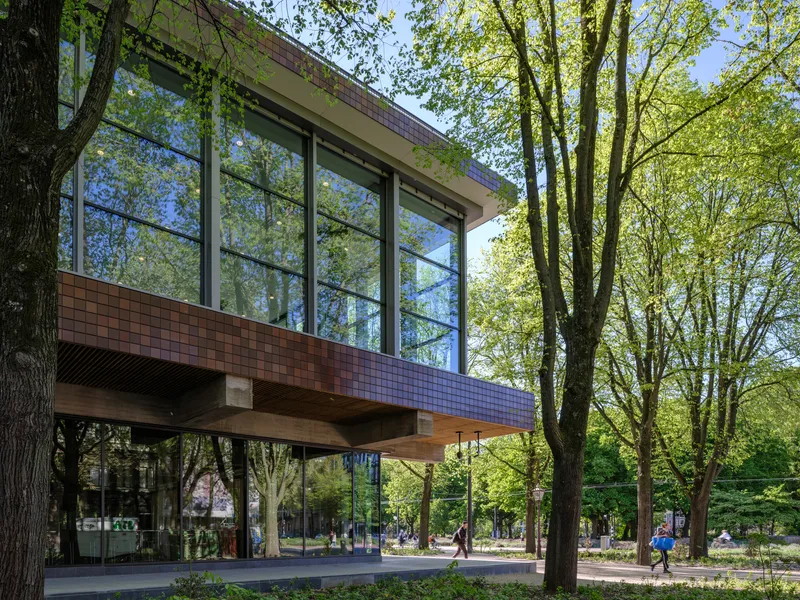
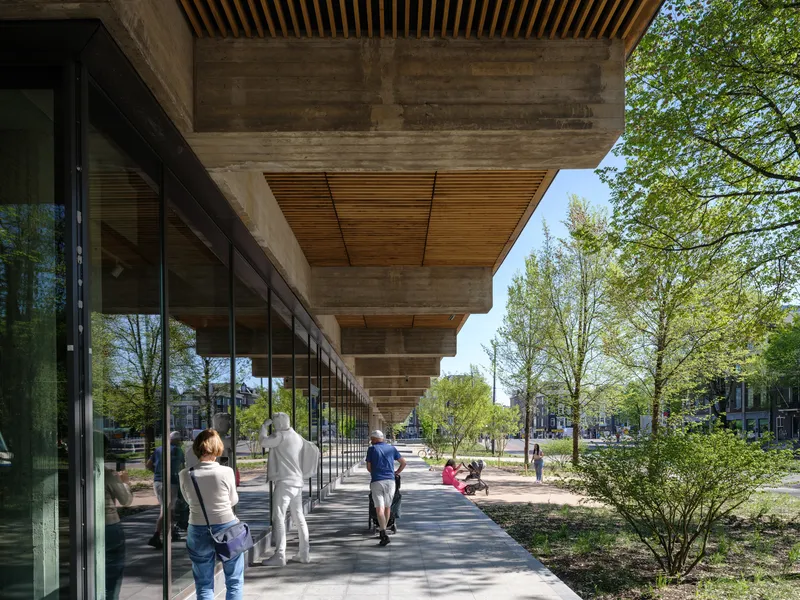
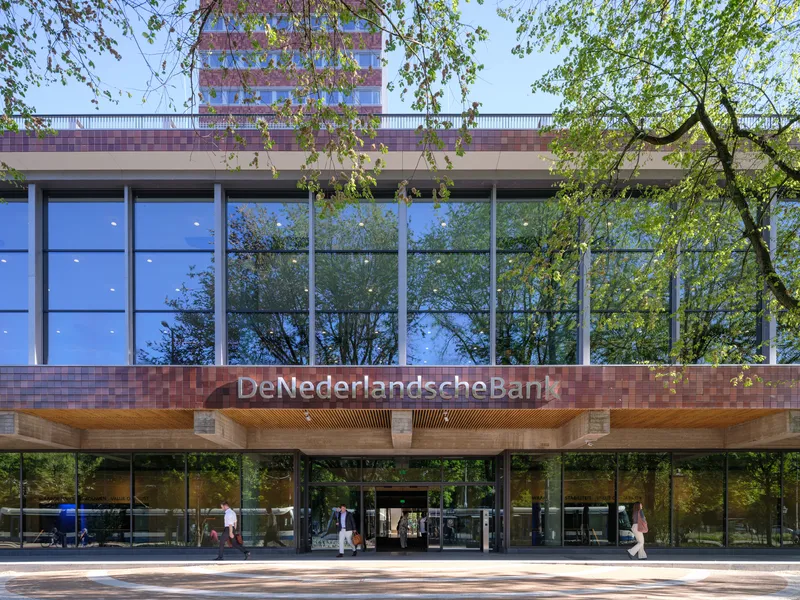
Duintjer's original concept placed the low-rise volume on a transparent glass base that deferred to the surrounding three-story canal houses. Security imperatives gradually turned that base opaque. Mecanoo restores the legibility of the hovering plinth by opening up the ground plane with full-height glazing and a generous timber soffit that extends outward as a canopy, shading pedestrian paths beneath spring-leafed trees. The effect is striking: a building that once presented a blank wall to cyclists and walkers now invites movement beneath and through it.
The cantilevered brick volume on timber columns creates a covered public threshold that feels more like a park pavilion than a bank entrance. Pedestrians and cyclists pass freely beneath, erasing the boundary between institution and city. It is a deceptively simple move, but it required rethinking every security protocol the bank had inherited.
A Canal Presence Reclaimed
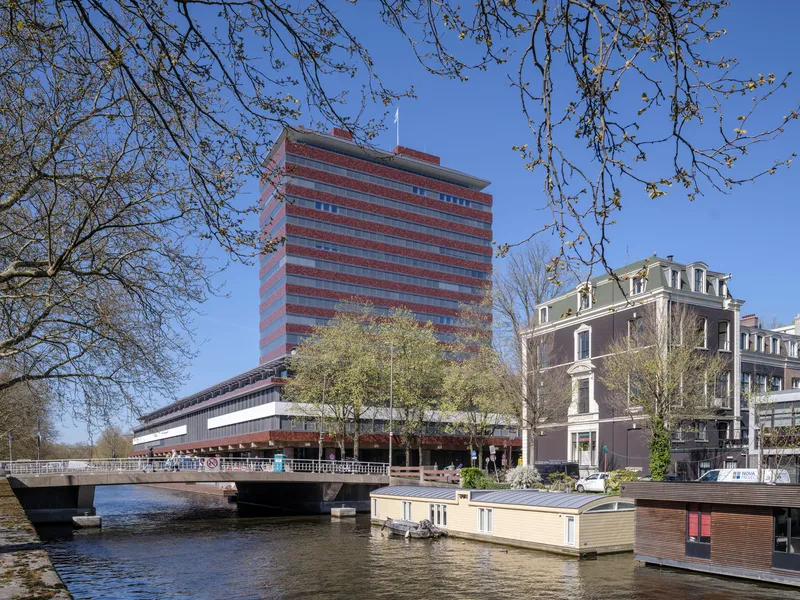

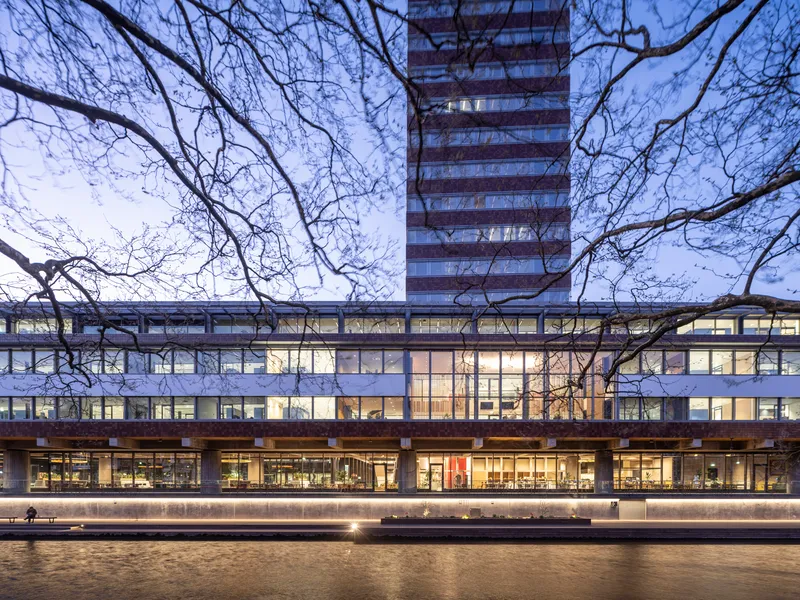
Seen from the Singelgracht, the composition reads clearly again: a horizontal datum of brown tile, closely matching the brickwork tonality of Amsterdam's canal belt, with the glazed tower rising above. The quay has been lowered and widened by two and a half meters, making the water's edge publicly accessible and stitching the bank into Amsterdam's network of canalside promenades. A wooden jetty hovers just above the water, offering a vantage point that did not exist before.
The dusk views are particularly revealing. Light floods outward from the transparent plinth, turning the building's base into a lantern along the canal. Where the original facade tiles were lost to asbestos remediation, Mecanoo undertook extensive color studies to replicate the subtle variations of the originals. A mechanical suspension system now holds the replacement tiles on their concrete plates, designed so the entire facade can be disassembled in the future without demolition. It is circular thinking applied at the scale of a city block.
The Garden at the Core


The most dramatic spatial inversion happens at the heart of the 110 by 120 meter complex. What was once a parking lot sealed inside the building's perimeter is now a publicly accessible city garden, planted with young trees and ground-level beds. Staff tend a herb and vegetable garden nearby. Green terraces occupy various rooftops, contributing to the 4,270 square meters of greenery added in and on the building, with another 800 square meters around it.
The courtyard mediates between the low-rise wings and the tower, providing daylight and orientation to the deep floor plates. At night, the illuminated facades around the garden transform the space into a sheltered urban room, visible from multiple levels and accessible from the new entrance on Frederiksplein. Cutting through the former gold vault to create that entrance required saw blades up to two meters in diameter and took two full days. The gesture is as literal as architecture gets: you walk through what was once the most fortified room in the building.
The Atrium as Civic Stage
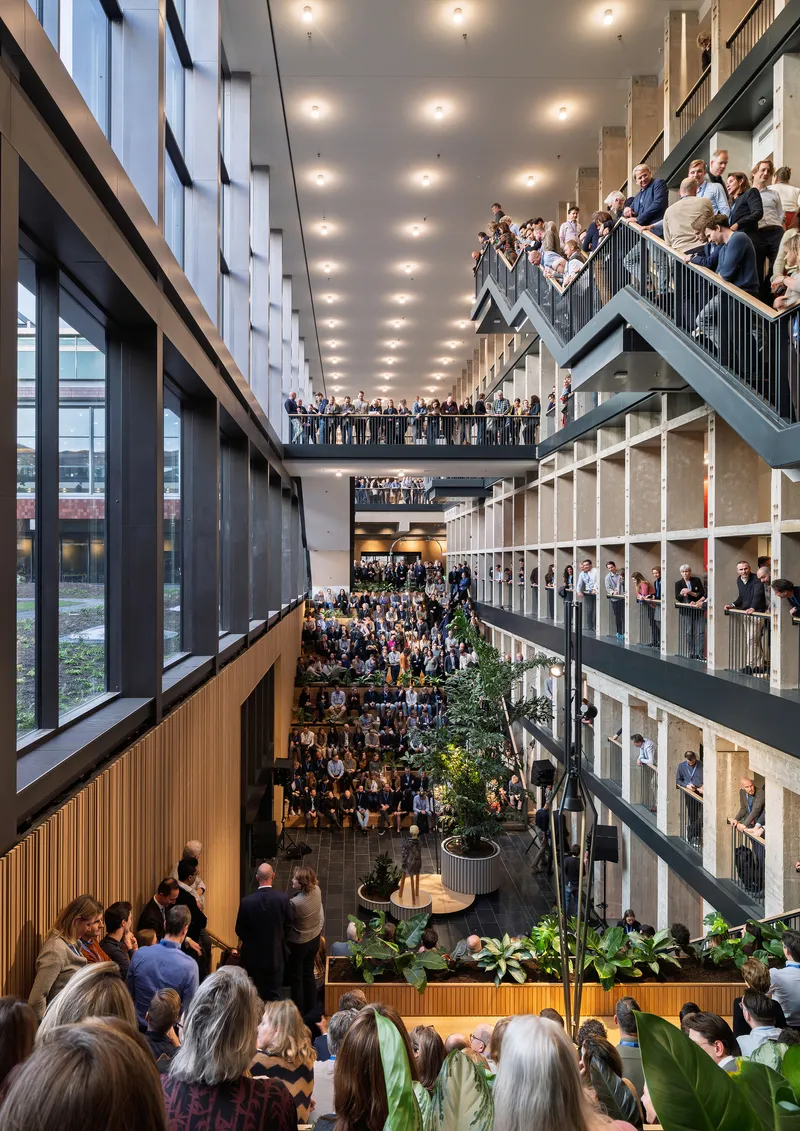
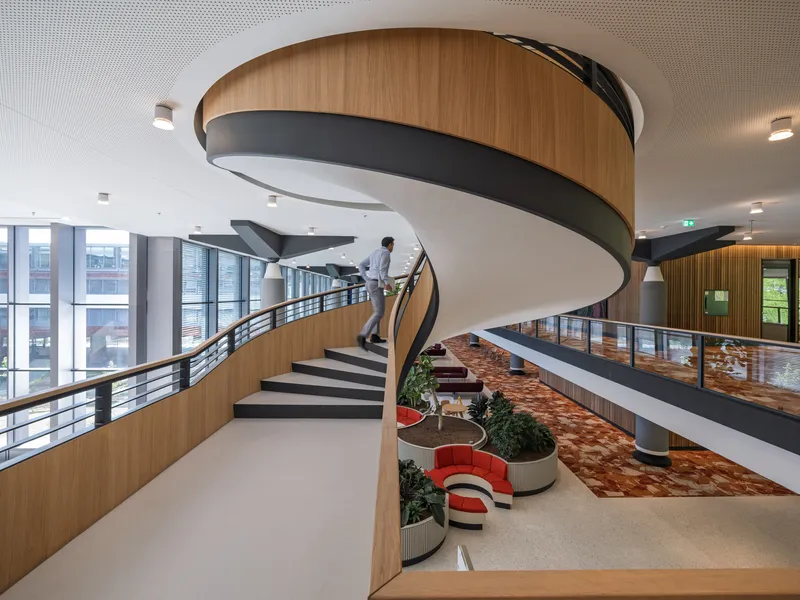
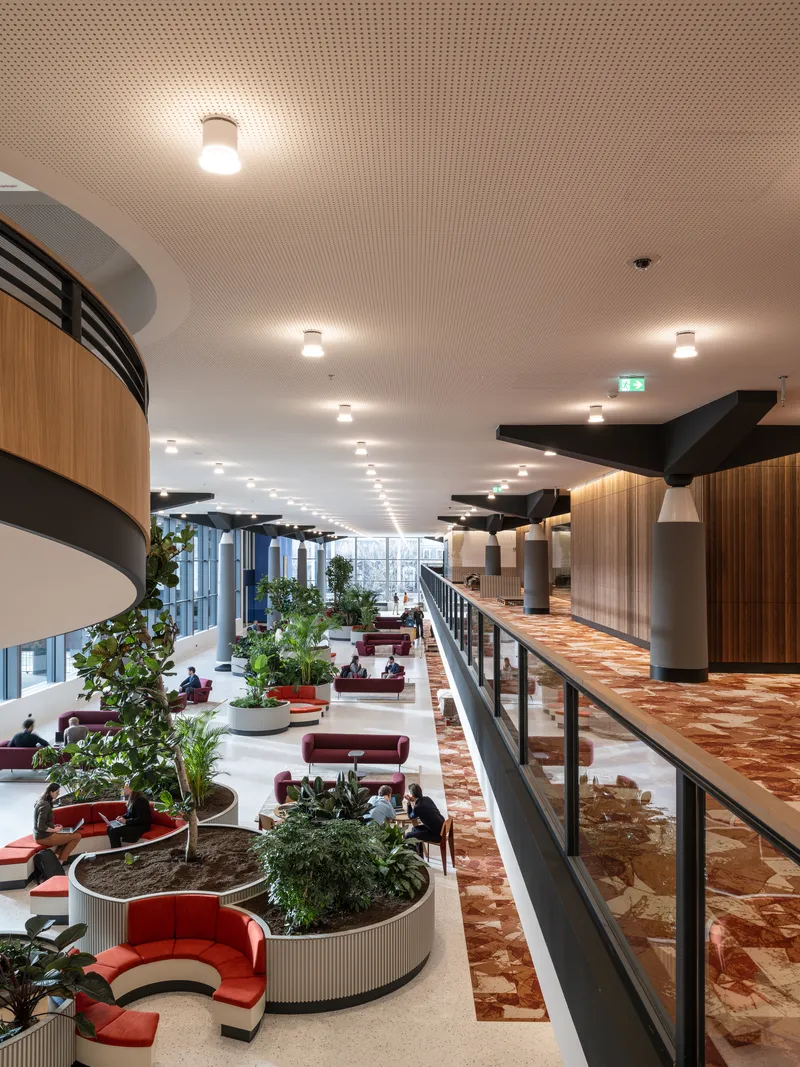
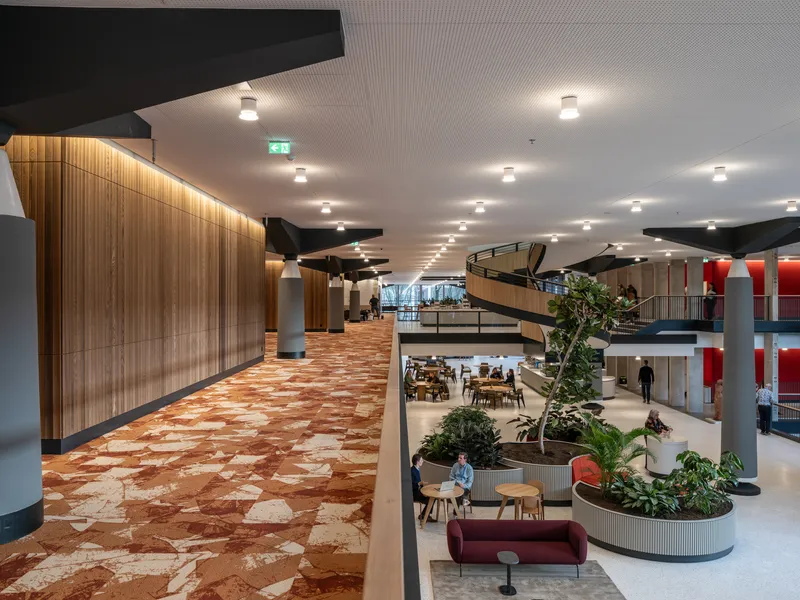
A new five-story atrium has been carved into the semi-public zone, connected by a spiraling timber staircase that wraps around circular planters at ground level. The space functions as the social spine of the building: during events, balconies fill with spectators looking down into the planted floor, and the staircase becomes a kind of vertical piazza. Colored PET-felt lines the walls, absorbing sound, while FSC-certified wood and terrazzo flooring establish a warm material register that avoids corporate anonymity.
Mecanoo's healthy-building philosophy is legible here. The design prioritizes movement, offering stairs as the primary means of circulation rather than elevators. Sightlines across levels encourage chance encounters. It is an approach borrowed from contemporary workplace design, but scaled up to the ambitions of a national institution that explicitly wants to be seen as open, transparent, and at the center of society.
From Cash Hall to Reading Room
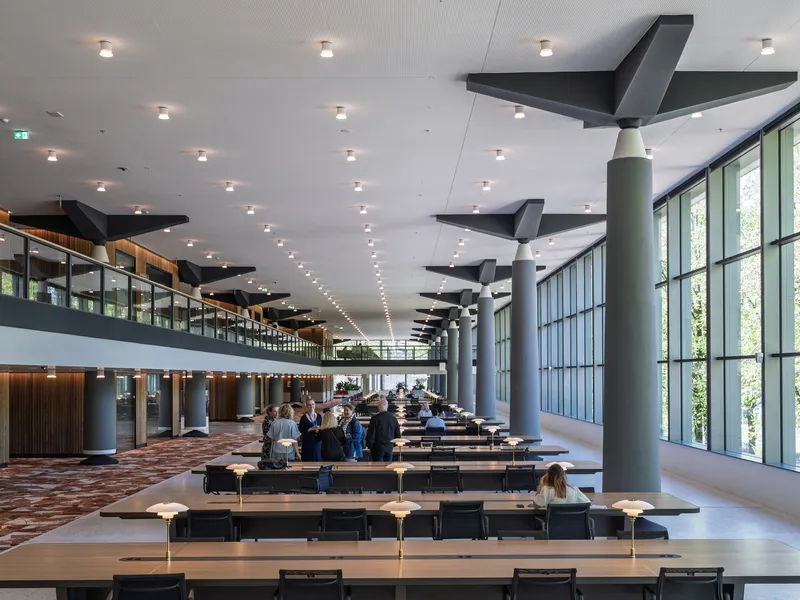

The former cash hall, 120 meters long and double height, has been repurposed as a meeting center with a reading room. Long study tables sit beneath angular black ceiling baffles that manage acoustics without touching the original concrete structure. Cylindrical columns march through the space, a reminder of the Duintjer-era skeleton that Mecanoo has wisely left exposed. The room feels genuinely public, closer in atmosphere to a university library than a corporate boardroom.
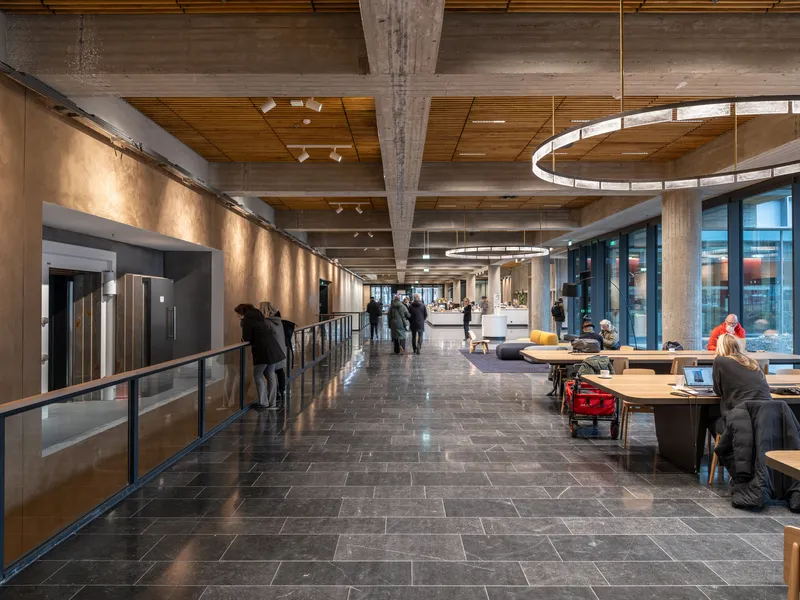
Adjacent corridors are lined with timber ceiling panels and circular pendant lights. The cafe space uses dark stone flooring and the same cylindrical columns, creating continuity across the public ground floor. These spaces are designed to draw people in from the Frederiksplein, not just during business hours but as a genuine extension of Amsterdam's cultural infrastructure.
Two Auditoria, Two Registers

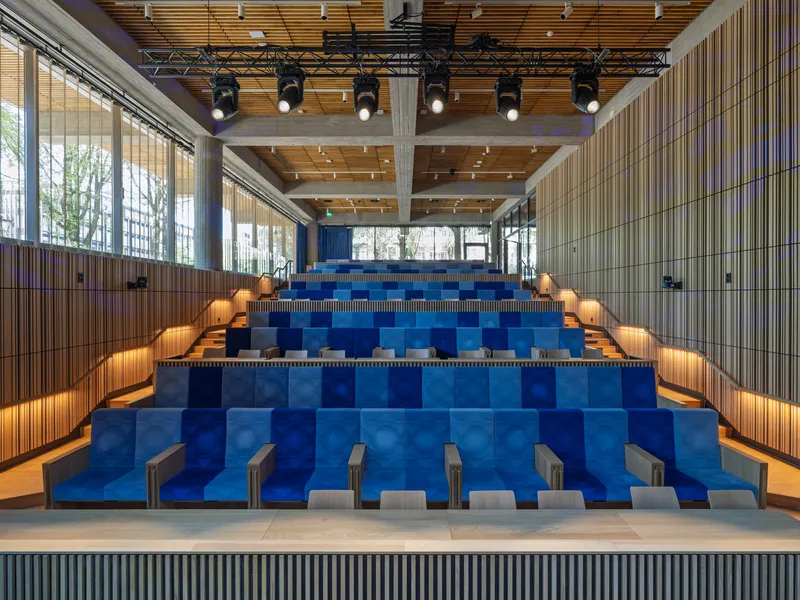

The program includes two auditoria calibrated to different audiences. The formal auditorium, with tiered wooden seating and exposed concrete ceiling beams, hosts lectures and performances. The informal auditorium, finished in blue tiered seating with theatrical lighting and vertical timber wall cladding, is sized for school groups and community events. Together they signal a bank that has decided to invest in public programming, not just public relations.
The foyer connecting these spaces is itself carefully composed: a blue portrait wall, potted palms, full-height glazing, and an exposed black ceiling beam create a threshold that is institutional without being intimidating. It is the kind of spatial generosity that transforms a renovation from a facilities upgrade into an architectural argument.
Material Intelligence and Circular Ambition
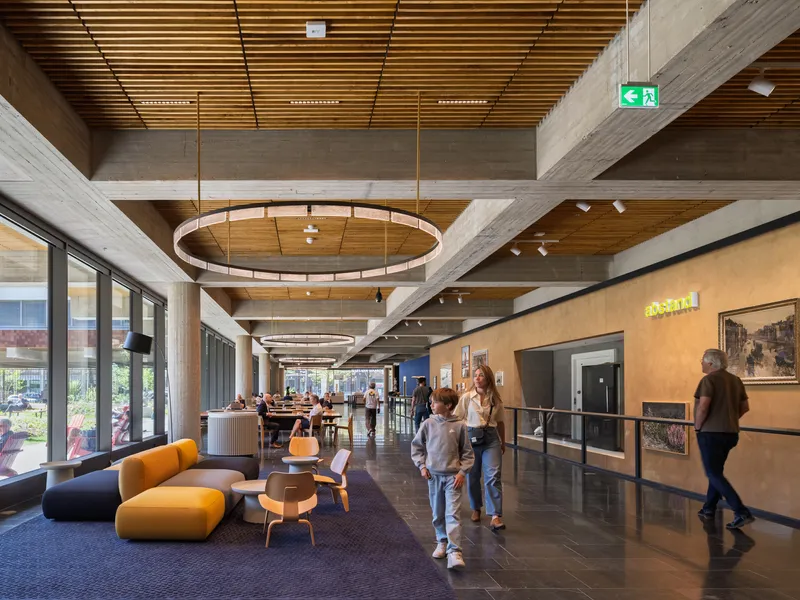

The material strategy deserves close attention. The wooden slatted ceiling beneath the original concrete structure is made from locally felled old and diseased poplars, a poetic inversion of the typical supply chain. Demolition debris from the renovation was reused as circular concrete for the new quay construction along the Singelgracht. The round satellite tower, once a security appendage, was dismantled and given a second life as three apartment buildings elsewhere.
Behind the facade, a ventilated double-glass system with external sun shading and a Kastenfenster configuration provides insulation while allowing operable windows. Heat recovery, thermal energy storage, solar panels, and sedum roofs complete a climate strategy that delivers the 80 percent reduction in energy consumption claimed by the project. The original insulation was just two centimeters of cork behind the facade tiles. The upgrade is comprehensive, but it has been executed without demolishing the structural logic of the 1968 building.
Plans and Drawings
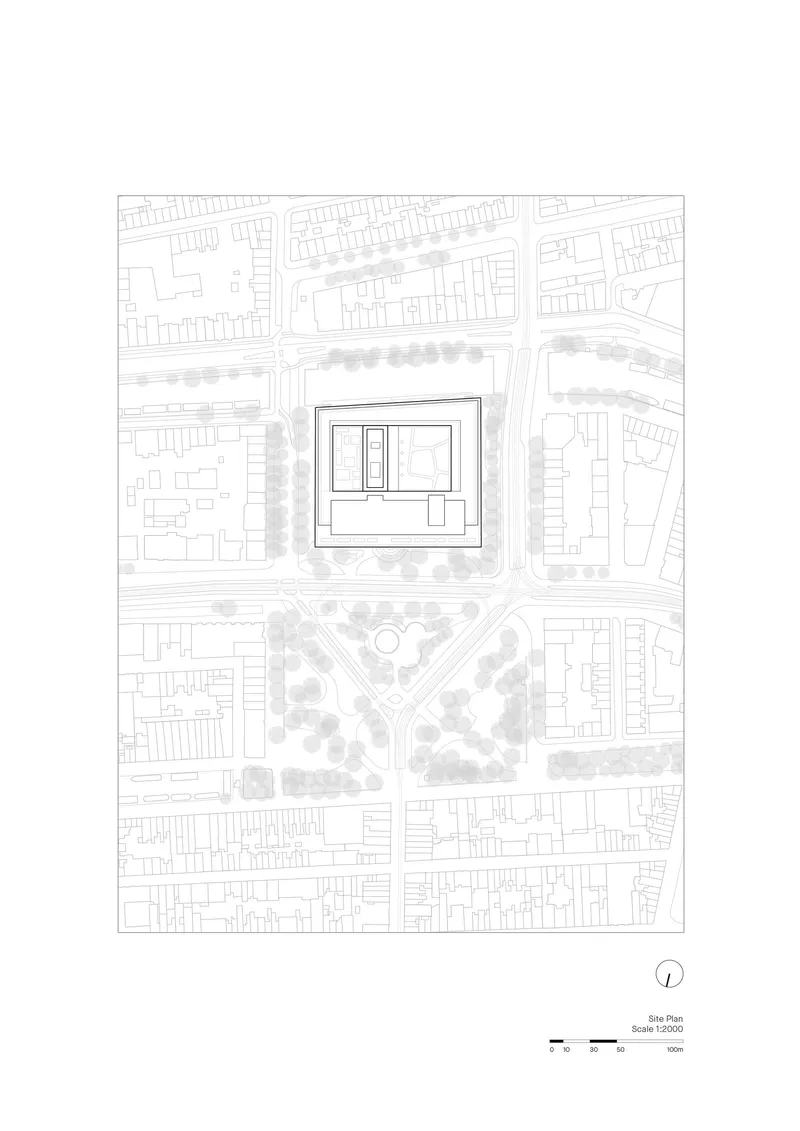


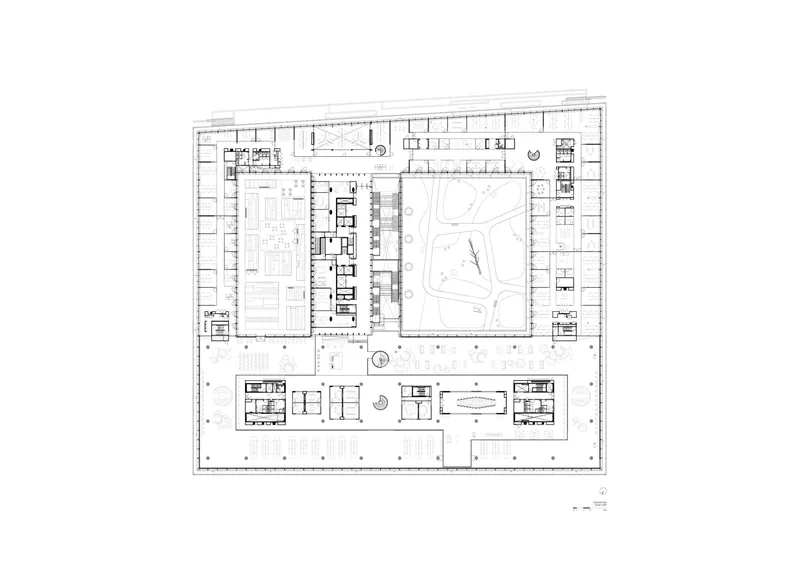
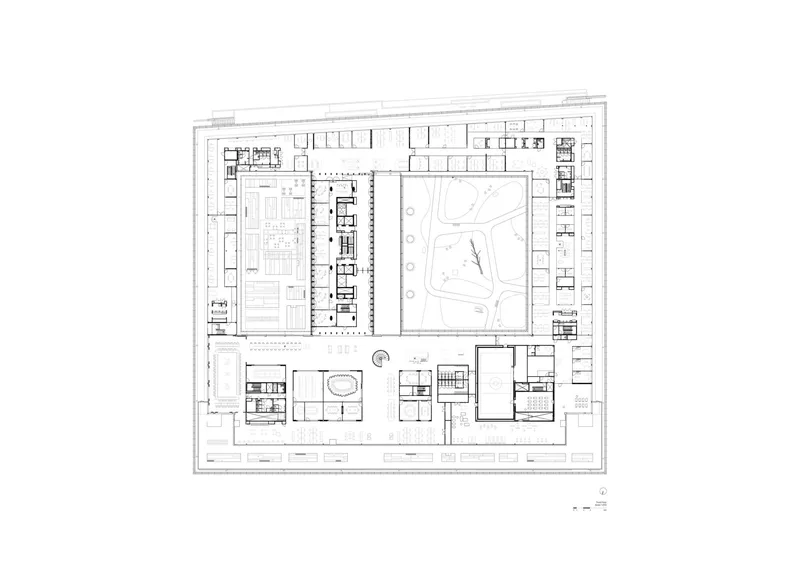


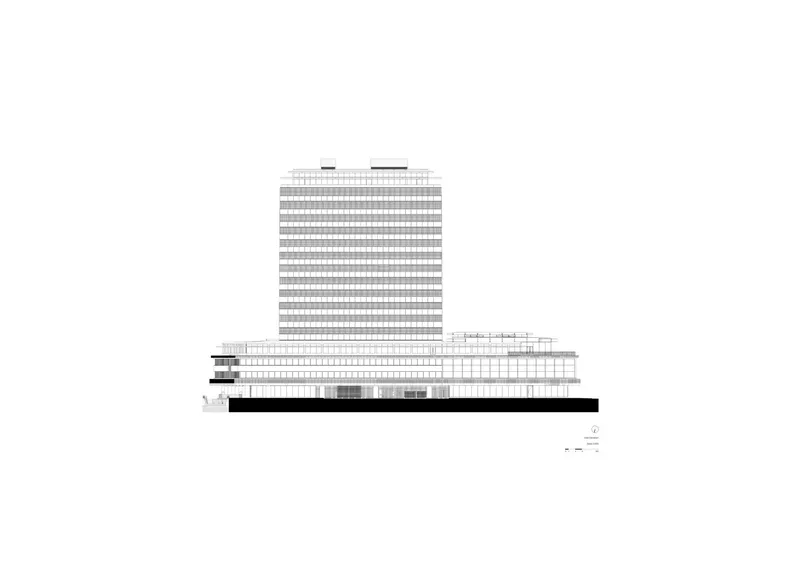

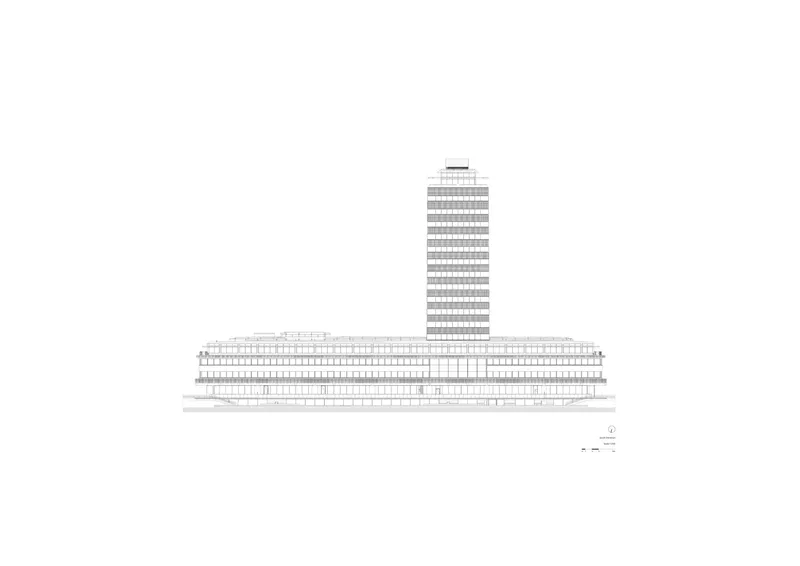
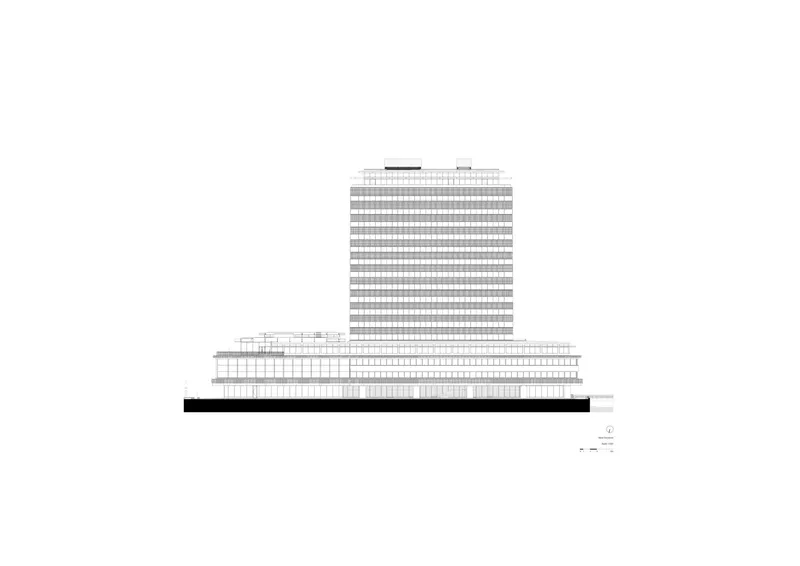
The site plan reveals the building's urban scale: a near-perfect rectangle filling its block, with tree rows along every edge and the tower offset within the footprint. The ground floor plan shows the central courtyard garden, the new entrance cut through the vault, and the public program distributed along the perimeter. Upper floor plans demonstrate how the cellular office layout wraps a central planted atrium, maximizing daylight penetration to the deep plates.
The sections are perhaps most instructive. They show the 73-meter tower rising from the horizontal plinth with multiple underground levels beneath, confirming how much of the building's mass is invisible from the street. The horizontal striped facade of the tower reads as a continuous datum against the terraced base, reinforcing Duintjer's original compositional hierarchy. The elevations in multiple orientations demonstrate how the long, low podium anchors the composition, with the tower's slender profile shifting dramatically depending on the viewing angle.
Why This Project Matters
De Nederlandsche Bank's renovation matters because it proves that institutional transparency is an architectural problem, not just a branding exercise. Mecanoo did not add a flashy extension or wrap the building in a new skin. They rethought circulation, dismantled barriers both literal and psychological, and reconfigured a fortress into a building that belongs to its city. The decision to cut through the gold vault and turn a parking lot into a public garden is not metaphorical. It is a physical commitment to openness that will be tested every day the doors are open.
The project also offers a model for how to renovate postwar institutional buildings without erasing them. By restoring Duintjer's compositional logic while upgrading every system to contemporary environmental standards, Mecanoo demonstrates that preservation and performance are not competing goals. The circular material strategies, from poplar ceilings to recycled concrete quays to mechanically suspended facade tiles designed for future disassembly, push the conversation beyond energy efficiency into genuine lifecycle thinking. For a central bank, the symbolism is apt: this is long-term investment, not short-term speculation.
De Nederlandsche Bank, designed by Mecanoo, Amsterdam, The Netherlands. 1,500 m² new construction within a 67,000 m² complex. Completed 2025. Photography by Ossip Architectuurfotografie.
About the Studio
Share Your Own Work on uni.xyz
If projects like this are the kind of work you want to make, uni.xyz is a place to publish your own, find collaborators, and enter design competitions.


Popular Articles
Popular articles from the community


Jaramillo Van Sluys Arquitectura and Urbanismo Turn a Demolished Registry Lot in Quito into an Orchard Plaza
In Quito's Centro Histórico, a 2,800 m² plaza exposes the San Agustín convent wall and redraws its lost Augustinian orchard in volcanic stone.

Juan García Correa, John González and Claudia Rueda Sink a Circular Amphitheater into a Manizales Engineering Building
On the La Nubia campus in Manizales, Colombia, the S1 Building folds labs and offices into a hillside of ramped lawns that double as a campus route.

GROUP A Strips a 1969 Rotterdam Harbor Headquarters to Its Frame and Wraps It in Timber Louvers
In Rotterdam's M4H harbor district, Ferro Offices reuses a 1969 frame, adds one timber storey and reaches BREEAM-NL Outstanding.

Cube Design Draws an Ecological Corridor Between Two Shenzhen Hills with the Nankai Building
Beside Shenzhen's container docks, the Nankai Building pairs stacked balconies with a climbing green screen to connect two hillsides across its height.

Similar Reads
You might also enjoy these articles


LAVA Architecten Gives Vocational Education a Sawtooth-Roofed Face on a Mechelen School Campus
In Mechelen, Belgium, a 2,053 m² STEM school on a 6×6 m grid turns workshops and classrooms into rooms that can be rearranged as teaching changes.

KEMA Studio Turns a Derelict Marvila Attic into a 60 m² Lighthouse Apartment Above Lisbon
In Lisbon's Marvila district, a rebuilt roof, four skylights and two plywood volumes turn an unlivable attic into a bright home facing the Tagus.

Pixel Gardens: One Repeated Module Stacked Into a Terraced Social Housing Tower for Famagusta
Salem Bader's shortlisted housing tower builds a vertical neighbourhood from one repeated module, offsetting units to carve terraces, light and air.

Bao Huynh Watercolor Atelier: A Serene Art Retreat in Hội An
Bao Huynh Watercolor Atelier in Hội An blends multifunctional art spaces, sustainable design, local materials, and family-friendly living in a serene environment.

Explore Landscape Design Competitions
Discover active competitions in this discipline

Challenge to design luxury tourism on rails

VR headsets Storefront design competition

Designing a staircase for a client
Comments (0)
Please login or sign up to add comments
No comments yet. Be the first to comment!