
A Translucent Canopy Channels Bogotá's Lost River
Alsar Atelier's ephemeral installation in Bogotá uses ribbed blue canopies and modular steel vaults to recall the city's buried waterways.


Bogotá is a city built over its own rivers. Streams that once defined neighborhoods and shaped settlement patterns were gradually buried under asphalt, channeled into culverts, and erased from collective memory. The Memory of the River, a 900 square meter ephemeral installation by Alsar Atelier with SCRD, El Lider S.A.S, and INGEACERO, attempts something quietly radical: it makes the invisible legible again. Not through signage or didactic panels, but through structure, light, and the gentle undulation of translucent blue fins overhead.
The project sits at the intersection of public art and ephemeral architecture, a transitory infrastructure that is designed to be assembled, disassembled, and relocated. What makes it genuinely interesting is not the concept of impermanence (temporary pavilions are everywhere) but the specific material intelligence deployed here. Barrel vaulted steel canopies, sheathed in hanging translucent strips, create shifting blue shadows that evoke water without mimicking it. The structure reads simultaneously as shelter, landscape feature, and urban signal, proof that temporary architecture does not need to look provisional.
Blue Light and the Language of Water

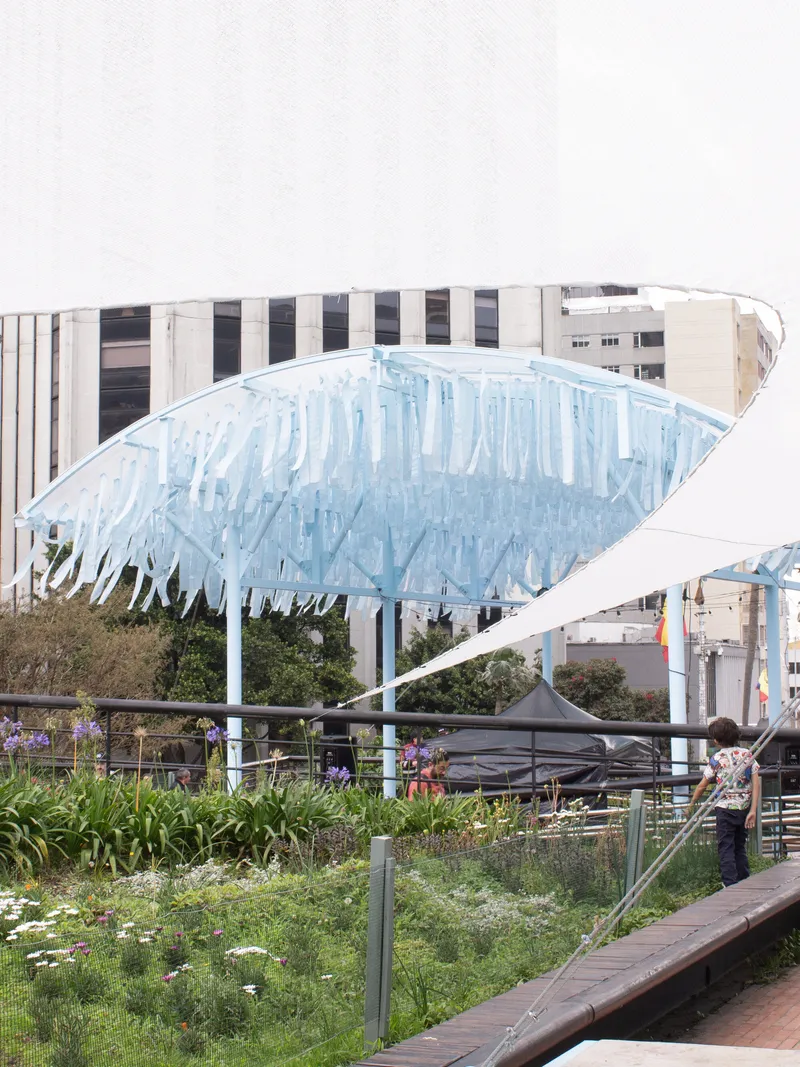
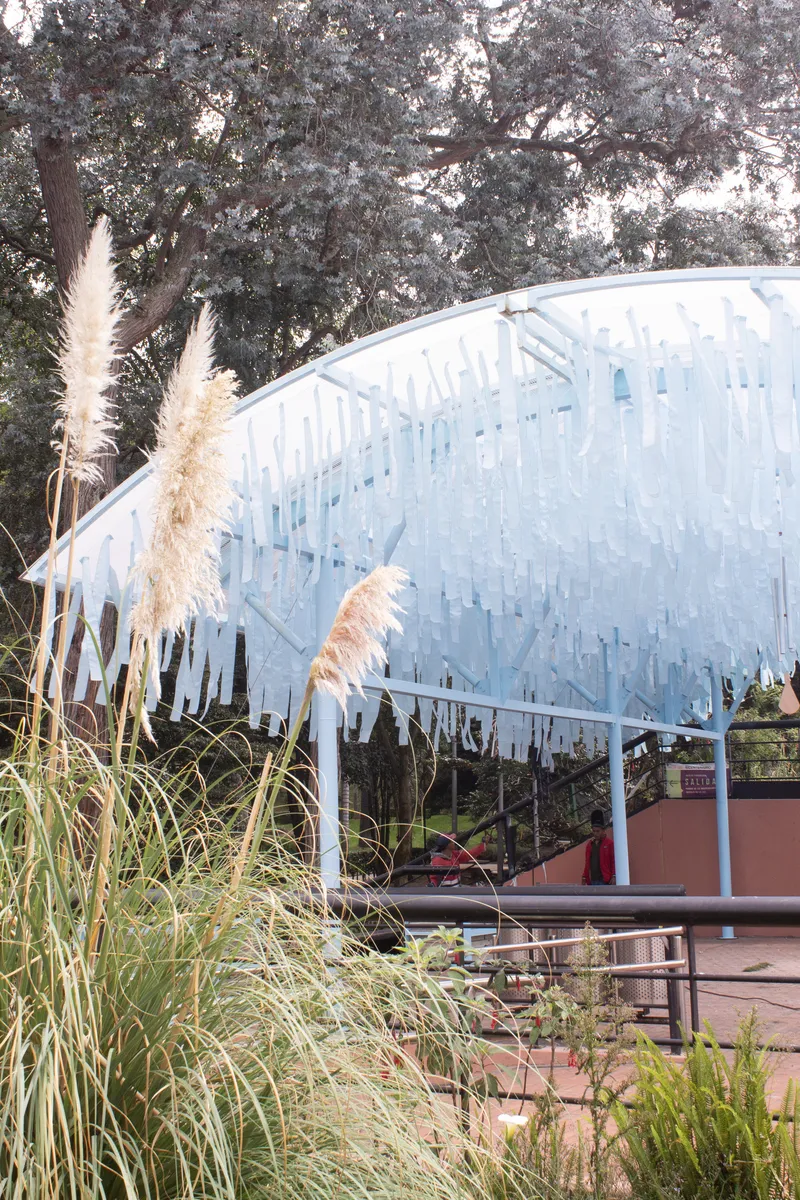
The canopy's vertical fins are the project's most distinctive gesture. Made from translucent blue panels, they hang from the vaulted frames like aquatic vegetation or, more precisely, like a curtain of falling water frozen mid-cascade. As light passes through them, the space below is bathed in a cool, shifting glow that transforms depending on time of day, cloud cover, and wind. The material choice is deliberate: it avoids the heaviness of solid roofing while creating a genuine sense of enclosure.
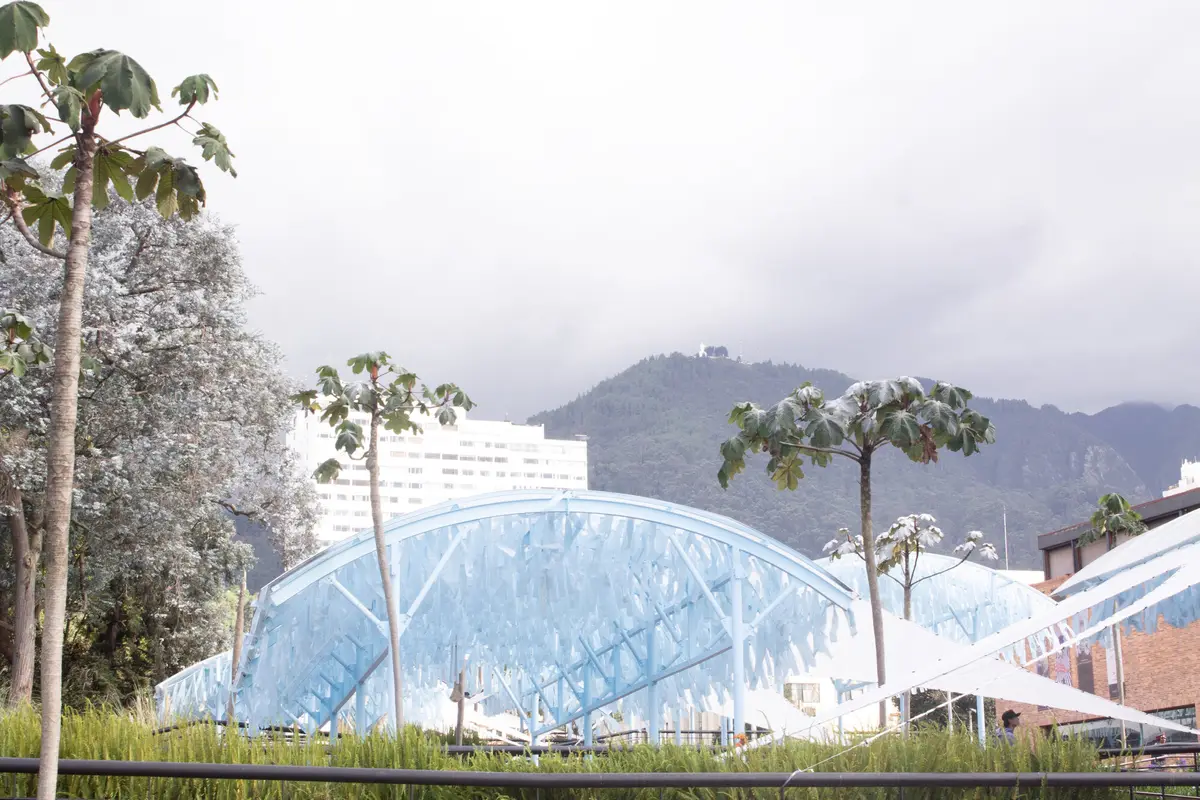
Seen from a distance, the structures rise above the tree line as translucent blue ridges, their ribbed profiles calling to mind wave crests or the scales of a living organism. Against Bogotá's green hillside, they register as something both foreign and organic. The ornamental grasses and pampas plumes planted at the canopy's edges reinforce this riparian atmosphere, softening the boundary between structure and landscape.
Underneath: Gathering and Performance
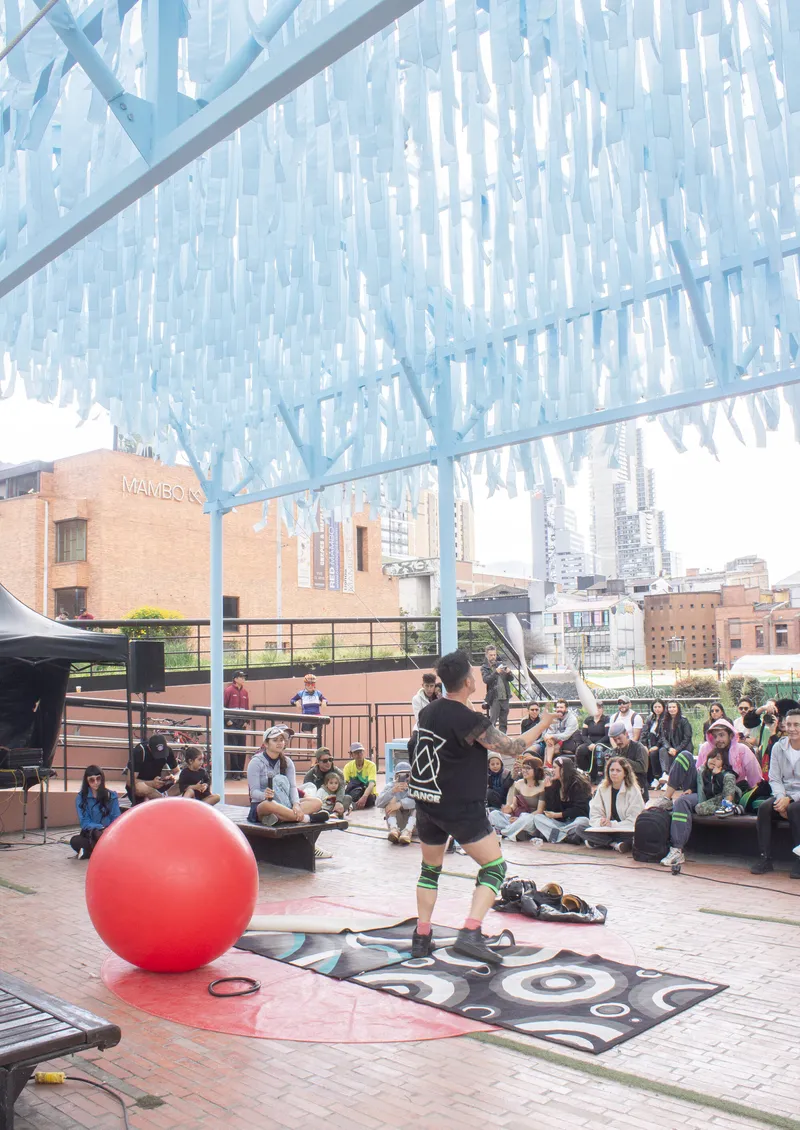


The real test of any public canopy is what happens underneath it. Here, the spaces beneath the vaults serve multiple roles: performance venue, shaded seating area, casual meeting point. One photograph captures a seated audience watching a performance beneath the arched structure, a large red ball punctuating the scene like a theatrical prop. The canopy frames these activities without constraining them. Terracotta and tile paving, combined with simple benches, keep the ground plane unpretentious.
The diagonal white columns that support the vault are slim enough to remain visually unobtrusive, creating a colonnade that pedestrians pass through without feeling impeded. The hanging blue strips add a layer of intimacy to what would otherwise be an open shelter, filtering views and creating micro-zones of privacy within the public realm. It is a smart move: the canopy does not merely shade, it curates degrees of exposure.
Structural Precision in a Temporary Frame


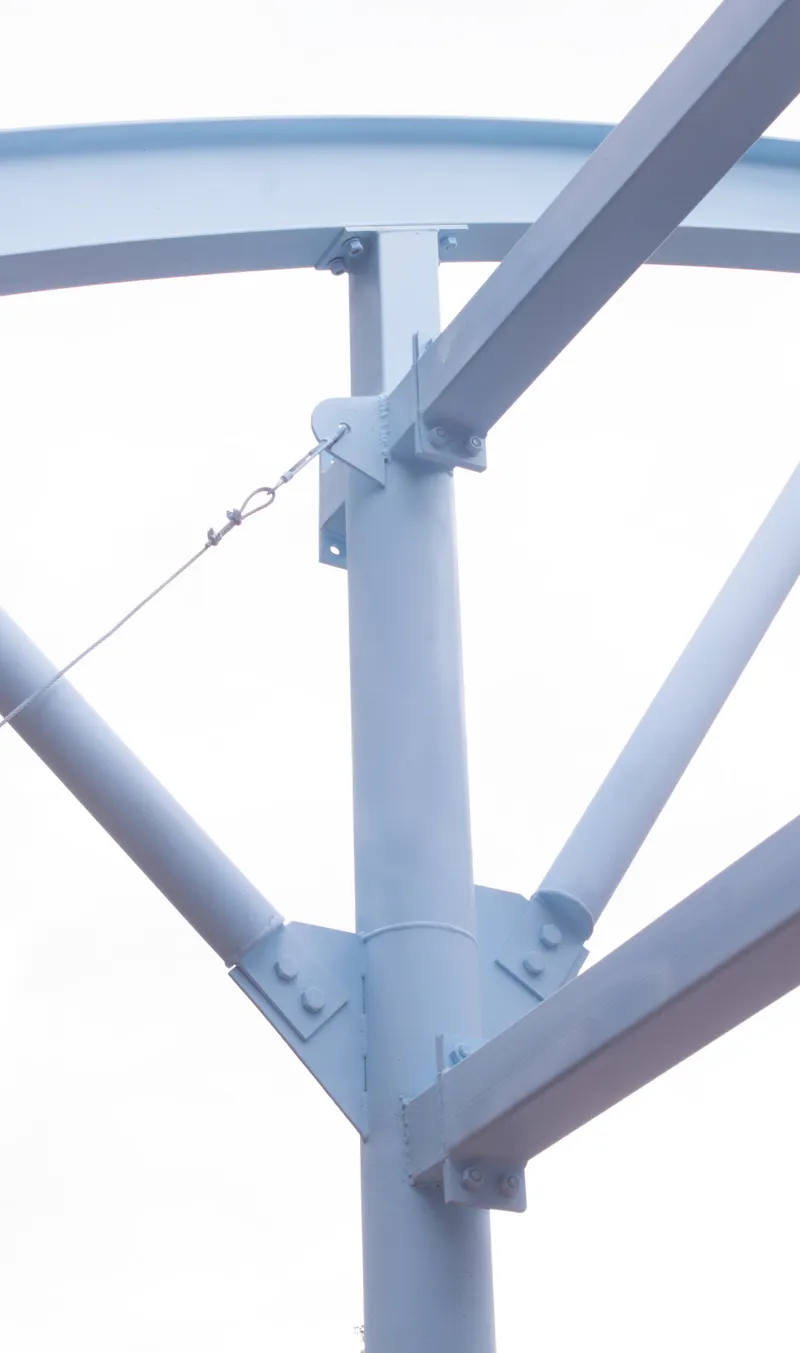
For a project designed to be taken apart and reassembled, the structural detailing is remarkably refined. Painted tubular steel columns meet at bolted plate connections with tensioned cables providing lateral stability. These joints are cleanly expressed, not hidden behind cladding or decorative screens. The white steel frame contrasts with the blue panels above, establishing a clear visual hierarchy: structure in white, atmosphere in blue.
The overhead views reveal the serpentine logic of the canopy system, where multiple barrel vaults link together to form a continuous, meandering route. Planted terraces fill the gaps between adjacent roofs, creating an alternating rhythm of covered and open space. The system accommodates bicycles, benches, potted plants, and foot traffic with equal ease. Nothing about the steel work reads as temporary; the bolted connections simply make it reversible.
Landscape as Infrastructure
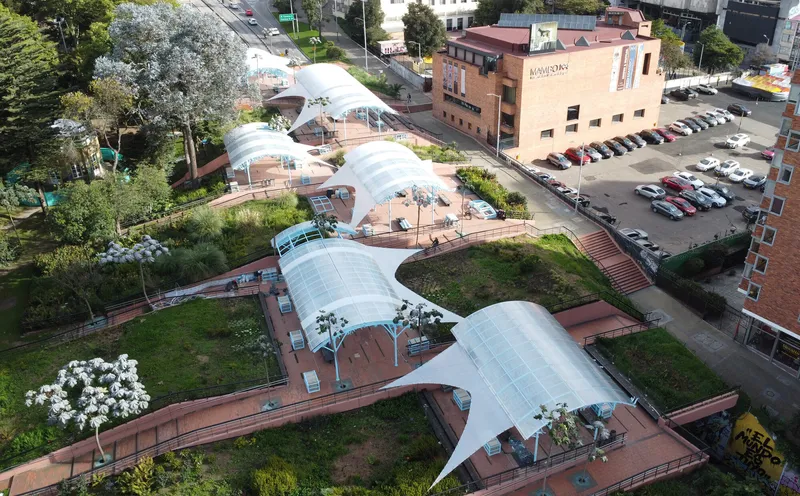
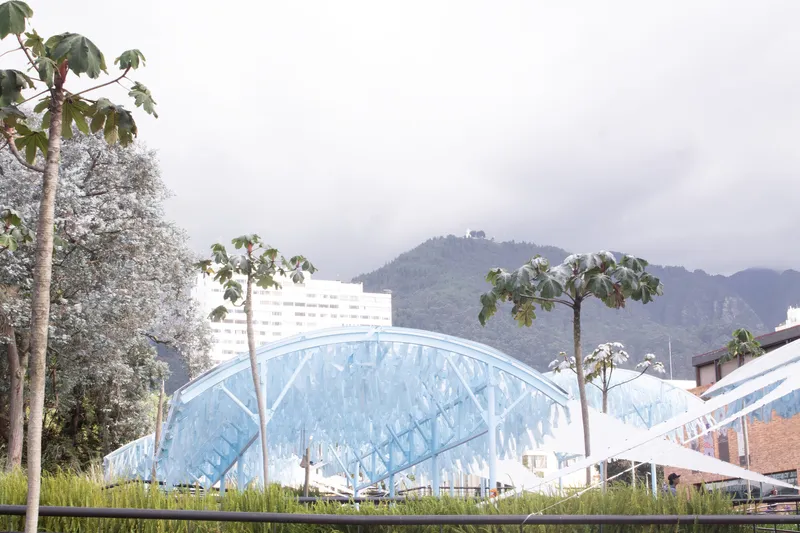
Aerial views make the site strategy legible. The canopy system follows a sinuous path, loosely tracing the memory of a watercourse through what is now an urban district with adjacent parking lots and roads. Between the vaulted pavilions, planted beds of grasses and young trees create a green corridor that functions as both stormwater management and ecological amenity. The landscape is not decoration; it is the conceptual backbone of the project, insisting that even a temporary installation can build ecological capacity.
Against the foothills of Bogotá's eastern mountains, the blue canopies establish a middle scale between the domestic horizon of nearby buildings and the vast topographic backdrop. The installation argues, correctly, that small-scale landscape interventions can reshape the perception of entire neighborhoods if they are placed with care.
Model and Material Thinking

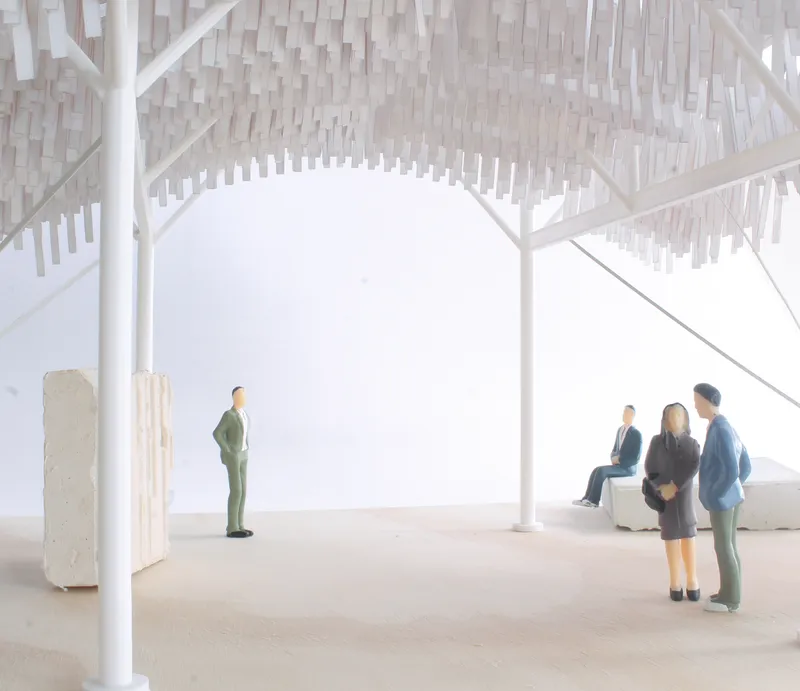
The physical model reveals the design team's thinking about the relationship between column, vault, and hanging element with unusual clarity. White structural members define the frame; icicle-like vertical elements represent the translucent strips at a scale where their cumulative effect is immediately legible. Miniature figures clustered beneath the canopy confirm the project's primary ambition: to draw people together under a shared atmospheric condition.
What the model also demonstrates is the system's proportional logic. The barrel vault spans just enough to shelter a small crowd, not so wide that it requires heavy trusses, not so narrow that it feels constricting. This Goldilocks dimension is critical to the project's success: it creates intimacy at the scale of a street market or a neighborhood gathering.
Plans and Drawings
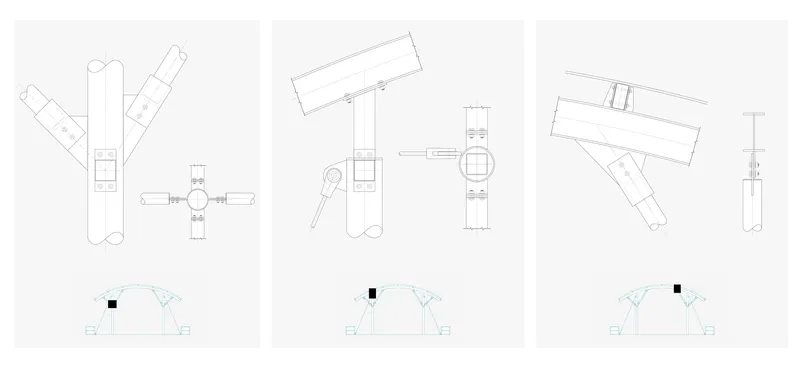

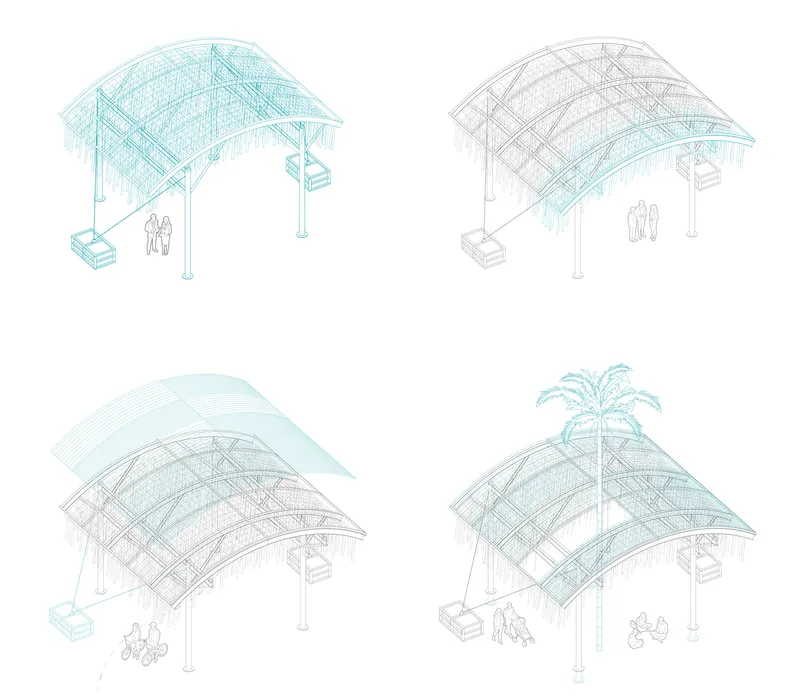

The technical drawings reveal a system designed for adaptability. Column assembly details show standardized bolted connections that allow rapid erection and disassembly. The axonometric drawings present the barrel vault roofs arching over interconnected pavilions, with palm trees and landscaping woven through the structural grid. Four variations of the canopy configuration demonstrate how the same modular components can be recombined into different spatial arrangements.
The site plan diagrams are perhaps the most revealing documents. They show the modular pavilion system adapted to different urban and landscape configurations, from linear corridors to open plazas. The design is explicitly conceived as a kit of parts, a transferable infrastructure that can respond to diverse site conditions across Bogotá or, potentially, any Latin American city dealing with buried watercourses and fragmented public space.
Why This Project Matters
Ephemeral architecture tends to fall into two camps: the spectacular (biennale pavilions, festival stages) and the modest (market stalls, pop-up shelters). The Memory of the River occupies a rare third position. It is technically sophisticated enough to feel permanent, conceptually grounded enough to justify its form, and modular enough to prove that temporary does not mean disposable. The fact that it can be relocated and reconfigured turns a single installation into a potential urban strategy.
More importantly, the project takes a position on memory. It does not reconstruct a lost river or pretend to restore an ecosystem. It builds an atmospheric analogy, a place where light, color, and structure conspire to remind you that water once flowed here. In a city where rapid urbanization has severed most ties between citizens and their watersheds, that reminder is not sentimental. It is political. If we are going to reclaim buried rivers anywhere in the world, the first step is making people care about something they can no longer see. This project does exactly that.
The Memory of the River by Alsar Atelier + SCRD + El Lider S.A.S + INGEACERO. Bogotá, Colombia. 900 m². Completed 2025. Photography by Alsar-Atelier.
About the Studio
Share Your Own Work on uni.xyz
If projects like this are the kind of work you want to make, uni.xyz is a place to publish your own, find collaborators, and enter design competitions.


Popular Articles
Popular articles from the community


Lunar Spiral: Space Architecture Shaped by the Mathematics of the Universe
Lunar Spiral reimagines space architecture through Fibonacci geometry, lunar regolith, levitating habitats, and self-sustaining Moon living.

Hill & Cross Opera: Sculptural Opera House Architecture Shaped by Tallinn’s Landscape and Identity
Hill & Cross Opera reimagines opera house architecture in Tallinn through its sculptural hill, civic plaza, glass wave and a luminous cross.

Co-life: Sustainable Architecture for Age-Friendly Community Living
Co-life reimagines sustainable architecture for seniors through courtyards, rammed earth, shared gardens, and spaces designed for belonging.

ALGAL REALM: A Bio-Integrated Lunar Habitat Design for Life Beyond Earth
ALGAL REALM reimagines lunar habitat design with algae-powered life support, 3D-printed regolith, and vertical living for a lunar future.

Similar Reads
You might also enjoy these articles

Bao Huynh Watercolor Atelier: A Serene Art Retreat in Hội An
Bao Huynh Watercolor Atelier in Hội An blends multifunctional art spaces, sustainable design, local materials, and family-friendly living in a serene environment.

Atelier Macri Concept Store Interior Design by CASE-REAL
Atelier Macri store features a "ko" counter, walnut wood details, cork displays, blending retail, gallery, and seamless customer experiences.

Manuel Vargas Izquierdo Stadium and High-Performance Sports Center: Architectural Excellence in Jalpa de Méndez
The Manuel Vargas Izquierdo Stadium blends sustainable design, inclusive sports facilities, and cultural-inspired architecture, revitalizing Jalpa de Méndez’s public spaces.

KAKR Buluh Awar Hall: Revitalizing Community and Ecology Through Bamboo Architecture
Community built bamboo hall revitalizes Buluh Awar village, empowering youth, restoring ecology, celebrating vernacular craftsmanship through sustainable architecture and culture.

Explore Bogota Competitions
Discover active competitions in this discipline

Challenge to design a portable theatre

Challenge to design a portable music platform

Challenge to design an open learning module for the elderly
Comments (0)
Please login or sign up to add comments
No comments yet. Be the first to comment!