
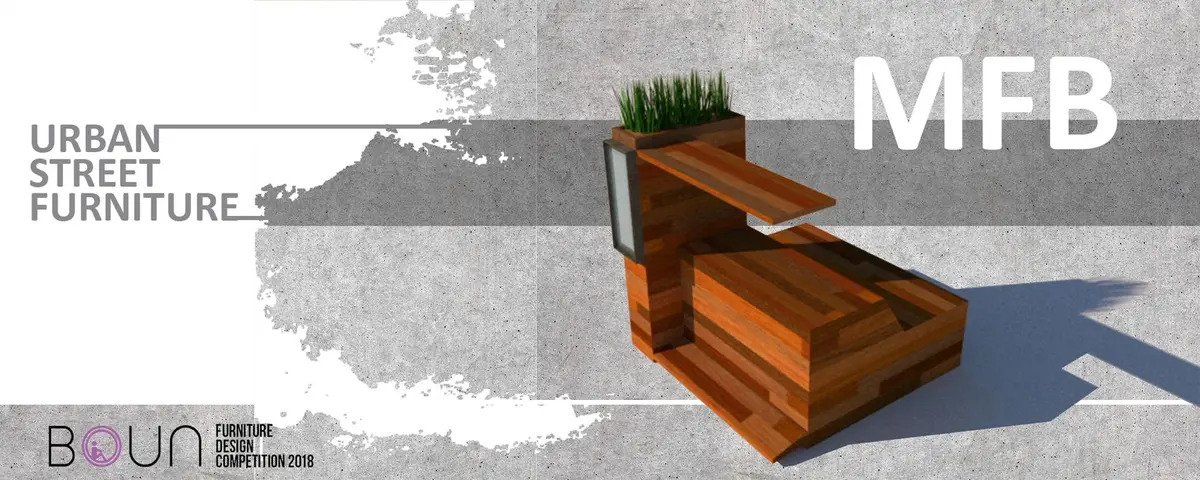
MFB: Modular Street Furniture That Plays Like Tetris in Public Space
A 4-foot cube becomes the building block for seating, working, planting, and socializing across urban plazas and streetscapes.


What if a single four-foot cube could replace an entire catalogue of street furniture? The MFB project proposes exactly that: a modular unit measuring 4'x4'x4', built from wood and stainless steel, that snaps together in Tetris-like configurations to form seating, work surfaces, planters, lighting bollards, and waste receptacles. Rather than scattering discrete objects across a plaza, MFB treats urban furniture as a combinatorial system, one where the arrangement itself becomes a design act.
Designed by Jahnavi Manem and Avanitha Thaduri, the project reframes the public bench as a multi-utility module that responds to the overlapping activities of contemporary city life. Professionals working on laptops, friends lounging after lunch, commuters pausing mid-route: MFB accommodates all of these scenarios within a single architectural vocabulary, deployable in parks, plazas, and high-traffic streetscapes.
A Single Cube, Seven Functions
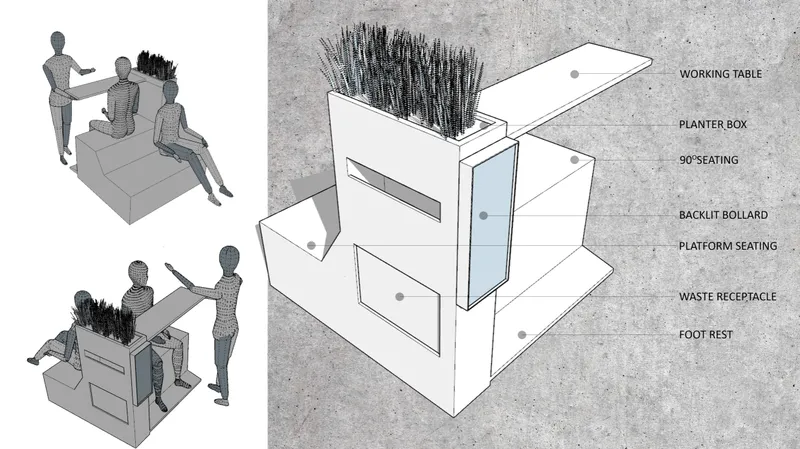
The isometric breakdown of a single MFB module reveals just how much the designers have packed into a compact footprint. Integrated planter boxes introduce greenery at the seating level. A foldable, adjustable working table flips up to serve as a workstation or dining surface, then tucks away when the module needs to function purely as a bench. Platform seating encourages informal lounging, while a built-in foot rest shifts the ergonomic profile from upright to reclined. A backlit bollard element handles ambient lighting and can double as a surface for wayfinding maps or advertisements. Even a waste receptacle is folded into the unit, eliminating the need for standalone trash bins nearby.
The material palette, wood paired with stainless steel, is a deliberate choice rooted in durability and familiarity. These are materials already proven in street furniture applications, so the innovation here is not in surface treatment but in programmatic density. Each cube is self-sufficient; it does not depend on adjacent infrastructure to function.
Tetris Logic Applied to Plaza Layout
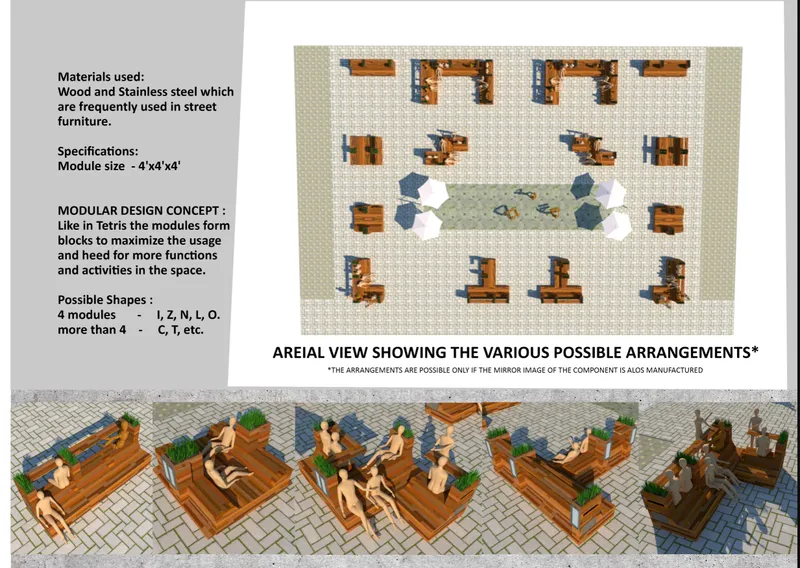
Seen from above, the configurability of MFB becomes its strongest spatial argument. The modules assemble in I, Z, N, L, O, C, and T shapes, each arrangement calibrating for different crowd densities, sight lines, and programmatic needs. A linear I-formation channels foot traffic along a promenade. An L-cluster creates a sheltered nook for small group conversation. A sprawling T-arrangement anchors a gathering point in the middle of an open plaza. The aerial plan view shows these formations distributed across a paved surface, turning what would otherwise be empty hardscape into a landscape of social opportunity.
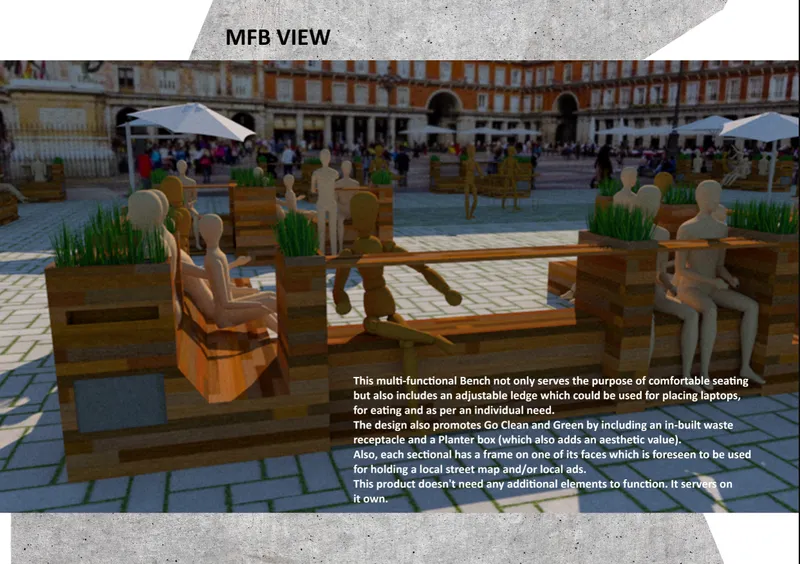
The rendering of timber modules scattered across a historic plaza with striped awnings demonstrates how MFB holds its own alongside existing architectural character. The warm wood tones and clean geometry do not compete with the surrounding context; they sit quietly within it while multiplying the plaza's functional capacity. Integrated planter boxes soften the edges and introduce a layer of green that traditional benches rarely offer.
Folding, Stowing, Adapting
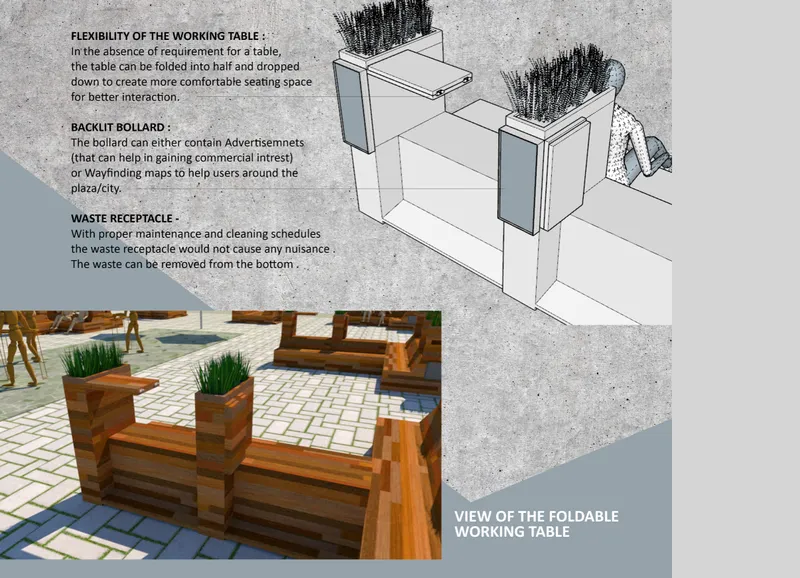
The axonometric and perspective drawings expose the mechanical intelligence of the design. The foldable working table is not merely a bolt-on accessory; it is integrated into the timber frame so that the module reads as a coherent object whether the table is deployed or stowed. The waste receptacle is similarly embedded, visible enough to invite use but tucked into the geometry so it does not dominate the form. These details matter because street furniture lives or dies on the quality of its everyday interactions. A surface that jams, a hinge that rusts, a bin that overflows: any of these failures can turn a well-intentioned design into an obstacle.
By consolidating planters, seating, work surfaces, lighting, and waste management into a single producible unit, MFB reduces the coordination burden on city agencies. Instead of specifying and maintaining five or six separate product lines, a municipality could deploy one module in varying quantities and configurations, scaling up for a festival or paring back for a quiet residential street.
Why This Project Matters
Most street furniture design operates within narrow lanes: a bench is a bench, a bollard is a bollard, a planter is a planter. MFB collapses these categories into a single modular system, and in doing so, it shifts the conversation from object selection to spatial choreography. The question is no longer "which bench?" but "which configuration, for whom, and how might it change next season?" That reframing is more valuable than any individual formal gesture.
Jahnavi Manem and Avanitha Thaduri have produced a project that takes a familiar urban problem, the underperforming public bench, and addresses it with systems thinking rather than aesthetic novelty. The 4'x4'x4' module is simple enough to manufacture, robust enough to endure public use, and flexible enough to serve radically different programs. As cities densify and public space becomes more contested, this kind of combinatorial approach to furniture will prove far more resilient than any single bespoke installation.
View the Full Project
About the Designers
Designers: Jahnavi Manem, Avanitha Thaduri
Enter a Design Competition on uni.xyz
uni.xyz runs architecture and design competitions year-round that reward proposals with spatial conviction and real site intelligence.
Project credits: MFB by Jahnavi Manem, Avanitha Thaduri.


Popular Articles
Popular articles from the community


David Ortega Stacks a Two-Story Mexico City Penthouse Around a Steel Stair and a Pergola-Shaded Roof Terrace
In Colonia Roma, a 300 m² penthouse uses oak joinery, a planted steel stair and a slatted roof pergola to make a new-build apartment feel like a house.

FCC Arquitectura Expands a Portuguese Granite House with a Board-Marked Concrete Wing
In Portugal, JV House pairs a cleaned-up whitewashed and granite dwelling with a timber-shuttered concrete extension, courtyards and a garden pool.

Cube Design Draws an Ecological Corridor Between Two Shenzhen Hills with the Nankai Building
Beside Shenzhen's container docks, the Nankai Building pairs stacked balconies with a climbing green screen to connect two hillsides across its height.


Singing Woman: An Opera House That Performs Before the Curtain Rises
Ovidiu Cristian Pavel's conceptual opera house translates Estonia's choral identity into a sculpted waterfront landmark facing the Baltic Sea.

Similar Reads
You might also enjoy these articles

Aquadapt: An Underwater Habitat That Rewrites Its Rooms by the Hour
Curved modules ring the seabed while one shell shifts from breakfast room to cinema, farm and football pitch as residents' needs change.

Play: Fragments of Their World: Remembered Architecture Rebuilt as a Modular Playground for Refugee Camps
Tom Gardner abstracts domes, arches and towers from the homelands of displaced families into a kit of child-scaled play parts for camp settlements.
REBIRTH: A Circular Settlement Where Afghan Widows and Their Children Rebuild Life Together
A shortlisted Resile entry turns the circle into a protective ring of timber and brick, gathering homes, classrooms and gardens around a shared landscape.
The Main Dream: A Recycled Plastic Kit That Lets Refugee Children Build Their Own Playground
Thirty-centimetre interlocking cubes that connect on three axes turn play into construction, letting children author the spaces they occupy.

Explore Urban Furniture Competitions
Discover active competitions in this discipline

Design challenge to equip cities with modern furniture

Competition to design a workstation for architects

Packaging challenge - Design meets sustainability
Comments (0)
Please login or sign up to add comments
No comments yet. Be the first to comment!