

MFOLM Arquitectos Designs Two Sister Houses in Mendoza That Share a Plot but Not an Identity
Built for two siblings on a single irregular lot, FCA Houses balance thermal mass, privacy, and mutual generosity in suburban Argentina.


Building one house is hard enough. Building two on the same irregular lot, for two sisters who want harmony without sameness, is a design problem that could easily collapse into compromise. MFOLM Arquitectos, led by Florencia Oña, treats this constraint as a generative force. The FCA Houses in suburban Mendoza are offset from one another so that each volume secures its own sunlight and privacy, yet together they read as a composed pair rather than two projects that happen to share a fence.
What makes the project worth studying is less the twin-house brief and more the disciplined way it resolves Mendoza's desert climate through material choices. Board-formed concrete walls on the ground floor carry enormous thermal mass. Black cementitious brick enclosures sandwich insulation. The upper floors switch to a lighter metal structure clad in sheet metal outside and wood inside. Every orientation is considered: large glazing faces north for passive solar gain in winter, while west and east openings are deliberately minimized. The result is a pair of houses that look blunt and tectonic from the street yet feel warm and precisely calibrated inside.
Street Presence and Concrete Expression
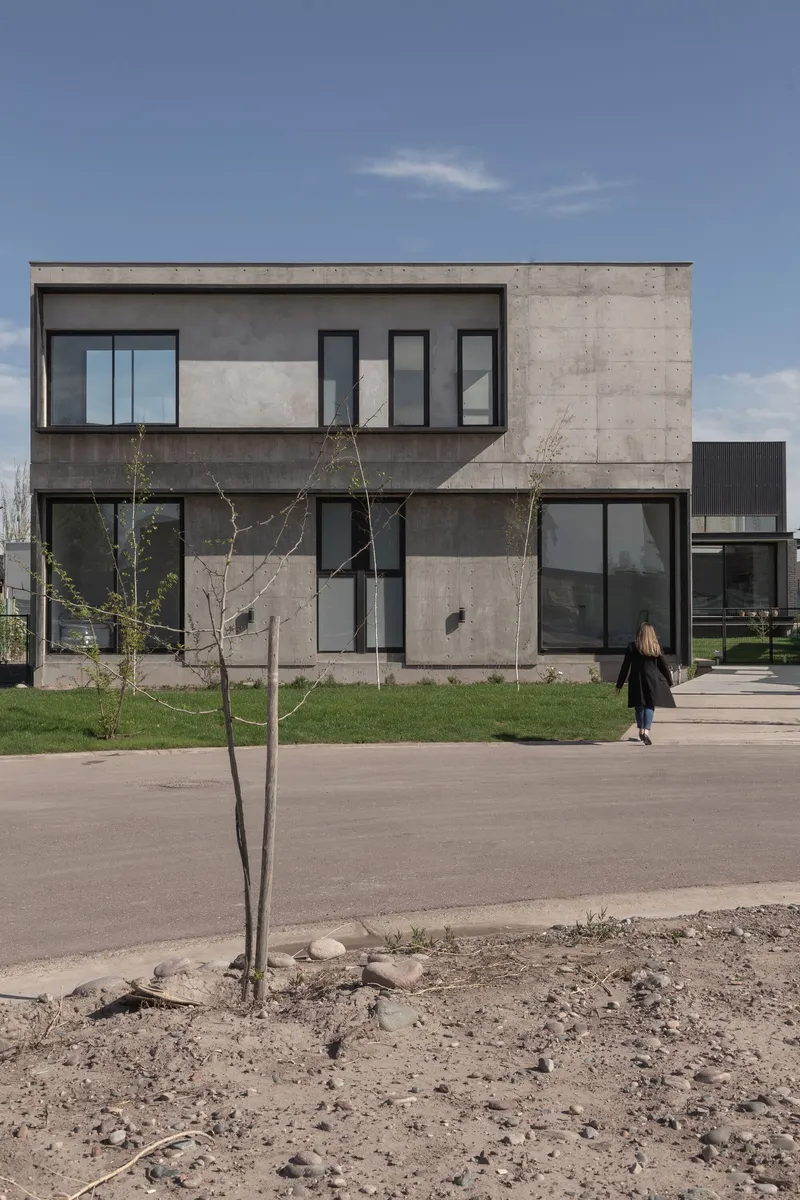
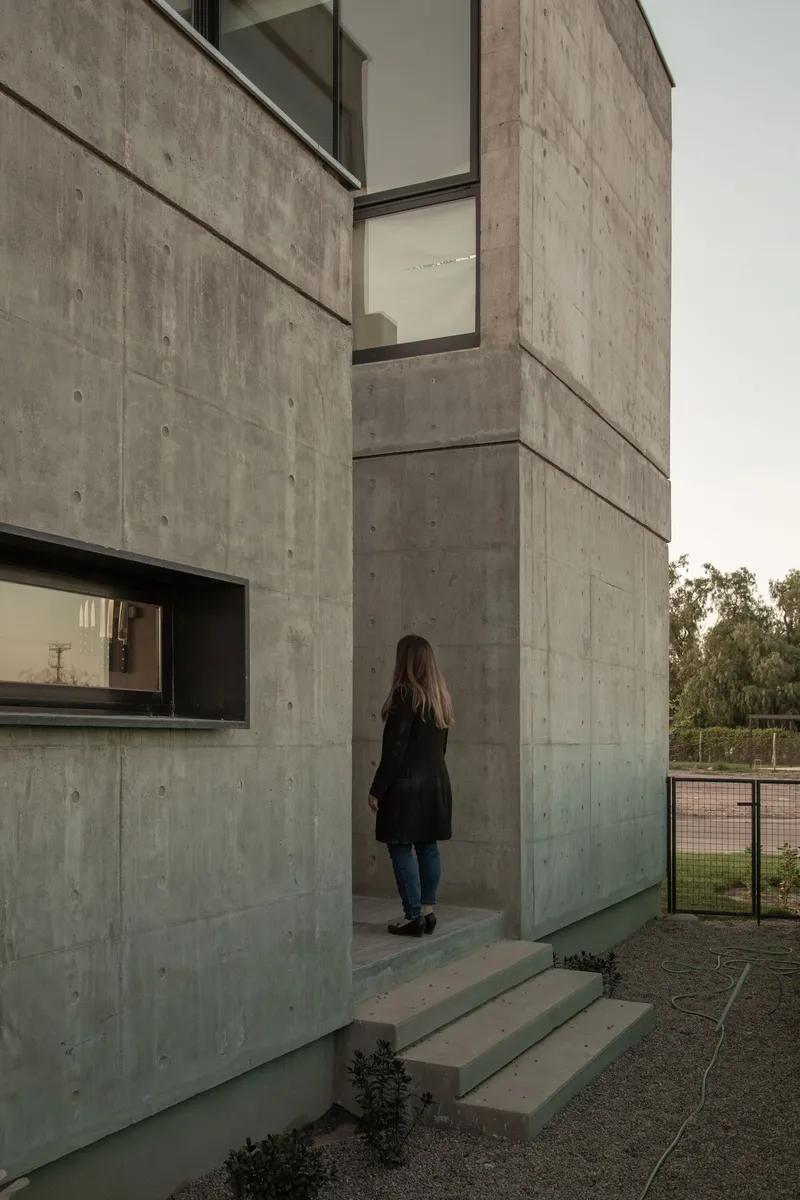
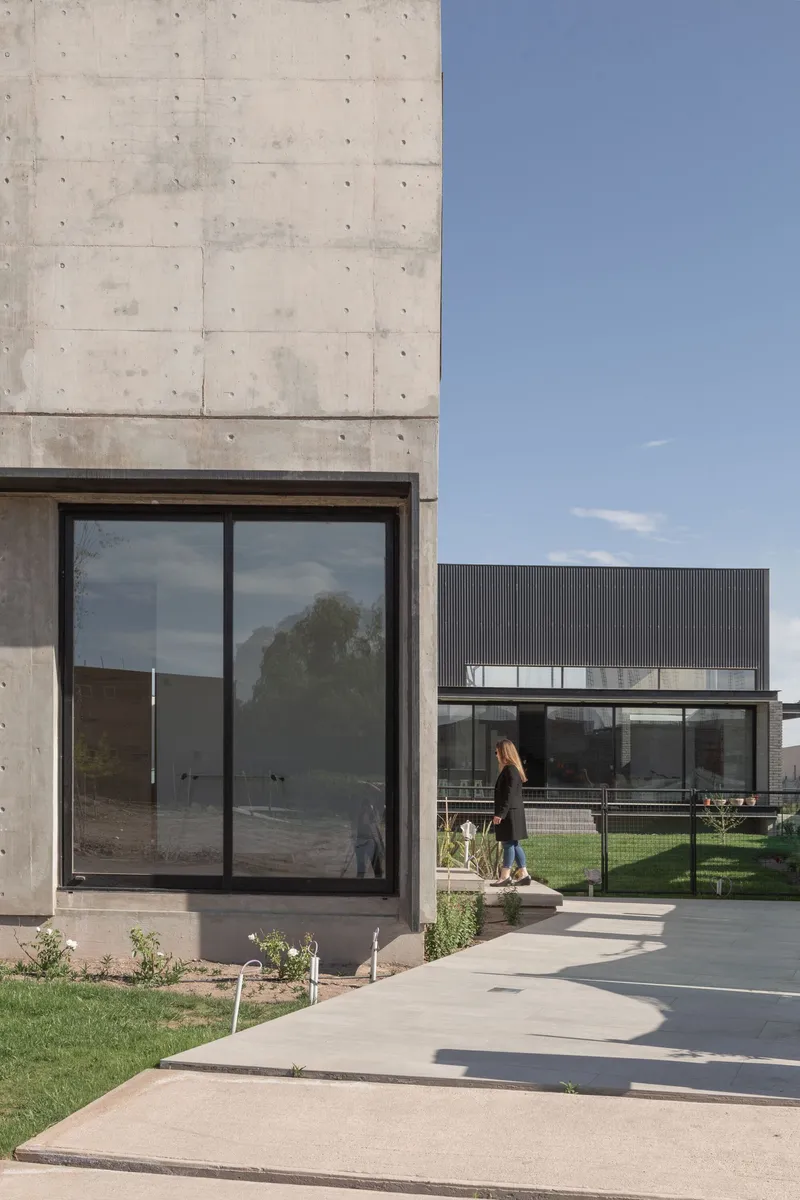
From the street, the FCA Houses present themselves as unapologetically raw. The horizontal board formwork leaves its grain in the concrete, giving the facades a texture that shifts throughout the day as Mendoza's strong sun rakes across them. Young trees planted along the boundary will soften this severity over time, but the architects are clearly not in a hurry. The recessed entries compress the threshold experience: you approach a narrow, low opening before the volume opens up to its full interior height.
This strategy of compression and release is one of the oldest spatial moves in the residential playbook, but it works here because the concrete mass around the entry is genuinely thick. You feel it. The generous wall depth is not decorative; it is the thermal strategy made legible.
Opening to the North
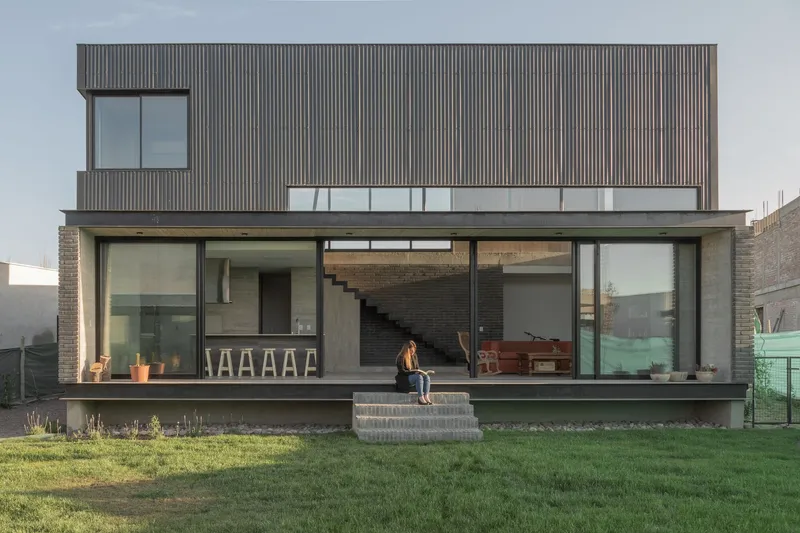
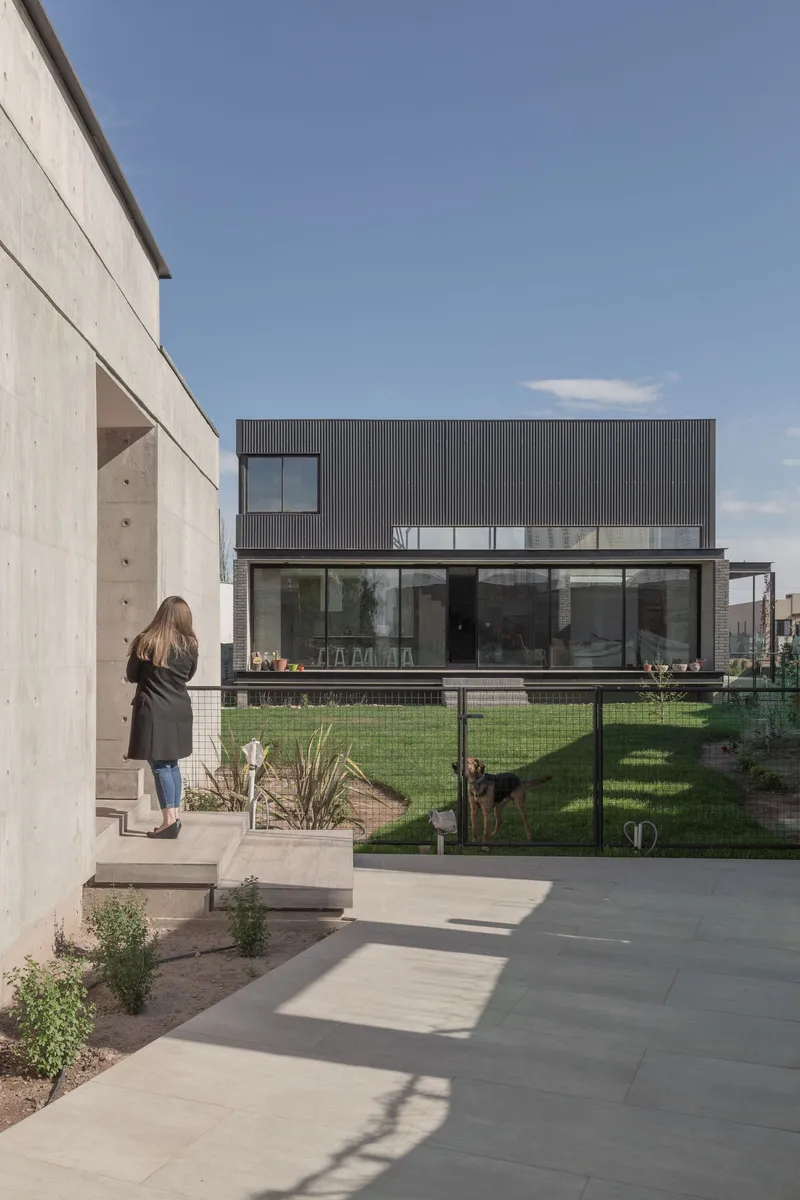
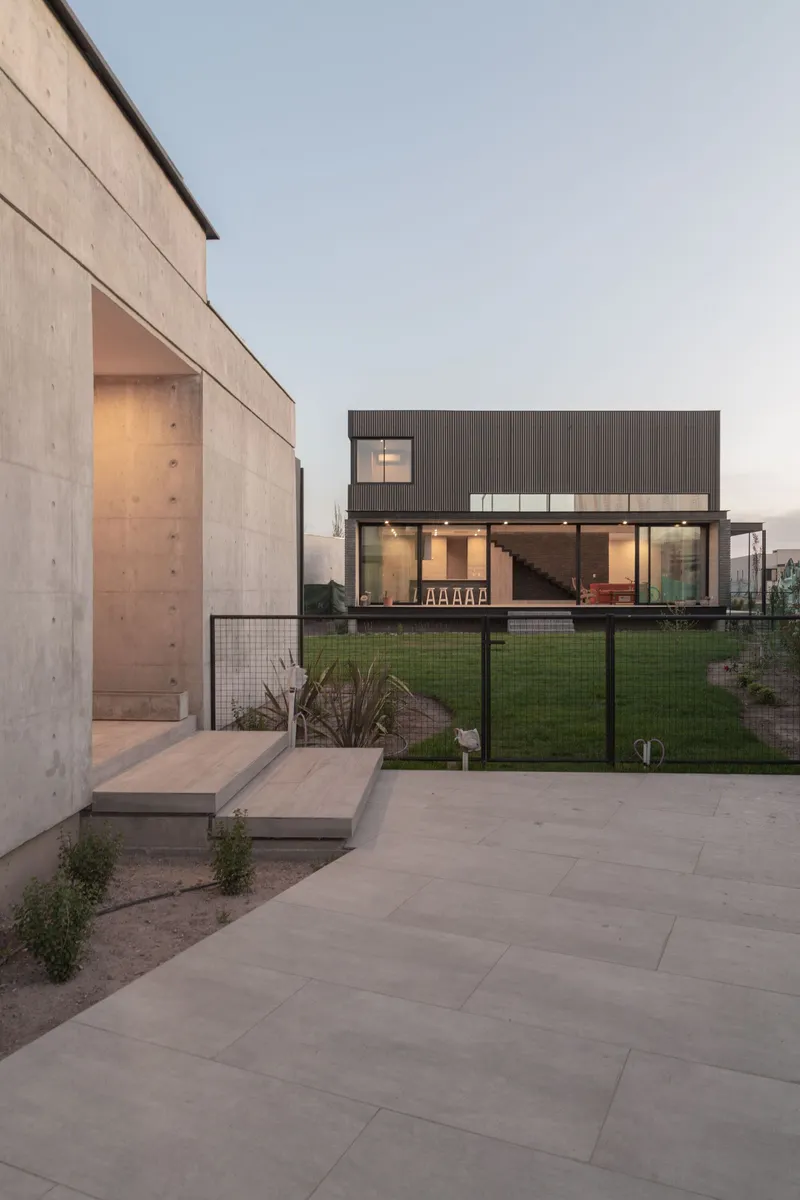
The rear facades tell the opposite story. Where the street side is guarded, the garden side dissolves into floor-to-ceiling glazing. In the southern hemisphere, north-facing openings are the prize orientation for passive solar design, and MFOLM maximizes this advantage. The social spaces on the ground floor extend directly onto concrete terraces and then into the shared garden, blurring the line between interior living and outdoor ground.
Covered galleries along the north edge act as thermal buffers, cushioning the transition between the full exposure of the garden and the conditioned interior. Solar control devices on these openings permit direct gain during Mendoza's cold winters while blocking the high summer sun. The timber cladding on the upper volume adds warmth to the composition without competing with the raw concrete below.
The Offset and the Space Between
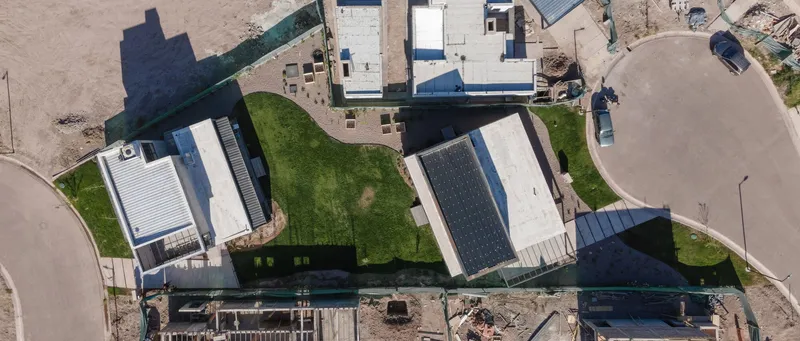
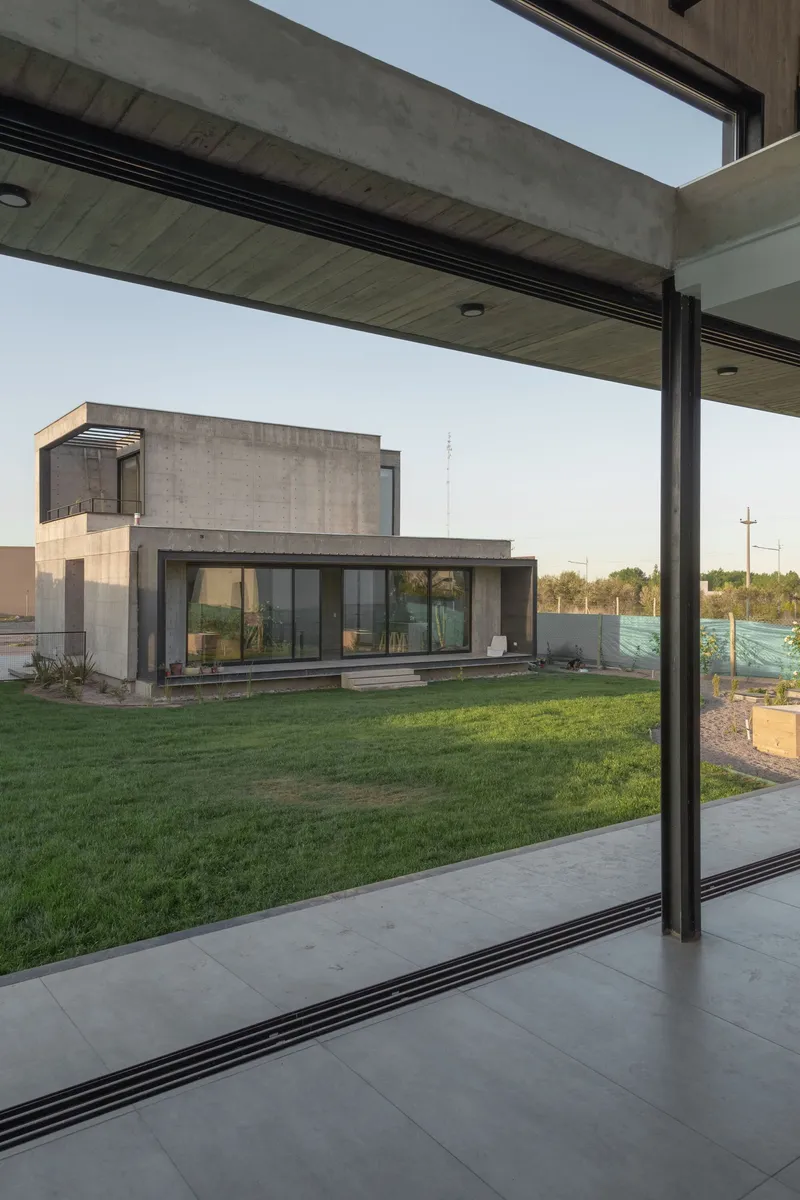
Seen from above, the logic of the site plan becomes clear. The two volumes are staggered so that neither house stares directly into the other. The offset also means each living room catches sunlight without the neighboring mass casting a shadow at the wrong hour. It is a simple move on paper, but it required the architects to study orientation, land use, and the relationship between the two briefs simultaneously rather than designing one house and then fitting the second around it.
Between the volumes, the lawn and tree plantings occupy a shared landscape that is substantially larger than the built footprint. MFOLM deliberately minimized the implantation surface, an approach that reads as restraint but also produces the generous breathing room that makes suburban living feel different from urban density. The golden-hour view through the concrete overhang, framing the sister house across the grass, captures this spatial generosity in a single glance.
Interior Tectonics: Brick, Concrete, and Wood
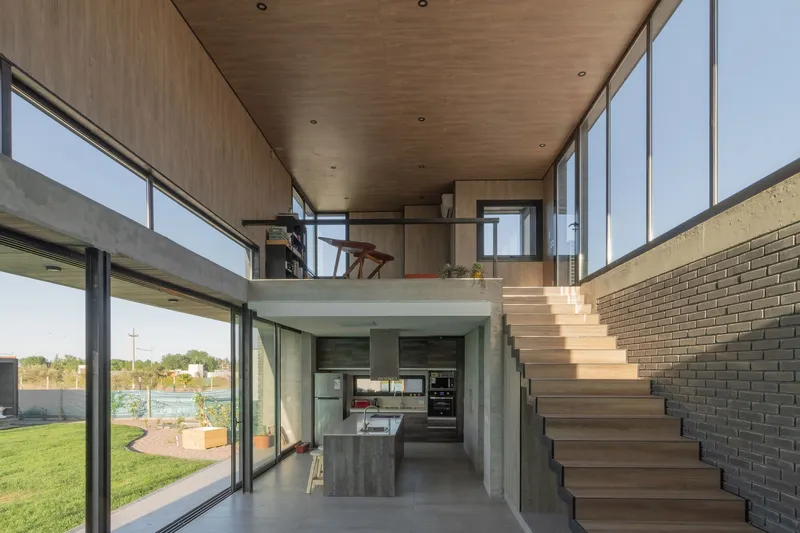
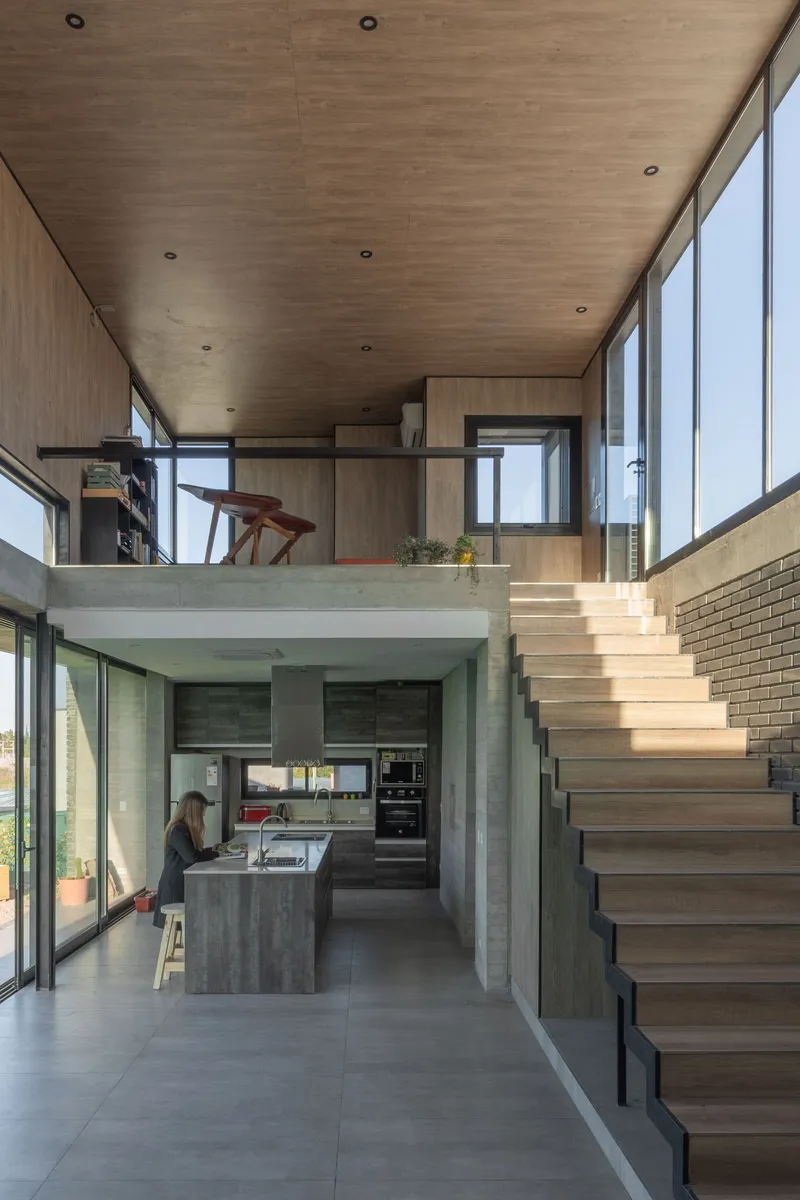
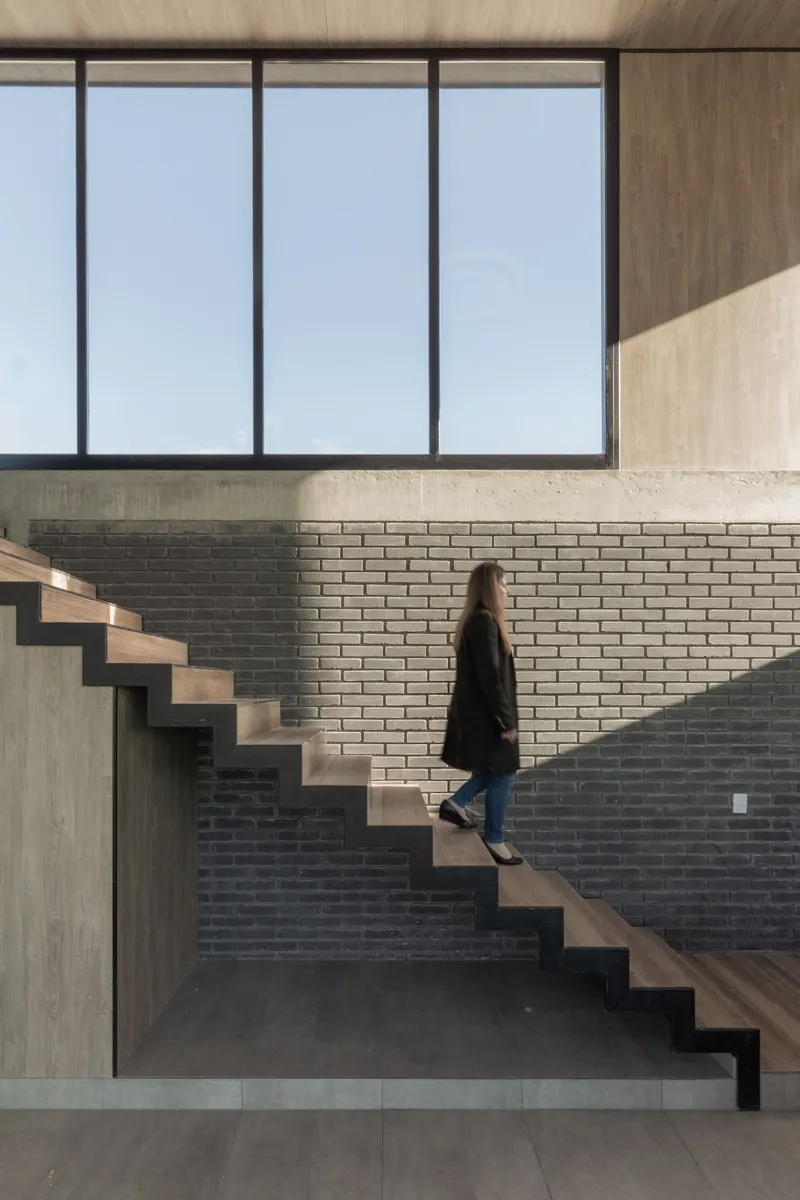
Inside, the material palette remains honest. The cantilevered timber staircase climbs against a wall of black cementitious brick, its treads hovering with just enough separation to let light filter through. The double-height volume in the social area is lined with wood on the mezzanine level, providing acoustic warmth and a visual break from the concrete and brick below. This is not a house that hides its structure; the U 300 profile system that wraps the perimeter doubles as both formwork support and a finishing element.
The kitchen sits beneath the mezzanine, tucked into the lower ceiling zone while the living area stretches upward. It is a classic section strategy that gives each domestic function the ceiling height it actually needs rather than defaulting to uniform floor-to-floor dimensions. The brick wall running alongside the stair grounds the vertical circulation with a material that feels heavier and more domestic than the exposed concrete of the exterior.
Light, Shadow, and the Concrete Surface
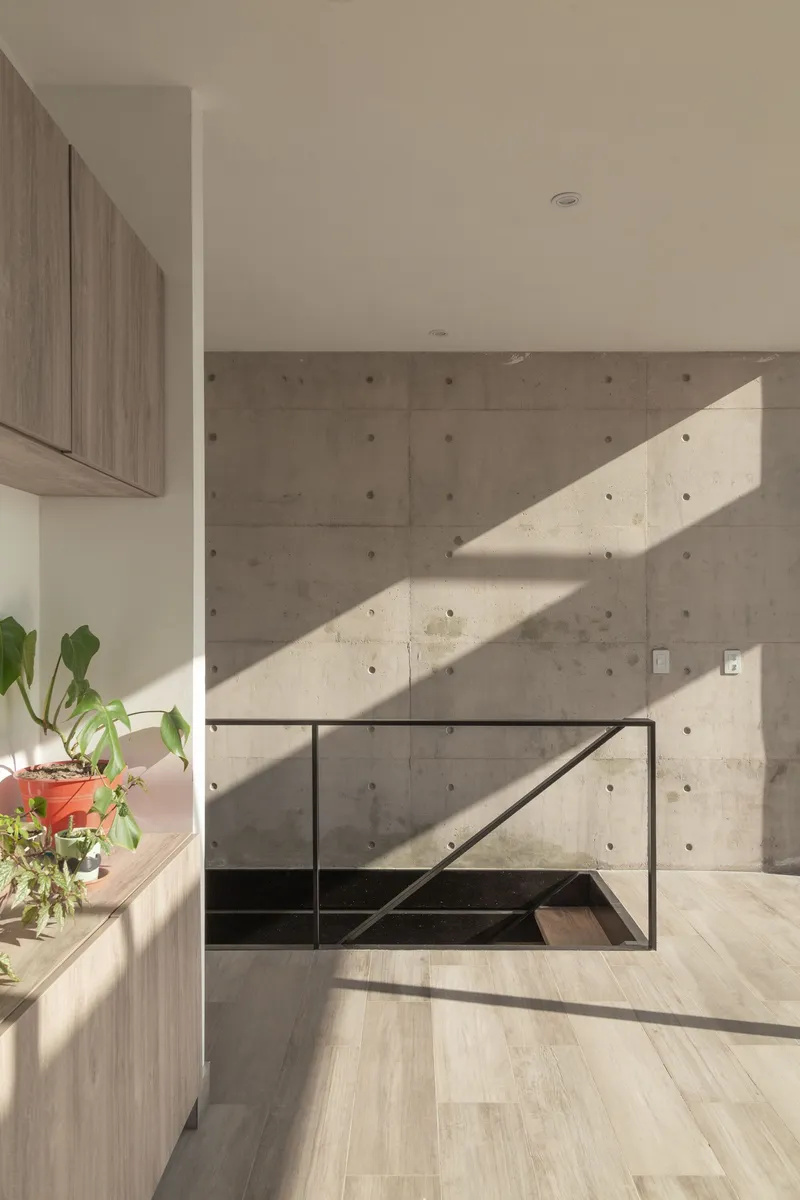
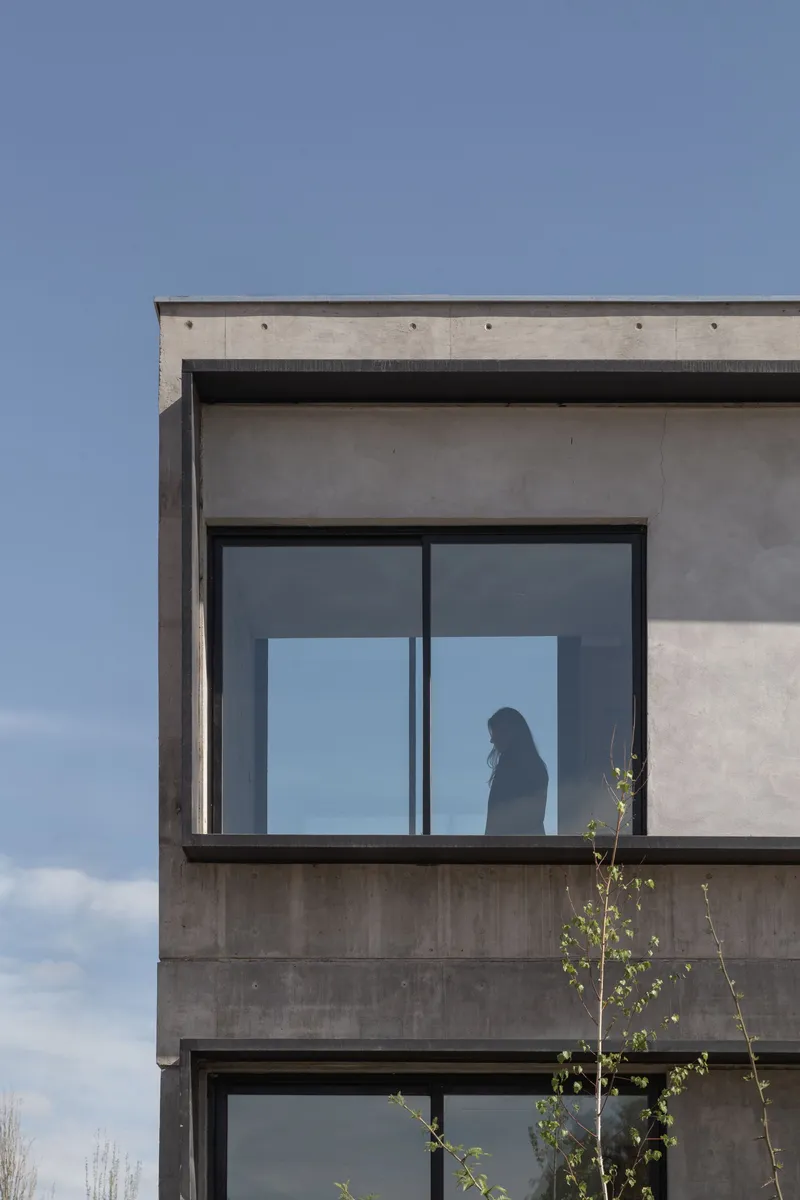
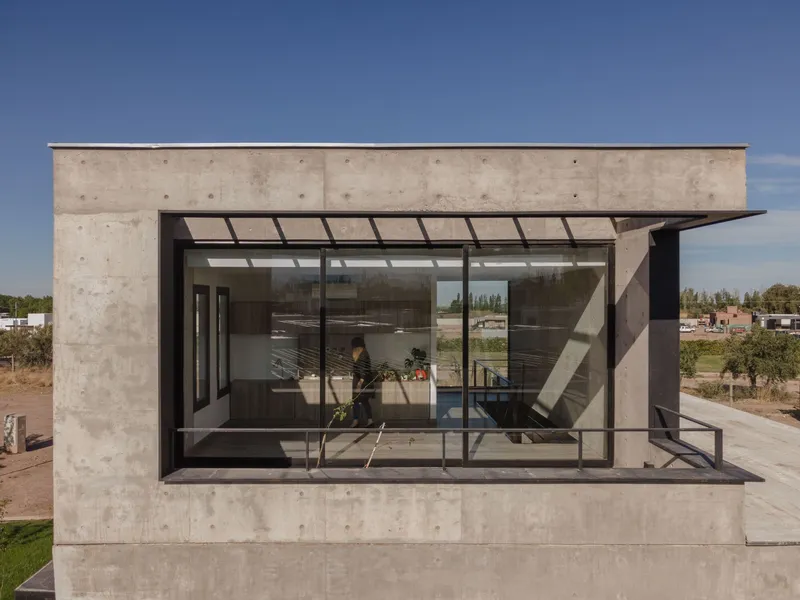
Mendoza's climate delivers sharp, reliable sunlight, and MFOLM uses the board-formed concrete as a surface that records this light. The diagonal shadow patterns cast across the wooden floors in the afternoon are not accidental; they result from precise aperture placement on the west-controlled facades. At dusk, the upper-level glazing silhouettes figures against the sky, turning the house into a lantern seen from the garden.
The projecting bay window on one of the volumes pushes a glazed box out from the concrete mass, catching sidelight and creating a reading nook or workspace that hovers above the landscape. A metal canopy above it controls rain and direct sun. These small moves, a bay here, a recess there, keep the otherwise austere volumes from becoming monotonous.
Upper Terraces and Roof Life
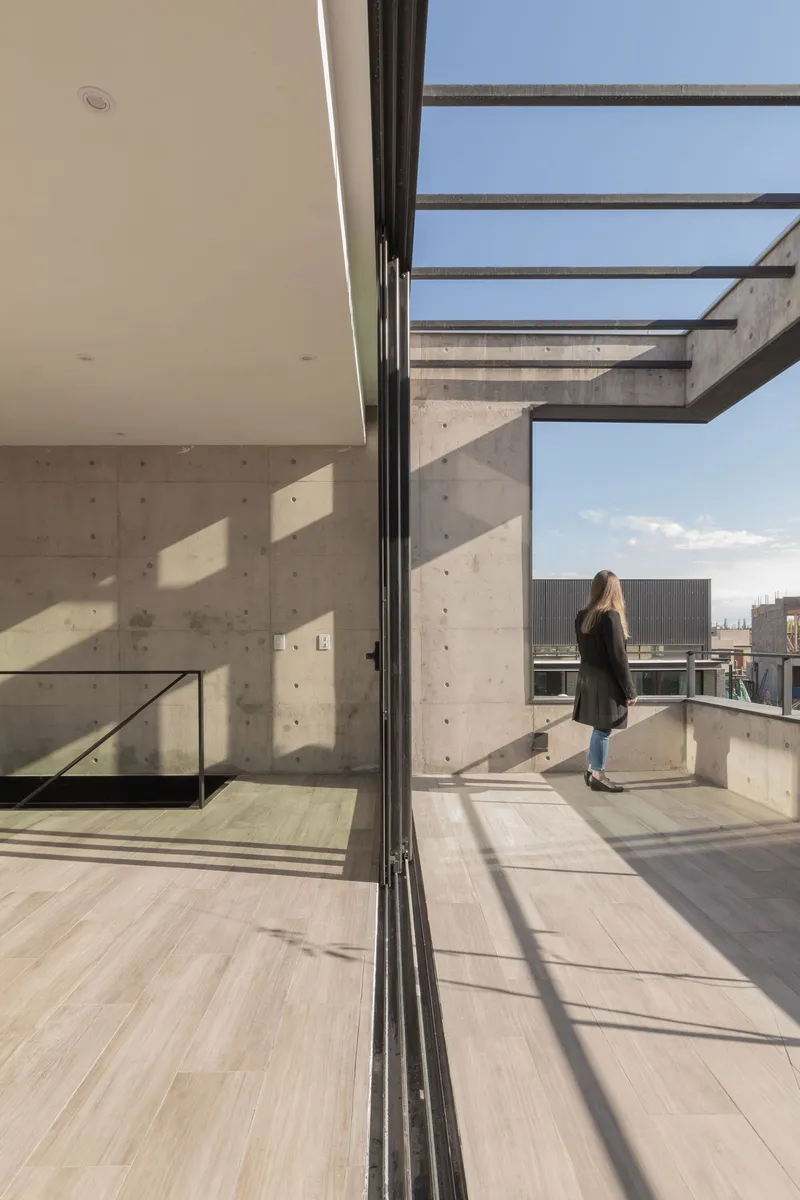
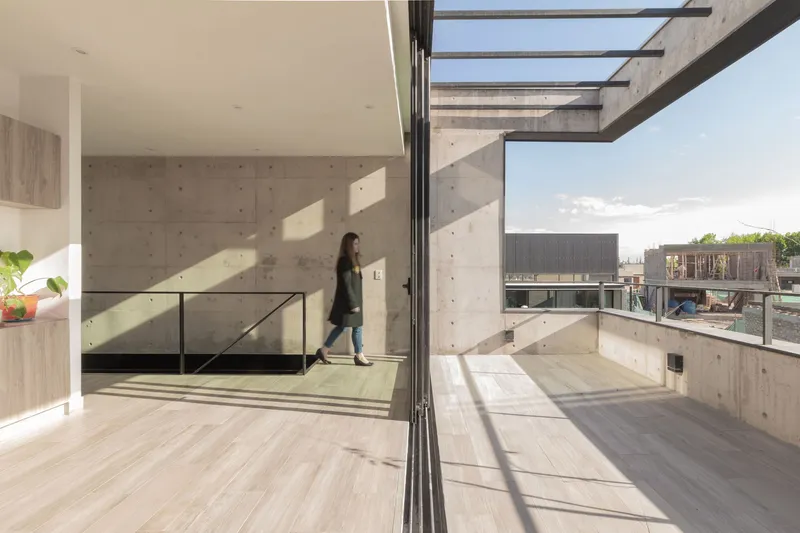
The upper levels offer a second layer of outdoor living. Concrete rooftop terraces are shaded by steel-beam pergolas, providing usable space without the full exposure of the garden below. Glass railings maintain sightlines across the neighborhood and toward the Andes foothills. A skylight opening on one terrace pulls light down into the stair volume, turning the vertical circulation into a light well.
These rooftop rooms are not afterthoughts. In a climate with over 300 clear days a year, they extend the livable area significantly. The steel pergola will eventually support climbing vegetation, adding a layer of bioclimatic shading that complements the fixed architectural devices below.
Plans and Drawings
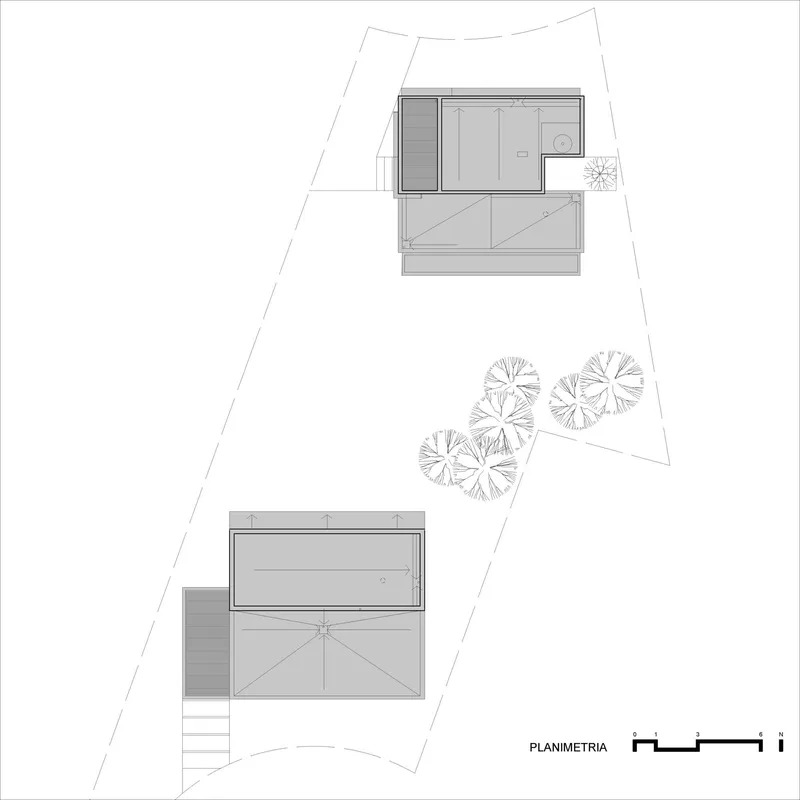
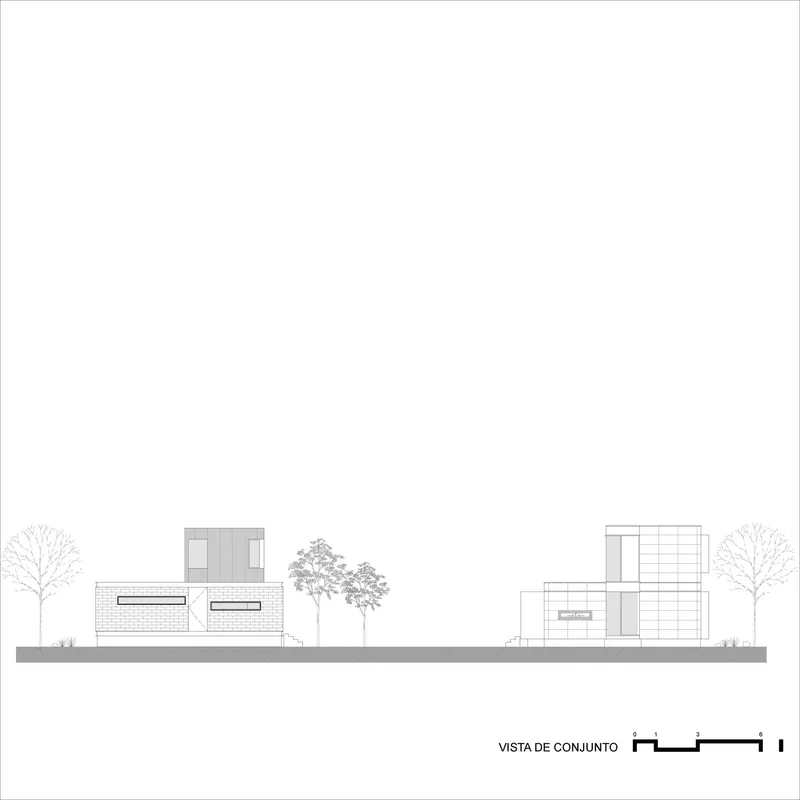
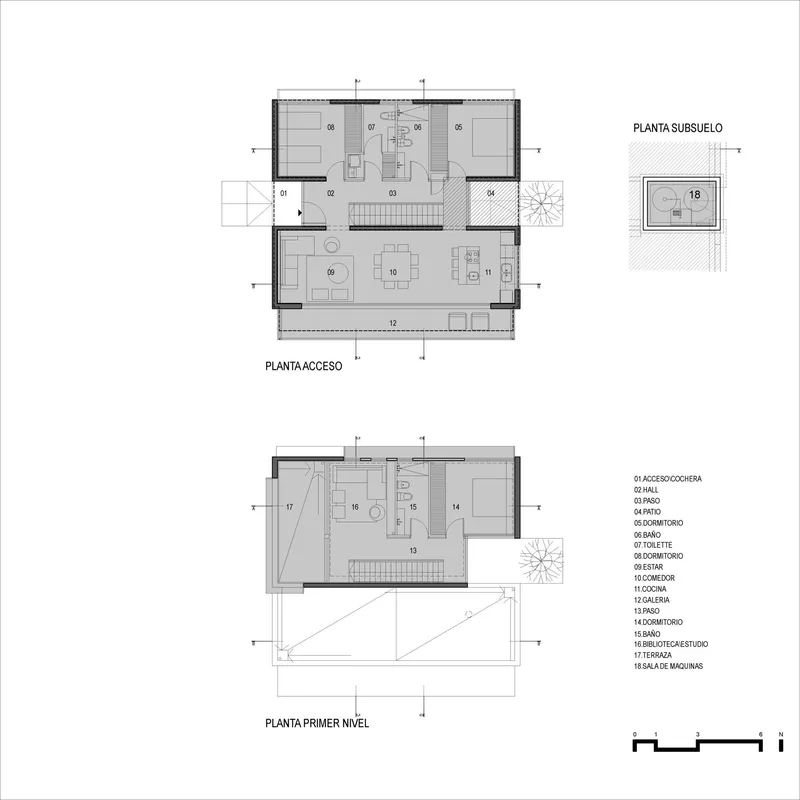
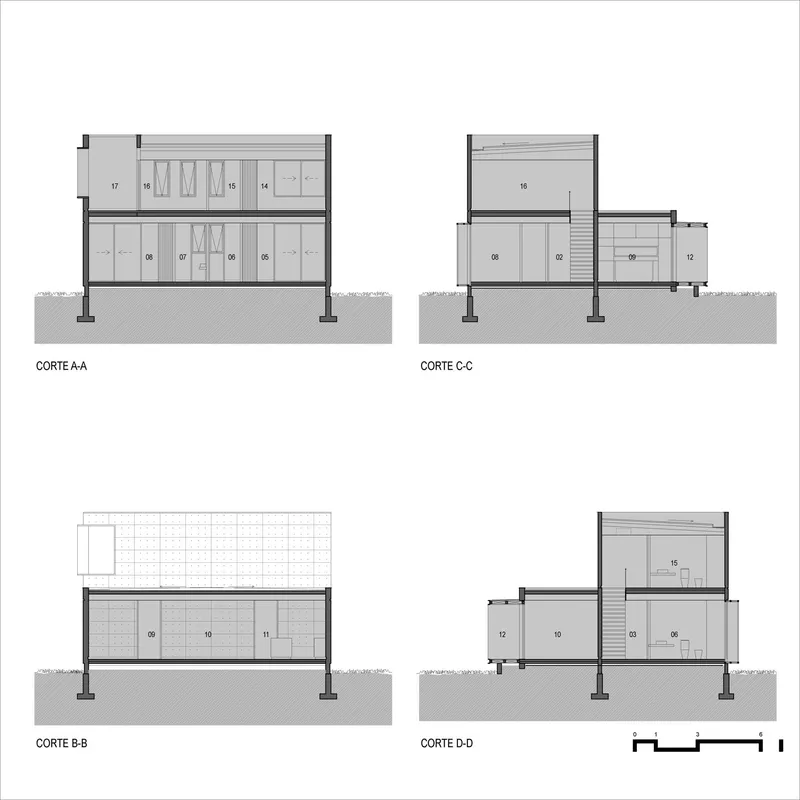
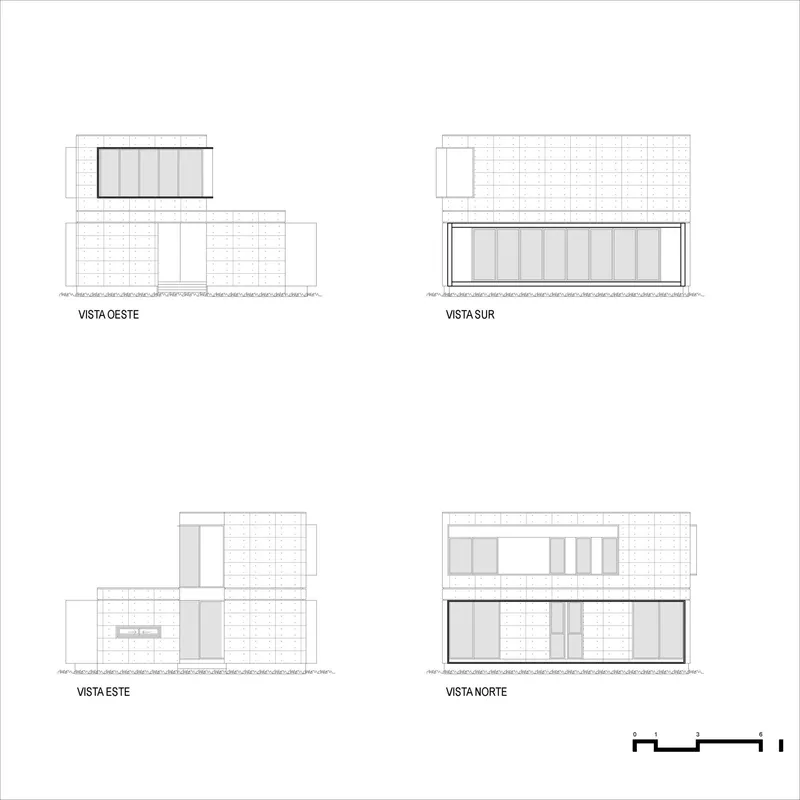
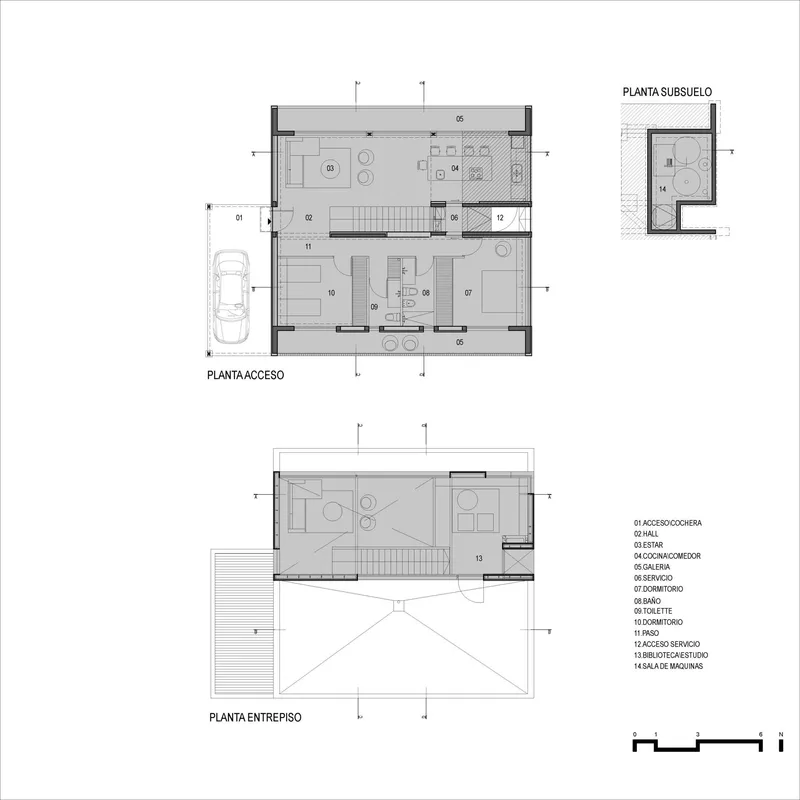
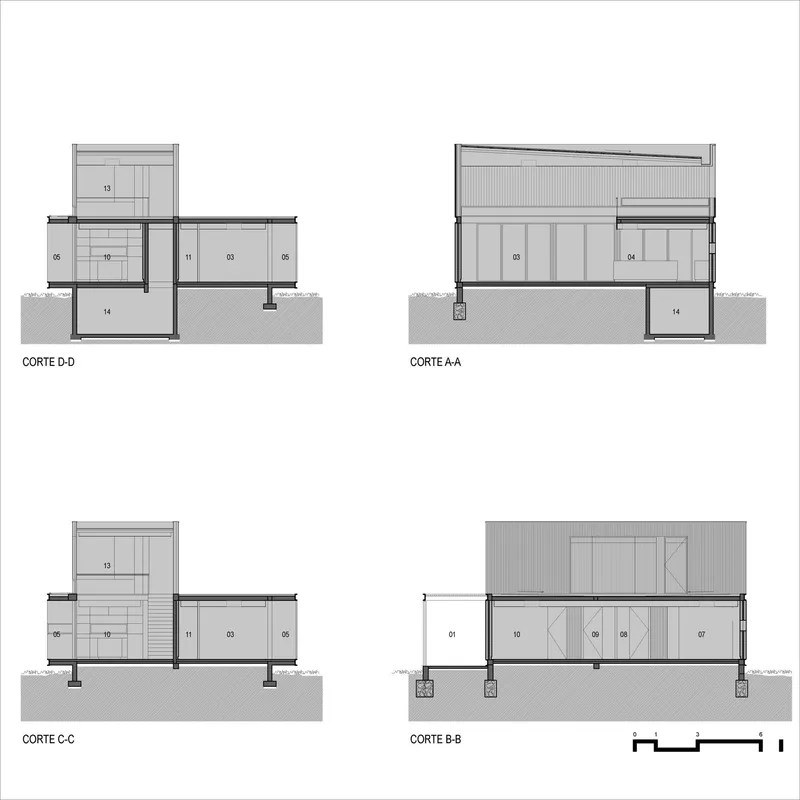
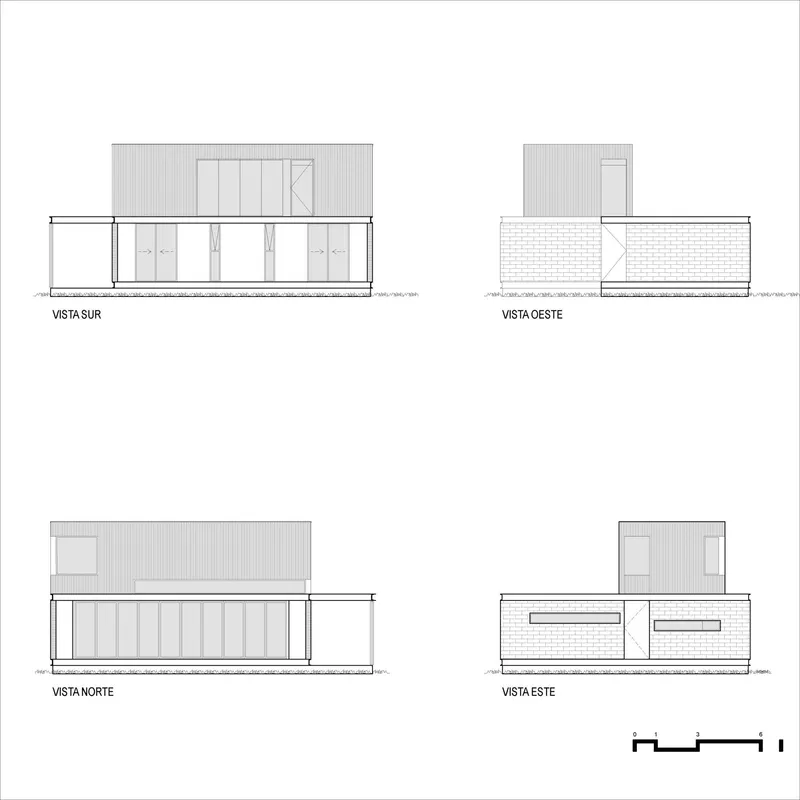
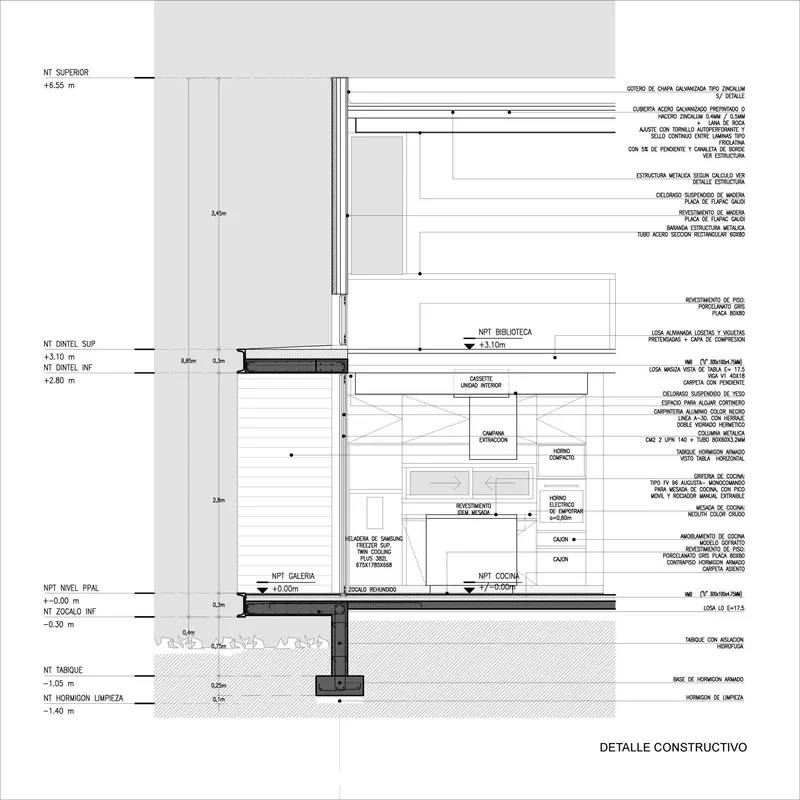
The site plan reveals the irregular lot geometry and the deliberate offset between the two volumes, with tree plantings filling the interstitial space. Floor plans show compact, efficient layouts on both levels: parking and service spaces are pushed to the edges, while the social core opens directly to the north-facing garden. The sections are especially revealing. They expose the compressed entry sequence, the double-height living volumes, and the way the upper metal structure sits atop the heavier concrete base like a lighter parasitic addition.
The construction detail drawing of the foundation, floor slab, and wall assembly is the kind of document that separates a well-conceived project from a merely photogenic one. It shows the insulated cavity within the double brick walls, the relationship between the concrete slab and the ground plane, and the layering of waterproofing and finishes. For anyone interested in how passive design translates to buildable reality in a semi-arid Argentine climate, this section is the most instructive image in the set.
Why This Project Matters
The FCA Houses matter because they demonstrate that suburban residential architecture does not have to choose between environmental responsibility and material ambition. MFOLM Arquitectos could have delivered two insulated stucco boxes with the same passive performance at a fraction of the effort, but they chose instead to make the thermal strategy visible. The thick concrete, the oriented glazing, the double-brick cavity walls: every climate decision is also an architectural decision. The houses wear their logic on their facades.
They also offer a model for the increasingly common scenario of shared lots among family members. By studying both houses together from the outset, the architects avoided the territorial conflicts and solar access disputes that plague speculative twin-house developments. The offset is generous, the landscape is shared, and each sibling gets a home that responds to her own program and material preferences while remaining part of a coherent whole. That negotiation, between autonomy and kinship, is ultimately what gives the project its resonance.
FCA Houses by MFOLM Arquitectos (lead architect: Florencia Oña). Mendoza, Argentina. 521 m². Completed 2022. Photography by Luis Abba.
About the Studio
Share Your Own Work on uni.xyz
If projects like this are the kind of work you want to make, uni.xyz is a place to publish your own, find collaborators, and enter design competitions.


Popular Articles
Popular articles from the community


Extended Shell: Retrofitting Kolkata's Balconies as Living Urban Thresholds
A modular retrofit system recovers the social and environmental intelligence of Kolkata's historic verandas for contemporary Park Street residents.

Faces of the Soviet Avant-Garde: Turning Moscow's Street Names into an Open-Air Museum
A network of sculptural installations across a Moscow residential district transforms forgotten architect names into spatial encounters with cultural memor

Opera by the Sea Estonia: Three Shells Dissolving Architecture into Tallinn's Coastline
A winning opera house proposal replaces monumental form with interconnected shells that blur the boundary between building, park and Baltic Sea.

Singing Woman: An Opera House That Performs Before the Curtain Rises
Ovidiu Cristian Pavel's conceptual opera house translates Estonia's choral identity into a sculpted waterfront landmark facing the Baltic Sea.

Similar Reads
You might also enjoy these articles

Pixel Gardens: One Repeated Module Stacked Into a Terraced Social Housing Tower for Famagusta
Salem Bader's shortlisted housing tower builds a vertical neighbourhood from one repeated module, offsetting units to carve terraces, light and air.

Bao Huynh Watercolor Atelier: A Serene Art Retreat in Hội An
Bao Huynh Watercolor Atelier in Hội An blends multifunctional art spaces, sustainable design, local materials, and family-friendly living in a serene environment.

Atelier Macri Concept Store Interior Design by CASE-REAL
Atelier Macri store features a "ko" counter, walnut wood details, cork displays, blending retail, gallery, and seamless customer experiences.

Manuel Vargas Izquierdo Stadium and High-Performance Sports Center: Architectural Excellence in Jalpa de Méndez
The Manuel Vargas Izquierdo Stadium blends sustainable design, inclusive sports facilities, and cultural-inspired architecture, revitalizing Jalpa de Méndez’s public spaces.

Explore 2X1 Architects Competitions
Discover active competitions in this discipline

Challenge to design mud housing for contemporary communities

Challenge to reimagine the Iron Throne

Photograph architecture without architects

Illustrate the lost glory of Angkor Wat - Render Challenge
Comments (0)
Please login or sign up to add comments
No comments yet. Be the first to comment!