

Michan Architecture and PARABASE Scatter Three Pavilions Beneath the Canopy of Chapultepec Forest
An international competition win delivers 70,000 square meters of new parkland architecture woven into Mexico City's most iconic urban forest.


Mexico City's Chapultepec Forest is one of the largest urban parks in the Western Hemisphere, a sprawling ecosystem that has served as royal retreat, public commons, and pressure valve for a metropolis of over 20 million. In 2022, Michan Architecture and PARABASE, working alongside landscape firm Taller de Paisaje Entorno, won an international design competition to insert three new pavilions into this forest without overwhelming it. Completed in 2024, the Chapultepec Forest Scenic Garden spreads 70,000 square meters of rethought landscape and architecture across the park, and the most striking thing about it is how little it announces itself.
Rather than dropping a single landmark building onto the site, the design team decomposed the program into discrete volumes: a performance space, a café, and a rehearsal hall, each sited according to topography and existing tree cover. The architecture operates less as object and more as negotiation, curving its rooflines to clear canopy branches, burying its walls inside planted berms, and lifting its floors on slender columns to preserve root systems. The result is a project that feels discovered rather than built, an approach that is easy to romanticize but genuinely difficult to execute at this scale.
Ground as Architecture
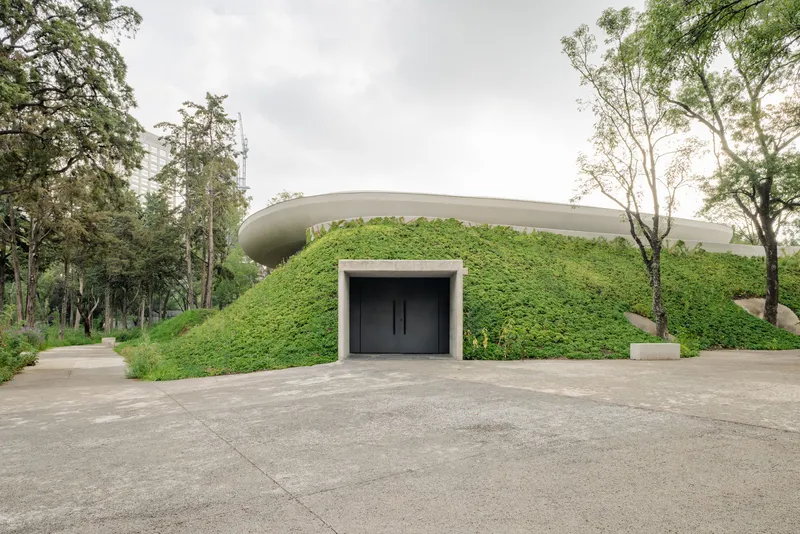
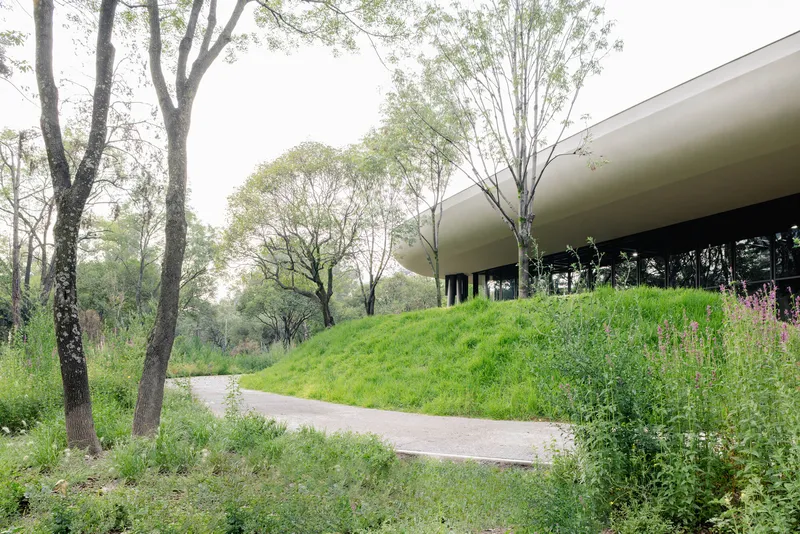
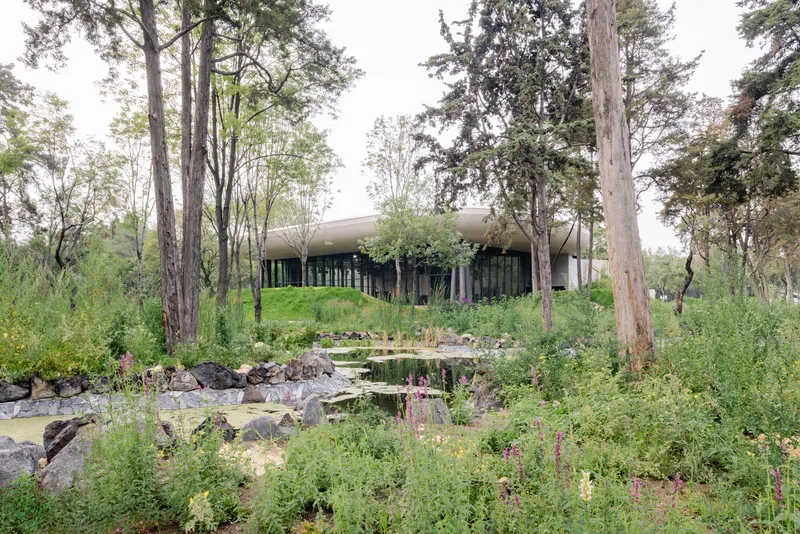
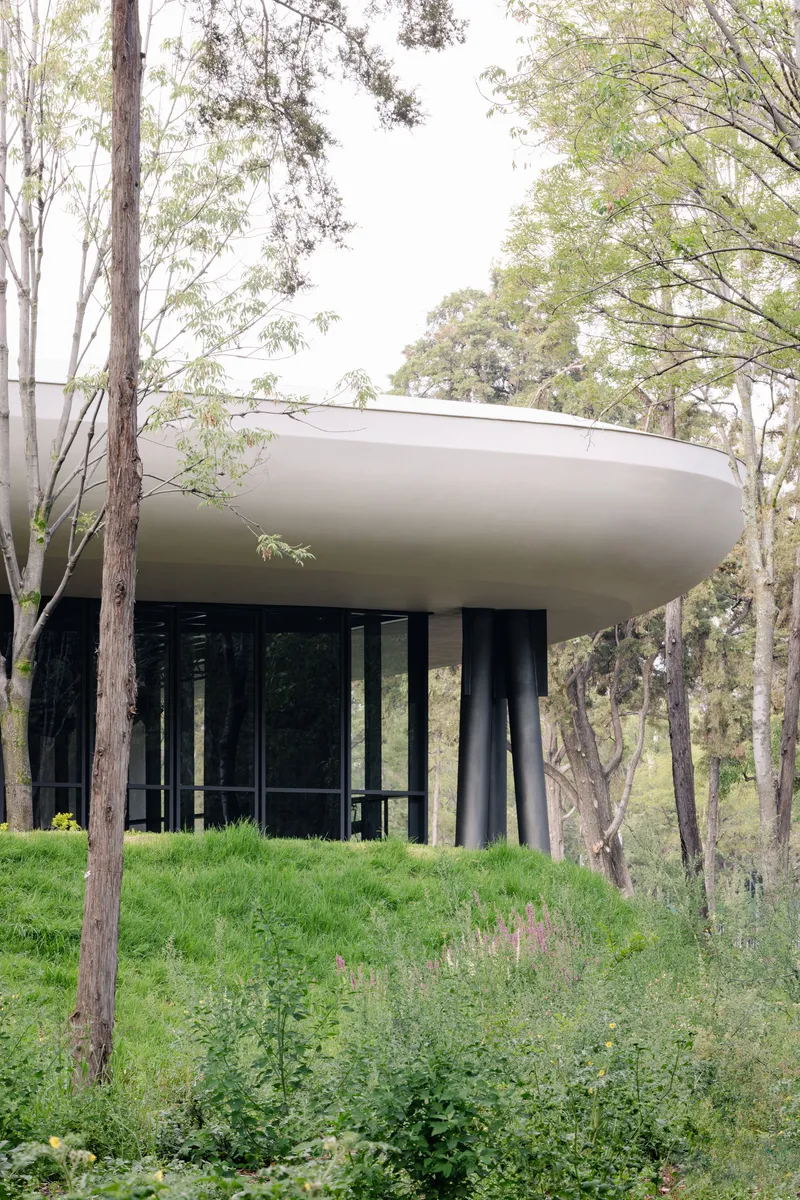
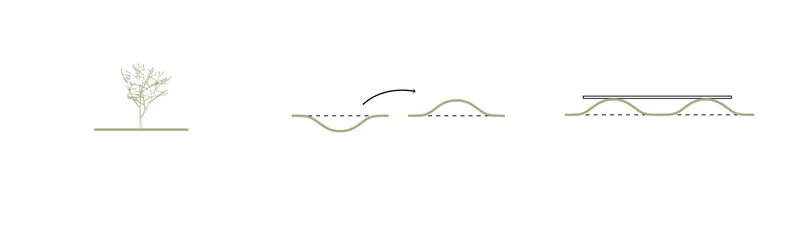
The most compelling move across the three pavilions is the use of the ground plane itself as an architectural element. Rather than sitting on the landscape, the buildings grow out of it. Planted earth berms wrap around and over the structures, creating entry sequences that feel like walking into a hillside. Curved glass facades are set back beneath these artificial topographies, visible only at close range, so the building reads as terrain from a distance and as enclosure only once you arrive at its threshold.
Gravel and wildflower pathways lead visitors along indirect routes through these berms, slowing the approach and filtering out the noise of Paseo de la Reforma a few hundred meters away. The landscape design is not merely decorative framing for the architecture; it is co-structural. The berms serve as retaining walls, acoustic barriers, and thermal mass, collapsing several engineering functions into a single topographic gesture.
Roof as Canopy
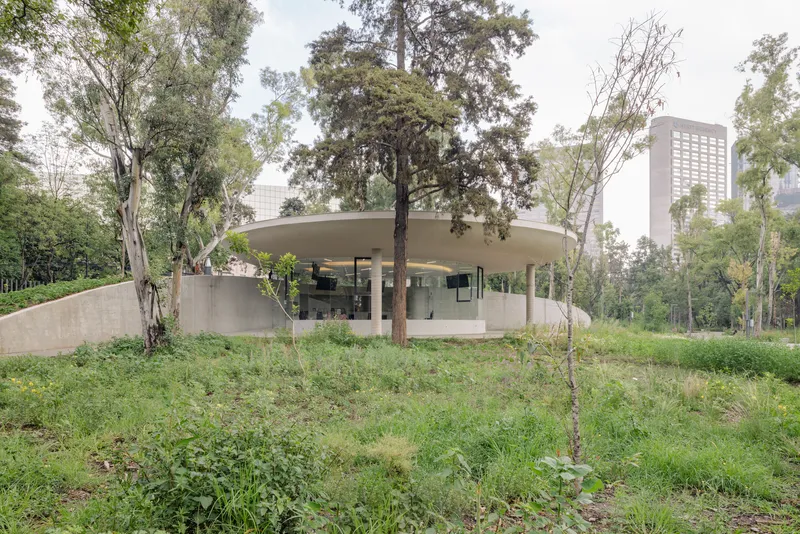
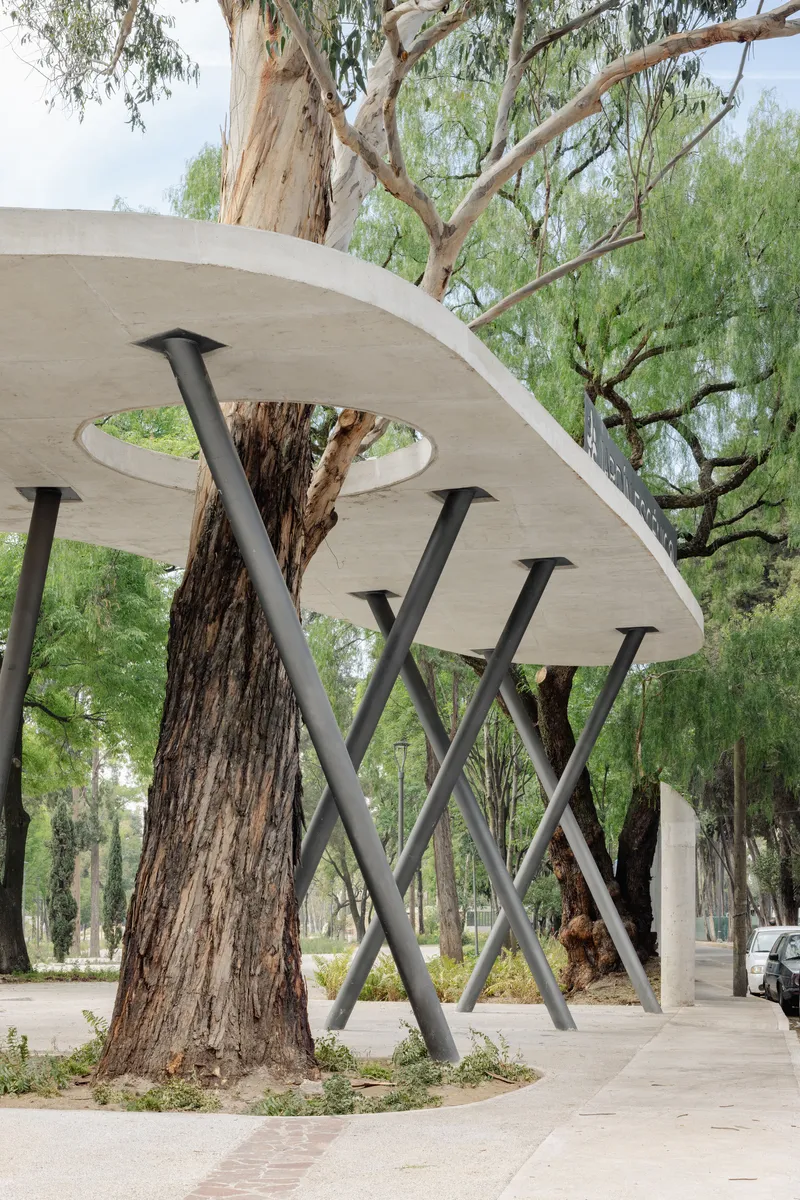
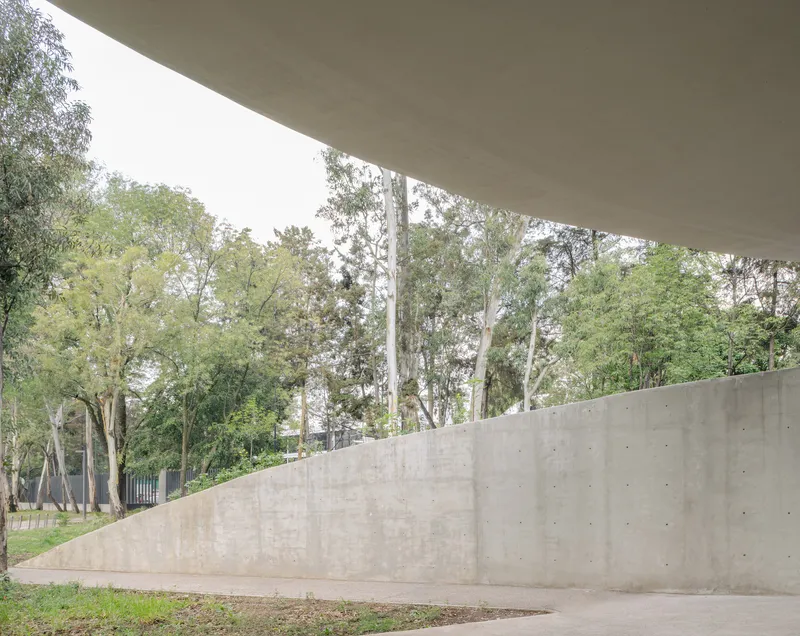
Each pavilion is crowned by a concrete roof slab that hovers above the enclosure below. These are not conventional roofs so much as artificial canopies designed to coexist with the biological ones above them. The main pavilion features a broad, curved shell that cantilevers outward, its edge thin enough to appear weightless from below. Where large trees penetrate the building footprint, branching steel columns wrap around their trunks to support the roof, turning structural accommodation into a visible commitment to preservation.
Viewed from beneath, the cantilevered slab creates a deep shaded threshold between inside and outside. The angled concrete retaining walls that anchor the roof to the ground give the underside a geological quality, as though you're standing beneath a rock overhang. The effect is simultaneously primitive and precisely engineered, a combination that works because the detailing never tries to disguise the concrete's weight.
Interior Transparency
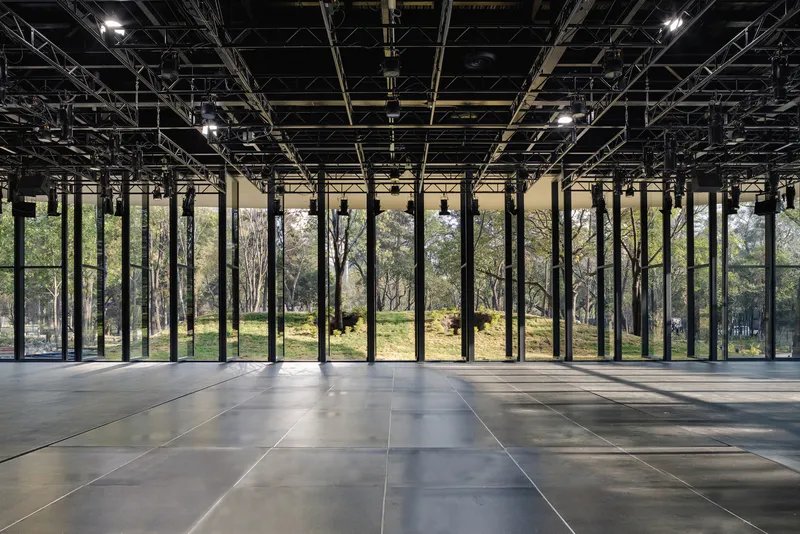
Inside the pavilions, the structural discipline shifts from concrete to steel. An exposed black grid ceiling carries the roof loads down to perimeter columns, freeing the facades for floor-to-ceiling glass. The interiors are essentially viewing platforms aimed at the forest: the trees become the ornament, the light the atmosphere. There is almost no applied decoration.
One pavilion is elevated on slender cylindrical black columns above a grassy slope, floating just high enough to open sightlines to the surrounding canopy while keeping the ground below permeable and walkable. The restrained material palette, black steel, clear glass, raw concrete, ensures the building recedes behind whatever is happening outside its walls at any given moment.
Site Strategy from Above
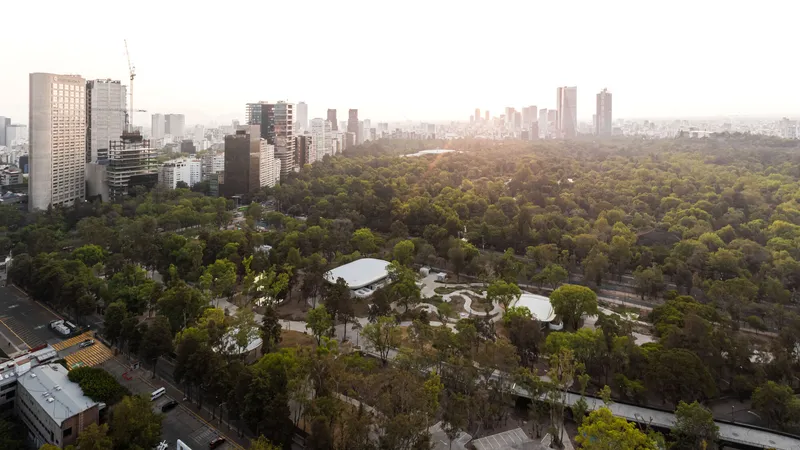
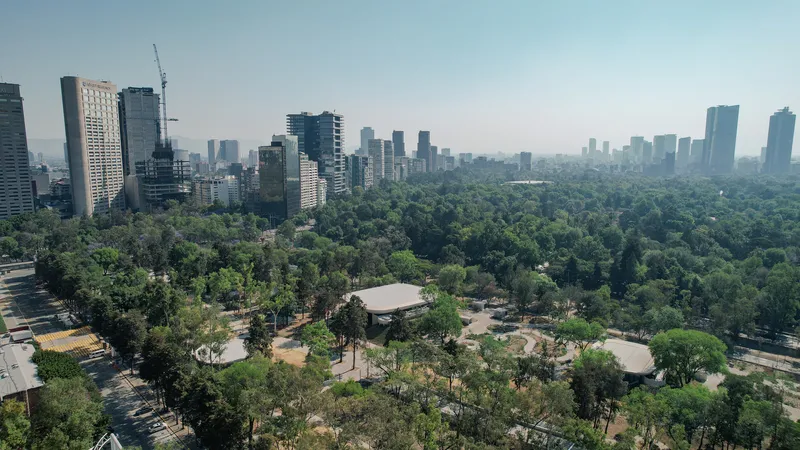
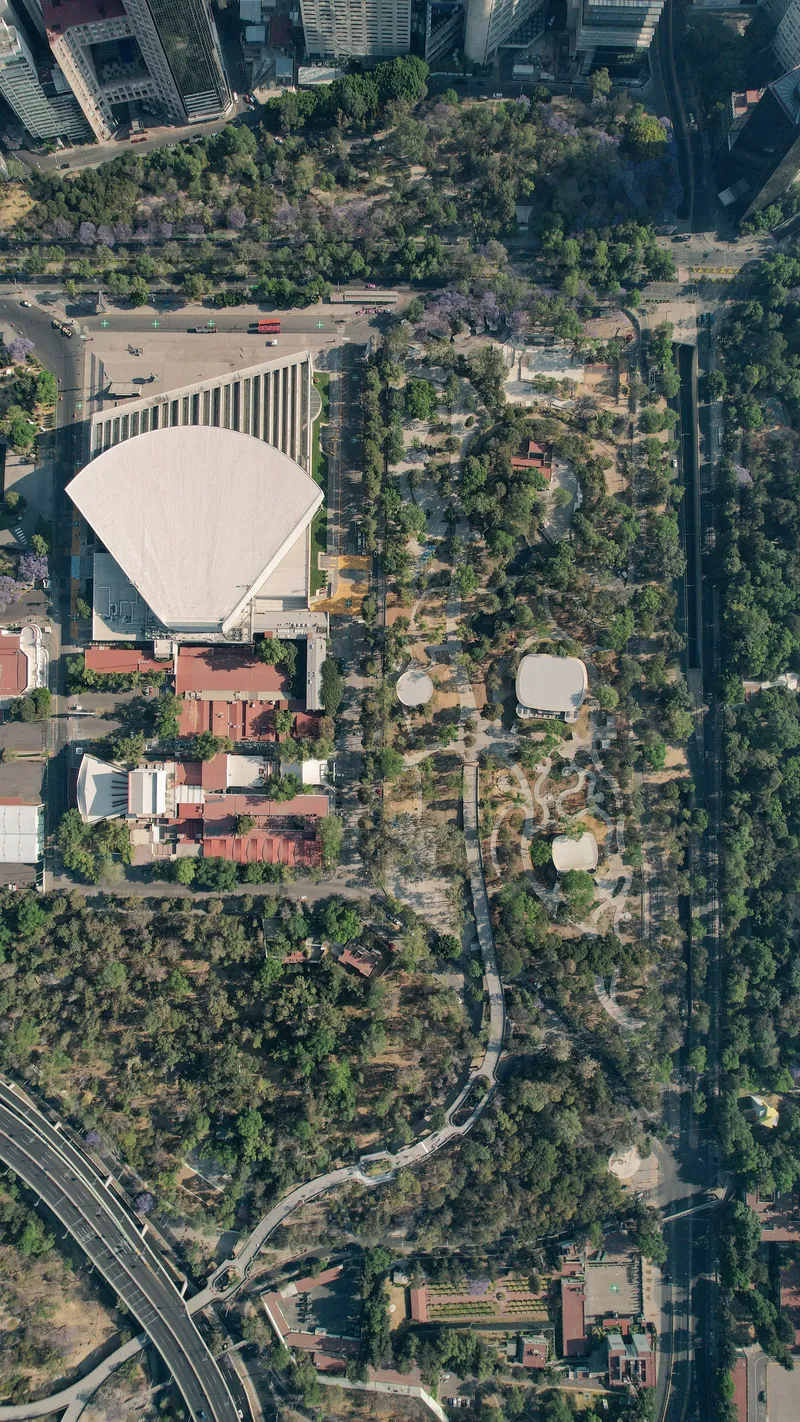
Aerial photographs reveal what the ground-level experience deliberately conceals: the full extent of the intervention. The main pavilion's shell-shaped roof sits like a large leaf among the trees, its organic profile calibrated to avoid the canopy's densest clusters. Secondary volumes are scattered at calculated distances, connected by a network of paths rather than corridors. The strategy borrows from campus planning rather than conventional building design, distributing program across the site to minimize any single footprint's impact.
From drone altitude, the relationship between the park and the surrounding city becomes stark. Dense urban blocks press in from all sides, and the forest reads as a fragile island. Inserting new architecture into this context carries real risk. The fact that the pavilions nearly disappear into the tree cover, visible mainly as pale geometric patches among the green, suggests the design team understood that the forest's continuity was more important than any individual building's legibility.
Landscape Integration
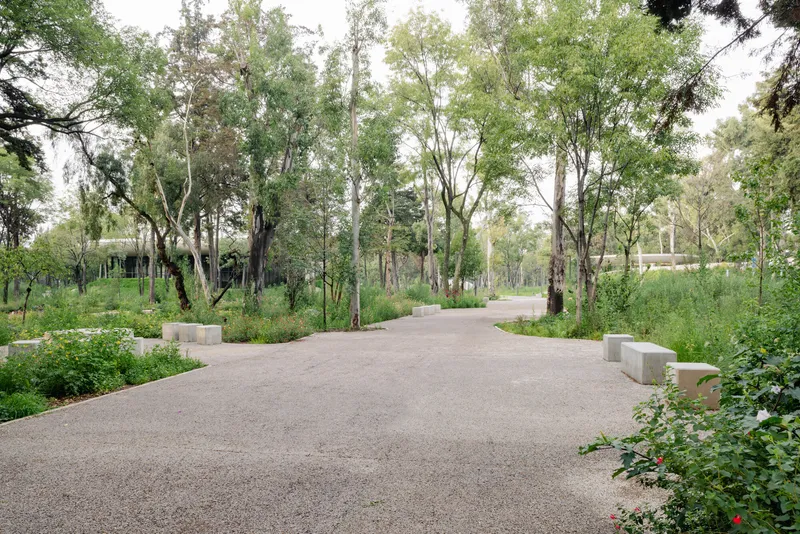
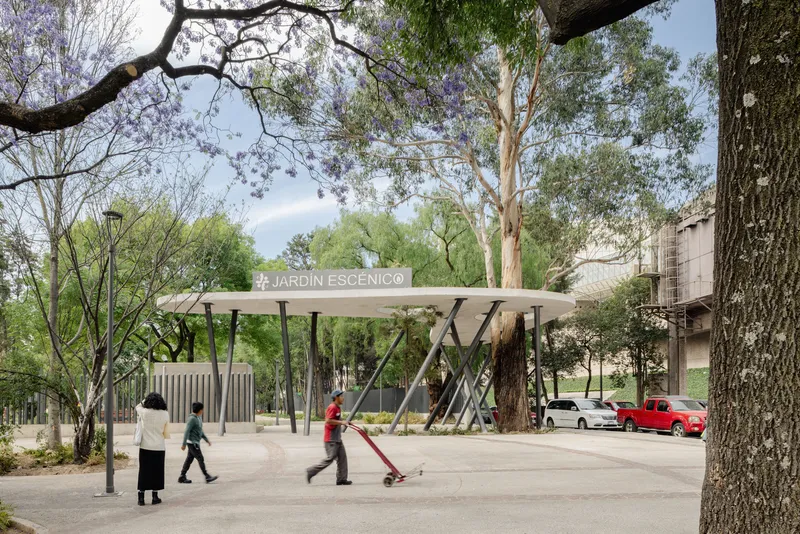
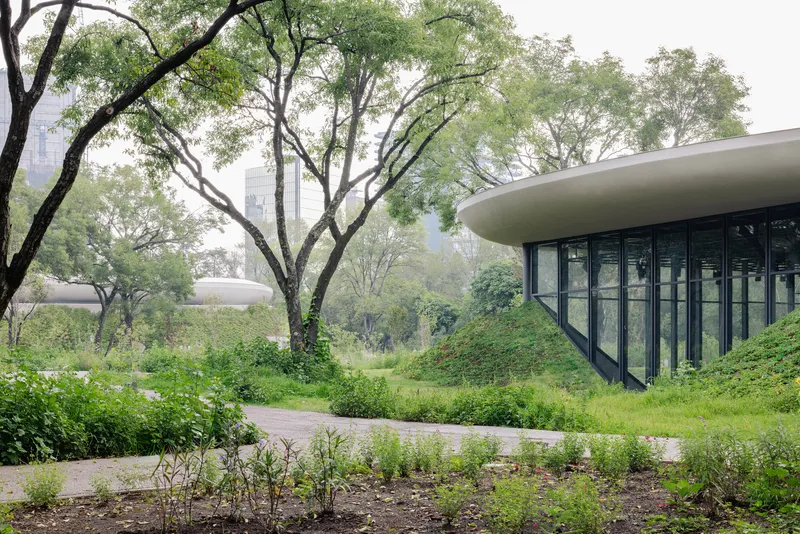
Beyond the pavilions themselves, the project includes a thorough reworking of the park's ground surfaces and planting. Gravel walkways bordered by concrete bollards cut through wildflower beds and wooded groves, establishing a material hierarchy that distinguishes pedestrian routes from planted zones without resorting to fences or curbs. The entry sequence for vehicles is handled by a separate canopy with angled steel supports beneath mature trees, keeping cars out of the main visual field.
The landscape palette leans toward native species and naturalistic compositions rather than manicured lawns. Rocks, ponds, and slopes are treated as existing features to be amplified, not obstacles to be graded away. This is landscape architecture that knows the difference between a park and a garden, and chooses park.
Plans and Drawings
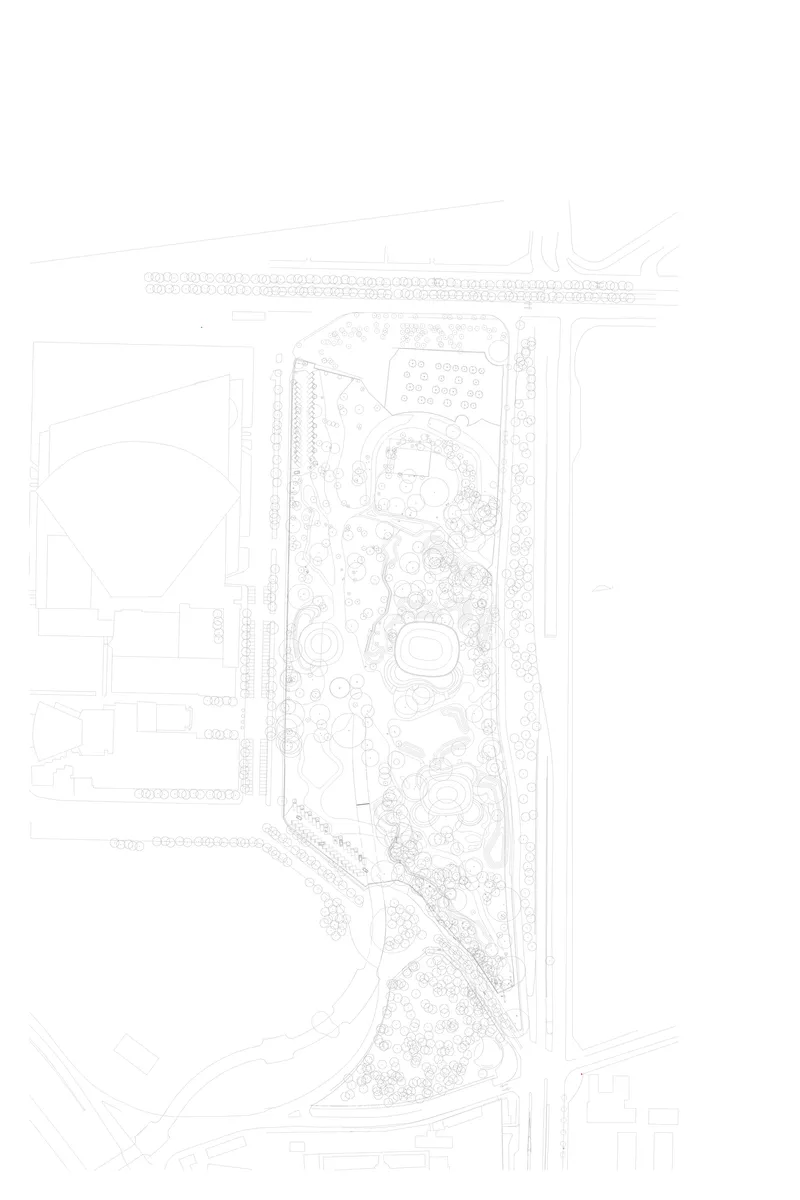
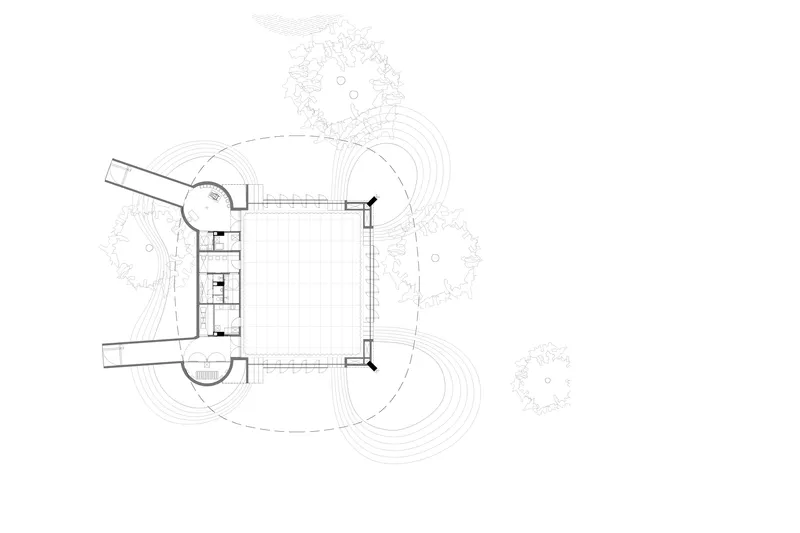
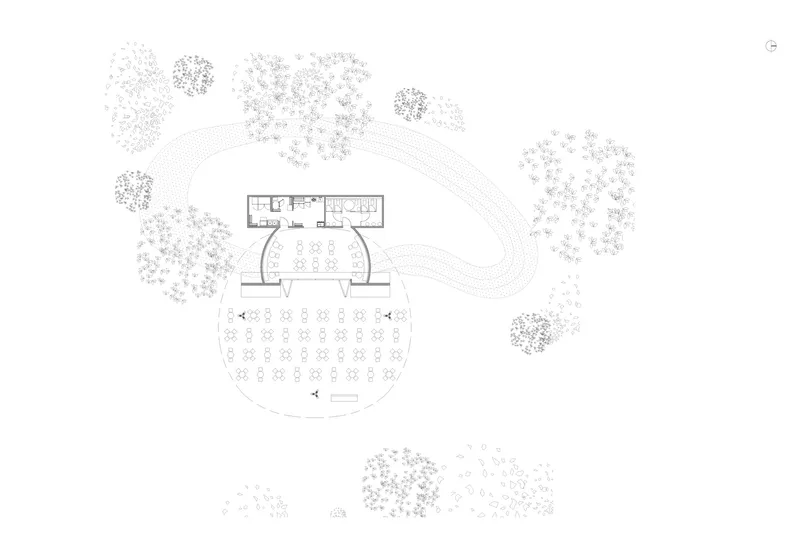
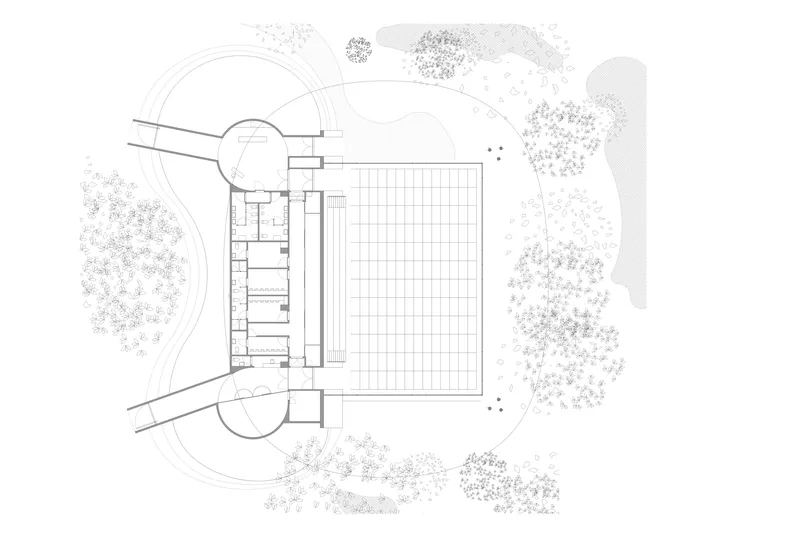
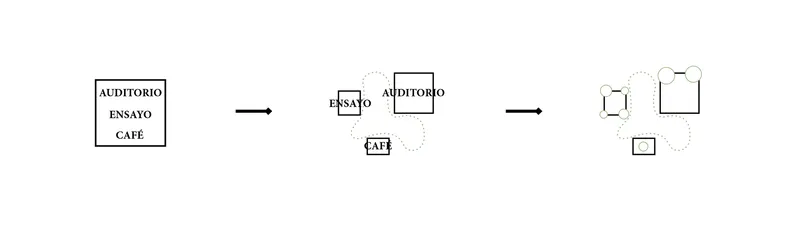
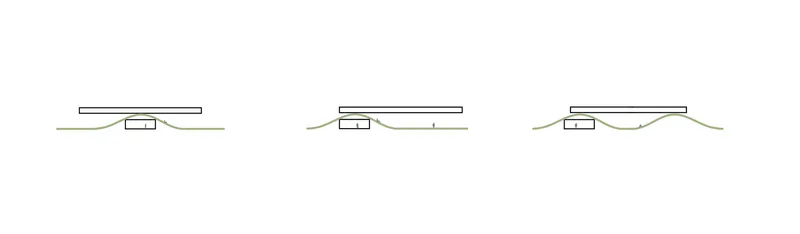
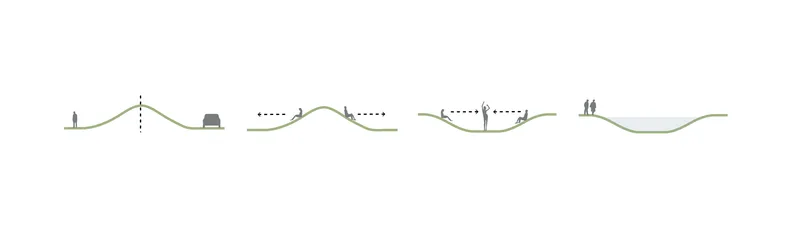
The drawings reveal the project's organizational logic with clarity. A diagrammatic sequence shows how the competition brief's combined program, an auditorium, a rehearsal hall, and a café, was broken apart into three independent volumes and distributed across the site according to landscape conditions. Site plans depict the organic arrangement of buildings, pathways, and vegetation, with each pavilion responding to a different topographic situation: one adjacent to a circular performance clearing, another beside a rectangular pool, the third embedded within contoured terrain.
Section drawings are particularly instructive. They show how each building is carved into the rolling ground rather than placed on top of it, with roof slabs floating at a consistent datum while the ground rises and falls beneath them. Human figures move through spaces where the section cuts through earth and air in nearly equal proportions. The drawings make the case that this is landscape design that happens to contain buildings, rather than the reverse.
Why This Project Matters
Chapultepec Forest Scenic Garden is a rebuke to the idea that public architecture in major parks needs to announce itself. The pavilions by Michan Architecture and PARABASE are precise, well-crafted buildings, but their greatest achievement is their willingness to subordinate themselves to a 700-hectare forest. In a design culture that rewards visual spectacle, choosing near-invisibility as a strategy is a genuine act of discipline, and it requires far more design effort than a conspicuous form. Every curve, every berm, every column placement represents a decision to defer to an existing condition rather than override it.
The project also offers a practical model for how to densify program within ecologically sensitive urban landscapes. By decomposing a single building into scattered volumes, the architects avoided the need for large-scale excavation, preserved mature trees, and maintained the visual continuity of the canopy. The approach is replicable without being formulaic, because every site will dictate a different decomposition. For cities around the world struggling to add cultural infrastructure to their parks without paving them, this is a project worth studying closely.
Chapultepec Forest Scenic Garden, Ciudad de México, Mexico. Completed 2024. 70,000 m². Designed by Michan Architecture and PARABASE, with landscape design by Taller de Paisaje Entorno. Photography by Arturo Arrieta.
About the Studio
Share Your Own Work on uni.xyz
If projects like this are the kind of work you want to make, uni.xyz is a place to publish your own, find collaborators, and enter design competitions.


Popular Articles
Popular articles from the community


Manzana Morphosis: Stretching Barcelona's Grid into a Living Landscape for 2050
A radical reworking of the Eixample manzana turns density into a tool for generous public space, vertical ecology, and environmental performance.

The Amber Palace Opera: A Geological Fiction Surfaces on Tallinn's Baltic Waterfront
Pierre Brillard reimagines a Baltic legend as a public landscape, opera house, and waterfront promenade rooted in Tallinn's coastal identity.

Singing Woman: An Opera House That Performs Before the Curtain Rises
Ovidiu Cristian Pavel's conceptual opera house translates Estonia's choral identity into a sculpted waterfront landmark facing the Baltic Sea.
Extended Shell: Retrofitting Kolkata's Balconies as Living Urban Thresholds
A modular retrofit system recovers the social and environmental intelligence of Kolkata's historic verandas for contemporary Park Street residents.

Similar Reads
You might also enjoy these articles

Pixel Gardens: One Repeated Module Stacked Into a Terraced Social Housing Tower for Famagusta
Salem Bader's shortlisted housing tower builds a vertical neighbourhood from one repeated module, offsetting units to carve terraces, light and air.

Bao Huynh Watercolor Atelier: A Serene Art Retreat in Hội An
Bao Huynh Watercolor Atelier in Hội An blends multifunctional art spaces, sustainable design, local materials, and family-friendly living in a serene environment.

Atelier Macri Concept Store Interior Design by CASE-REAL
Atelier Macri store features a "ko" counter, walnut wood details, cork displays, blending retail, gallery, and seamless customer experiences.

Manuel Vargas Izquierdo Stadium and High-Performance Sports Center: Architectural Excellence in Jalpa de Méndez
The Manuel Vargas Izquierdo Stadium blends sustainable design, inclusive sports facilities, and cultural-inspired architecture, revitalizing Jalpa de Méndez’s public spaces.


Comments (0)
Please login or sign up to add comments
No comments yet. Be the first to comment!