
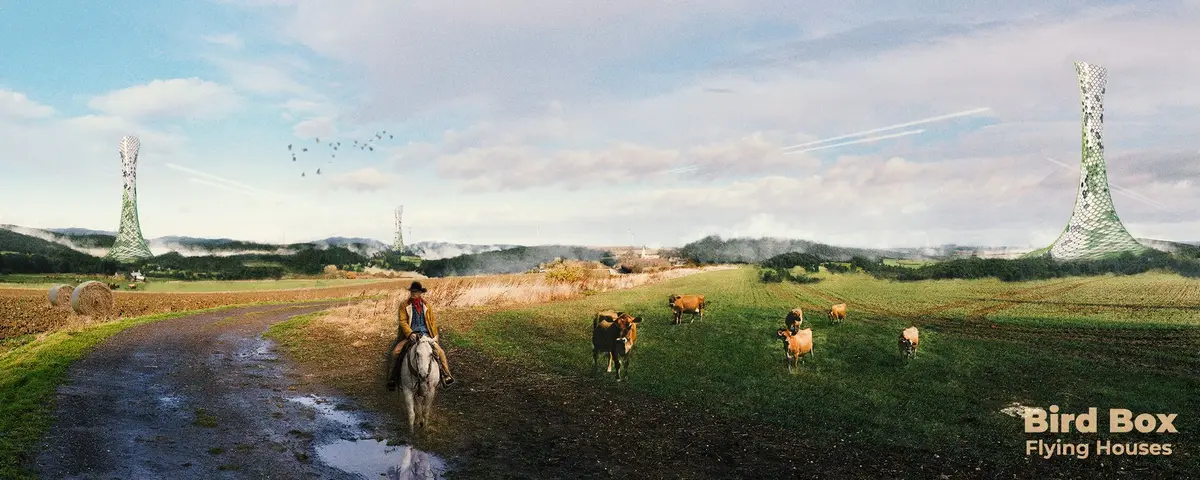
Bird Box: Architecture That Migrates with the Seasons
Detachable living modules that fly between permanent Mother Towers, following warmth and daylight like birds migrate across continents.


Birds migrate. They follow warmth, food, and daylight. They do not rebuild their nests in the same place every year. They move to where conditions are best and build again. Bird Box, a project by Saeed Mosavvari, Mahtab Rb, Soroush Attarzade, and Surush Ameli, asks: what if architecture did the same?
Shortlisted in the Hybrid Futures '19: Work x Fly competition on uni.xyz, the project proposes Mother Towers: permanent vertical hubs to which detachable living modules migrate seasonally, clustering in warm regions during winter and dispersing to cooler ones in summer. The building itself stays. The homes fly.
The Mother Tower: A Permanent Hub
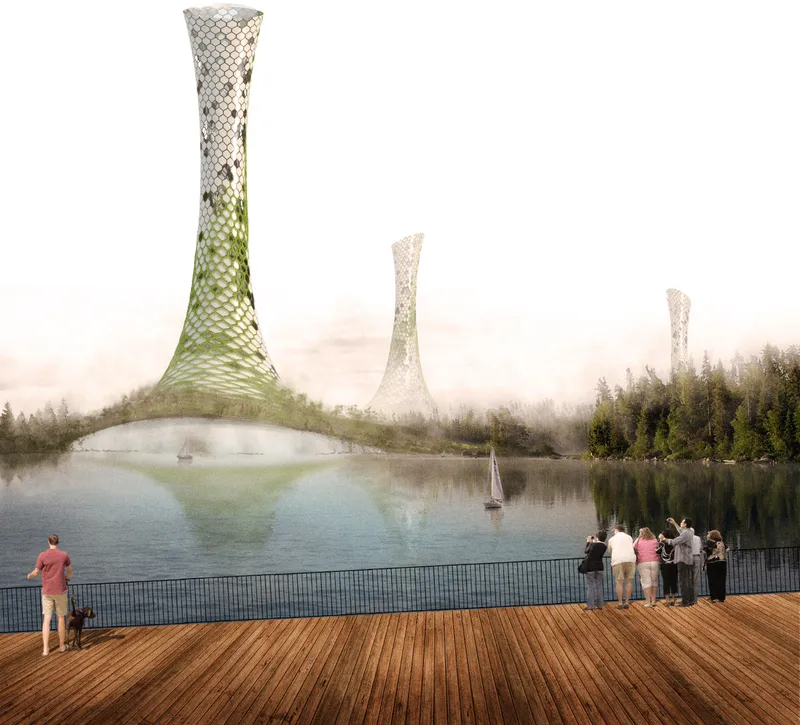
The Mother Towers are the fixed points in the system. They are large, organic, tapered structures with hexagonal perforated facades that accommodate vegetation and modular docking points. They sit in landscapes, by lakes, near cities. They do not move. They wait.
Each tower provides the shared infrastructure that individual modules cannot carry: energy generation, water treatment, communal gardens, schools, clinics, recreation, and a zoo. The section drawing shows these programmes stacked below and around the tower base, with underground parking, infrastructure levels, and a green public terrace at ground level.
The Section: What Lives Underground
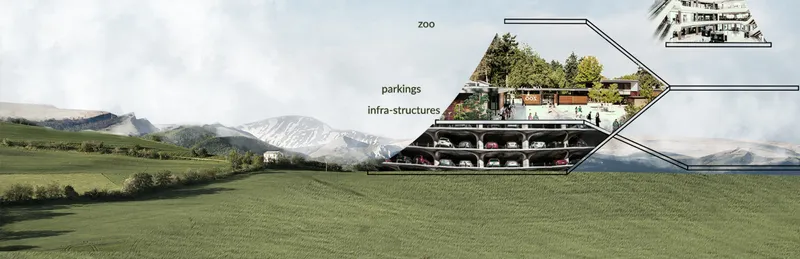
The base section is the project's most practical drawing. It shows that the Mother Tower is not just a tower. It is a piece of urban infrastructure embedded in a landscape. Underground levels house parking and services. The ground level offers public gardens and a zoo. The tower above hosts the docking structure for migratory modules.
This layering is what makes the concept more than a metaphor. The modules can migrate because the heavy infrastructure stays behind. Homes fly light. The tower carries the weight.
Seasonal Migration: The Core Idea
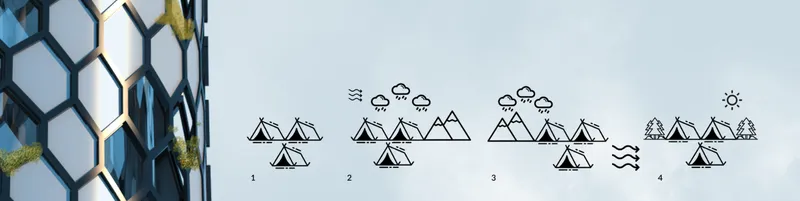
The migration diagrams show the system's logic. In winter, modules cluster around Mother Towers in warm climates. In summer, they detach and fly to towers in cooler regions. The pattern mirrors bird migration routes: seasonal, cyclical, and driven by climate rather than economics.
This is a fundamentally different model of living. Instead of choosing a city and staying there, residents choose a network of towers and follow the seasons. The home is portable. The community reconstitutes at each destination. The tower provides continuity. The movement provides variety.
The Facade: Hexagonal Skin with Living Surfaces
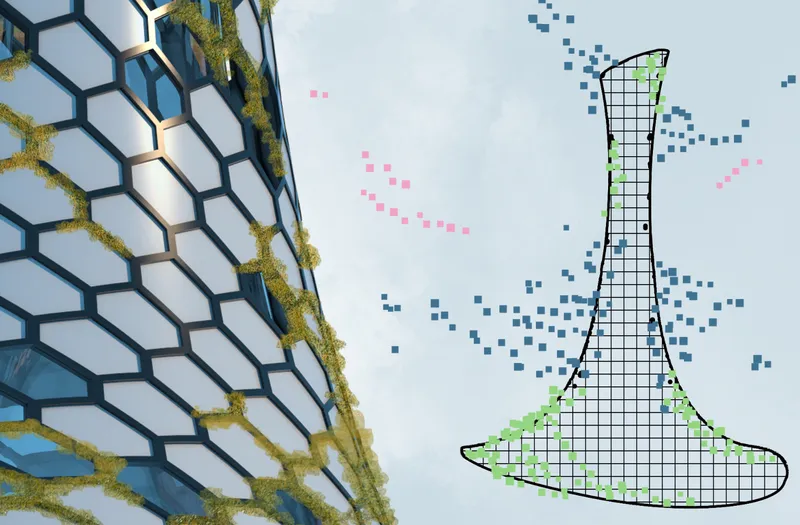
The facade detail shows hexagonal panels, some open for docking, some closed and covered with growing vegetation. The surface is not static. As modules attach and detach, the facade changes. When the tower is full in winter, it is dense, green, and enclosed. When modules leave in spring, voids open and light enters. The building breathes with the seasons.
The vegetation on the facade panels serves a double function: thermal insulation when modules are present, and ecological habitat when they are absent. The tower is never empty. When people leave, plants take over.
Why This Project Matters
The Hybrid Futures competition asked designers to merge work and flight. Most entries kept flight as transport: you fly to a building, you land, you work. Bird Box makes flight the organising principle of domestic life. You do not fly to your home. Your home flies with you. This is a more radical interpretation of the brief than almost any other entry.
The project also touches a real question that climate change is making urgent: as temperatures shift and regions become less habitable, will people need to move seasonally? If so, what kind of architecture supports that? Bird Box proposes an answer that is speculative but structurally clear: permanent infrastructure, portable homes, and seasonal networks.
View the Full Project
About the Designers
Designers: Saeed Mosavvari, Mahtab Rb, Soroush Attarzade, Surush Ameli
Enter a Design Competition on uni.xyz
If migratory architecture, modular housing, or climate-responsive design is the kind of work you want to explore, uni.xyz runs competitions year-round that reward radical spatial thinking.
Project credits: Bird Box by Saeed Mosavvari, Mahtab Rb, Soroush Attarzade, Surush Ameli. Shortlisted, Hybrid Futures '19: Work x Fly (uni.xyz).


Popular Articles
Popular articles from the community


Cloaked Colonization: A Mobile Underwater Habitat That Moves Like a Fish
Micah Abaya's shortlisted EHC Pacific entry reimagines ocean settlement as a dispersed network of self-sustaining architectural organisms.
Temporary Home for Dogs: A Reversed Zoo Rethinks Animal Shelter Architecture
In Bucharest, a sinuous corridor and freed landscape flip the logic of containment, designing a shelter that works to make itself unnecessary.

Singing Woman: An Opera House That Performs Before the Curtain Rises
Ovidiu Cristian Pavel's conceptual opera house translates Estonia's choral identity into a sculpted waterfront landmark facing the Baltic Sea.
Opera by the Sea Estonia: Three Shells Dissolving Architecture into Tallinn's Coastline
A winning opera house proposal replaces monumental form with interconnected shells that blur the boundary between building, park and Baltic Sea.

Similar Reads
You might also enjoy these articles

Shakur's House: Exposed Brick as an Interior Organiser in a 168 m² Mashhad Residence
Brick moves indoors in this Mashhad residence, where masonry walls, glass partitions and teal planes sequence a compact home without closing it off.

Day and Night Park: A Time-Based Urban Newsstand in Beijing
A temporary urban newsstand in Beijing blending travel, light, and reading through poetic colors, compact form, and community-focused design.

Modernist Patio Renovation in El Masnou, Barcelona by Oliver Segura Arquitectura + Cebrià Arquitectura
Modernist patio renovation blending tradition and innovation with a movable pool, leveled floors, and Catalan materials in El Masnou.

Alto Residencial Coop: Cooperative Housing Development in Santiago de Compostela by Carbajo Barrios Arquitectos
A linear cooperative housing complex blending white volumes and perforated metal façades, enhancing community living, natural light, privacy, and urban integration.

Comments (0)
Please login or sign up to add comments
No comments yet. Be the first to comment!