

Miguel Pinto Guimarães Stacks Concrete Terraces into Rio's Forest Canopy at MB House
An 817-square-meter residence in Rio de Janeiro's Botanic Garden neighborhood frames the Tijuca Forest, Christ statue, and lagoon views.


Rio de Janeiro is a city where nature doesn't politely sit at the edge of the frame. It crowds in, climbs walls, drops roots into gutters, and forces architecture to negotiate rather than dictate. MB House, designed by Miguel Pinto Guimarães Arquitetos Associados and completed in 2018, takes that negotiation seriously. Sitting on a compact urban plot in the Botanic Garden neighborhood, the 817-square-meter residence is bounded by the Rodrigo de Freitas Lagoon in front and the Tijuca Forest at its back, with the Christ the Redeemer statue visible from its upper levels. The building doesn't try to compete with any of that. It positions itself as infrastructure for looking.
What makes MB House genuinely compelling is not the view itself but the architectural mechanism built to capture it. The house is a concrete box, stacked and staggered so that every level steps back or forward to create terraces, each floor becoming a distinct platform from which the surrounding landscape is reframed. This is a house organized vertically around the act of being outside while technically being inside. Timber screens, cantilevered slabs, and planted rooftops blur the line between architecture and canopy until the distinction feels irrelevant.
A Vertical Landscape Strategy
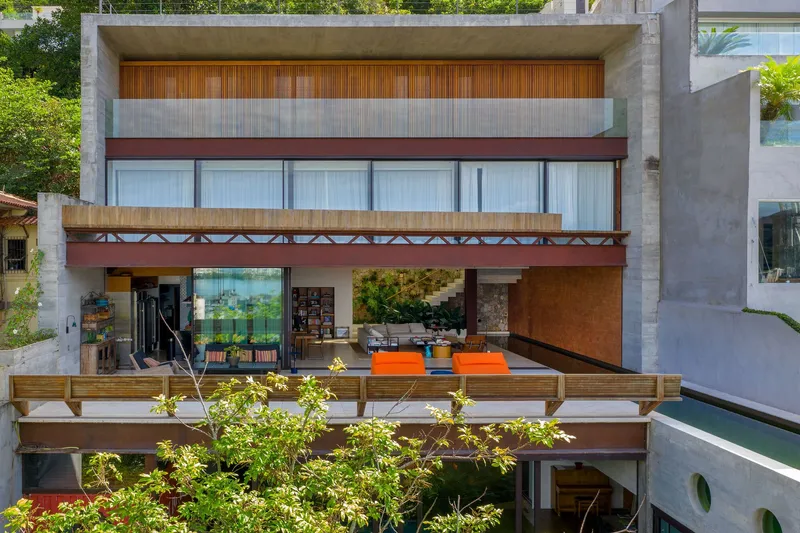
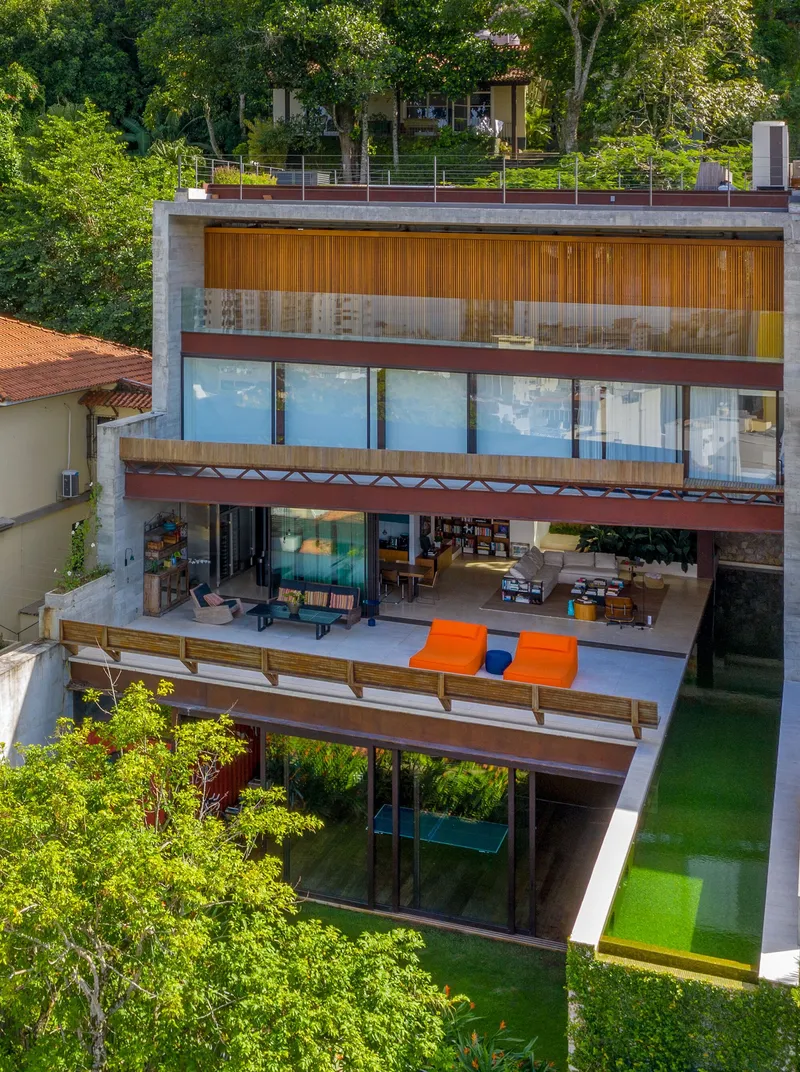
The facade tells you almost everything you need to know. Concrete floors project outward at staggered intervals, each one sheltering the terrace below while exposing its own surface to sun and rain. Timber louvers run along the railings and upper levels, softening the mass of the concrete and filtering light without blocking air. The result is a building that reads less like a house and more like a series of inhabited shelves inserted into the tree line.
From the street, the house practically disappears behind mature trees. From above, the rooftop garden and glass pavilion suggest that the building's ambition is to become part of the topography rather than sit on top of it. Alex Hanazaki's landscape design is integral here: planting is not decorative but structural, weaving through terraces and softening the concrete at every level.
Concrete, Brick, and the Honesty of Materials
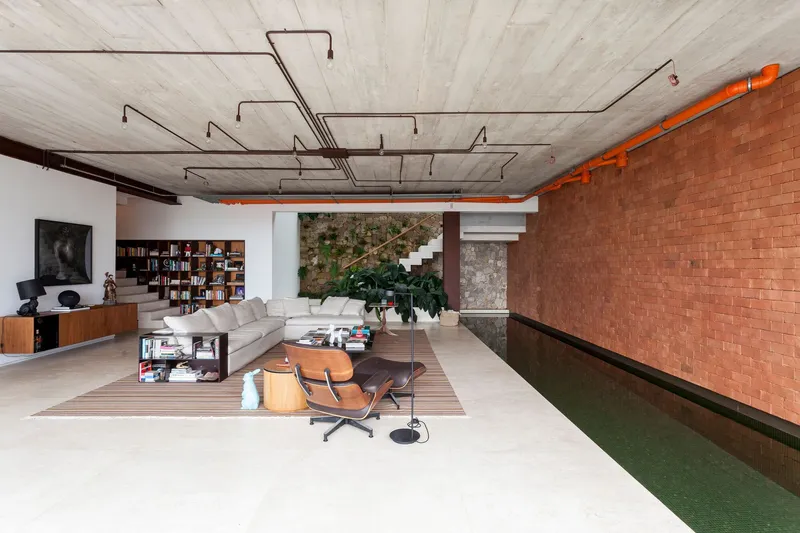
Inside, the material palette stays deliberately raw. The living room pairs an exposed concrete ceiling with a red brick wall, and an interior pool runs alongside the social space, bringing water into the core of the house. It's an unusual pairing that works because neither element is trying to be polished. The brick has the texture of something handmade; the concrete overhead has the grain of its formwork still visible.
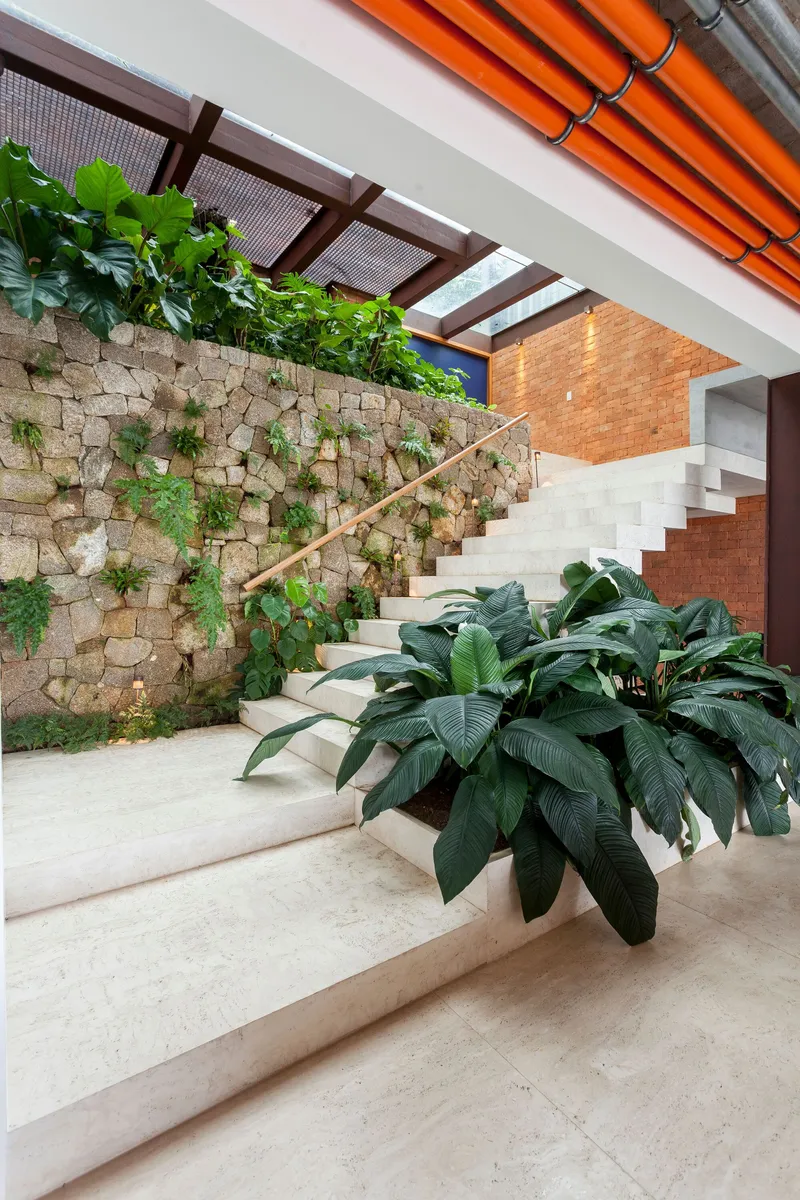
A stone-walled staircase with cascading plants and a brass handrail demonstrates the same ethos. Orange-painted conduits are left exposed, not as an industrial affectation but as an honest acknowledgment of the building's systems. There is a warmth to this kind of frankness. It lets the materials age, patinate, and eventually match the weathered landscape outside.
Living Between Indoors and Out
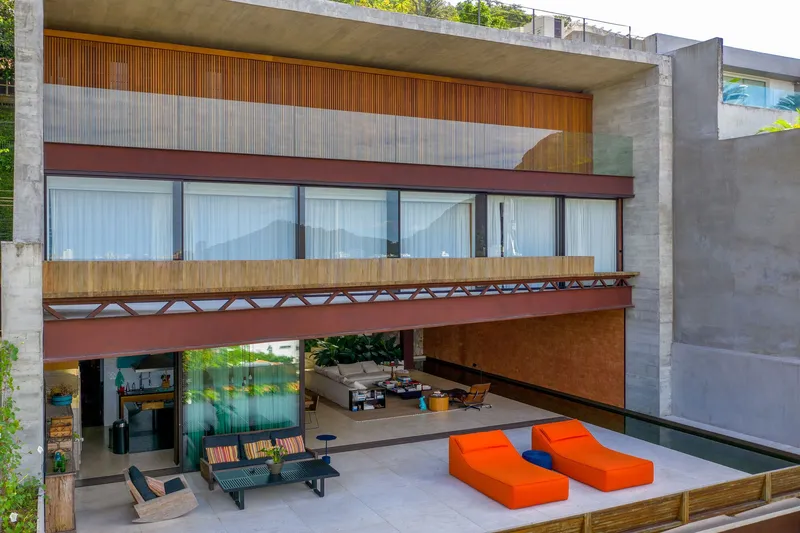
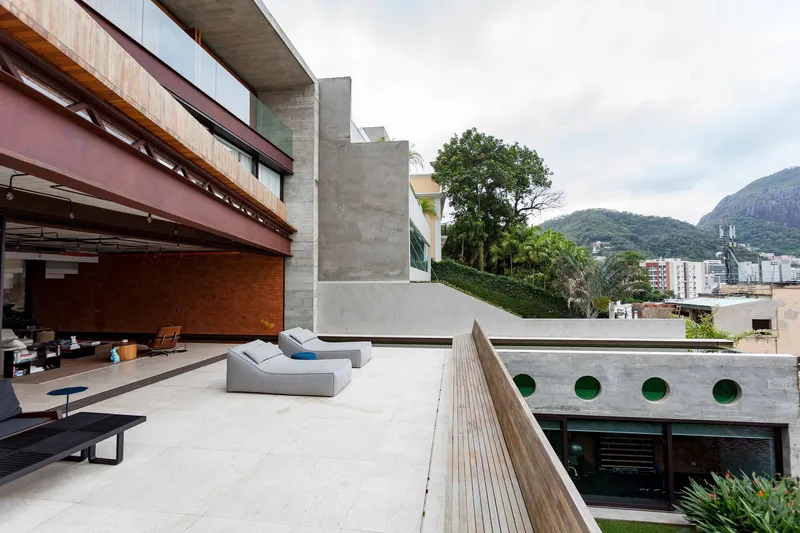
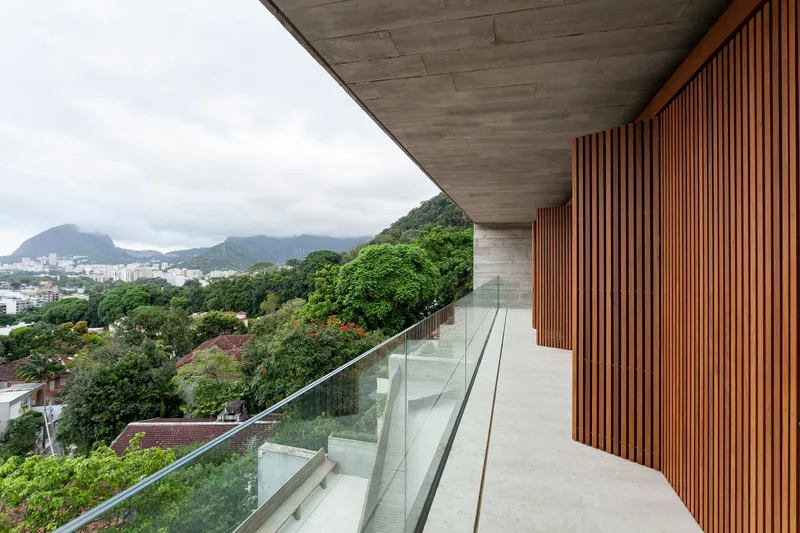
The terraces are where MB House makes its strongest argument. On the lower levels, orange loungers sit beneath cantilevered floors and timber lattice railings, shaded but fully open to the breeze. Higher up, a covered terrace with steel louvers looks out across the mountains and the Tijuca Forest canopy. These are not balconies tacked onto bedrooms. They are rooms in their own right, with enough depth and shelter to be used in rain as well as sun.
A timber-slatted walkway on one of the intermediate levels runs along the edge of the building with glass railings offering unobstructed views into the dense vegetation below. The effect is of walking through a treehouse that happens to be made of reinforced concrete. Maneco Quinderé's lighting design extends the usability of these spaces well into the evening, turning each terrace into a room without walls.
Singular Details: The Shipping Container Door
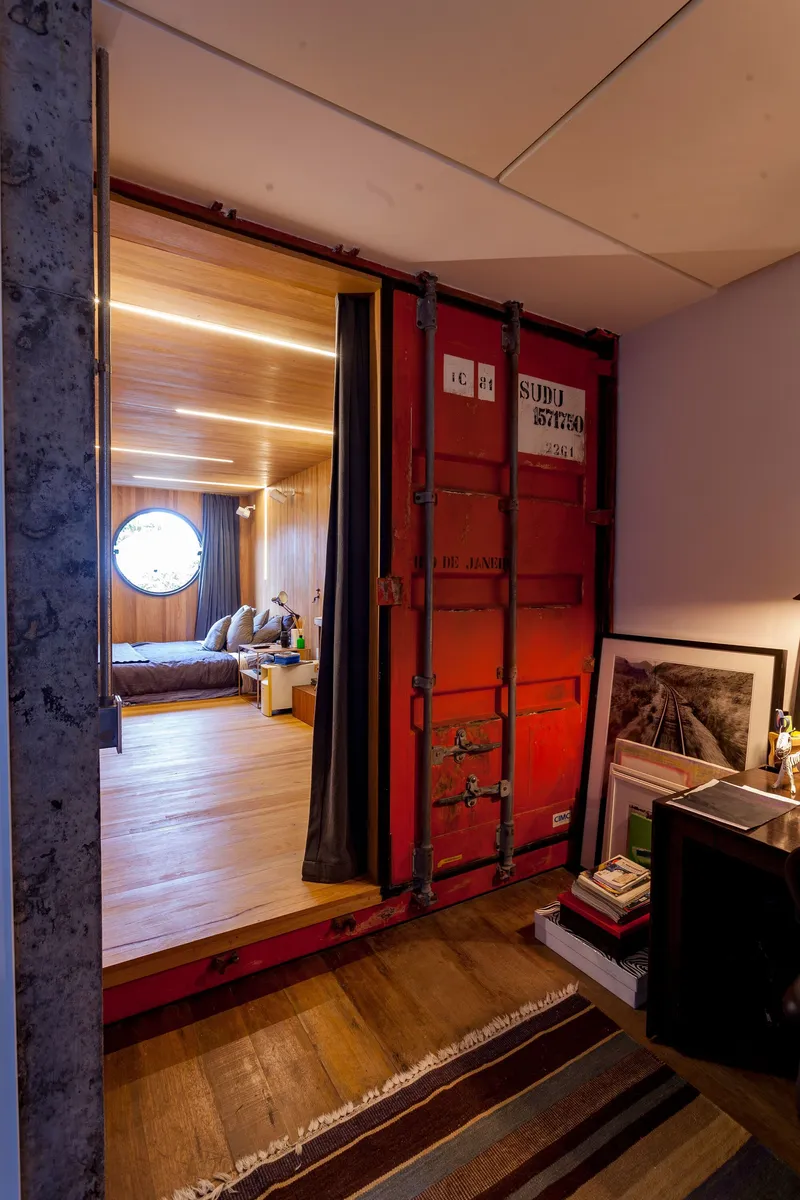
One of the most unexpected moments in the house is a repurposed red shipping container door, mounted on rails, that opens into a timber-clad bedroom. It's a playful gesture in a building that otherwise maintains a restrained material discipline. The door functions as both a sliding partition and a piece of found-object sculpture, its industrial red paint creating a sharp contrast against the warm wood paneling of the bedroom beyond.
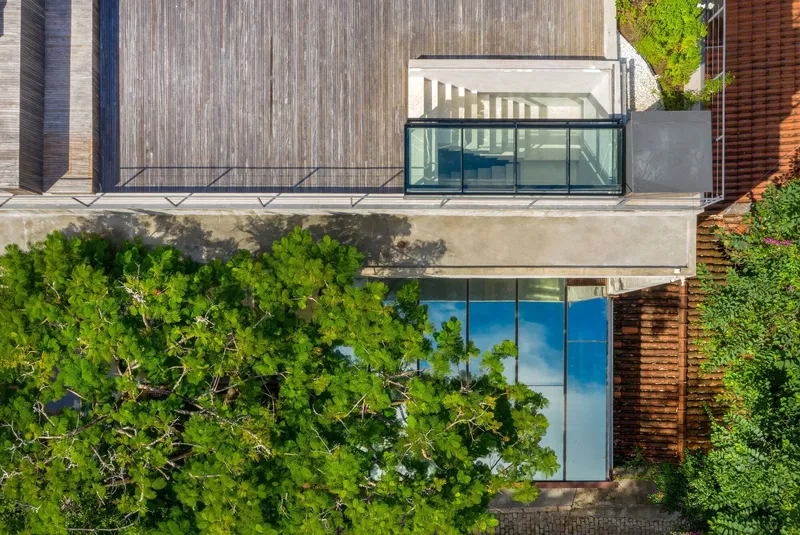
The aerial view of the rooftop terrace reveals another surprise: a glass-enclosed pavilion sits on a weathered concrete deck, surrounded by planting. The concrete here has been left to age naturally, its surface already beginning to take on the grey-green patina of the surrounding forest. This is deliberate. The building is designed to converge with its environment over time, not to resist it.
Plans and Drawings
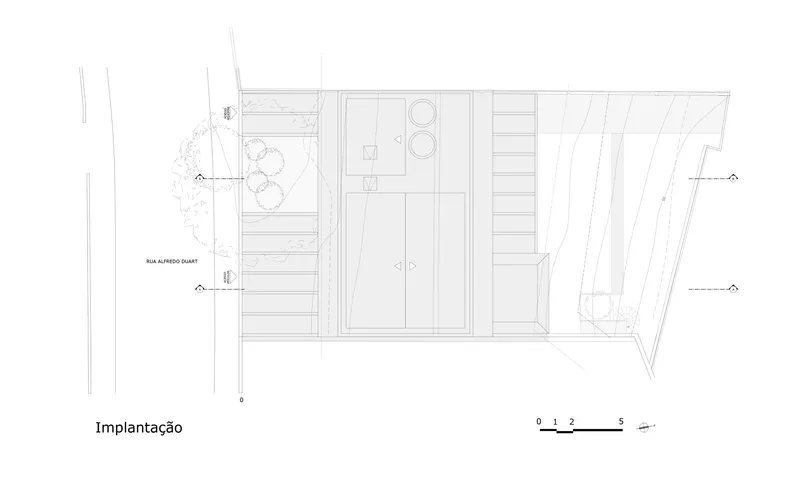
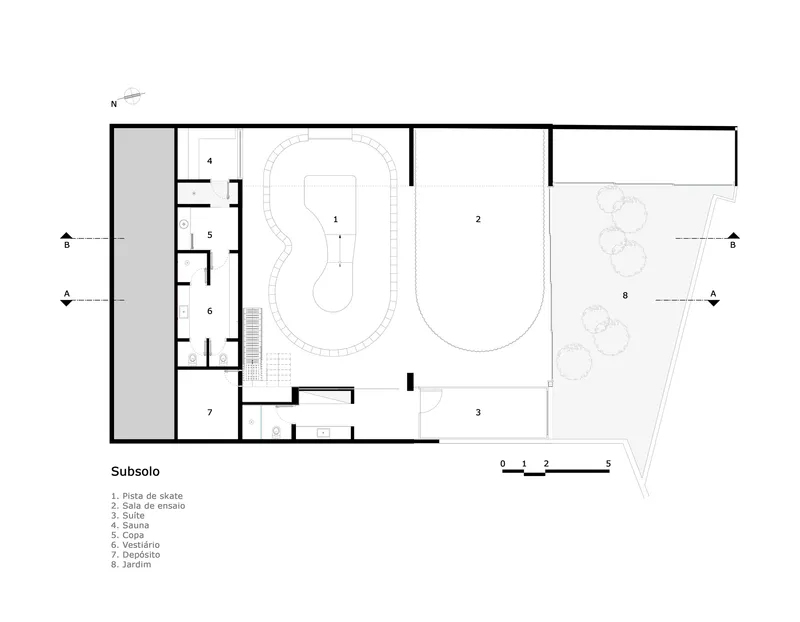
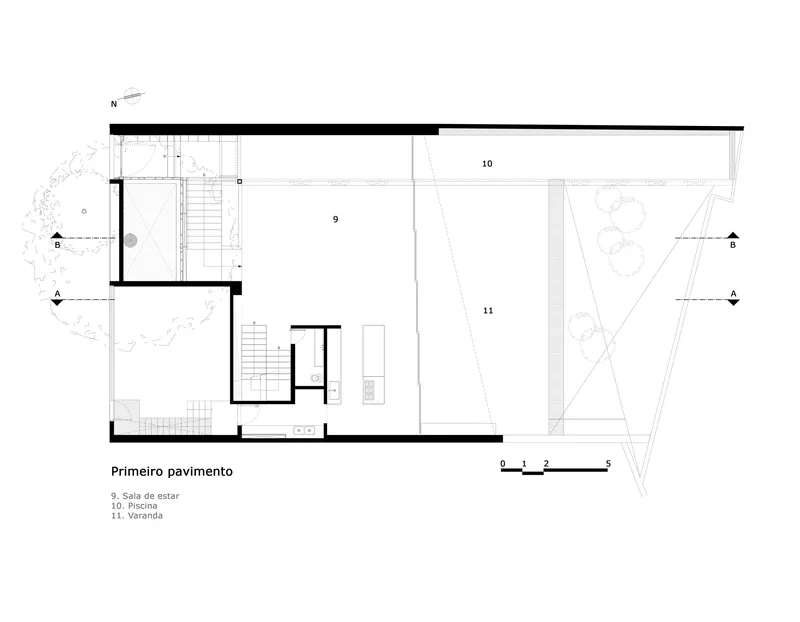
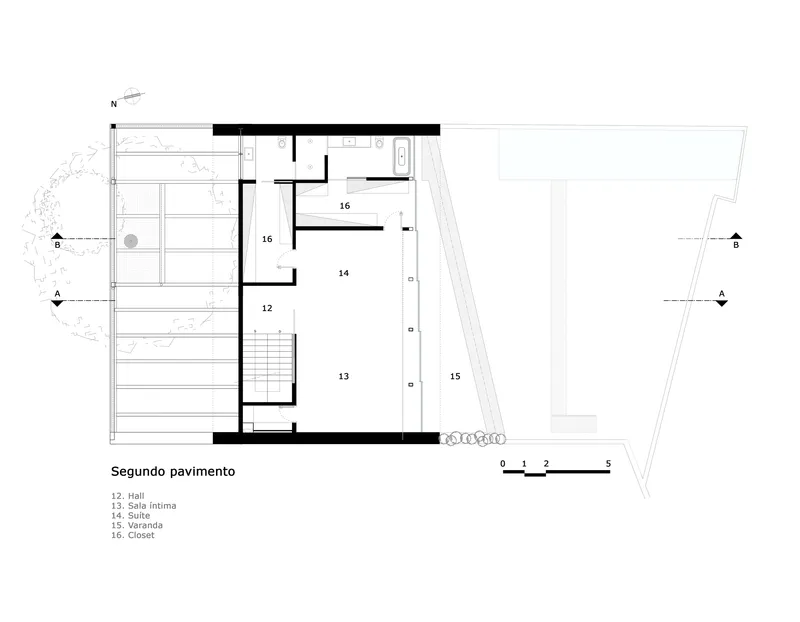
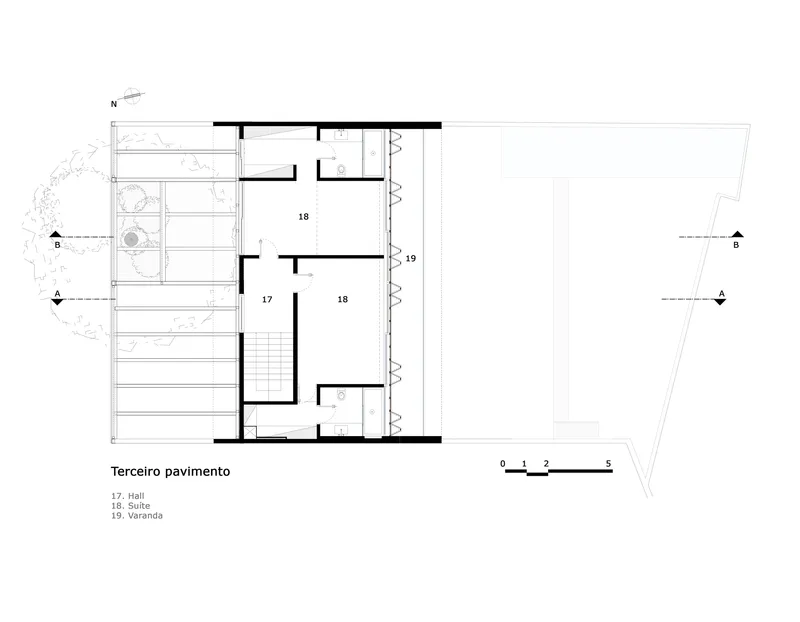
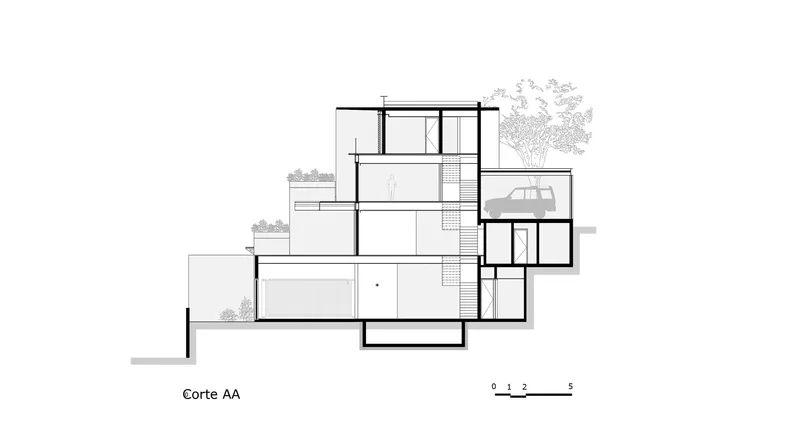
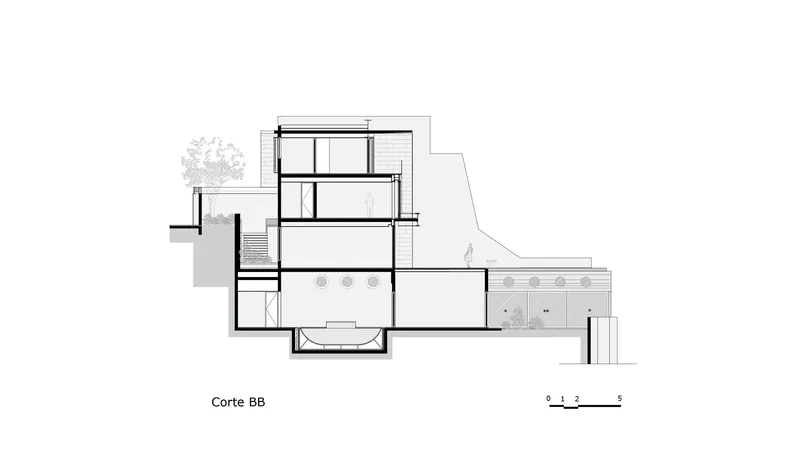
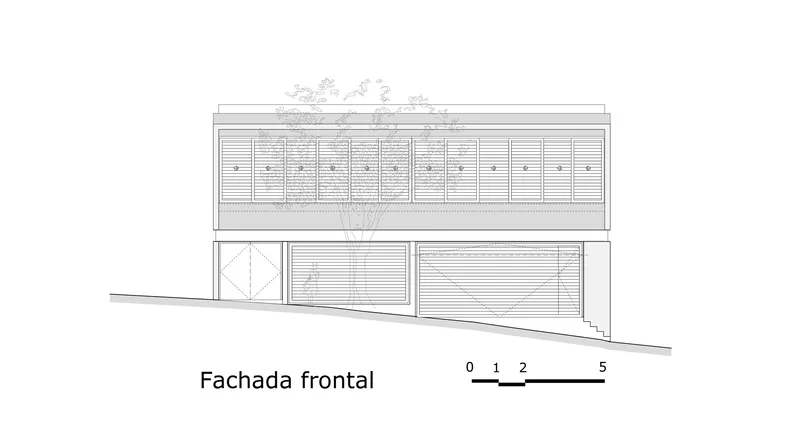
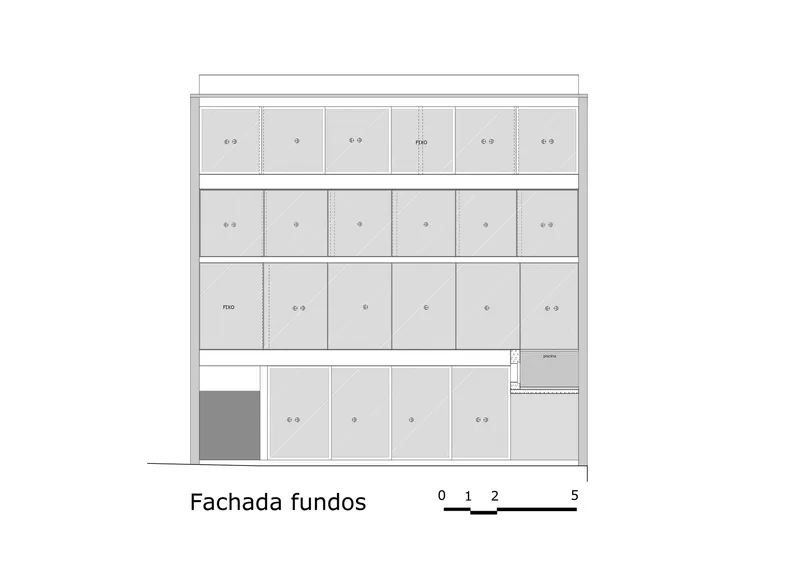
The floor plans reveal the compact logic behind the house's generous spatial feel. The lower level wraps a curved pool into the garden, establishing water and planting as the ground-level datum. Above, the program distributes living spaces and verandas on the second floor, with suites occupying the third. Each level shifts its footprint slightly, generating the terracing visible from the exterior. The central staircase acts as a spine, threading the levels together while allowing each floor to have its own distinct relationship with the landscape.
The two section drawings are perhaps the most revealing. They show the house descending into the site, with a garage at the lowest level and the pool carved into the terrain above. Trees grow at the roofline, their canopies level with the uppermost terrace. The front elevation confirms the louvered upper facade, while the rear elevation exposes a four-story grid of regular openings, a quieter, more urban face that contrasts sharply with the layered, planted facade that greets the forest.
Why This Project Matters
MB House is part of a broader conversation about what a Brazilian house should be, one that Miguel Pinto Guimarães has been pursuing for years. The answer here is not about style or spectacle. It is about porosity: the degree to which a building allows its environment to pass through it. Every decision, from the staggered concrete slabs to the timber screens to the planted rooftop, serves to dissolve the boundary between domestic space and the extraordinary landscape of Rio de Janeiro.
On a compact urban site, that porosity is hard-won. The house manages to feel expansive because it distributes its program vertically, giving each level access to air, light, and views without relying on a sprawling footprint. It is a model for how to build densely in a tropical city without sacrificing the connection to landscape that defines Brazilian domestic architecture at its best. The skate park by Rio Ramp Design, tucked somewhere within the program, is a reminder that this is also a house built for living, not just looking. But the looking is extraordinary.
MB House by Miguel Pinto Guimarães Arquitetos Associados, Rio de Janeiro, Brazil. 817 m², completed 2018. Photography by André Nazareth and Tuca Reinés.
About the Studio
Share Your Own Work on uni.xyz
If projects like this are the kind of work you want to make, uni.xyz is a place to publish your own, find collaborators, and enter design competitions.


Popular Articles
Popular articles from the community


Singing Woman: An Opera House That Performs Before the Curtain Rises
Ovidiu Cristian Pavel's conceptual opera house translates Estonia's choral identity into a sculpted waterfront landmark facing the Baltic Sea.
Tsunami Convergenics: Turning Catastrophic Ocean Forces into Underwater Housing Infrastructure
A speculative underwater settlement off the coast of Onagawa, Japan, treats tsunamis and typhoons as energy sources rather than threats.

Opera by the Sea Estonia: Three Shells Dissolving Architecture into Tallinn's Coastline
A winning opera house proposal replaces monumental form with interconnected shells that blur the boundary between building, park and Baltic Sea.
Faces of the Soviet Avant-Garde: Turning Moscow's Street Names into an Open-Air Museum
A network of sculptural installations across a Moscow residential district transforms forgotten architect names into spatial encounters with cultural memor

Similar Reads
You might also enjoy these articles

Pixel Gardens: One Repeated Module Stacked Into a Terraced Social Housing Tower for Famagusta
Salem Bader's shortlisted housing tower builds a vertical neighbourhood from one repeated module, offsetting units to carve terraces, light and air.

Bao Huynh Watercolor Atelier: A Serene Art Retreat in Hội An
Bao Huynh Watercolor Atelier in Hội An blends multifunctional art spaces, sustainable design, local materials, and family-friendly living in a serene environment.

Atelier Macri Concept Store Interior Design by CASE-REAL
Atelier Macri store features a "ko" counter, walnut wood details, cork displays, blending retail, gallery, and seamless customer experiences.

Manuel Vargas Izquierdo Stadium and High-Performance Sports Center: Architectural Excellence in Jalpa de Méndez
The Manuel Vargas Izquierdo Stadium blends sustainable design, inclusive sports facilities, and cultural-inspired architecture, revitalizing Jalpa de Méndez’s public spaces.


Comments (0)
Please login or sign up to add comments
No comments yet. Be the first to comment!