
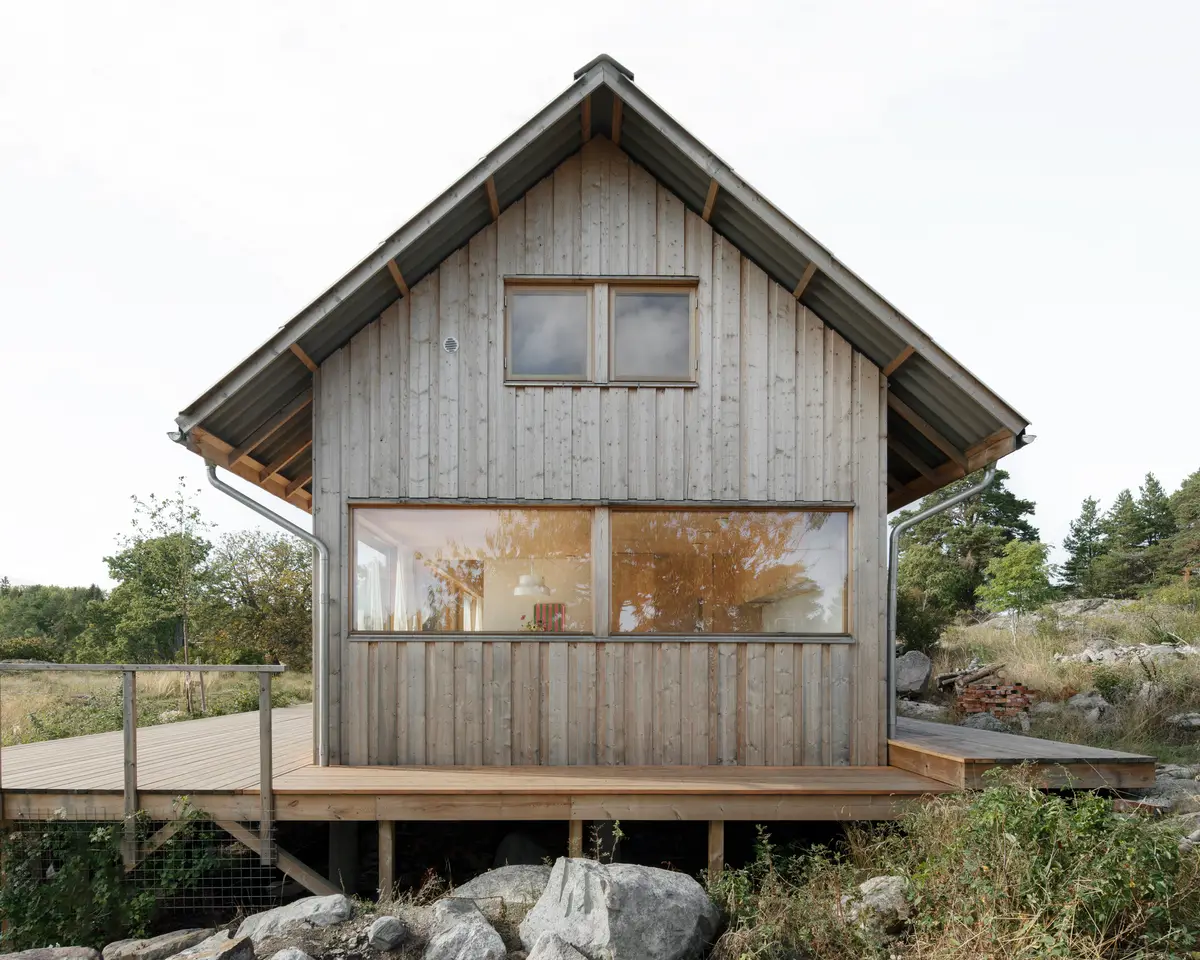
Mikael Bergquist Builds a Boat-Access-Only Retreat for Two Artists on a Stockholm Archipelago Island
On the island of Nämdö, a farmhouse-inspired timber cabin ages alongside the Swedish landscape it inhabits.


Some houses earn their character through location alone. The House for Two Artists, completed in 2022 by Mikael Bergquist Arkitektkontor, sits on Nämdö, an island in the Stockholm Archipelago reachable only by boat. That fact alone shapes everything about the project: its modesty, its material logic, its refusal to compete with the rocks, pines, and water that surround it. The building is a simple gabled volume raised on a platform among mature trees and rock outcrops, borrowing its silhouette from the traditional Swedish farmhouse.
What makes it worth studying is not the form, which is deliberately ordinary, but the intelligence behind that ordinariness. Bergquist treats the house as a piece of furniture set into the landscape, an object whose every surface is considered yet whose total effect is one of unstudied ease. Untreated fir cladding will silver over time. Larch windows and doors will darken. Zinc downpipes and fiber cement roofing will hold their composure for decades with almost no maintenance. For a house you arrive at by boat, that low-maintenance covenant with time is not a stylistic choice; it is a survival strategy.
A Farmhouse Silhouette, Elevated

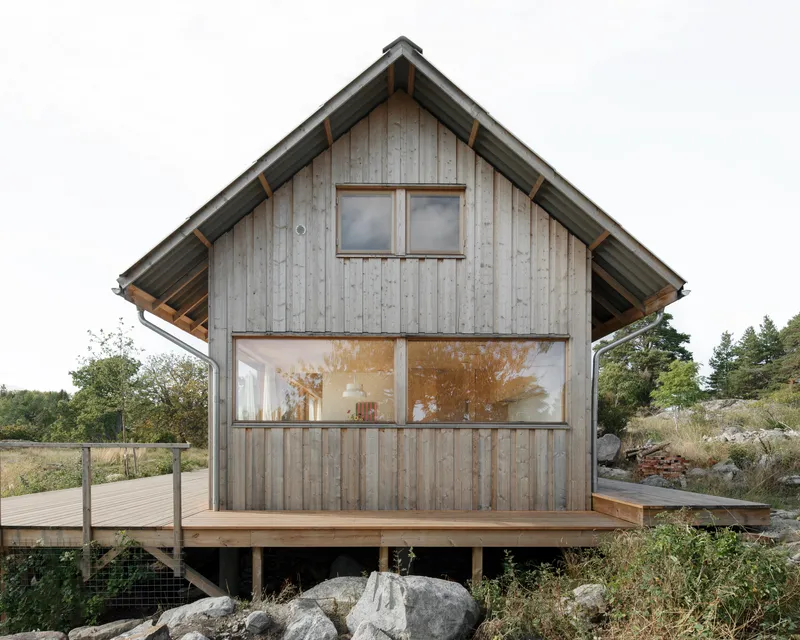
The gabled profile reads instantly as domestic, even archetypal. Bergquist keeps the proportions tight: a single steep-roofed volume with vertical timber siding that reinforces its height relative to its modest footprint. The house is lifted slightly off the ground on a platform that extends outward into a wraparound deck, creating a generous threshold between interior and landscape. That deck is not an afterthought. It mediates every arrival, every departure, every evening spent watching the water.
The elevated position also protects the structure from ground moisture and snow accumulation, a practical move dressed up as a spatial one. From the gable end, the house reads as a crisp geometric object against wild grass and granite. From the long side, where glazing opens generously, it dissolves into the tree canopy.
Untreated Timber and the Discipline of Aging

The exterior cladding is untreated fir, a material choice that demands commitment. In the first year, it is honey-toned. Within a few seasons, it will turn grey, eventually approaching the same muted silver as driftwood on the island's shores. Bergquist's palette of fir, larch, zinc, and fiber cement is calibrated so that nothing needs painting, staining, or replacing on any predictable cycle. For two artists living on an island with no road access, this is not minimalism for aesthetics; it is minimalism for logistics.
The horizontal strip window on the gable end, framed in larch, sits low enough to catch light from the deck level while preserving privacy. It is a small detail, but it reveals Bergquist's precision: every opening is sized and placed to frame a specific relationship between the inhabitant and the terrain.
Interior as Furniture

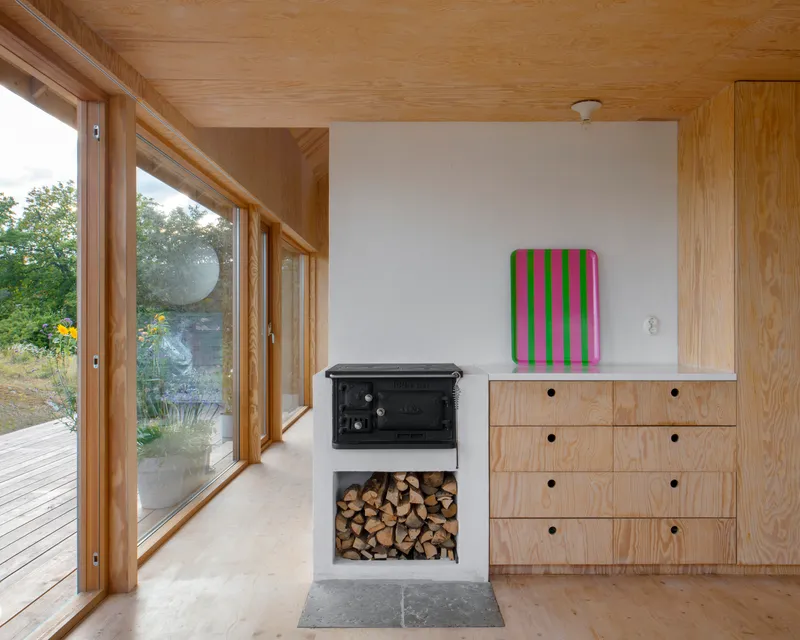
Step inside and the language shifts from weathering exterior to warm enclosure. Pine plywood lines the walls and ceilings, creating a continuous interior shell that Bergquist has described as being treated like a large piece of furniture. The analogy is precise. There is a cabinetmaker's sensibility at work here: seams are intentional, surfaces are smooth, and storage is integrated into the building's bones rather than added on.
The vaulted ceiling rises into a loft accessed by a simple ladder, compressing and expanding the space within a compact envelope. A white masonry stove, fully functioning and traditional in its form, anchors the living room. Nearby, a cast iron wood stove sits in a purpose-built niche with firewood storage beside it. These are not decorative gestures. On an island where heating infrastructure is limited, these stoves are the primary warmth strategy, and the plywood interior acts as a thermal buffer that warms quickly and retains heat.
Fir plank floors underfoot complete the material trio of pine, fir, and larch, all softwoods, all Scandinavian, all allowed to show grain and knots rather than being sanded into anonymity. The effect is honest and tactile, a house that rewards bare feet.
Plans and Drawings

The floor plan and section confirm what the photographs suggest: the program is direct. A single rectangular volume under a gable roof, with a loft tucked into the peak, surrounded on all sides by the timber deck. The section drawing reveals the spatial payoff of the steep roof pitch, enough height at the ridge to fit a usable sleeping loft while keeping the eave line low and sheltering. The wraparound deck reads in plan as a continuous band of outdoor room, almost as large as the enclosed floor area itself.
There is no corridor, no hallway, no wasted circulation. For a house designed to accommodate both social interaction and guest privacy, this economy of plan is notable. The architects achieve spatial variety not through room count but through section: the double-height living space, the compressed loft, the expansive deck.
Why This Project Matters
The House for Two Artists matters because it demonstrates that restraint is not the same as simplicity. Every decision here, from the choice of untreated fir over painted timber to the placement of a strip window on a gable wall, is the product of rigorous thinking about site, climate, access, and inhabitation. Bergquist does not romanticize the island setting. He responds to it with materials that will hold up, a structure that sits lightly, and an interior that turns the compact footprint into an advantage.
In a moment when residential architecture often reaches for spectacle, this project argues for a quieter ambition: a house that belongs to its place from day one and will belong more fully with every passing winter. The boat ride to reach it is not just a logistical fact. It is a design constraint that enforces a certain discipline, and that discipline, fully embraced, produces architecture that feels both ancient and entirely of its time.
House for Two Artists by Mikael Bergquist Arkitektkontor, Nämdö, Sweden, 2022. Photography by Mikael Olsson.
About the Studio
Share Your Own Work on uni.xyz
If projects like this are the kind of work you want to make, uni.xyz is a place to publish your own, find collaborators, and enter design competitions.


Popular Articles
Popular articles from the community


LT2A and OPEN Architectes Thread a Brick and Glass High School Through a Wooded Belgian Campus
In Braine-l'Alleud, a 3,000 m² wing for Collège Cardinal Mercier pairs pale brick with a glazed colonnade, deferring to a small chapel and a dense wood.

David Macias Steps a Doorless Stone and Plaster House Down a Tropical Colombian Hillside
In the humid hills of Colombia, Threshold House replaces the front door with an open void and terraces its 850 m² down the slope instead of fighting it.

Juan García Correa, John González and Claudia Rueda Sink a Circular Amphitheater into a Manizales Engineering Building
On the La Nubia campus in Manizales, Colombia, the S1 Building folds labs and offices into a hillside of ramped lawns that double as a campus route.

U.GA Architects Wraps an Oval Rooftop Pool in Curved Board-Formed Concrete on Busan's Jeollidan-gil
In Busan's Jeonpo-dong, a 454 m² mixed-use block stacks a neighborhood facility, guest rooms and an oval rooftop pool inside spiraling concrete walls.

Similar Reads
You might also enjoy these articles


LAVA Architecten Gives Vocational Education a Sawtooth-Roofed Face on a Mechelen School Campus
In Mechelen, Belgium, a 2,053 m² STEM school on a 6×6 m grid turns workshops and classrooms into rooms that can be rearranged as teaching changes.

KEMA Studio Turns a Derelict Marvila Attic into a 60 m² Lighthouse Apartment Above Lisbon
In Lisbon's Marvila district, a rebuilt roof, four skylights and two plywood volumes turn an unlivable attic into a bright home facing the Tagus.

Pixel Gardens: One Repeated Module Stacked Into a Terraced Social Housing Tower for Famagusta
Salem Bader's shortlisted housing tower builds a vertical neighbourhood from one repeated module, offsetting units to carve terraces, light and air.

Bao Huynh Watercolor Atelier: A Serene Art Retreat in Hội An
Bao Huynh Watercolor Atelier in Hội An blends multifunctional art spaces, sustainable design, local materials, and family-friendly living in a serene environment.

Explore Plug-In House Competitions
Discover active competitions in this discipline

Challenge to design mud housing for contemporary communities

Challenge to reimagine the Iron Throne

Photograph architecture without architects

Illustrate the lost glory of Angkor Wat - Render Challenge
Comments (0)
Please login or sign up to add comments
No comments yet. Be the first to comment!