

Modern Educational Architecture: The School of Public Health by Allies and Morrison
The School of Public Health at Imperial College London exemplifies modern educational architecture, integrating sustainability, flexibility, and collaborative academic spaces.


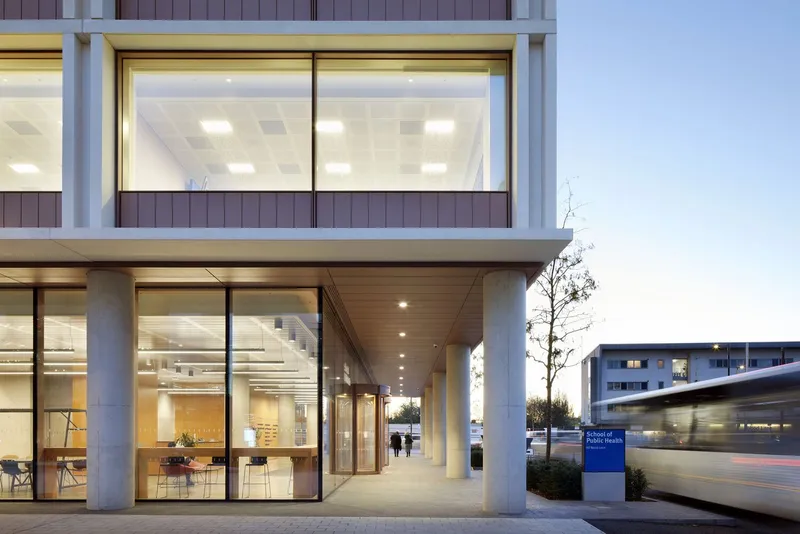
The School of Public Health at Imperial College London, designed by Allies and Morrison, is a state-of-the-art facility that exemplifies modern educational architecture. Located on White City Campus, this ten-story building provides flexible teaching, research, and community outreach spaces, supporting the multidisciplinary work of healthcare professionals, researchers, and students.
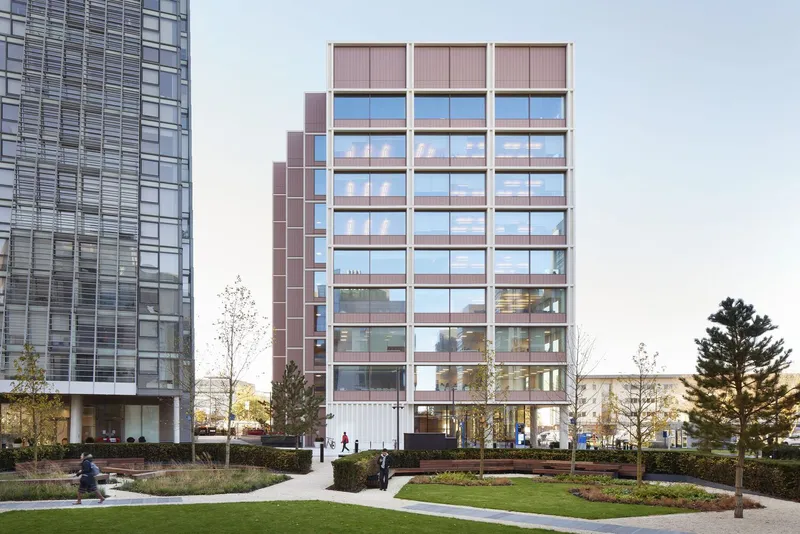
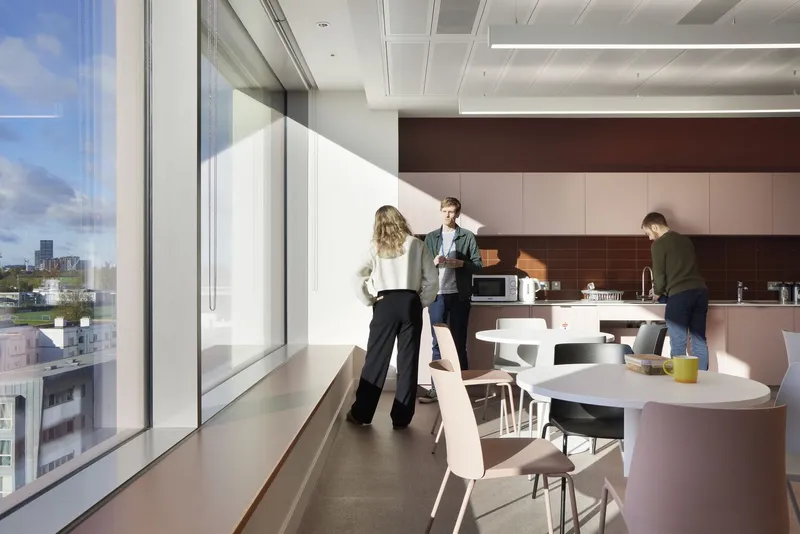
Designed to foster collaboration, the structure prioritizes open, reconfigurable spaces, optimizing both daylight and circulation. Its material palette, sustainable approach, and integration within the broader White City development mark it as a benchmark for contemporary educational buildings.
A Collaborative Space for Research and Learning
The School of Public Health is strategically positioned within Imperial College London's expanding White City Campus, just an eight-minute walk from Hammersmith Hospital. The building acts as a hub for public health research and education, offering a range of spaces designed to support interdisciplinary collaboration.

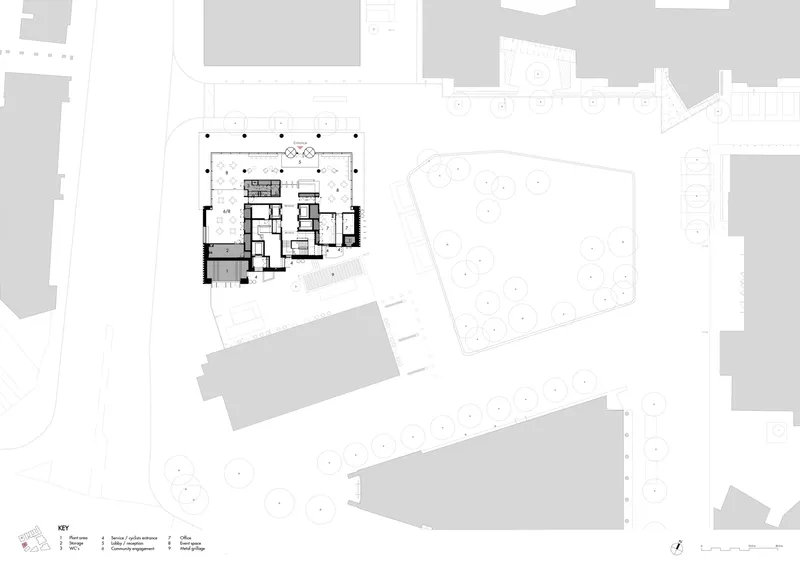
The ground floor houses community engagement spaces, reinforcing the school’s commitment to public health outreach. Floors one and two feature dedicated teaching areas, while floors three to seven accommodate research labs, offices, and collaborative spaces. The basement includes cycle storage and plant rooms, ensuring that the facility is both functional and sustainable.
The 7.8m x 7.8m modular bay system allows for easy reconfiguration, making the space adaptable for different research groups and working styles. This high level of flexibility ensures that the building can evolve with future academic and medical advancements.

Sustainability and Passive Design Strategies
A fundamental aspect of modern educational architecture is sustainability, and the School of Public Health integrates several eco-conscious features.
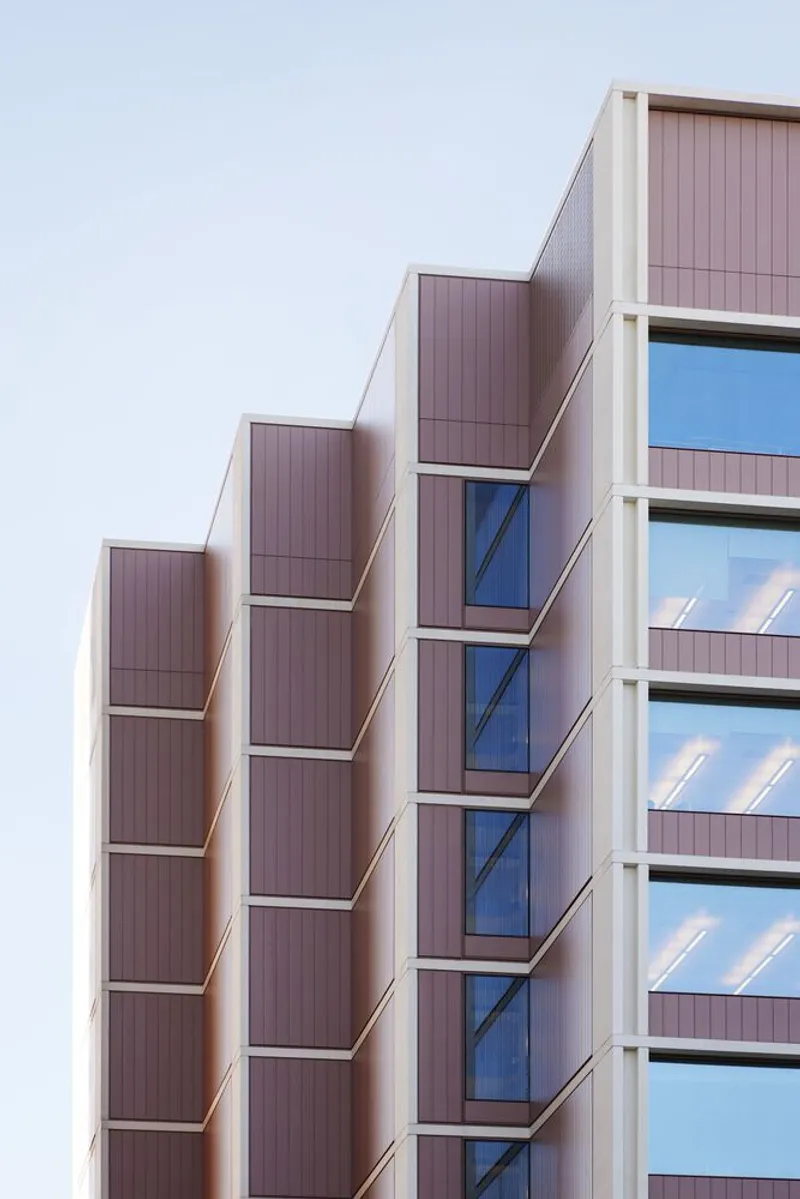
The building’s orientation optimizes natural daylight while minimizing glare. The north façade is open and transparent, maximizing daylight penetration, whereas the south-facing façade is stepped and shielded, reducing heat gain and enhancing privacy.
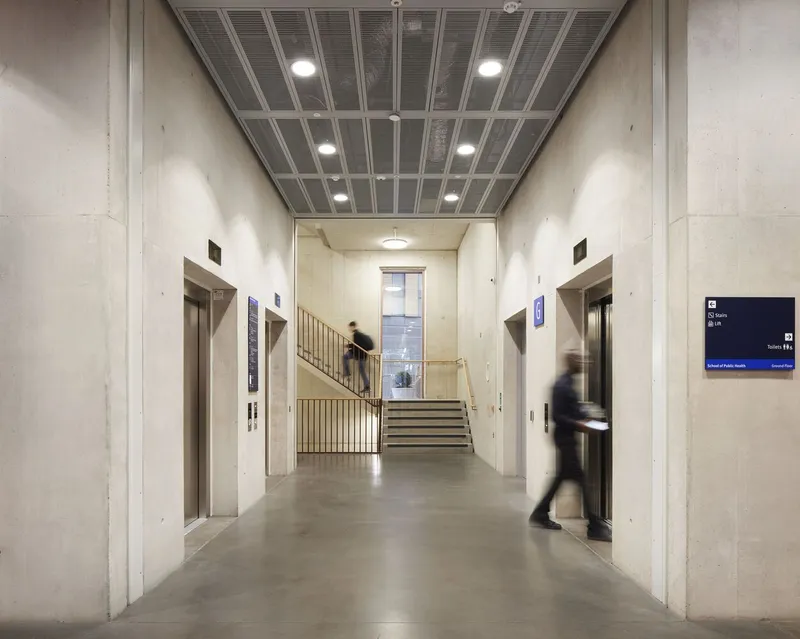
To encourage active circulation, the main stairwell is designed as a daylit, visible element, promoting physical movement over elevator use. The building’s exterior material palette, featuring pale terracotta-colored metal cladding and precast concrete panels, enhances thermal efficiency while complementing the surrounding campus architecture.
Urban Context and Architectural Integration
The School of Public Health plays a key urban role, acting as a gateway to Imperial’s White City North Campus. Its ten-story structure mediates between the lower-scale Victorian terraces of Wood Lane and the adjacent high-rise residential towers, ensuring seamless integration into the urban fabric.
The building entrance is positioned at the center of a colonnade, reinforcing its significance within the campus masterplan. On its eastern side, the structure faces a small square, serving as a social and academic gathering space for students and faculty.
Materiality and Interior Design
The interior material palette reflects the principles of modern educational architecture, emphasizing durability, warmth, and acoustic comfort.
The reception area and circulation stair are defined by exposed in-situ concrete and Douglas fir finishes, adding warmth to the industrial aesthetic. Deep red acoustic panels and painted doors introduce a sense of identity, while tiled surfaces in kitchenettes, WCs, and shower rooms further reinforce the design’s material cohesion.
A Vision for the Future of Education and Research
The School of Public Health represents a critical milestone in the ongoing expansion of Imperial College London’s White City Campus. The Sir Michael Uren Hub, another Allies and Morrison project, was completed in 2019, while upcoming developments will further support advancements in mathematics, AI, data sciences, and business innovation.
By prioritizing collaborative spaces, sustainability, and urban integration, this project sets a new precedent for modern educational architecture, demonstrating how institutions can blend research, education, and community engagement into a single, cohesive architectural vision.

The School of Public Health by Allies and Morrison exemplifies the future of modern educational architecture, offering flexible, sustainable, and collaborative spaces designed for academic innovation and public engagement. With its thoughtful spatial organization, passive design strategies, and seamless urban integration, the project serves as a model for future academic buildings, ensuring that education, research, and public health remain at the core of Imperial College London’s expanding campus.

All photographs are works of Jack Hobhouse


Popular Articles
Popular articles from the community


Faces of the Soviet Avant-Garde: Turning Moscow's Street Names into an Open-Air Museum
A network of sculptural installations across a Moscow residential district transforms forgotten architect names into spatial encounters with cultural memor

Cloaked Colonization: A Mobile Underwater Habitat That Moves Like a Fish
Micah Abaya's shortlisted EHC Pacific entry reimagines ocean settlement as a dispersed network of self-sustaining architectural organisms.

Temporary Home for Dogs: A Reversed Zoo Rethinks Animal Shelter Architecture
In Bucharest, a sinuous corridor and freed landscape flip the logic of containment, designing a shelter that works to make itself unnecessary.

Extended Shell: Retrofitting Kolkata's Balconies as Living Urban Thresholds
A modular retrofit system recovers the social and environmental intelligence of Kolkata's historic verandas for contemporary Park Street residents.

Similar Reads
You might also enjoy these articles


FAMM Arquitectura Organizes Ten Villas Around Courtyards and Jungle in Nosara, Costa Rica
El Molino pairs two elongated volumes with deep overhangs and timber louvers to build a compact coastal community five minutes from the beach.
Oscar Niemeyer's Ibirapuera Park Pavilions Define São Paulo's Cultural Identity in Concrete and Curve
A constellation of modernist volumes set within São Paulo's most important urban park, conceived for the city's 400th anniversary in 1954.
Sanjay Puri Architects Wraps a Jaipur Office Tower in Capsule-Shaped Green Buffers
A nine-level climate-responsive workplace near Jaipur Airport uses stacked planter terraces and aluminium screens to fight 40°C heat.
RHO Converts a Berlin Spree-Side Industrial Courtyard into Enkime's 1,000 m² Agency Headquarters
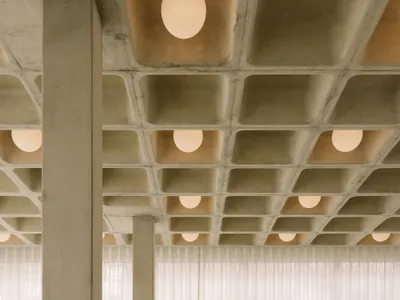
A social media agency's new home in Charlottenburg trades glossy branding for concrete waffle ceilings, glazed tile, and sheer curtains.

Explore Modern University Competitions
Discover active competitions in this discipline

Challenge to reimagine the Iron Throne

Photograph architecture without architects

Illustrate the lost glory of Angkor Wat - Render Challenge

Design challenge to reuse E-waste
Comments (0)
Please login or sign up to add comments
No comments yet. Be the first to comment!