
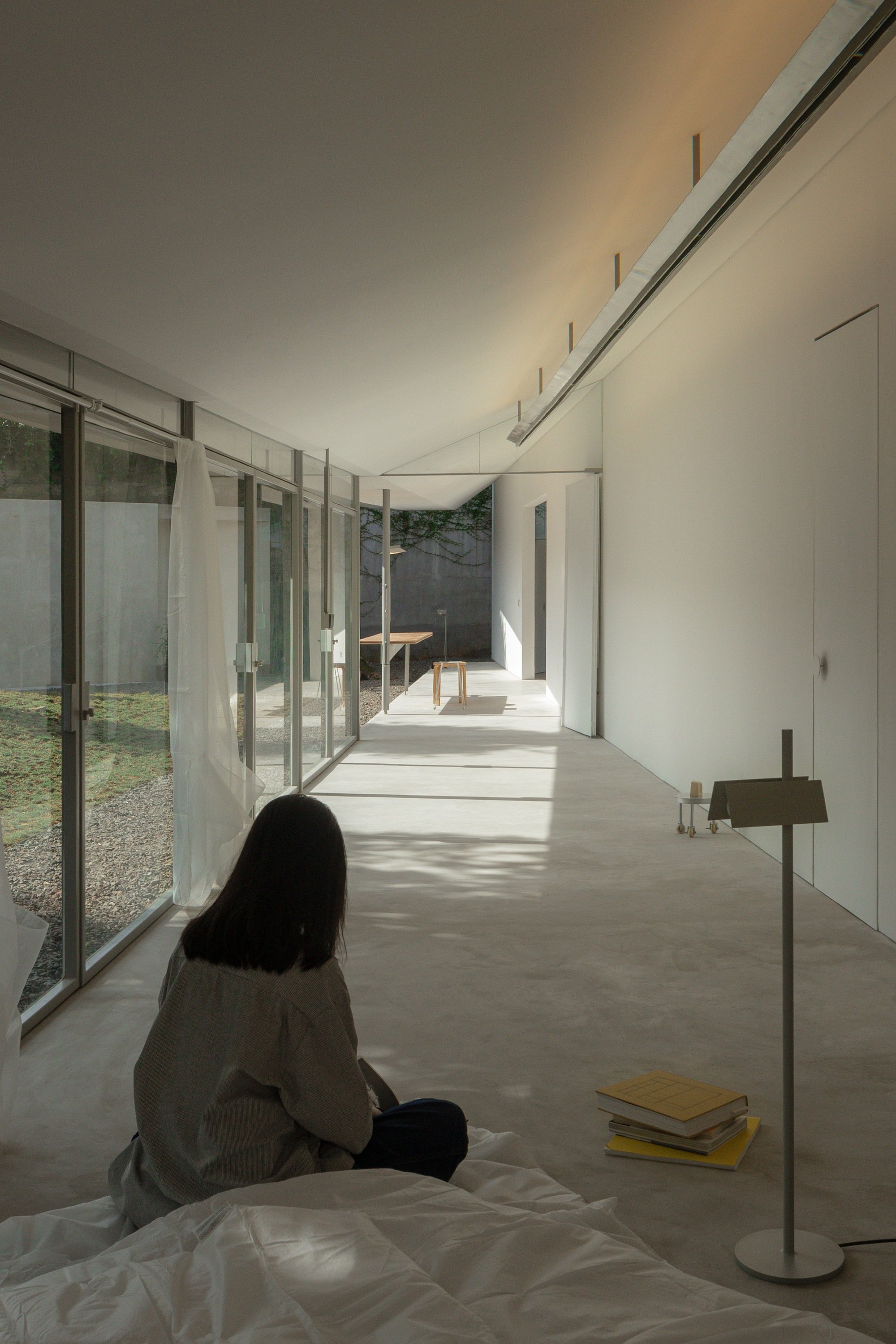
dua studio Stretches a 3.6-Meter-Wide House Across 24 Meters of Indonesian Garden
In Pesanggrahan, a single diagonal wall organizes an entire domestic program into two slender bands flanked by courtyards and trees.

How narrow can a house be before it stops feeling like one? dua studio answers with 3.6 metres: the width of a generous hallway, a tight parking space, or, in this case, the full cross-section of a 136 square metre family home in Pesanggrahan, Indonesia. The 24 m' House is exactly what its name promises, a single-story volume drawn out to 24 metres in length, compressed almost to the point of abstraction, and organized entirely around one diagonal wall that cuts through its center.
What makes this project genuinely interesting is not the constraint itself but the argument it makes about domestic sufficiency. The diagonal wall is not a gimmick; it is the structural spine, the spatial divider, and the environmental regulator all at once. Openings carved into it connect two parallel bands of program, allowing the entire house to read as a single continuous room oriented toward its garden. Fewer partitions, lower volumes, narrower rooms: the house asks how little a dwelling can require and still remain generous.
A Pavilion Between Gardens
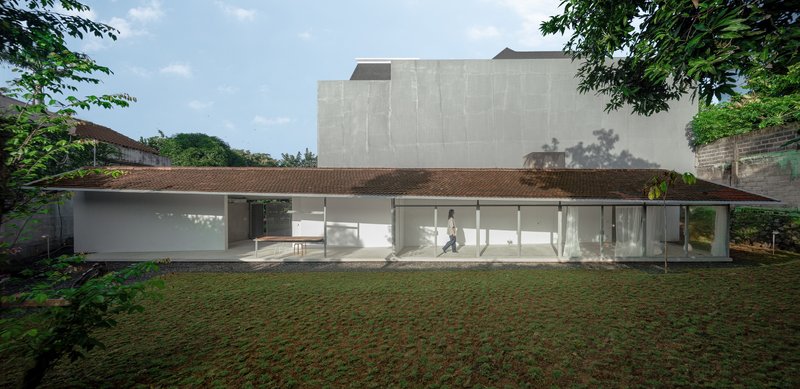
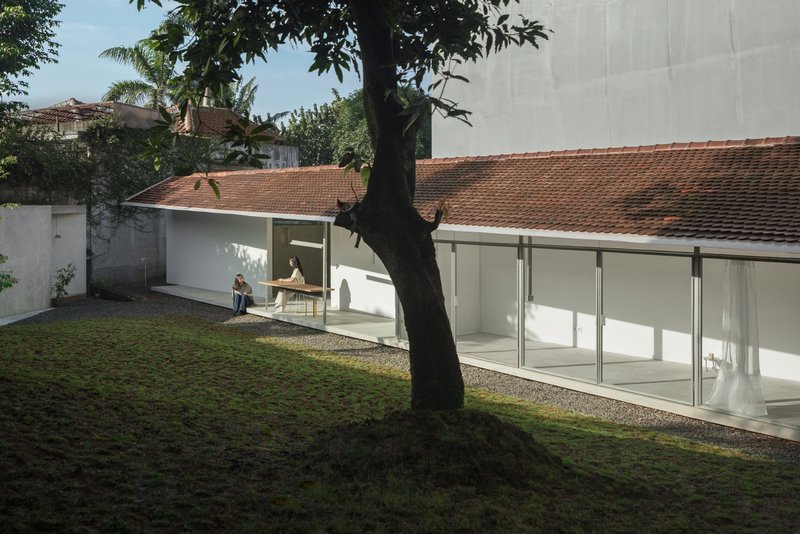
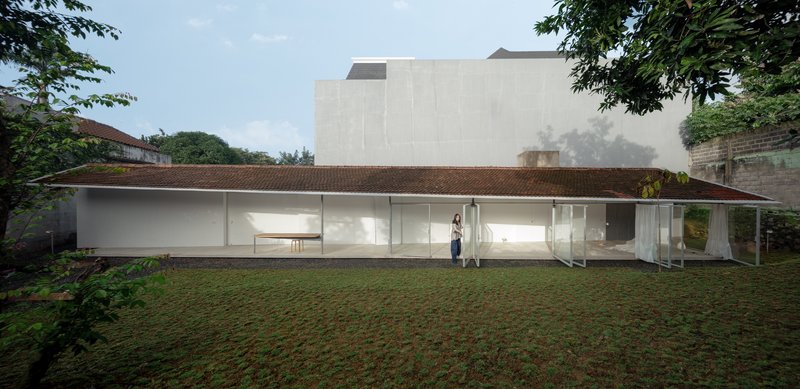
Seen from the garden, the house reads less as a building and more as a covered threshold between two planted zones. Glass walls dissolve the long elevations, and a low-pitched terracotta roof hovers above the structure, its eaves throwing shade without imposing mass. Mature trees frame and, in places, nearly absorb the pavilion, making the boundary between architecture and landscape deliberately ambiguous.
The gardens flanking the house are not leftovers from the plan but active participants in it. Gravel courtyards, grassed embankments, and climbing vines extend the spatial experience well beyond the 136 square metres of enclosed floor area. Light, ventilation, and views all arrive laterally, through the full-height glazing that lines both long facades.
The Diagonal Wall as Organizing Logic
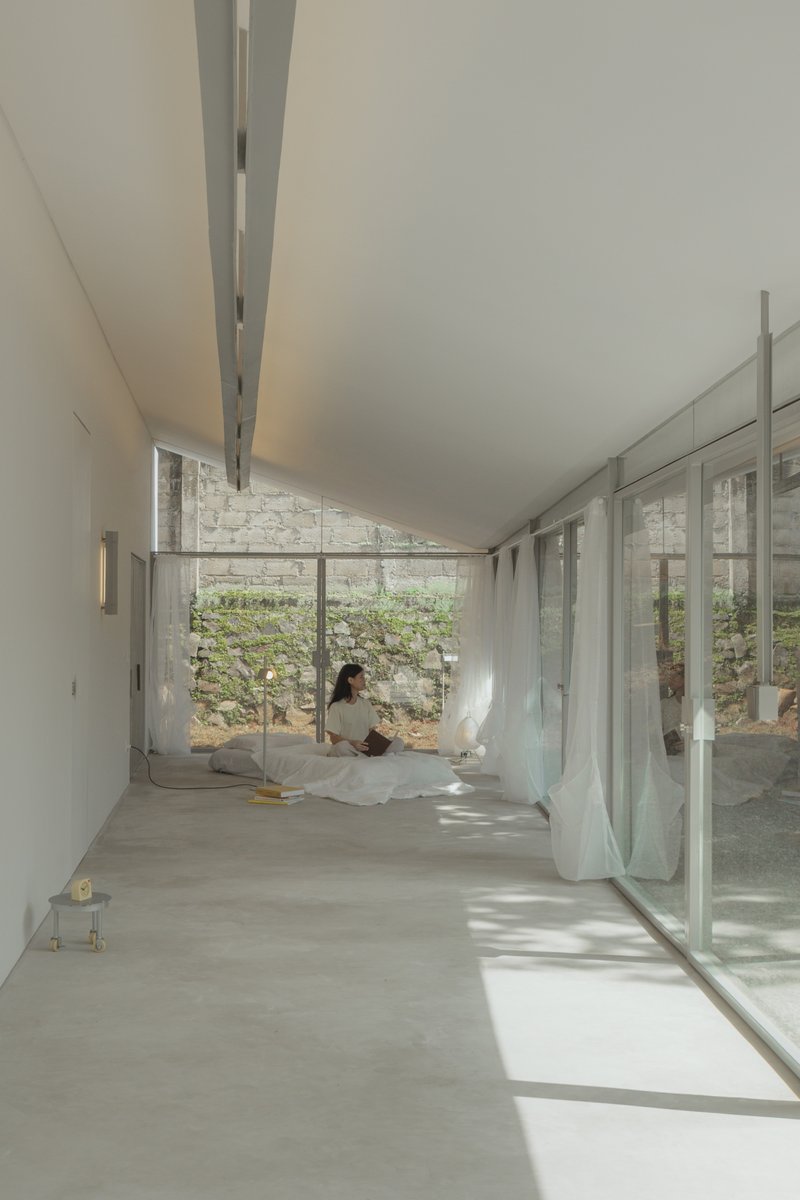
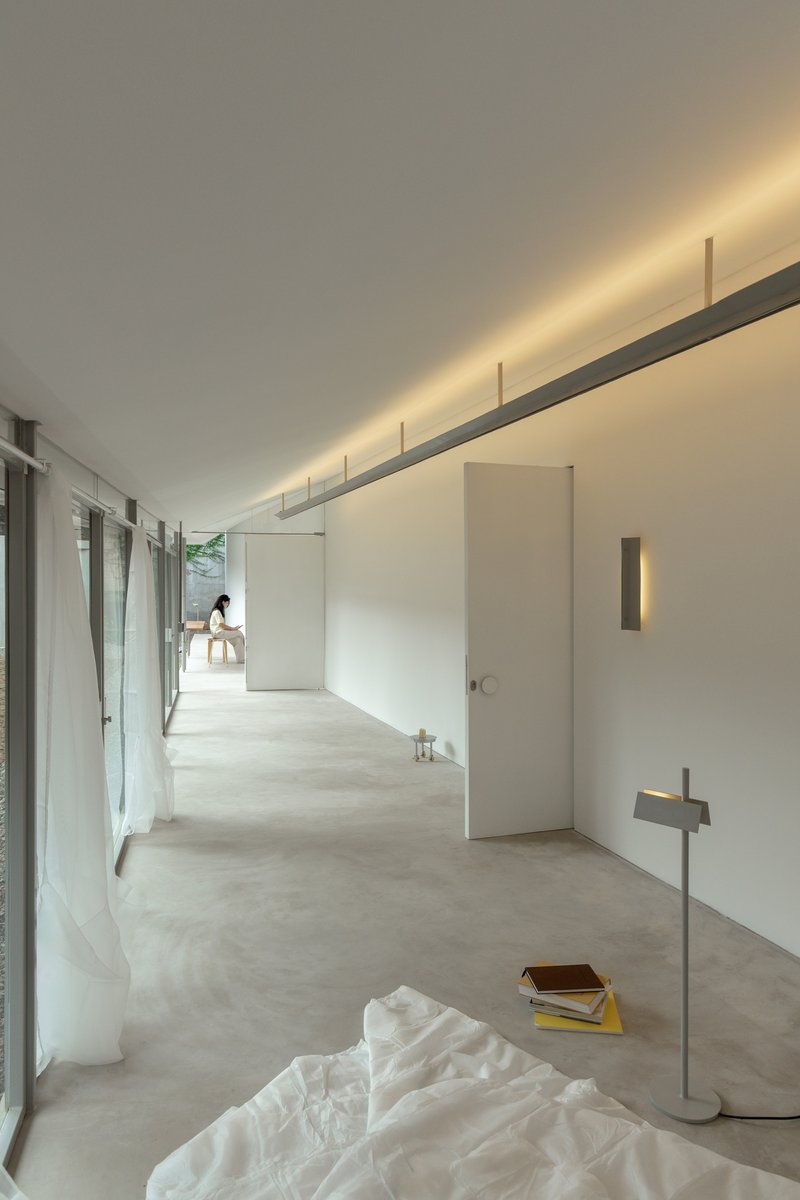
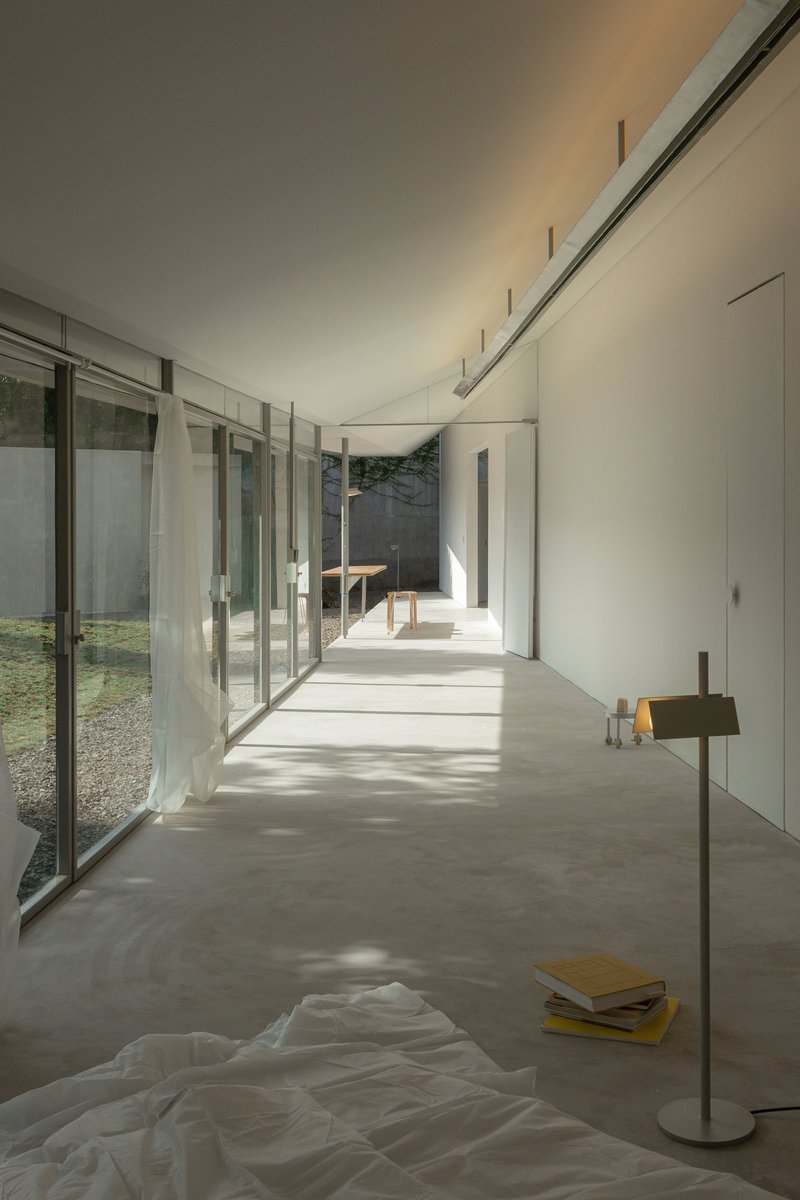
The single diagonal wall running through the plan is the project's defining move. Positioned at the center, it divides the house into two elongated bands. One side holds the living room, dining area, kitchen, bathroom, and a secondary bedroom. The other contains the master bedroom and study, separated by a partition that can open fully across the width of the room. When everything slides open, the house becomes one continuous 24-metre-long space.
Structurally, the wall supports the roof. Spatially, it calibrates the relationship between public and private. Environmentally, its carved openings allow air and light to move between the two zones. It is a single gesture doing triple duty, and the economy of that decision is what gives the project its clarity.
Linear Living and Cooking
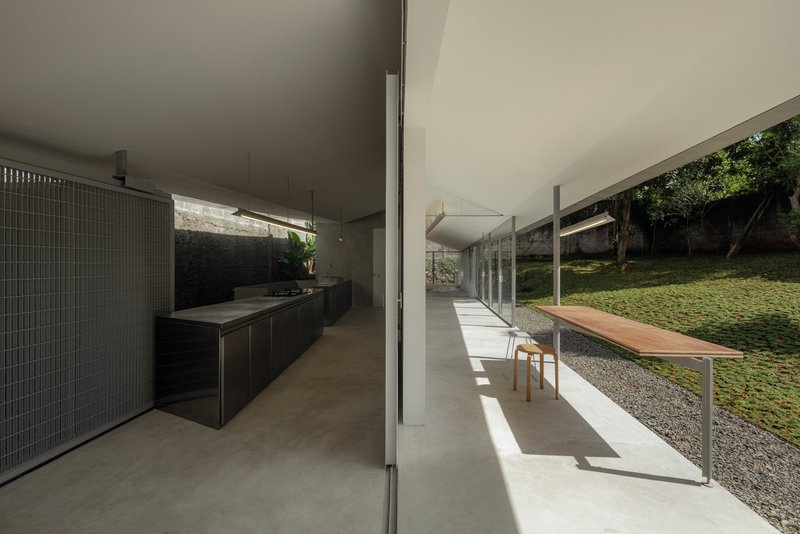
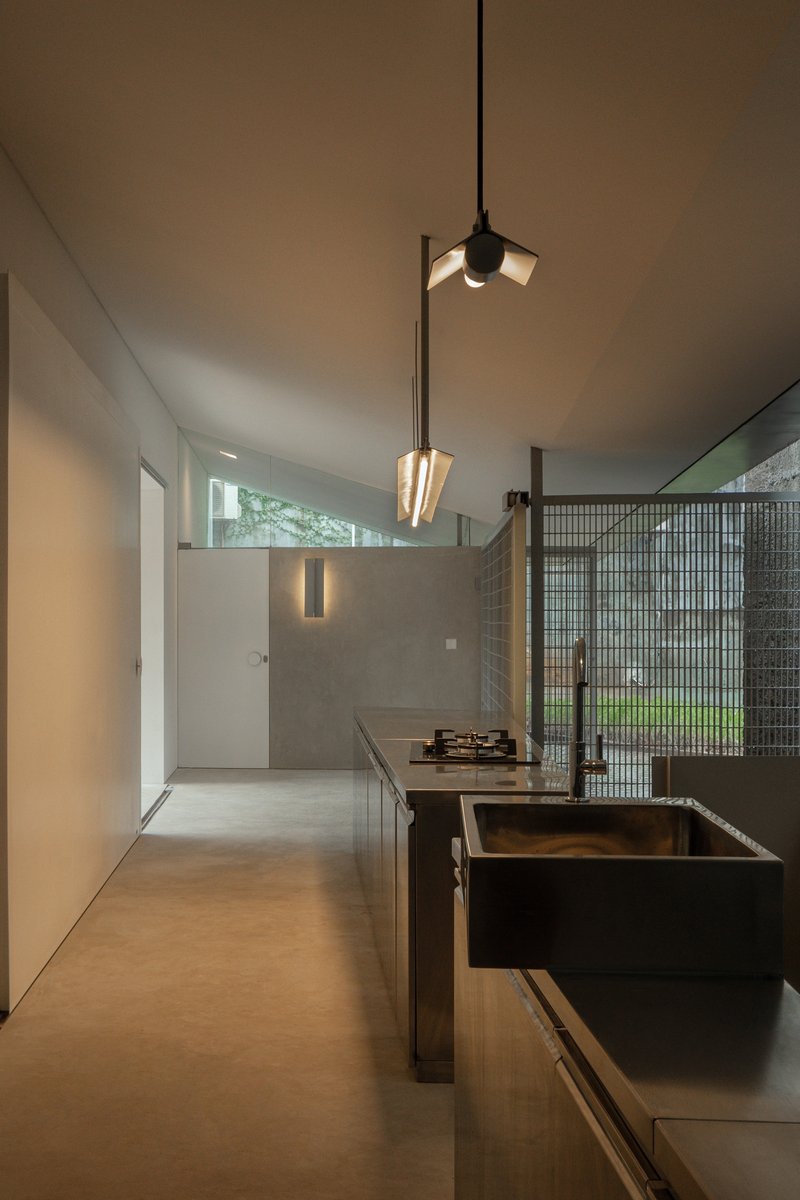
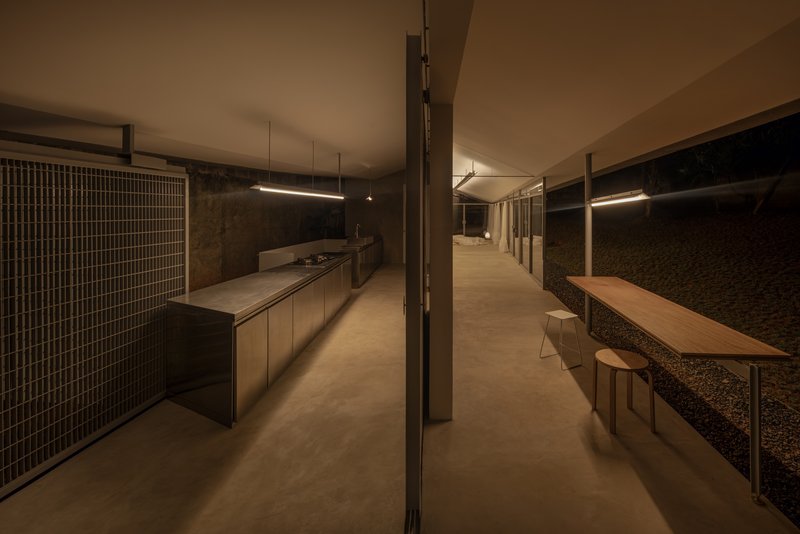
The kitchen and dining zone occupies one of the two bands and demonstrates how a narrow plan can actually improve domestic circulation. Everything lines up: black steel cabinetry, a long dining table, pendant lights dropping from the angled ceiling. The result is a galley that feels deliberate rather than cramped, with mesh sliding doors and openings providing constant visual access to the gravel courtyard and lawn beyond.
There is no dead space here. The 3.6-metre width forces every surface to work, and the linear arrangement means movement through the house is always directional, always framed by a view at one end or the other. Cooking, eating, and socializing happen along the same axis, with the garden always visible.
Courtyards, Terraces, and the In-Between
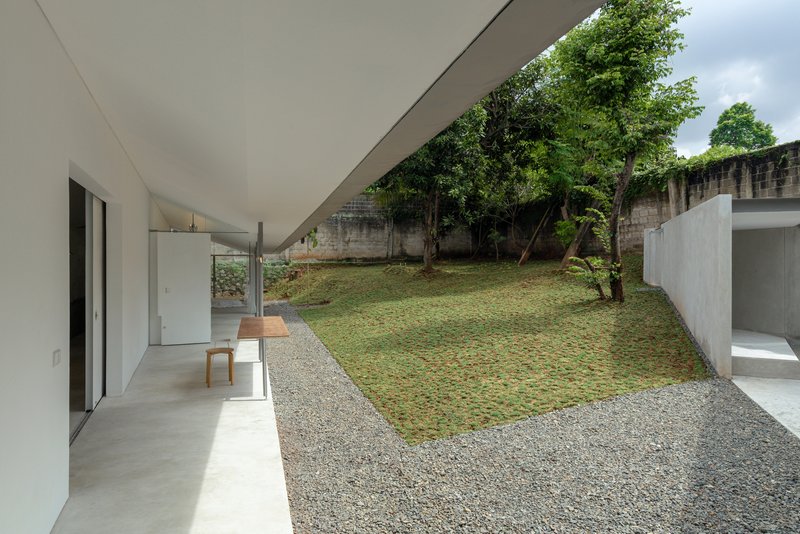
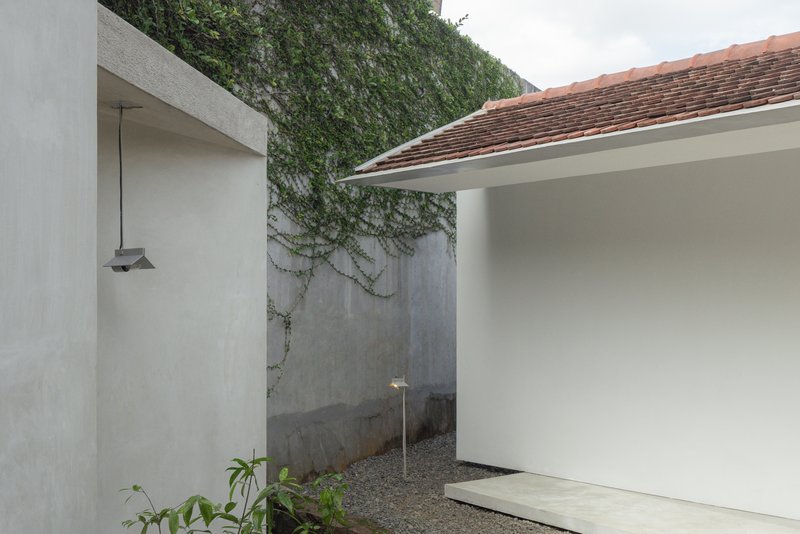
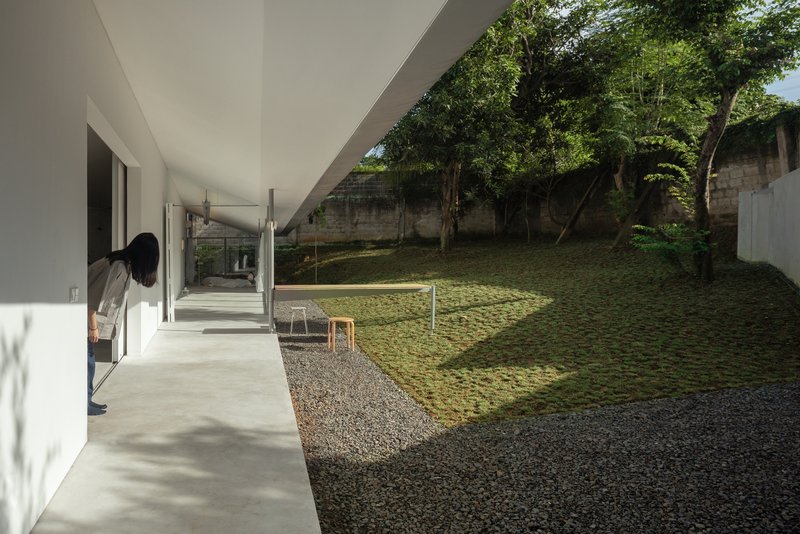
The house generates a surprising number of distinct outdoor conditions for such a compact plan. Covered terraces with wooden benches and mesh screens serve as transitional zones between inside and out. Small gravel courtyards with climbing vines and suspended pendant lamps create intimate pockets of outdoor domesticity. Wider walkways open to lawns and embankments, stretching the perception of space laterally.
These are not decorative gestures. In a tropical climate, the space between the wall and the garden is where most of the living actually happens. The covered corridors function as outdoor rooms, shaded by the terracotta roof and cooled by cross-ventilation. Rain transforms them too: the view down the covered walkway during a downpour, framed by columns of water, makes the narrowness feel cinematic rather than confining.
Light, Rain, and the Long View
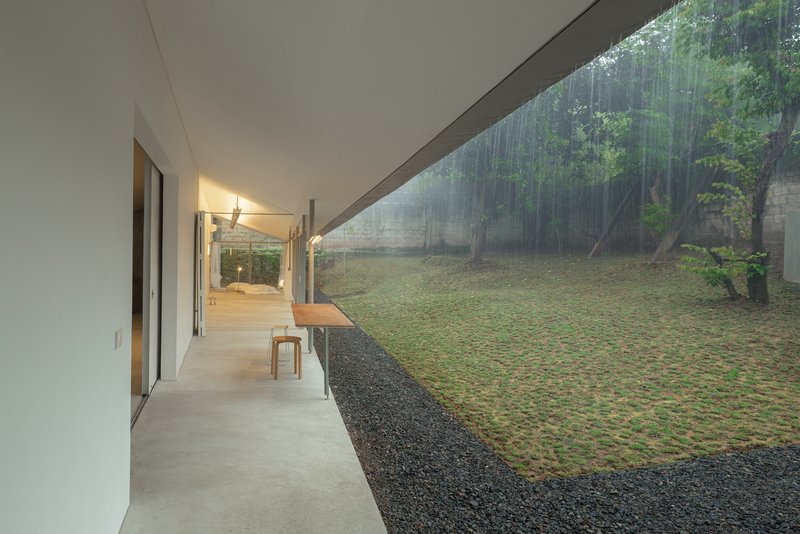
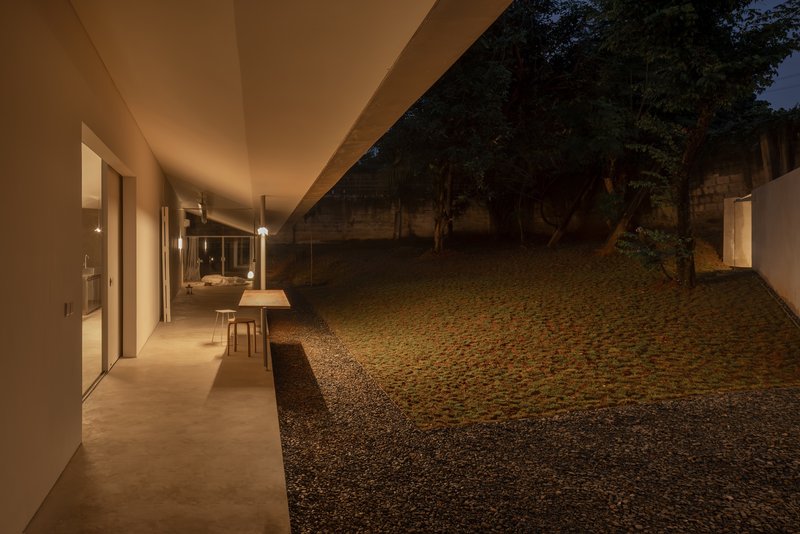
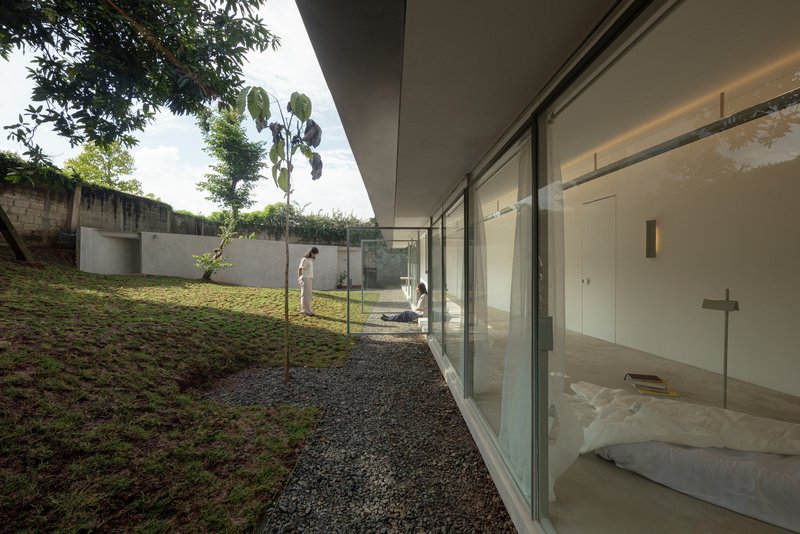
The extreme proportions of the house turn environmental phenomena into architectural experiences. Dappled sunlight through tree canopies plays across the polished concrete floors. At night, the linear cove lighting in the ceiling transforms the corridors into glowing channels. During rain, the long covered walkways become observation decks for watching weather move across the garden.
The bedroom, fully glazed on one side, opens directly to a courtyard where a young tree grows. Two figures standing beside it in one image give the scene its scale and its tenderness. This is a house that trusts proximity to landscape as its primary source of comfort, rather than material extravagance or spatial excess.
Arriving and Settling In
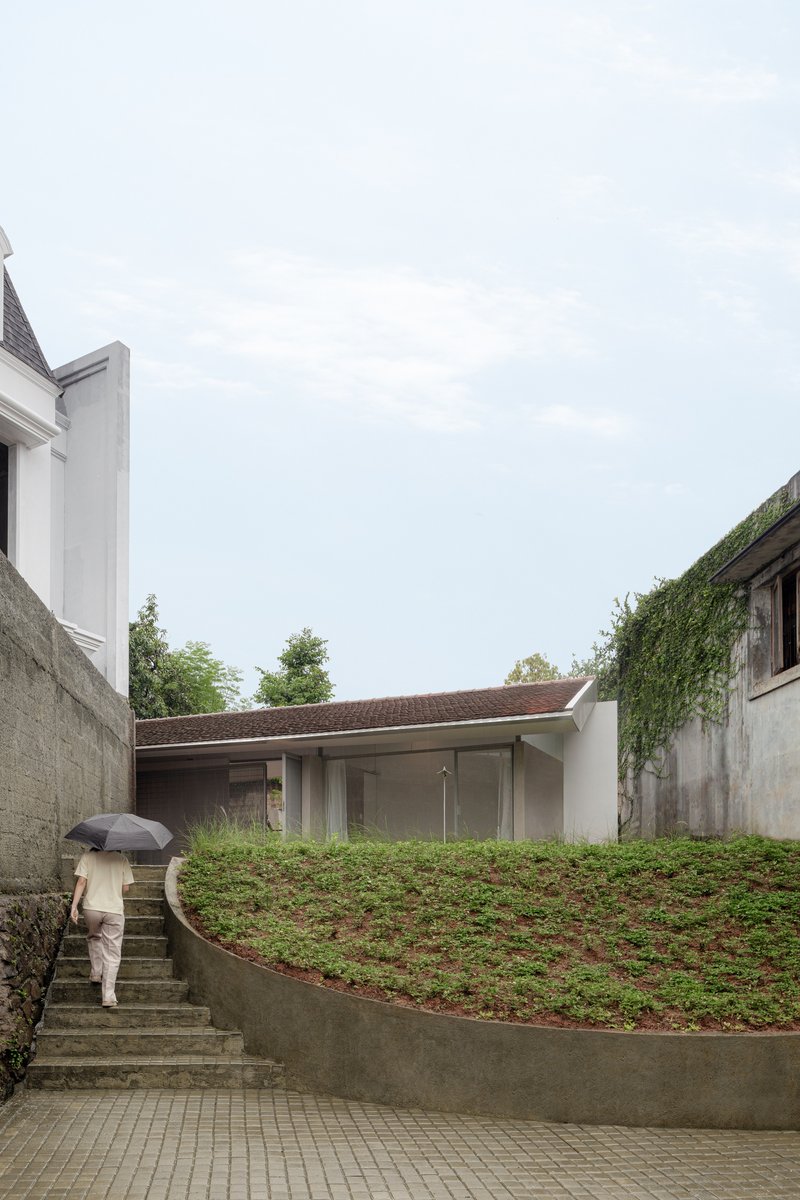
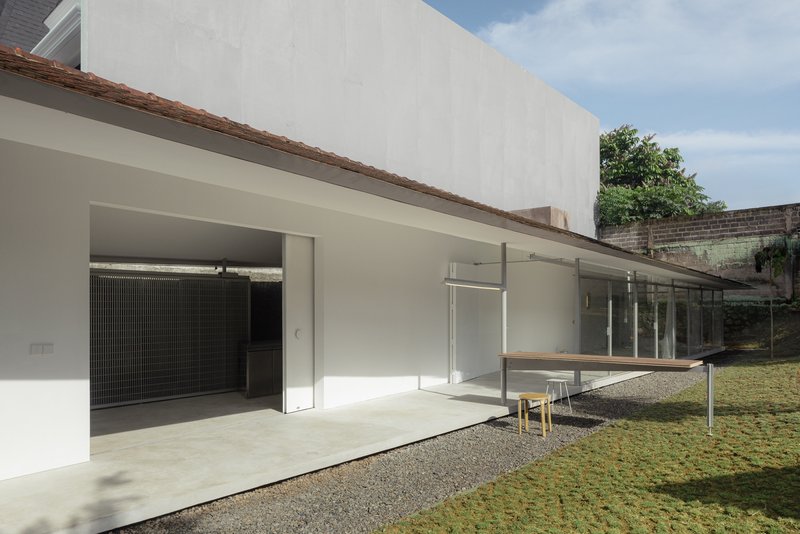
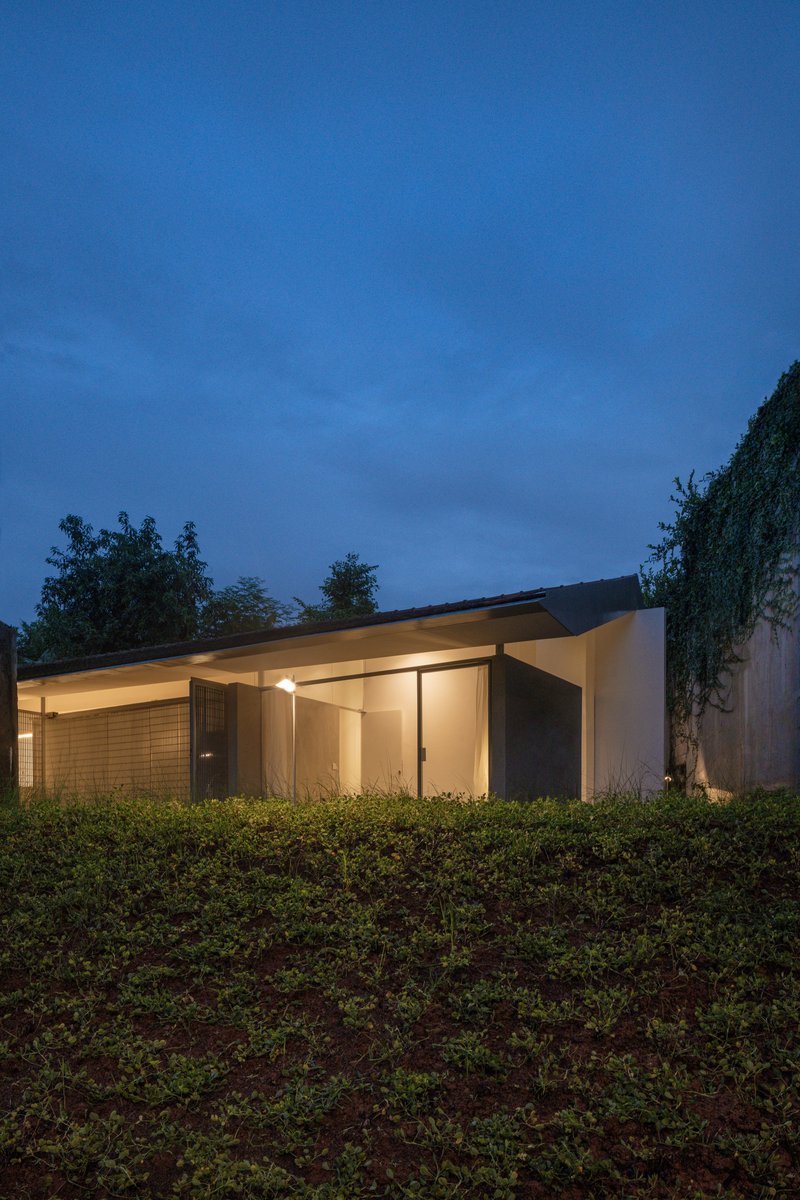
The approach to the house is understated. Concrete steps ascend beside a planted green roof under overcast sky. A white-rendered facade with glass doors opens to a gravel courtyard and lawn. At dusk, the low-slung folded roof structure nestles into hillside vegetation, its profile barely breaking above the tree line. The house does not announce itself; it settles into its site.
There is a quiet confidence in a building that asks you to walk alongside it rather than stand before it. The 24-metre length means the house reveals itself sequentially, room by room, courtyard by courtyard. You experience it in time, not in a single glance.
Covered Threshold and Mesh Screens
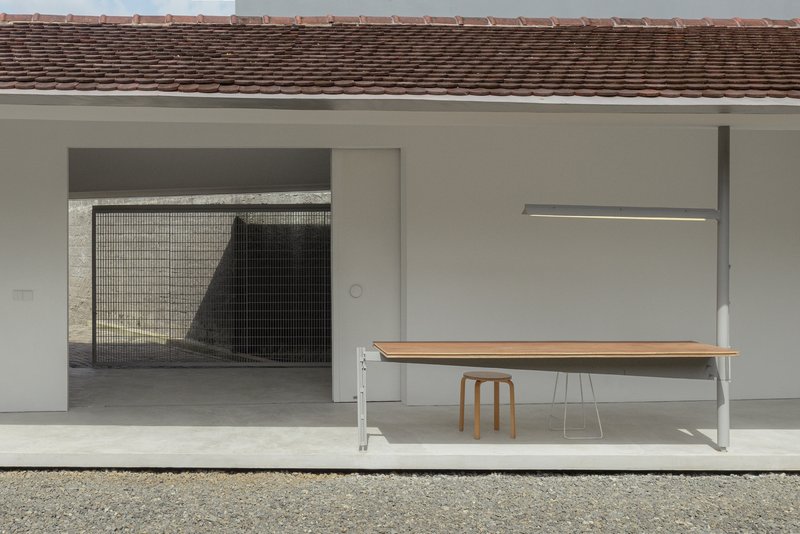
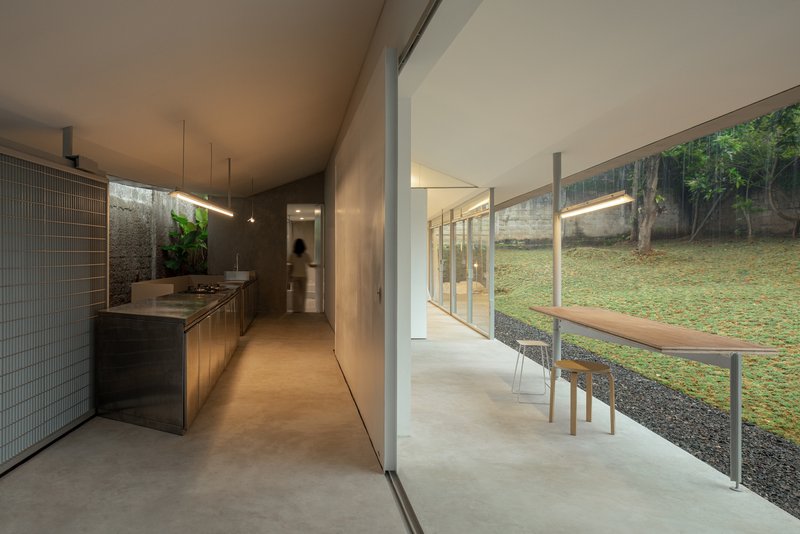
Mesh screens appear throughout the house as a low-tech filter between interior and exterior. They moderate light, admit breeze, and provide a degree of visual privacy without closing off the view. Combined with the tiled roof overhang, they create a layered threshold condition: you are never simply inside or outside but always somewhere along a gradient.
Plans and Drawings
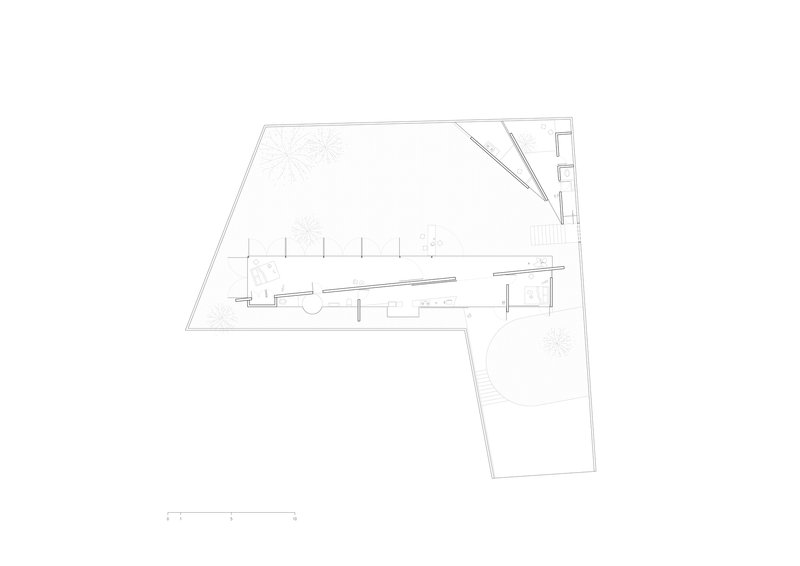
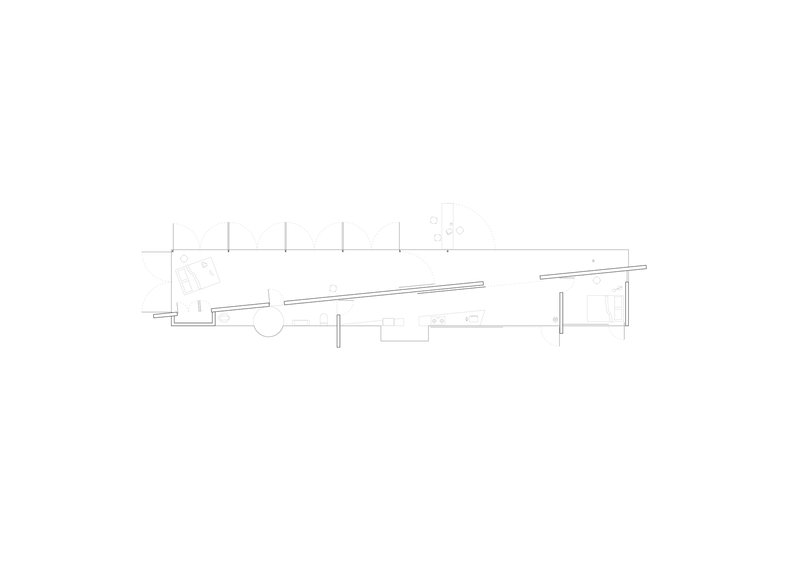
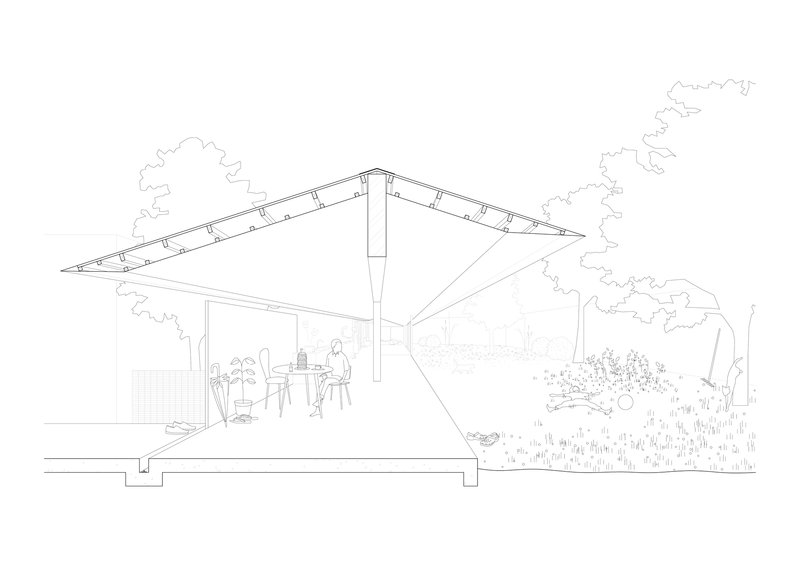
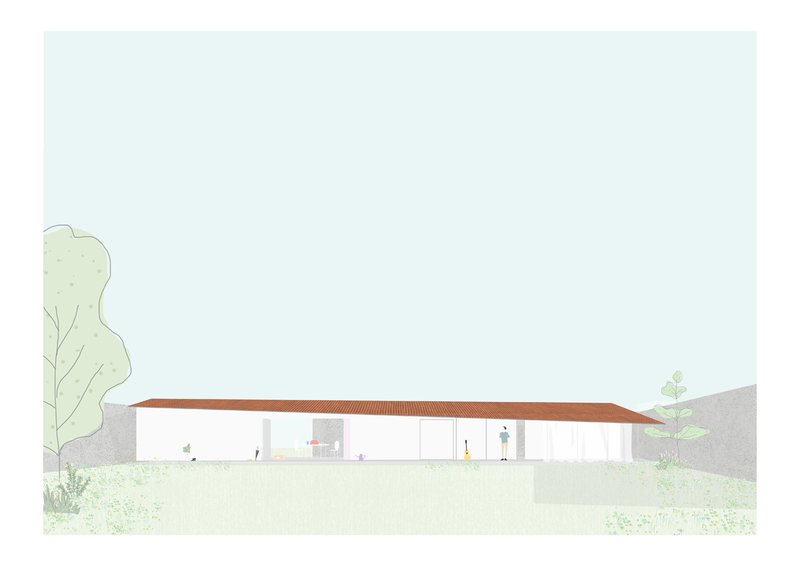
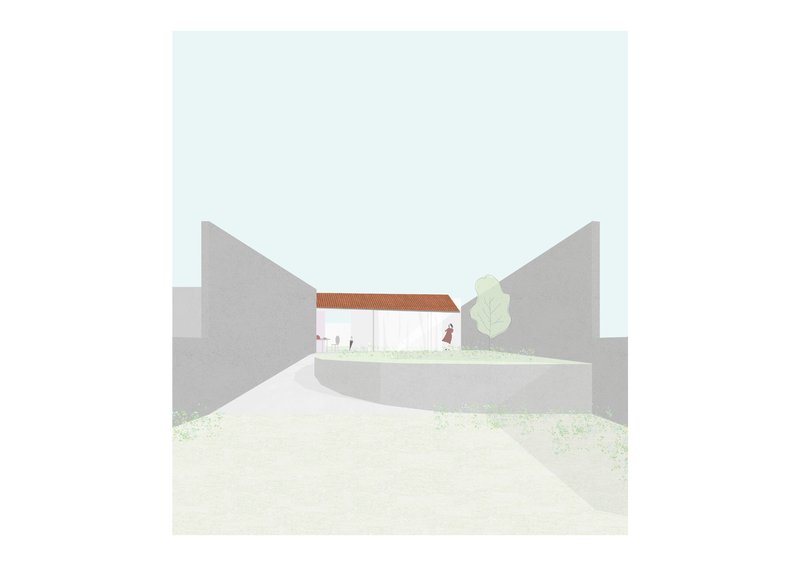
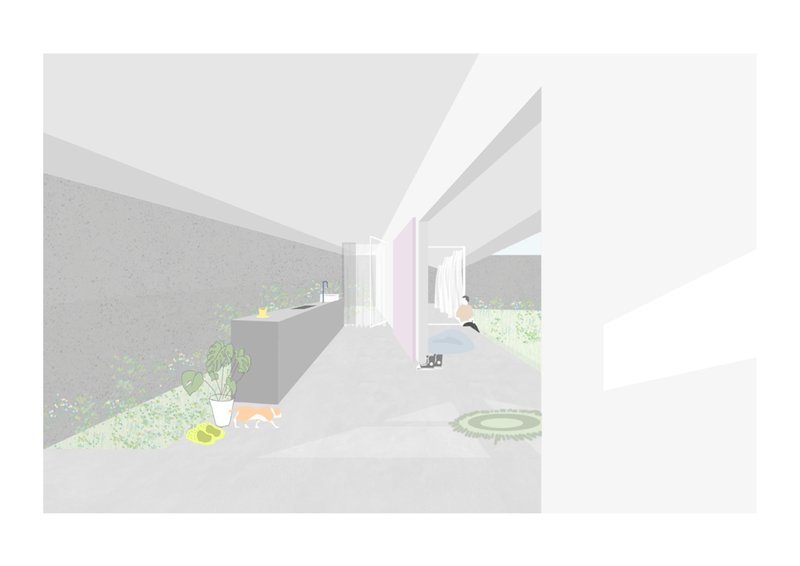
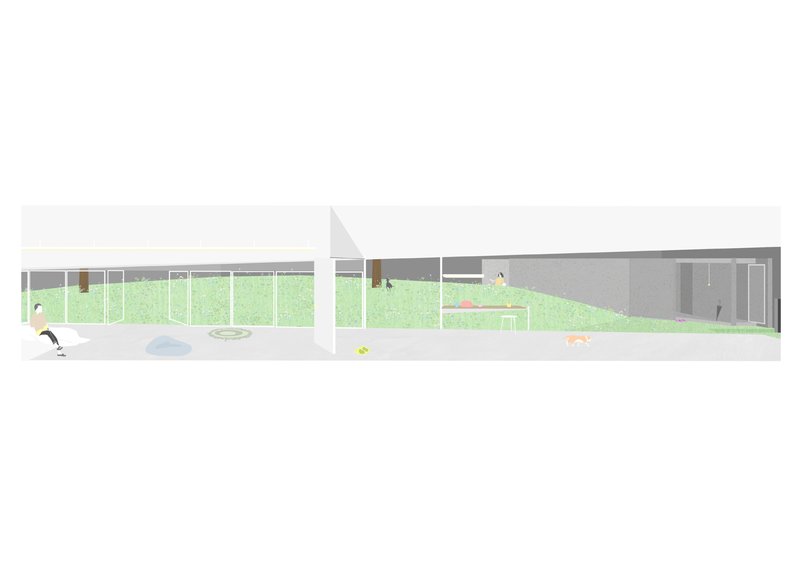
The site plan makes the logic of the diagonal wall immediately legible: two linear volumes offset by its angle, with gravel courtyards filling the gaps. The sections reveal how the pitched roof shelters both dining and garden, and how the exposed structural columns maintain openness along the full 24-metre length. The perspective drawings show the approach sequence through angled walls and the interior quality of concrete surfaces facing planted courtyards.
What the drawings confirm is the project's disciplined economy. There are very few moves here: one wall, two bands, gardens on both sides, a roof. The restraint is the point. Every decision is load-bearing, structurally and conceptually.
Why This Project Matters
The 24 m' House is a provocation dressed as a modest pavilion. It challenges the assumption that domestic generosity requires width, multiple rooms, or complex plans. By compressing the section to 3.6 metres and stretching the plan to 24, dua studio demonstrates that proportion, orientation, and the relationship to landscape can substitute for sheer floor area. The house feels larger than its 136 square metres because it borrows space constantly from its gardens, courtyards, and covered terraces.
More importantly, the project proposes an ethic of sufficiency that is genuinely architectural, not merely rhetorical. The diagonal wall is not a manifesto pinned to the wall; it is a structural element that holds up the roof and organizes the life inside. The mesh screens are not sustainability theater; they regulate climate. In a moment when residential architecture often confuses generosity with consumption, this house offers a sharper definition: generosity as the intelligent calibration of exactly enough.
24 m' House by dua studio, Pesanggrahan, Indonesia. 136 m², completed 2026. Photography by Tristan Salim.
About the Studio
Share Your Own Work on uni.xyz
If projects like this are the kind of work you want to make, uni.xyz is a place to publish your own, find collaborators, and enter design competitions.




Popular Articles
Popular articles from the community

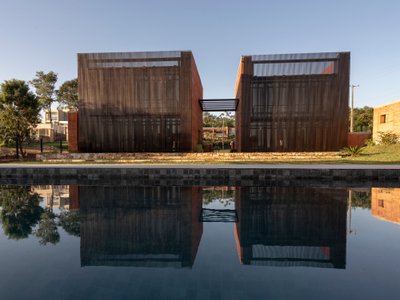
BAUEN Builds Two Rammed Earth Volumes in Paraguay Inspired by the Ovenbird's Nest
In San Bernardino, a house of compacted earth channels the instinct of a constructive bird to shelter life from the Paraguayan summer.
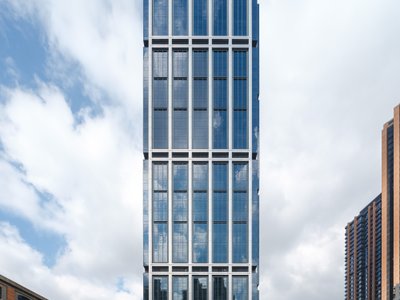
Foster + Partners Wraps a 200-Meter Shanghai Tower in Stainless Steel and Industrial Memory
The Suhe Centre Office Tower anchors a regenerated waterfront district in Shanghai with an all-steel structure that nods to local warehouse heritage.

VEIVE Architects Builds a Mountain Hostel That Disappears into a Hangzhou Hillside
On the Huihang Ancient Trail in Xiangjian Village, a shelter of wood, steel, and rammed earth roots itself in the rural landscape.
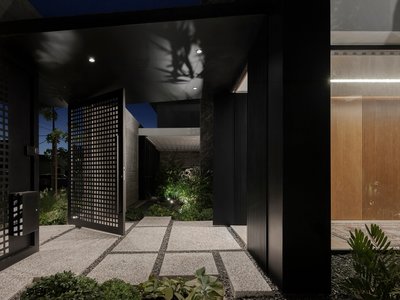
Constanti Architects Builds a Fortress of Privacy in Nicosia with House 345
A concrete and timber residence in Cyprus reinterprets the traditional introverted courtyard house for a new urban landscape.


Similar Reads
You might also enjoy these articles

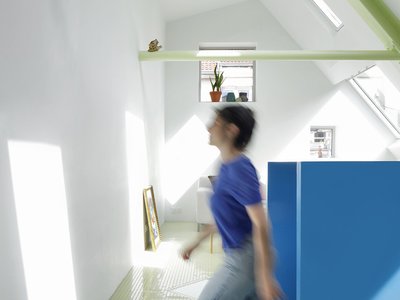
127af Flips a Tiny Bagnolet Rowhouse Upside Down with a Handcrafted Roof Extension
A 55-square-meter terraced house on the edge of Paris gains a luminous upper living floor through lightweight timber and steel.
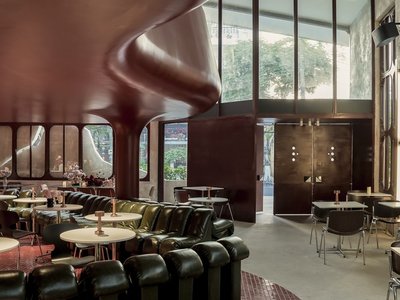
1.61 Design Workshop Wraps a 600-Square-Meter Café in Vietnam in Sculptural Burgundy Drama
Reden Café & Bistro pairs a helical staircase, mosaic floors, and deep red interiors to rethink Vietnamese hospitality space.

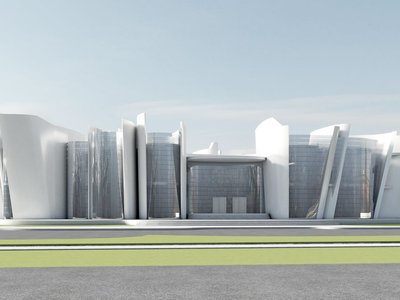
The Unbound Brain: A School Shaped by Cognitive Architecture
Cylindrical learning pods radiate like neurons from a central cortex, turning the floor plan into a spatial model of human thought.
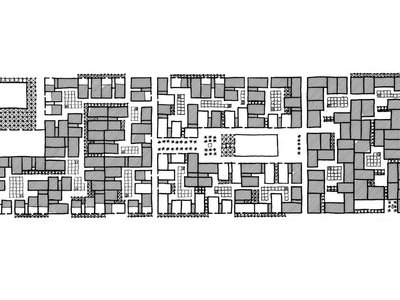
Revival Vernacular Architecture: Rammed Earth Settlements for the Sahara
A modular desert community in Mauritania that fuses passive cooling techniques with earthen construction and local craftsmanship.


Explore Residential Building Competitions
Discover active competitions in this discipline




The Global Benchmark for Architecture Dissertation Awards


Challenge to design a portable theatre


Challenge to design a portable music platform


Challenge to design an open learning module for the elderly
Comments (0)
Please login or sign up to add comments
No comments yet. Be the first to comment!