

Sandro Ferreira Arquitectura Carves a Four-Level Residence into a Ten-Meter Slope in Braga
SA House replaces a ruined building on a steep central street with 845 square meters of travertine, walnut, and slate-clad urban living.


A ten-meter drop between a city street and a rear garden is the kind of topographic problem that either defeats a project or defines it. In central Braga, Sandro Ferreira Arquitectura chose the latter path with SA House, an 845-square-meter residential building that stacks four distinct programs across four levels, threading them together with staircases, landings, terraces, and a material palette that refuses to acknowledge a boundary between inside and out.
The site previously held a ruined building of no patrimonial value, which freed the architect to think in purely contemporary terms. What emerged is a project that treats its steep gradient not as a constraint to mitigate but as an organizational engine: garage at street level, apartments on the first floor, the social heart of a duplex on the second, and private bedrooms set back on the top floor where they look out over a sloped garden that cascades down to a pool. Every floor is calibrated for daylight, ventilation, and spatial economy, and the material continuity of travertine, walnut wood, and slate cladding knits the whole sequence into a single legible gesture.
A Street Façade Built on Rhythm
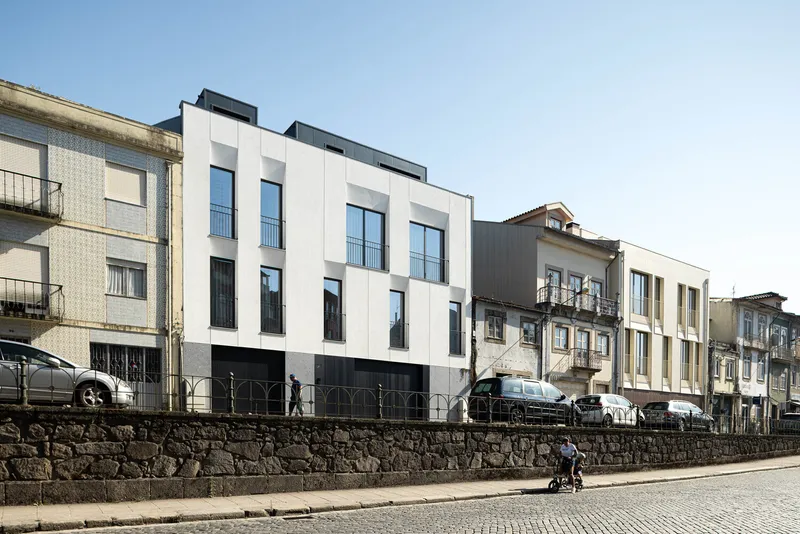
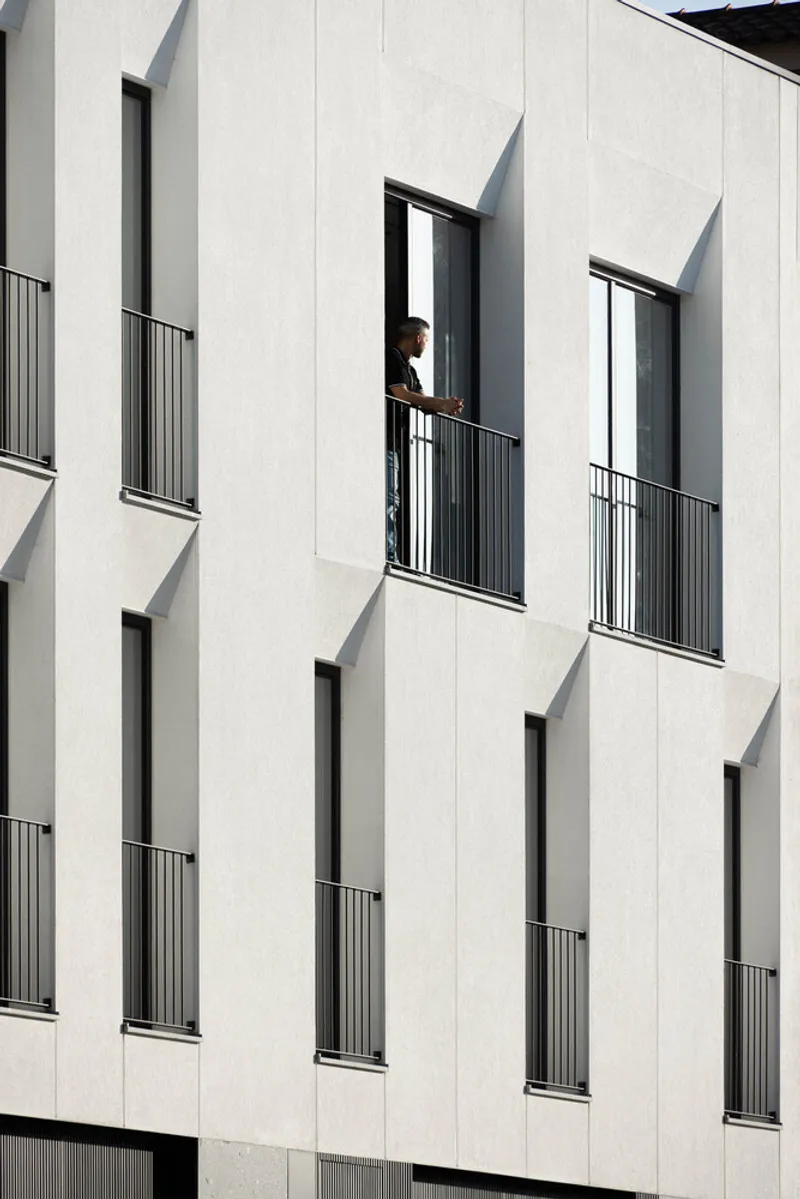
The street elevation is a controlled composition of solids and voids. White panels dominate, punctuated by recessed balcony openings and vertical window slots that alternate across the facade in a pattern that reads as deliberate rather than decorative. The effect is a building that participates in the rhythm of Braga's central streets without mimicking any historical neighbor. It feels assertively modern yet appropriately scaled, a difficult balance on a narrow urban lot.
Privacy is handled through depth rather than opacity. Recessed openings create shadow pockets that shield interiors from the street while still pulling light inward. It is a strategy that acknowledges the density of the context: passersby are close, so the architecture mediates through layering rather than simply curtaining off.
The Rear Reveals What the Front Conceals
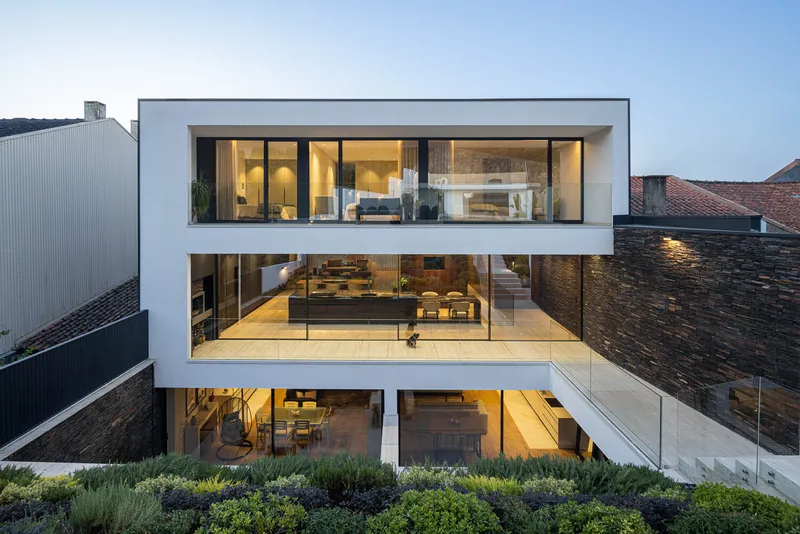
Turn to the rear elevation and the building's character inverts. Three stacked glazed volumes glow at dusk, their interiors fully visible against the planted slope. Where the street facade is guarded and rhythmic, the garden facade is expansive and transparent. Floor-to-ceiling glass on the social levels dissolves the wall plane entirely, letting the dining room and living spaces spill onto stone patios.
The dusk photograph makes the case clearly: light, program, and landscape are legible in a single glance. You can read the sectional logic of the house from outside, which is a testament to how cleanly the four levels are organized. Each volume steps back slightly, giving every floor its own terrace and its own relationship with the garden below.
Material Continuity from Kitchen to Terrace
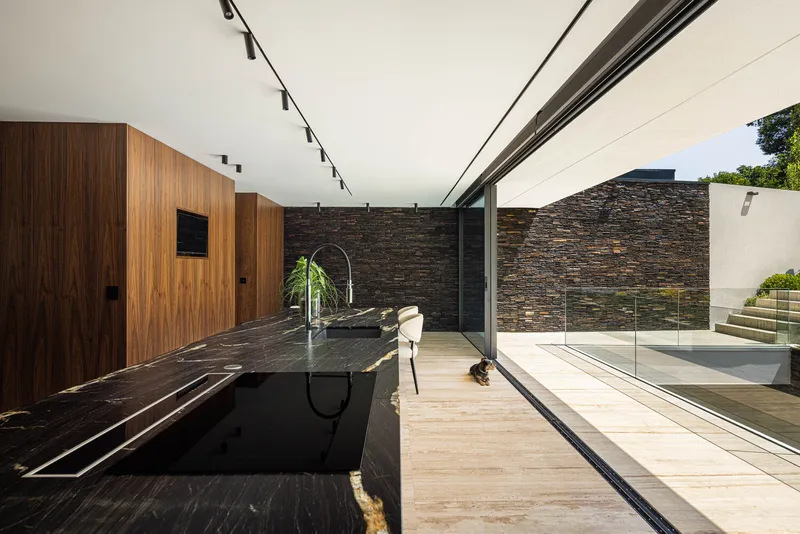

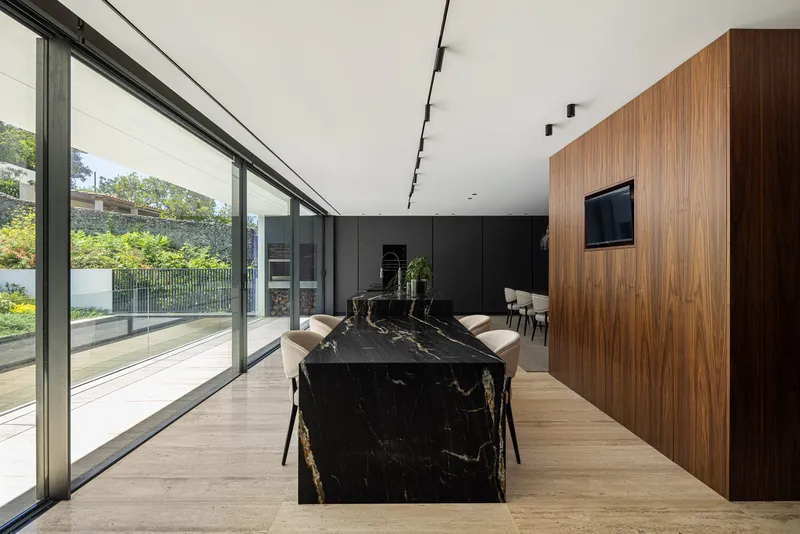
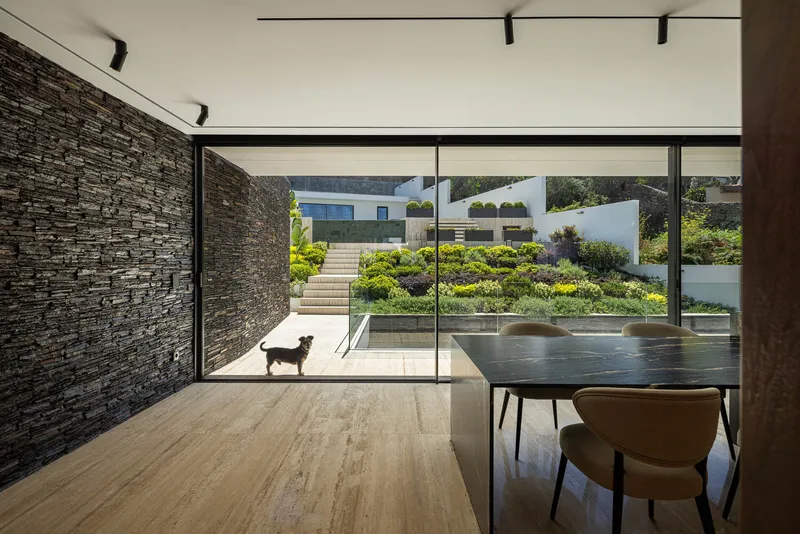
The most convincing move in SA House is the way materials cross the threshold. Travertine flooring runs from interior dining spaces out onto terraces without a change in level or finish. The layered slate wall visible through the covered patio is the same stone that appears inside as an accent surface. Walnut wood wraps partitions and cabinetry indoors, then yields to stone outdoors, but the warmth of tone carries through. The result is that you stop perceiving a hard line between shelter and garden.
Sliding glass walls on the social floor amplify this reading. When open, the dining table and kitchen island share air with the planted terrace. When closed, the continuity of flooring and wall cladding maintains the visual connection. It is a well-worn strategy in residential architecture, but the steep site gives it added punch: you are simultaneously inside a room and suspended above a garden that drops away beneath you.
The Social Core: Walnut, Marble, and Open Plans
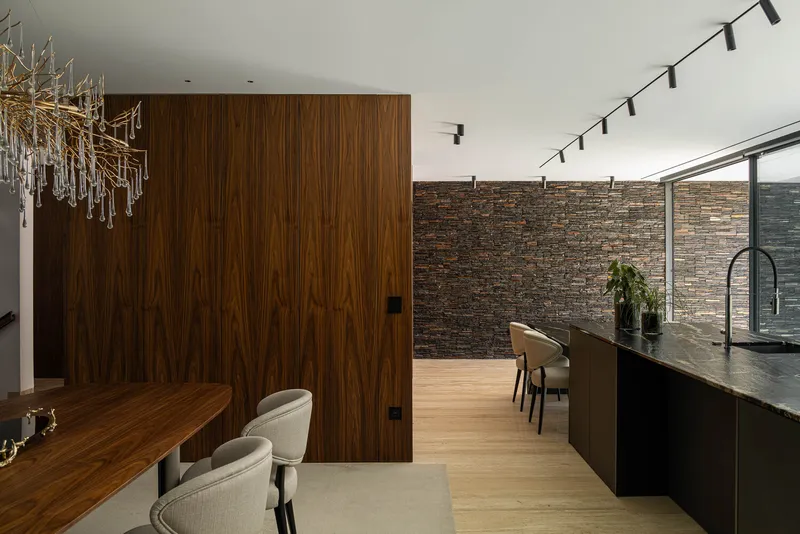
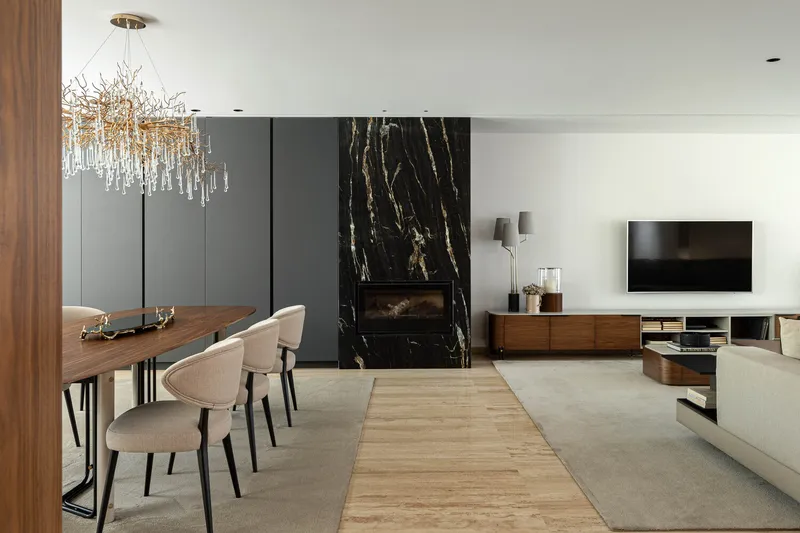
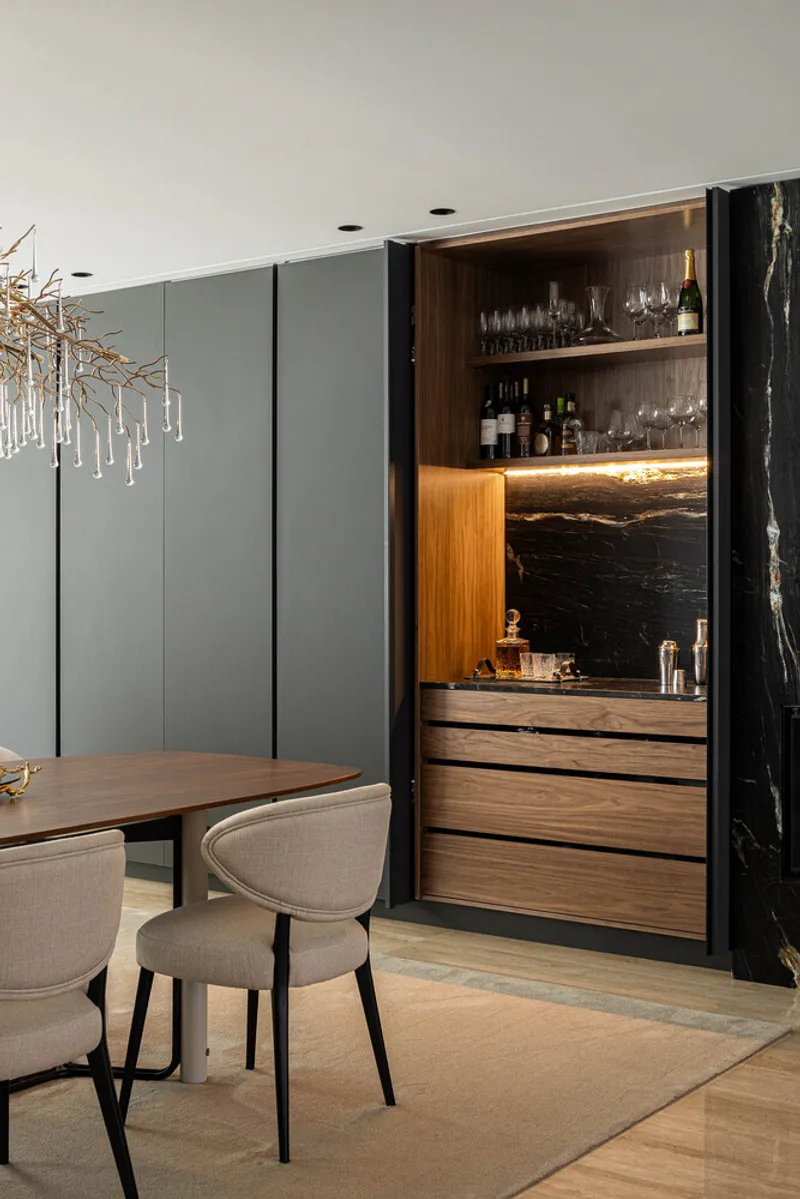
The T4 duplex's second-floor social area is where the design's ambitions are most fully realized. An open-plan layout groups the kitchen, dining, and living zones under one ceiling, articulated by a walnut veneer partition wall and a black marble kitchen island. Track lighting above the island keeps the ceiling plane clean, while a branched chandelier over the dining table introduces a softer, more residential note.
A bar niche tucked into a grey paneled storage wall is a small detail worth noting. Illuminated shelving and a black marble backsplash turn what could be dead corridor space into a functional moment. The fireplace surround in the living zone uses the same dark stone, creating a material anchor that holds the open plan together without walls. These are the kinds of decisions that separate competent space planning from genuinely considered interior architecture.
Ascending Through the Section
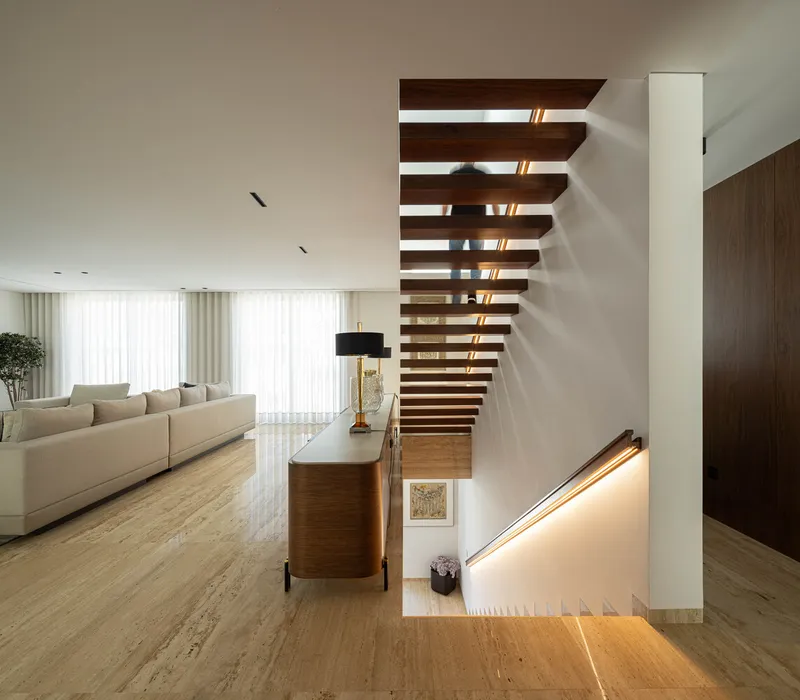
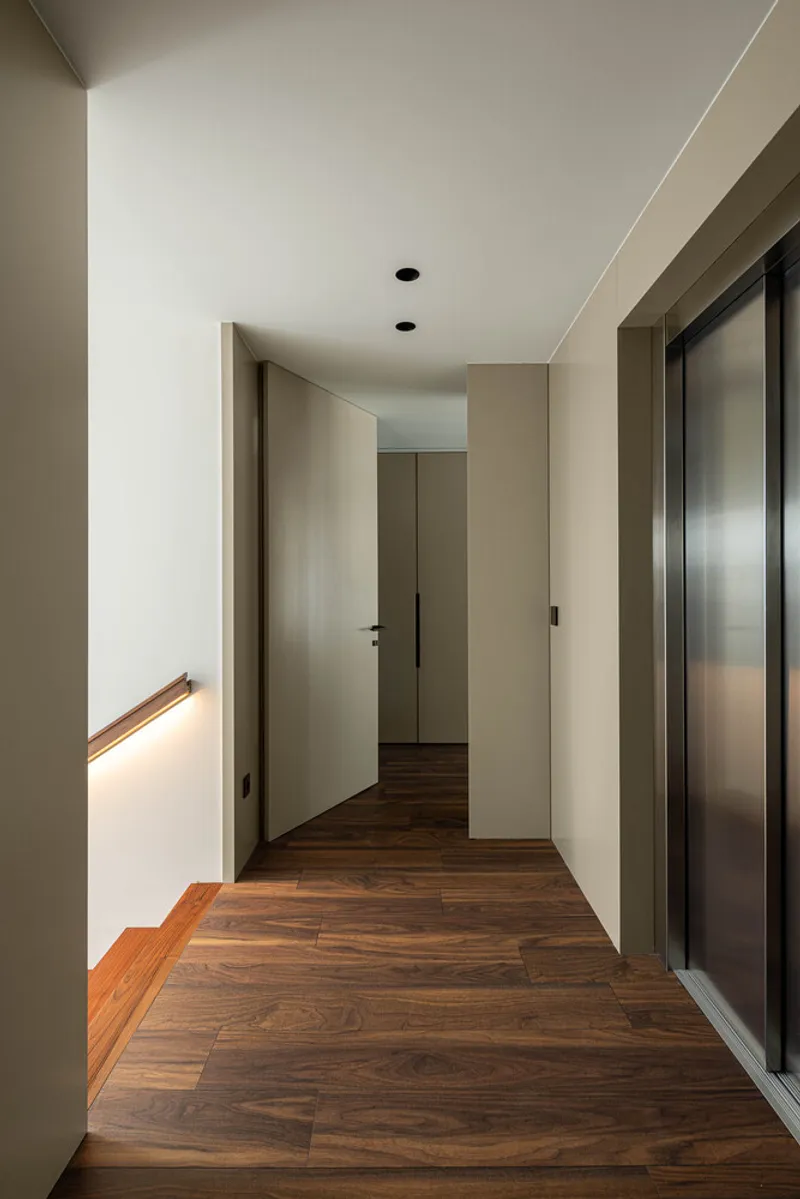
Circulation in a four-level building on a steep slope has to work hard. SA House uses an open-tread timber staircase as its primary vertical connector, lit from below by indirect strips that make the treads appear to float. The staircase is narrow and efficient, consistent with the architect's stated goal of minimizing circulation area on every floor.
A steel elevator door visible in the corridor photograph suggests that accessibility was not an afterthought. Dark timber flooring and flush panel doors in the corridor keep the private zones quiet and restrained, a deliberate contrast to the expansiveness of the social floor below. The shift in mood between public and private levels is handled through proportion and material tone rather than any dramatic architectural gesture.
Private Quarters and the Garden Connection
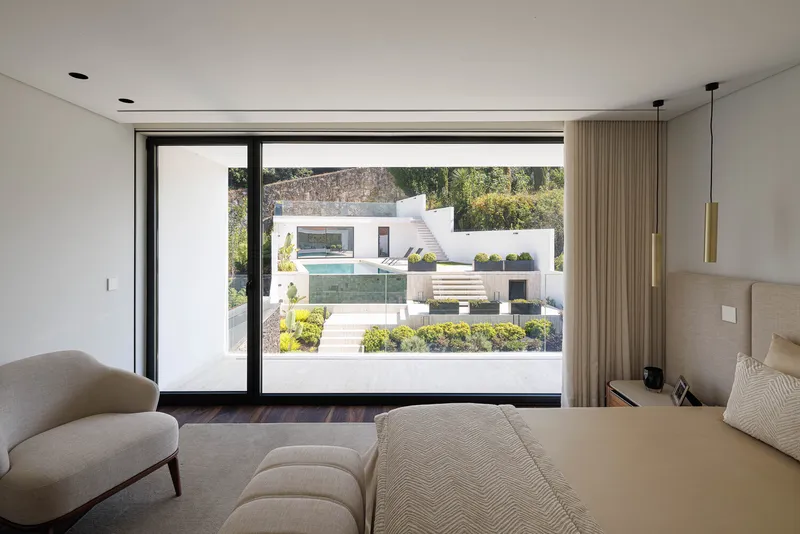
The top floor bedrooms are set back from the street, which achieves two things at once: it reduces the building's apparent mass on the elevation, and it gives the private quarters an unobstructed east-facing orientation toward the garden and pool. Full-height glazed doors in the primary bedroom frame the terraced landscape as a single composition, with the pool visible below and planted beds stepping down the slope.
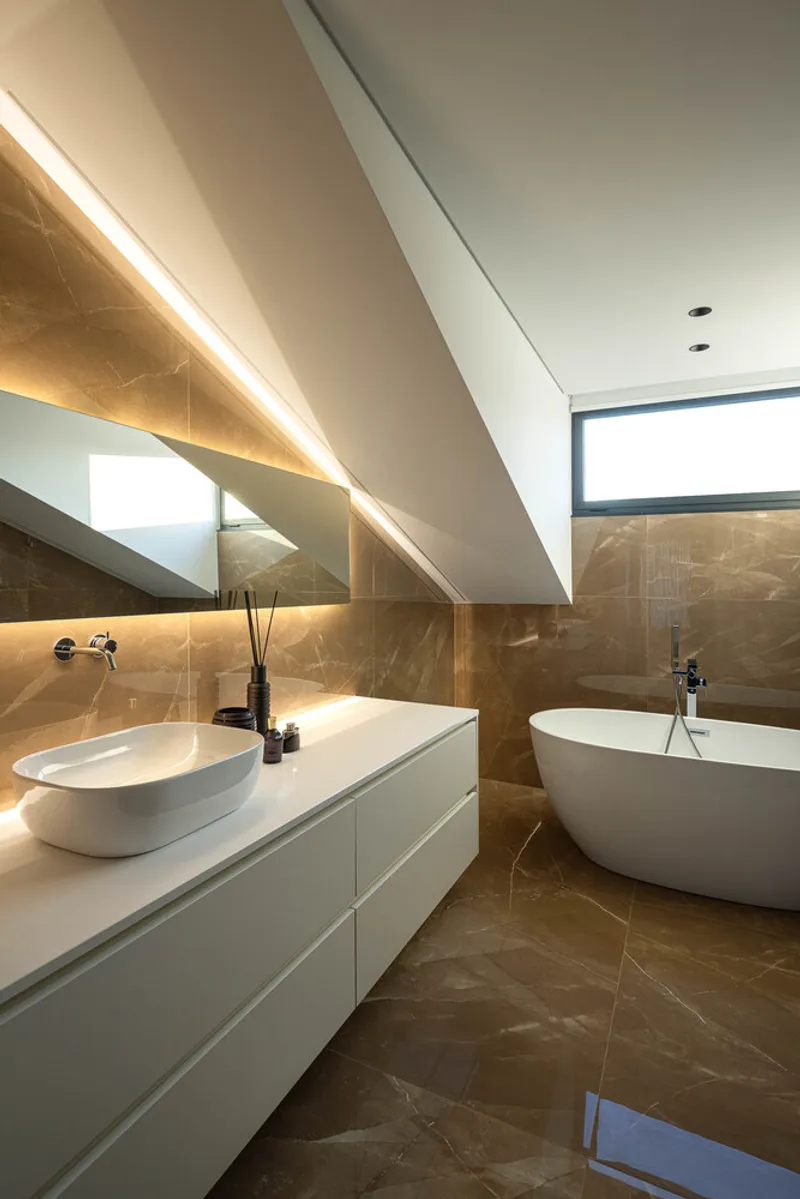
The bathroom, tucked under a sloped ceiling, uses brown marble wall tiles, a freestanding tub, and a backlit mirror to create a space that feels deliberately calm. It is compact but not cramped, another instance of the project's commitment to spatial economy. Every square meter earns its keep.
The Terraced Garden and Pool
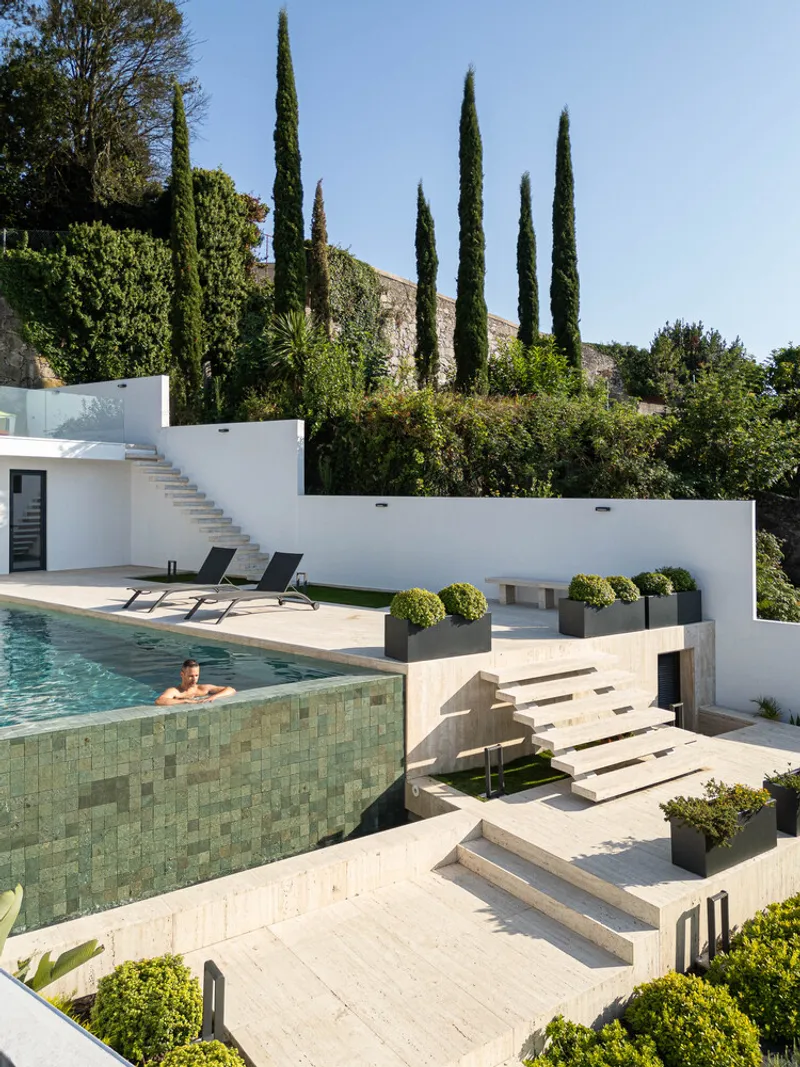
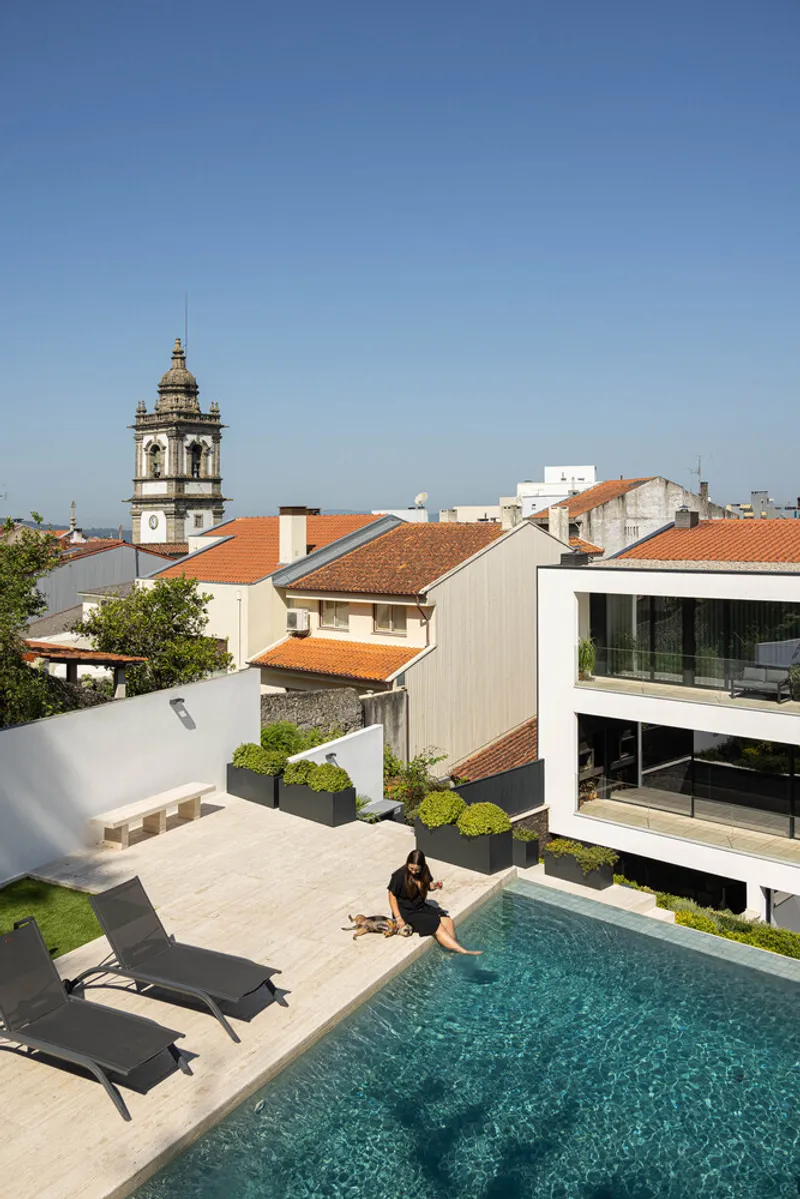
The outdoor sequence is the project's most ambitious spatial move. From the social floor, a sloped garden descends through stone steps and planted beds to a pool clad in green mosaic tile. Landings at intervals create pauses in the descent, turning a purely functional grade change into a choreographed experience. At the top, a rooftop terrace with the pool offers views toward a church bell tower, placing the house firmly within Braga's urban skyline.
Outdoor living in a dense city center is often reduced to a balcony and a planter box. Here, the ten-meter gradient is leveraged into a genuine garden that feels private despite its urban context. Walls and vegetation screen neighbors, while the terraced geometry ensures that every level of the house participates in the landscape rather than simply overlooking it.
Why This Project Matters
SA House is a demonstration that difficult urban sites, the steep ones, the narrow ones, the ones wedged between party walls, are precisely where inventive residential architecture thrives. The ten-meter slope could have produced a building that fights its context at every turn. Instead, Sandro Ferreira Arquitectura used the gradient to generate a clear sectional logic: each level has a purpose, a relationship to light, and a connection to the garden that would not exist on a flat lot. The constraint produced the design.
The material strategy is equally disciplined. Travertine, walnut, and slate are not unusual choices, but their continuity across interior and exterior thresholds gives SA House a coherence that many multi-unit urban buildings lack. Combined with the facade's controlled rhythm of openings and the generous outdoor program, the project offers a convincing argument that density and domestic comfort are not competing values. They are, when the architecture is this carefully considered, the same thing.
SA House, designed by Sandro Ferreira Arquitectura. Braga, Portugal. 845 m². Completed 2024.
About the Studio
Share Your Own Work on uni.xyz
If projects like this are the kind of work you want to make, uni.xyz is a place to publish your own, find collaborators, and enter design competitions.




Popular Articles
Popular articles from the community


Co-life: Sustainable Architecture for Age-Friendly Community Living
Co-life reimagines sustainable architecture for seniors through courtyards, rammed earth, shared gardens, and spaces designed for belonging.

The Musturak Paradise: Senior Living Architecture for a Connected Future in Temara, Morocco
The Musturak Paradise reimagines senior living architecture in Temara via private homes, social spaces, culture, community, and shared care.

Conexión: Biophilic Design Reimagines High-Rise Living in Hong Kong
Conexión reimagines high-rise living in Hong Kong through biophilic design, green facades, shared spaces, daylight, water and nature within.

Riyadh For All: Intergenerational Urban Design for Active Aging in Rabat
Riyadh For All reimagines urban design in Rabat with intergenerational co-living, adaptive courtyards, and Moroccan cultural exchange today.


Similar Reads
You might also enjoy these articles

Bamboo Housing Challenge 2026: Design Affordable, Sustainable Homes Using Bamboo
An international design competition by Bamboo U and IBUKU inviting architects and designers to reimagine affordable housing using bamboo — with the winning design built full-scale in Bali.

Computational Design & Education: Beegraphy Design Awards Introduces 7th Category (Featuring Jiyun's Innovative Approach)
Dive into Beegraphy’s 7th Design Awards category, where computational design meets education to create immersive, interactive learning tools, inspired by Jiyun’s work.

From Parametric Lighting to Urban Furniture: Join the 2nd Workshop in Beegraphy’s Computational Design Series
Dive into Cutting-Edge Design Techniques and Practical Applications with Industry Experts

Last Call: Unleash Your Architectural Genius in SHAK's Kindergarten Design Competition
Urgent call for architects to join SHAK's kindergarten design competition before the looming deadline


Explore Architecture Competitions
Discover active competitions in this discipline



Challenge to reimagine the Iron Throne


Photograph architecture without architects


Illustrate the lost glory of Angkor Wat - Render Challenge


Design challenge to reuse E-waste
Comments (0)
Please login or sign up to add comments
No comments yet. Be the first to comment!