

Tetris: A Modular Park Where Visitors Build the Space They Need
Fachwerk-inspired path grids and mobile wooden modules let an intergenerational community reshape four activity zones at will.


What if a park worked like a puzzle, where every visitor could rearrange the pieces? "Tetris" takes its name literally: lightweight wooden and plastic modules on wheels can be stacked, grouped, and inserted into fixed structures, turning a single green space into a sports court one morning and an open-air amphitheater by afternoon. The concept collapses the distinction between designer and user, handing spatial authority to the people who actually occupy the park.
Designed by Sofa Gushchina and Юлия Дроздова, this entry was shortlisted in the Huddle competition. The project addresses a quiet but persistent failure of conventional park design: the assumption that a fixed layout can serve every generation, every season, and every social occasion equally well. Tetris refuses that premise and proposes a living framework instead.
A Fachwerk Grid That Keeps Everyone Connected
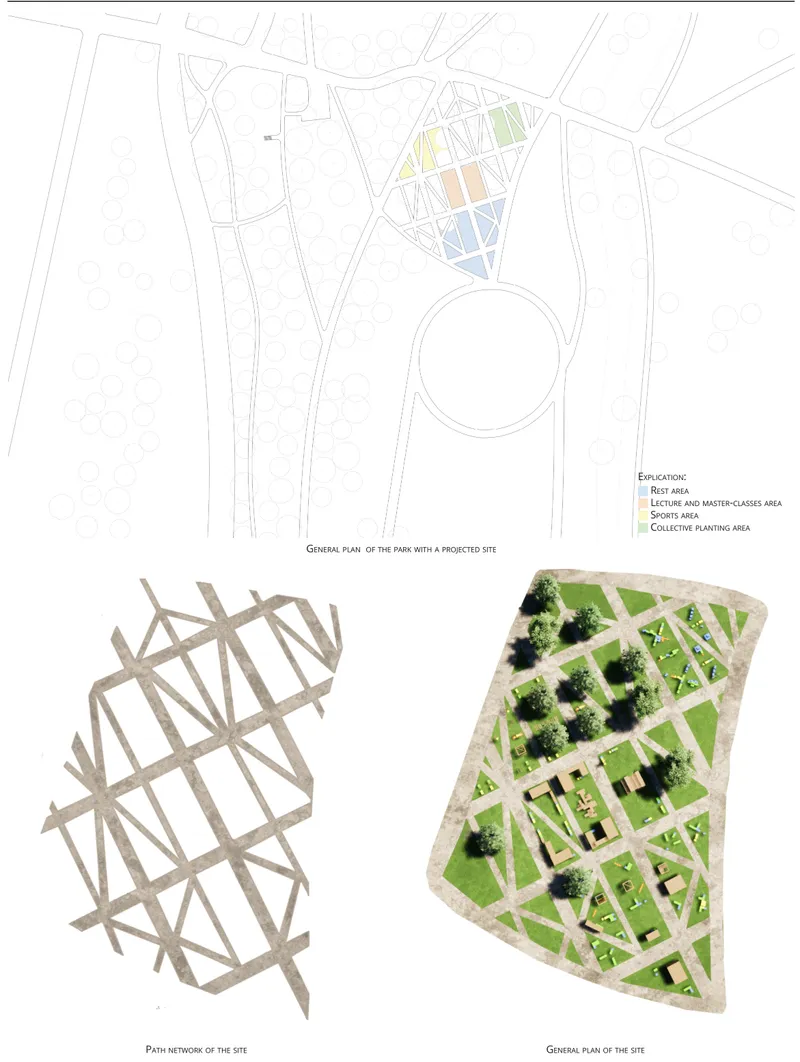
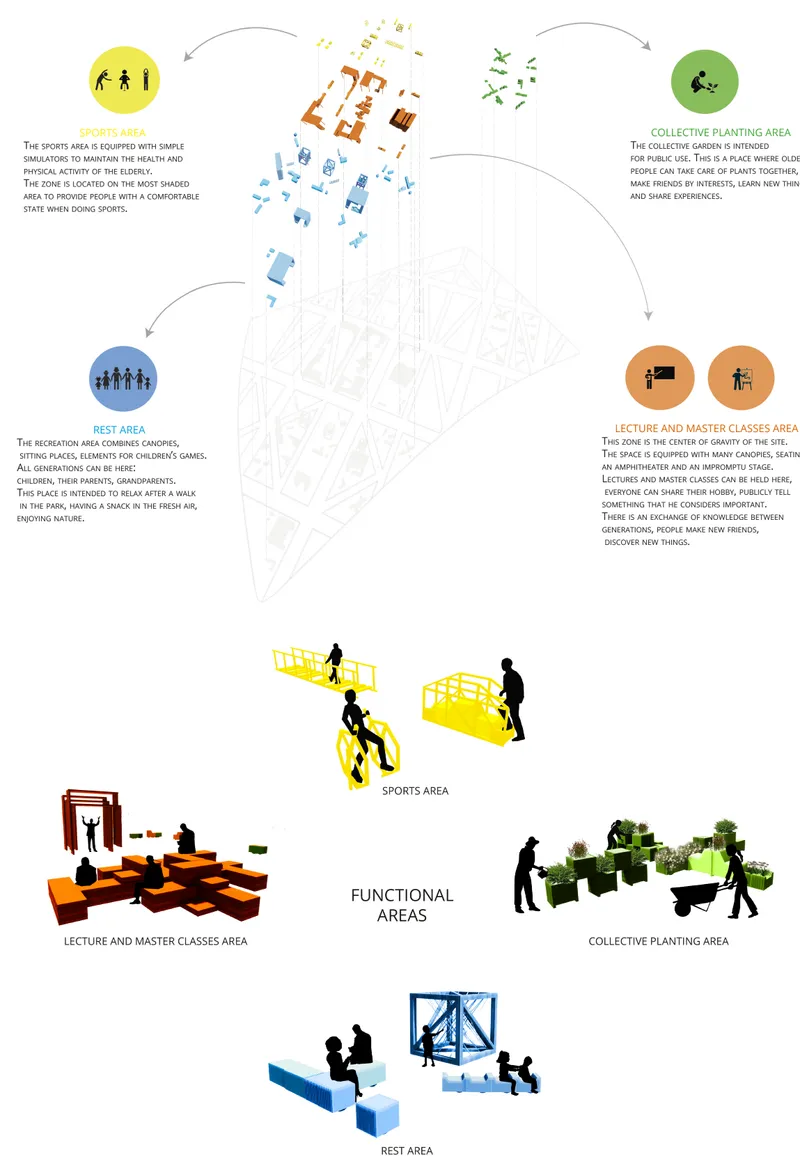
The plan's organizing logic comes from an unlikely source: the Fachwerk house, a traditional German timber-frame typology whose exposed structural grid becomes, here, a crisscrossing pedestrian network. The diagonal and orthogonal paths overlap to produce short, intuitive routes between every zone, a critical detail for elderly visitors who need frequent rest stops and clear sightlines. The site plan and circulation diagram reveal four color-coded functional areas (sports, lectures, rest, collective planting) mapped onto this grid, each distinct in program yet physically interconnected.
What the axonometric view makes clear is that this is not a decorative pattern imposed on the landscape. The grid generates buildable plots for modular elements while preserving mature tree canopy above. Paths double as stage edges, planting borders, and seating alignments, so the infrastructure does multiple jobs simultaneously.
Timber Pavilions Rooted in the Canopy
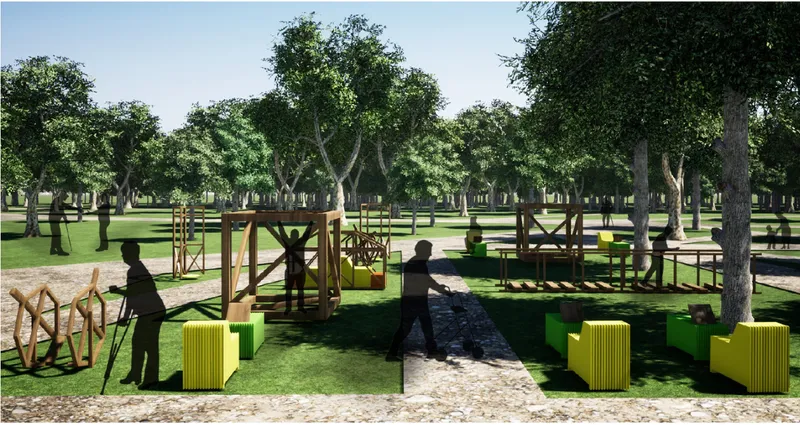
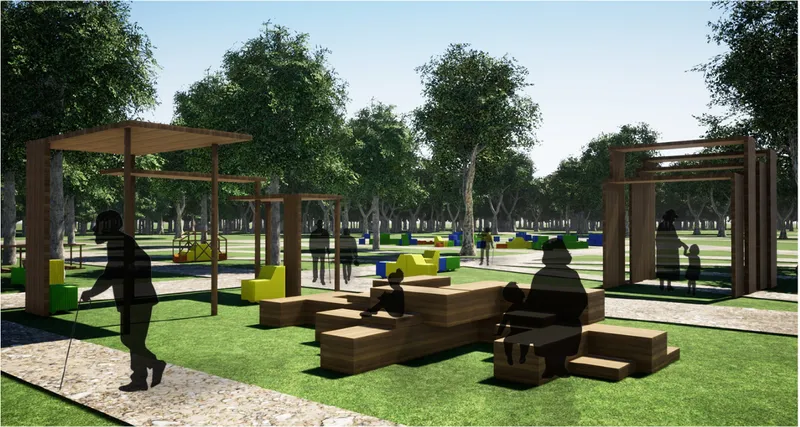
The rendered views show how the timber-framed pavilions sit beneath mature trees, their pergola structures filtering light rather than blocking it. Yellow and green seating elements appear to have been slotted into the frames, illustrating the modular insertion system at work. Stacked wood platforms function as bleachers, benches, or informal stages depending on arrangement, and the open sides of each pavilion ensure that sightlines and breezes pass through freely.
Material choices reinforce the project's ecological ambitions. Wood composites and plastic-wood hybrids keep the modules light enough to wheel around while offering outdoor durability. The structures read as crafted rather than industrial, an appropriate register for a park that asks its users to engage physically with the furniture.
Cantilevered Shelter and the Lecture Zone

One pavilion stands out for its cantilevered roof, which extends beyond the timber columns to shade a row of yellow bench seating without enclosing the space. This is the lecture and master-class zone, designed for dialogue, demonstrations, and intergenerational learning. The open-sided configuration means the pavilion can serve a seated audience of a dozen or expand outward when modules are wheeled in from adjacent zones. It is architecture that anticipates change rather than resisting it.
Colored Cubes, Planters, and the Tetris Logic
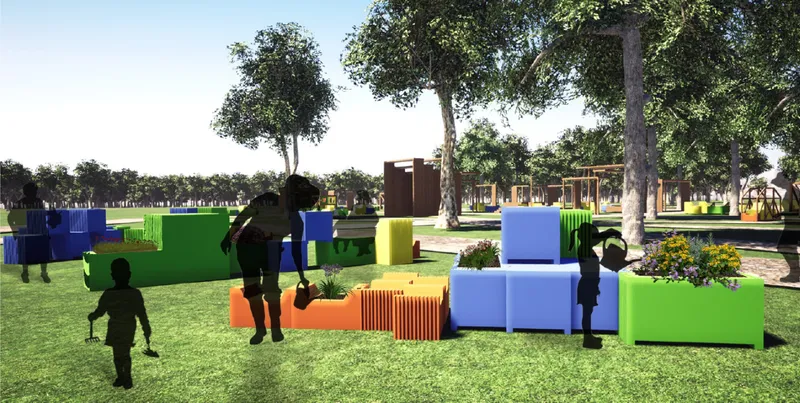
The final image crystallizes the project's core proposition. Brightly colored seating cubes and mobile planters sit on the grass in loose, user-determined clusters. No two arrangements need be the same. Children stack them into play forts; gardeners group planters into a collective growing patch; older visitors pull a bench into the shade. Adjustable heights and rolling mechanisms make each module accessible across ages and physical abilities, and the color coding ties back to the four programmatic zones, so even in their scattered state the modules carry spatial legibility.
Why This Project Matters
Most public parks are designed once and maintained forever, a model that treats communities as static populations with fixed habits. Tetris inverts that relationship by embedding adaptability into the architecture itself. The Fachwerk grid provides just enough structure to organize movement, while the modular system opens up nearly everything else to negotiation. The result is a park that can evolve weekly, seasonally, or hourly without any redesign.
Gushchina and Дроздова have proposed something more radical than a flexible layout. They have argued that the act of rearranging space is itself a social activity, one that generates the intergenerational encounters, ecological awareness, and community ownership that conventional parks hope to foster through programming alone. When the furniture becomes the program, design becomes a shared, ongoing conversation.
View the Full Project
About the Designers
Designers: Sofa Gushchina, Юлия Дроздова
Enter a Design Competition on uni.xyz
uni.xyz runs architecture and design competitions year-round that reward proposals with spatial conviction and real site intelligence.
Project credits: Tetris by Sofa Gushchina, Юлия Дроздова Huddle (uni.xyz).


Popular Articles
Popular articles from the community


graciastudio Turns a Viewless Tijuana Lot Inward Around a Courtyard of Concrete, Timber and Trees
In Tijuana, Jorge Gracia's GA2 House stacks a timber-clad private floor over exposed concrete and replaces a missing view with a planted interior patio.

FCC Arquitectura Expands a Portuguese Granite House with a Board-Marked Concrete Wing
In Portugal, JV House pairs a cleaned-up whitewashed and granite dwelling with a timber-shuttered concrete extension, courtyards and a garden pool.

Cube Design Draws an Ecological Corridor Between Two Shenzhen Hills with the Nankai Building
Beside Shenzhen's container docks, the Nankai Building pairs stacked balconies with a climbing green screen to connect two hillsides across its height.

David Ortega Stacks a Two-Story Mexico City Penthouse Around a Steel Stair and a Pergola-Shaded Roof Terrace
In Colonia Roma, a 300 m² penthouse uses oak joinery, a planted steel stair and a slatted roof pergola to make a new-build apartment feel like a house.

Similar Reads
You might also enjoy these articles


Vereda Arquitetos Renovates a 40-Square-Meter Apartment Inside Niemeyer's Copan Building
A compact unit in São Paulo's most iconic residential tower gets a material overhaul that pairs exposed concrete with bold blue Formica.

Shakur's House: Exposed Brick as an Interior Organiser in a 168 m² Mashhad Residence
Brick moves indoors in this Mashhad residence, where masonry walls, glass partitions and teal planes sequence a compact home without closing it off.

Day and Night Park: A Time-Based Urban Newsstand in Beijing
A temporary urban newsstand in Beijing blending travel, light, and reading through poetic colors, compact form, and community-focused design.

Modernist Patio Renovation in El Masnou, Barcelona by Oliver Segura Arquitectura + Cebrià Arquitectura
Modernist patio renovation blending tradition and innovation with a movable pool, leveled floors, and Catalan materials in El Masnou.


Comments (0)
Please login or sign up to add comments
No comments yet. Be the first to comment!