

Mohar: A Modular Seal That Stamps Jaipur's Ancient Grid onto Contemporary Public Space
Drawn from the city's 3x3 Prastara layout, a system of interlocking modules reimagines Jaipur's streets as adaptive civic infrastructure.


Every planned city carries a signature. For Jaipur, that signature is a 3x3 grid conceived in 1727 by Maharaja Sawai Jai Singh II, rooted in the Shilpa Shastra's cosmic geometry and rendered in terracotta pink sandstone. Nearly three centuries later, the question is not how to preserve that identity but how to propagate it: how to take the spatial DNA of bazaars, chowks, and mohallas and let it reproduce at the scale of a bench, a planter, a gathering node. Mohar answers by treating the grid itself as a mold, stamping its logic onto a modular furniture system that can populate streets, plazas, and parks without ever losing the city's rhythmic pulse.
Designed by Payoja KNS, Santosh Jadhav, Kanhai Gandhi, and KNS Architects, Mohar sits at the intersection of heritage urbanism and adaptable public infrastructure. The project takes Jaipur's original Prastara layout, the nine-block matrix that organized civic, commercial, and spiritual life into a walkable hierarchy, and distills it into a repeatable module. Each unit functions as a "seal" (mohar in Hindi), a microcosm of the larger urban form that can interlock, cluster, and reconfigure to serve seating, planting, play, and pause across wildly different street conditions.
Palace Facade as Civic Spine
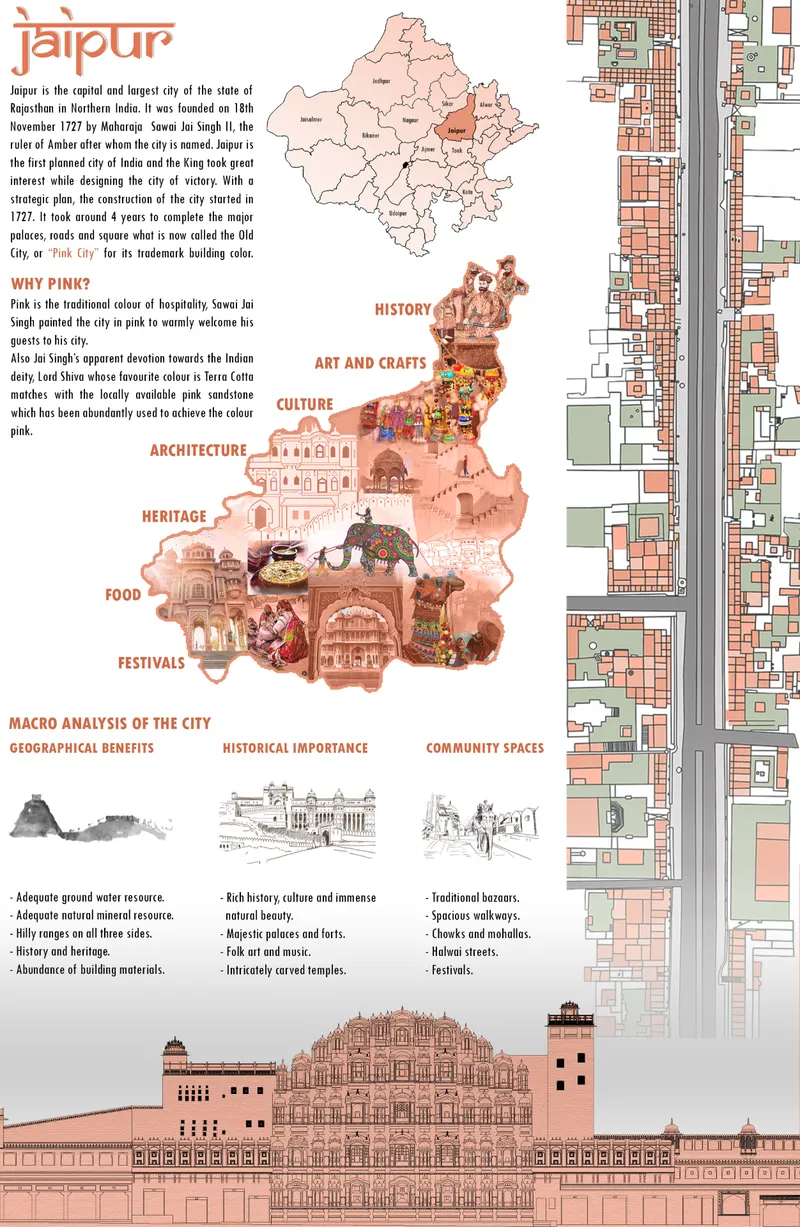
The illustrated site plan and elevation read like a palimpsest: the historic palace facade, with its layered jharokhas and rhythmic bays, is overlaid with program markers for cultural and civic functions. What the drawing makes explicit is the relationship between Jaipur's monumental architecture and its street life. The major north-south and east-west boulevards, the Rajmarg, intersect to form public nodes where markets, temples, and gathering spaces coexist. Mohar does not compete with this backdrop. Instead, it populates the foreground, inserting modular clusters into the gaps between monument and market where people actually linger.
From Single Unit to Urban Cluster
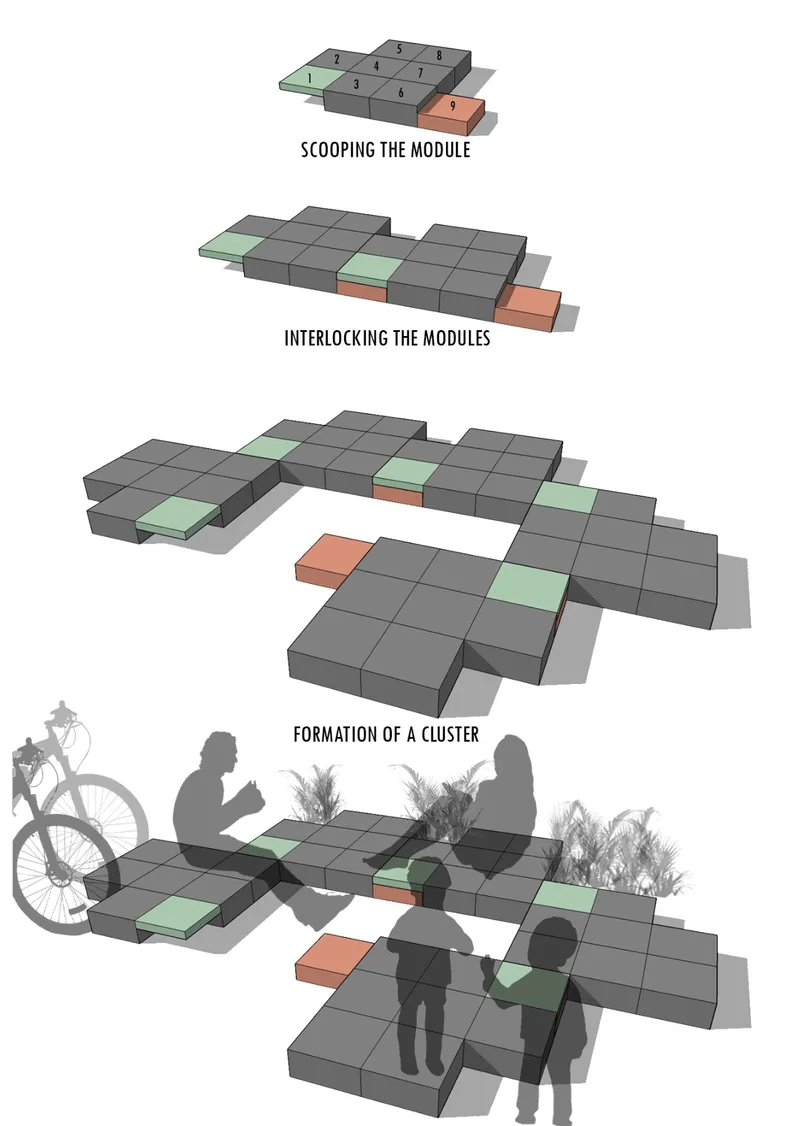
The axonometric sequence is the project's clearest argument. A single module, carved from the nine-block grid, is scooped to define space. Two modules interlock. Four form a cluster. Silhouetted figures stand among them, calibrating the scale: these are not sculptural objects stranded in a plaza but inhabitable geometries sized for the human body. The design team frames the logic in four principles: order, flexibility, efficiency, and harmony. Order comes from the grid inheritance; flexibility from the interlocking joints; efficiency from the hollow-pipe construction that doubles as structure and aesthetic texture; harmony from the fact that every configuration echoes the rhythm Jaipur is already built on.
The modular system's real power lies in its scalar ambiguity. The same cluster that fills a narrow bazaar passage can expand into an open chowk without redesign. Function shifts with arrangement: a tight linear formation becomes seating along a market edge, a radial grouping becomes a social node around a tree, a loose scatter becomes rest stops in a park. The module is the vocabulary; the sentence changes with the site.
Perforated Brick Meets the Bazaar Edge
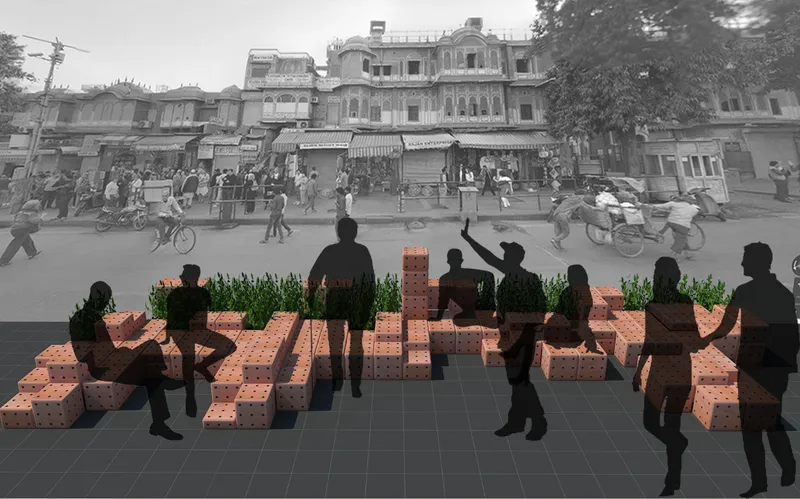
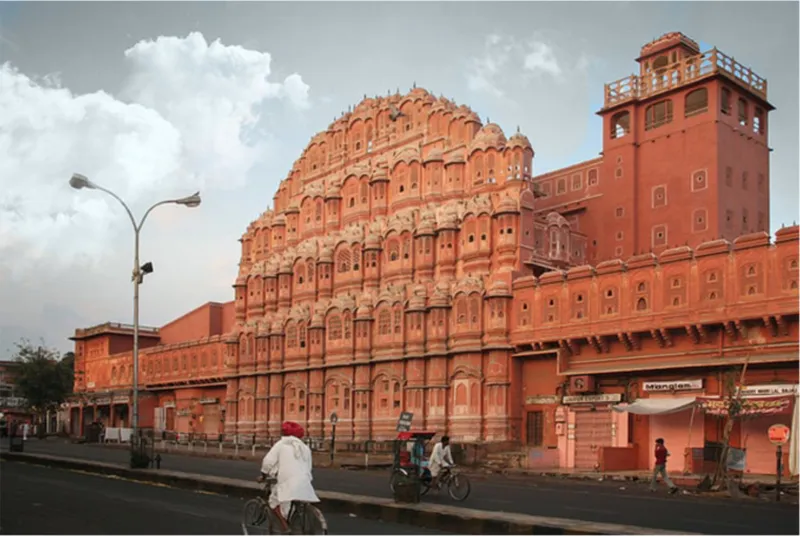
Two renderings ground the module in Jaipur's daily life. The section view shows perforated brick seating clusters with integrated planters facing a busy street market, vendors' awnings just visible beyond. The material choice matters: interlocking hollow pipes form both the structural skeleton and the perforated surface, allowing air and light to pass through while evoking the jali screens that punctuate Rajasthani architecture. The honeycomb sandstone facade in the street view reinforces this reading. Cyclists and pedestrians pass under overcast skies, and the modules sit naturally against a palette that already favors warm, porous stone. Pink is not decoration here; it is geology, hospitality, and continuity compressed into a single hue.
After Dark and Among Trees
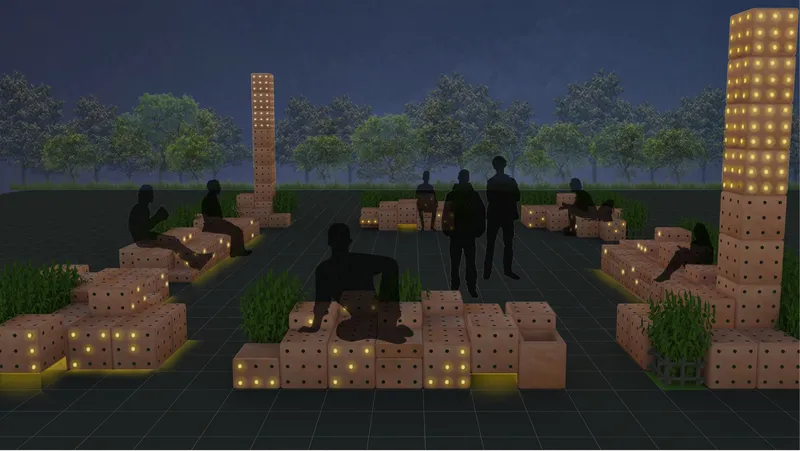
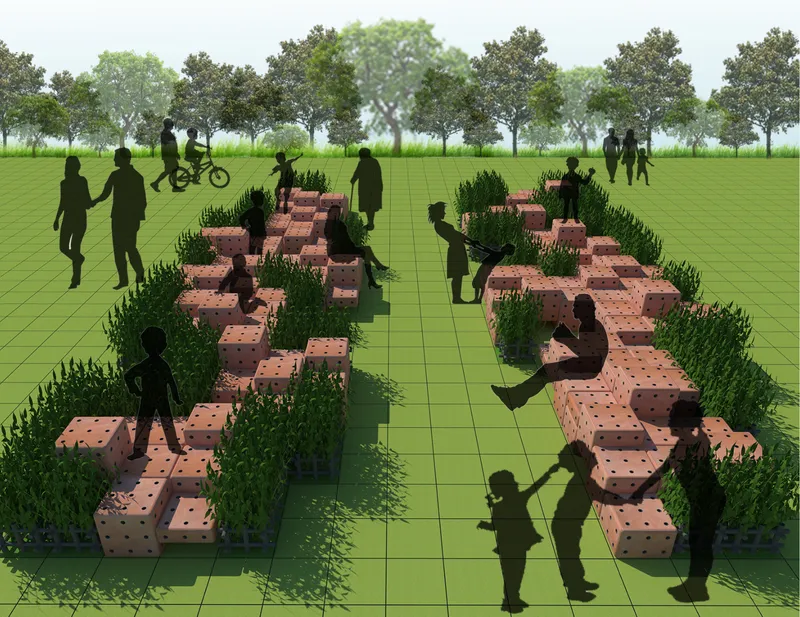
The night rendering reveals a dimension the daytime views cannot: the perforated modules become lanterns. Light escapes through hollow-pipe openings, casting patterned shadows on the ground and drawing figures into a tree-lined plaza. The effect transforms functional street furniture into wayfinding infrastructure, marking gathering points without signage. In the park rendering, the same modules appear among hedges and mature trees on an open green lawn, their geometric precision set against organic planting. Figures sit, walk, pause. The clusters do not dominate the landscape; they punctuate it, offering moments of rest within a continuous green field.
Both scenes demonstrate the system's contextual range. A hard urban plaza and a soft parkland demand different atmospheres, yet the module adapts without formal alteration. The brick materiality warms under sunlight and glows under uplighting. The planter pockets sustain greenery in both conditions. It is the same vocabulary producing two distinct spatial sentences, which is precisely what a modular system should do.
Why This Project Matters
Heritage cities worldwide face a recurring dilemma: how to introduce contemporary public infrastructure without flattening the spatial character that made the city legible in the first place. Mohar sidesteps the usual solutions (pastiche on one hand, generic stainless-steel benches on the other) by extracting the city's organizational principle rather than its ornamental surface. The 3x3 grid is not a motif to be appliquéd; it is an operating system that generates form, function, and rhythm simultaneously. That distinction elevates the project from street furniture design to genuine urban strategy.
What Payoja KNS, Santosh Jadhav, Kanhai Gandhi, and KNS Architects have produced is a transferable method as much as a product. The module's logic could, in theory, be re-derived from any city's foundational geometry, making it a template for identity-driven public design far beyond Rajasthan. For Jaipur specifically, though, the gesture is poetic: a mohar is a seal of authenticity, and this project presses that seal into the everyday ground plane where residents and visitors actually live.
View the Full Project
About the Designers
Designers: Payoja KNS, Santosh Jadhav, Kanhai Gandhi, KNS Architects
Enter a Design Competition on uni.xyz
uni.xyz runs architecture and design competitions year-round that reward proposals with spatial conviction and real site intelligence.
Project credits: Mohar' - Redefining Identity by Payoja KNS, Santosh Jadhav, Kanhai Gandhi, KNS Architects.


Popular Articles
Popular articles from the community


U.GA Architects Wraps an Oval Rooftop Pool in Curved Board-Formed Concrete on Busan's Jeollidan-gil
In Busan's Jeonpo-dong, a 454 m² mixed-use block stacks a neighborhood facility, guest rooms and an oval rooftop pool inside spiraling concrete walls.

LT2A and OPEN Architectes Thread a Brick and Glass High School Through a Wooded Belgian Campus
In Braine-l'Alleud, a 3,000 m² wing for Collège Cardinal Mercier pairs pale brick with a glazed colonnade, deferring to a small chapel and a dense wood.

Jaramillo Van Sluys Arquitectura and Urbanismo Turn a Demolished Registry Lot in Quito into an Orchard Plaza
In Quito's Centro Histórico, a 2,800 m² plaza exposes the San Agustín convent wall and redraws its lost Augustinian orchard in volcanic stone.

David Macias Steps a Doorless Stone and Plaster House Down a Tropical Colombian Hillside
In the humid hills of Colombia, Threshold House replaces the front door with an open void and terraces its 850 m² down the slope instead of fighting it.

Similar Reads
You might also enjoy these articles

Yenisei Monitoring Center: A Sun-and-Moon Sphere Anchors a Research Campus on Siberia's Great River
In Krasnoyarsk, shifting square blocks, a glazed central sphere and descending window rhythms turn river science into a public spectacle on the Yenisei.
Andretta Artist's Village: A Node-Based Masterplan That Lets the Hills Write the Plan
A cultural landscape strategy for Palampur's artist colony threads studios, residences and stages along a porous spine shaped by the Dhauladhar terrain.
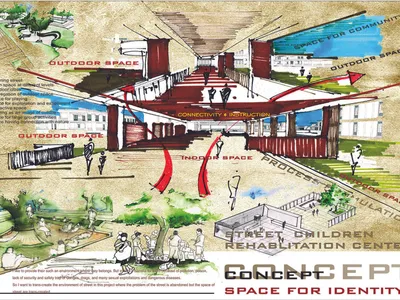
Street Children Rehabilitation Center: A Brick Campus That Eases Children From Street to Safety
A low-rise courtyard campus where learning streets, uthans and shaded verandahs stage a gradual passage from street into protective, family-scale life.

The NEON Culture: A Field of Pavilions Built for the 24-Hour City
Smaran Alva spreads galleries, stages, clubs and markets across a varied site, treating light, sound and ramped movement as the real building materials.

Explore Urban Design Competitions
Discover active competitions in this discipline

Design challenge to equip cities with modern furniture

Challenge to reimagine the Iron Throne

Photograph architecture without architects

Illustrate the lost glory of Angkor Wat - Render Challenge
Comments (0)
Please login or sign up to add comments
No comments yet. Be the first to comment!