

What will be living on the Moon in the future look like in the 100th anniversary of Artemis program?
Artemis Centenary Design Competition - Moon Base 2124


In 1969, the Space Race peaked with the successful Apollo 11 mission, which allowed the first man to walk on the moon.
Between 1969 and 1972, there have been six successful manned missions to the Moon, all from the USA. In total, 12 people (all male) have walked on the lunar surface.
Nobody has ever walked on the surface of the Moon since 1972.
Today, nearly half a century later, new technological advances and a renewed desire for space exploration have ignited a new race. Attention is moving back to the Moon. This time, however, we are tired of just walking… what we want is to inhabit! Space Architecture is becoming a growing field with the desired outcome to kick-start space tourism, expand our scientific knowledge, and ultimately make mankind a multi-planetary / galactic species.
The Artemis program is an ongoing crewed spaceflight program carried out predominately by NASA, U.S. commercial spaceflight companies, and international partners such as the European Space Agency (ESA), the Japan Aerospace Exploration Agency (JAXA), and the Canadian Space Agency (CSA) with the goal of landing "the first woman and the next man" on the Moon, specifically at the lunar south pole region by 2024. NASA sees Artemis as the next step towards the long-term goal of establishing a sustainable presence on the Moon, laying the foundation for private companies to build a lunar economy, and eventually sending humans to Mars.
The Moon Base competition 2124 asks architects and engineers “What will be living on the Moon in the future look like in the 100th anniversary of Artemis program?”
We challenge students, architects, designers, scientists, and visionaries to propose ideas on how the lunar settlement in 2124 would be constructed. Ideas could be realistic, actually analyzing how we may live on the Moon in the next 104 years, or creative fantasies of how the Moon can serve the human race. Moonbase 2124 consists of the planning and design of a phase three colonization on the Moon to support a resident staff of a minimum viable population of 160 people. The primary purpose of Moon Base 2124 is to provide a permanent commercial, science, and technology development facility on the Moon.
The challenge here was to design a Self-sufficient, Self-sustaining lunar settlement with a closed-loop system and a modular nature designed for ease of future expansion, construction, and assembly. It will be much more advanced in achieving self‐sufficiency such as food production and regenerative life support. To be a stepping stone for outer space exploration (i.e. Mars).
The jury for the competition consisted of esteemed designers, professionals, and academicians from around the world. The Lead Jurors for the competitions were as follows:
Melodie Yashar, Co-Founder, SEArch+ / Space Exploration Architecture, New York, USA
Moon Hoon, Creative Director, MOONBALSSO / MOONHOON Architects, South Korea

Some of the Best of competition projects are:
Winning Project: Lunar Stalactite
By: Harshad Manglori & Siddanth Rao

Description: The Lunar Stalactite Colony is a Self-Sustained Habitat Research & Communications Station located beneath the Sinuous Rille. Encased within a lava tube, the sub-surface station hangs atop the roof of the cave beneath a crater opening. The sub-surface station provides a habitable environment with research and development facilities & leisure spaces.
----------------------
People’s Choice: ALGAL REALM
By: Praneeth Aashwinay, Preetham Bharadwaj & Abhijith Lakshman

Description: The project focuses on building a sustainable ecosystem using bioengineered algae to create an ecosystem which caters to the need of people living on the moon rather than depending on complex machinery.
--------------------
Editor’s Choice: Lunar Spiral
By: Misak Terzibasiyan

Description: Today we are standing on the eve of the year 2024, which is dedicated to the Artemis mission. A mission that will change our perspective on space exploration and will lay the foundation for future generations to travel to Mars. A mission that is the next step towards establishing long-term sustainable human habitation on the Moon.
--------------------
Editor’s Choice: Aitken
By: Polina Boldyreva

Description: The project is named after its location in Aitken - a large lunar impact crater that lies on the far side of the Moon. In accordance with the peculiarities of habitation - a daily temperature difference of 200 °C, radiation exposure - the space base is a closed self-regulating structure with the possibility of qualitative and quantitative changes over time.
Discover the design brief here: https://uni.xyz/competitions/moon-base-2124/info/about
Discover the full results here: https://uni.xyz/competitions/moon-base-2124/entries
Follow us on social media: Facebook | Instagram | LinkedIn | Twitter | Youtube
Discover other design competitions to participate here: https://uni.xyz/competitions


Popular Articles
Popular articles from the community


GROUP A Strips a 1969 Rotterdam Harbor Headquarters to Its Frame and Wraps It in Timber Louvers
In Rotterdam's M4H harbor district, Ferro Offices reuses a 1969 frame, adds one timber storey and reaches BREEAM-NL Outstanding.

LT2A and OPEN Architectes Thread a Brick and Glass High School Through a Wooded Belgian Campus
In Braine-l'Alleud, a 3,000 m² wing for Collège Cardinal Mercier pairs pale brick with a glazed colonnade, deferring to a small chapel and a dense wood.

David Macias Steps a Doorless Stone and Plaster House Down a Tropical Colombian Hillside
In the humid hills of Colombia, Threshold House replaces the front door with an open void and terraces its 850 m² down the slope instead of fighting it.

longwave studio Reorganizes a 112 m² Tainan Apartment Around the Daily Routines of a Family and Two Cats
In Tainan, Taiwan, birch plywood, rust-red furniture and a freestanding plaster wall link arrival, storage, work and family life in one apartment.

Similar Reads
You might also enjoy these articles


Aquadapt: An Underwater Habitat That Rewrites Its Rooms by the Hour
Curved modules ring the seabed while one shell shifts from breakfast room to cinema, farm and football pitch as residents' needs change.

Play: Fragments of Their World: Remembered Architecture Rebuilt as a Modular Playground for Refugee Camps
Tom Gardner abstracts domes, arches and towers from the homelands of displaced families into a kit of child-scaled play parts for camp settlements.
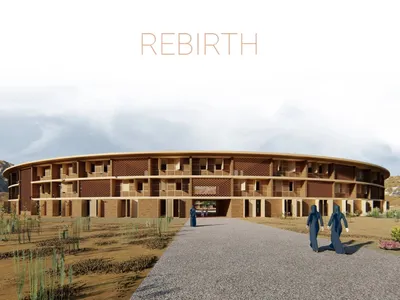
REBIRTH: A Circular Settlement Where Afghan Widows and Their Children Rebuild Life Together
A shortlisted Resile entry turns the circle into a protective ring of timber and brick, gathering homes, classrooms and gardens around a shared landscape.
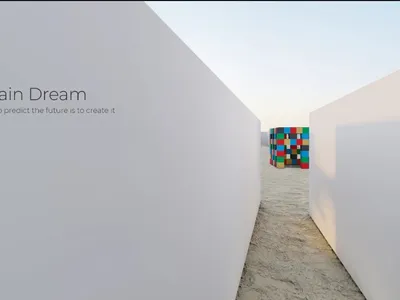
The Main Dream: A Recycled Plastic Kit That Lets Refugee Children Build Their Own Playground
Thirty-centimetre interlocking cubes that connect on three axes turn play into construction, letting children author the spaces they occupy.

Comments (0)
Please login or sign up to add comments
No comments yet. Be the first to comment!