
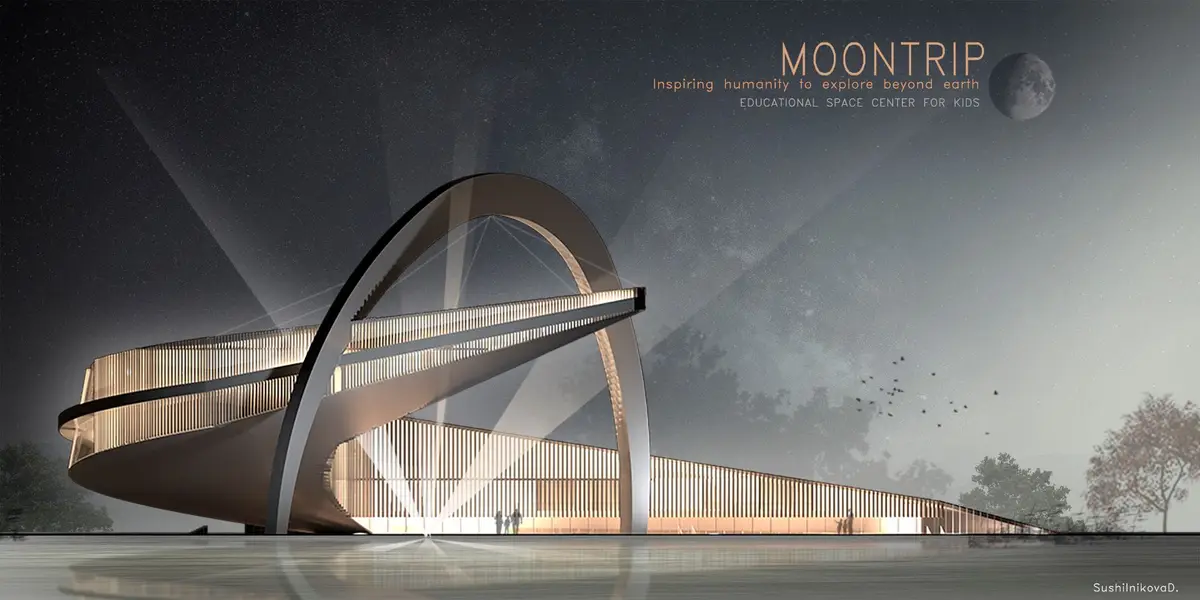
Moontrip: A Cable-Stayed Museum That Teaches Children Through Structure
Dora Sushilnikova's shortlisted entry reimagines the museum as a cantilevered learning landscape anchored by a concrete pylon and NASA-inspired forms.


Suspend a building from a single concrete pylon, wrap it in vertical louvers, and fill it with spacecraft models and circular skylights. What you get is not a conventional museum but a spatial argument: that structure itself can be a teaching tool. Moontrip takes the logic of a cable-stayed bridge and applies it to a children's museum, creating cantilevered volumes that seem to defy gravity, mirroring the weightlessness of the space exploration narrative housed within.
Designed by Dora Sushilnikova, this shortlisted entry in the Moontrip 2019 competition draws its formal vocabulary from the iconic NASA logo, translating its graphic energy into an architectural language of sweeping cantilevers, bold pylons, and terraced landscapes. The project pushes past the familiar tropes of children's museum design, proposing that young visitors learn not only from exhibits but from the building's own structural performance.
A Pylon and Its Cantilevers: Structure as Spectacle
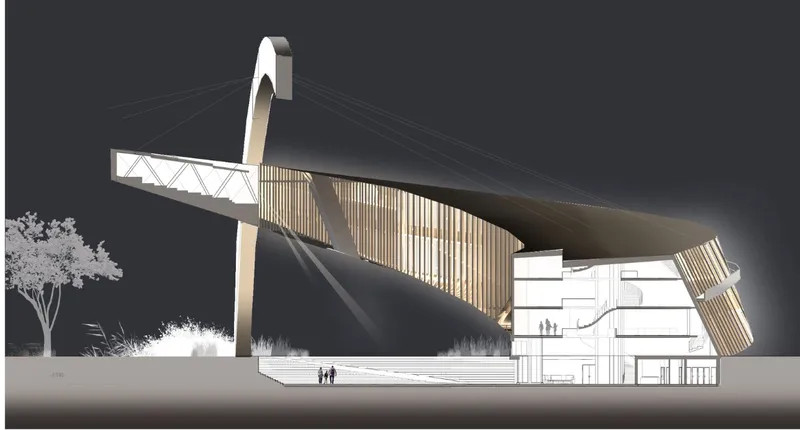
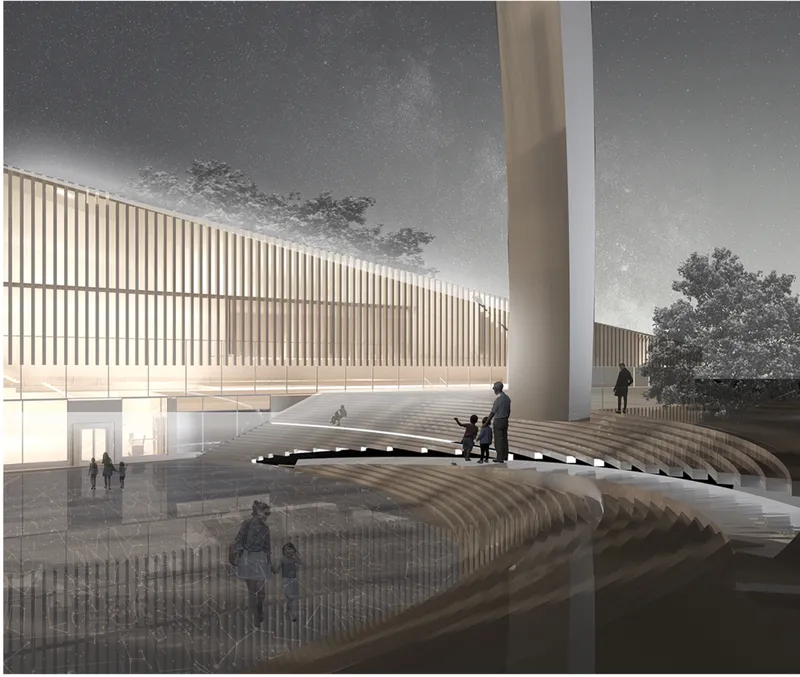
The section drawing reveals the project's structural ambition in a single glance. A cable-stayed tower rises as the building's spine, anchoring cantilevered volumes that extend outward like outstretched arms. Vertical louvers wrap the suspended forms, filtering light while giving the facade a rhythmic texture. Below, terraced spaces cascade down toward an interior courtyard, where stepped seating platforms gather beneath the louver screen and the concrete pylon. The courtyard becomes an outdoor classroom, a threshold between the engineered drama above and the grounded landscape below.
What makes this structural system pedagogically powerful is its visibility. Children don't need a placard to understand that something extraordinary is holding the building up. The cables, the pylon, the hovering mass: these are lessons in physics made tangible at architectural scale.
The Hovering Form Above the Lawn
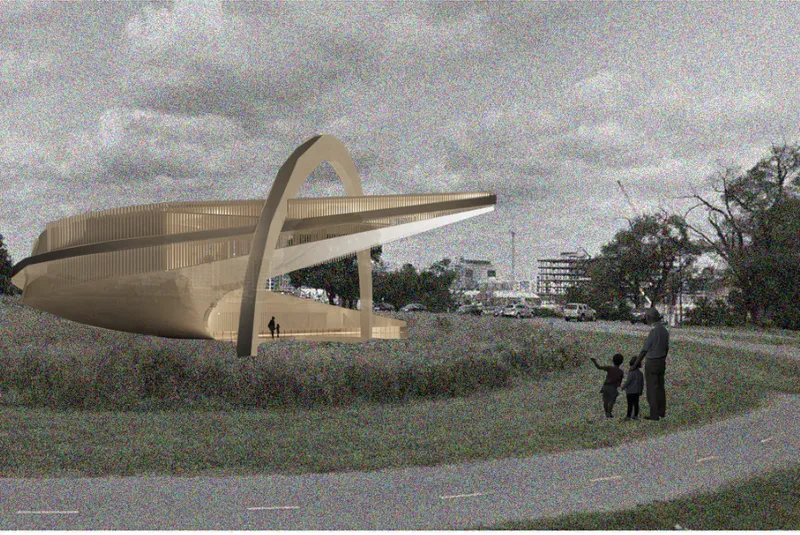
From the exterior, the building reads as two distinct conditions: a heavy concrete pylon planted firmly in the ground, and a suspended cantilevered volume that floats above an open lawn. The louver facade softens the mass of the upper form, breaking it into a screen of vertical lines that shift in density as you move around the building. The open ground plane beneath the cantilever is generous, inviting visitors to pass underneath and look up, experiencing the building's weight from the most dramatic vantage point. It is a deliberate inversion of the typical museum entrance sequence, where arrival happens under the building rather than in front of it.
Circular Light Wells and the Library Below
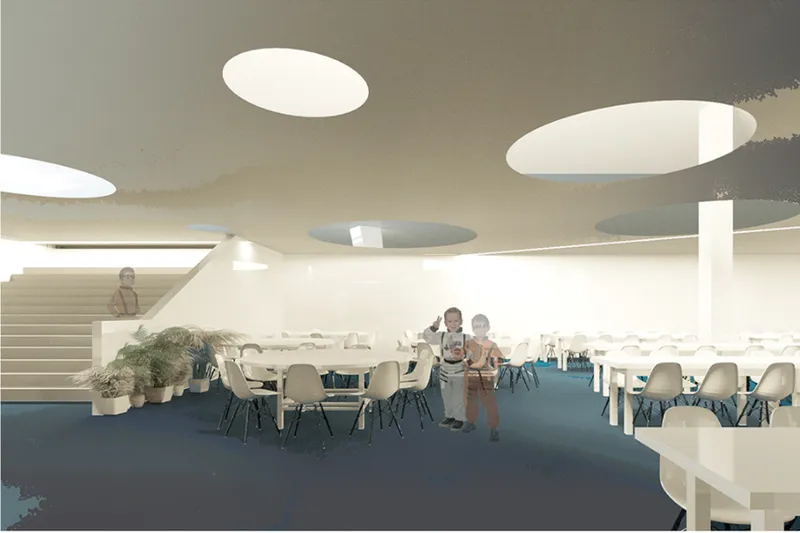
Inside, the project trades structural bravado for atmospheric warmth. The library space is defined by circular ceiling openings that pull daylight down into a room floored in blue carpet, where reading tables sit beneath indirect cove lighting. The geometry of these openings recalls portholes or planetary forms, reinforcing the space-travel narrative without resorting to literal decoration. It is a quiet room nested within a loud building, a necessary counterpoint.
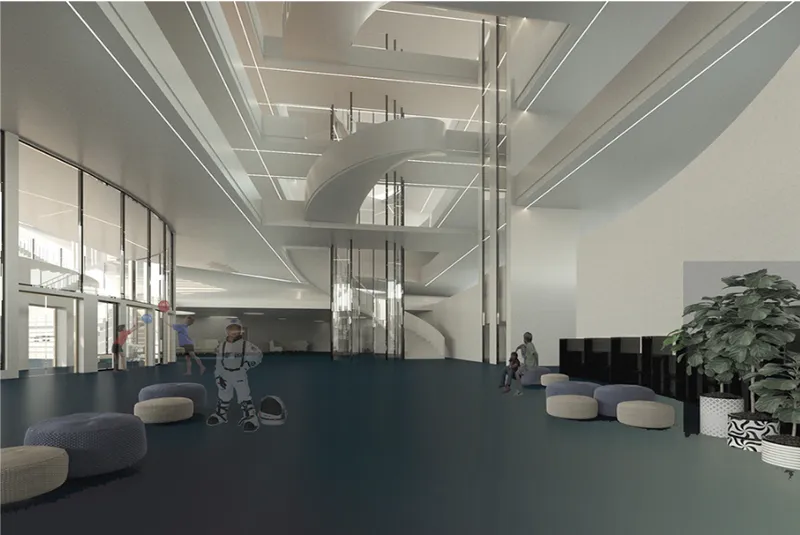
The double-height lobby amplifies the sense of arrival. Suspended glass elevator cores puncture the space vertically, while circular soft seating modules on the blue carpet ground the room at a child's scale. The material palette here, glass and concrete above, soft textiles below, creates a layered experience where the industrial and the domestic coexist. Young visitors can look up at the elevator shafts and understand vertical circulation as a visible event, not something hidden behind a wall.
Spacecraft Models and Terraced Timber: The Gallery as Theater
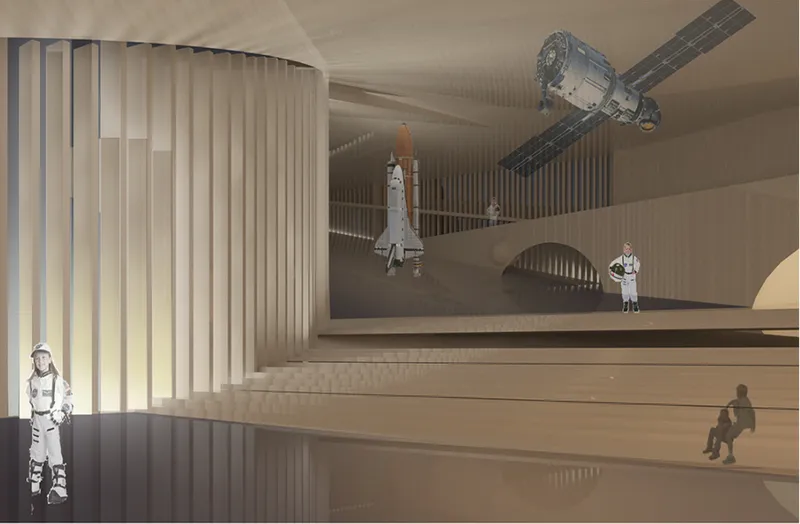
The gallery space is where the architectural and curatorial ambitions of Moontrip converge most convincingly. Suspended spacecraft models hang above terraced timber seating, turning the exhibit into a theatrical experience. Visitors sit on the steps and look up, their bodies positioned in the same orientation as astronauts during launch. A curved vertical louver screen wraps one edge of the gallery, providing both spatial enclosure and filtered sightlines to adjacent program. The terracing is a smart move: it eliminates the flat-floor fatigue that plagues conventional museums, replacing passive walking with active inhabitation.
Why This Project Matters
Children's museums too often rely on bright colors and cartoon graphics to signal that a space is "for kids." Moontrip refuses that shortcut. Sushilnikova instead trusts the architecture, its cantilevers, its cable-stayed logic, its circular light wells, to do the work of engagement. The result is a building that treats young visitors as capable of understanding structural forces, spatial sequences, and material contrasts, not because a label tells them to, but because the building makes those ideas physically unavoidable.
As a shortlisted entry in the 2019 competition, Moontrip demonstrates that educational architecture does not need to dumb itself down to reach younger audiences. Quite the opposite. By raising the architectural stakes, by making structure visible and space theatrical, Sushilnikova proposes a museum where the building itself is the most compelling exhibit.
View the Full Project
About the Designers
Designer: Dora Sushilnikova
Enter a Design Competition on uni.xyz
uni.xyz runs architecture and design competitions year-round that reward proposals with spatial conviction and real site intelligence.
Project credits: Moontrip by Dora Sushilnikova.


Popular Articles
Popular articles from the community


LT2A and OPEN Architectes Thread a Brick and Glass High School Through a Wooded Belgian Campus
In Braine-l'Alleud, a 3,000 m² wing for Collège Cardinal Mercier pairs pale brick with a glazed colonnade, deferring to a small chapel and a dense wood.

Juan García Correa, John González and Claudia Rueda Sink a Circular Amphitheater into a Manizales Engineering Building
On the La Nubia campus in Manizales, Colombia, the S1 Building folds labs and offices into a hillside of ramped lawns that double as a campus route.

David Ortega Stacks a Two-Story Mexico City Penthouse Around a Steel Stair and a Pergola-Shaded Roof Terrace
In Colonia Roma, a 300 m² penthouse uses oak joinery, a planted steel stair and a slatted roof pergola to make a new-build apartment feel like a house.

Architekt Andreas Gruber Scatters 23 Dark Timber Chalets Across a South Tyrolean Forest Edge
In Molini di Tures, Amonti Chalets breaks a resort into a hamlet of gabled timber houses, with parking, storage and services pushed into the slope.

Similar Reads
You might also enjoy these articles

Gil Mello Arquitetura Tilts a Single Roof Toward the Waterfalls on a Plateau Above Aiuruoca, Brazil
In Aiuruoca, Minas Gerais, a 200 m² house of local labor and reclaimed poles pairs a low valley veranda with a tall mountain one.

U.GA Architects Wraps an Oval Rooftop Pool in Curved Board-Formed Concrete on Busan's Jeollidan-gil
In Busan's Jeonpo-dong, a 454 m² mixed-use block stacks a neighborhood facility, guest rooms and an oval rooftop pool inside spiraling concrete walls.

Felipe Hess Arquitetos Turns a Blind Stone Wall to the Street and Opens a Brazilian House onto a Courtyard and Canal
A canal-front house in Brazil hides behind painted stone and planting, then opens to an olive-tree courtyard, a reed-ceilinged porch and a curving pool.

David Macias Steps a Doorless Stone and Plaster House Down a Tropical Colombian Hillside
In the humid hills of Colombia, Threshold House replaces the front door with an open void and terraces its 850 m² down the slope instead of fighting it.

Explore Moontrip Competitions
Discover active competitions in this discipline

Challenge to design luxury tourism on rails

VR headsets Storefront design competition

Designing a staircase for a client
Comments (0)
Please login or sign up to add comments
No comments yet. Be the first to comment!