
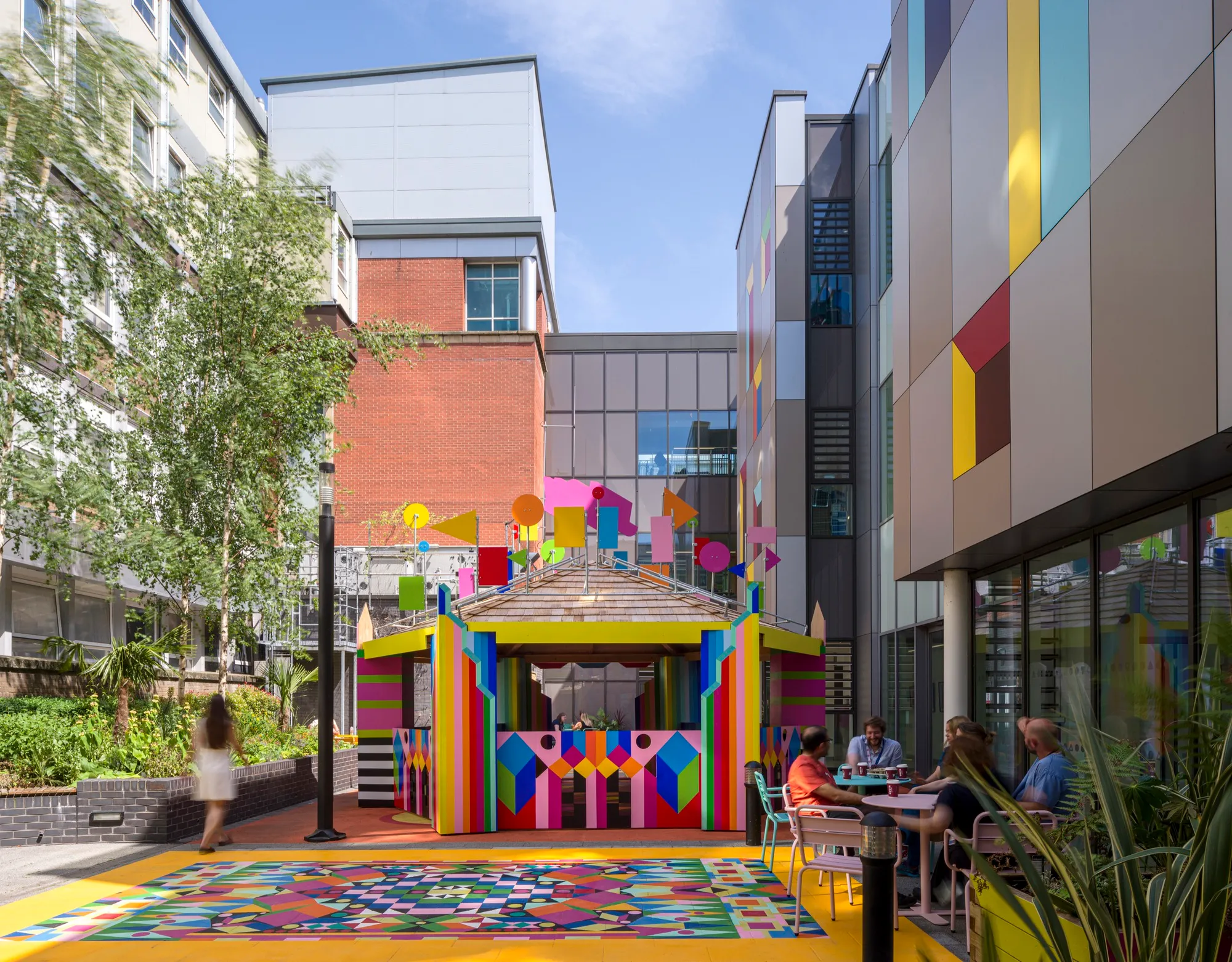
Morag Myerscough Fills a Sheffield Hospital Courtyard with Color, Wood, and Joy
A previously underfunded courtyard at Sheffield Children's Hospital becomes a secret garden of hand-painted timber and geometric ground murals.


Hospital courtyards are notoriously joyless. They tend to be afterthoughts, spaces that get squeezed out of the budget once the clinical interiors are sorted. That is exactly what happened at Sheffield Children's Hospital, where an extension designed by Avanti Architects in 2017 produced a courtyard with some colorful seating and planters but no real identity. The money had gone to more essential interior spaces, and the courtyard sat underused, a missed opportunity at the geographic heart of the building. Morag Myerscough was brought in to change that.
What arrived in 2022 is the Joy Garden Courtyard: a timber pavilion, geometric ground murals, extensive planting, and moveable furniture that together turn a leftover rectangle of paving into something closer to a secret garden. Myerscough is known for saturated color and bold pattern, but what makes this project interesting is the restraint of its construction. The pavilion is almost entirely wood, the shingles are hand-cut, the panels were painted by the artist herself in her workshop, and the fabrication was handled by Design Workshop Ltd, a Sheffield-based maker. The flamboyance of the surface sits on top of a genuinely modest, craft-led build.
A Pavilion Built Like Furniture


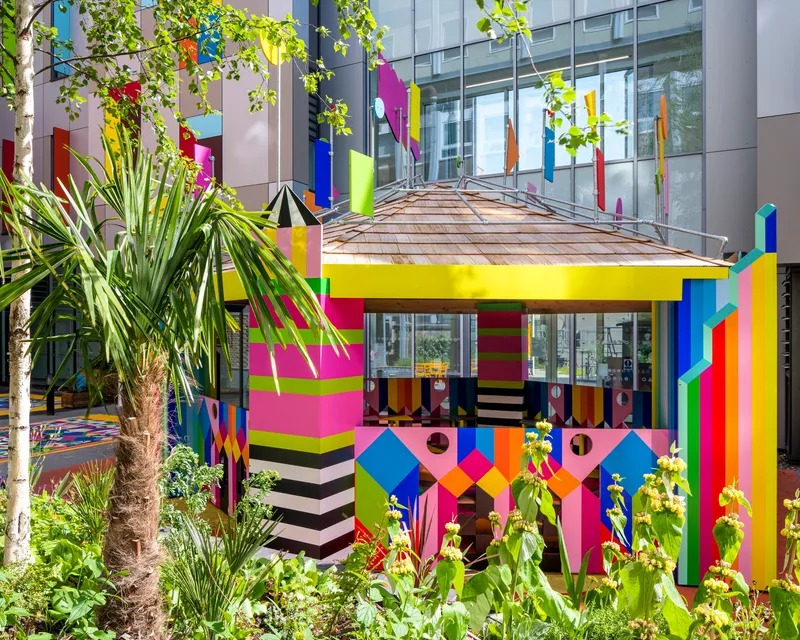
The Joy Pavilion is the anchor of the courtyard. Structurally it is a timber shelter: vertical striped columns hold up a slatted roof finished in hand-cut wooden shingles. There is no glass enclosure, no HVAC, no clinical ambition. It reads more like a large piece of furniture than a building, which is precisely the point. In a hospital environment governed by infection control protocols and institutional finishes, the pavilion offers a counter-atmosphere. It is tactile, open to the air, and deliberately impermanent in feeling.
The columns deserve a second look. Each one is painted in vertical stripes of varying width, a technique Myerscough has used across her career to dissolve the reading of structural elements into pure chromatic rhythm. Up close, you stop seeing posts and start seeing color fields. From across the courtyard, they frame views of the pavilion interior like a theater proscenium. The shingled roof adds a domestic note, a quiet texture above all the visual noise.
Interior as Immersion

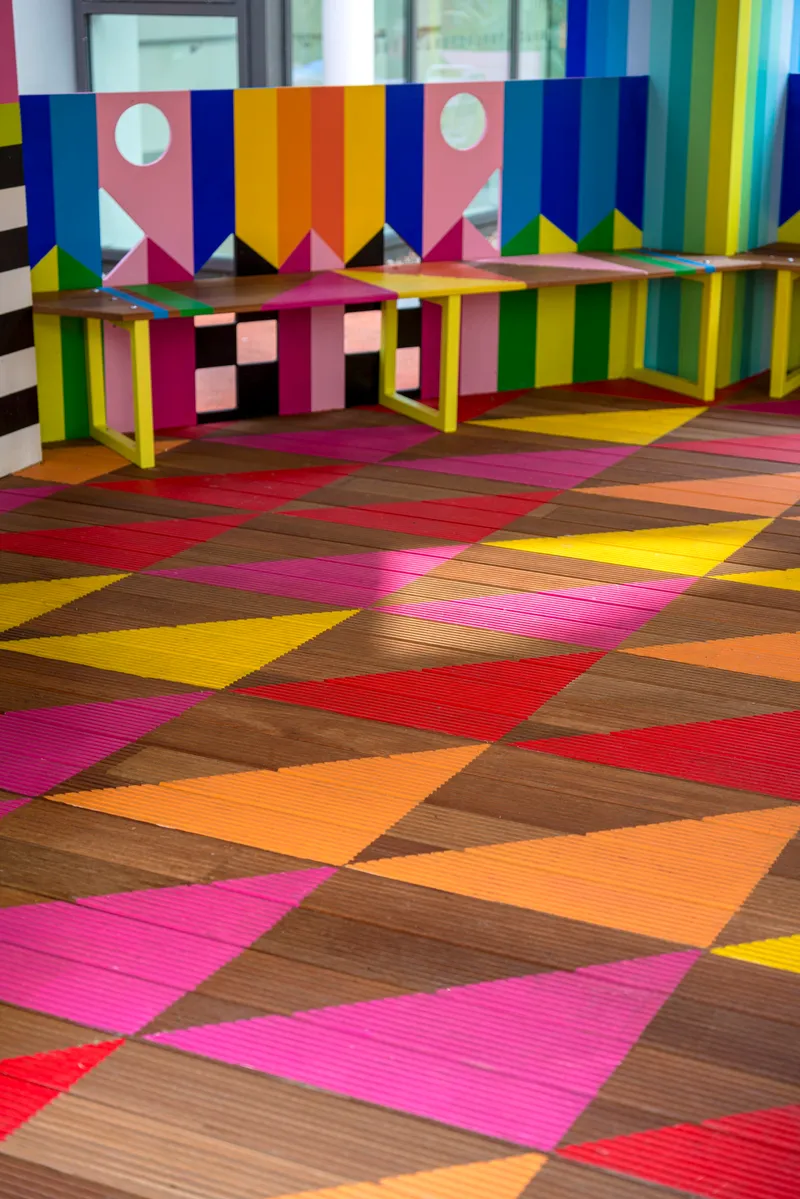

Step inside the pavilion and the color becomes total. Wraparound bench seating lines the perimeter, its panels painted in the same geometric vocabulary as the exterior. The decking runs in diagonal multicolored bands, each plank a different hue. Metal legs in bright yellow support the benches. The timber ceiling overhead provides a moment of calm, its natural grain offering a visual rest from the saturation below. It is a considered composition: warm wood above, maximum color at eye level and underfoot.
The overhead detail of the decking reveals just how labor-intensive the installation is. Each diagonal plank has been individually painted before assembly, creating a gradient effect that reads as a single coherent surface rather than a collection of boards. For a project completed with eco-friendly paint donated by YesColours, the finish is remarkably consistent. The space is designed for multiple uses: quiet solitude, small performances, workshops, or simply lunch away from a ward.
Ground Mural as Urban Carpet


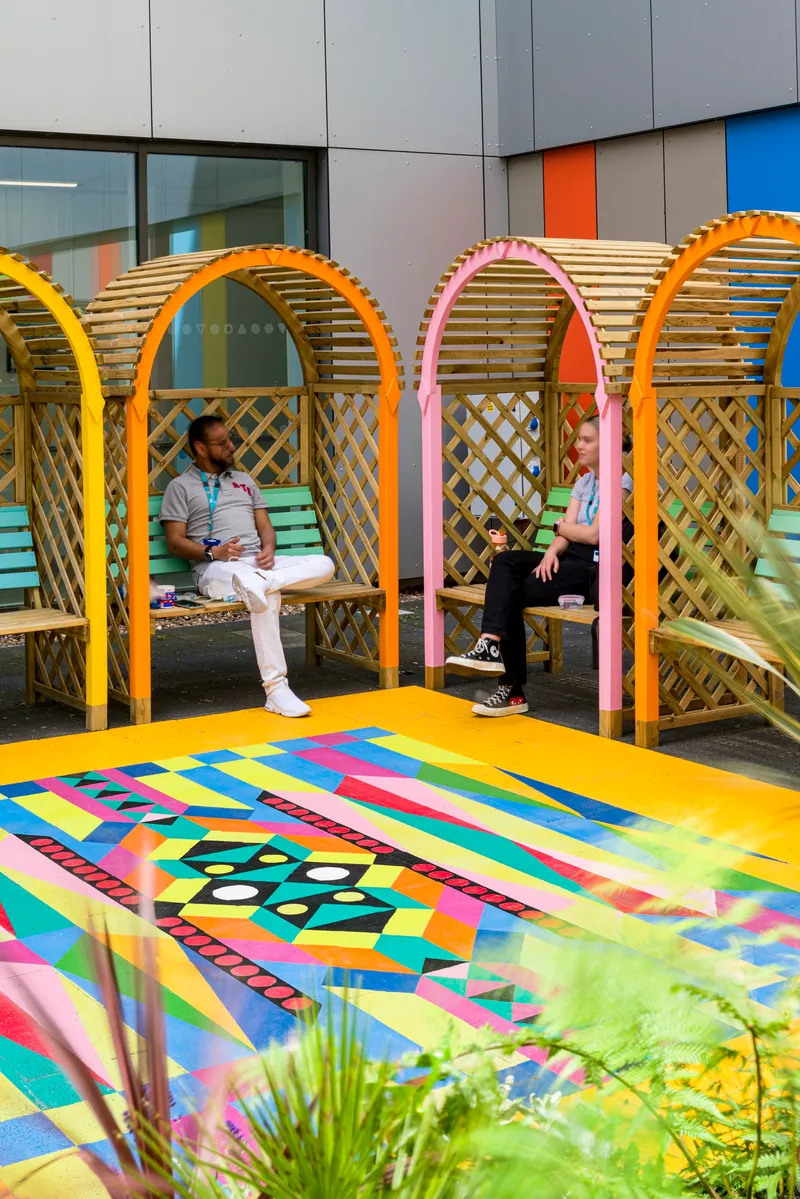
The floor mural is arguably the most ambitious element of the project. Provided by Geveko Markings, the geometric patterns spill across the entire courtyard and appear to "blow" up the side of the hospital facade. The design was originally conceived for a public artwork in London that was cancelled, and Myerscough repurposed it here. That origin story matters: it means the floor pattern was designed for a civic scale, and the fact that it works equally well in a hospital courtyard speaks to its graphic clarity.
The circular and triangular motifs create zones without walls. Around the arched timber lattice seating alcoves, the paving shifts in density and palette, suggesting different programmatic areas. There are spots for dining, spots for sitting alone, and open areas large enough for a group workshop. The ground plane does all the spatial work that partition walls would do in a conventional interior, but without any of the rigidity.
Planting and Seasonal Change
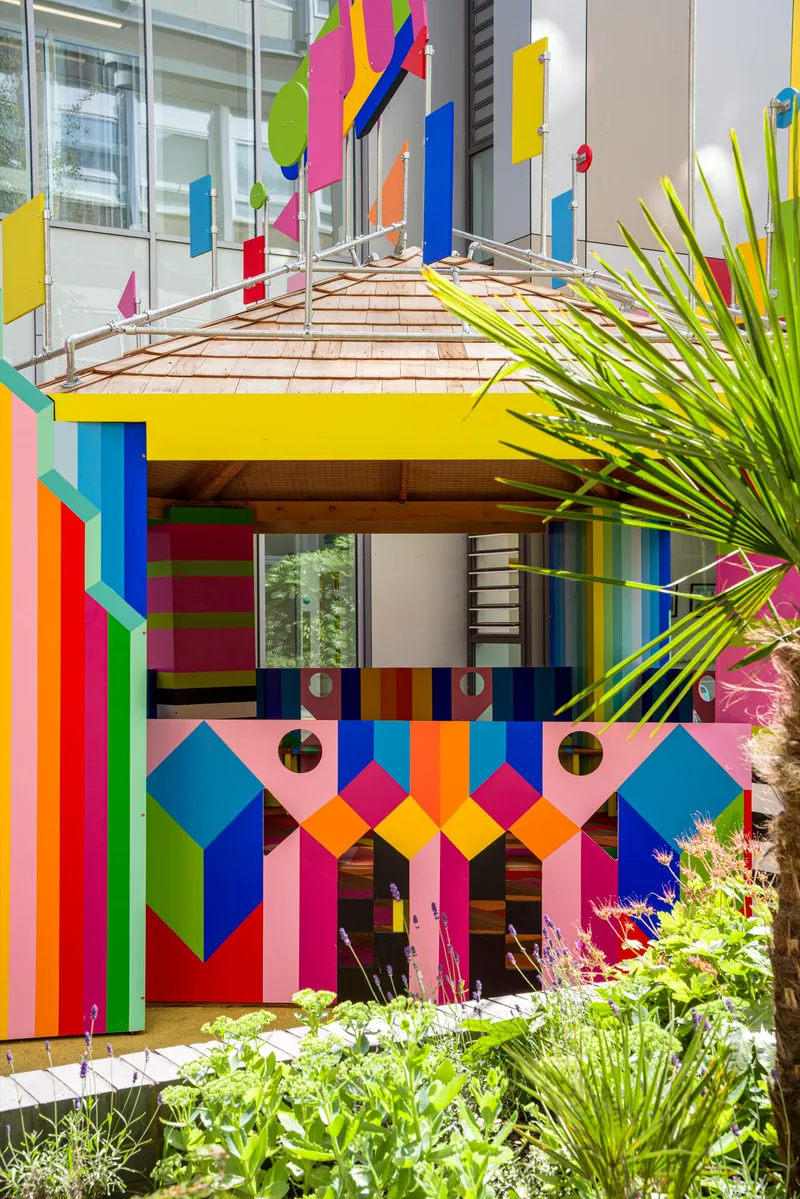

Myerscough's palette is relentlessly synthetic, all acrylic pinks, electric blues, and cadmium yellows. The planting strategy pushes back against that in a productive way. Evergreen species provide year-round structure, while scented perennials and bulbs shift the courtyard's character with the seasons. Palm fronds frame the pavilion entrance in one view; flowering plants soften the painted edges in another. The planting is not ornamental background. It is the thing that keeps the space from tipping into pure spectacle.
Fragrance was treated as a design material. Workshop sessions were held at the hospital with families, staff, and a fragrance expert from Method to explore scent preferences. That consultative process shaped the selection of perennials, grounding the planting choices in the sensory needs of the people who actually use the courtyard. For patients whose days are defined by antiseptic smells and clinical lighting, the presence of rosemary or lavender is not trivial.
Context and Community

The courtyard sits between residential blocks, which means the Joy Garden is visible from apartment windows and hospital wards alike. On a sunny day the space fills with pedestrians, families eating lunch at tables, and staff taking breaks. The moveable furniture is a critical detail: it lets users reconfigure the courtyard for different group sizes and activities, preventing the space from ossifying into a single arrangement. Flexibility here is not a buzzword; it is a functional requirement for a courtyard that serves both a children's hospital and a neighborhood.
Myerscough's deliberate decision to work with local craftspeople, specifically Design Workshop Ltd in Sheffield, kept the project tied to its community in a way that a London-fabricated installation would not have achieved. The panels were painted in her own workshop, but the structure was built locally. That split between artistic authorship and local construction is a model worth noting for public art projects that want to claim community relevance.
Plans and Drawings
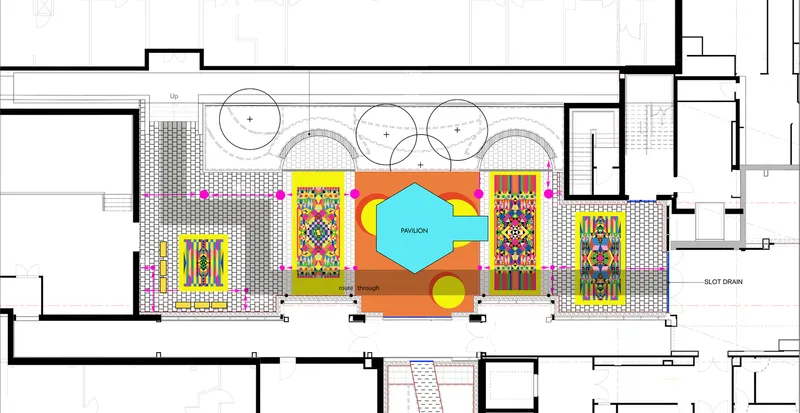

The floor plan reveals the courtyard's organizational logic. Circular planters anchor the corners while the pavilion sits off-center, creating an asymmetrical sequence of open and sheltered zones. The rendering shows the intended atmosphere: clusters of people gathering informally between planted beds and colored structures. What is notable is how closely the built result matches the rendered vision. There is no gap between promise and delivery here, which is rarer than it should be in public realm projects.
Why This Project Matters
Joy Garden Courtyard is a corrective to the assumption that hospital environments must be neutral. Neutral is not calming; it is depressing. Myerscough's intervention proves that maximum color, when organized with graphic discipline and paired with genuine craft, can create a therapeutic atmosphere that clinical beige never will. The project also demonstrates that "art in hospitals" does not have to mean a mural on a corridor wall. It can be spatial, structural, and landscape-scaled.
The more transferable lesson is about budgets and second chances. The courtyard existed for five years as an underfunded leftover before Myerscough's intervention. Timber, hand-cut shingles, donated paint, and local fabrication are not expensive materials or processes. What was expensive was the design intelligence that organized them. For every hospital, school, or civic building sitting on an underperforming courtyard, this project is evidence that a modest budget and a clear artistic vision can turn residual space into the best room in the building.
Joy Garden Courtyard by Morag Myerscough, located at Sheffield Children's Hospital, Broomhall, United Kingdom. Completed in 2022. Photography by Gareth Gardner.
About the Studio
Share Your Own Work on uni.xyz
If projects like this are the kind of work you want to make, uni.xyz is a place to publish your own, find collaborators, and enter design competitions.




Popular Articles
Popular articles from the community


Hill & Cross Opera: Sculptural Opera House Architecture Shaped by Tallinn’s Landscape and Identity
Hill & Cross Opera reimagines opera house architecture in Tallinn through its sculptural hill, civic plaza, glass wave and a luminous cross.

Play: Fragments of Their World
Familiar architecture becomes modular playground design, creating safe spaces where displaced children can learn, connect, imagine and play.

Co-Life: Senior Housing Design That Reconnects Older Adults With the City
Co-Life reimagines senior housing design through healing gardens, shared streets, workshops, and a sustainable community across generations.

Lunar Spiral: Space Architecture Shaped by the Mathematics of the Universe
Lunar Spiral reimagines space architecture through Fibonacci geometry, lunar regolith, levitating habitats, and self-sustaining Moon living.


Similar Reads
You might also enjoy these articles

Bao Huynh Watercolor Atelier: A Serene Art Retreat in Hội An
Bao Huynh Watercolor Atelier in Hội An blends multifunctional art spaces, sustainable design, local materials, and family-friendly living in a serene environment.

Atelier Macri Concept Store Interior Design by CASE-REAL
Atelier Macri store features a "ko" counter, walnut wood details, cork displays, blending retail, gallery, and seamless customer experiences.

Manuel Vargas Izquierdo Stadium and High-Performance Sports Center: Architectural Excellence in Jalpa de Méndez
The Manuel Vargas Izquierdo Stadium blends sustainable design, inclusive sports facilities, and cultural-inspired architecture, revitalizing Jalpa de Méndez’s public spaces.

KAKR Buluh Awar Hall: Revitalizing Community and Ecology Through Bamboo Architecture
Community built bamboo hall revitalizes Buluh Awar village, empowering youth, restoring ecology, celebrating vernacular craftsmanship through sustainable architecture and culture.


Explore Courtyard Competitions
Discover active competitions in this discipline



Challenge to design locus for the upliftment of human rights


Design challenge to reuse E-waste
Comments (0)
Please login or sign up to add comments
No comments yet. Be the first to comment!