
Motion: New Jersey Culture Center
Adaptive reuse transforms a historic rail shed into a cultural hub, blending memory, mobility, and community in a unified spatial narrative.

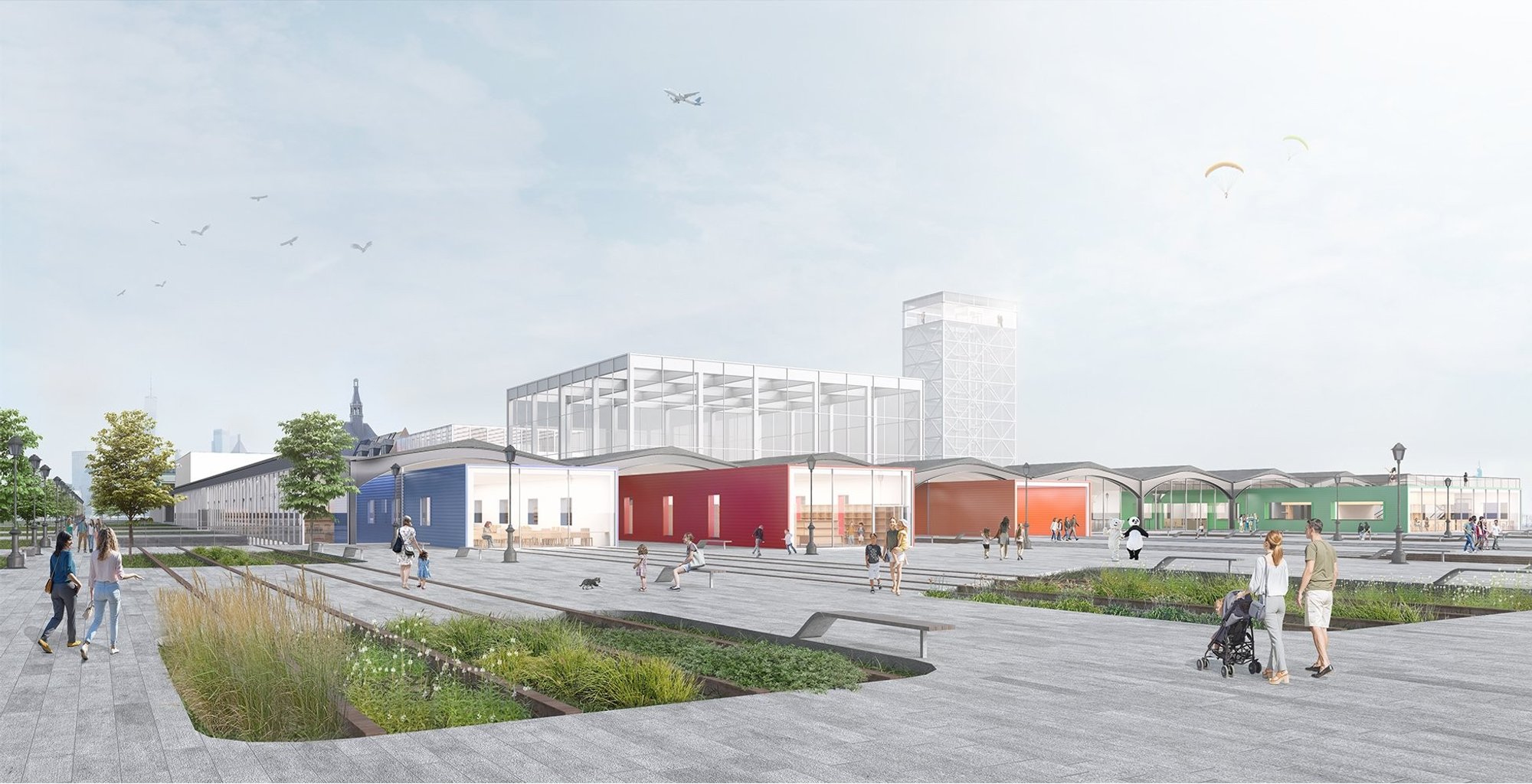
In the evolving discourse of adaptive reuse architecture, projects that transform abandoned infrastructure into active civic spaces hold particular significance. Motion: New Jersey Culture Center, designed by Hao Zhong, Yuchen Qiu, and Peicong Zhang, exemplifies this approach by reinterpreting a historic train shed as a contemporary cultural destination. As the winning entry of Liberty Today, the project proposes a spatial and conceptual framework that reconnects past and present through architecture.
Context and Historical Significance
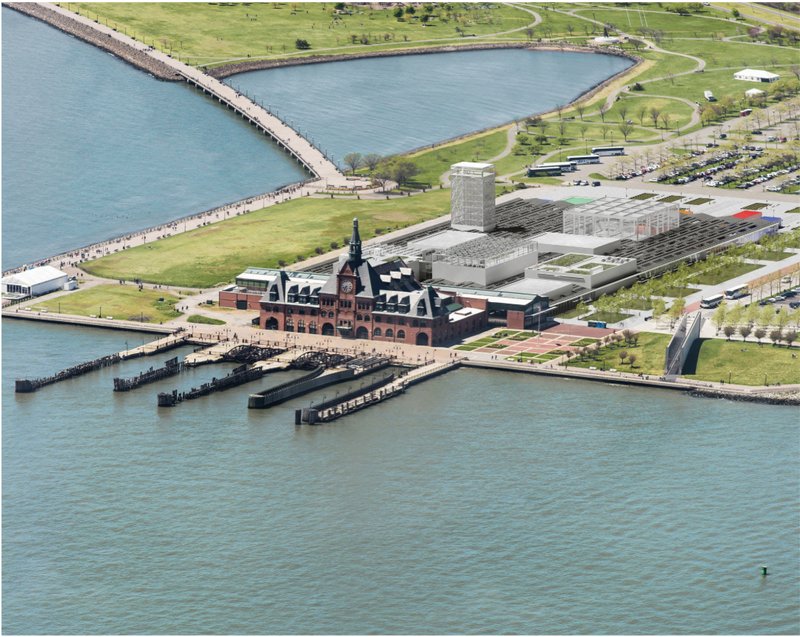
Located near Ellis Island, the site once functioned as a critical transportation node where immigrants, commuters, and travelers began their journeys across America. Since the cessation of train operations in 1964, the railway shed has remained vacant, gradually losing its relevance within the urban fabric.
Rather than erasing this history, the design leverages adaptive reuse architecture to preserve the shed’s structural identity. The intervention treats the site as a “melting point,” reactivating its historical role as a place of convergence while introducing new cultural and social programs.
Design Concept: Architecture as a Cultural Convergence
At its core, the project is driven by the idea of motion, both literal and metaphorical. Movement is embedded in the spatial sequencing, programmatic layering, and circulation strategies. The architecture creates an environment where people, ideas, and cultures intersect.
The design introduces a dual spatial strategy:
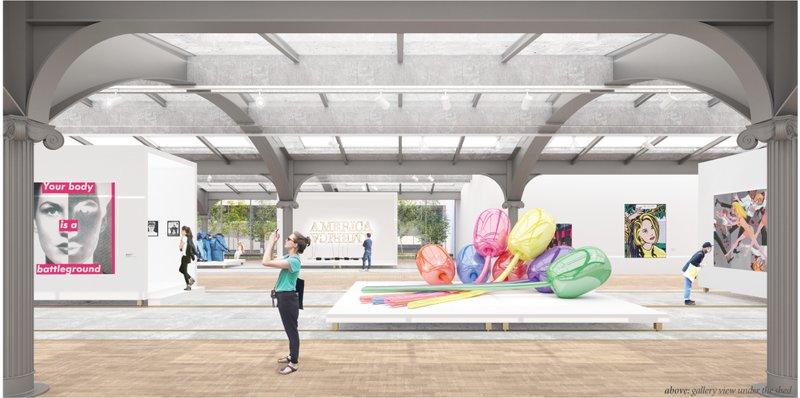
- Large-scale exhibition boxes inserted within the shed for major installations
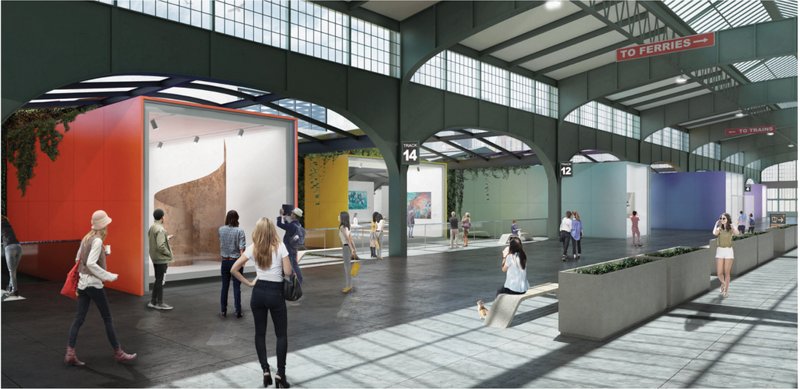
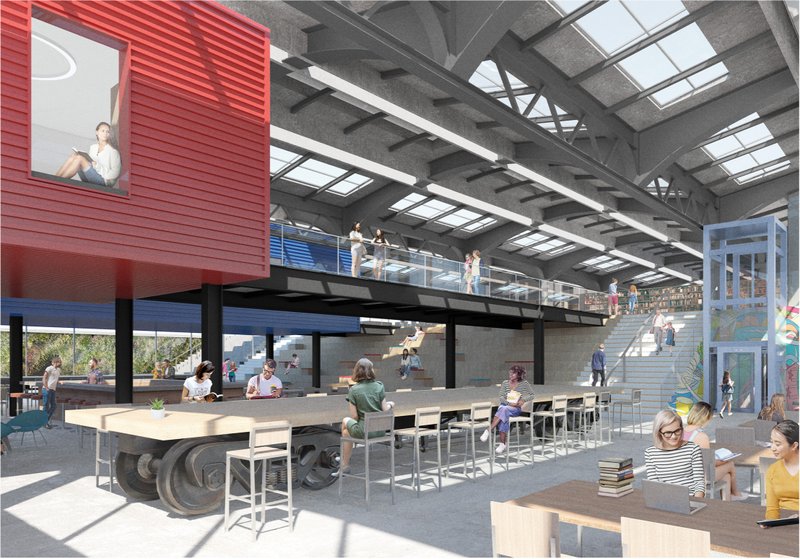
- Smaller movable exhibition cabins inspired by train compartments, recalling the site’s transportation legacy
These elements enable flexibility, allowing spaces to expand, contract, or reconfigure based on curatorial needs. This adaptability is a defining characteristic of contemporary adaptive reuse architecture.
Spatial Organization and Program
The project organizes its program through a linear logic derived from the original railway tracks. This strategy ensures continuity between past infrastructure and present use.
Key programmatic components include:
- Art galleries and multimedia exhibition spaces
- Public library and educational facilities
- Auditorium and performance spaces
- Food court and social gathering zones
- Sculpture gardens and outdoor courtyards
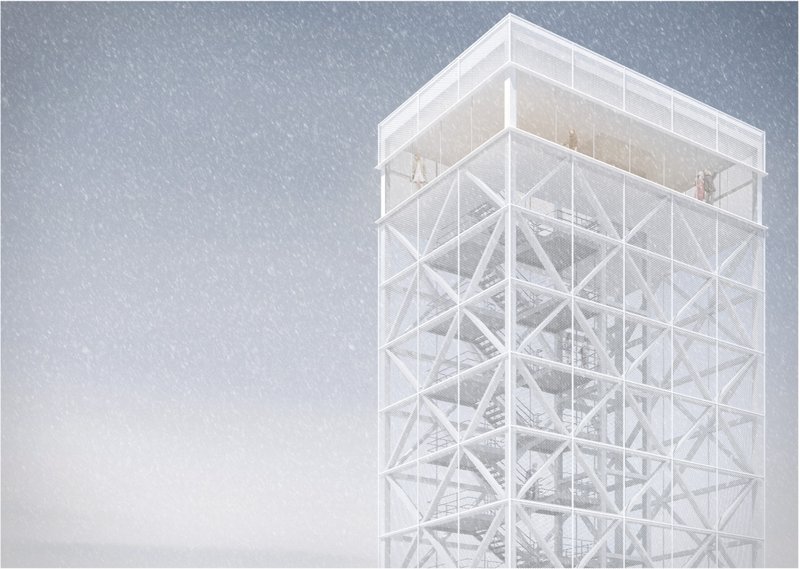
- Viewing tower offering panoramic urban perspectives
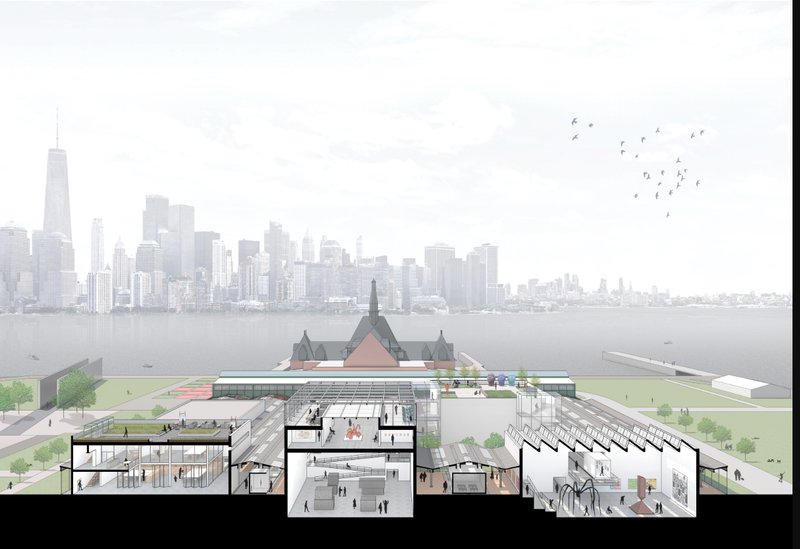
The majority of spaces are distributed either beneath the existing shed or within inserted volumes. This layered spatial system creates a dynamic interplay between openness and enclosure.
Architectural Strategy: Preservation and Insertion
A critical decision in the project is the selective preservation of the original structure. Only the westernmost bays of the shed are removed to introduce a public plaza, while the rest of the structure is retained.
This approach allows the project to:
- Maintain the industrial character of the site
- Minimize environmental impact by reusing existing materials
- Reinforce historical continuity through architectural expression
The insertion of rectilinear volumes contrasts with the repetitive rhythm of the shed, creating a dialogue between old and new. These volumes extend outward, echoing the movement of trains and reinforcing the concept of motion.
Experiential Qualities and Circulation
The user experience is structured as a journey. Visitors enter through an elevated volume that bridges the underground and above-ground programs, creating a moment of transition.
Circulation is designed to evoke the experience of travel:
- Linear pathways reference train tracks
- Transitional thresholds mimic platforms and departures
- Interconnected spaces allow for continuous exploration
The result is an immersive spatial narrative where movement becomes both a functional and symbolic element.
Cultural and Social Impact
Beyond its architectural innovation, the project addresses broader societal objectives. It repositions the site as a cultural anchor within the New Jersey, New York metropolitan region.
By integrating diverse programs and inclusive public spaces, the design fosters:
- Cross-cultural interaction
- Community engagement
- Collective memory preservation
The art gallery, in particular, acts as a unifying space where diverse artistic expressions converge, reinforcing the theme of unity through diversity.
Environmental and Urban Considerations
From an ecological perspective, the project prioritizes sustainability through adaptive reuse. By retaining most of the existing structure, it reduces construction waste and embodied energy.
Urbanistically, the intervention reconnects the site to its surroundings through:
- Public plazas and green spaces
- Pedestrian-friendly circulation networks
- Visual and physical links to the waterfront
These strategies ensure that the project operates not as an isolated object, but as an integrated component of the urban ecosystem.
Motion: New Jersey Culture Center demonstrates the transformative potential of adaptive reuse architecture. By preserving the essence of a historic railway shed while introducing flexible, contemporary programs, the project redefines how architecture can mediate between memory and modernity.
Through its thoughtful integration of history, program, and spatial experience, the design establishes a new cultural landmark that celebrates movement, diversity, and collective identity.




Popular Articles
Popular articles from the community

Stanton Architects Sculpts a Curving Family Home into Sydney's Inner West Fabric
Five Dock House uses cantilevers, curved concrete, and layered courtyards to carve out privacy on a tight suburban lot in Sydney.

The Faith: Modular Architecture for Play, Learning, and Hope in Kutupalong Refugee Camp
A modular playground architecture project in Bangladesh where play, learning, safety, and hope rebuild childhood inside a refugee camp anew.
PLATAFORMArq Folds a Concrete Roof Over the Portuguese Mountains in House #474
A 220-square-meter residence in Teixoso, Portugal, wraps board-formed concrete into an angular canopy that frames the Serra da Estrela foothills.
Kerry Kounnapis Packs 800 Daily Coffees into a 43-Square-Metre Melbourne Laneway Bar
Palace Coffee channels Pellegrini's and European standing bars through oxide-red steel and spotted gum timber in a Ridgway Place sliver.

Similar Reads
You might also enjoy these articles
Eco Chapel: A Green Architecture Pavilion Designed in Symbiosis with the Forest
Eco Chapel uses green architecture to weave prayer, learning and reuse into a forest pavilion shaped by modular hexagonal canopies for life.
Kaffeebühnen: Coffee Shop Architecture Designed as a Civic Stage Between Vienna’s City and Park
Kaffeebühnen turns coffee shop architecture into a civic stage, linking Vienna’s park edge, urban life, warm timber yards, and coffee craft.
Healing Façade: Sustainable Architecture for Reforestation, Community, and Sacred Ecology in Ethiopia
Healing Façade reimagines sustainable architecture as a living wall that restores soil, catches water and renews Ethiopia's forest churches.


Urban Forest: A Vertical Ecosystem for 5,000 Workers in Singapore's Changi Business Park
Radially stacked pods and layered green decks turn a 7-acre plot into 47 acres of ecological workspace projected for 2040.
Explore Interior Design Competitions
Discover active competitions in this discipline




The Global Benchmark for Architecture Dissertation Awards


Challenge to design luxury tourism on rails


VR headsets Storefront design competition

Designing a staircase for a client
Comments (0)
Please login or sign up to add comments
No comments yet. Be the first to comment!