
MTA Architects Build Their Own Satellite Office as a Garden Pavilion in Chennai
A working studio and client lounge rooted in regional materials, passive strategies, and a landscape that refuses to be an afterthought.


When architects design for themselves, the results tend to say more about their convictions than any client brief ever could. The Innovation Lab, completed in 2024 by Chennai-based MTA Architects, is their own satellite office: part working studio, part client lounge, and wholly a declaration of how they think buildings should meet the ground in southern India. Led by Ar Ramesh B and Ar Uma Shankar D, the project occupies a garden site in Chennai and treats landscape not as decoration but as the primary organizing system.
What makes the project genuinely interesting is its refusal to separate the act of working from the act of being outdoors. The building is low, linear, and porous, threaded through with verandas, courtyards, and a reflecting pool that blur any legible boundary between inside and out. Every material decision, from the barrel-vaulted brick ceilings to the rough stone columns and rammed earth walls, points toward a construction logic that is regional without being nostalgic. The Innovation Lab reads less like an office and more like a piece of inhabited landscape.
A Building That Sits Within, Not On Top Of, Its Site
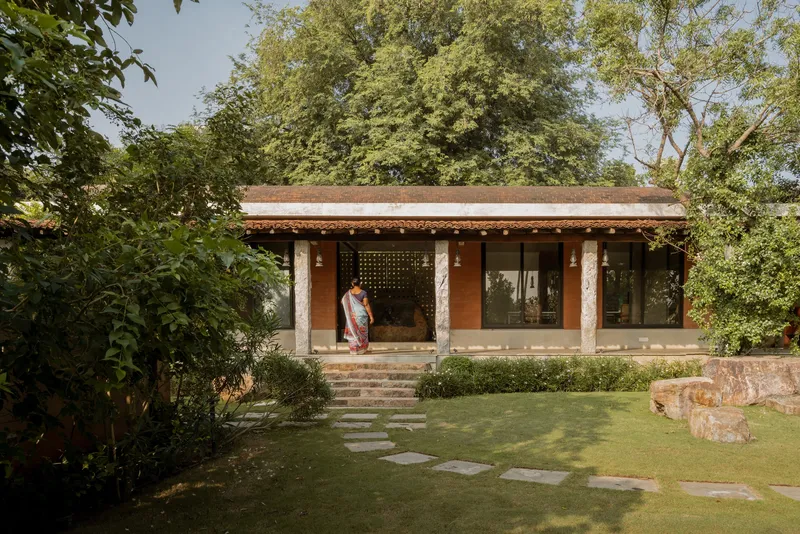
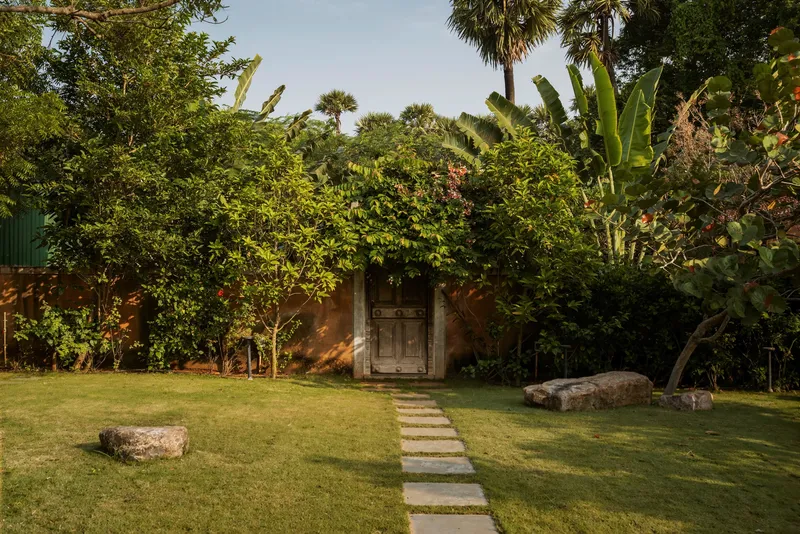
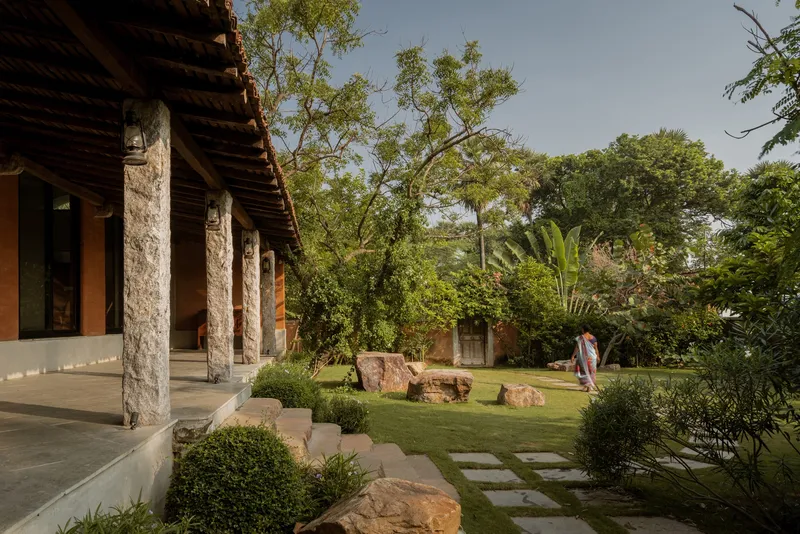
The approach is set by the landscape before any architectural gesture registers. Stepping stones cross a lawn dotted with native species and large rock formations, leading to an entrance embedded in a planted earth wall. The building sits low under terracotta tile roofs, its profile deliberately subdued so that the garden canopy reads as the dominant vertical element. Cylindrical stone columns hold up generous verandas on either side, creating deep shade before you ever touch a wall.
This is a deliberate inversion of the typical office typology, which usually privileges the facade and treats landscape as leftover space. Here, the lawn and garden are the first rooms you occupy. The pavilion is simply where you go when you need a roof.
Verandas as Working Rooms
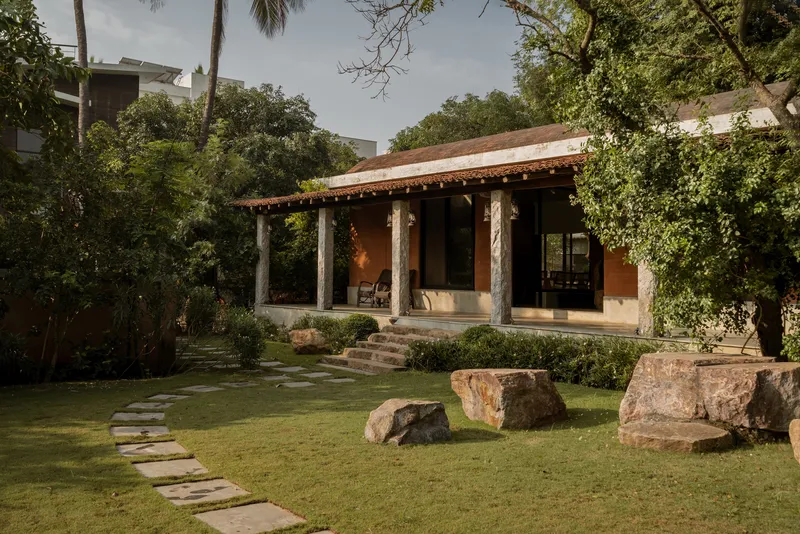
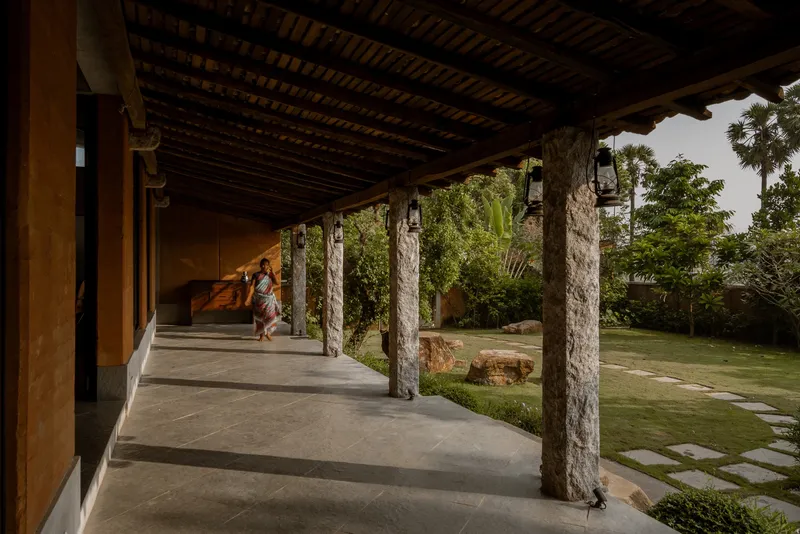
The verandas are not transitional. They are primary spaces, wide enough and furnished enough to function as meeting areas, informal desks, or simply places to think. Rough stone columns carry exposed timber ceilings overhead, while ochre-washed walls catch the changing light throughout the day. The combination of mass at the base and lightness at the roof creates a particular quality of shelter: protective but never enclosed.
Chennai's climate, hot and humid for much of the year, makes the veranda one of the oldest and most effective passive strategies in the region. MTA Architects are not reinventing the form; they are insisting on its relevance. The depth of these covered spaces means the interior rooms beyond them rarely receive direct sun, reducing cooling loads without any mechanical intervention.
Brick Vaults and the Logic of Construction
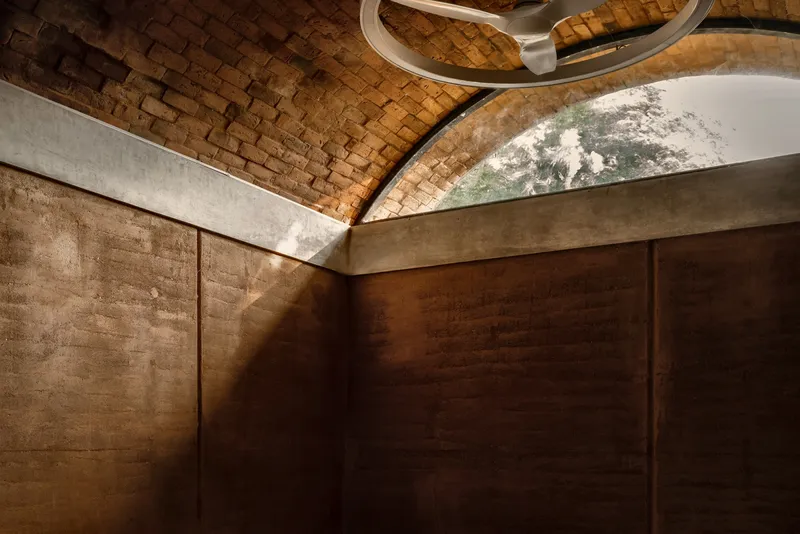
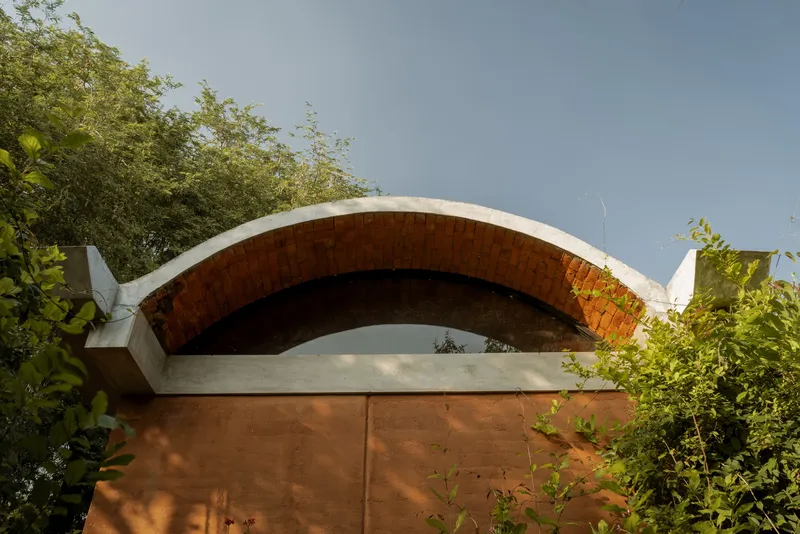
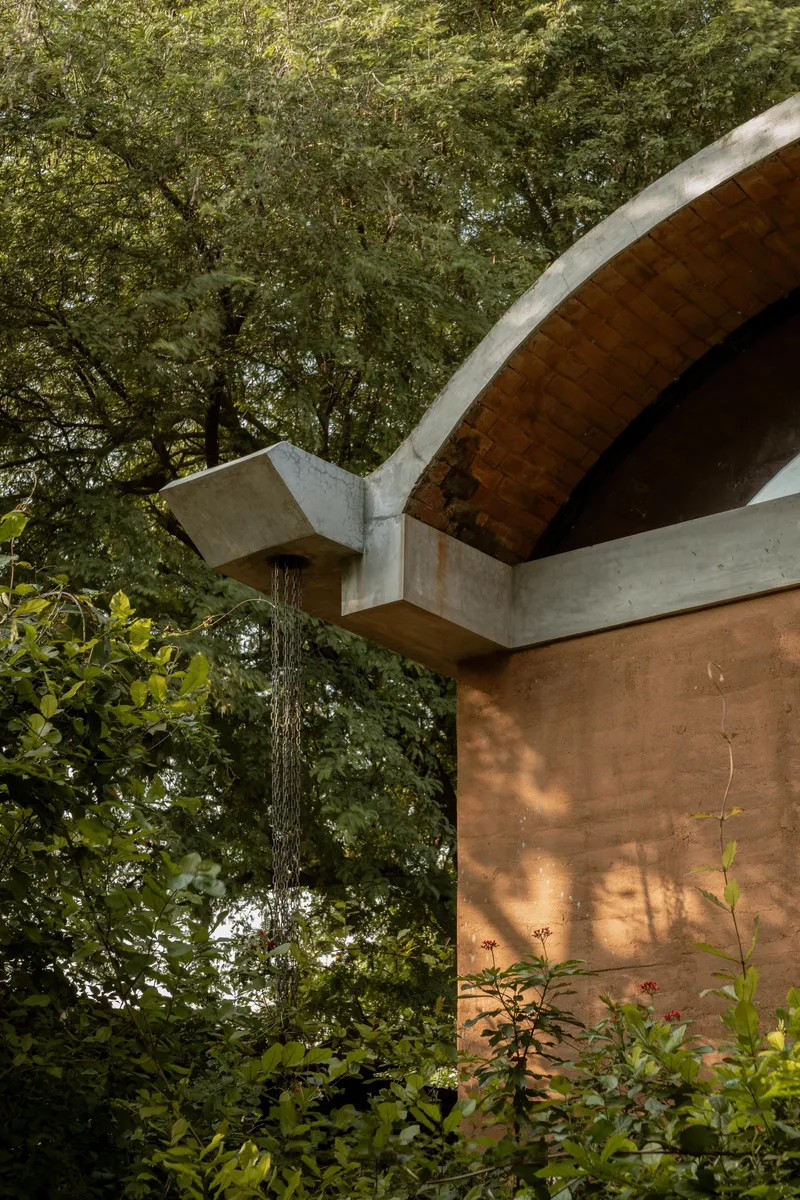
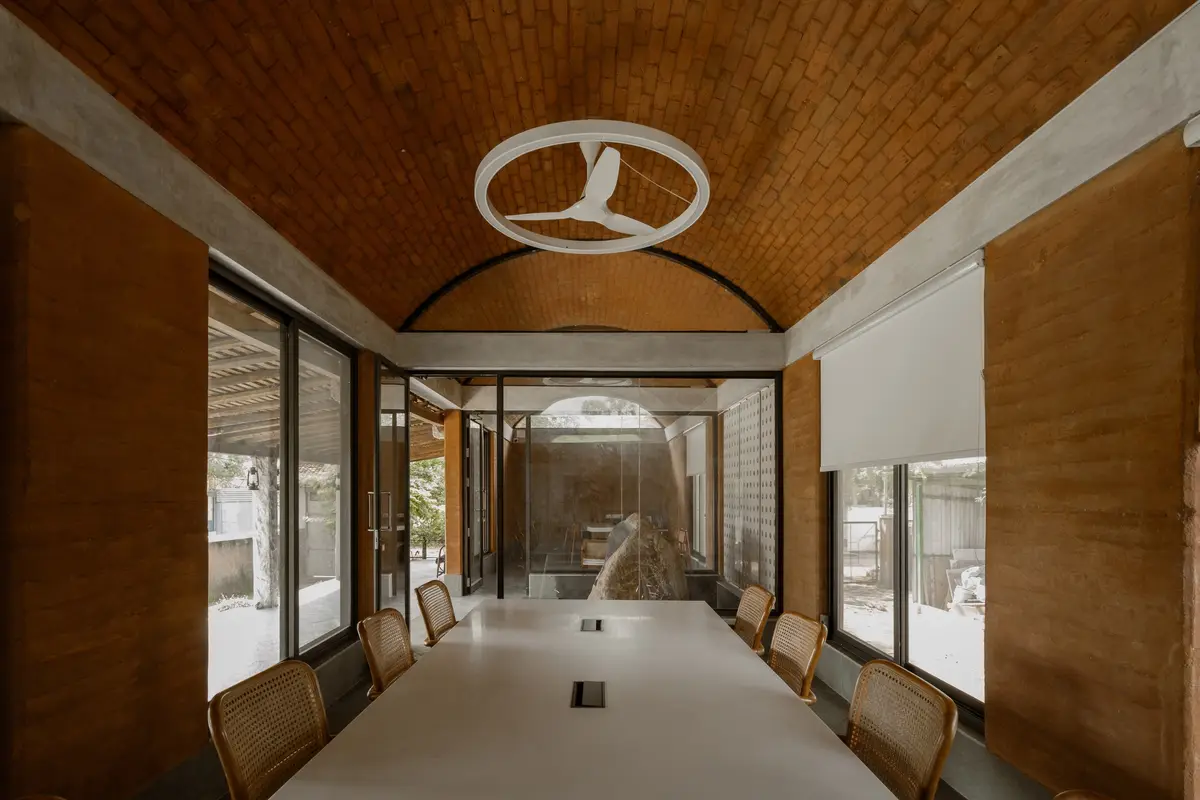
The most striking structural move is the barrel-vaulted brick ceiling that spans the principal interior spaces. Seen from inside, the vault is a warm, rhythmic surface punctuated by a circular skylight that admits a controlled disk of light. A concrete ring beam traces the oculus, while a visible edge beam at the exterior reveals the section honestly: brick compression held in place by a concrete frame. From outside, the vault's curved profile emerges above rammed earth walls and beneath the dappled shade of trees, looking almost geological.
The choice of a masonry vault in a studio context is pointed. It requires skill, it is slow, and it produces a spatial quality that flat slabs cannot replicate. For a firm building its own office, it functions as a proof of concept: this is the kind of construction we believe in, and we are willing to live with it every day.
Interior Warmth Without Excess
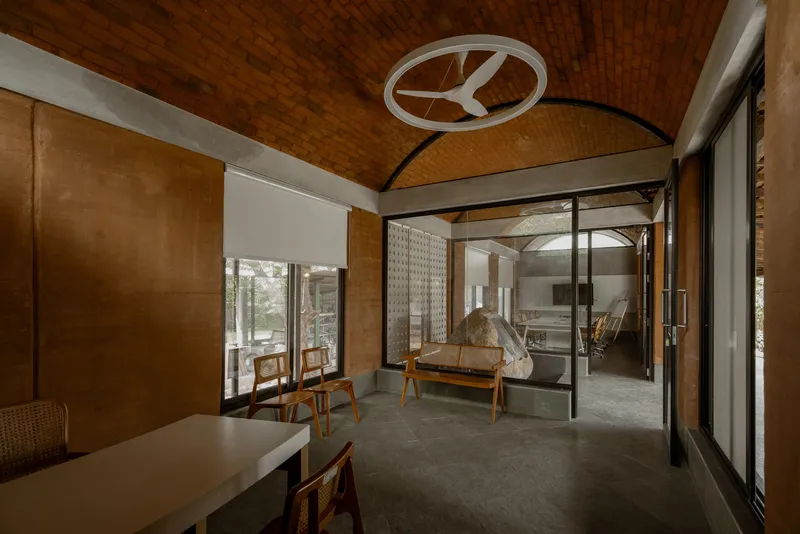
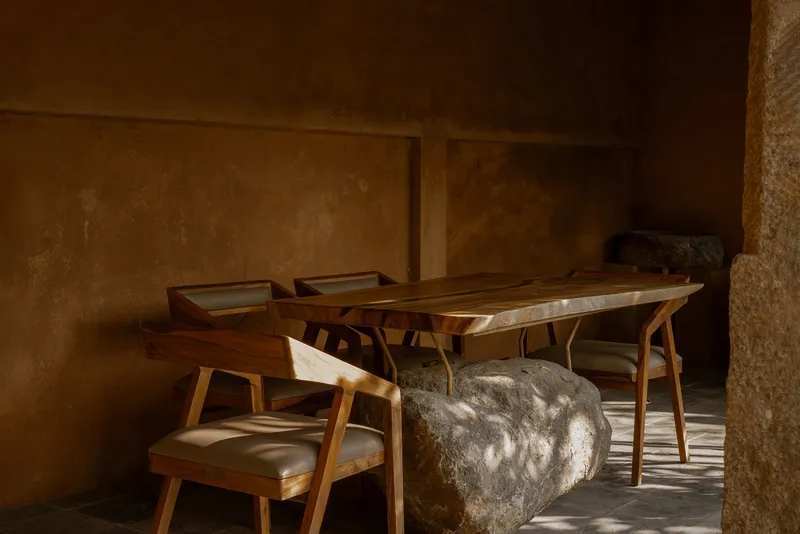
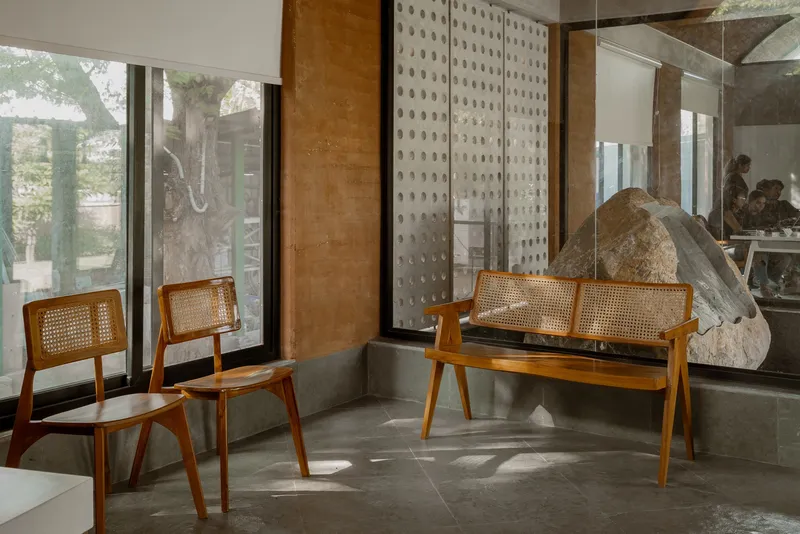
Inside, the palette stays deliberate and restrained. The living space features a woven timber ceiling vault, different in material but related in form to the brick version, with full-height glass doors that fold open to a courtyard where a sculpture sits on axis. A dining table rests on a raw boulder base, its mass anchoring the room. Caned timber chairs and benches fill a seating nook beside a perforated stone screen that filters afternoon light into soft patterns.
Nothing here is precious, and nothing is accidental. The textured earthen walls, the stone screens, the woven surfaces overhead: each element does double duty, providing thermal mass, ventilation, or light control alongside its visual role. The interiors feel inhabited rather than decorated, which is the correct register for a space that functions as both a workplace and a place for hosting clients.
Courtyards, Water, and the Tropical Edge
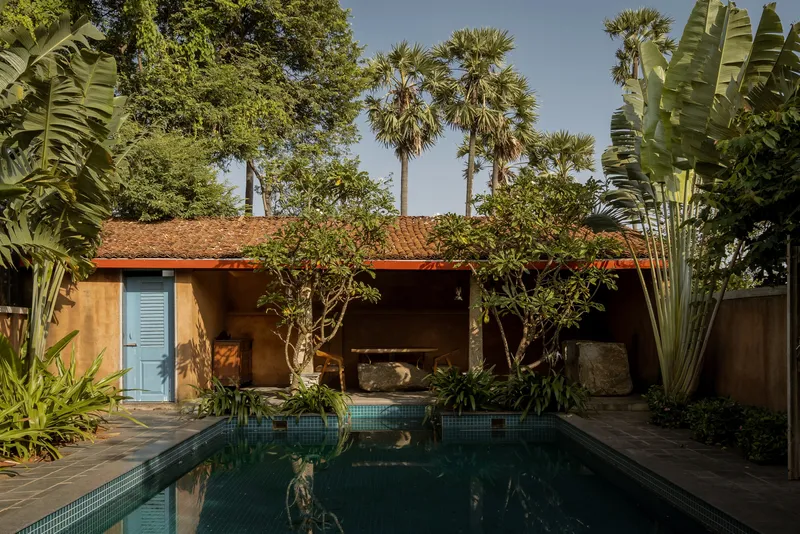
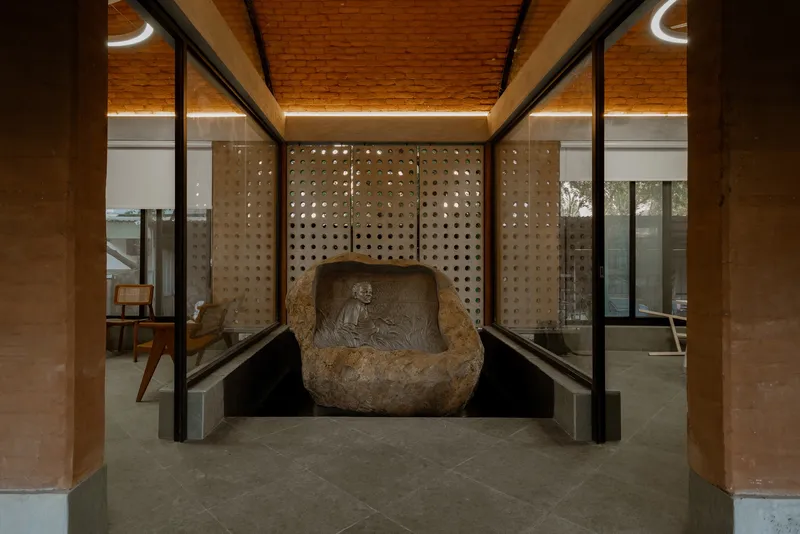
At the rear, a reflecting pool stretches beneath the terracotta roof overhang, flanked by banana trees and palms. The courtyard operates as a microclimate device: water cools the air before it reaches the interior, while the planting provides humidity and shade. At dusk, a carved stone sculpture glows within a perforated wall niche, framed by glass partitions that separate inside from outside with the thinnest possible gesture.
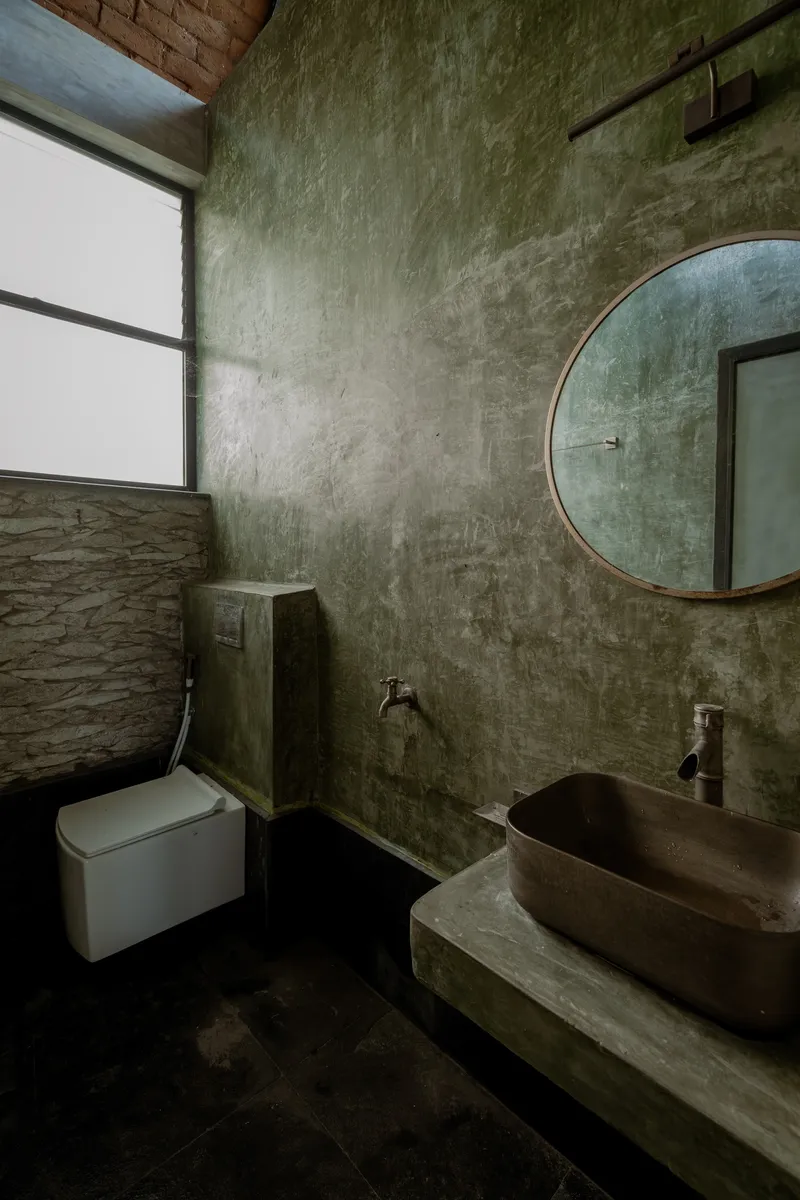
Even the bathroom commits to the material language, with textured plaster walls, a stone vessel sink, and a high corner window that admits light without compromising privacy. There is a consistency to the detailing across the project that speaks to a practice operating with genuine control over its construction process.
Plans and Drawings
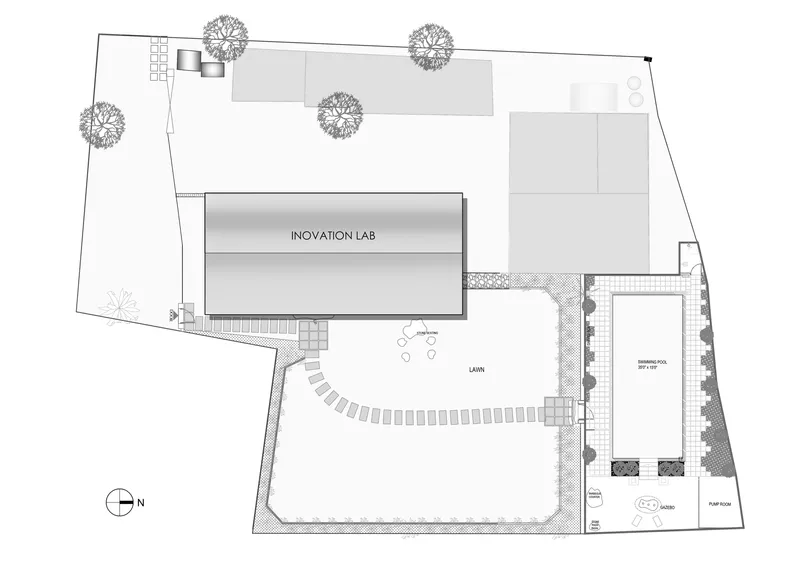
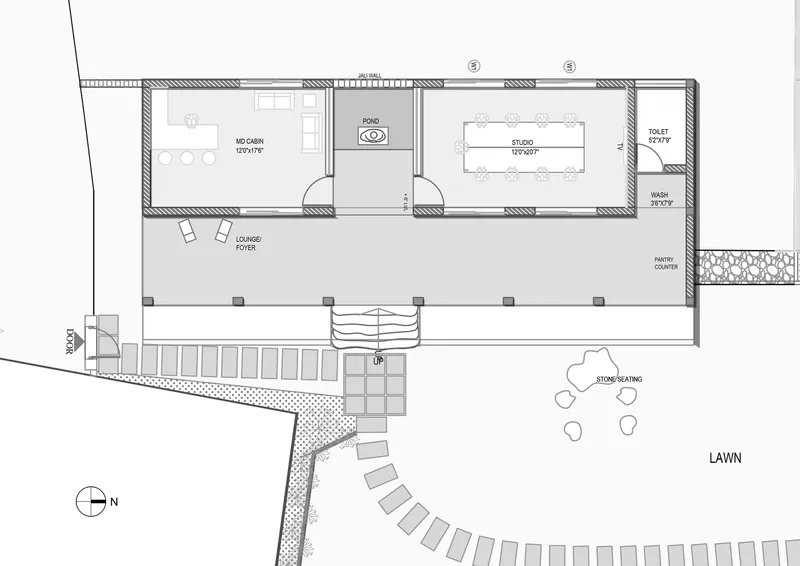
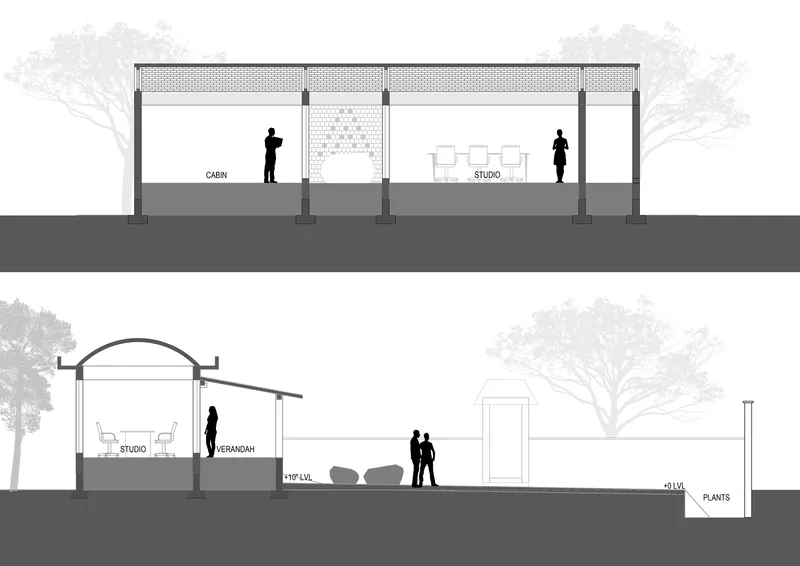
The site plan confirms what the experience suggests: the building is a slender bar set within a generous landscape of lawn and swimming pool. The floor plan reveals a linear arrangement, cabin at one end, studio in the middle, service spaces at the other, all fronted by a continuous veranda that acts as the primary circulation and social spine. Section drawings show the vault profiles in clear proportion to the human figure, with tree canopies drawn at full scale to indicate that landscape and structure were designed as a single system.
The economy of the plan is notable. There is very little corridor, very little wasted area. The veranda absorbs the functions that hallways and lobbies serve in conventional offices, collapsing multiple programs into a single generous space open to the garden.
Why This Project Matters
The Innovation Lab is a small building, but its ambitions are not modest. By choosing to build their own office with local materials, passive environmental strategies, and construction techniques rooted in the regional tradition of southern India, MTA Architects have placed a bet that climate-responsive design does not require high-tech systems or imported materials. It requires attention, craft, and a willingness to let the site lead.
For a profession that often treats its own offices as afterthoughts or, conversely, as showrooms for client persuasion, the Innovation Lab strikes a rare balance. It is persuasive precisely because it is unpretentious. The brick vaults, stone columns, and garden courtyards do not perform regionalism for an audience; they perform shelter for the people who work there. That sincerity, in a city growing as fast as Chennai, is worth paying attention to.
Innovation Lab, designed by MTA Architects (lead architects Ar Ramesh B and Ar Uma Shankar D), Chennai, India. Completed 2024. Photography by 0nebox photography.
About the Studio
Share Your Own Work on uni.xyz
If projects like this are the kind of work you want to make, uni.xyz is a place to publish your own, find collaborators, and enter design competitions.


Popular Articles
Popular articles from the community


Temporary Home for Dogs: A Reversed Zoo Rethinks Animal Shelter Architecture
In Bucharest, a sinuous corridor and freed landscape flip the logic of containment, designing a shelter that works to make itself unnecessary.

Extended Shell: Retrofitting Kolkata's Balconies as Living Urban Thresholds
A modular retrofit system recovers the social and environmental intelligence of Kolkata's historic verandas for contemporary Park Street residents.

Singing Woman: Contemporary Architecture Inspired by Estonia’s Voice and the Sea
Singing Woman turns Estonia’s song culture into flowing opera house architecture, blending public life, landscape, sea, and national memory.

Cloaked Colonization: A Mobile Underwater Habitat That Moves Like a Fish
Micah Abaya's shortlisted EHC Pacific entry reimagines ocean settlement as a dispersed network of self-sustaining architectural organisms.

Similar Reads
You might also enjoy these articles

Bao Huynh Watercolor Atelier: A Serene Art Retreat in Hội An
Bao Huynh Watercolor Atelier in Hội An blends multifunctional art spaces, sustainable design, local materials, and family-friendly living in a serene environment.

Atelier Macri Concept Store Interior Design by CASE-REAL
Atelier Macri store features a "ko" counter, walnut wood details, cork displays, blending retail, gallery, and seamless customer experiences.

Manuel Vargas Izquierdo Stadium and High-Performance Sports Center: Architectural Excellence in Jalpa de Méndez
The Manuel Vargas Izquierdo Stadium blends sustainable design, inclusive sports facilities, and cultural-inspired architecture, revitalizing Jalpa de Méndez’s public spaces.

KAKR Buluh Awar Hall: Revitalizing Community and Ecology Through Bamboo Architecture
Community built bamboo hall revitalizes Buluh Awar village, empowering youth, restoring ecology, celebrating vernacular craftsmanship through sustainable architecture and culture.

Explore Innovation Competitions
Discover active competitions in this discipline

Challenge to design a portable theatre

Challenge to design a portable music platform

Challenge to design an open learning module for the elderly
Comments (0)
Please login or sign up to add comments
No comments yet. Be the first to comment!