
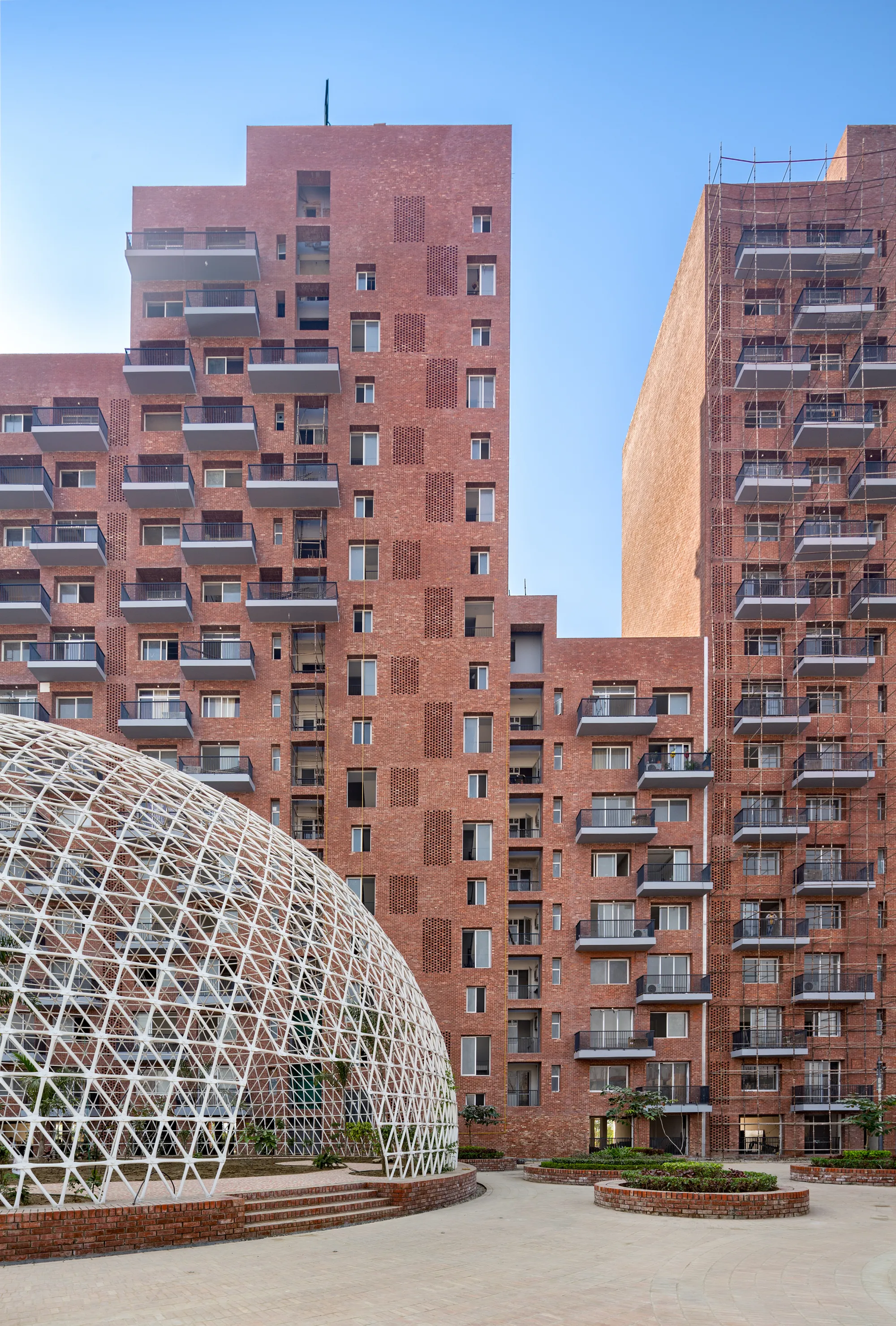
MVRDV and Studio Archohm Wrap 437 Apartments Around a Courtyard the Size of Two Football Fields
Oranje Castle in Lucknow rethinks Indian group housing with a brick perimeter block, terraced silhouettes, and a landscape inspired by Anish Kapoor.


Indian group housing has a familiar formula: identical towers stamped across a site, separated by parking lots and leftover greenery. The formula is efficient, reproducible, and almost completely indifferent to orientation, privacy, or public life. Oranje Castle, a 437-unit development on a 7-acre site in Lucknow's Gomti Nagar Extension, was designed by MVRDV and Studio Archohm as a direct challenge to that model. Instead of scattering towers, the architects fused 16 of them into a continuous perimeter ring, creating a single enormous courtyard at the center large enough to hold two football fields.
What makes the project genuinely interesting is not the courtyard plan alone, which has deep roots in Indian residential tradition, but the way the two firms handled the massing above it. No two towers share the same profile. Upper floors are carved back to create private terraces, breaking the roofline into a jagged, almost geological silhouette that shifts as you move around the complex. The entire facade is clad in machine-moulded brick with double walls for thermal and acoustic insulation, a choice that grounds the project in Lucknow's materiality while performing seriously in the city's tropical climate. Completed in 2022 after seven years of development, Oranje Castle is one of the most ambitious attempts to rethink mass housing in North India.
A Ring, Not a Grid

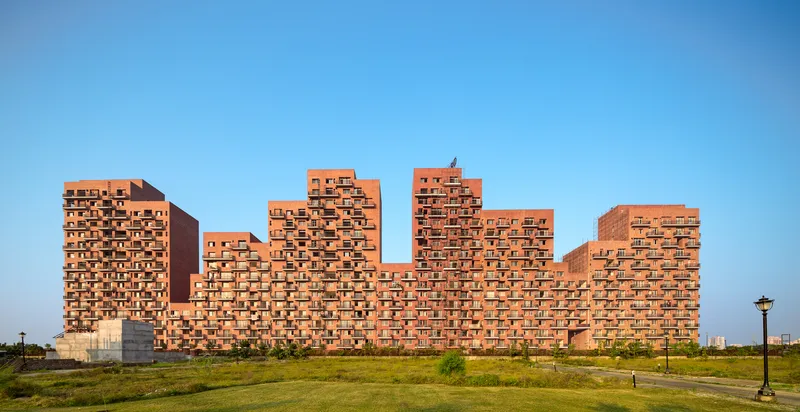
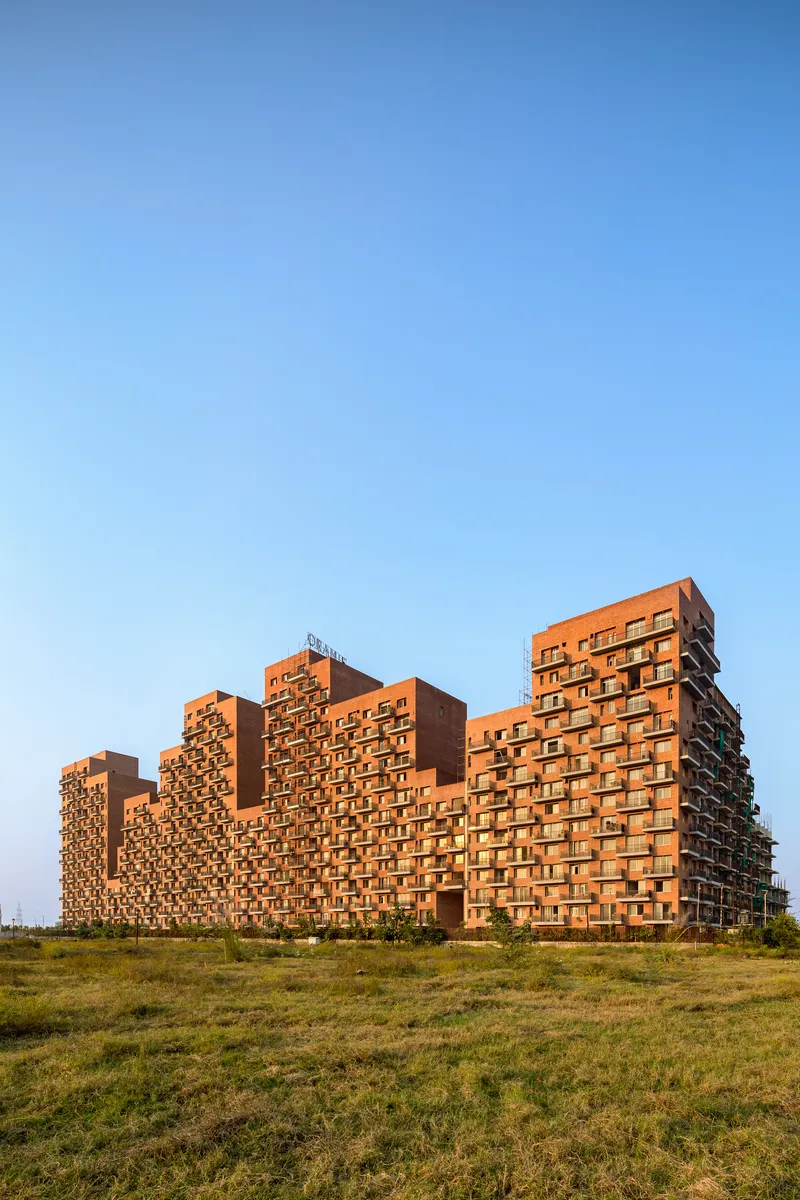
Seen from above, the logic is immediately legible: residential wings trace the edges of the site, enclosing a vast central void. The decision to consolidate built mass along the perimeter maximizes open space at the heart while guaranteeing that every apartment faces inward toward landscape. Situated just off Amar Shaheed Path, the main road connecting Lucknow to its airport, and overlooking the Gomti River's green buffer, the site benefits from both urban connectivity and a degree of isolation.
The ring format also solves a problem that plagues tower-in-a-park layouts: privacy. Because the buildings form a continuous wall, overlooking between separate blocks is eliminated. Within the ring, sight lines cross the courtyard at distances that make casual visual intrusion nearly impossible. It is a plan that earns its density rather than apologizing for it.
Brick as Both Armor and Ornament
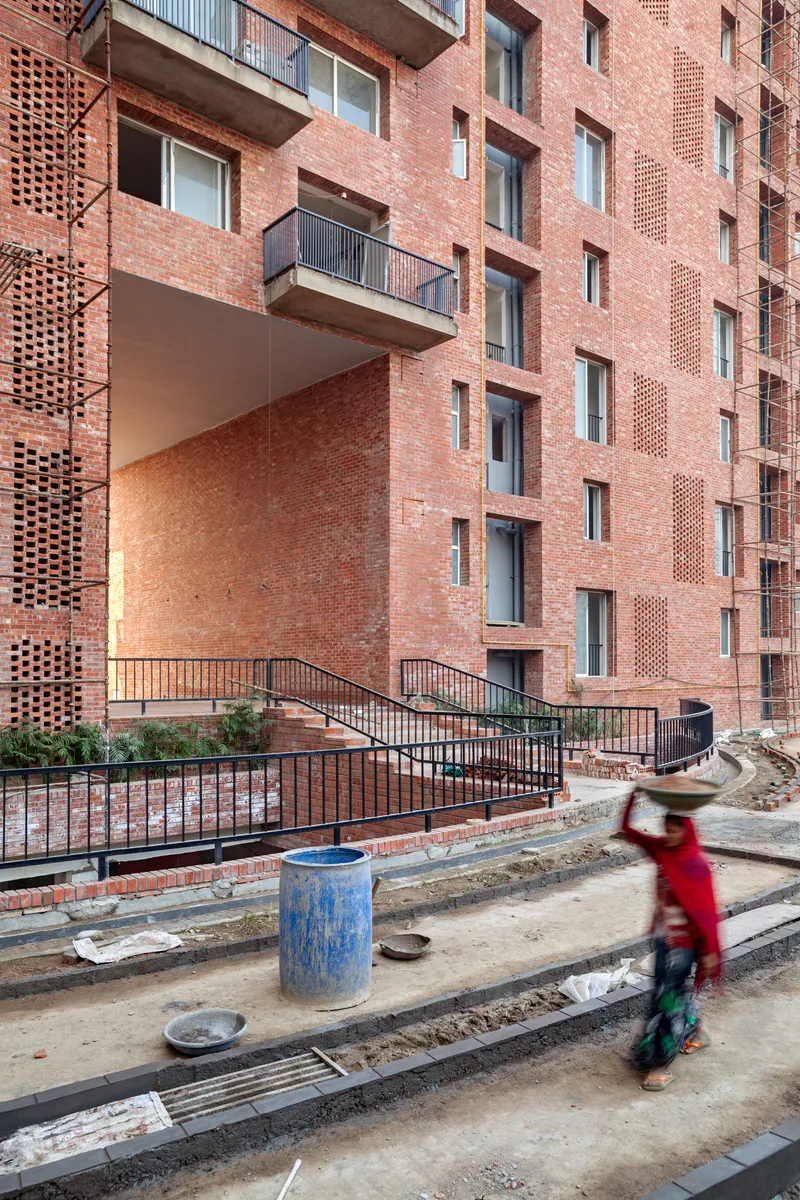
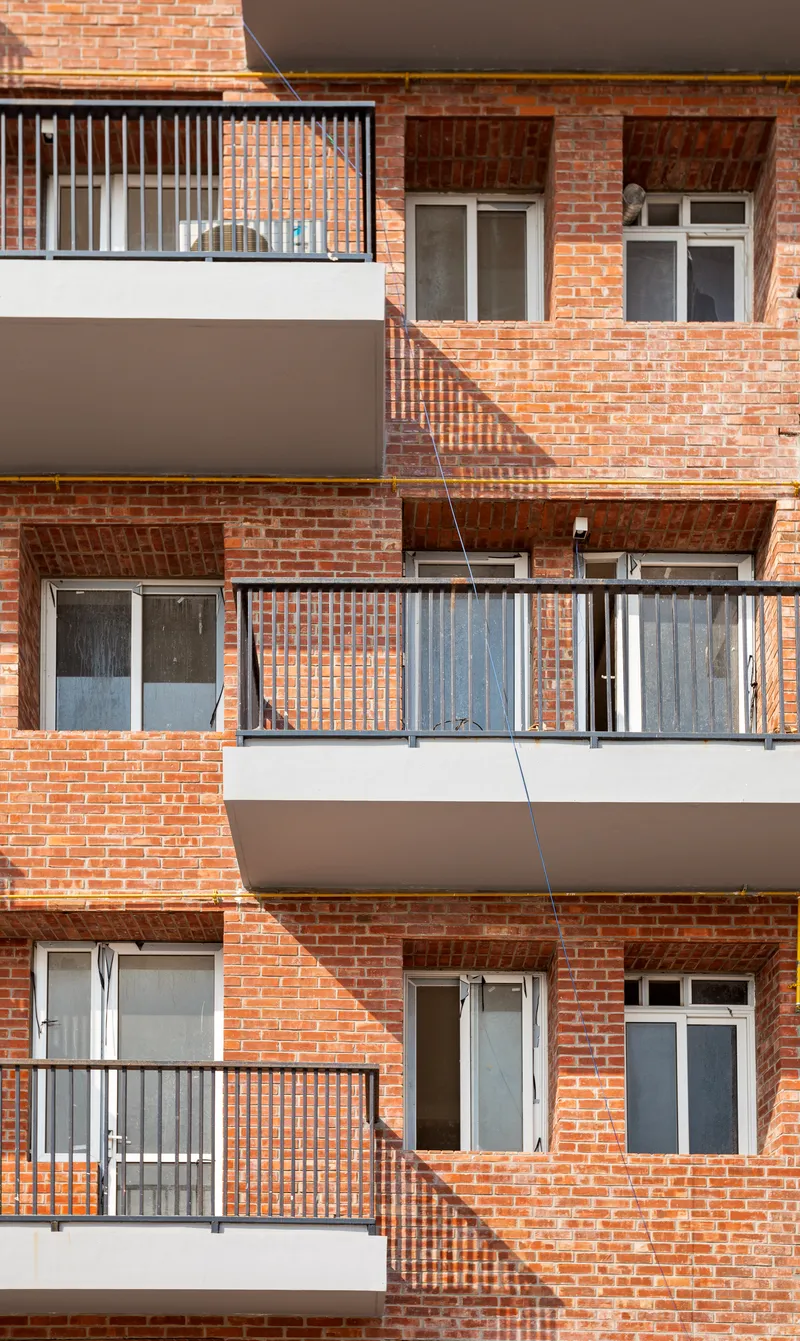
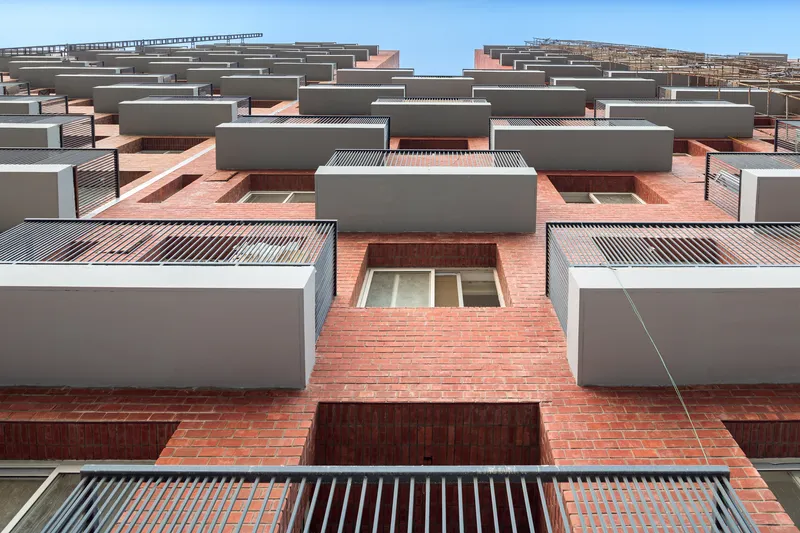
The facade is the project's public face, and it works hard. Machine-moulded brick wraps every tower, punctuated by two types of balconies: some hollowed out of the building volume, others projected forward from the surface. The alternation creates a rhythm of deep shadow and shallow relief that changes character throughout the day. Perforated brick screens filter light on some levels, adding a finer grain of pattern without resorting to applied decoration.
Behind the visible surface, double walls provide substantial insulation against Lucknow's intense summers, where temperatures routinely exceed 45°C. The brick cladding is not cosmetic; it is the first layer of a climate strategy that also includes cross-ventilated apartment plans and terraced gardens at multiple levels. The material choice ties the project to the broader brick tradition of the Gangetic Plain without lapsing into nostalgia.
Terraced Silhouettes and Unit Diversity
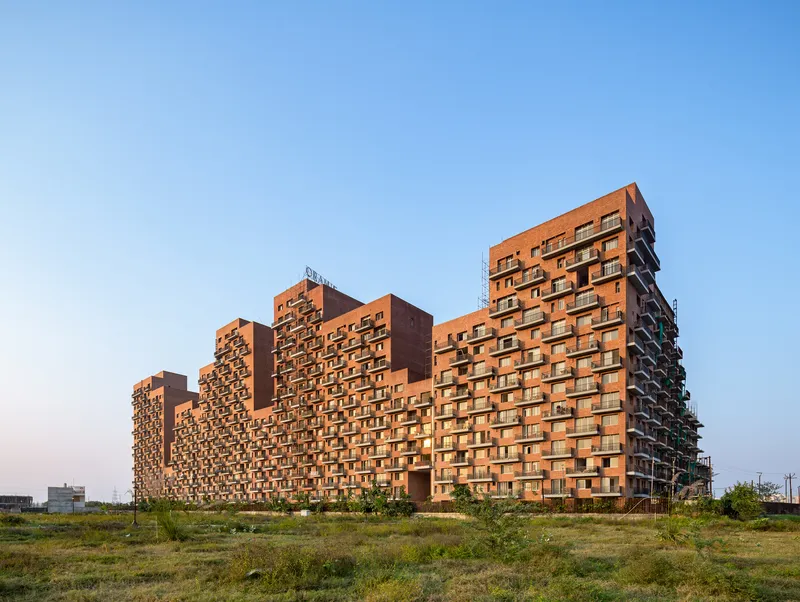
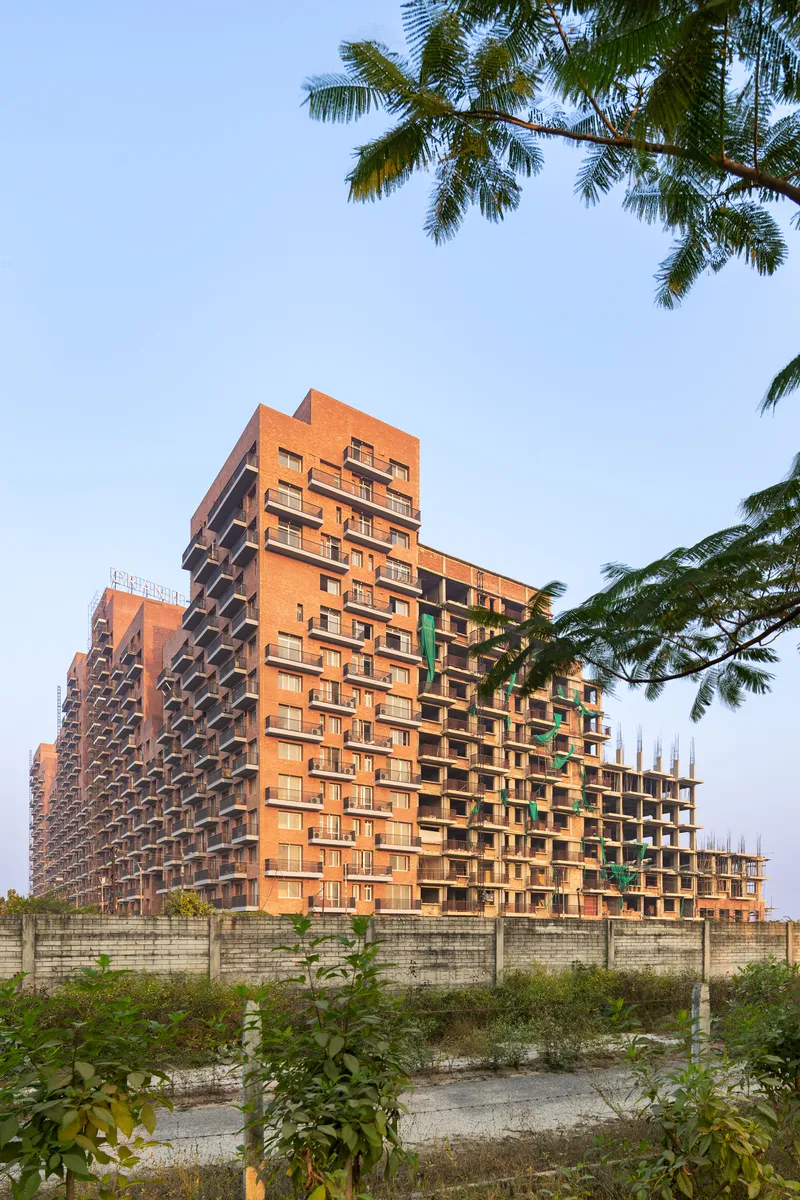
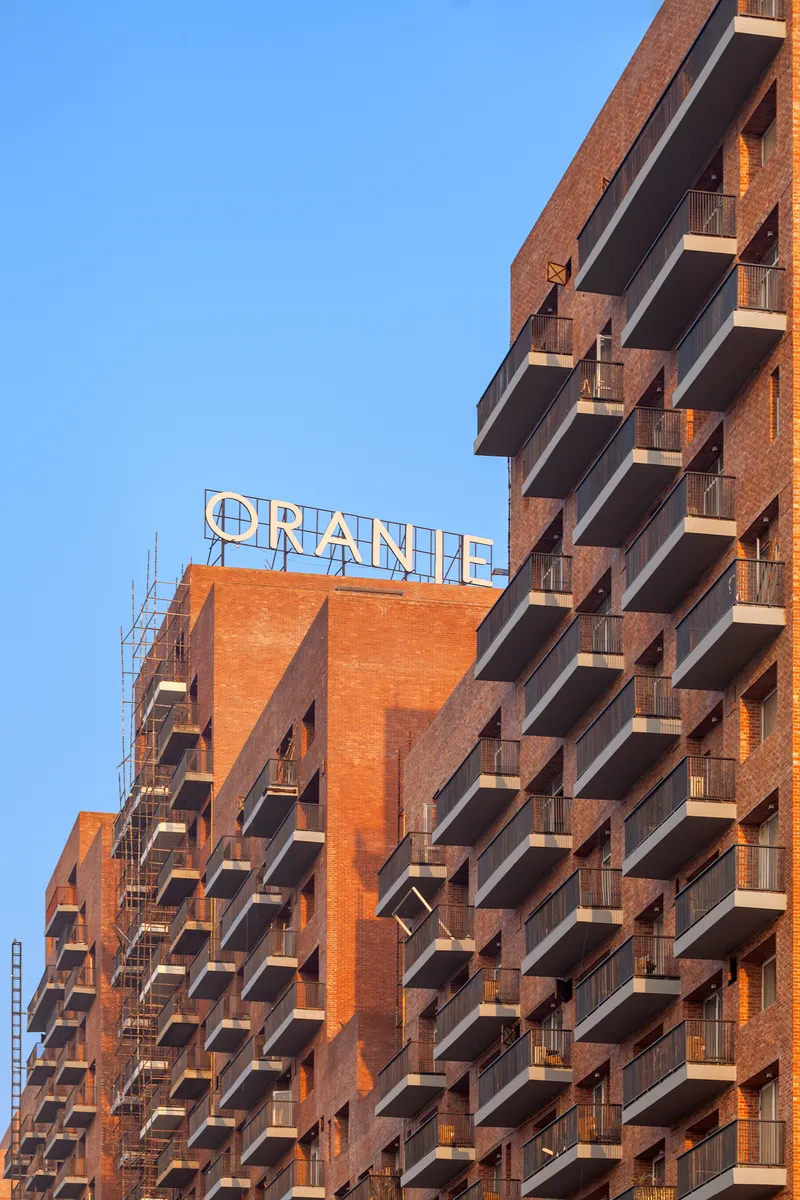
The most legible move from the street is the stepping of upper floors. Standard 3BHK apartments occupy the lower seven stories of each 17-floor tower. Above that, the massing modulates: 3 and 4BHK units with exclusive terraces, and at the very top, 5BHK penthouses with private outdoor spaces. The setbacks give the roofline its distinctive cascading profile and ensure that no two towers present the same elevation.
This is a meaningful departure from the cost-optimized repetition that dominates Indian housing construction. The terracing costs more, complicates waterproofing, and demands careful structural coordination across the earthquake-resistant RCC framework. But it delivers something that identical extrusions cannot: a sense that the complex is a composed landscape rather than a warehouse of living units.
The Courtyard as Urban Garden
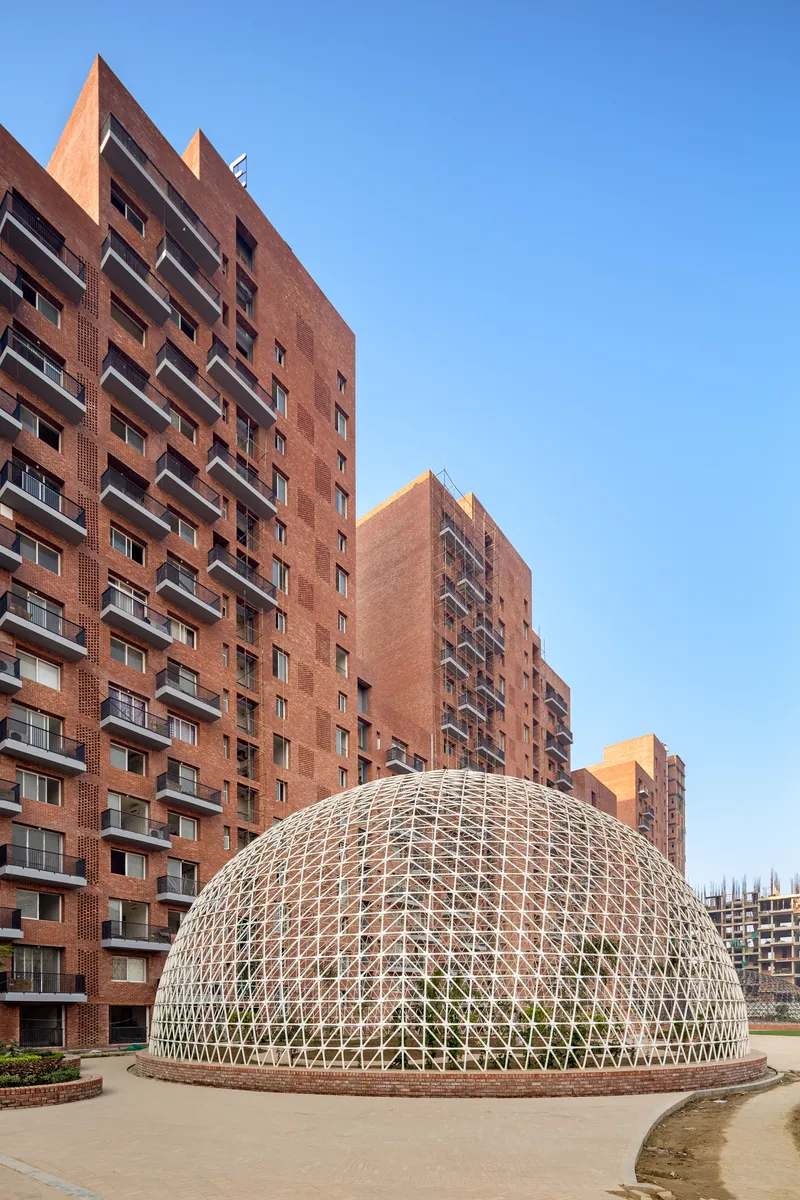
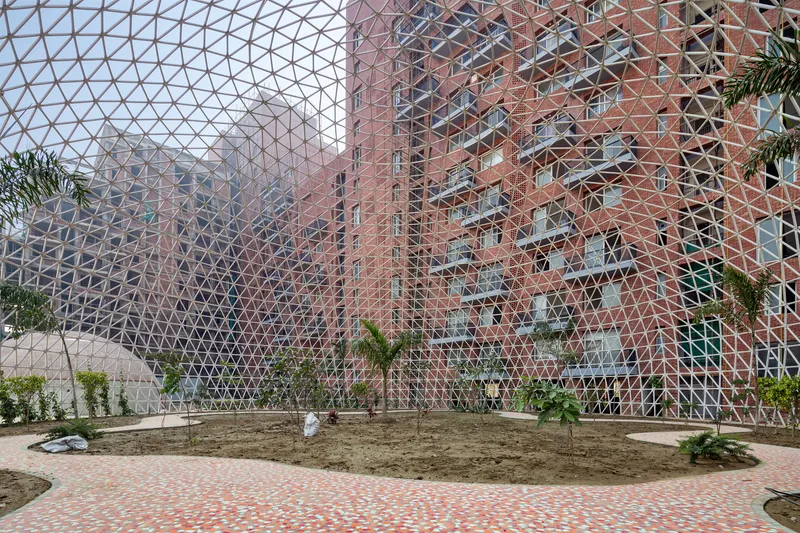
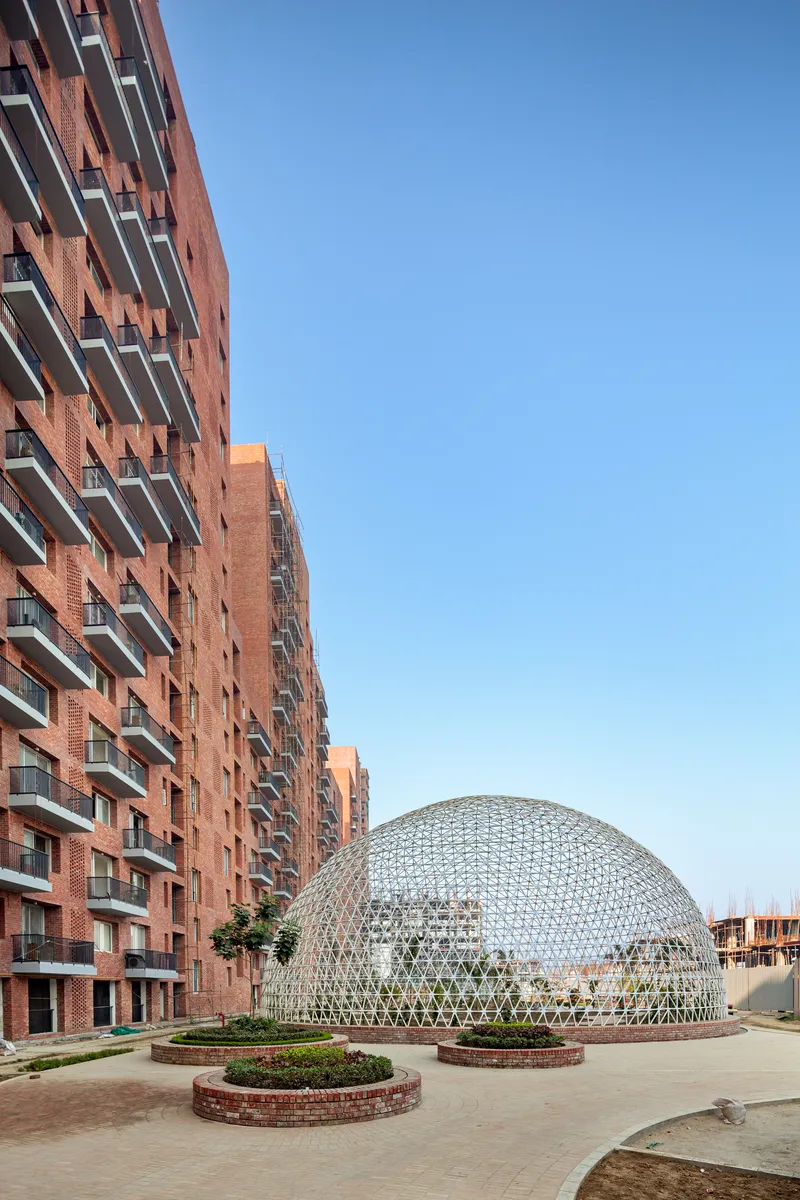
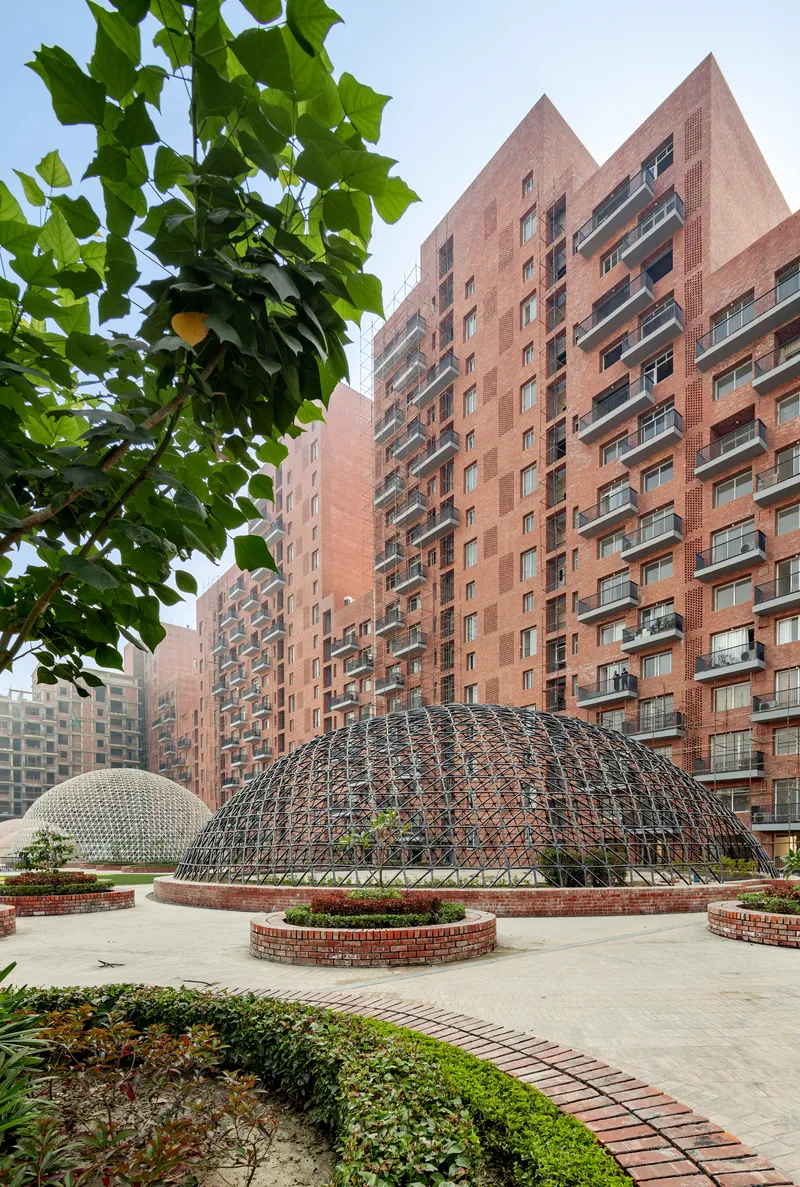
The central courtyard was designed by Berlin-based landscape firm TOPOTEK 1, and it is anything but a default patch of lawn. The concept draws on the traditional Indian garden, which historically combined live animals, water fountains, and dense shade planting. Here, the courtyard hosts a geodesic dome, brick dome pavilions, circular planting beds, water features, and a series of climbing mounds. The complex geometries of traditional Indian textile design and the evocative sculptural forms of Anish Kapoor served as direct references for the landscape.
The white geodesic dome is the courtyard's focal point, visible through narrow brick passageways that frame views from the perimeter walkways. Inside, it shelters planted beds with palms, creating a microclimate that bridges indoor and outdoor. Around it, smaller brick domes and paved plazas establish a sequence of spaces scaled for different social encounters, from solitary reading to community gathering.
Play Structures and Community Infrastructure
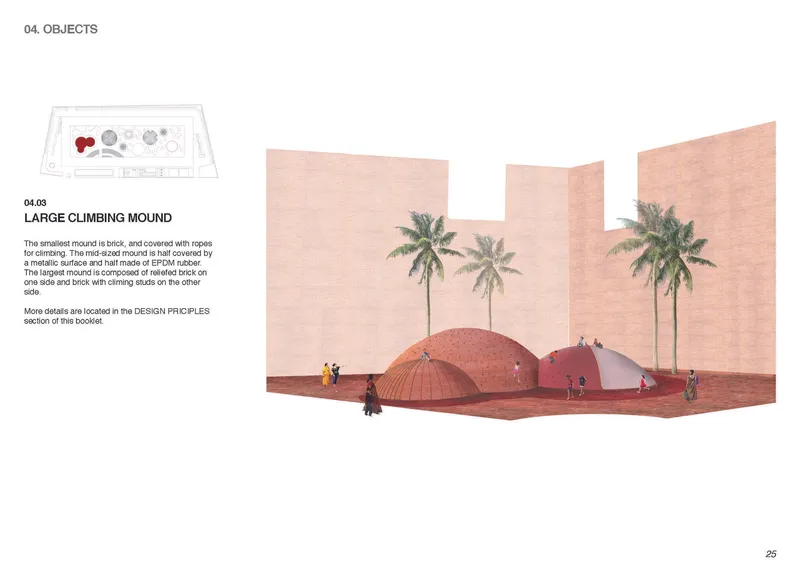
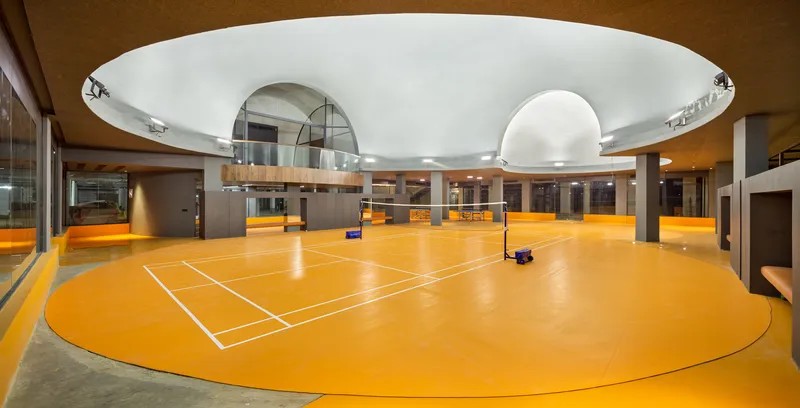
Group housing in India often treats amenities as afterthoughts, tucked into leftover basements or tacked onto podium roofs. Oranje Castle places them front and center. The courtyard includes rope-covered climbing mounds, trampolines, an amphitheater with concentric stepped seating, and a full indoor sports court with an orange floor beneath a circular white ceiling pierced by skylights. These elements are not buried in a brochure; they are the spatial core of the project.
The climbing mounds, wrapped in rope netting and framed by pink walls and palms, manage to look both playful and serious. They function as topographic incidents that break the flatness of the courtyard floor and provide physical engagement for children without the sterile geometry of typical playground equipment. It is landscape as infrastructure, not decoration.
Dusk and the Illuminated Perimeter
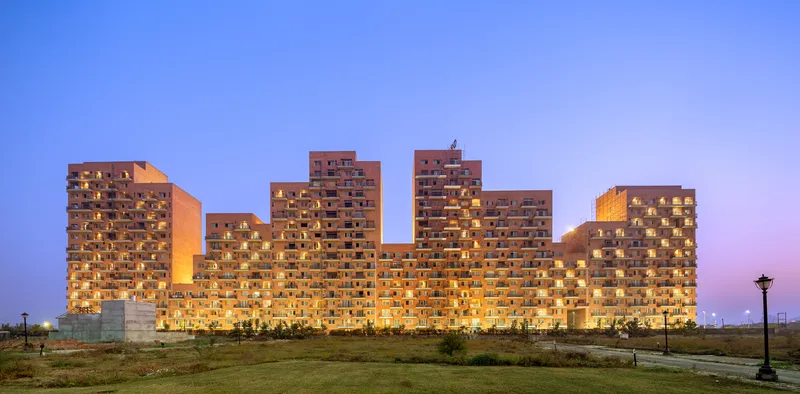
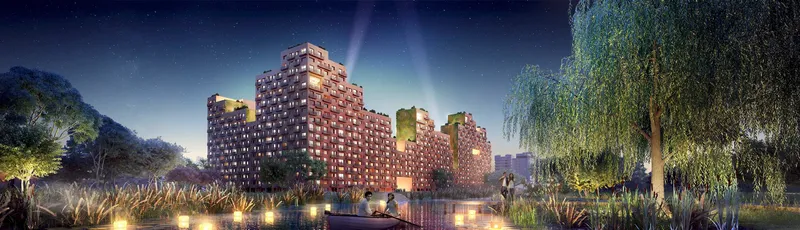
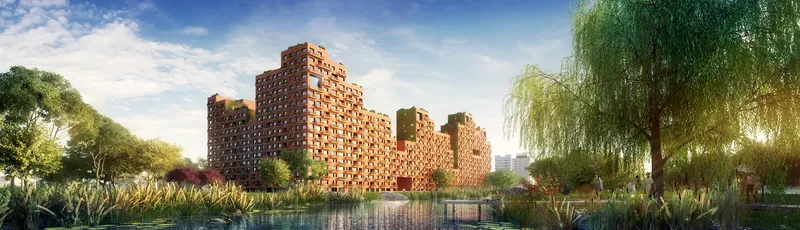
The project transforms at twilight. The perforated brick screens and recessed balconies, which cast deep shadows during the day, begin to glow as interior lights leak through the facade's apertures. Seen from the riverbank, the complex reads as a single luminous mass above the water and willow trees, its stepped profile more pronounced against a darkening sky.
This nighttime identity is not incidental. The brick screens, which exist primarily for climate performance, double as a light-modulating surface that gives the facade visual depth at any hour. It is a reminder that the best passive design strategies often produce the most compelling aesthetics without any additional effort or cost.
Plans and Drawings
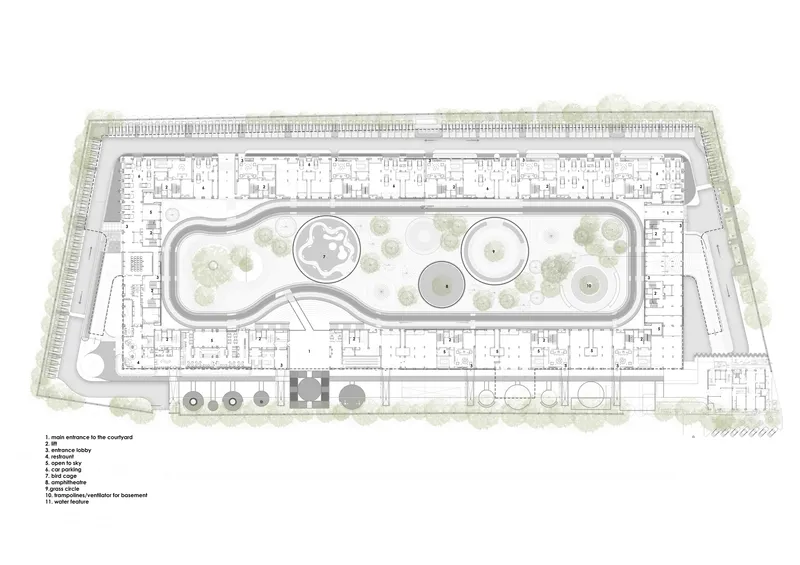
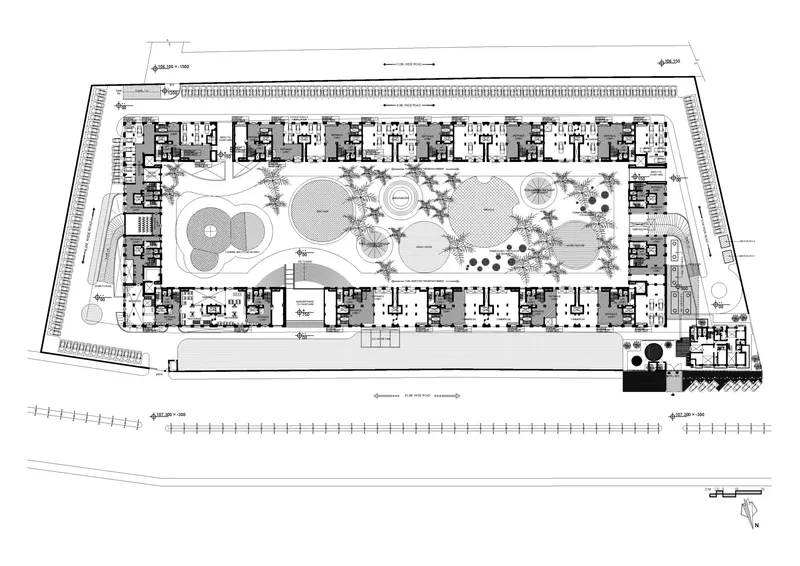
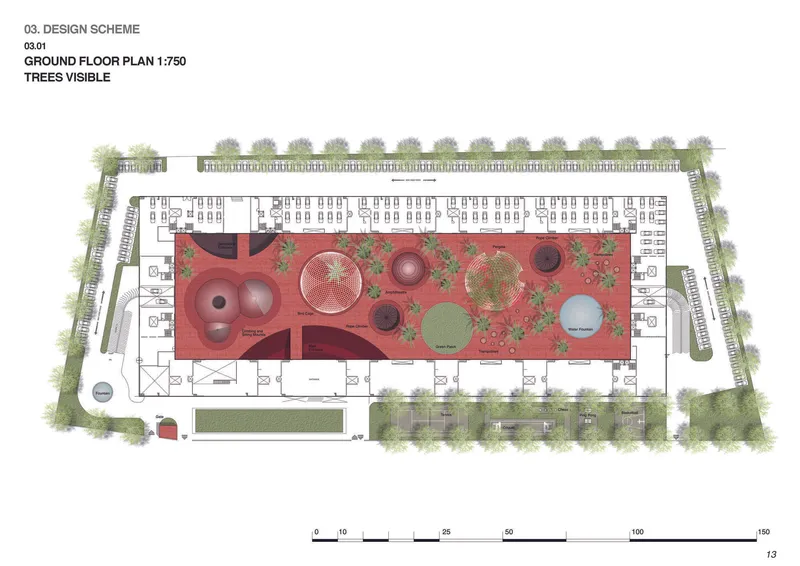
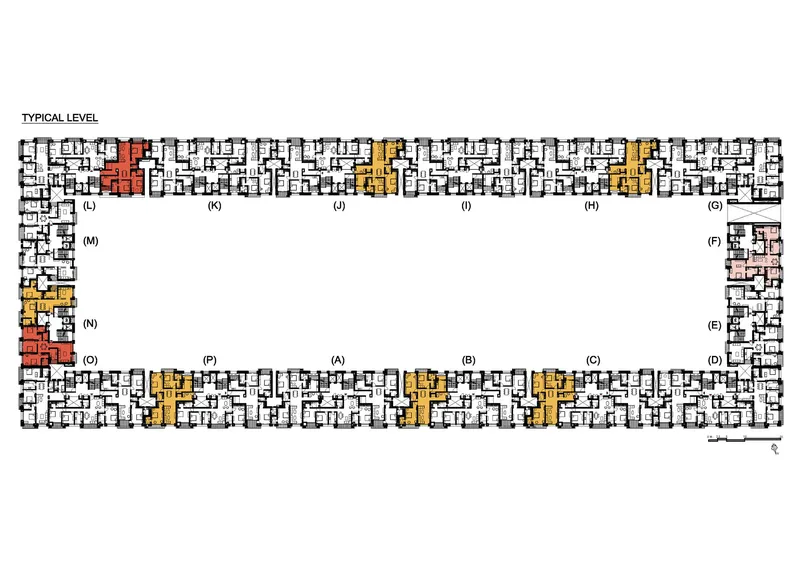
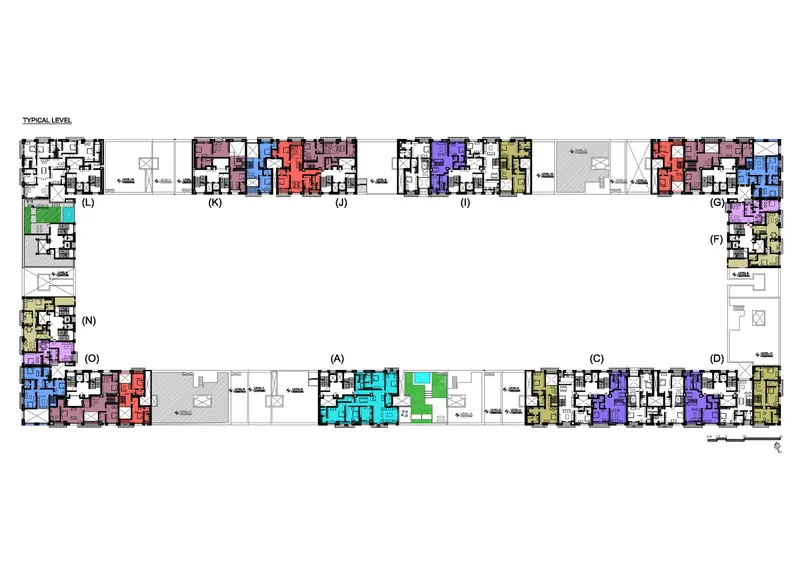
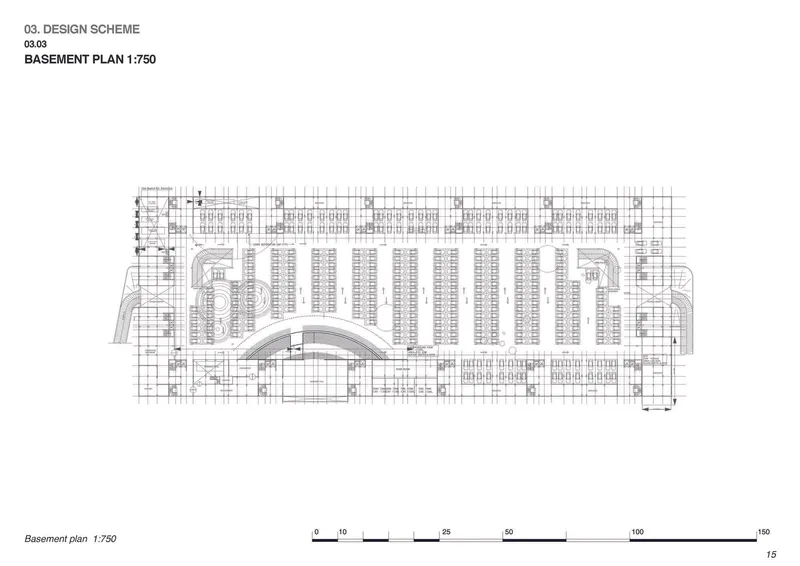
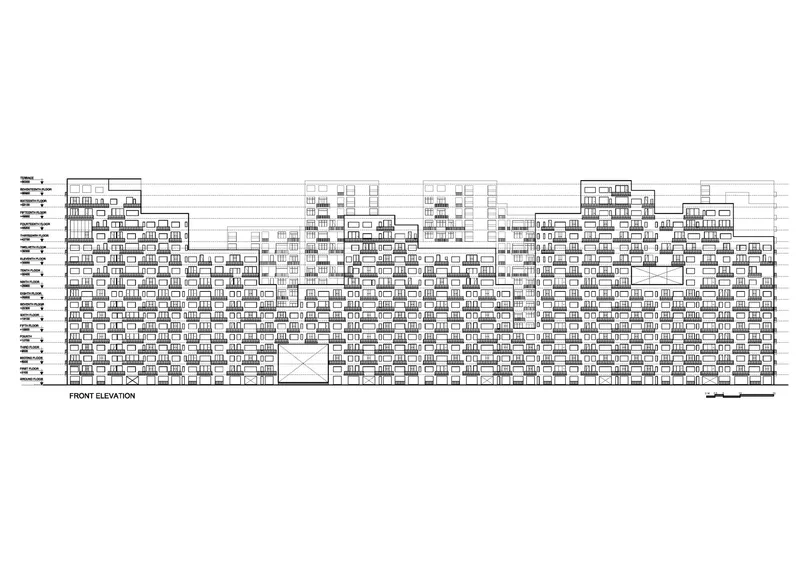
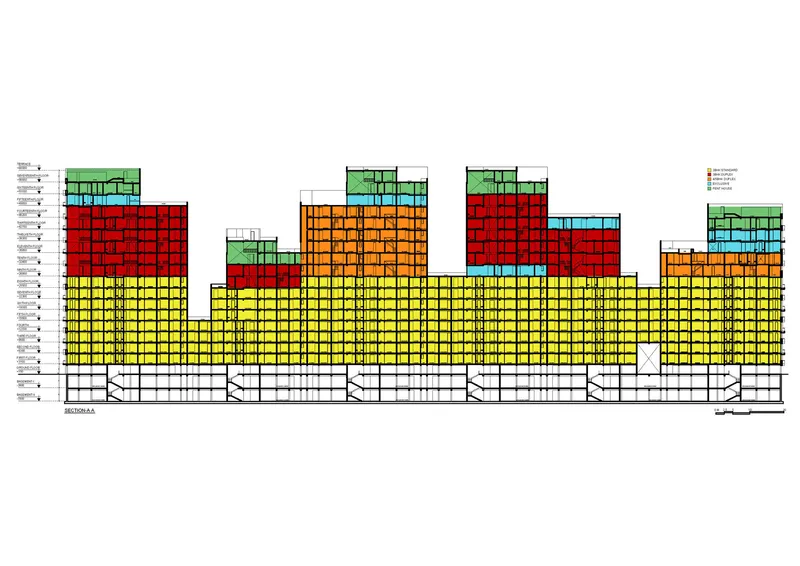
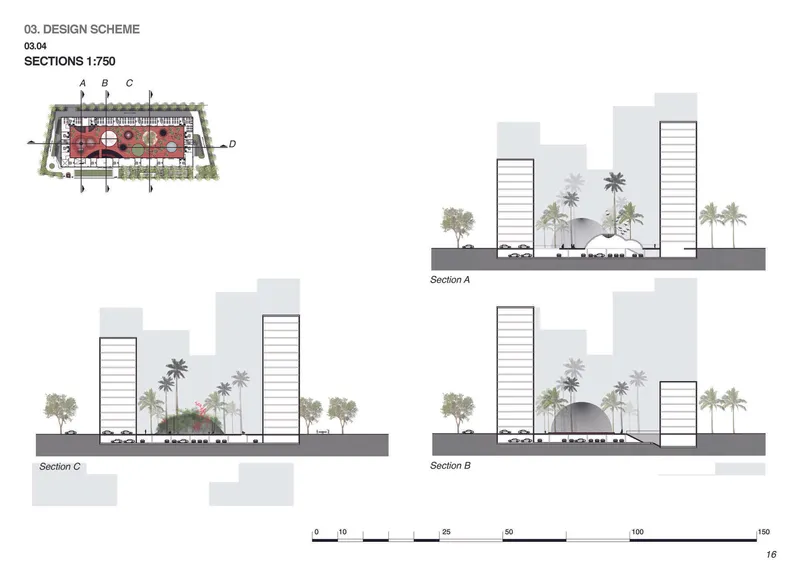
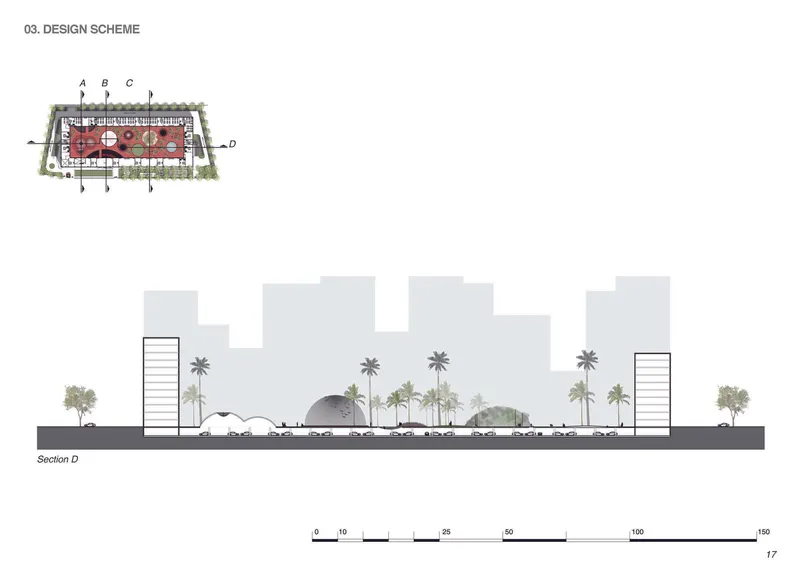
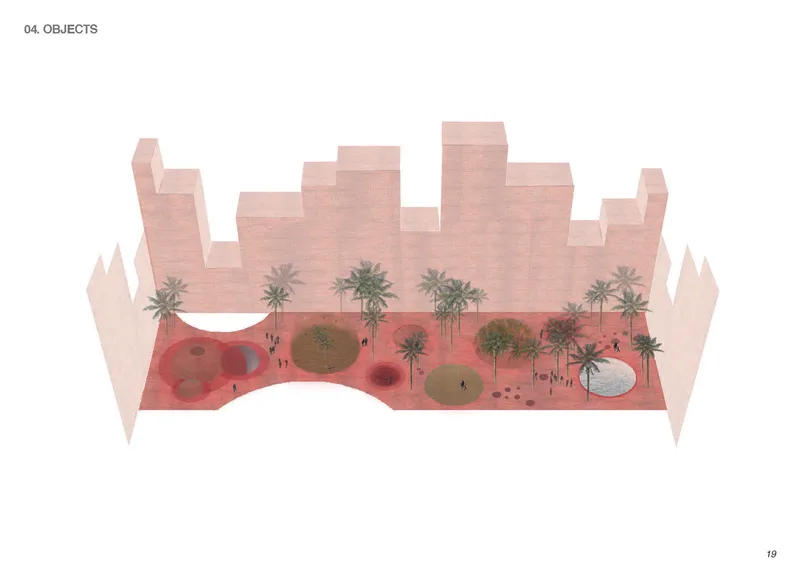
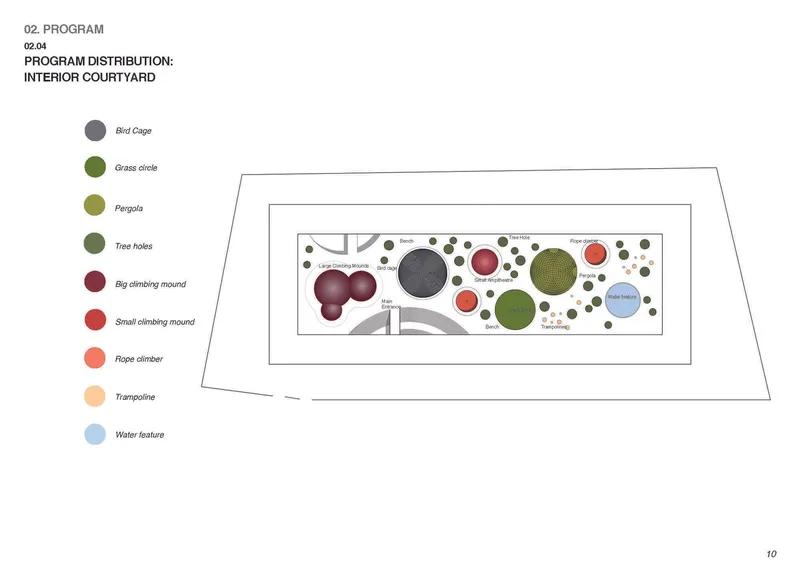
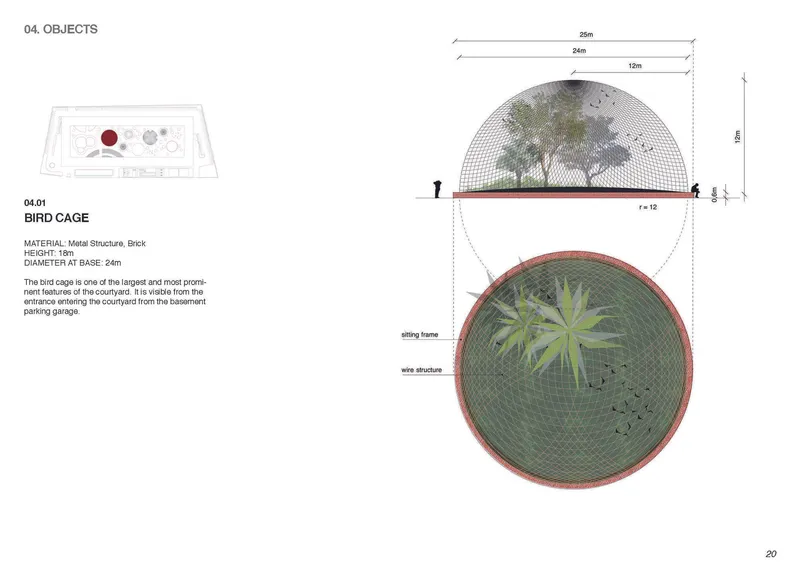
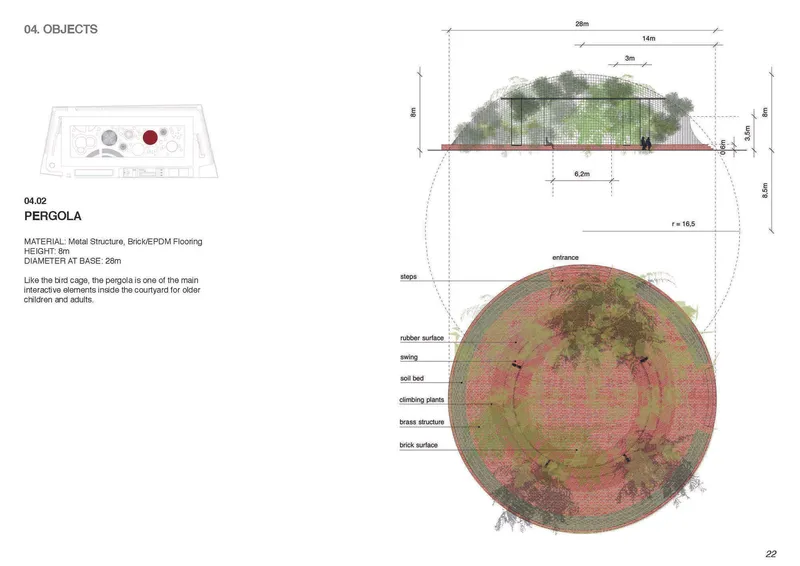
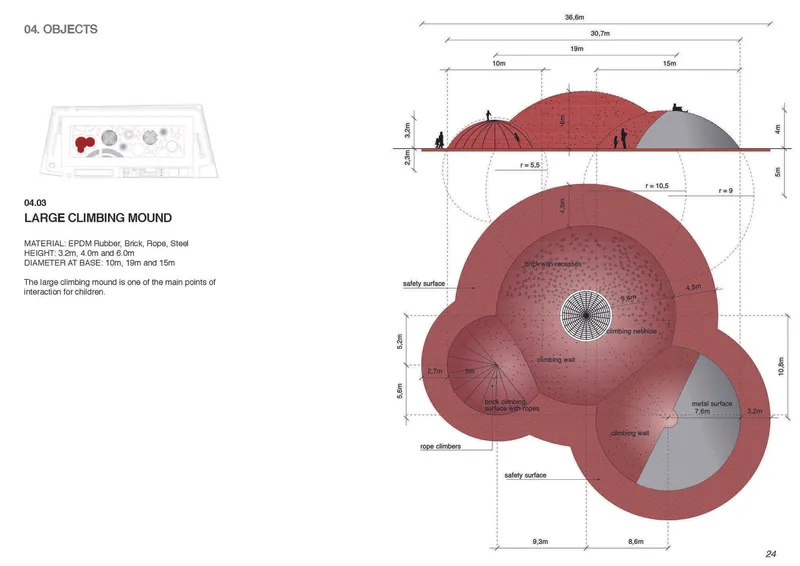
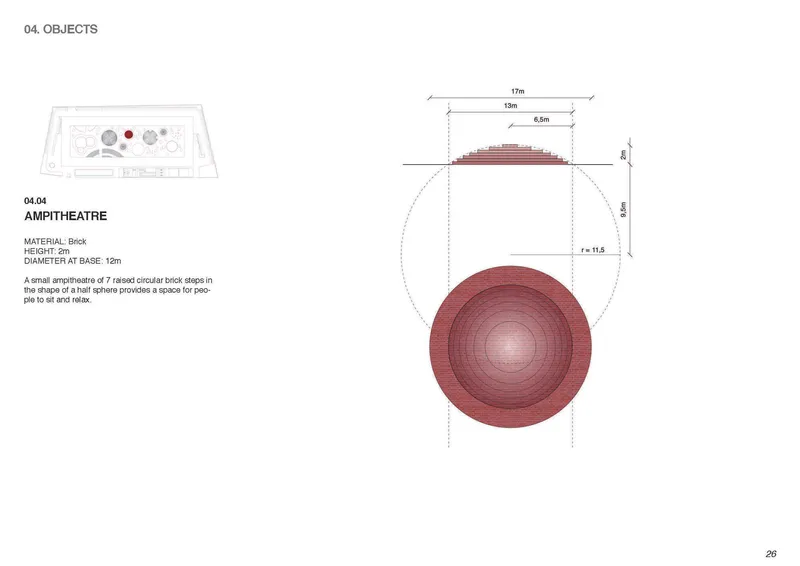
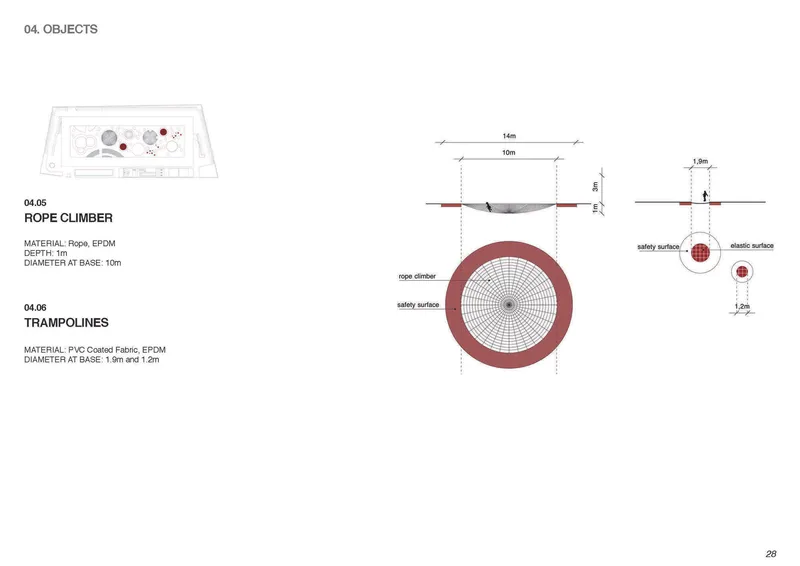
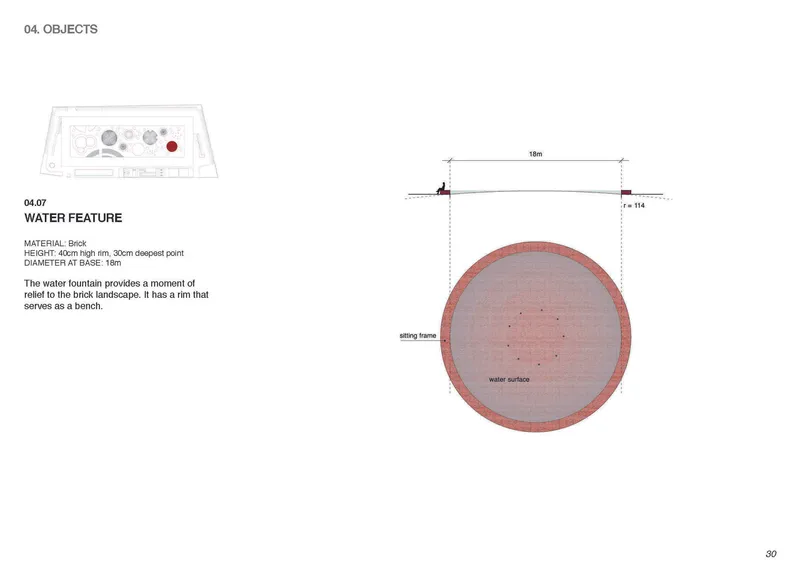
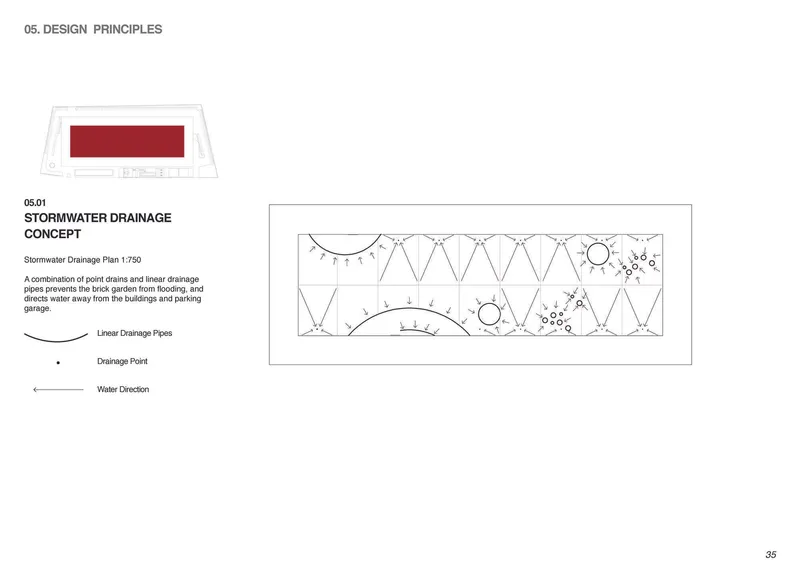
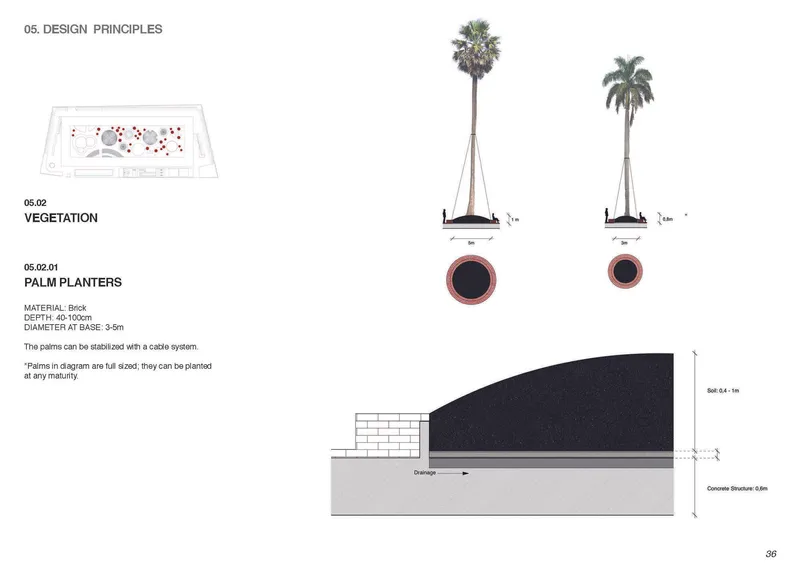
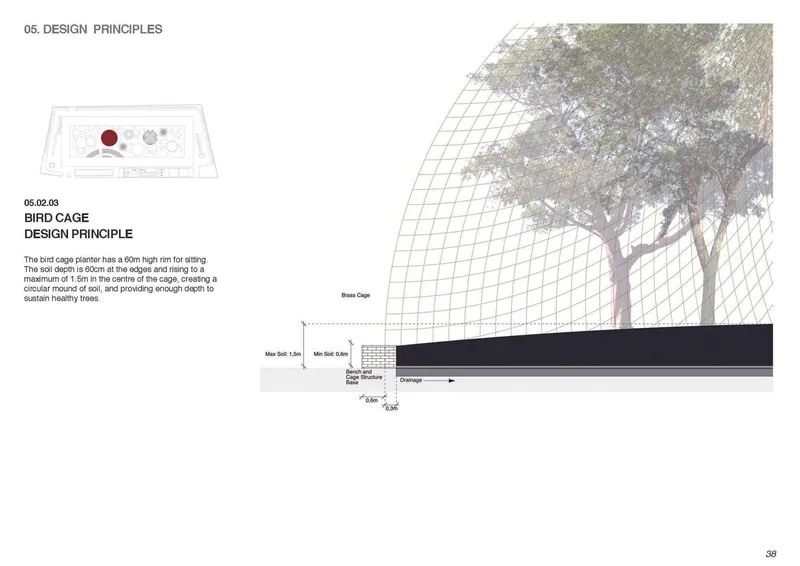
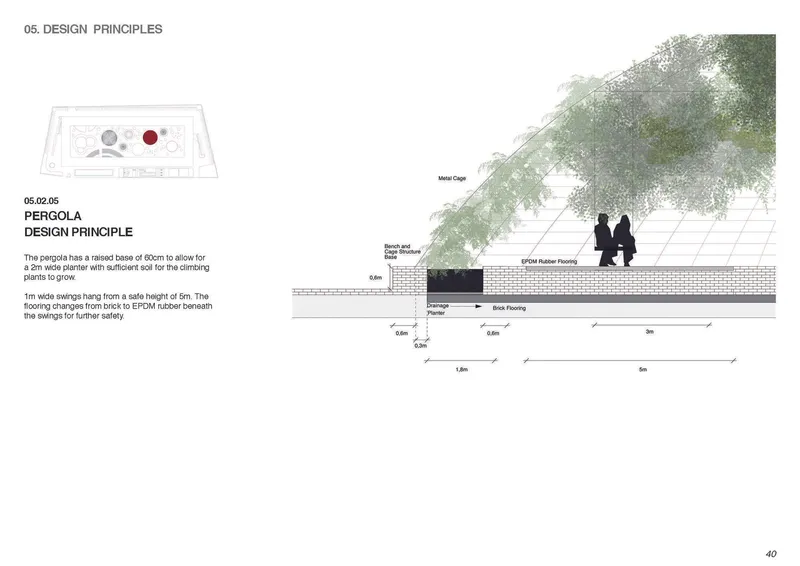
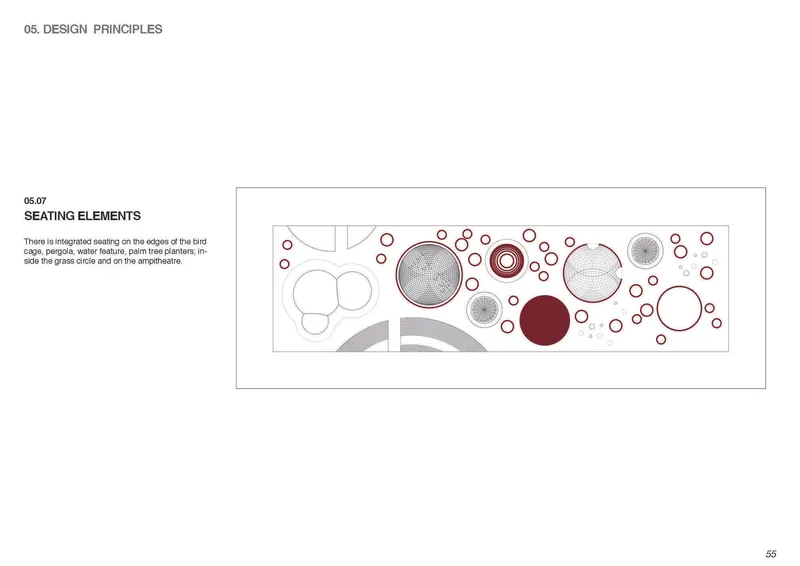
The drawings reveal how carefully the perimeter ring organizes circulation. Color-coded cores are distributed across lettered towers, each serving a cluster of units that open onto the central courtyard. The section drawings are particularly instructive: a yellow podium base contains parking, above which the residential floors rise and then step back to form the terraced upper levels. The courtyard program drawings, detailed down to drainage layers beneath planters and dimensional annotations for every play element, demonstrate a level of landscape documentation that is rare in Indian residential projects.
The renderings of individual courtyard elements, from the geodesic dome to the amphitheater to the water features, show that TOPOTEK 1 treated each piece as a small building in its own right, with dedicated plans, sections, and material specifications. The stormwater drainage concept drawing makes clear that the courtyard is also a functioning piece of infrastructure, directing runoff through linear pipes and point drains rather than relying on the surrounding landscape to absorb it passively.
Why This Project Matters
Oranje Castle matters because it proves that density and livability are not mutually exclusive in Indian group housing. The perimeter block typology, standard in European cities for centuries, is adapted here with intelligence: thickened brick walls for insulation, stepped massing for terrace access, and a courtyard program that treats shared space as the project's primary asset rather than its leftover. At 131,602 square meters of built-up area on just seven acres, the project achieves high density without the alienating repetition that defines most developments of this scale in India.
The collaboration between MVRDV and Studio Archohm also points to a productive model for international partnerships. MVRDV's expertise in massing manipulation and housing typology is visible in the stepped silhouettes and courtyard strategy, while Archohm's deep knowledge of Indian construction practice and climate is evident in the brick detailing and double-wall system. Neither firm disappears into the other. The result is a project that could not have been produced by either office alone, and one that sets a new benchmark for what group housing in a rapidly urbanizing Indian city can aspire to be.
Oranje Castle Group Housing, designed by MVRDV and Studio Archohm, with landscape design by TOPOTEK 1. Lucknow, India. 131,602 m². Completed 2022. Photography by Noughts & Crosses LLP.
About the Studio
Studio Archohm
Official website of Studio Archohm, one of the studios behind this project.
archohm.comShare Your Own Work on uni.xyz
If projects like this are the kind of work you want to make, uni.xyz is a place to publish your own, find collaborators, and enter design competitions.



Popular Articles
Popular articles from the community


Hill & Cross Opera: Sculptural Opera House Architecture Shaped by Tallinn’s Landscape and Identity
Hill & Cross Opera reimagines opera house architecture in Tallinn through its sculptural hill, civic plaza, glass wave and a luminous cross.

Play: Fragments of Their World
Familiar architecture becomes modular playground design, creating safe spaces where displaced children can learn, connect, imagine and play.

The Ocean Hive: Sustainable Architecture for a Self-Sufficient Civilization at Sea
The Ocean Hive imagines sustainable architecture at sea, where modular habitats, algae, wave power and ocean waste sustain a growing colony.

Riyadh For All: Intergenerational Urban Design for Active Aging in Rabat
Riyadh For All reimagines urban design in Rabat with intergenerational co-living, adaptive courtyards, and Moroccan cultural exchange today.

Similar Reads
You might also enjoy these articles

Bao Huynh Watercolor Atelier: A Serene Art Retreat in Hội An
Bao Huynh Watercolor Atelier in Hội An blends multifunctional art spaces, sustainable design, local materials, and family-friendly living in a serene environment.

Atelier Macri Concept Store Interior Design by CASE-REAL
Atelier Macri store features a "ko" counter, walnut wood details, cork displays, blending retail, gallery, and seamless customer experiences.

Manuel Vargas Izquierdo Stadium and High-Performance Sports Center: Architectural Excellence in Jalpa de Méndez
The Manuel Vargas Izquierdo Stadium blends sustainable design, inclusive sports facilities, and cultural-inspired architecture, revitalizing Jalpa de Méndez’s public spaces.

KAKR Buluh Awar Hall: Revitalizing Community and Ecology Through Bamboo Architecture
Community built bamboo hall revitalizes Buluh Awar village, empowering youth, restoring ecology, celebrating vernacular craftsmanship through sustainable architecture and culture.


Explore Student Housing Competitions
Discover active competitions in this discipline



Challenge to reimagine the Iron Throne


Photograph architecture without architects


Illustrate the lost glory of Angkor Wat - Render Challenge


Design challenge to reuse E-waste
Comments (0)
Please login or sign up to add comments
No comments yet. Be the first to comment!