
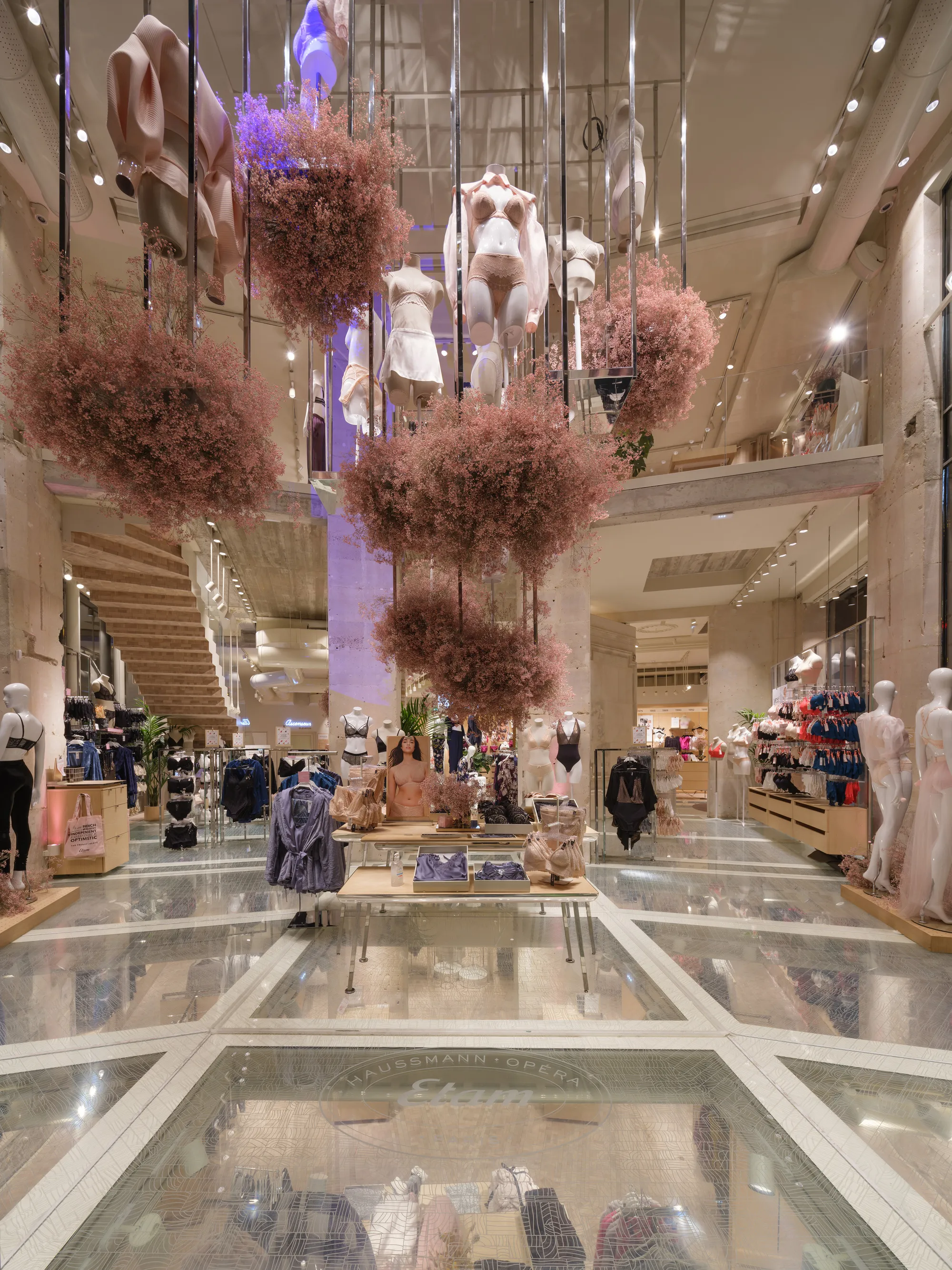
MVRDV Peels Back a Haussmann Building to Create Etam's Revealing Paris Flagship
A 350 square meter lingerie store on Boulevard Haussmann uses glass floors and a pivoting stone wall to balance intimacy with spectacle.


There is something undeniably cheeky about designing a lingerie store around the concept of transparency. MVRDV leans into the idea fully at the Etam flagship on Boulevard Haussmann, turning a 19th-century Parisian building into a retail space where glass floors, stripped walls, and a five-tonne pivoting stone doorway conspire to make the architecture itself feel like an act of undressing. Across the street from the Galeries Lafayette and a short walk from the Opéra Garnier, this 350 square meter corner store sits in one of the most commercially competitive stretches of Paris, a place where attention is scarce and ground-floor real estate is merciless.
What makes this project genuinely interesting is not the branding exercise but the surgical approach to an existing building. Rather than gut the interior and install a white box, MVRDV removed just enough: tearing out most interior walls and part of the entresol floor, stripping the exterior back to let daylight flood in from two sides, and then revealing the original stone structure as a raw, muscular backdrop. The result is a store that feels simultaneously ancient and startling, where limestone meets laminated glass and the basement becomes a visible extension of the ground floor.
Corner Presence on Boulevard Haussmann
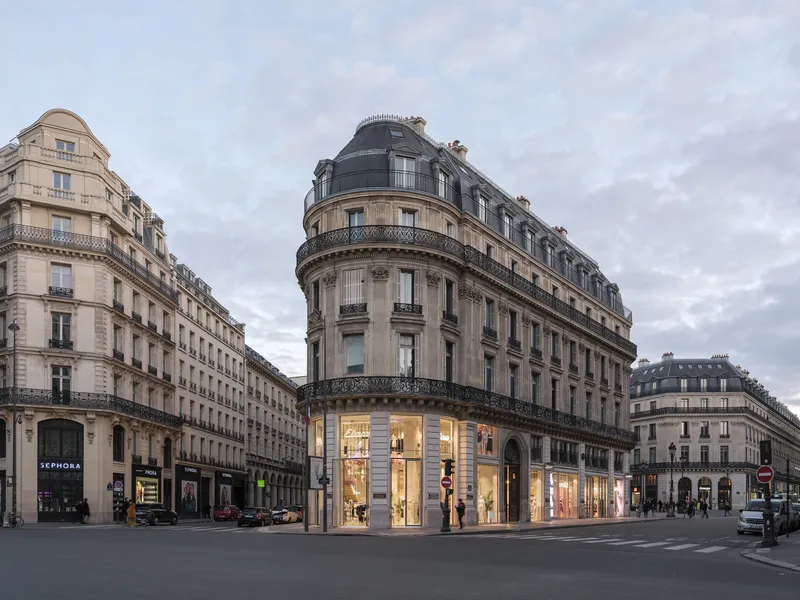

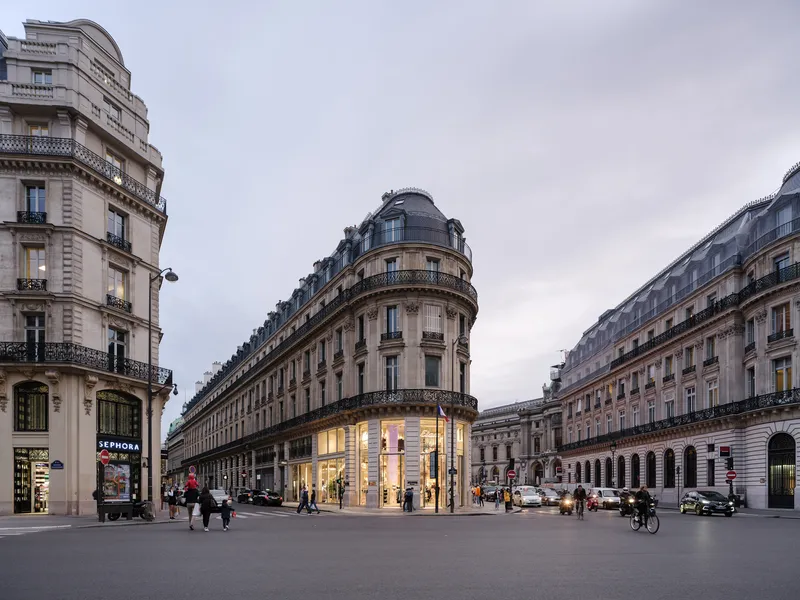
The building occupies a peninsular corner site, which gives it a curved facade and triple exposure to the street. MVRDV kept the Haussmannian envelope intact, with its rusticated stone base, mansard roof, and wrought-iron balconies reading exactly as they should in Paris's 9th Arrondissement. The intervention is almost entirely below the balcony line: tall storefront glazing that replaces opaque panels, turning the ground floor into a lantern at dusk.
From across the boulevard, the illuminated interior is the advertisement. The building becomes its own vitrine, pulling the eye through floor-to-ceiling glass to the displays, the suspended foliage, and the glowing atrium below. It is a strategy that respects the streetscape while competing aggressively for attention in a neighborhood dominated by department store spectacle.
The Glass Floor as Architectural Conceit


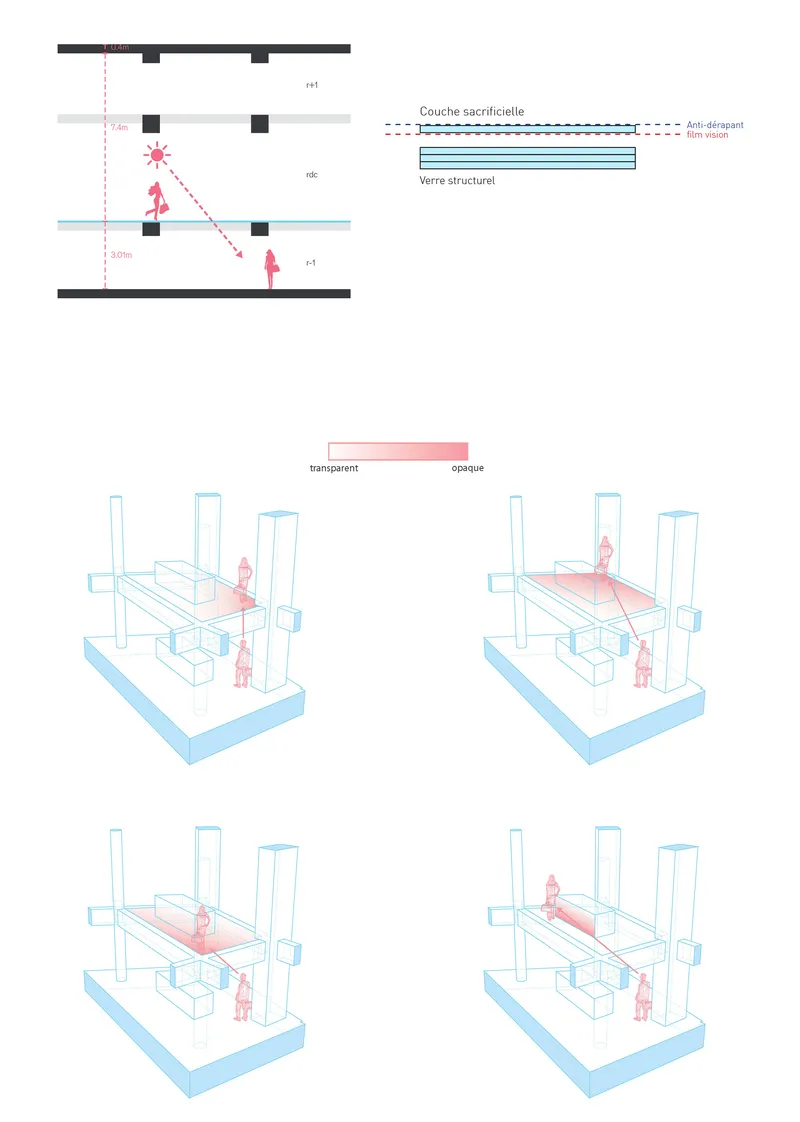
The centerpiece of the design is a structural glass floor at ground level that opens a visual shaft to the basement. MVRDV treated the glass with a special directional film: viewed at an angle, the floor is transparent, offering glimpses of the lower level; looked at from directly above or below, it clouds. The firm describes this as a reference to lingerie itself, revealing yet respectfully modest. Whether you find that metaphor clever or on the nose, the spatial consequence is genuinely effective. Daylight travels down, the basement no longer feels subterranean, and the store reads as a single connected volume rather than two stacked floors.
The non-slip pattern applied to the glass surface was developed from a wood flooring motif, which links to another material move: the light-colored wood flooring laid on its end that covers the stairs, the basement, and part of the ground level. That flooring references pavé en bois debout, the end-grain wood cobblestones that were widely used across Parisian streets in the 19th century. It is a neat historical citation that most customers will never consciously register, but it gives the floor surfaces a coherent texture and warmth.
Stripping Back to Stone
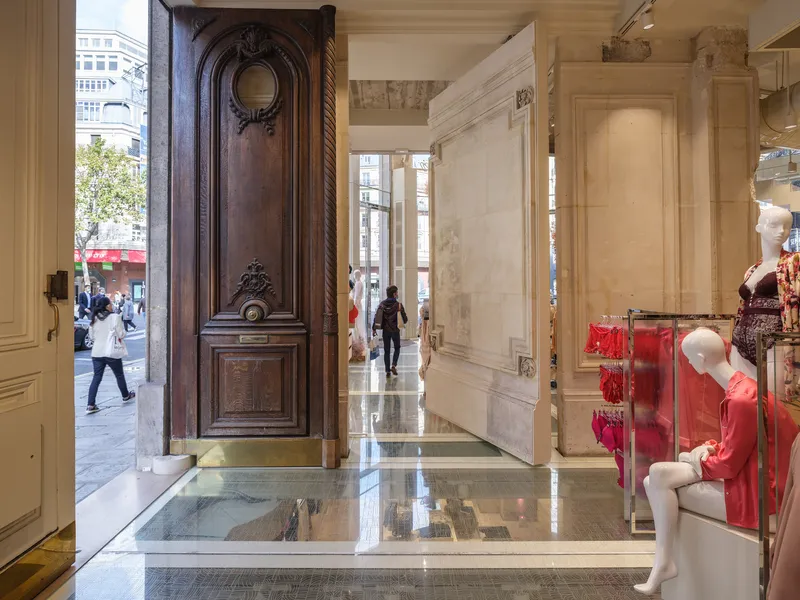
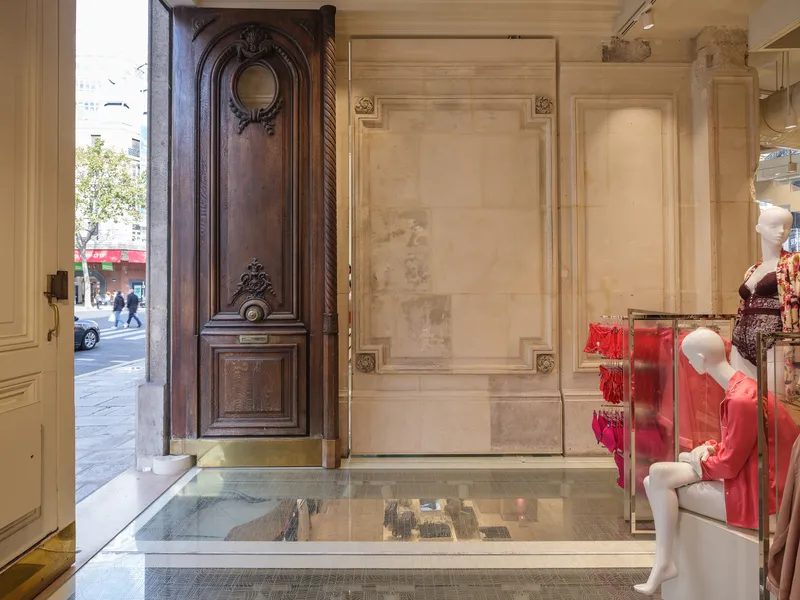

During interior demolition, the team uncovered an original stone wall section within the building. Rather than conceal it behind drywall, MVRDV transformed the five-tonne stone element into a pivoting doorway, a move inspired by the building-cutting work of artist Gordon Matta-Clark. It is the kind of detail that photographs beautifully and functions as a threshold between zones, giving the entry sequence a weight and tactility that no new construction could replicate.
The decision to expose the original load-bearing stone structure throughout the interior sets the material tone. Limestone walls, stripped of plaster, read as archaeology. Against this rough backdrop, the glass floor and contemporary fixtures feel deliberately placed rather than generically modern. The contrast gives the space character without the store needing to rely on heavy-handed scenic design.
Atrium and Vertical Connection


Removing part of the entresol floor created a double-height atrium at the center of the plan, which MVRDV uses to stage the main visual event: suspended pink foliage installations hanging through the void, visible from both levels and from the street. A grand central staircase descends to the basement, drawing customers down rather than relying on them to discover a lower level on their own. Retail designers know that getting shoppers below grade is one of the hardest problems in store planning, and the atrium void does that work architecturally.
Glass balustrades around the upper level maintain sightlines across the void. From the mezzanine, you look down through the atrium and, via the glass floor, further still to the basement. The result is a telescoping section that makes 350 square meters feel significantly larger, layering depth on a site that is already spatially complex thanks to its wedge-shaped footprint.
Facade and Streetscape at Dusk
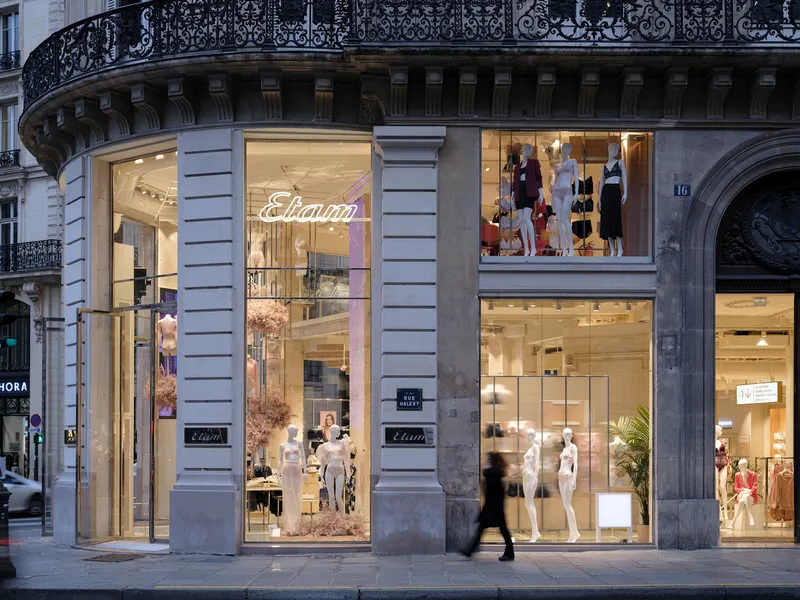

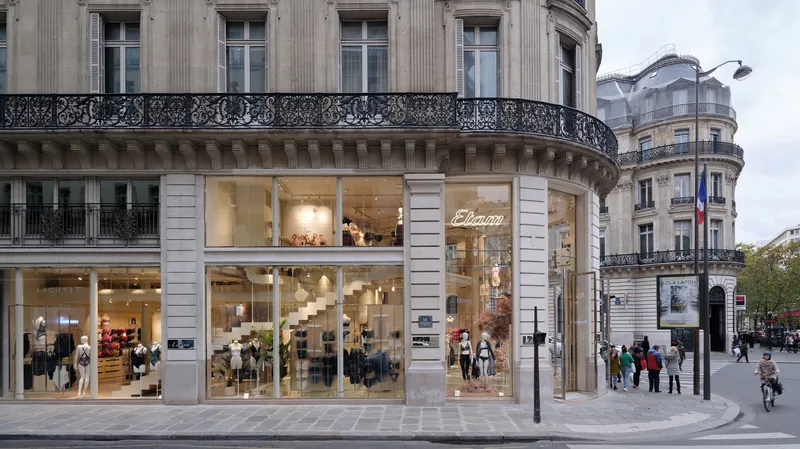
The storefront works hardest at twilight. Tall display windows framed by the existing stone base glow from within, with the suspended floral installations acting as a visual draw that is legible from across the boulevard. By day, the facade is restrained, just large glazed openings set into rusticated stone. At night, the building flips: the Haussmannian shell becomes a frame for an illuminated interior stage.
MVRDV resisted adding any signage or applied material to the upper floors. The mansard roof, the iron balconies, the carved stonework all remain untouched. The discipline here is worth noting. In a commercial district where brands routinely colonize entire facades with graphics, the restraint positions the architecture itself, not the branding, as the primary signal of quality.
Aerial Context and Urban Form

Seen from above, the building's curved corner and mansard roofscape lock it firmly into the repetitive grammar of Haussmannian Paris. The zinc roofs, the uniform cornice lines, the radiating boulevards: this is a city that exerts enormous pressure on any designer to conform. MVRDV's strategy, concentrating all visible intervention at the ground floor and below, is both pragmatic and contextually intelligent. The building's silhouette remains unchanged against the skyline.
Plans and Drawings

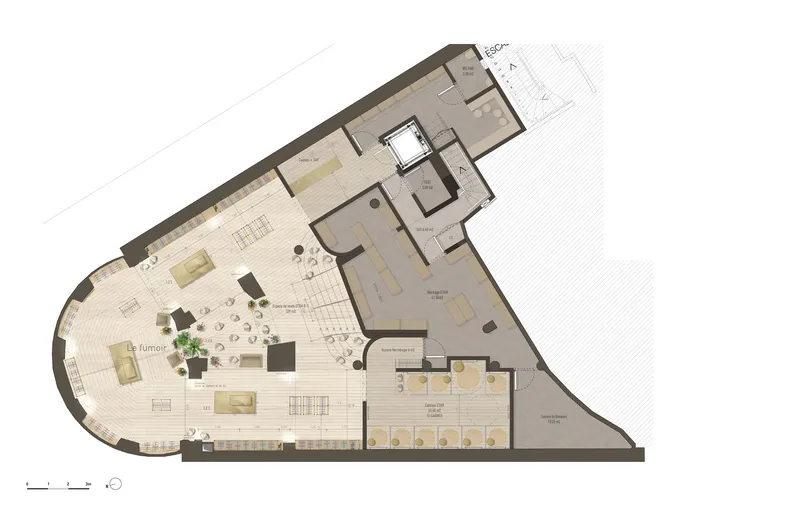

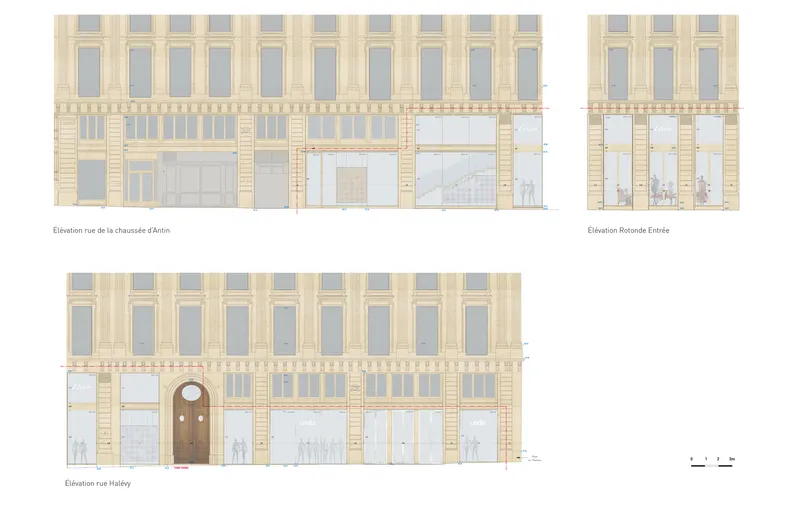

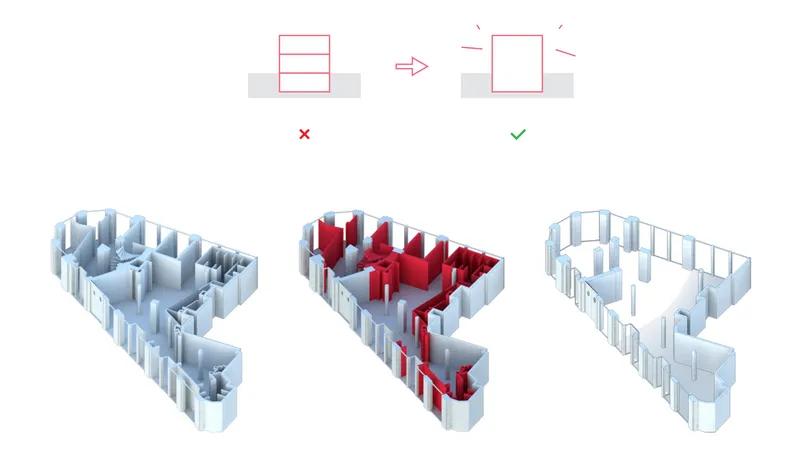
The floor plans reveal the wedge-shaped footprint clearly, with the curved perimeter walls following the street geometry and the central circulation core threading through all levels. Service zones are tucked against the party walls, leaving the street-facing areas entirely free for display. The section drawing shows how the atrium void and glass floor work together to knit the three levels into a single spatial experience, with the staircase acting as the primary vertical spine.
The axonometric diagram highlights the structural cores in red, making visible just how much original fabric MVRDV retained. The isometric detail of the glass floor layering is particularly instructive: it shows the laminated assembly, the film treatment, and the non-slip surface pattern, along with diagrams of anticipated movement patterns. These drawings communicate that the glass floor is not a decorative gesture but a carefully engineered structural element with precise optical and functional requirements.
Why This Project Matters
The Etam store is a compact case study in how adaptive reuse can be a branding strategy, not just a preservation obligation. MVRDV positions the decision to retain and reveal the Haussmann building's original stone structure as a sustainability move: avoiding the embodied carbon of demolition and new construction. That argument is legitimate, but the real achievement is tonal. The exposed limestone, the end-grain wood, the glass floor all create an atmosphere that no new-build white box could replicate. The building's history becomes the store's interior design.
More broadly, the project demonstrates that retail architecture can still operate at a high level of spatial invention without abandoning context. The pivoting stone wall, the directional glass film, the double-height void: these are specific, site-generated ideas, not transferable concepts applied to a generic shell. In a retail landscape dominated by interchangeable flagship templates, this kind of architectural specificity is increasingly rare and correspondingly valuable.
Etam Paris Store by MVRDV, Paris, France. 350 m², completed 2020. Photography by Ossip van Duivenbode.
About the Studio
Share Your Own Work on uni.xyz
If projects like this are the kind of work you want to make, uni.xyz is a place to publish your own, find collaborators, and enter design competitions.




Popular Articles
Popular articles from the community


Hill & Cross Opera: Sculptural Opera House Architecture Shaped by Tallinn’s Landscape and Identity
Hill & Cross Opera reimagines opera house architecture in Tallinn through its sculptural hill, civic plaza, glass wave and a luminous cross.

The Ocean Hive: Sustainable Architecture for a Self-Sufficient Civilization at Sea
The Ocean Hive imagines sustainable architecture at sea, where modular habitats, algae, wave power and ocean waste sustain a growing colony.

The Musturak Paradise: Senior Living Architecture for a Connected Future in Temara, Morocco
The Musturak Paradise reimagines senior living architecture in Temara via private homes, social spaces, culture, community, and shared care.

The Earth Pod: 3D Printed Homes for Resilient Refugee Communities
The Earth Pod reimagines refugee housing through 3D printed homes made from clay, combining resilience, self-sufficiency, and rapid shelter.

Similar Reads
You might also enjoy these articles

Bao Huynh Watercolor Atelier: A Serene Art Retreat in Hội An
Bao Huynh Watercolor Atelier in Hội An blends multifunctional art spaces, sustainable design, local materials, and family-friendly living in a serene environment.

Atelier Macri Concept Store Interior Design by CASE-REAL
Atelier Macri store features a "ko" counter, walnut wood details, cork displays, blending retail, gallery, and seamless customer experiences.

Manuel Vargas Izquierdo Stadium and High-Performance Sports Center: Architectural Excellence in Jalpa de Méndez
The Manuel Vargas Izquierdo Stadium blends sustainable design, inclusive sports facilities, and cultural-inspired architecture, revitalizing Jalpa de Méndez’s public spaces.

KAKR Buluh Awar Hall: Revitalizing Community and Ecology Through Bamboo Architecture
Community built bamboo hall revitalizes Buluh Awar village, empowering youth, restoring ecology, celebrating vernacular craftsmanship through sustainable architecture and culture.


Explore Commercial Buildings Competitions
Discover active competitions in this discipline


Challenge to design luxury tourism on rails


VR headsets Storefront design competition


Designing a staircase for a client
Comments (0)
Please login or sign up to add comments
No comments yet. Be the first to comment!