

MVRDV Strips a Shenzhen Factory Down to Its Bones and Builds a Rooftop Village on Top
In the ancient urban village of Nantou, a six-storey concrete frame gets a second life as a creative hub crowned by bamboo rooms.


There is a particular kind of courage required to take a building apart rather than tear it down. In Nantou, one of Shenzhen's surviving urban villages, MVRDV found a nondescript factory and did exactly that: peeled off its facades, exposed its raw concrete skeleton, and then carefully reassembled a new identity around the old structure. The result, Idea Factory, is 11,200 square meters of offices, retail, event space, and one of the most inventive rooftops in southern China. It is also a pointed argument that the most sustainable square meter is the one you don't demolish.
What makes this project genuinely interesting is not just the retrofit logic, which is increasingly common, but the way MVRDV treats the gap between old structure and new skin as inhabitable space. By recessing the new glass facade behind the original concrete frame, the architects create open loggias that wrap every floor, turning what would normally be dead corridor into breezy, semi-outdoor meeting space. In a subtropical climate like Shenzhen's, that move is both passive cooling strategy and social infrastructure. And then there is the roof: a bamboo maze that carves the flat top of the building into a constellation of program rooms, from a glass performance box to a trampoline court, a tea house, and a chess set. It reads less like architecture and more like a village stacked on top of a village.
A Skeleton Made Visible

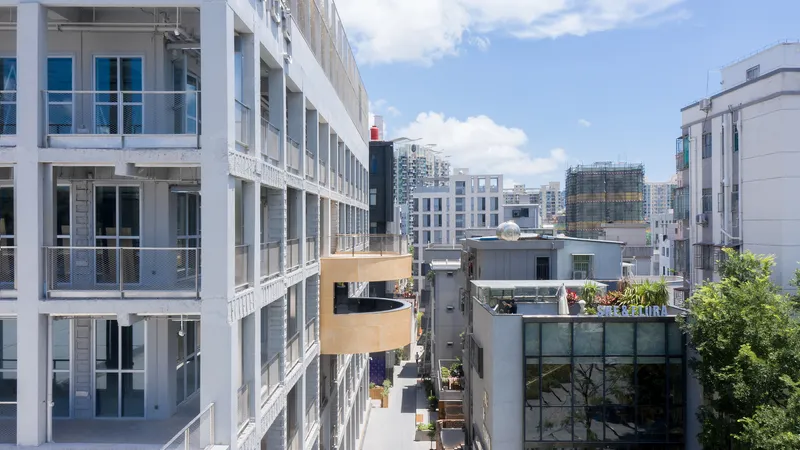
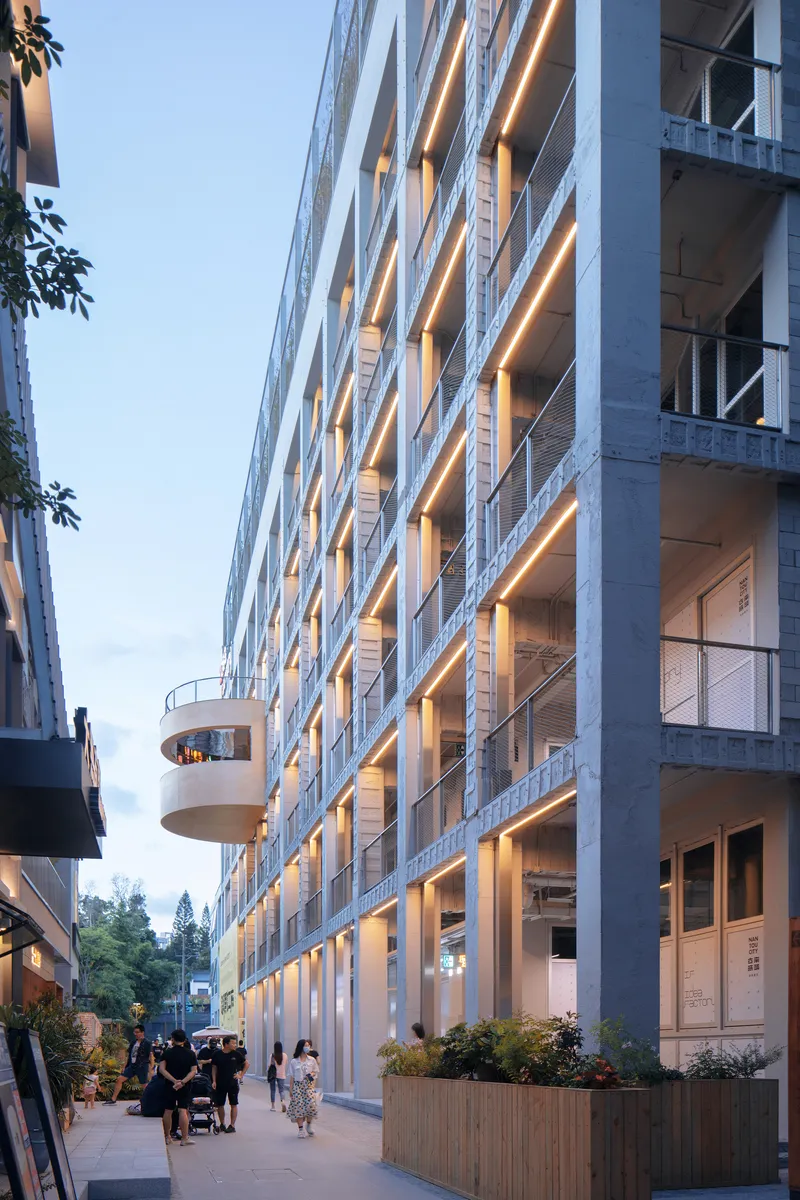
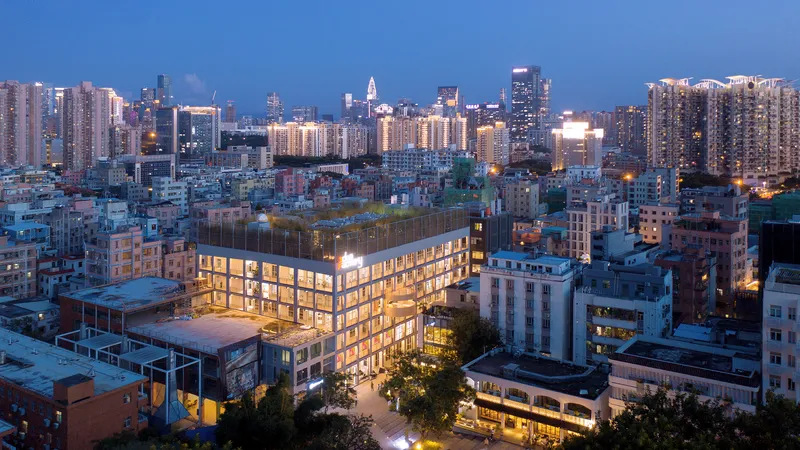
The original factory's concrete frame was never meant to be seen. It was utilitarian, repetitive, the kind of structure that hides behind cladding. MVRDV stripped all of that away, treated the exposed concrete with an off-white coating to slow weathering, and turned the grid into the building's primary visual identity. The result is a rigorous lattice of horizontal slabs and vertical columns that reads almost like a de Stijl composition against the chaotic roofscape of Nantou. At dusk, warm light bleeds through the recessed glass walls, and the frame becomes a lantern hovering above the surrounding low-rise fabric.
The decision to preserve and expose traces of the old structure, rather than skim-coating them into oblivion, gives the facade a texture that new construction rarely achieves. You can read the building's history in its bones: the marks of removed partitions, the patching where old connections were severed. It is honest work, and it contrasts sharply with Shenzhen's typical appetite for the brand-new.
The Loggia as Social Space


The single most consequential design move is the setback of the new facade from the structural frame. That gap, roughly a loggia's width, wraps the entire building and serves as open-air circulation on every floor. In a conventional office building, this would be an enclosed corridor, air-conditioned and forgettable. Here, it is a continuous balcony where people pass each other, pause, and look out over Nantou's tight alleyways. The curved protrusion on the fourth floor, where the public staircase punches through the envelope, adds a moment of sculptural drama to what is otherwise a disciplined grid.
At night, the loggias glow. The building becomes legible as a stack of inhabited shelves, its activity visible to the surrounding neighborhood. That transparency is deliberate: Idea Factory is the flagship of a broader effort by developer Vanke to transform Nantou into a cultural and creative district, and the building's openness is meant to signal welcome.
Neon Nostalgia Inside the Staircase


The public staircase that cuts diagonally through the building, from the ground floor plaza all the way to the roof, is lined with mirrors and drenched in multicolored neon. It is unabashedly theatrical, and it is meant to be. The neon signage is a direct homage to the early days of Shenzhen's urbanization, when the city was a frontier of commerce and its streets buzzed with the glow of hand-painted and neon-lit shopfronts. Walking up through the staircase, you are moving through a compressed history of the city itself.
The mirrors double the effect, fragmenting the light and the bodies moving through the space into a kaleidoscopic collage. It is the most Instagram-ready moment in the building, and MVRDV clearly knows it. But the staircase also performs a serious civic function: it turns a private office building into a piece of public infrastructure, giving anyone on the street a reason and a route to reach the rooftop.
A Rooftop Village in Bamboo
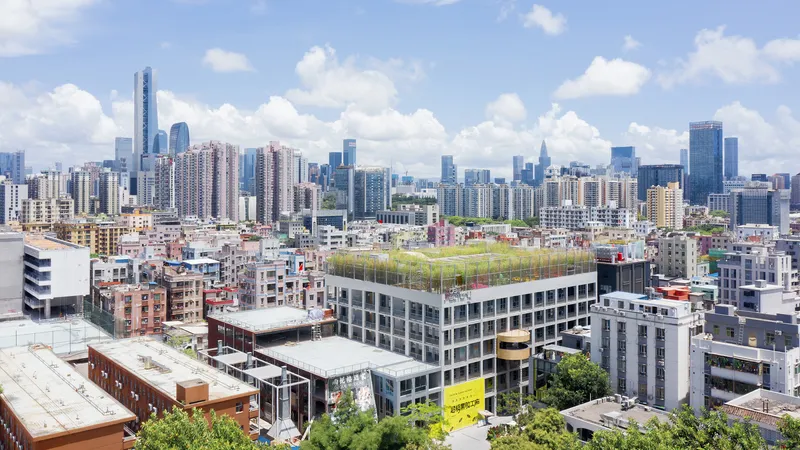
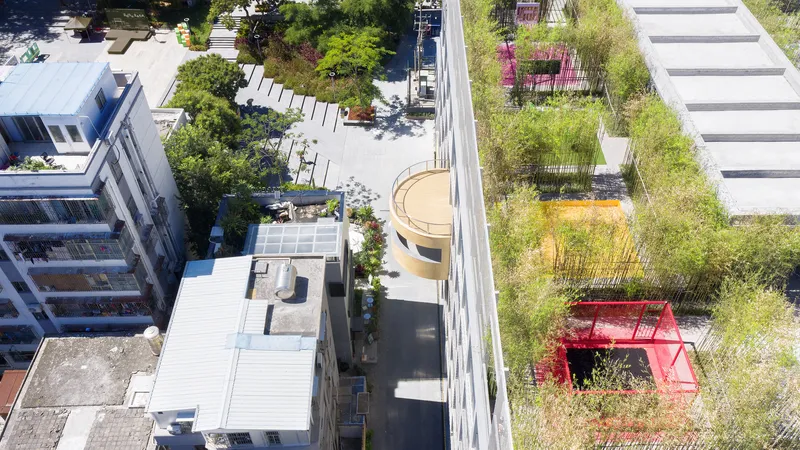

The roof is where the project transcends the logic of adaptive reuse and becomes something stranger and more generous. Living bamboo, planted in dense groves, is arranged to form a maze that divides the rooftop into discrete "rooms," each with its own program. There is a glass-enclosed performance pavilion, a gym with orange rubber flooring, a trampoline, a tea house, a dining area, a dance floor, and a giant chess set. The original factory structure was strengthened to carry the weight of this additional landscape floor, which is itself a significant investment in the idea that a roof should do more than keep water out.
The bamboo is functional, too: it shades the rooms below, cools the air through evapotranspiration, and supports biodiversity in a part of Shenzhen where green space is scarce. Seen from above, the rooftop reads like a small park that has drifted onto the building, blurring the boundary between landscape and architecture.
Rooms in the Canopy


Each rooftop room has a distinct material identity. The play area is surfaced in pink rubber with a magenta climbing sculpture. The seating terrace is finished in warm timber and set within a corridor of tall bamboo. The exercise zone gets orange rubber and metal equipment. These are not spaces designed for one demographic; they are deliberately varied to attract different people at different times of day. The effect is closer to a public park than a corporate amenity deck.
The brightly colored pavilion volumes, visible in aerial views as pink, green, and yellow tiles, give the rooftop a playful legibility from the surrounding towers. In a city where the view from above is often a monotonous carpet of grey and beige, MVRDV has turned the fifth elevation into a signal.
Colorful Pavilions and Aerial Presence


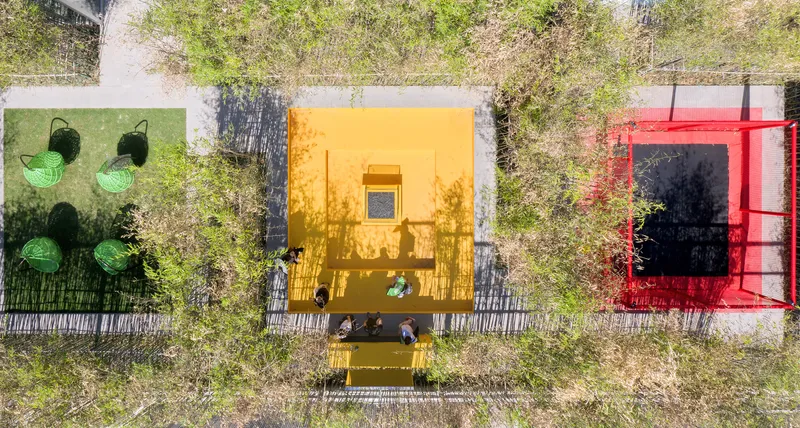
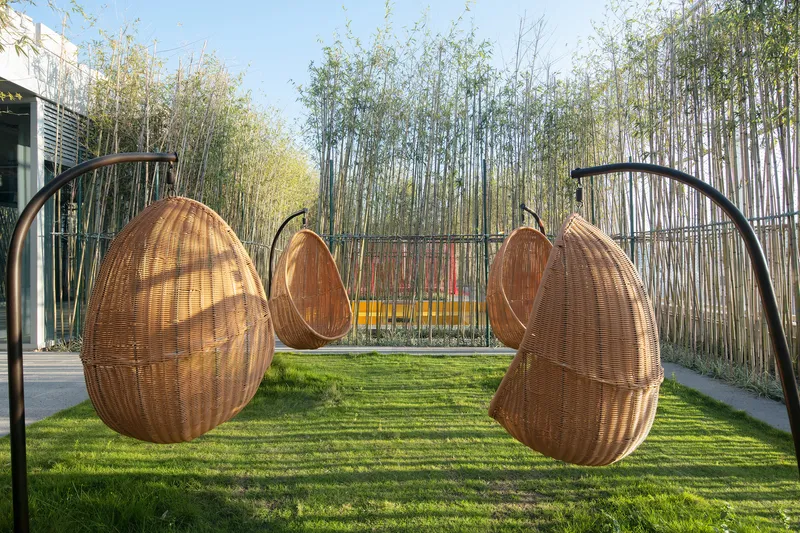
Seen from neighboring buildings or drones, the rooftop pavilions register as a cluster of jewel-toned objects nestled in overgrown vegetation. The tiled surfaces recall the patterning of traditional Chinese courtyards, but the colors are pushed to a contemporary intensity. Rattan egg chairs swing from arced metal frames; boardwalk paths thread between bamboo screens. The composition is deliberately informal, even messy, resisting the urge to over-design what is essentially an outdoor living room.


From a wider aerial perspective, you can see how Idea Factory's rooftop relates to the broader context of Nantou's transformation. Other nearby buildings sport running tracks and sports fields on their roofs, but none achieve the programmatic density or landscape ambition of MVRDV's intervention. The building's white grid rises above the village's pink and pastel rooftops like a deliberate punctuation mark, asserting a new standard for what adaptive reuse can deliver.
Plans and Drawings

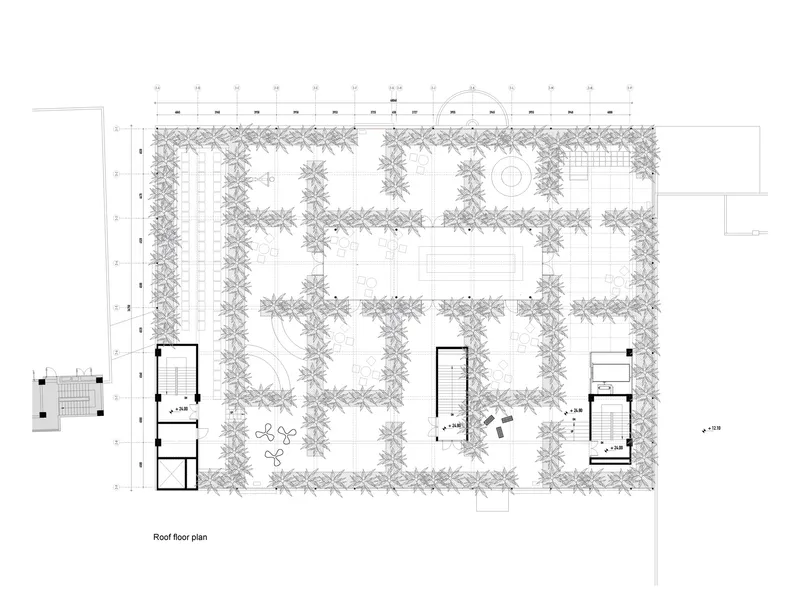


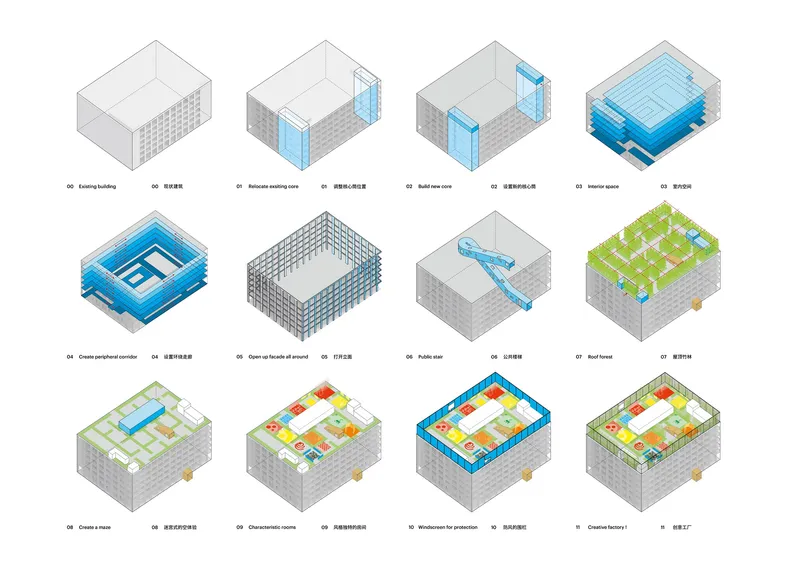
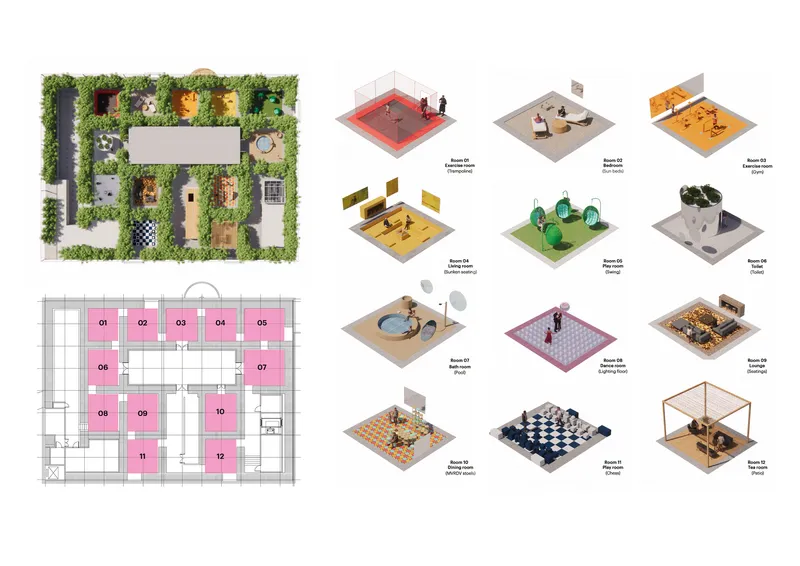
The drawings reveal the precision behind the apparent looseness. The floor plans show an open layout organized around a central void, with the structural grid of perimeter columns preserved intact. The roof plan is the most telling: tree symbols and planted zones are arranged to create the maze of rooms visible in the photographs, confirming that the bamboo landscape is planned infrastructure, not decorative afterthought. The east elevation reads the concrete grid clearly, while the cross section exposes the diagonal public staircase slicing through the building like a seam.
The axonometric sequence is particularly useful. It walks through the design process step by step, from the existing factory frame to facade removal, new glass insertion, loggia creation, and finally the addition of the rooftop garden. It is a clear diagram of an argument: that you can do more with less demolition, and that the constraints of an existing structure can generate spatial ideas that a blank site never would.
Why This Project Matters
Shenzhen is a city that has historically solved its architectural problems by building new. Its default setting is demolition and replacement, and the speed at which that cycle operates has produced a metropolis with very little collective memory embedded in its built fabric. Idea Factory is a counterproposal: proof that a generic factory in an overlooked urban village can become the most programmatically rich building in its neighborhood without consuming the embodied carbon of a new structure. The decision to retain the concrete frame, expose its history, and build outward from its logic is both ecologically responsible and culturally meaningful.
But the project's real contribution is the rooftop. Across East Asia, developers are increasingly willing to invest in green roofs and amenity decks, but few achieve the kind of genuine public generosity that MVRDV demonstrates here. The bamboo maze, the public staircase, the neon-lit ascent from street to sky: these are not gestures aimed at tenants alone. They are invitations to a neighborhood that has been largely ignored by the city growing around it. In Nantou, that invitation matters.
Idea Factory by MVRDV, located in Nantou, Shenzhen, China. 11,200 m². Completed in 2021. Photography by Xia Zhi.
About the Studio
Share Your Own Work on uni.xyz
If projects like this are the kind of work you want to make, uni.xyz is a place to publish your own, find collaborators, and enter design competitions.


Popular Articles
Popular articles from the community


Cube Design Draws an Ecological Corridor Between Two Shenzhen Hills with the Nankai Building
Beside Shenzhen's container docks, the Nankai Building pairs stacked balconies with a climbing green screen to connect two hillsides across its height.

Juan García Correa, John González and Claudia Rueda Sink a Circular Amphitheater into a Manizales Engineering Building
On the La Nubia campus in Manizales, Colombia, the S1 Building folds labs and offices into a hillside of ramped lawns that double as a campus route.

Architekt Andreas Gruber Scatters 23 Dark Timber Chalets Across a South Tyrolean Forest Edge
In Molini di Tures, Amonti Chalets breaks a resort into a hamlet of gabled timber houses, with parking, storage and services pushed into the slope.

LT2A and OPEN Architectes Thread a Brick and Glass High School Through a Wooded Belgian Campus
In Braine-l'Alleud, a 3,000 m² wing for Collège Cardinal Mercier pairs pale brick with a glazed colonnade, deferring to a small chapel and a dense wood.

Similar Reads
You might also enjoy these articles


LAVA Architecten Gives Vocational Education a Sawtooth-Roofed Face on a Mechelen School Campus
In Mechelen, Belgium, a 2,053 m² STEM school on a 6×6 m grid turns workshops and classrooms into rooms that can be rearranged as teaching changes.

KEMA Studio Turns a Derelict Marvila Attic into a 60 m² Lighthouse Apartment Above Lisbon
In Lisbon's Marvila district, a rebuilt roof, four skylights and two plywood volumes turn an unlivable attic into a bright home facing the Tagus.

Pixel Gardens: One Repeated Module Stacked Into a Terraced Social Housing Tower for Famagusta
Salem Bader's shortlisted housing tower builds a vertical neighbourhood from one repeated module, offsetting units to carve terraces, light and air.

Bao Huynh Watercolor Atelier: A Serene Art Retreat in Hội An
Bao Huynh Watercolor Atelier in Hội An blends multifunctional art spaces, sustainable design, local materials, and family-friendly living in a serene environment.

Comments (0)
Please login or sign up to add comments
No comments yet. Be the first to comment!