

NAC Arquitectos Wraps Twin Valencia Towers in Spiraling Ribbon Balconies
Saler Homes places 27-story residential volumes at the city's southern edge, framing views from farmland to the Mediterranean Sea.


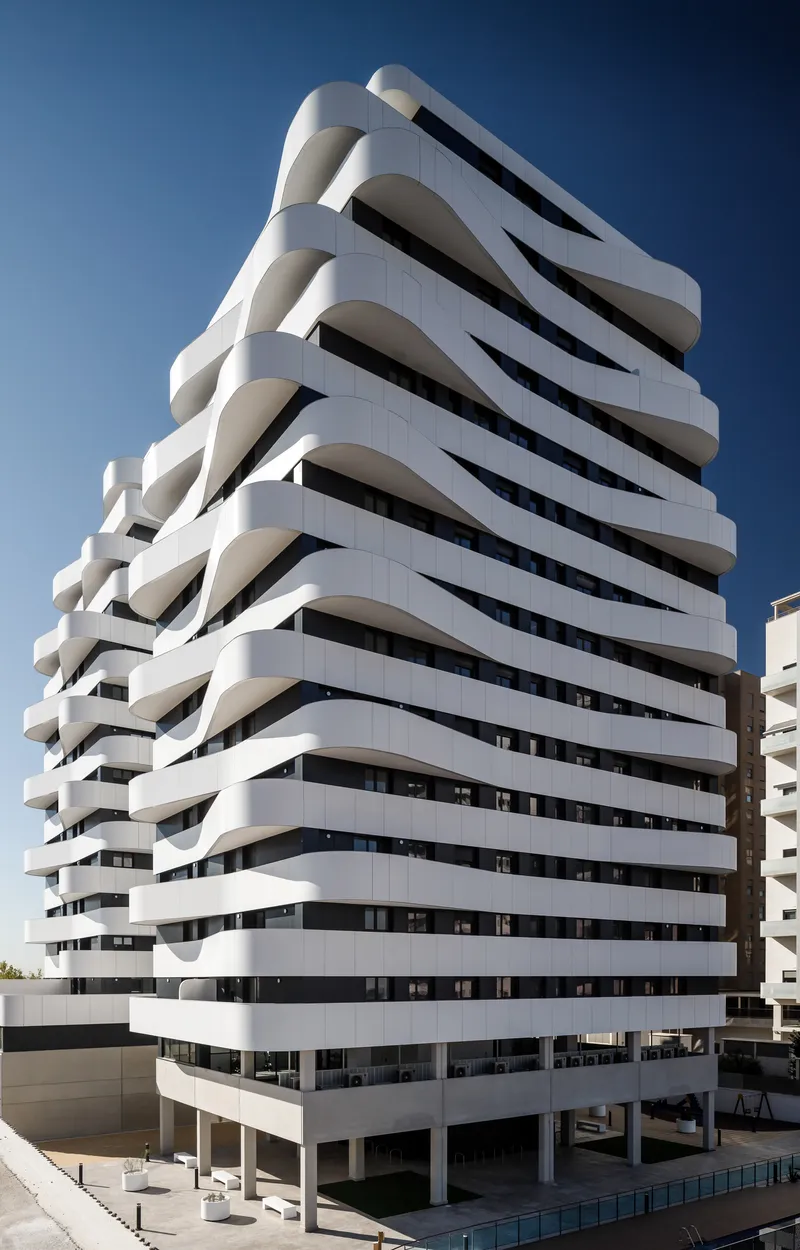
Valencia's southern fringe is a place of contradictions. Dense urban fabric on one side, open agricultural land stretching toward the Albufera Natural Park on the other. Saler Homes by NAC Arquitectos sits precisely at that seam, a pair of identical residential towers on Antonio Ferrandis Street that negotiate the tension between city scale and landscape horizon. The project, developed for client Neinor Homes and built by contractor Proyme, doesn't try to blend in. It announces itself with a formal gesture that is legible from a great distance: continuously spiraling white balconies that give each tower a kinetic, almost organic profile against the sky.
What makes the project genuinely interesting is how a single architectural device, the cascading ribbon balcony, solves multiple problems at once. It provides deep, usable outdoor space for every unit. It softens the rectangular volume into something more aerodynamic and contextually responsive. And it gives the building a strong identity without relying on expensive or exotic materials. The twins are clad in Alucoil composite aluminum panels over a Rockwool-insulated ventilated facade, a pragmatic envelope that performs well in Valencia's hot summers while reading as a clean, sculptural surface from the street.
A Threshold Between City and Landscape
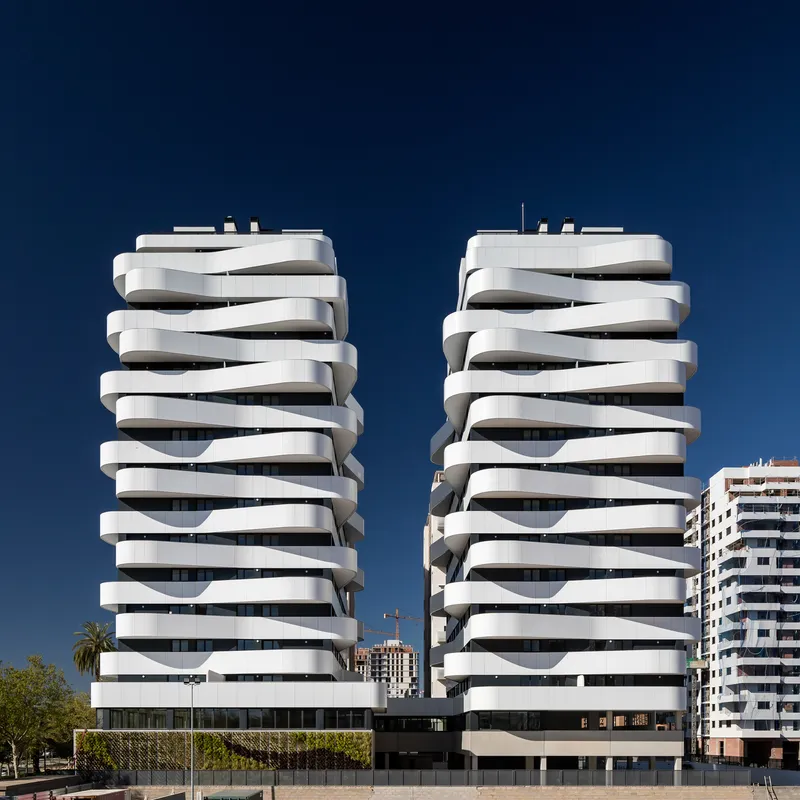
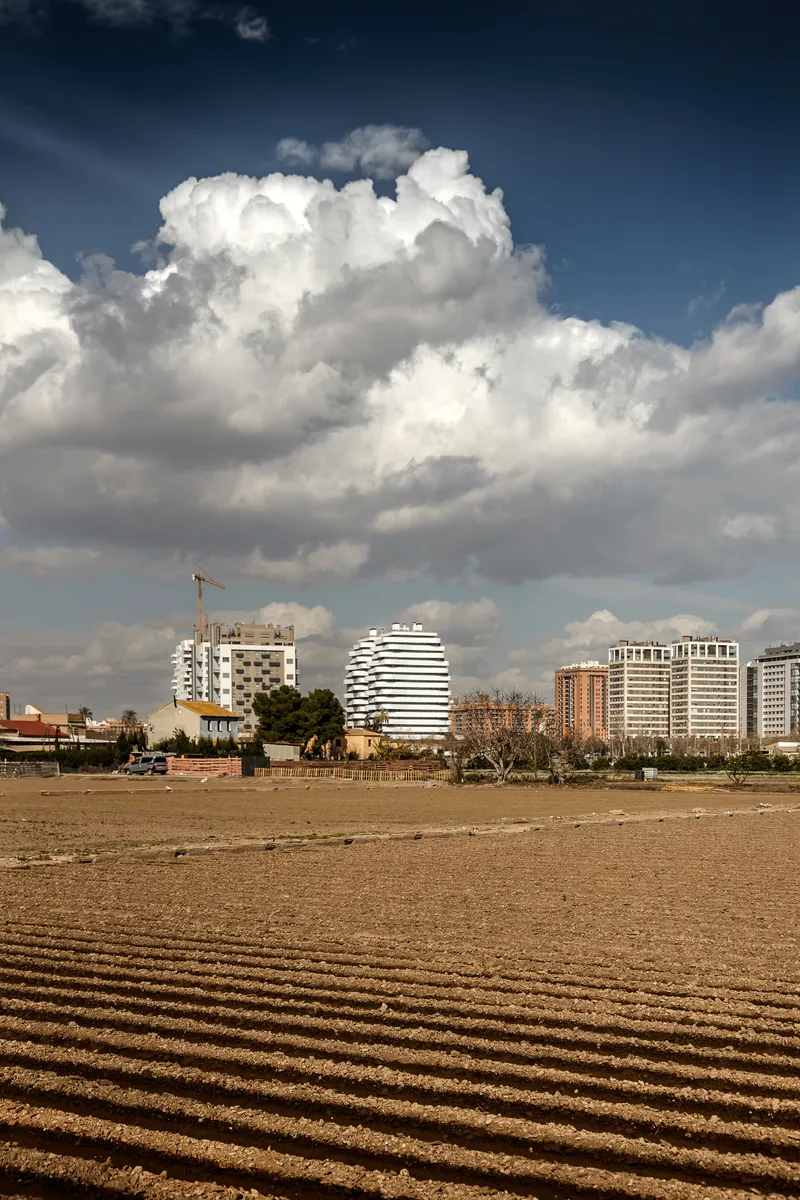
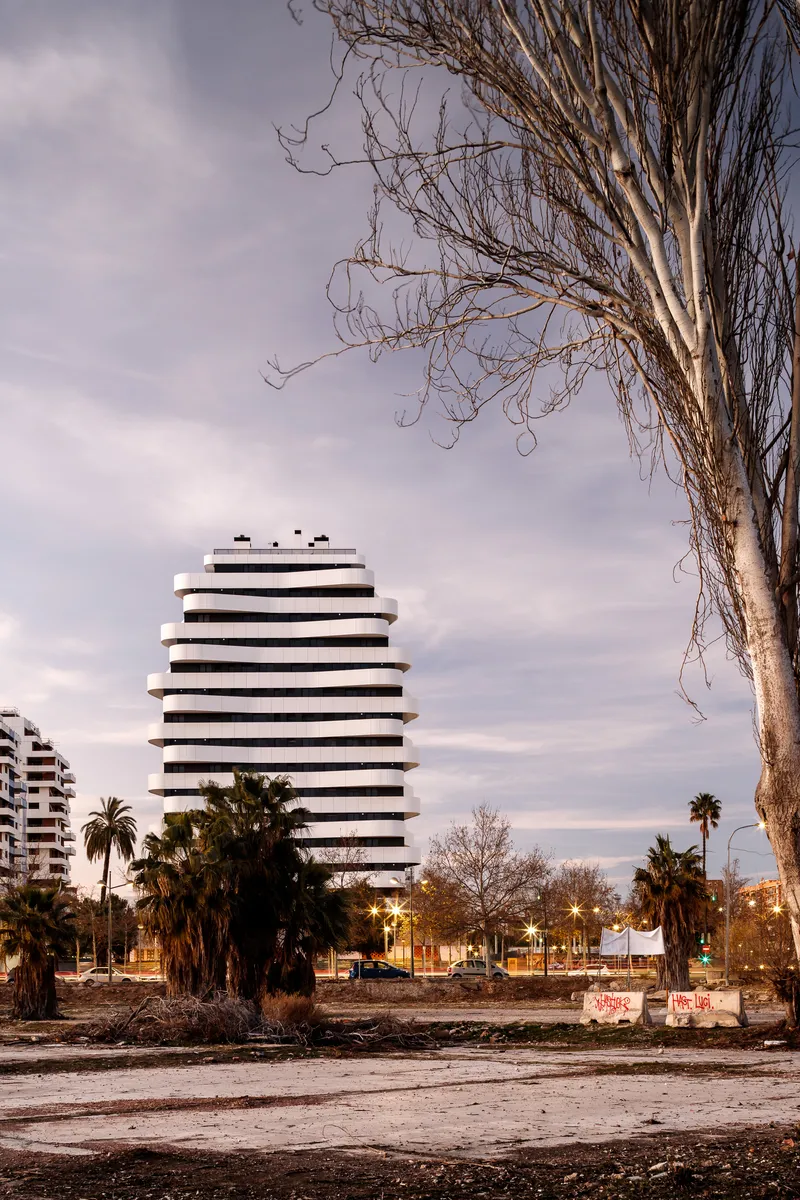
The P.P. Quatre Carreres planning area represents one of Valencia's most significant expansion zones, and Saler Homes occupies a site that separates two radically different conditions: the dense residential grid to the north and the flat, patchwork farmland that runs south toward the coast. From the beach, the towers register as horizontally banded cylinders, their stacked slabs compressing into a single rhythmic texture at distance. Up close, on Antonio Ferrandis Street, the spiral becomes legible, each floor's balcony offset just enough to create a continuous helical line ascending the facade.
The two volumes sit on a shared podium containing tertiary commercial space on the ground and first floors, oriented toward the urban side. This base stitches the towers into the street wall while the residential levels above float free, connected to sky and horizon. It is a strategy borrowed from mid-century tower-on-podium typologies, but the spiraling balconies give it a contemporary elasticity that avoids the monolithic feeling those precedents sometimes produce.
The Spiral in Detail
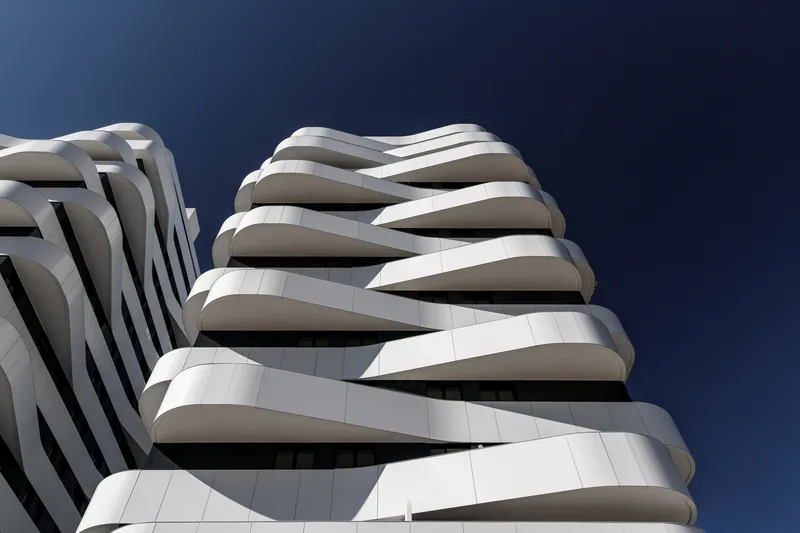
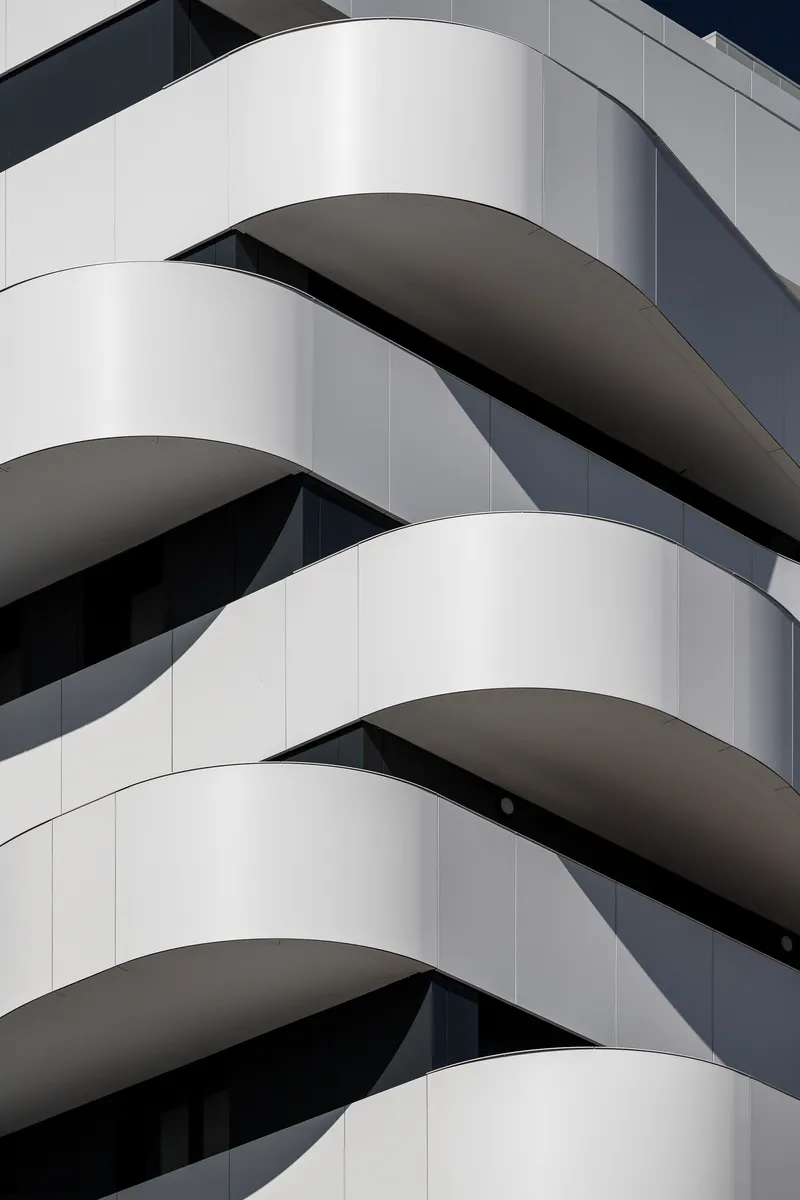
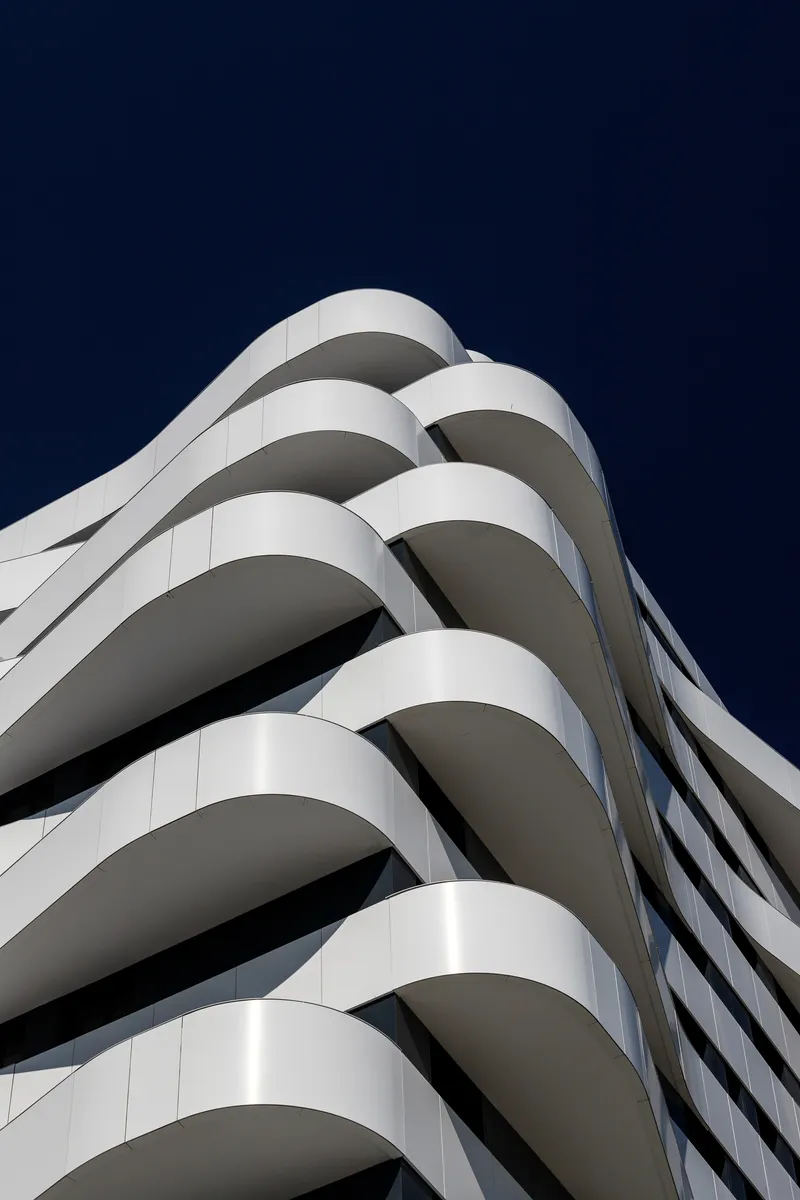
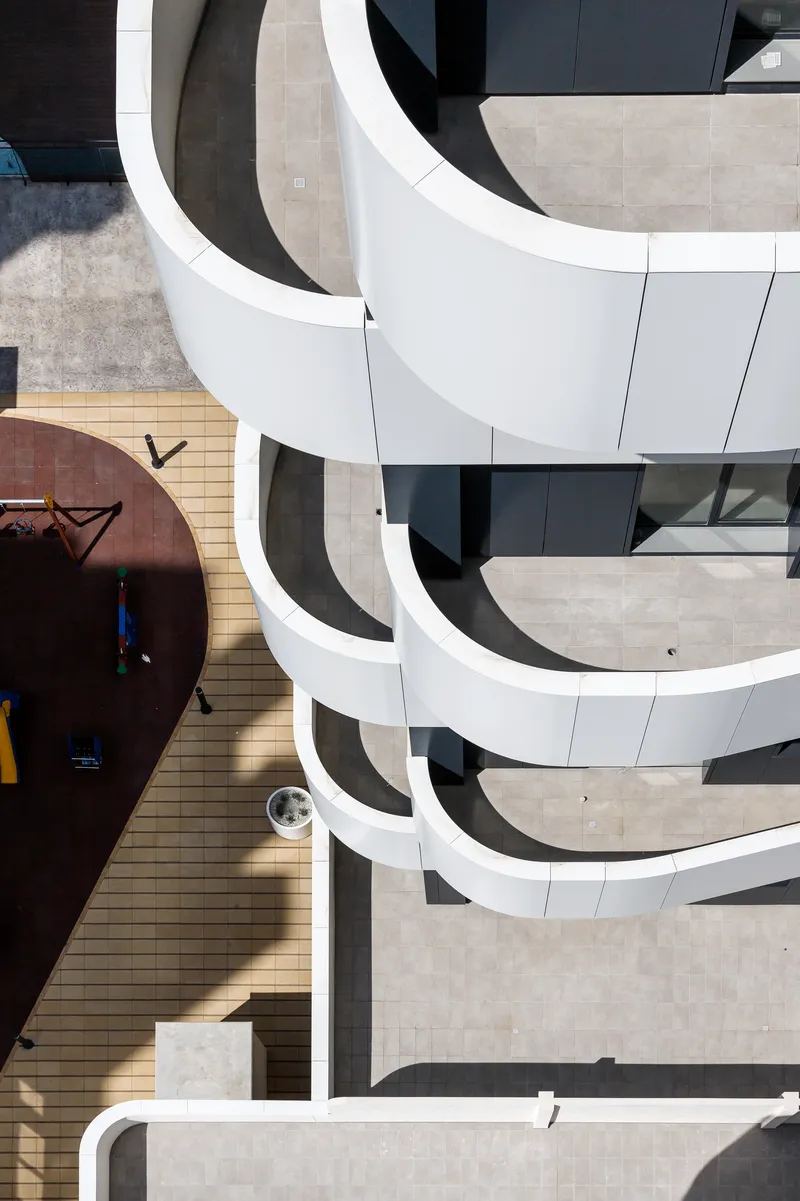
Seen from below, the balcony slabs stack into a vertiginous composition of white edges and shadow. The curved geometry is not arbitrary. Each slab wraps the corner of the rectangular plan, rounding what would otherwise be hard perpendicular intersections. The effect is that the building's corners dissolve into continuous surfaces rather than abrupt terminations. Afternoon light catches the underside of each slab differently, creating a gradient of warm and cool tones that shifts through the day.
The recessed panels between balcony slabs are finished in the same Alucoil LACORE and LARSON composite aluminum, maintaining a monochromatic palette that lets geometry do the talking. There is no applied ornament here. The architecture's expressive power comes entirely from the repetition and rotation of a single structural element, executed cleanly enough that it reads as effortless.
Living on the Edge
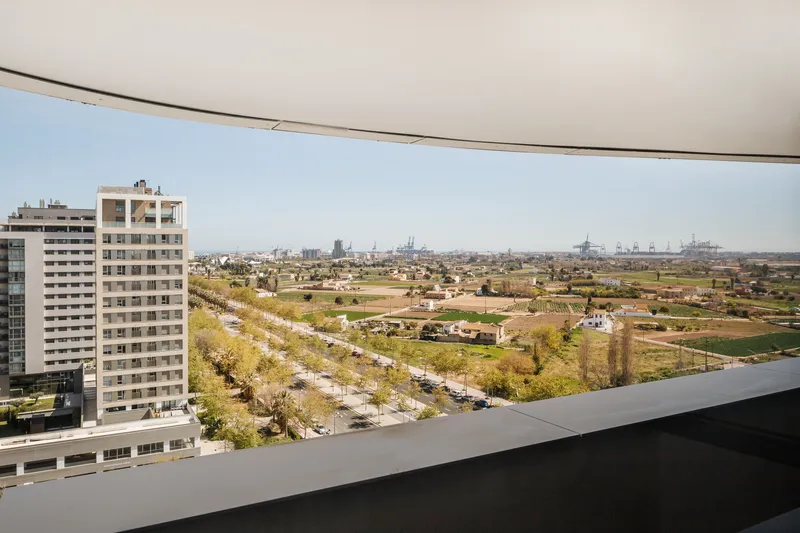
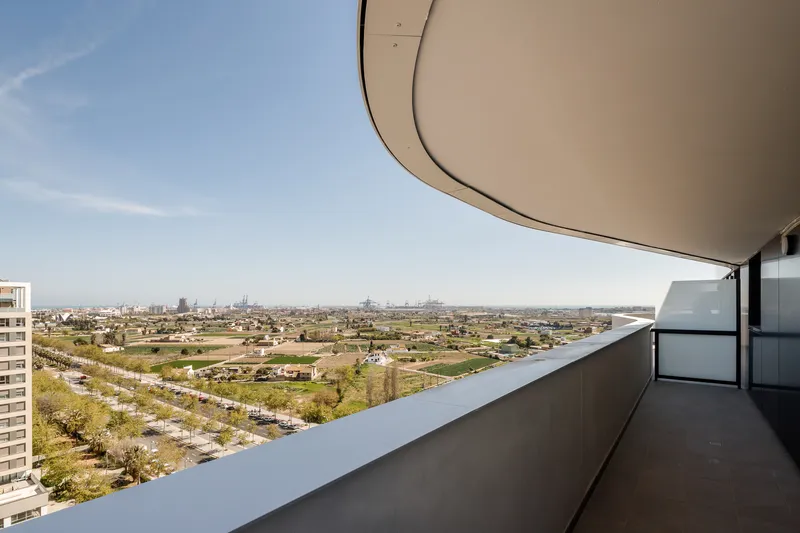
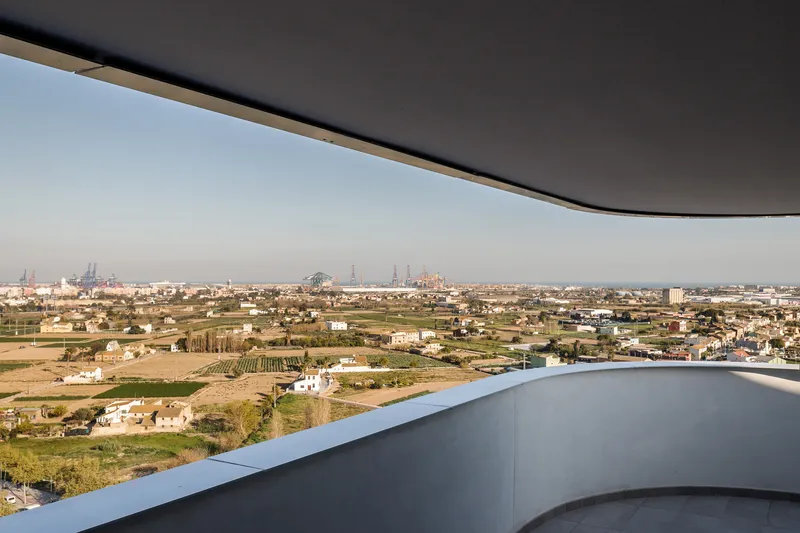
The real payoff of the spiraling balconies is experiential. Residents step out into deep, curved outdoor rooms that frame panoramic views across the Valencian huerta, the flat irrigated farmland that has defined the region's identity for centuries. From the upper floors, the visual continuity extends from tree-lined roads and patchwork agriculture all the way to the port infrastructure on the coast. On clear days, the Mediterranean itself is visible.
These are not token balconies. The depth of each slab provides genuine shade and shelter, a passive climate strategy that reduces solar gain on the glazed facade behind. Combined with the ventilated facade system insulated with Rockwool VENTROCK DUO, the envelope works hard without requiring complex mechanical interventions. The curved soffit overhead acts as a brise-soleil, filtering harsh southern light into something more habitable. Living here means occupying the threshold between interior comfort and open landscape, which is precisely where Valencia's climate rewards you most.
Ground Plane and Communal Amenities
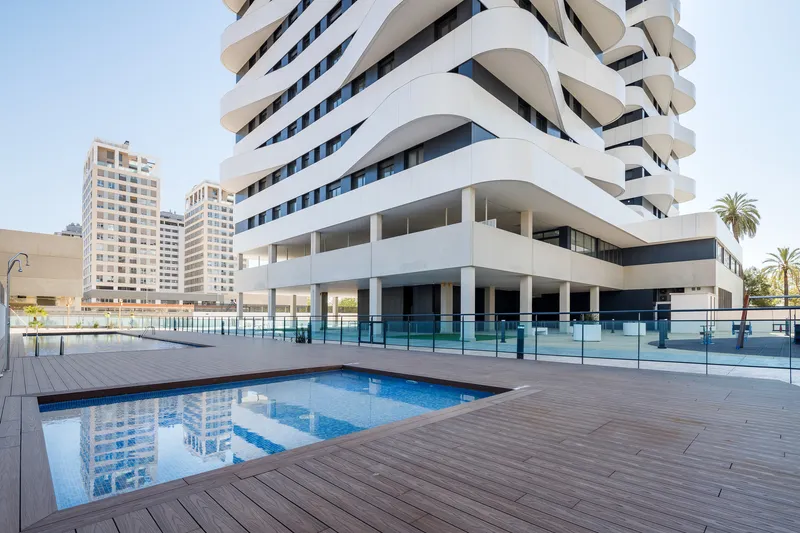
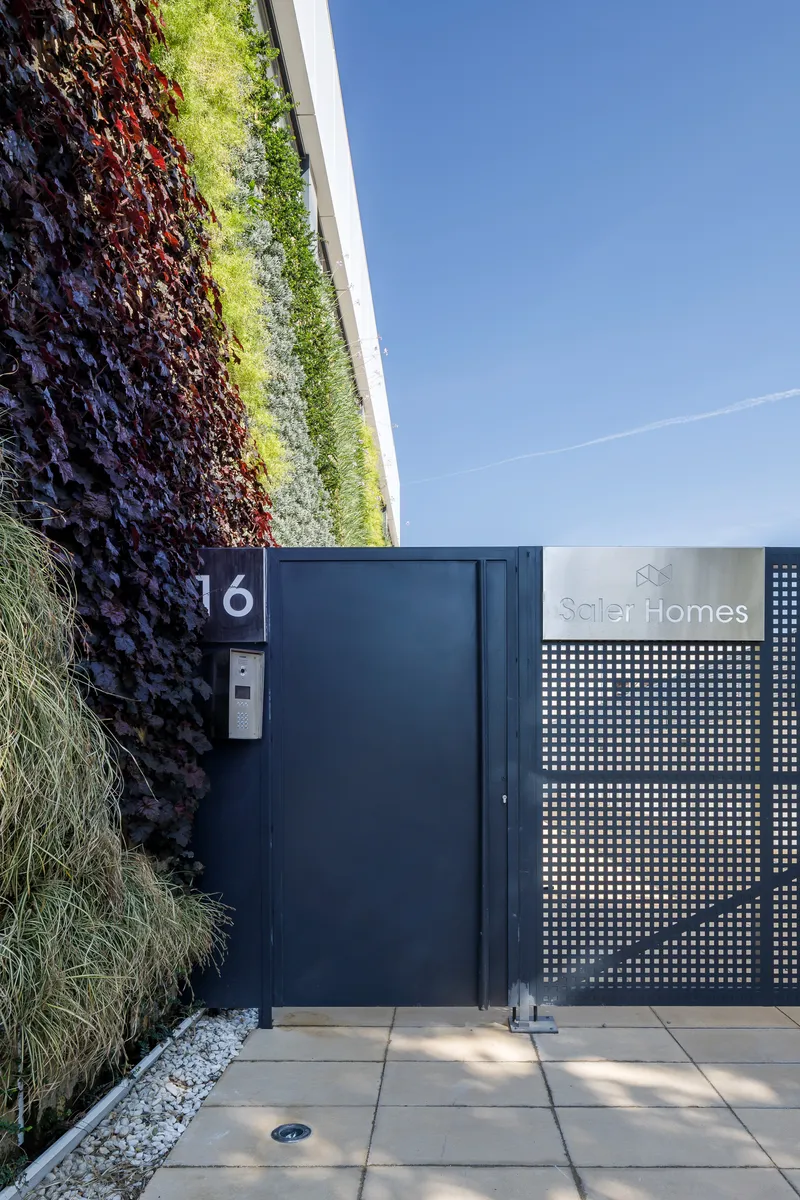
At ground level, the towers lift on pilotis to create a courtyard plaza that connects the two buildings. A pool deck with Dioco WPC timber decking and glass railings provides residents with a communal outdoor space that benefits from the shade cast by the overhanging balconies above. The entry sequence is marked by a perforated metal gate backed by a Singular Green vertical garden wall, lush with purple and green foliage, a small but effective biophilic gesture that signals the transition from public street to private residential domain.
The decision to raise the residential volume and open the ground floor to air and light is not merely aesthetic. In a southern edge location where summer temperatures regularly push past 35°C, cross-ventilation through the courtyard and beneath the building mass makes a measurable difference to the microclimate at pedestrian level.
Interior Circulation and Material Palette
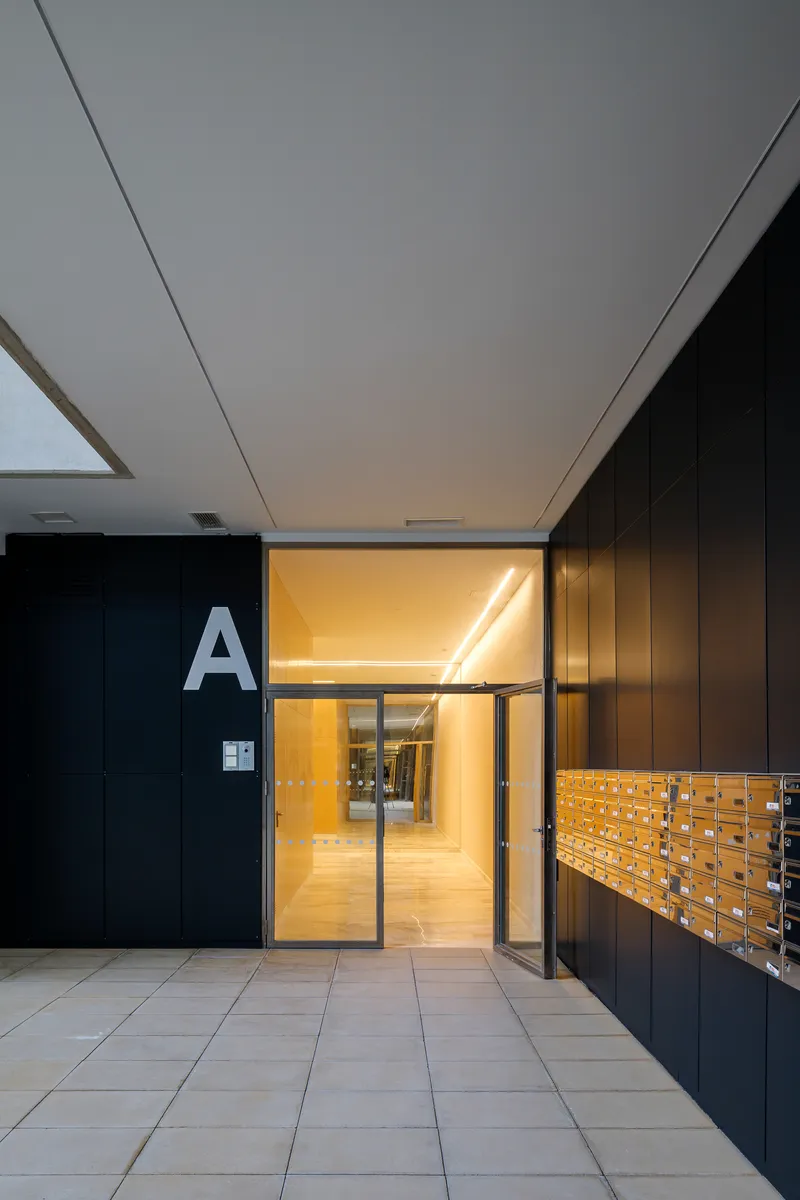
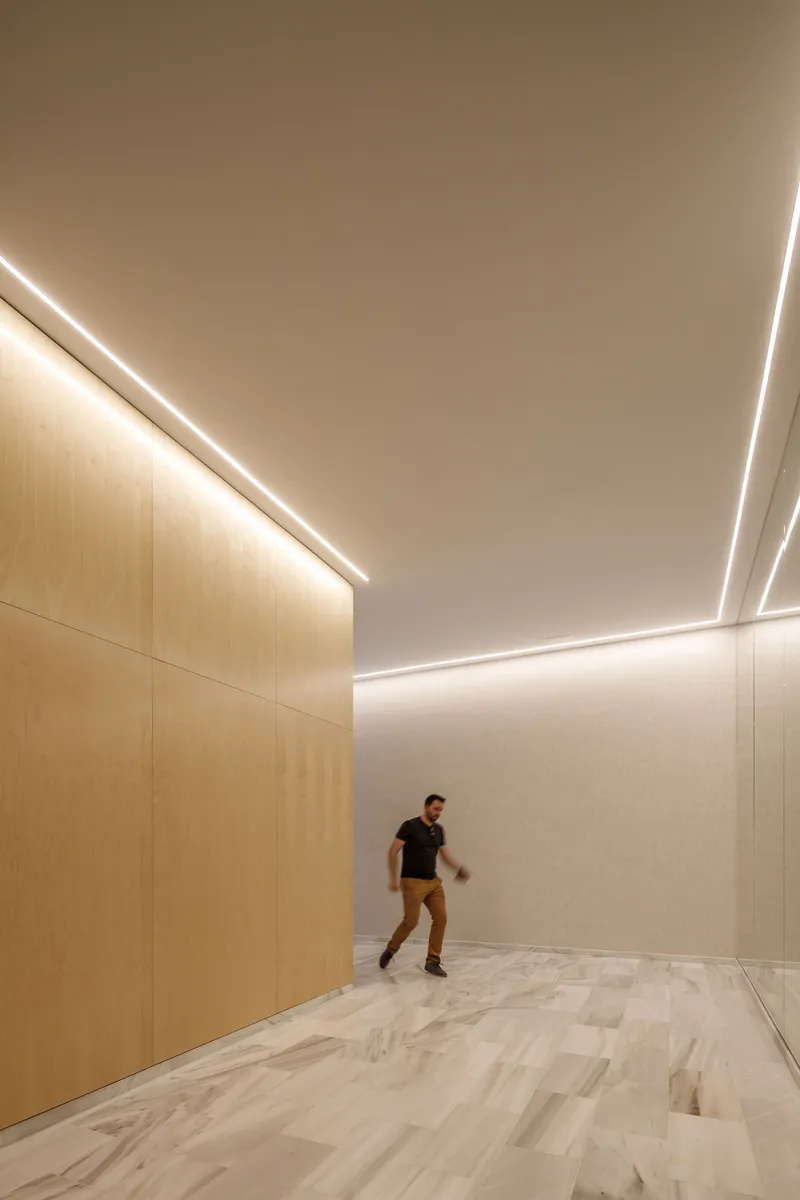
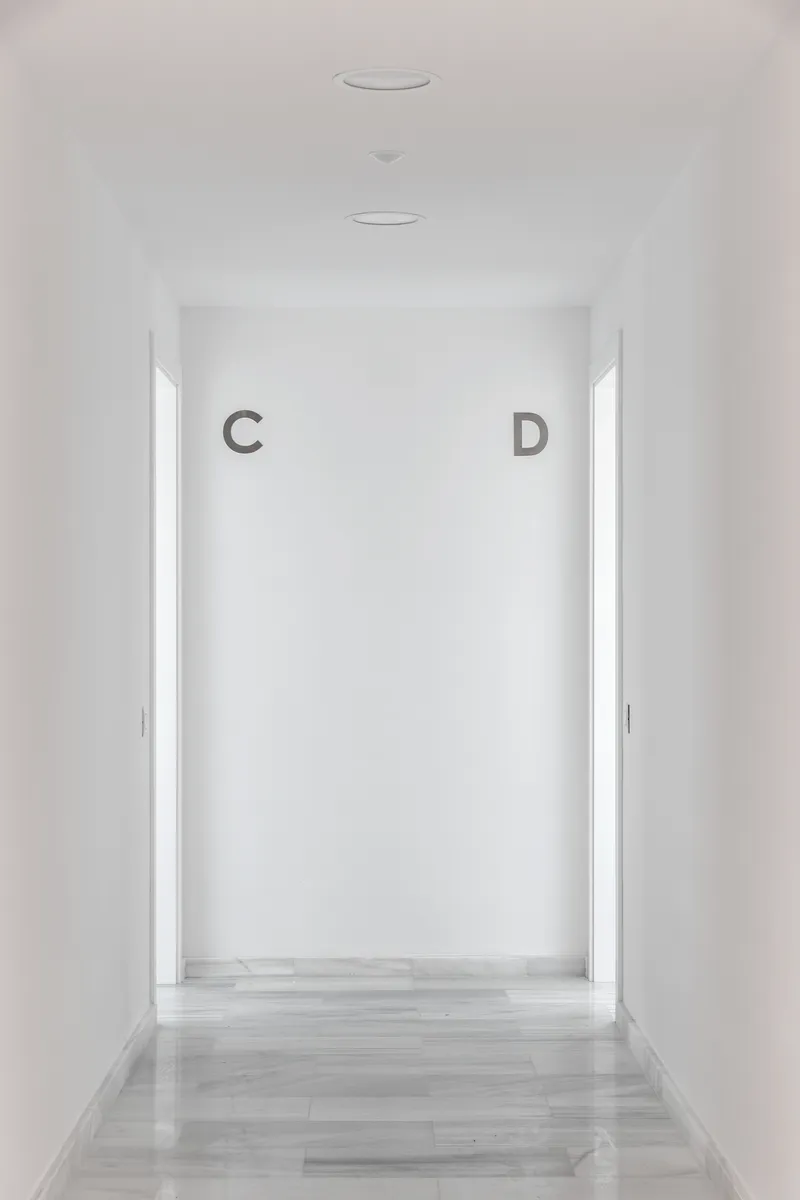
The lobbies and corridors pursue a different mood from the sculptural exuberance outside. Black paneling, concealed cove lighting, and pale Finsa FINFLOOR SUPREME laminated timber flooring create a sequence of calm, low-contrast spaces that feel more boutique hotel than residential block. An illuminated yellow mailbox wall in the lobby provides a single jolt of color, a wayfinding device that doubles as a graphic moment.
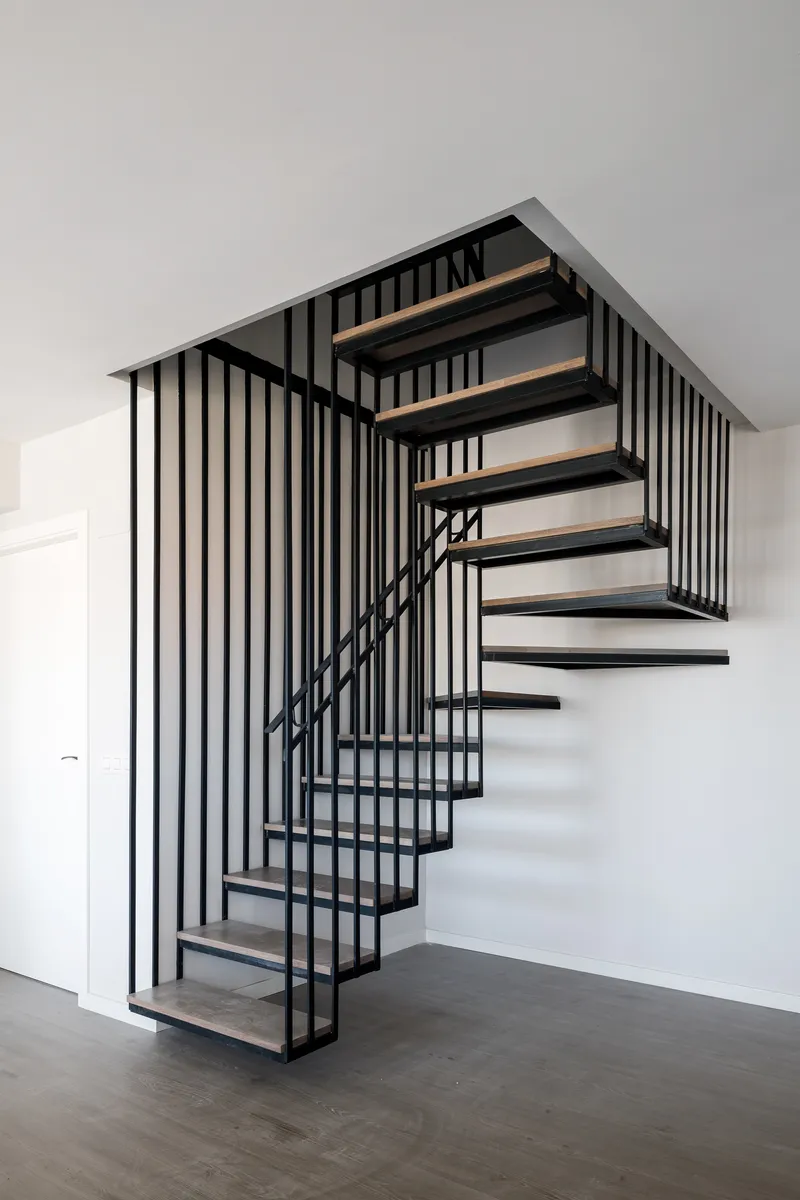
Corridors are wide enough to feel generous, with backlit signage marking elevator cores and unit entrances. Saloni ceramics and Roca sanitary ware complete the interior specification, a solid mid-range palette that prioritizes durability and clean lines over luxury branding. The black steel and timber staircase with its vertical rod balustrade is perhaps the strongest interior detail, its industrial materiality providing a counterpoint to the white plaster walls.
Rooftop and Twilight
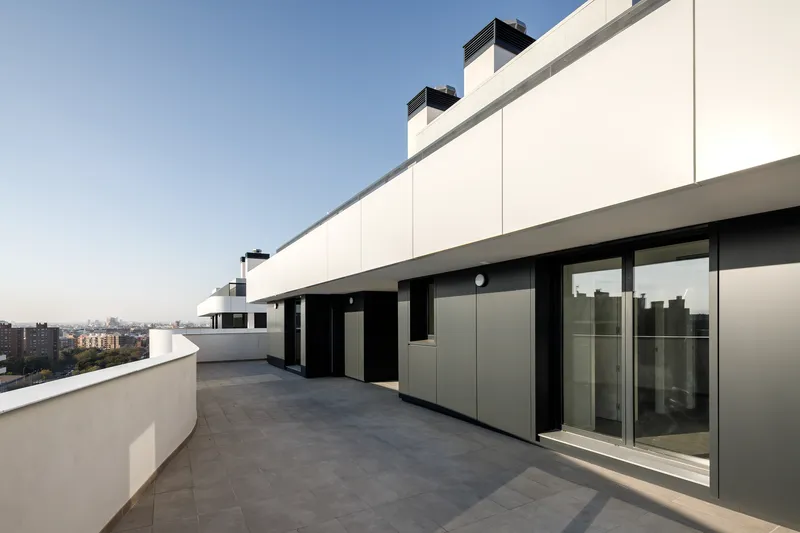
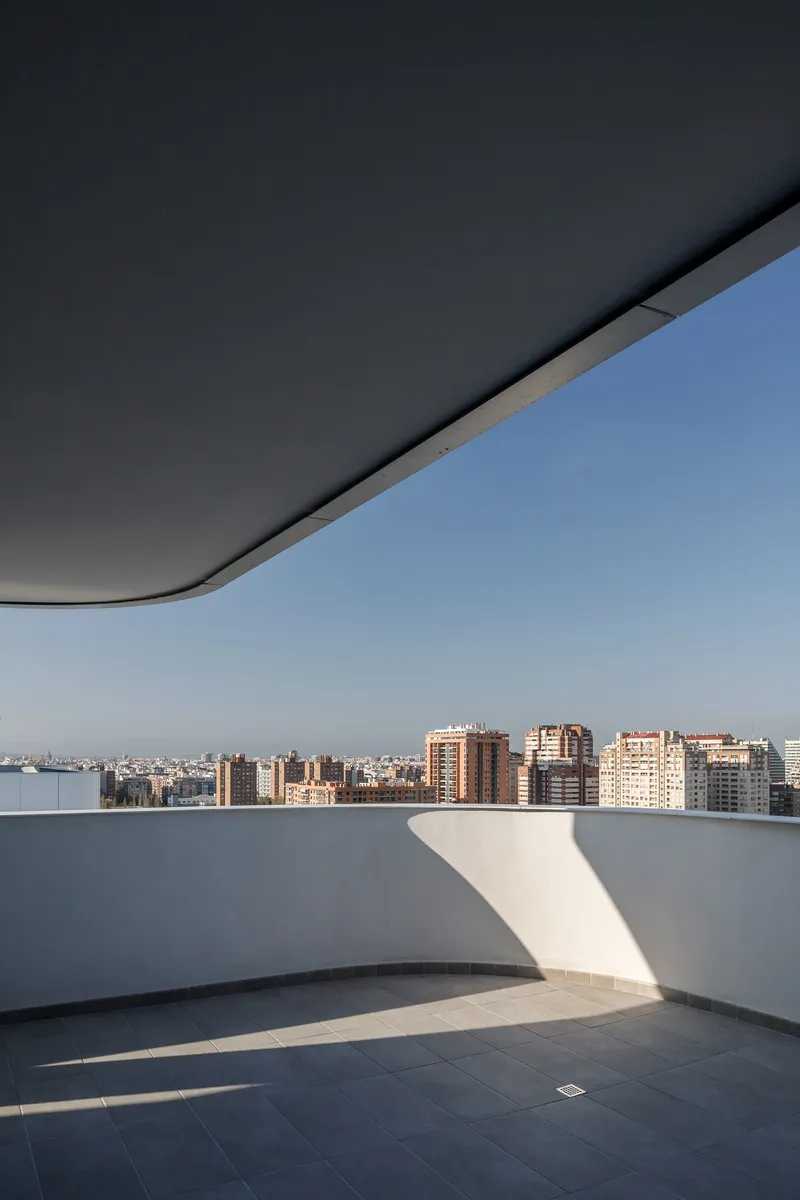
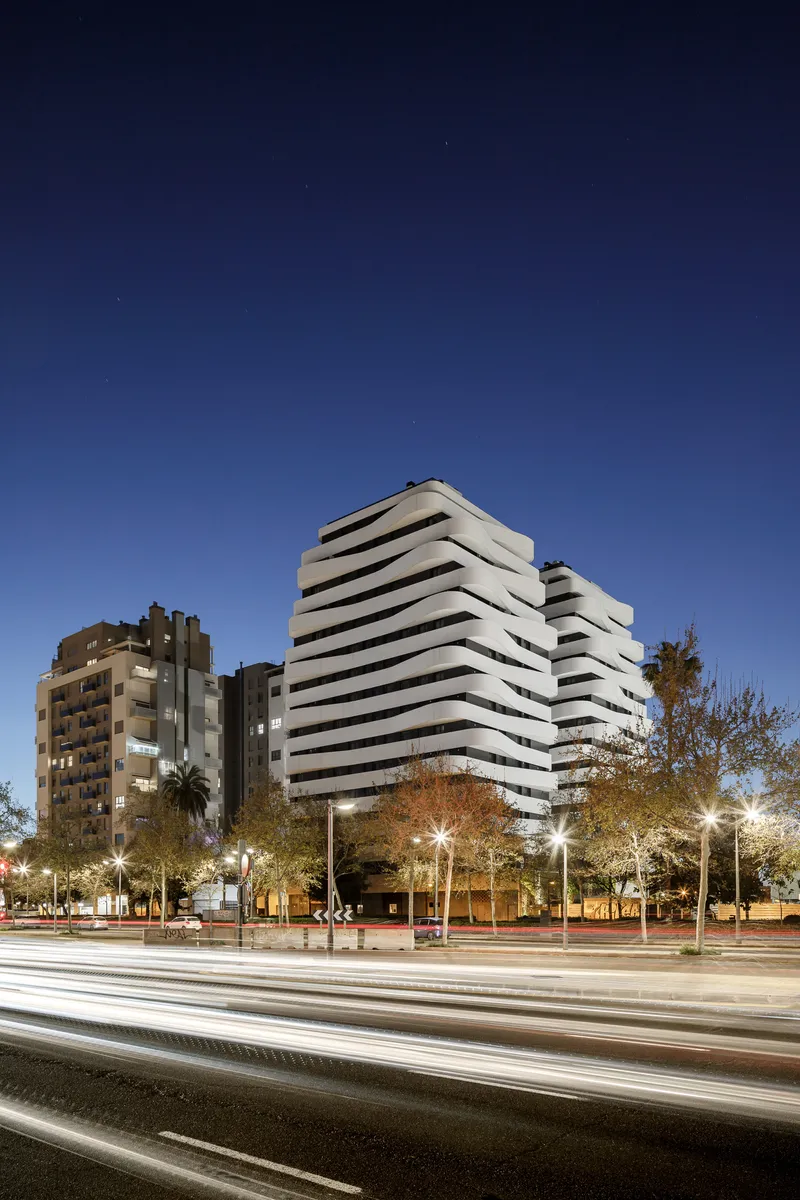
The rooftop terraces are designed as usable communal spaces rather than mechanical equipment graveyards. Grey tile paving and sliding glass doors create a clean platform from which residents can watch the sun set over the city. The curved dark soffit reappears here, framing views toward distant residential towers and the coastline beyond. At dusk, the building transforms. Interior lighting washes through the Cortizo COR 3500 RPT windows, and the white balcony slabs catch the last ambient light, turning the towers into stacked lanterns visible from the surrounding streets.
The twilight street view, with traffic light trails streaking past illuminated trees, captures the building's dual register: a calm domestic interior nested inside an urban landmark. Few residential projects in Valencia's expanding periphery manage this balance with such economy of means.
Plans and Drawings
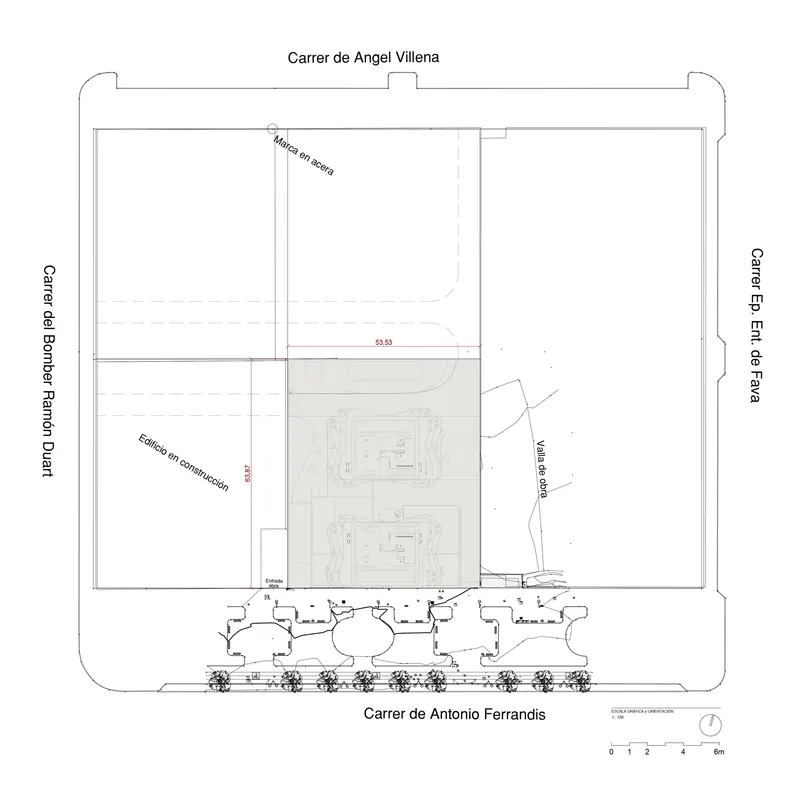
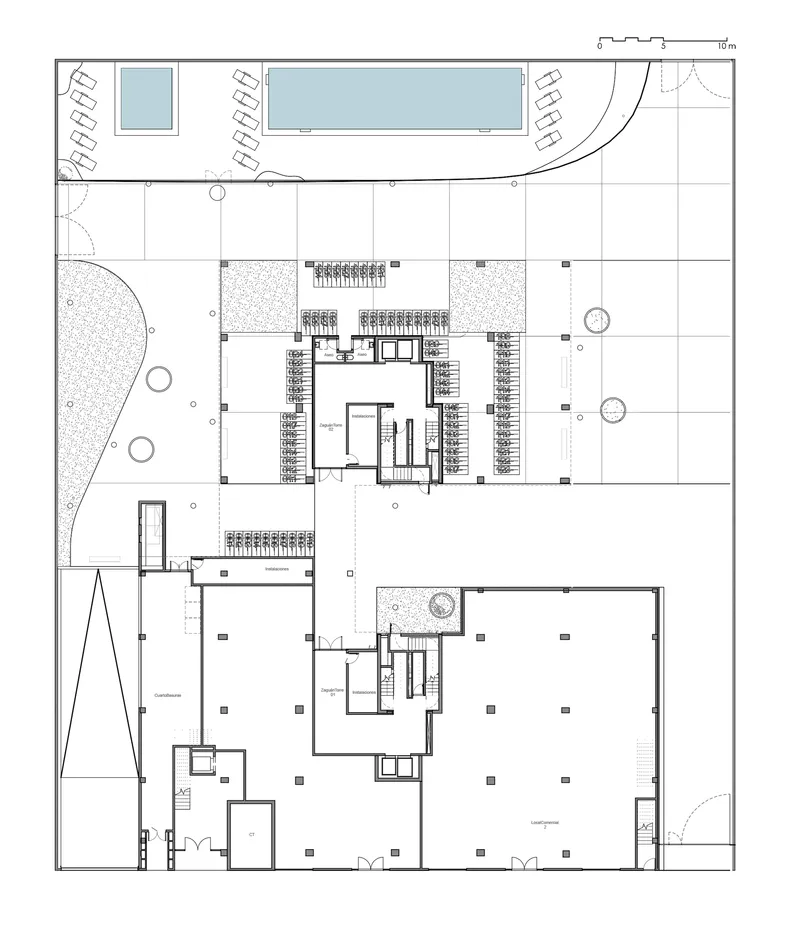
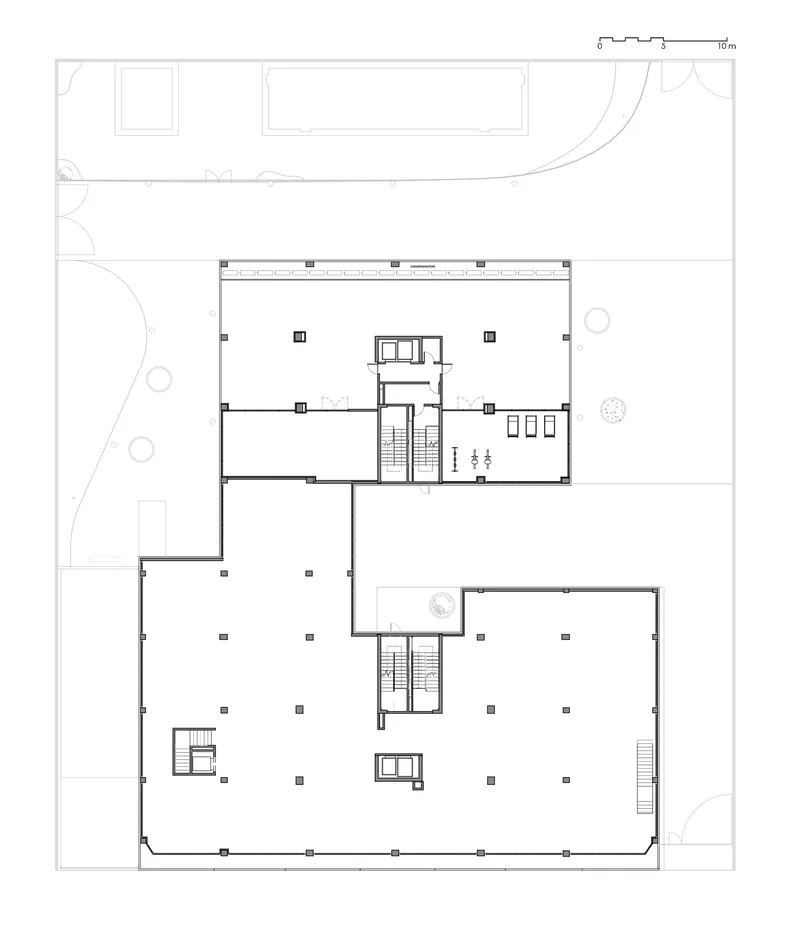
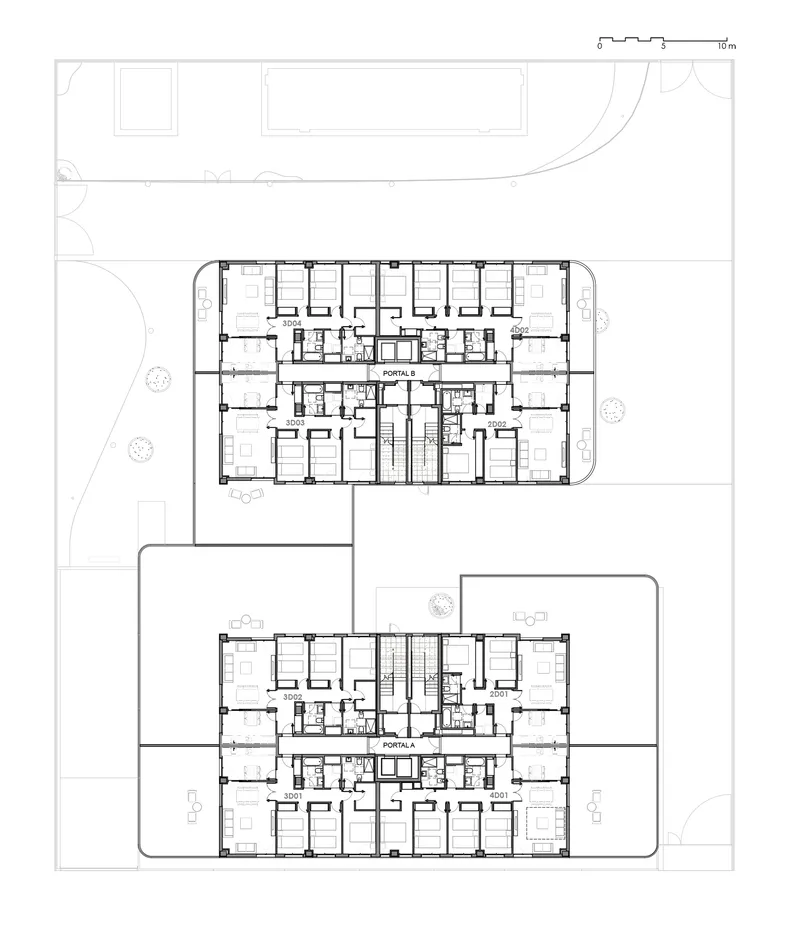
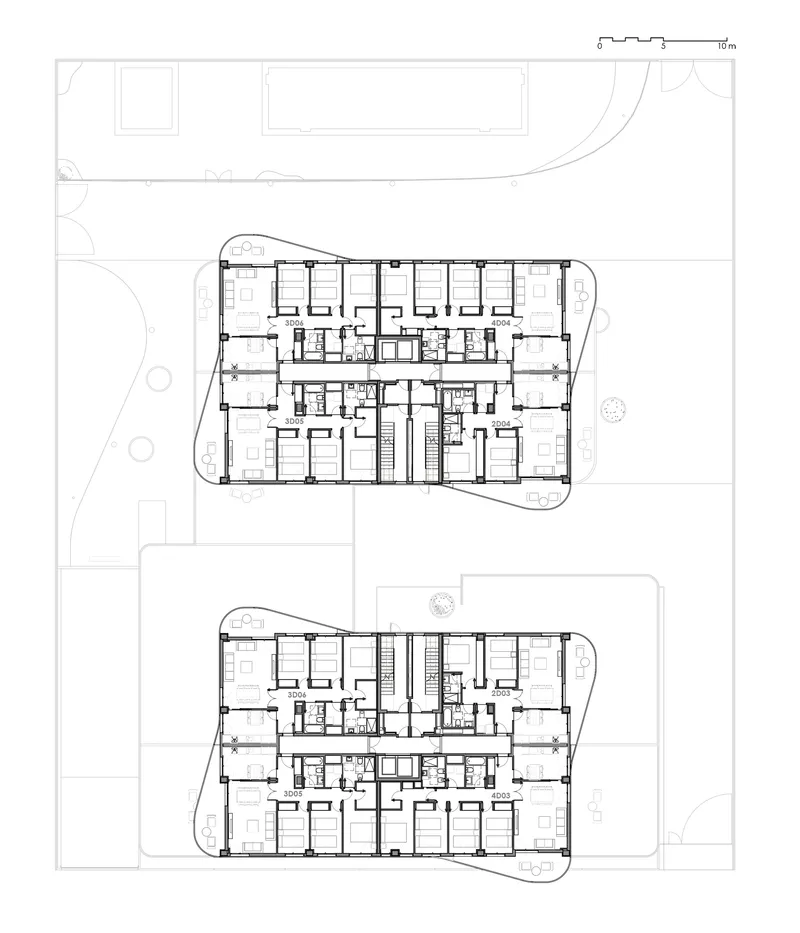
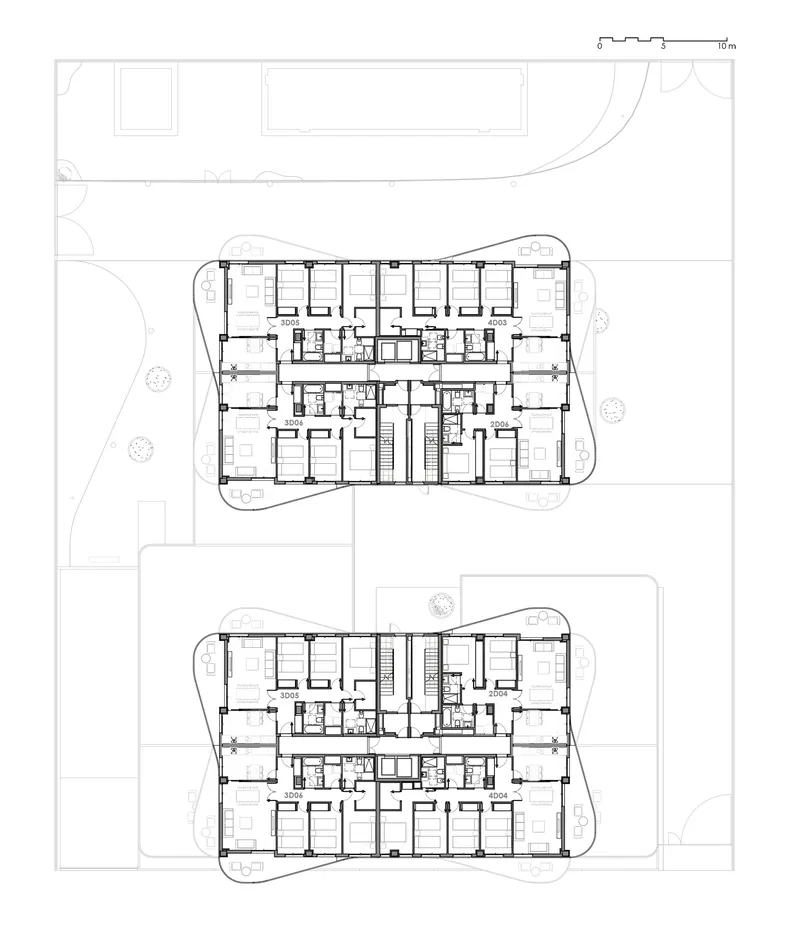
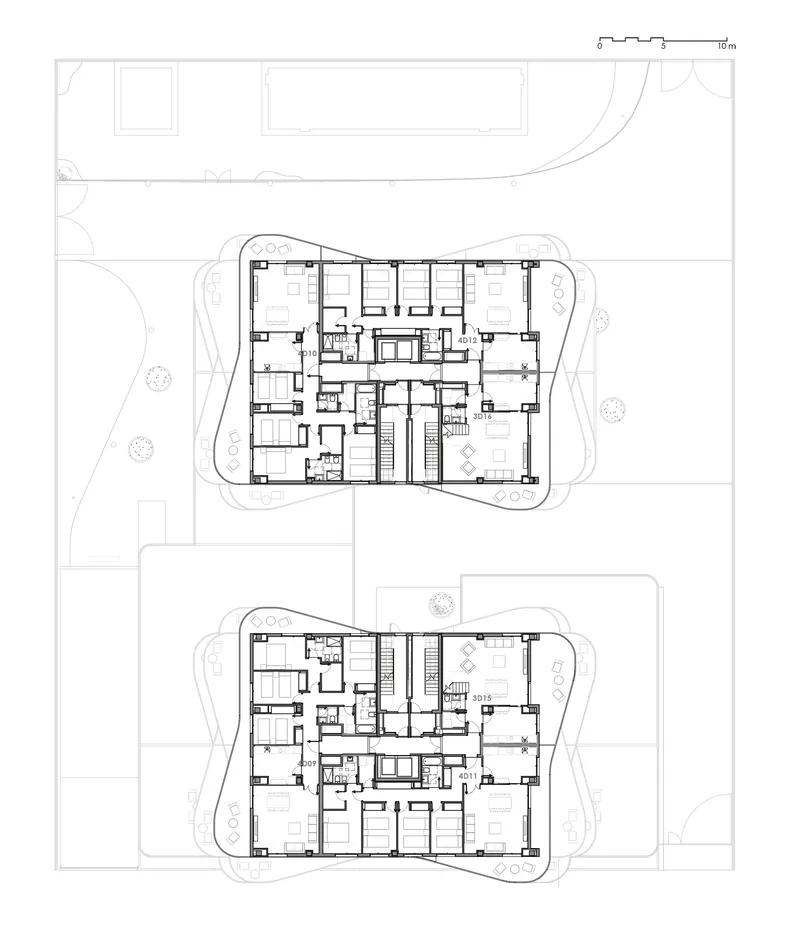
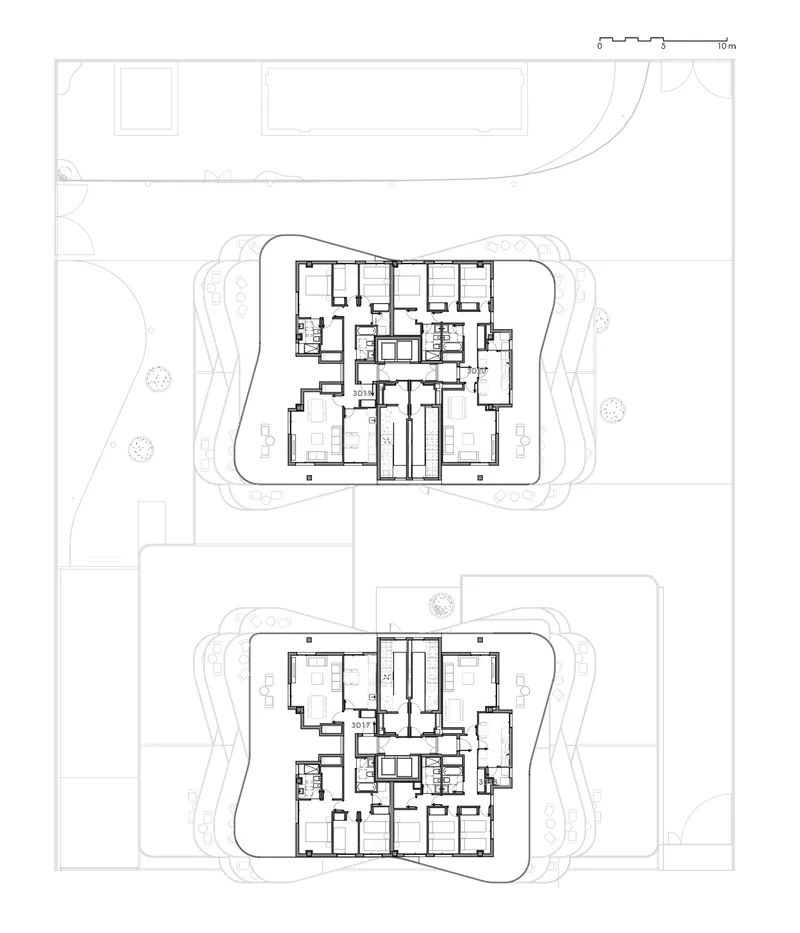
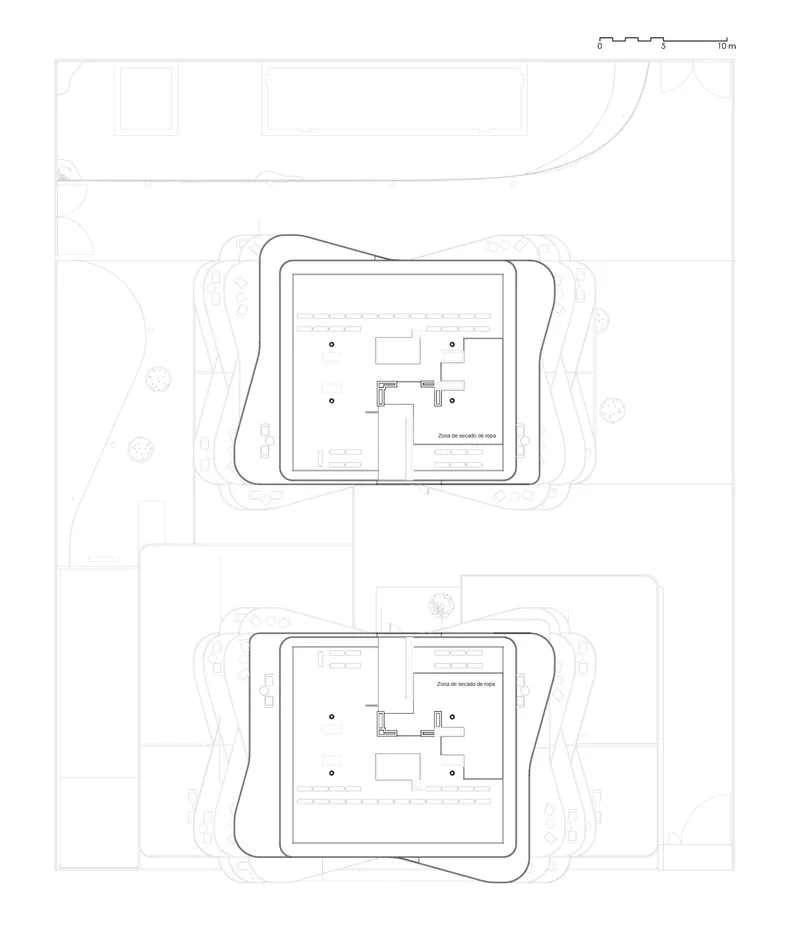
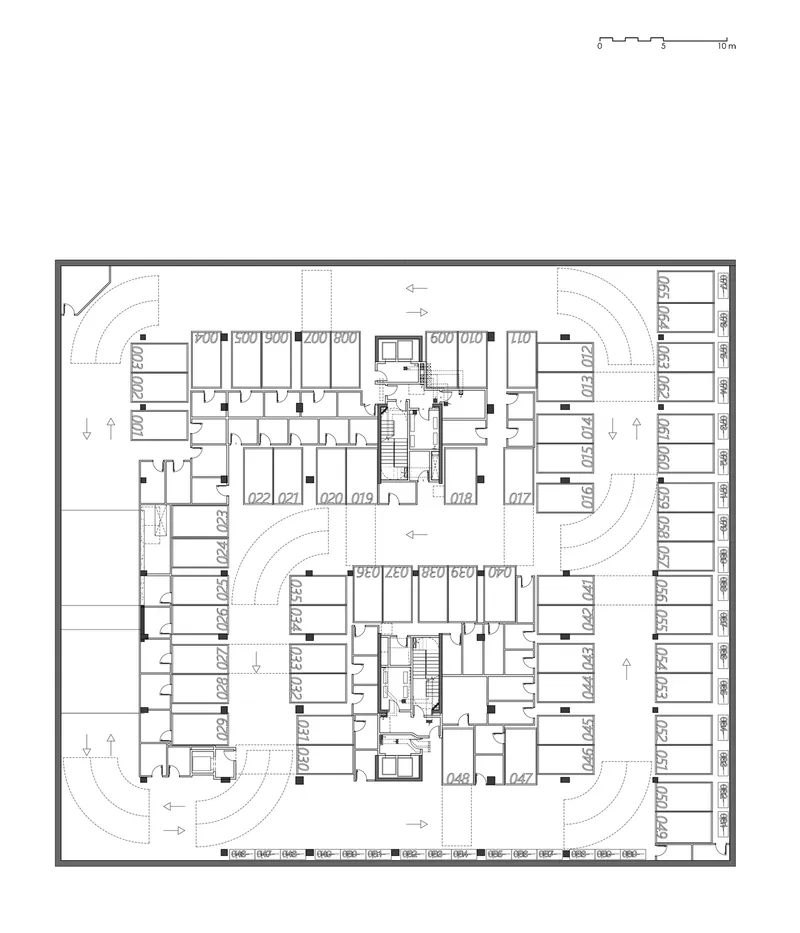
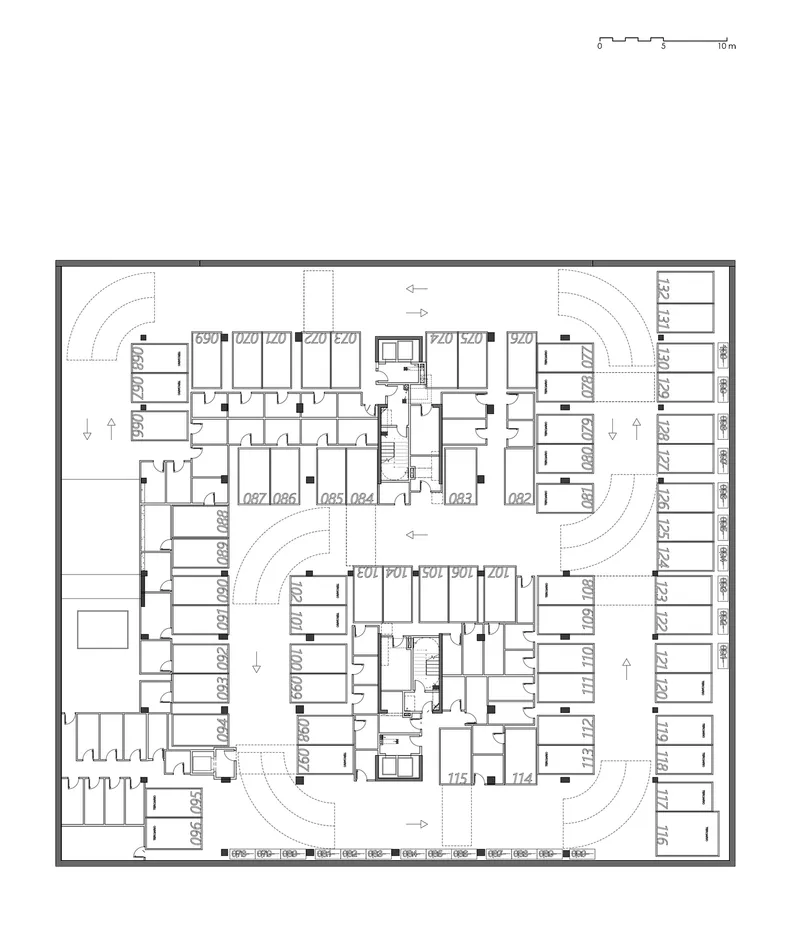
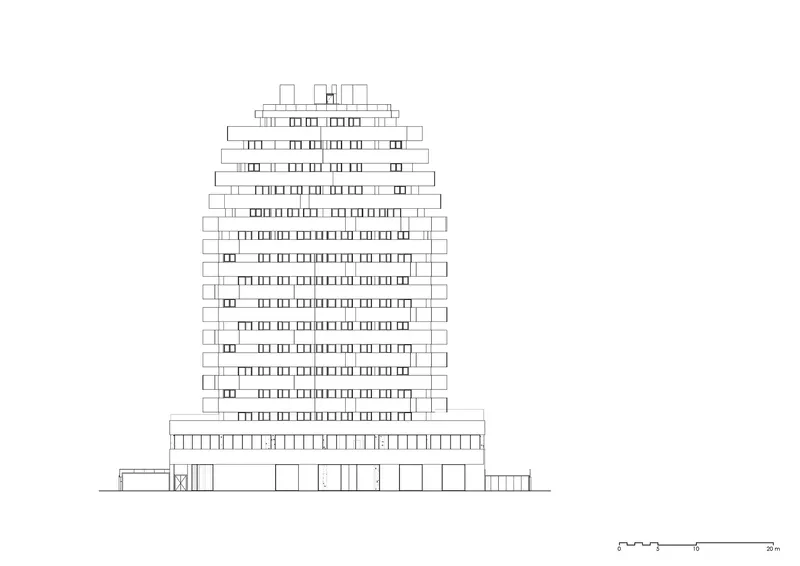
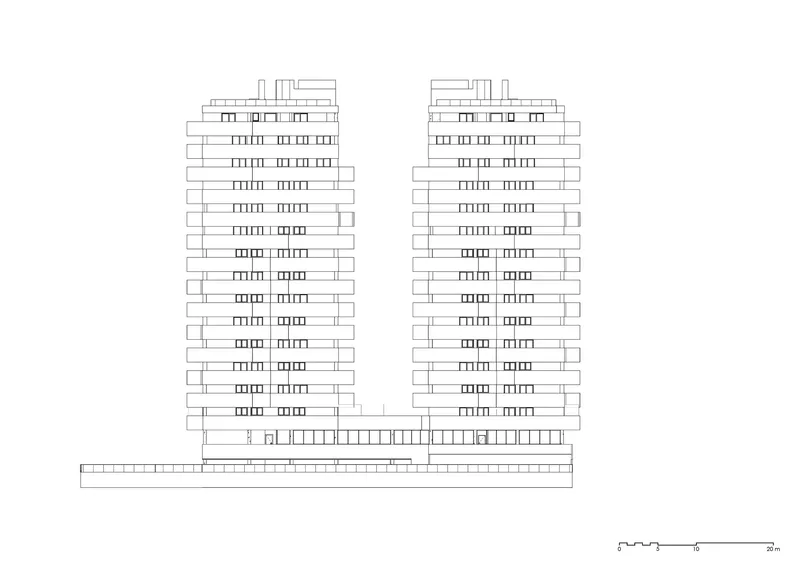
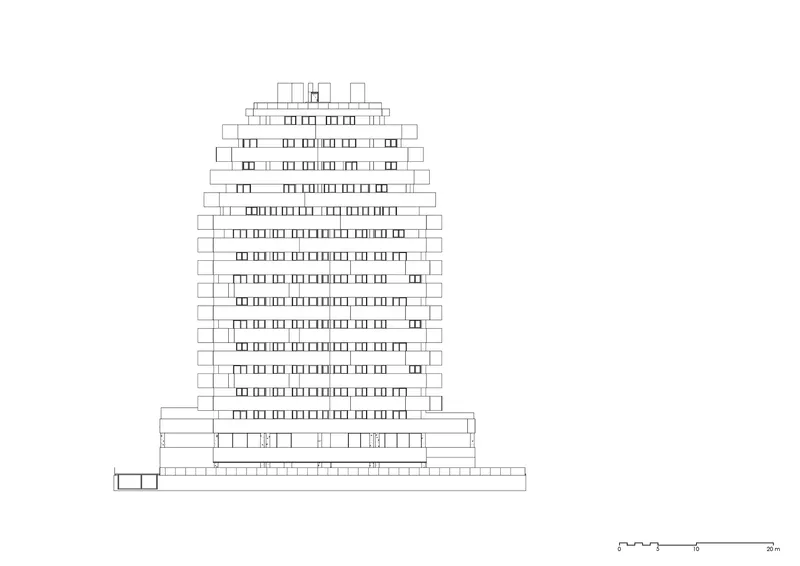
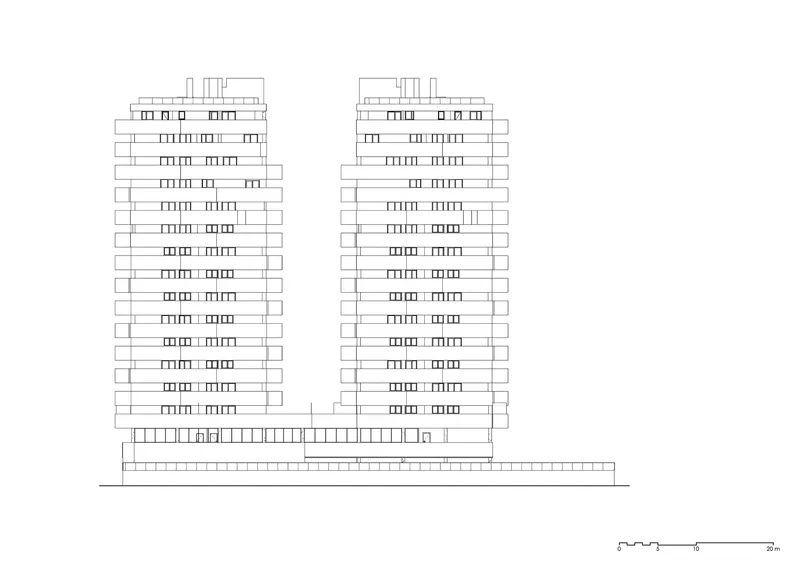
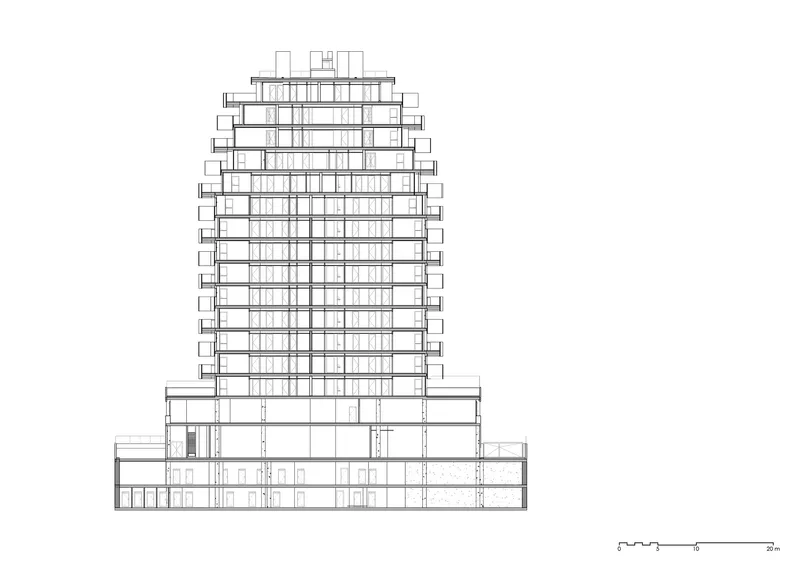
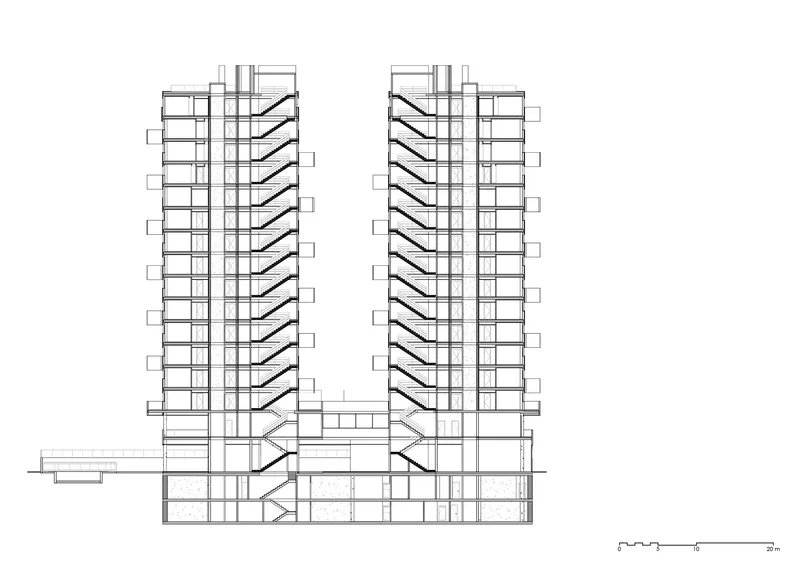
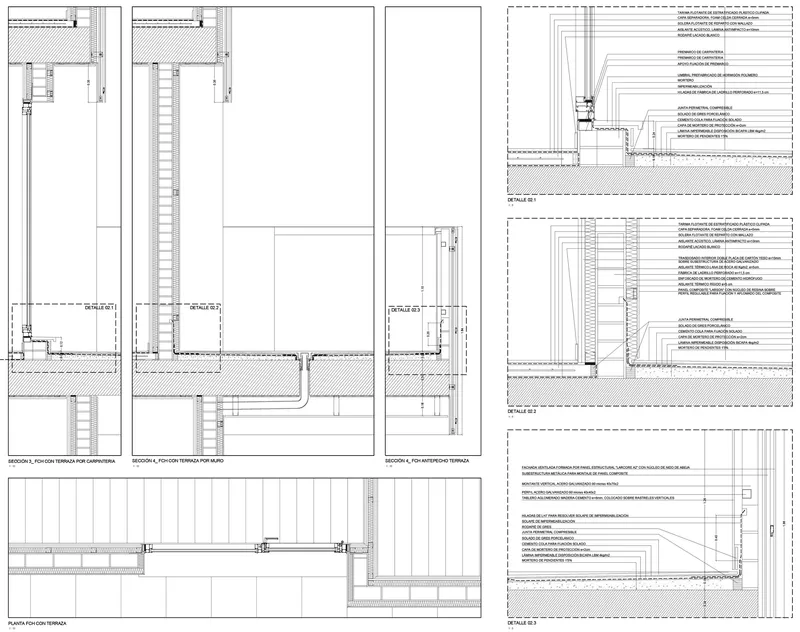
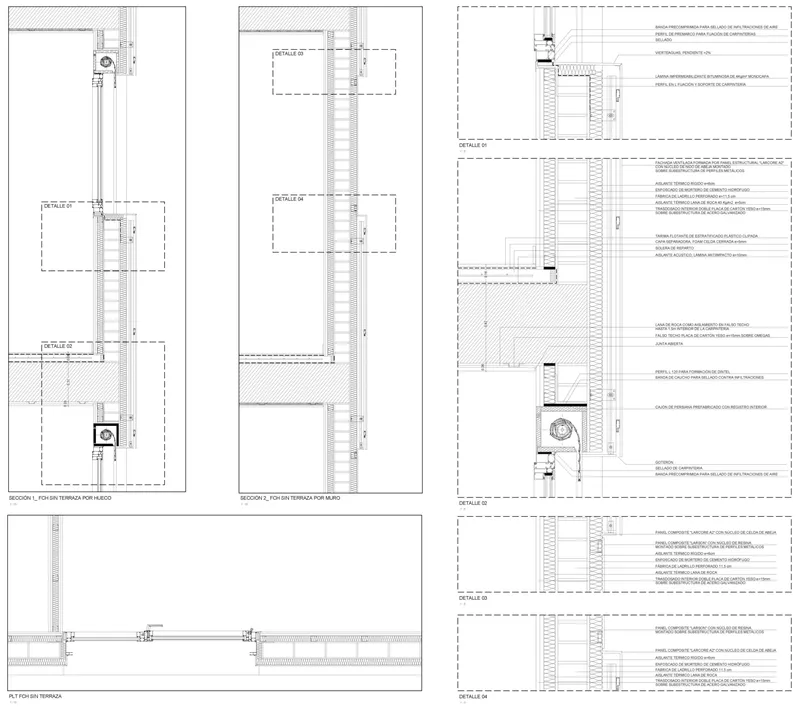
The drawings reveal the organizational logic behind the spiral. Each tower measures roughly 27 by 17 meters in plan, with a central circulation core serving units that radiate outward to the curved perimeter. The site plan confirms the twin-volume strategy: two rectangular footprints within a single city block, joined at their base by the commercial podium and shared basement parking. The floor plans progress from larger commercial floorplates at the lower levels to increasingly articulated residential layouts above, where the curved corners generate corner units with panoramic exposure on two or three sides.
The elevation and section drawings expose the stepped profile of the towers and the structural logic of the cantilevered balcony slabs. Construction details show the layered facade assembly: aluminum composite panels, an air cavity, Rockwool insulation, and the structural wall behind. The terrace conditions are carefully resolved, with waterproofing, drainage, and thermal break details that ensure the deep balconies perform as well technically as they do visually. These are not drawings that dazzle with graphic pyrotechnics, but they demonstrate the rigor necessary to make a simple formal idea buildable at scale.
Why This Project Matters
Saler Homes is a reminder that residential architecture at medium-to-large scale does not require formal gymnastics or exotic materials to achieve genuine character. NAC Arquitectos took a single idea, the spiraling ribbon balcony, and committed to it with enough discipline that it organizes everything from the urban silhouette to the passive climate strategy. The result is a building that is immediately recognizable on Valencia's skyline without resorting to the flashy parametricism that often accompanies such ambitions. It works because the gesture is functional: the balconies shade, shelter, and provide real outdoor living space in a climate that demands it.
More broadly, the project demonstrates how architecture can mediate the abrupt edge conditions that characterize so many expanding European cities. The site sits between urban density and agricultural openness, and the towers acknowledge both: grounded in a street-facing commercial podium on one side, open to the horizon of the huerta and Albufera on the other. For a development-driven residential commission, that level of contextual awareness is not guaranteed. Here, it is the project's defining strength.
Residential Building Saler Homes by NAC Arquitectos, located in València, Spain. Area: 273,102 sq ft. Completed in 2020. Photography by Alejandro Gómez Vives.
About the Studio
Share Your Own Work on uni.xyz
If projects like this are the kind of work you want to make, uni.xyz is a place to publish your own, find collaborators, and enter design competitions.


Popular Articles
Popular articles from the community


Hill & Cross Opera: Sculptural Opera House Architecture Shaped by Tallinn’s Landscape and Identity
Hill & Cross Opera reimagines opera house architecture in Tallinn through its sculptural hill, civic plaza, glass wave and a luminous cross.

Little Red Riding Hood: Architectural Design as a Journey Through Fear, Light, and Storytelling
Little Red Riding Hood reimagines the fairy tale through architectural design shaped by fear, light, scale, memory, uncertainty, and choice.

Conexión: Biophilic Design Reimagines High-Rise Living in Hong Kong
Conexión reimagines high-rise living in Hong Kong through biophilic design, green facades, shared spaces, daylight, water and nature within.

Lunar Spiral: Space Architecture Shaped by the Mathematics of the Universe
Lunar Spiral reimagines space architecture through Fibonacci geometry, lunar regolith, levitating habitats, and self-sustaining Moon living.

Similar Reads
You might also enjoy these articles

Bao Huynh Watercolor Atelier: A Serene Art Retreat in Hội An
Bao Huynh Watercolor Atelier in Hội An blends multifunctional art spaces, sustainable design, local materials, and family-friendly living in a serene environment.

Atelier Macri Concept Store Interior Design by CASE-REAL
Atelier Macri store features a "ko" counter, walnut wood details, cork displays, blending retail, gallery, and seamless customer experiences.

Manuel Vargas Izquierdo Stadium and High-Performance Sports Center: Architectural Excellence in Jalpa de Méndez
The Manuel Vargas Izquierdo Stadium blends sustainable design, inclusive sports facilities, and cultural-inspired architecture, revitalizing Jalpa de Méndez’s public spaces.
KAKR Buluh Awar Hall: Revitalizing Community and Ecology Through Bamboo Architecture
Community built bamboo hall revitalizes Buluh Awar village, empowering youth, restoring ecology, celebrating vernacular craftsmanship through sustainable architecture and culture.

Explore Residential Building Competitions
Discover active competitions in this discipline

Challenge to design mud housing for contemporary communities

Challenge to reimagine the Iron Throne

Photograph architecture without architects

Illustrate the lost glory of Angkor Wat - Render Challenge
Comments (0)
Please login or sign up to add comments
No comments yet. Be the first to comment!