

Narwall: An Autonomous Arctic Refuge That Splits Public Life Above and Below the Kara Sea
A ring-shaped promenade, a load-bearing central spine and a submerged hotel tier turn offshore infrastructure into a refuge on the Northern Sea Route.


Offshore architecture usually takes the form of an oil rig: a steel platform built for extraction, with people treated as a necessary cost. Narwall asks a different question. What would a building in the Arctic sea look like if it were designed for the people working there? The answer is an autonomous public and recreational complex that floats a glazed promenade above the waves and sinks its hotel rooms, clinics and machinery into the water below. It is part infrastructure, part habitat and part landmark.
Developed as a diploma project by Viktor Shidlovskii, Narwall received an Honorable Mention in UnIATA ’18. The site sits in the Kara Sea in northern Russia, about 200 kilometers from Vorkuta, the nearest major city. It can be reached only by helicopter or icebreaker. Shidlovskii takes that isolation as the starting brief, so energy, life support and logistics all have to work without help from the mainland.
A Waystation on the Northern Sea Route
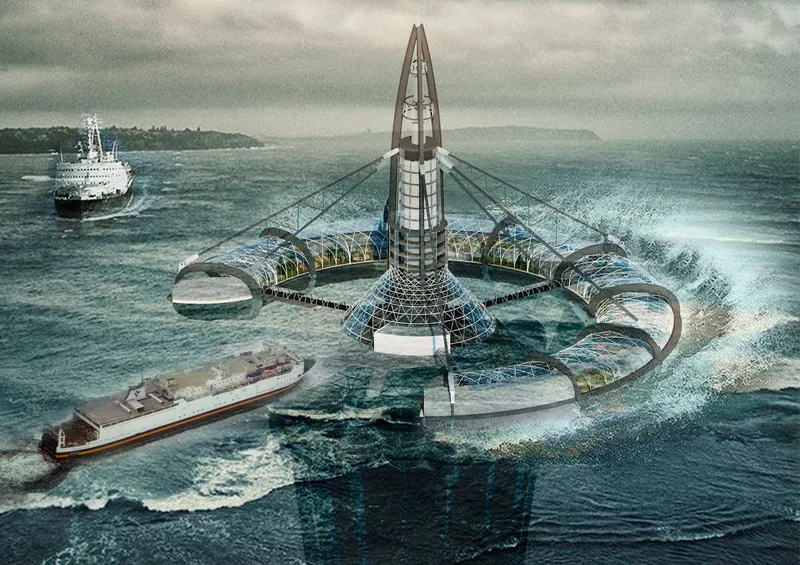
The opening rendering sets the tone: a ring-shaped glazed platform wrapped around a central spire, with ferries passing through grey, broken water under heavy cloud. This is the operating climate of the Northern Sea Route. The route is the shortest maritime link between European Russia and the Far East, and it carries growing freight traffic, oil and gas exploration and icebreaker navigation. Shidlovskii reads that rising activity as a demand for a new kind of building, one that gives seafarers and offshore workers rest, recreation and safety along a corridor that currently offers almost none.
The form takes its cues from marine life and shipbuilding, and the image makes that dual heritage clear. The spire reads like a mast. The ring reads like a hull turned inside out to hold a public room. Unlike the platforms it rethinks, Narwall presents itself as a destination, something seen from a passing deck and recognized from far away.
An Inverted Tower That Turns Depth into an Experience
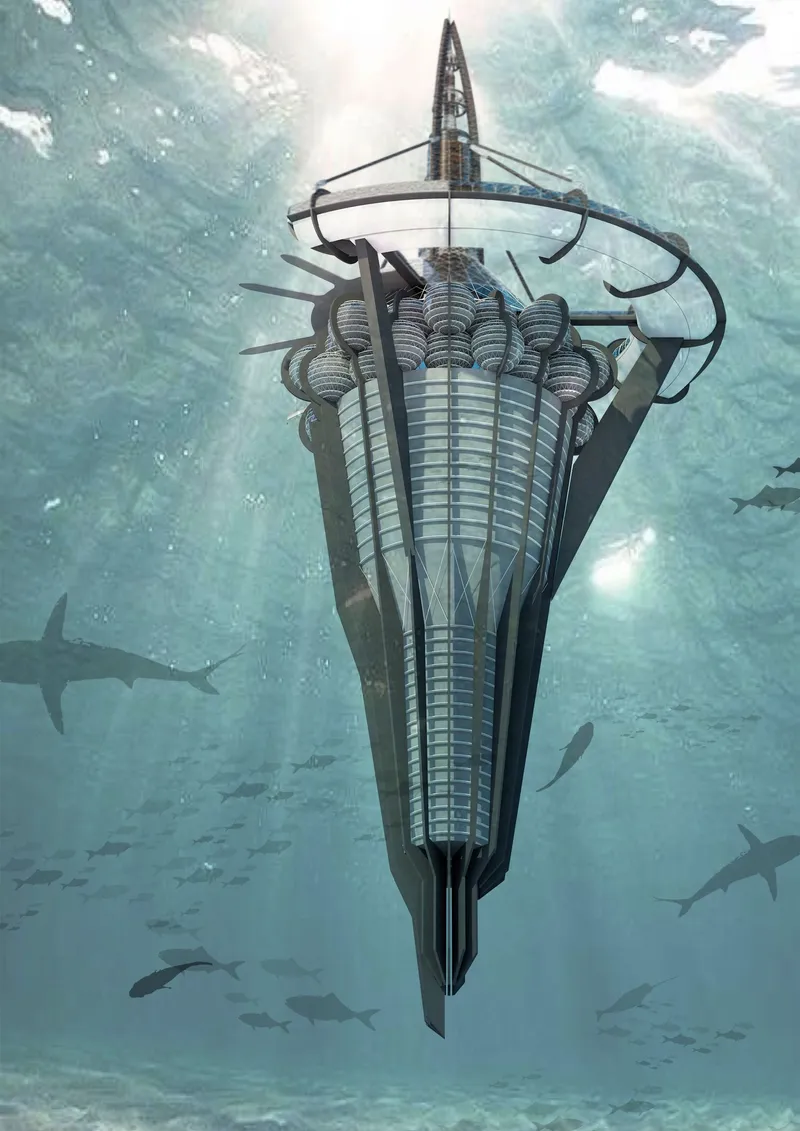
Below the surface the building changes character. The underwater view shows an inverted conical tower with clusters of spherical pods. Sharks and fish move through shafts of sunlight that pass down from the surface. This submerged body holds the working programme: hotel rooms, staff apartments, medical units, warehouses, recycling facilities and technical infrastructure.
The strongest idea here is experiential. Spaces descend gradually, so light, views and the sense of enclosure change with each level. Carefully placed glazing and structural membranes allow controlled views of the sea without compromising safety. A hotel room becomes a framed piece of the Kara Sea. For workers rotating through months of isolation, that is a real form of care, not a gimmick.
A Section Divided by the Waterline
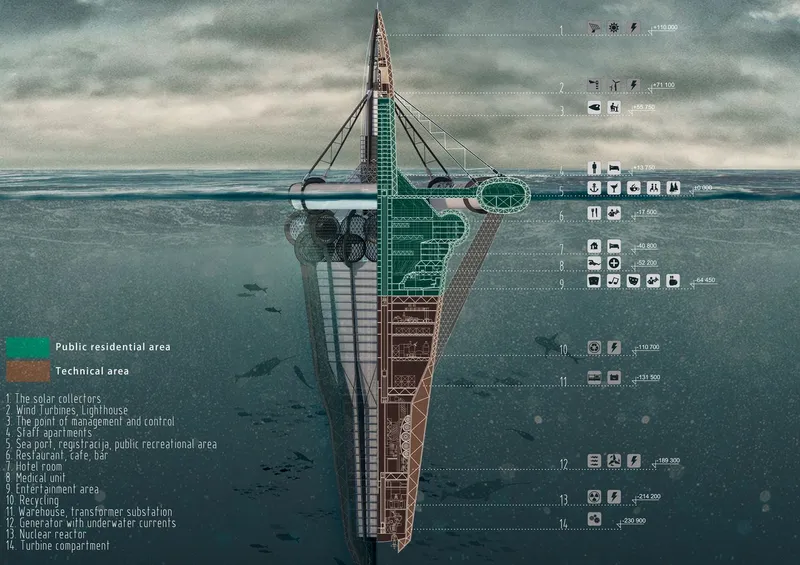
The section drawing explains the logic in one diagram. The tower is split at the waterline, with green public zones and brown technical zones, each function numbered and placed. Everything rests on a strong central core that serves as the main load-bearing and circulation element. This vertical spine contains walls, staircases, lift shafts and technical systems, so structure and movement share the same element.
The colour coding also shows a social hierarchy that is spatial too. Leisure faces the sky, and service and rest sit under the sea. An elevated atrium rises above the surface to send daylight down into the underwater public spaces, which keeps the lower levels from feeling like a basement. It is a precise move. The atrium links sea and sky visually while doing the practical job of a light well.
Ring, Core and Cable Against Wind, Ice and Waves
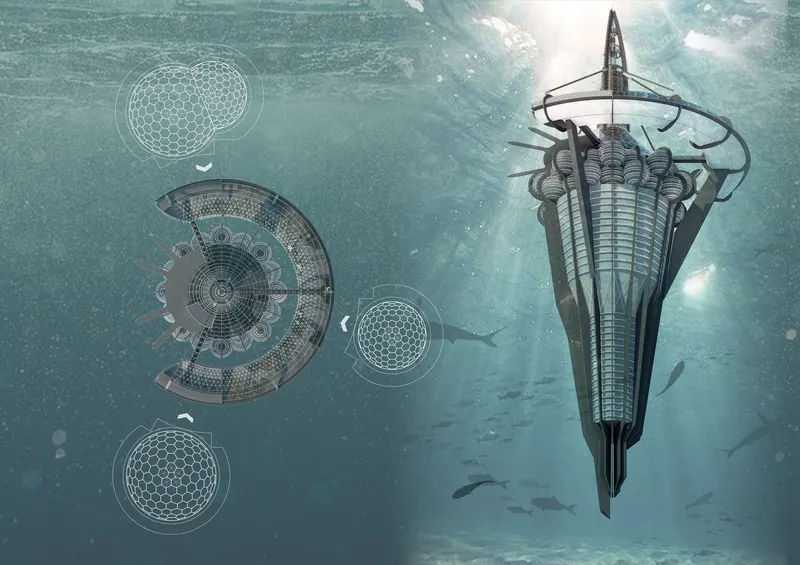
The composite sheet places a plan of the ring deck and its honeycomb domes beside the submerged tower lit from above. The ring is the project's public heart, a continuous recreational promenade that extends from the core. Its stability comes from engineering, not mass. An anchoring system and tension cables hold the upper ring in place, spread structural stress and balance the whole assembly. Shidlovskii arranges this so the building can resist the extreme winds, ice pressure and wave forces common in Arctic waters.
The honeycomb domes belong to the translucent membrane that encloses every public area above the water. It shields occupants from the climate while letting natural light reach deep into the structure. Choosing a membrane over heavy cladding matters here. In a place where daylight is scarce for much of the year, the envelope is designed to collect light, not just keep out the cold.
Leisure Organized Around the Spine
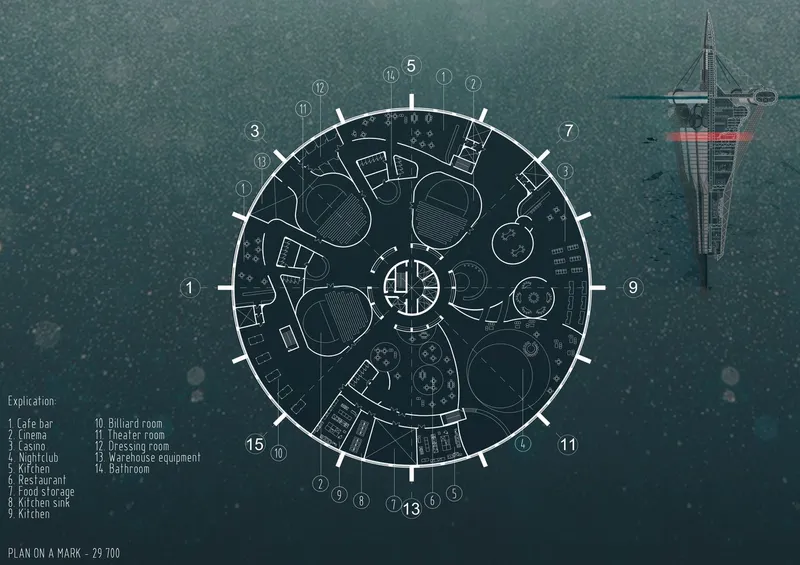
The entertainment level plan brings the abstract diagram down to the scale of a night off. A cinema, casino and restaurant are arranged in a circle around the central core, with a small tower elevation drawn alongside for orientation. Together with the cafés, observation decks and relaxation spaces described elsewhere in the brief, these programmes serve short-term visitors: sailors, researchers and offshore workers stopping between shifts or voyages.
The radial plan suits the context well. Every venue opens onto the same loop, so the floor works as a small town square wrapped around the lifts. Energy follows the same vertical logic, with solar collectors placed on the upper levels as part of a wider set of renewable and alternative systems that let the complex run independently of mainland grids.
Why This Project Matters
As shipping lanes open across the Arctic, the region will gain more infrastructure whether architects take part or not. Narwall argues that this infrastructure should be built around people, combining hospitality, healthcare, logistics and energy production in one resilient system rather than adding accommodation to an industrial platform. Its central idea, a public ring above and a functional tower below, joined by a single structural spine, is clear enough to survive the inevitable engineering scrutiny of a real offshore brief.
The project's Honorable Mention at UnIATA ’18 recognizes a thesis that treats autonomy as both a social goal and a technical one. Shidlovskii does not romanticize the Kara Sea. He designs for its ice, wind and isolation, and then uses light, views and a shared promenade to make living there bearable. For students working on extreme environments, Narwall is a useful example of how structure, programme and atmosphere can be resolved together.
View the Full Project
About the Designers
Designer: Viktor Shidlovskii
Enter a Design Competition on uni.xyz
uni.xyz runs architecture and design competitions year-round that reward proposals with spatial conviction and real site intelligence.
Project credits: NARWALL-diploma project by Viktor Shidlovskii UnIATA ’18 (uni.xyz).


Popular Articles
Popular articles from the community


Extended Shell: Retrofitting Kolkata's Balconies as Living Urban Thresholds
A modular retrofit system recovers the social and environmental intelligence of Kolkata's historic verandas for contemporary Park Street residents.
Temporary Home for Dogs: A Reversed Zoo Rethinks Animal Shelter Architecture
In Bucharest, a sinuous corridor and freed landscape flip the logic of containment, designing a shelter that works to make itself unnecessary.
Opera by the Sea Estonia: Three Shells Dissolving Architecture into Tallinn's Coastline
A winning opera house proposal replaces monumental form with interconnected shells that blur the boundary between building, park and Baltic Sea.

Manzana Morphosis: Stretching Barcelona's Grid into a Living Landscape for 2050
A radical reworking of the Eixample manzana turns density into a tool for generous public space, vertical ecology, and environmental performance.

Similar Reads
You might also enjoy these articles

Maya Harvest: A Cacao Resort Village Rooted in Mayan Tradition and Local Craft
Situated within a Tabasco cacao plantation, this shortlisted resort proposal merges vernacular materials with hands-on cultural immersion.
Harmonia: A River-Shaped Community That Grows Over Decades in Boa Vista
Curved pathways and modular grid structures along the Branco River create a phased settlement designed to evolve from 2030 to 2050.
The Architecture of Bathing: A Mughal Hammam Reimagined Across the Yamuna
Charlotte May's honorable mention entry for The Black Taj reinterprets Agra's bathing rituals through red sandstone, water, and framed views of the Taj Mah
Om-1: A Wall-Hung System That Moves Your Workspace Off the Desk
Modular plywood boards, magnetic pegs, and utility elements migrate clutter from the horizontal surface to the vertical plane.

Explore Ocean Architecture Competitions
Discover active competitions in this discipline

Challenge to reimagine the Iron Throne

Photograph architecture without architects

Illustrate the lost glory of Angkor Wat - Render Challenge

Design challenge to reuse E-waste
Comments (0)
Please login or sign up to add comments
No comments yet. Be the first to comment!