
Neo Architects Folds a 63-Square-Meter Chapel Around Light, Water, and Sacred Geometry in Pretoria
On the Doxa Deo Campus in Brooklyn, Pretoria, two curved walls and a cantilevered roof create a sanctuary scaled to intimacy.


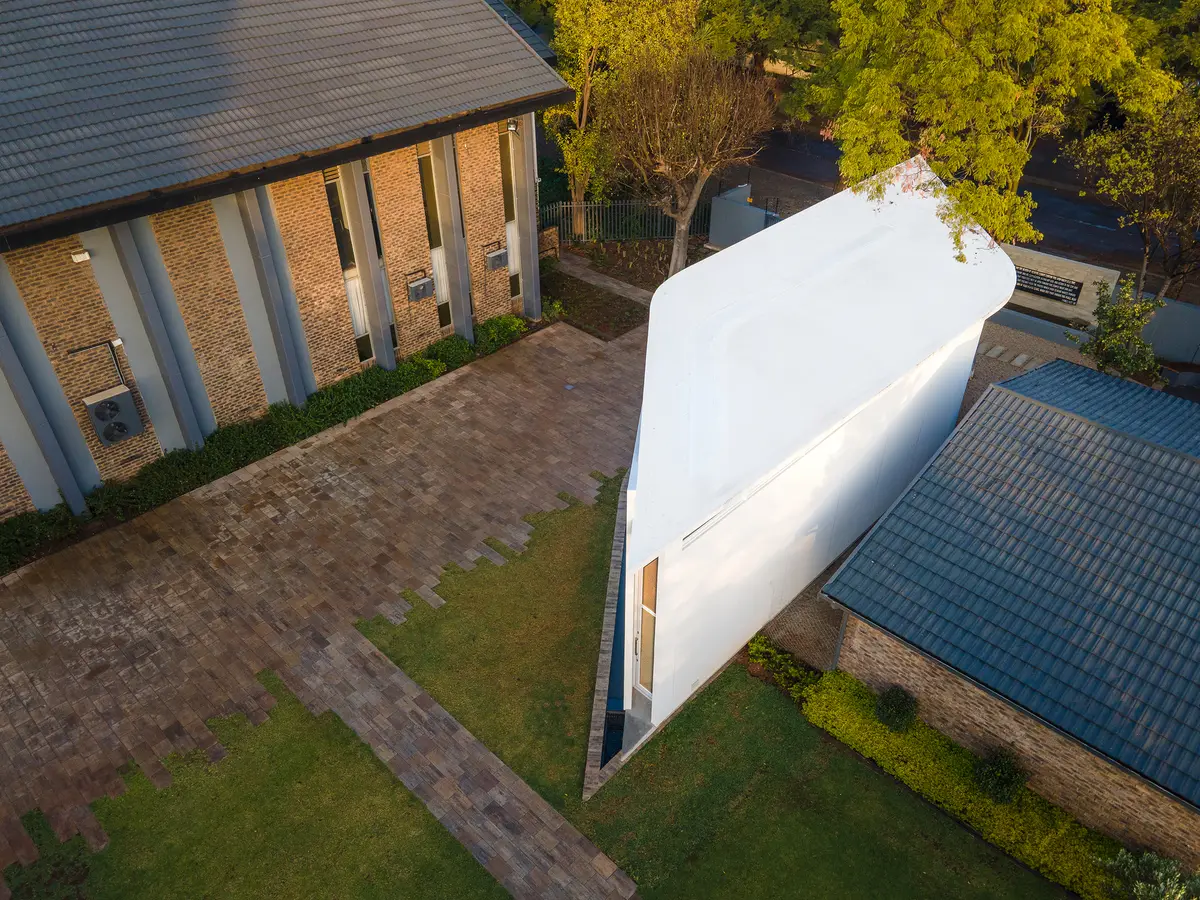
A chapel does not need to be large to feel vast. Neo Architects, led by Phoebe van Dyk and Dries Verbeek, proved that with Doxa Chapel: 63 square meters of steel frame and birch slats wedged into a narrow rectangle of lawn on the Doxa Deo Campus in Brooklyn, Pretoria. The site sits at a hinge between a low-rise residential suburb and the taller apartment buildings that press in around it, and the chapel's role is partly urban suture, partly sacred space, partly garden room. It replaces what was essentially leftover grass and a storage yard behind an admin building, and it does so with a single, continuous curved fold that reads as both wall and roof.
What makes this project worth studying is the economy of its symbolic logic. The floor plan derives from the number seven and its mirror, generating a geometry that pinches at two points: the entrance, which the architects call Alpha, and the altar end, Omega. Between these two apertures, narrow slits let daylight enter as moving rectangles that track across the interior throughout the day. The result is a building whose ornament is nothing more than the passage of the sun.
A Curved Shell in a Suburban Fabric
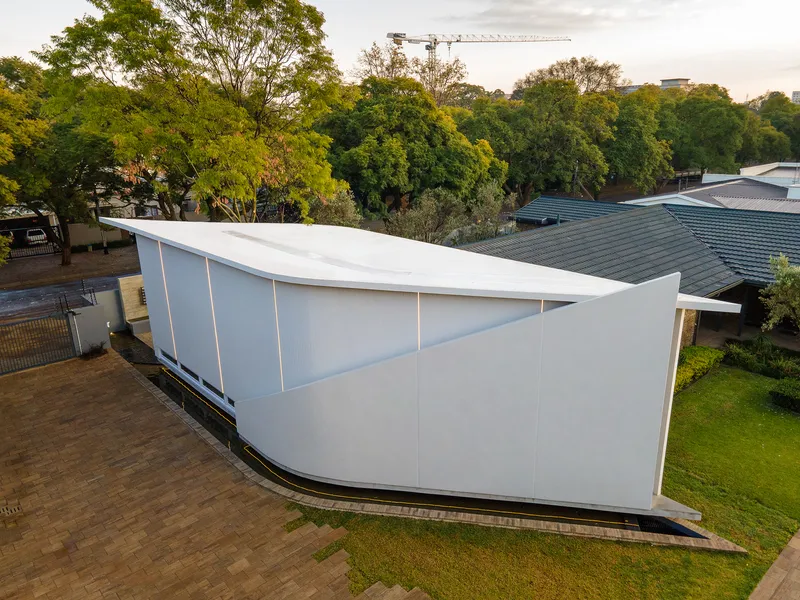
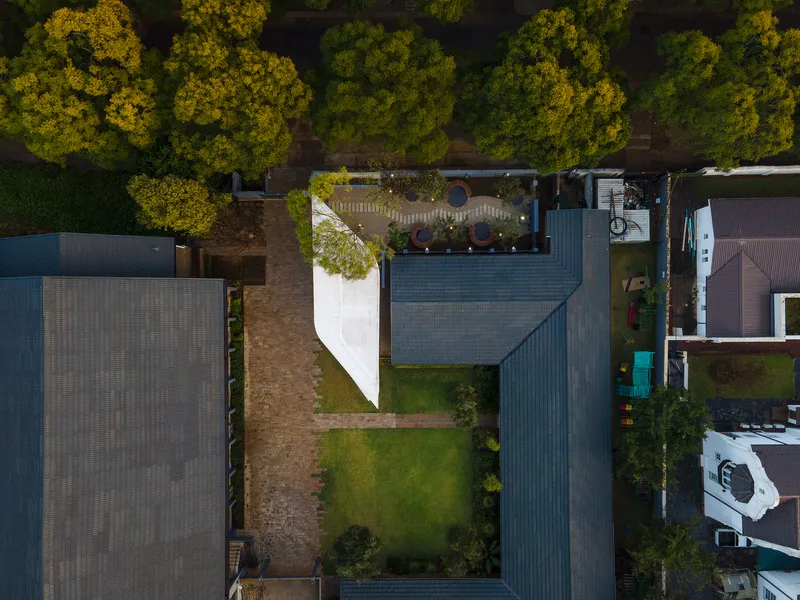
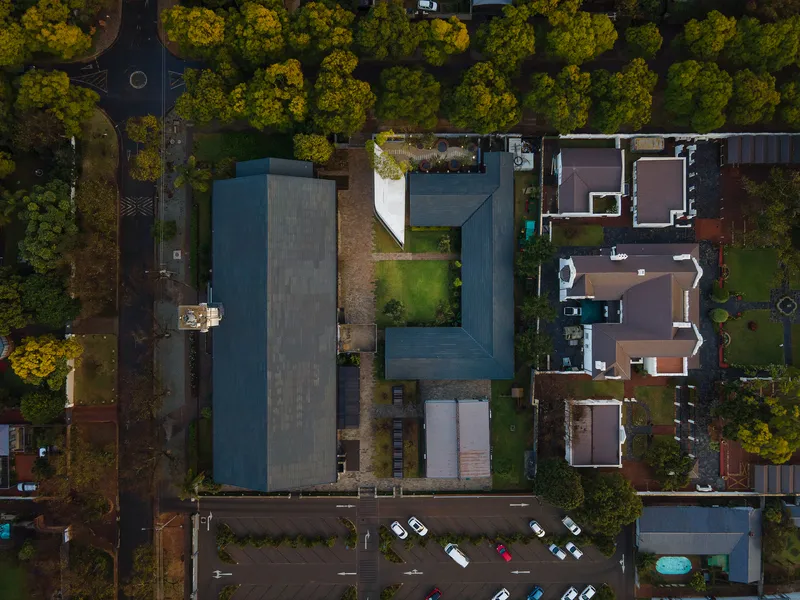
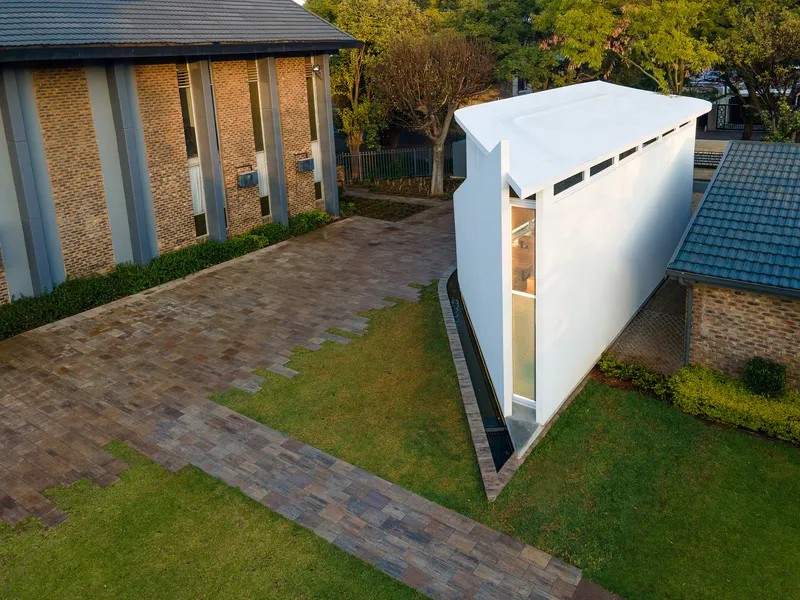
Seen from above, Doxa Chapel is startlingly small. Its white form sits among tiled roofs, garden plots, and mature trees, almost camouflaged by the canopy of a retained Leopard tree that stretches over the entrance courtyard. The aerial views reveal how tightly the chapel is stitched into the campus: it bridges the gap between the admin building and the church's processional entrance, turning a residual strip into a destination.
The contrast between the chapel's smooth, curved envelope and the angular domesticity of its neighbors is deliberate. Where suburban Pretoria tends toward pitched roofs and brick, this building offers a monolithic white volume with a cantilevered roof shard that juts out among the trees. It registers as something set apart without being alien.
The White Fold and Its Apertures
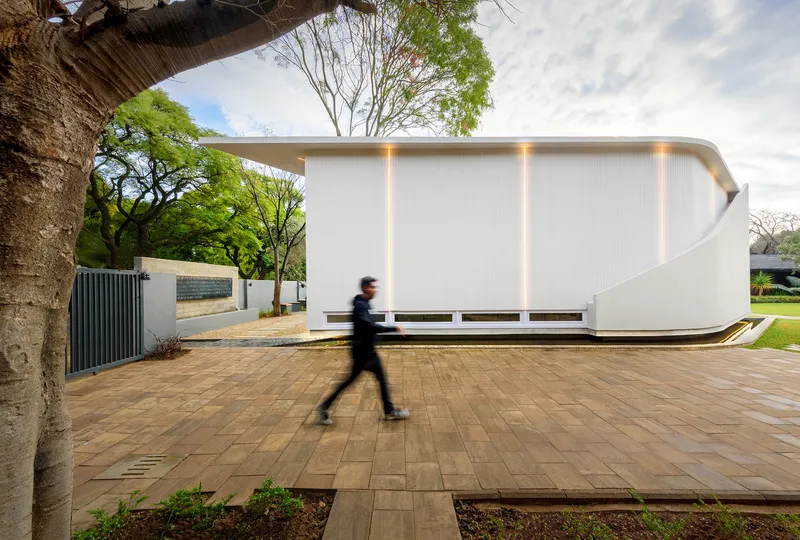
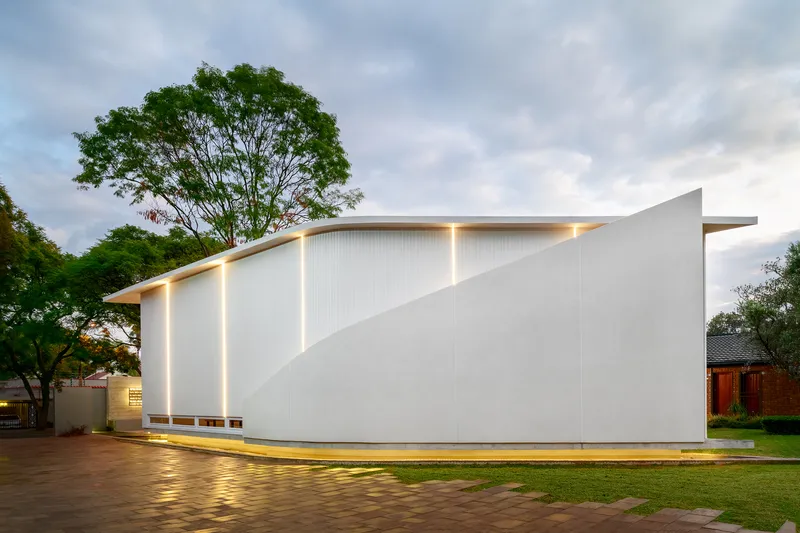
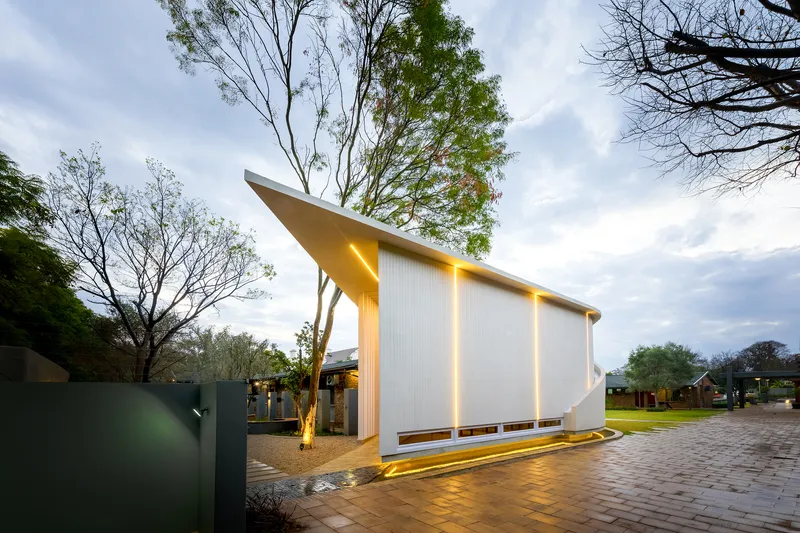
The exterior is clad in Terraco board with a textured plaster finish, creating a ribbed surface that catches raking light at dusk. Vertical light slots punctuate the facade, thin enough to suggest concealment rather than transparency. At the base of one wall, low horizontal vents open near ground level, a functional choice for cross-ventilation that also reinforces the building's grounded relationship to the earth. On the opposite wall, a second slot sits just below the roofline.
The ETICS lightweight steel frame system allowed the specialist contractor to achieve the compound curves without the mass and cost of concrete. It is a pragmatic choice that also keeps the building light on its foundations, important on a site that needed minimal disruption to existing trees and infrastructure.
Threshold and Arrival
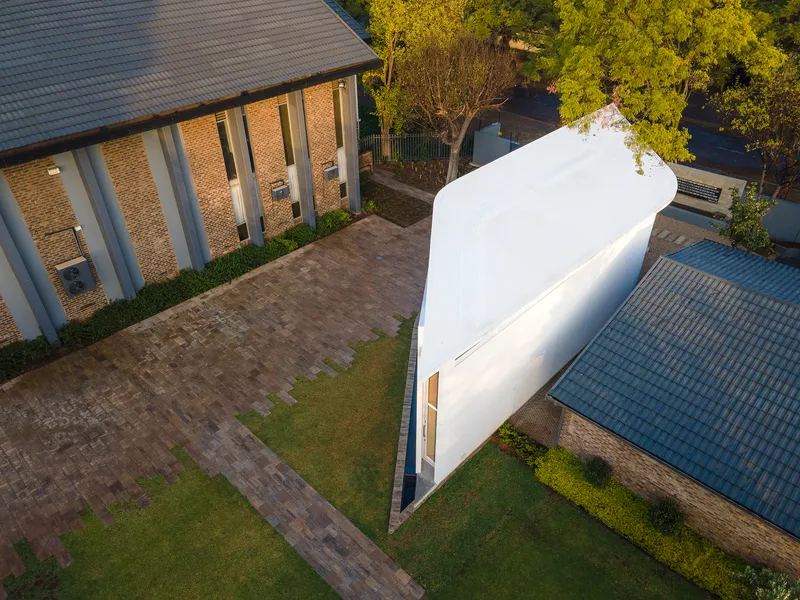
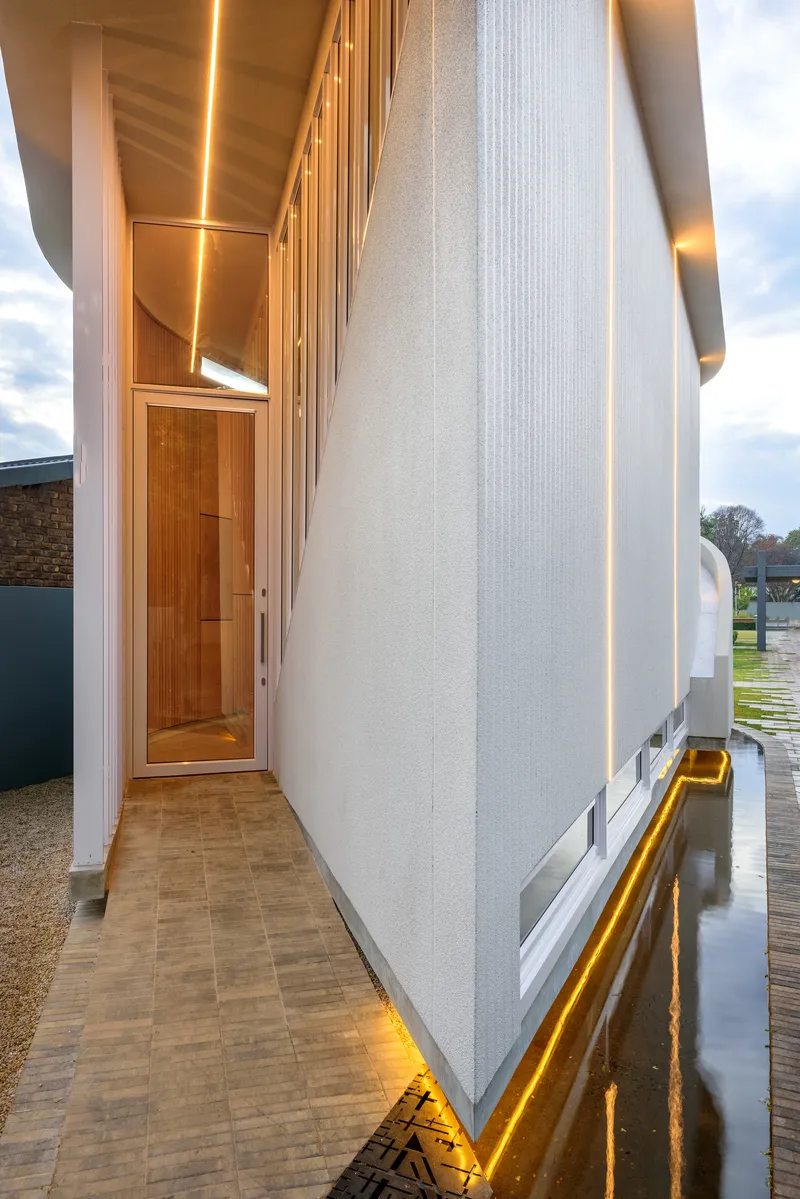
Approach matters in a building intended for contemplation, and Neo Architects orchestrate it carefully. The cantilevered white form hovers over a brick forecourt, its horizontal slot window opening toward the lawn like a squinting eye. You pass beneath the Leopard tree canopy, encounter a water feature, then arrive at a covered entry passage where vertical ribbed cladding, a timber door, and a thin line of recessed lighting set up the transition from secular to sacred.
The wet pavement in the entry corridor catches reflections, doubling the linear lighting and extending the sense of depth. It is a small move, but it compresses the spatial experience so that when the interior opens up, the release feels genuine.
Birch, Light, and the Interior Curve
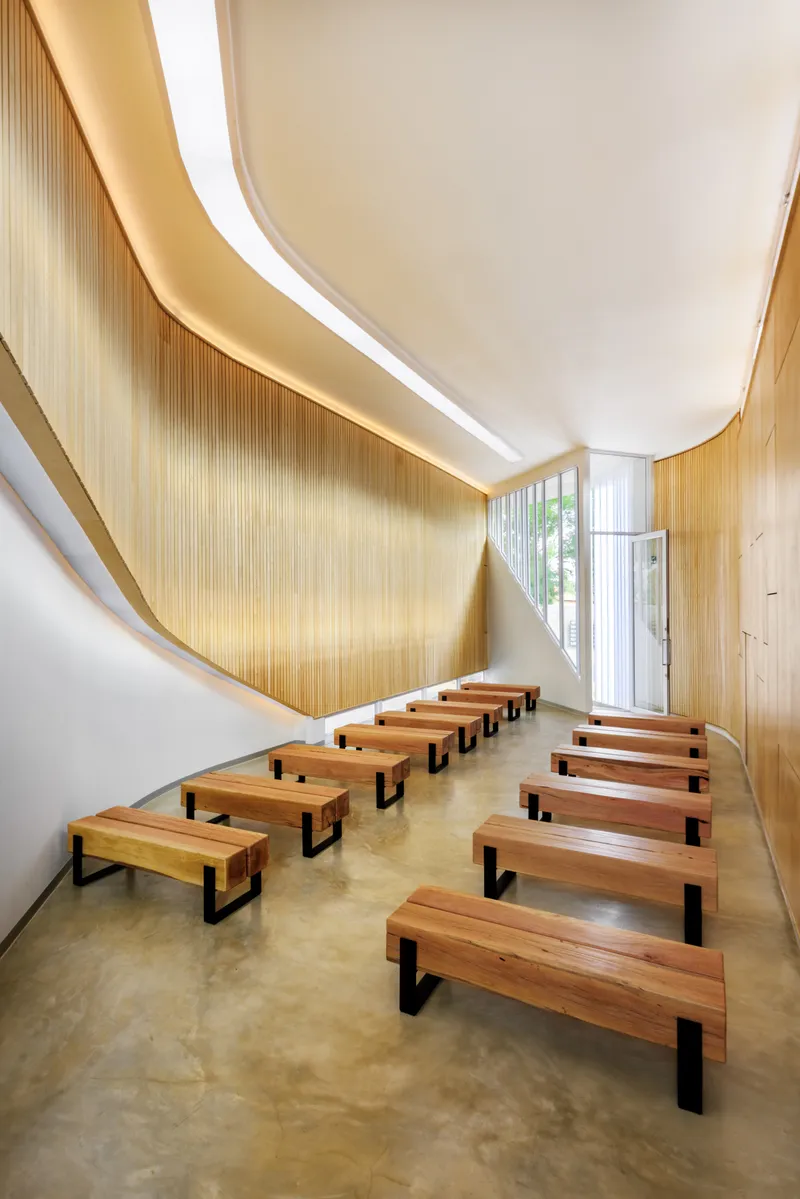
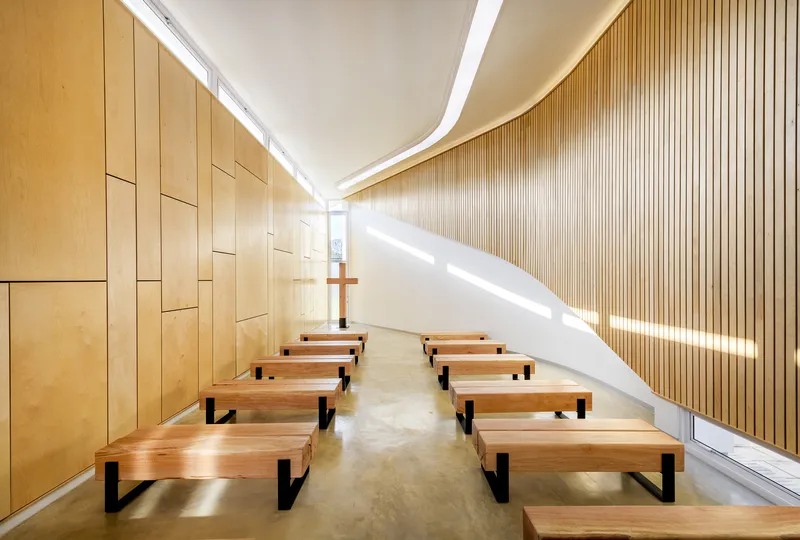
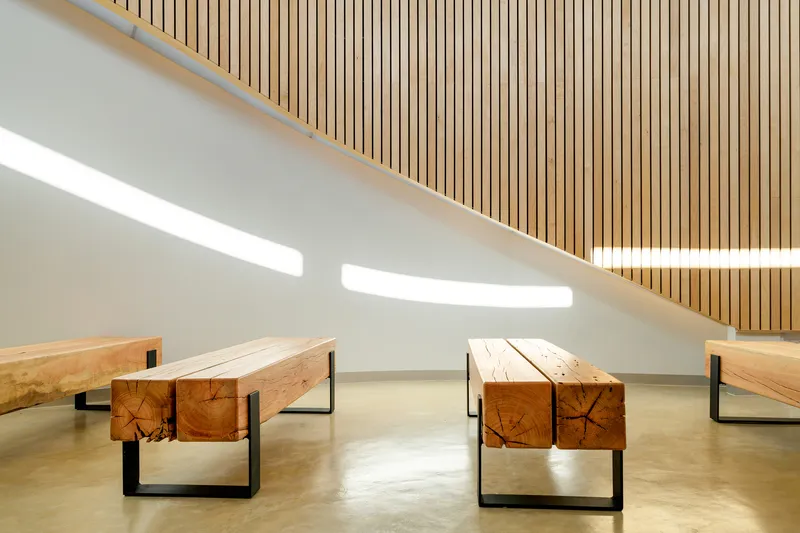
Inside, the palette reduces to birch wall panelling, timber slats, epoxy resin flooring, and light. The two slightly offset curved walls wrap around the nave, creating a space that feels both enveloping and directional. Concealed cove lighting washes the curved ceiling, and a continuous light slot at the roof edge admits a blade of natural light that shifts with the hours. The effect is closer to a James Turrell installation than to conventional ecclesiastical decoration.
Timber benches on steel frames sit on the polished floor, movable so the room can serve weddings, small services, or individual prayer. The furniture's simplicity is essential: anything heavier would compete with the architecture's own theatrics of curvature and light.
The Altar Wall as Luminous Screen
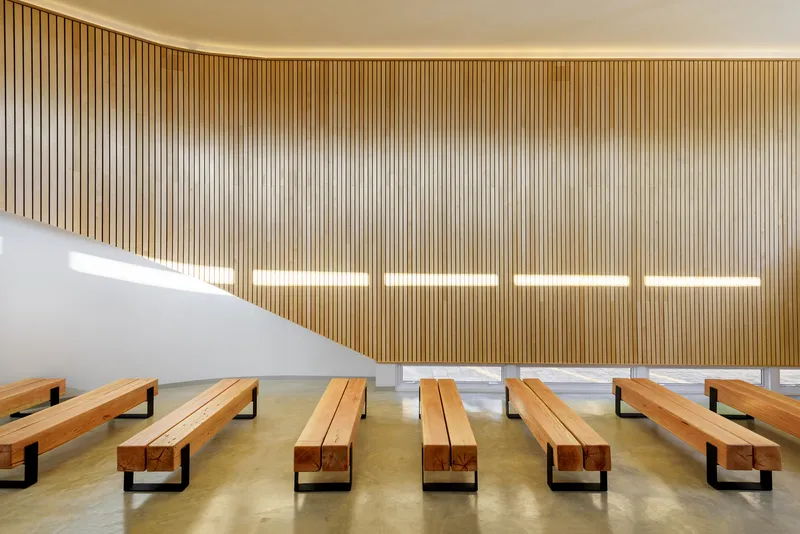
At the Omega end, vertical timber slats compose the altar wall, interrupted by five horizontal light strips that glow against the warm wood grain. The cross is implied by the geometry rather than applied as object. This is minimalism in the service of theology: early Christian buildings used light and material to evoke presence, and Neo Architects return to that instinct rather than relying on iconography.
The horizontal bars of light recall the slivers of sun that enter from the facade slots, creating a consistent language of illumination throughout the building. Light is treated as the primary building material of the interior, which is fitting for a space named after a Greek word meaning glory.
Plans and Drawings
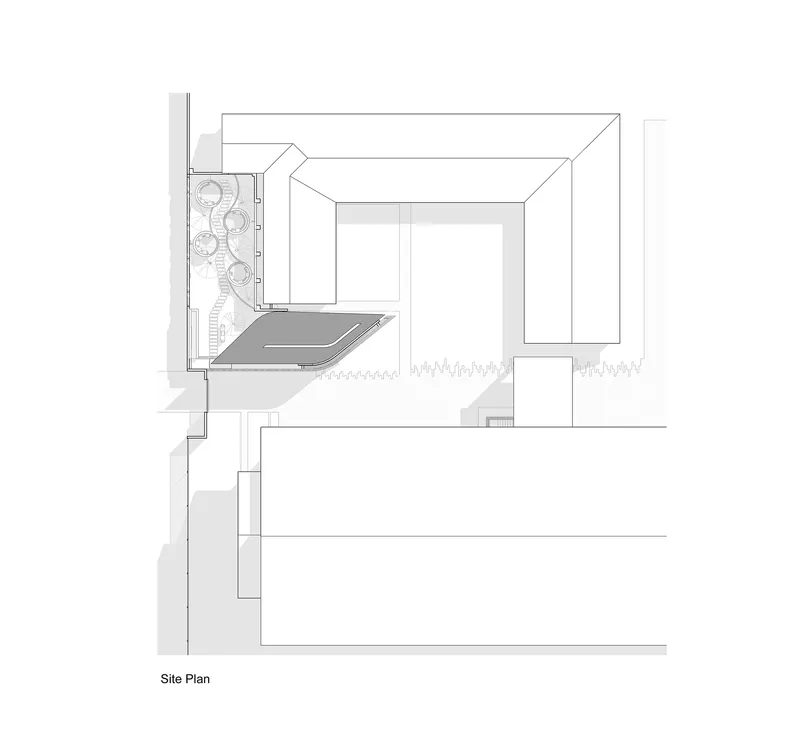
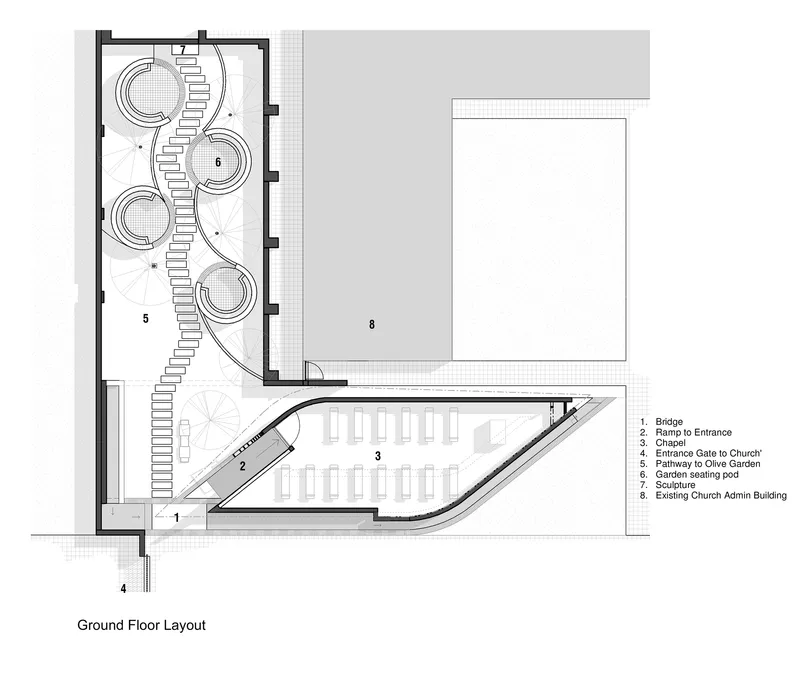
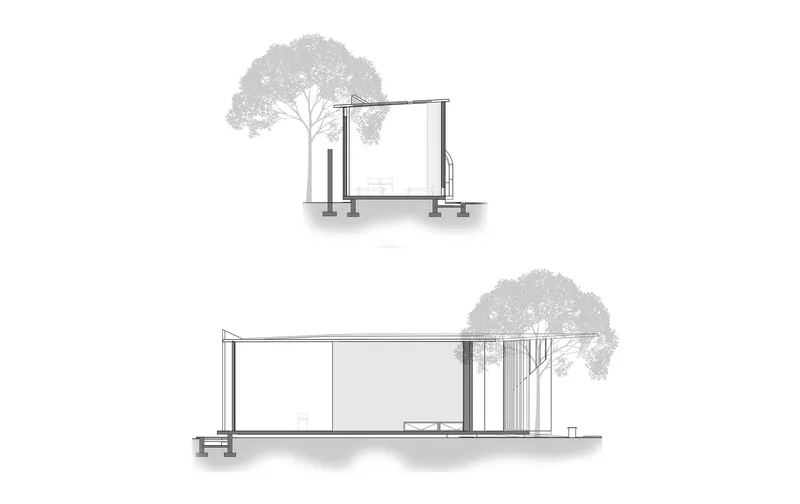
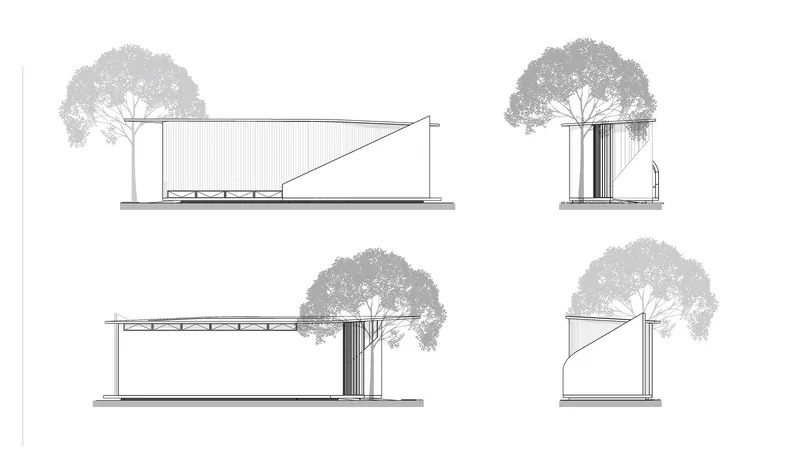
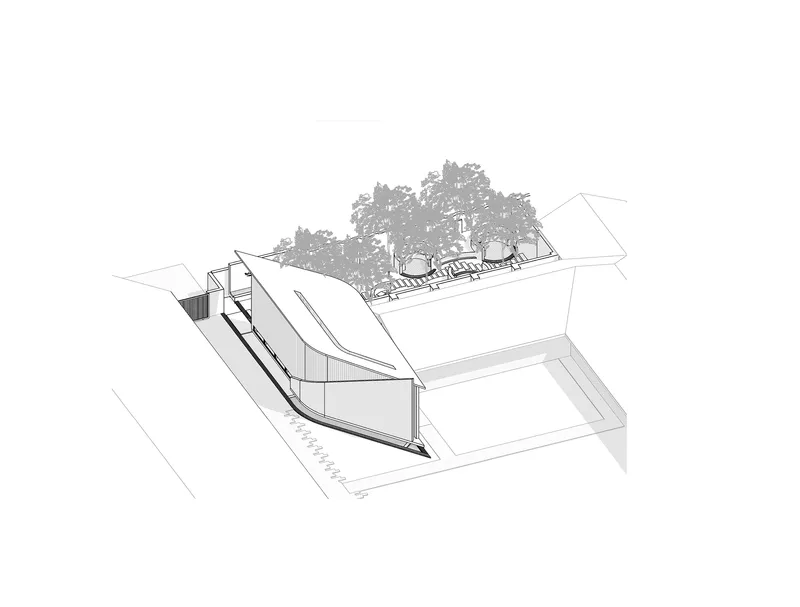
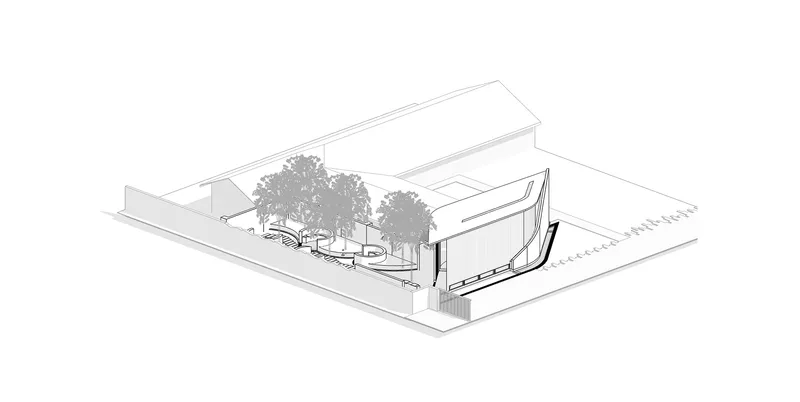
The site plan and ground floor plan reveal the logic of the fold: a single curved line generates both walls, pinching at entry and altar to form the Alpha and Omega points. The floor plan's derivation from the number seven is legible in the proportions of the curve. Circular elements in the garden area mark the olive tree landscape, an extension of the sanctuary into the open air. Sections show how the floating roof cantilevers beyond the enclosure, and the axonometric drawings illustrate the ramped entry sequence and the relationship between the canopy, the courtyard trees, and the building's own curved glass elements.
The elevations confirm how consistently the vertical timber cladding wraps the form, and how the sloped roof reads differently from each cardinal direction. From the north, the chapel is a compact wedge; from the east, a billowing sail. The drawings also make visible the building's modest column supports, which keep the structure elevated just enough to suggest levitation without leaving the ground.
Why This Project Matters
Doxa Chapel is a reminder that spiritual architecture does not require monumental scale. At 63 square meters, it is closer in size to a garden pavilion than to a church, yet it manages to produce genuine atmosphere through the manipulation of curve, slit, and surface. The ETICS steel frame system proves that complex geometries do not demand expensive concrete formwork, opening a path for smaller congregations or institutions to commission buildings with real spatial ambition on modest budgets.
More broadly, the project shows how to insert a contemplative program into a tight urban campus without dominating it. The retained Leopard tree, the olive garden, and the water feature are not landscaping afterthoughts; they are integral to the building's spatial sequence. Neo Architects have built a chapel that earns its presence through restraint, proving that when the material palette is pared back far enough, light itself becomes the most eloquent element in the room.
Doxa Chapel by Neo Architects (Phoebe van Dyk and Dries Verbeek), located on the Doxa Deo Campus in Brooklyn, Pretoria, South Africa. 63 m². Completed in 2021. Photography by Paris Brummer.
About the Studio
Share Your Own Work on uni.xyz
If projects like this are the kind of work you want to make, uni.xyz is a place to publish your own, find collaborators, and enter design competitions.


Popular Articles
Popular articles from the community


David Macias Steps a Doorless Stone and Plaster House Down a Tropical Colombian Hillside
In the humid hills of Colombia, Threshold House replaces the front door with an open void and terraces its 850 m² down the slope instead of fighting it.

David Ortega Stacks a Two-Story Mexico City Penthouse Around a Steel Stair and a Pergola-Shaded Roof Terrace
In Colonia Roma, a 300 m² penthouse uses oak joinery, a planted steel stair and a slatted roof pergola to make a new-build apartment feel like a house.

GROUP A Strips a 1969 Rotterdam Harbor Headquarters to Its Frame and Wraps It in Timber Louvers
In Rotterdam's M4H harbor district, Ferro Offices reuses a 1969 frame, adds one timber storey and reaches BREEAM-NL Outstanding.

U.GA Architects Wraps an Oval Rooftop Pool in Curved Board-Formed Concrete on Busan's Jeollidan-gil
In Busan's Jeonpo-dong, a 454 m² mixed-use block stacks a neighborhood facility, guest rooms and an oval rooftop pool inside spiraling concrete walls.

Similar Reads
You might also enjoy these articles


LAVA Architecten Gives Vocational Education a Sawtooth-Roofed Face on a Mechelen School Campus
In Mechelen, Belgium, a 2,053 m² STEM school on a 6×6 m grid turns workshops and classrooms into rooms that can be rearranged as teaching changes.

KEMA Studio Turns a Derelict Marvila Attic into a 60 m² Lighthouse Apartment Above Lisbon
In Lisbon's Marvila district, a rebuilt roof, four skylights and two plywood volumes turn an unlivable attic into a bright home facing the Tagus.

Pixel Gardens: One Repeated Module Stacked Into a Terraced Social Housing Tower for Famagusta
Salem Bader's shortlisted housing tower builds a vertical neighbourhood from one repeated module, offsetting units to carve terraces, light and air.

Bao Huynh Watercolor Atelier: A Serene Art Retreat in Hội An
Bao Huynh Watercolor Atelier in Hội An blends multifunctional art spaces, sustainable design, local materials, and family-friendly living in a serene environment.

Explore Chapel Competitions
Discover active competitions in this discipline

Design Challenge - Contemporary interpretation of a religious complex

Challenge to reimagine the Iron Throne

Photograph architecture without architects

Illustrate the lost glory of Angkor Wat - Render Challenge
Comments (0)
Please login or sign up to add comments
No comments yet. Be the first to comment!