
Next Office Folds a Tehran Villa into Itself, Turning Pitched Roofs into Vertical Light Wells
A 910 square meter house in Tehran reinterprets the pitched-roof villa typology by splitting its volume to carve deep shafts of daylight into every level.


Tehran's residential fabric is thick with pitched-roof villas. Row after row, they line the streets of the capital's sprawling northern neighborhoods, their profiles so ubiquitous they become invisible. Next Office–Alireza Taghaboni could have rejected the type altogether, pursuing the kind of flat-roofed minimalism that dominates Iranian architectural magazines. Instead, the Shahrak Villa accepts the pitched roof as a starting condition and then systematically dismantles what that form usually produces on the inside.
The real project here is not the roof but the void. By splitting what reads as a single volume into two angled masses, Taghaboni opens a series of vertical shafts that pull light deep into a 910 square meter plan. The result is a house where interior space behaves more like a sectional landscape than a sequence of rooms: stacked levels, glass floors, a triple-height skylight shaft, and a swimming pool that sits in visual conversation with the levels above it. From the street, none of this is visible. The white stucco facade and metal gate look almost deliberately ordinary.
Street Presence and the Art of the Unremarkable
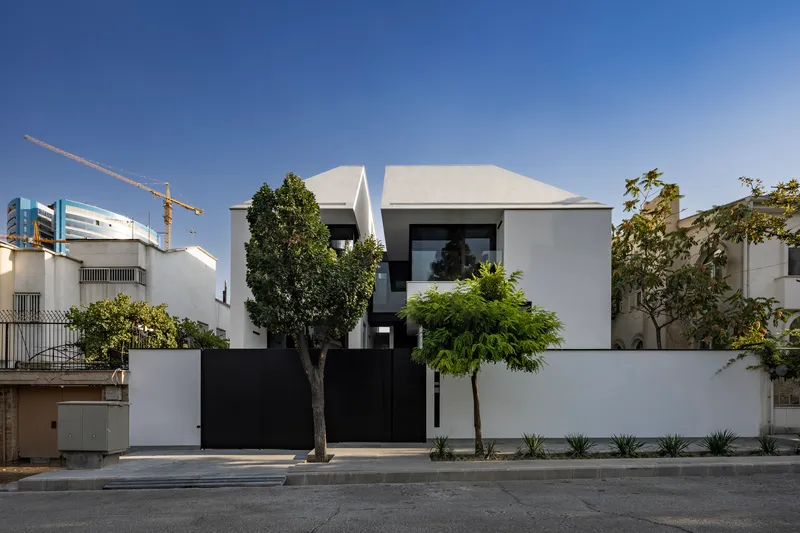
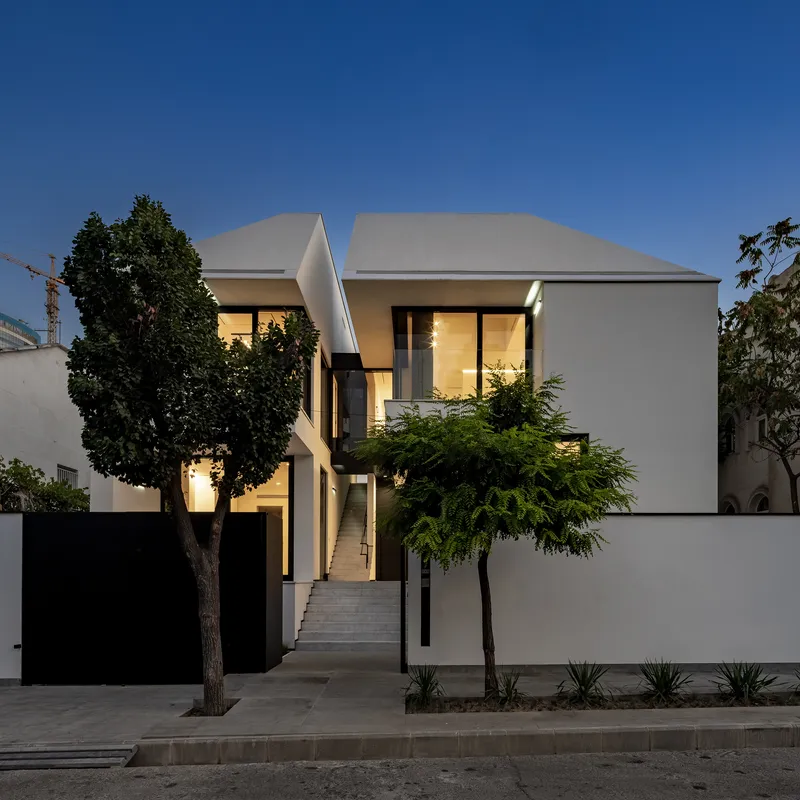
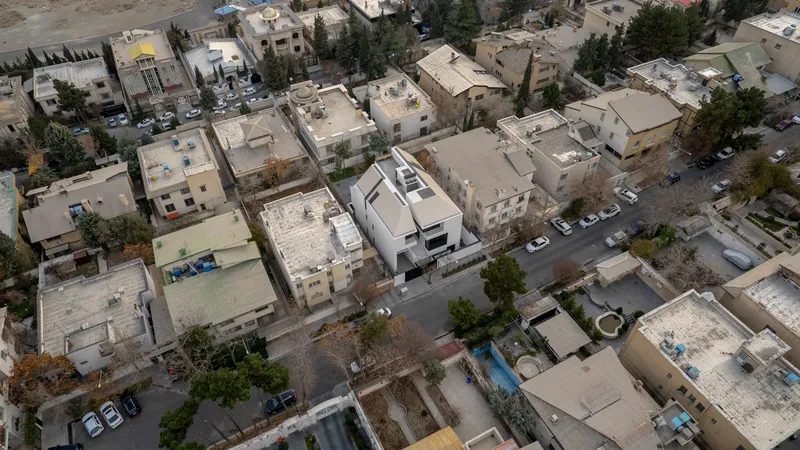
The villa's street-facing elevation is a lesson in restraint. White rendered walls, dark fenestration, a black metal gate, and a few planted trees along the sidewalk compose a facade that participates politely in its block. At dusk, the illuminated windows reveal the depth behind the surface, but during the day the building could pass for any well-maintained Tehran residence. The aerial views confirm this camouflage: the white roof planes sit among their neighbors without asserting formal dominance.
There is a deliberate ethics at work in this approach. Rather than treating the individual house as a billboard for architectural ambition, Taghaboni keeps the exterior vocabulary collective and the invention private. The pitched forms read as contextual from above, while the real spatial complexity is reserved for the inhabitants.
The Entry Passage as Threshold
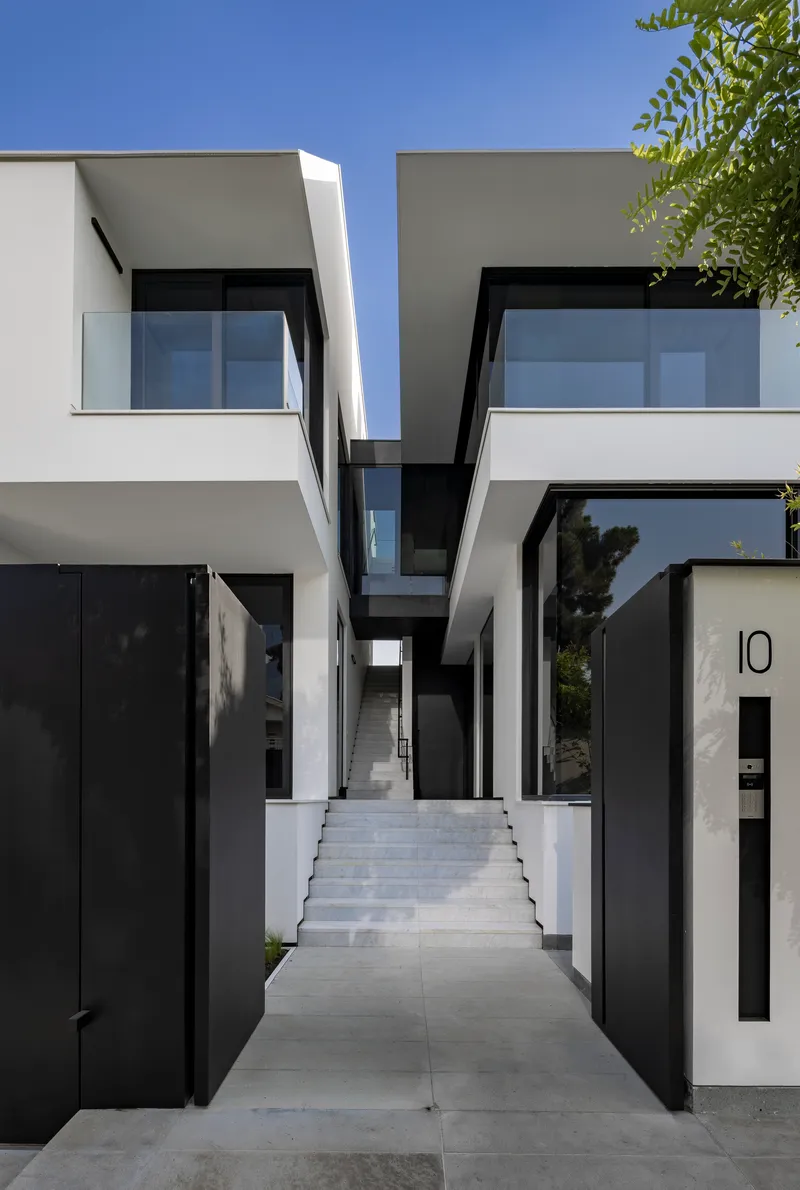
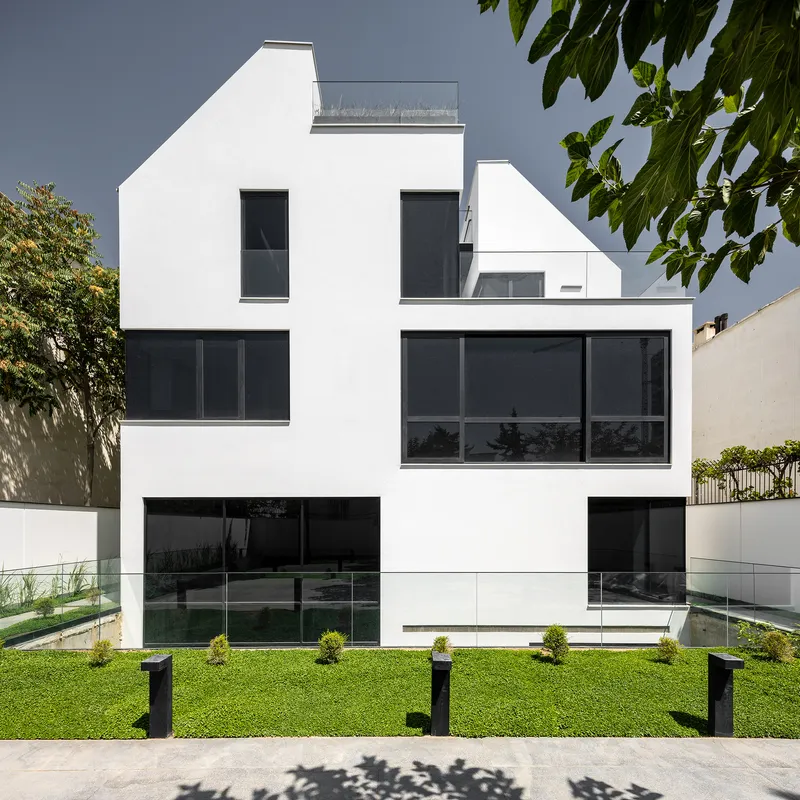
Arrival happens through a compressed passage between two angled white volumes, paved in stone and framed by black metal doors. The geometry narrows and angles, generating a sense of passage from one world to another. By the time you reach the garden side, with its lawn and overhanging tree branches, the street feels distant. This sequencing is a classic Persian architectural move, the hashti and transitional corridor translated into a modern sectional language.
Vertical Light and the Sectional Core
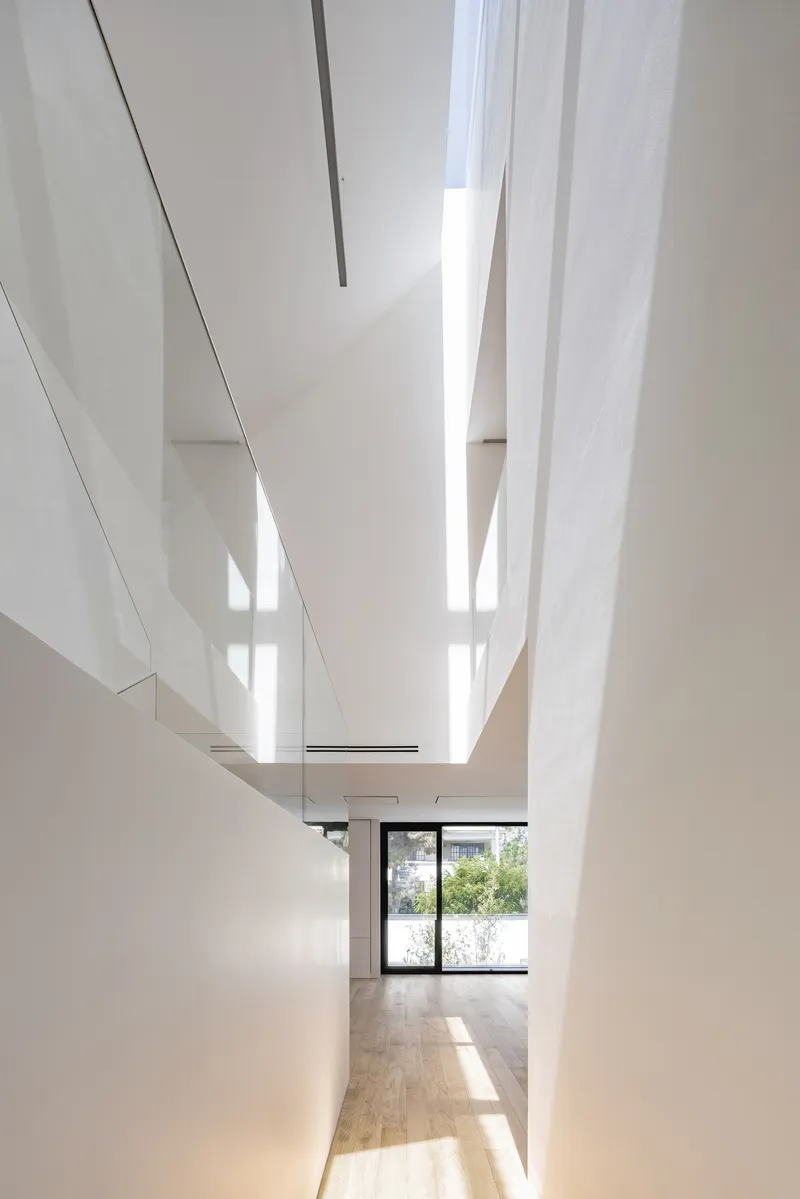
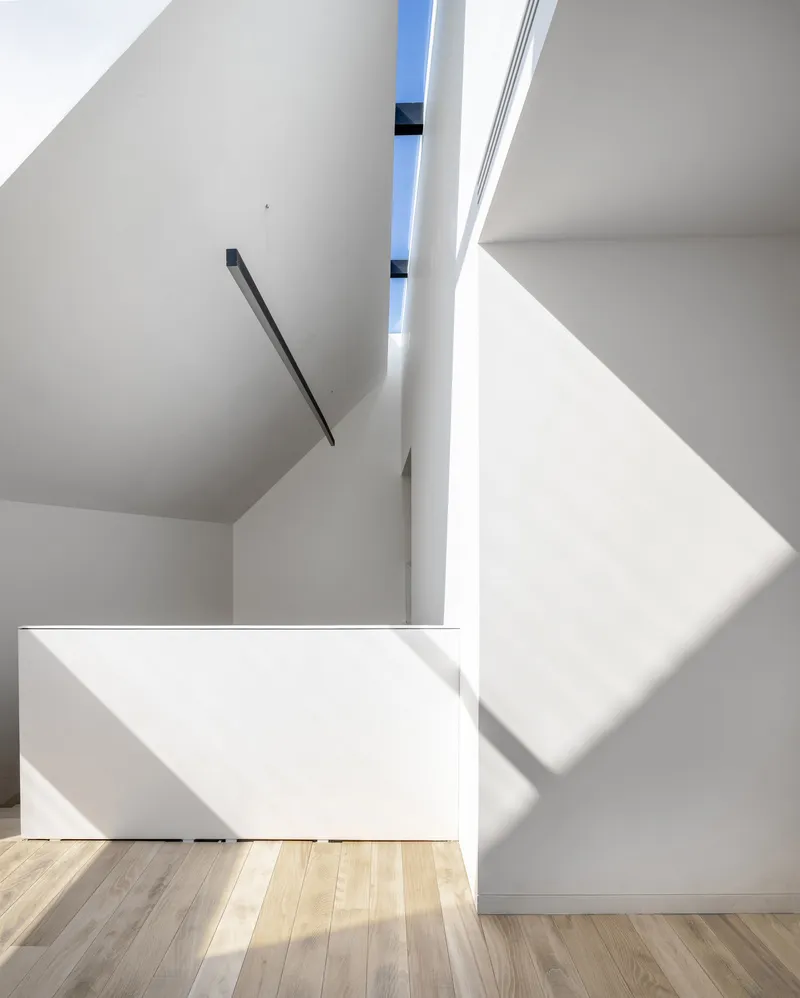
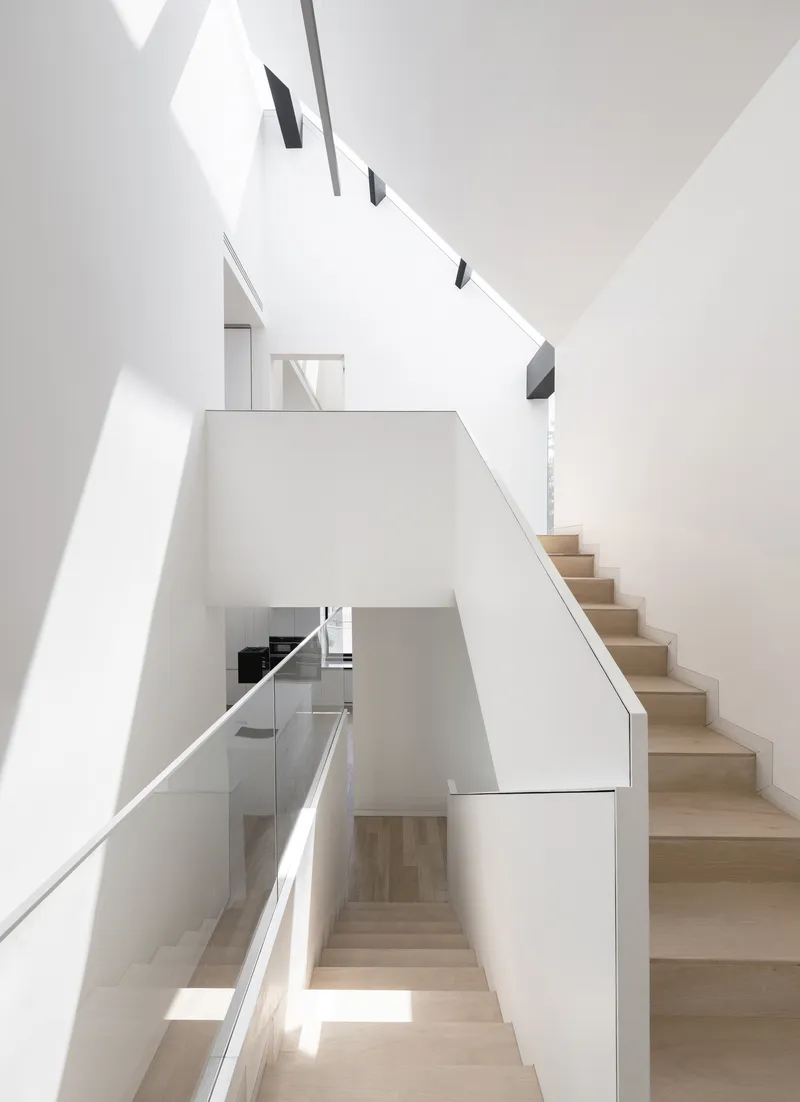
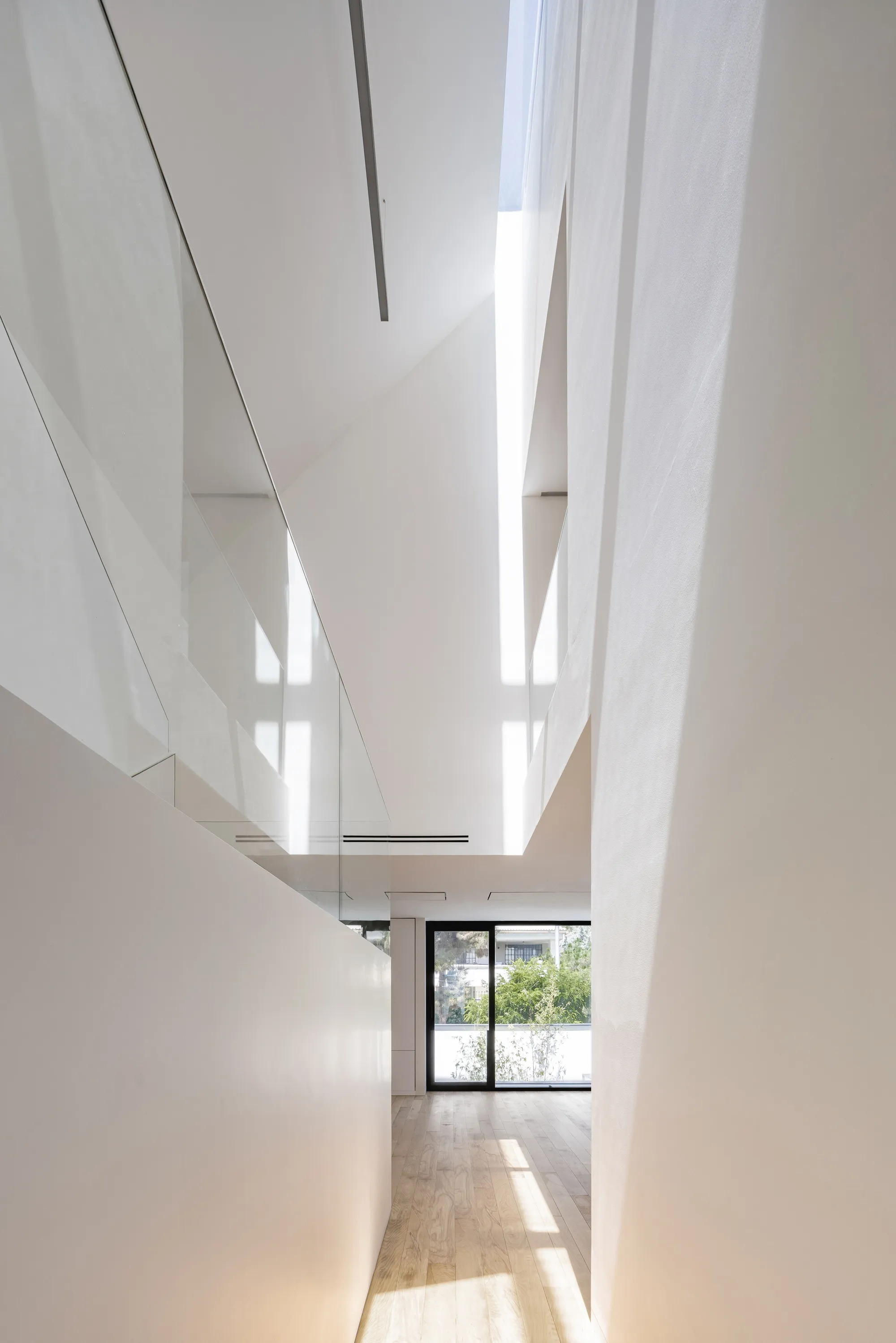
The heart of the Shahrak Villa is its triple-height skylight shaft, a void that runs from the roof down to the wood-floored lower levels. Bright daylight enters from above and washes down white walls, turning the interior into a sundial. Shadows shift throughout the day, drawing crisp diagonal lines across surfaces, stair treads, and handrails.
The staircase is more than circulation; it is the primary spatial experience of the house. Light wood treads, black metal handrails, and angled white walls create a composition that changes character at every landing. Taghaboni uses the stair not just to connect floors but to organize the entire section around a single luminous column of air. You are always aware of where the light is coming from, which means you are always aware of the sky.
Layered Levels and Transparency
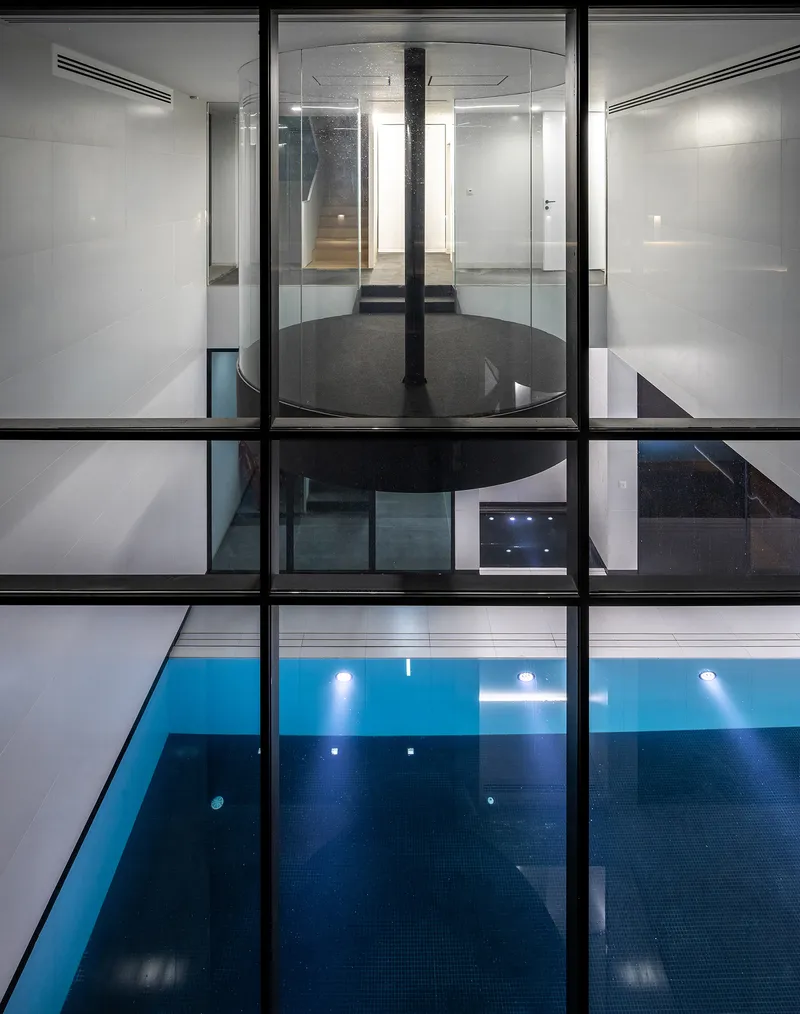
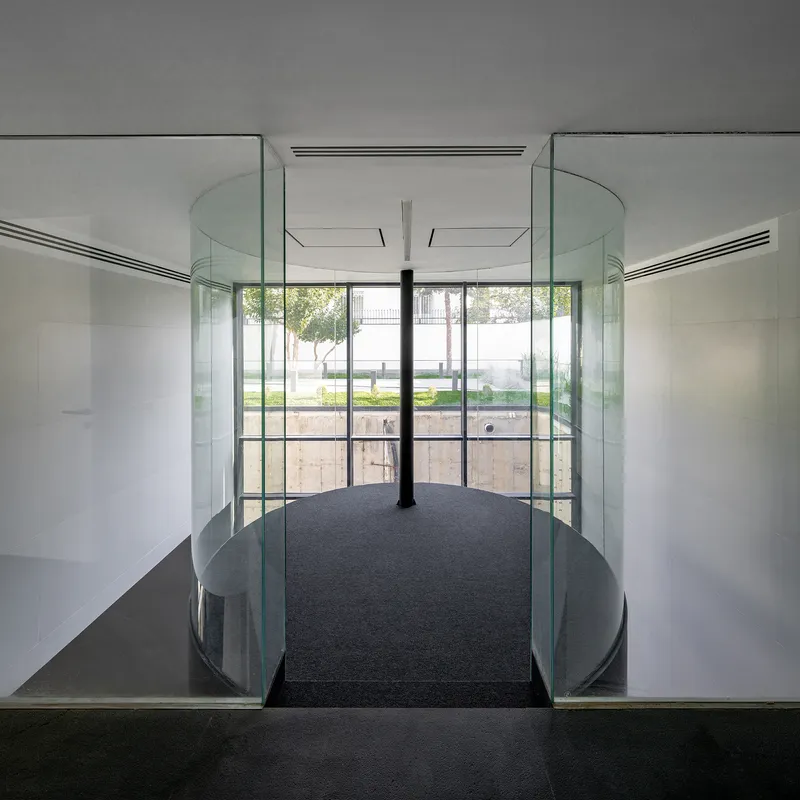
One of the most striking moves is the use of glass floors and transparent bridges to maintain visual continuity across levels. A sectional view through the house reveals the swimming pool at the lowest level, stacked living spaces above, and a central black column that anchors the composition structurally and visually. The glass-walled bridge with its curved railings overlooks a terraced garden courtyard, collapsing the boundary between interior and landscape.
The split-level arrangement means that no two spaces are on exactly the same plane. You ascend and descend through the house in half-flights, and the vertical openings ensure that each level borrows light and air from its neighbors. It is a strategy that makes 910 square meters feel significantly larger, not through sprawl but through interconnection.
Shadow, Surface, and the White Interior
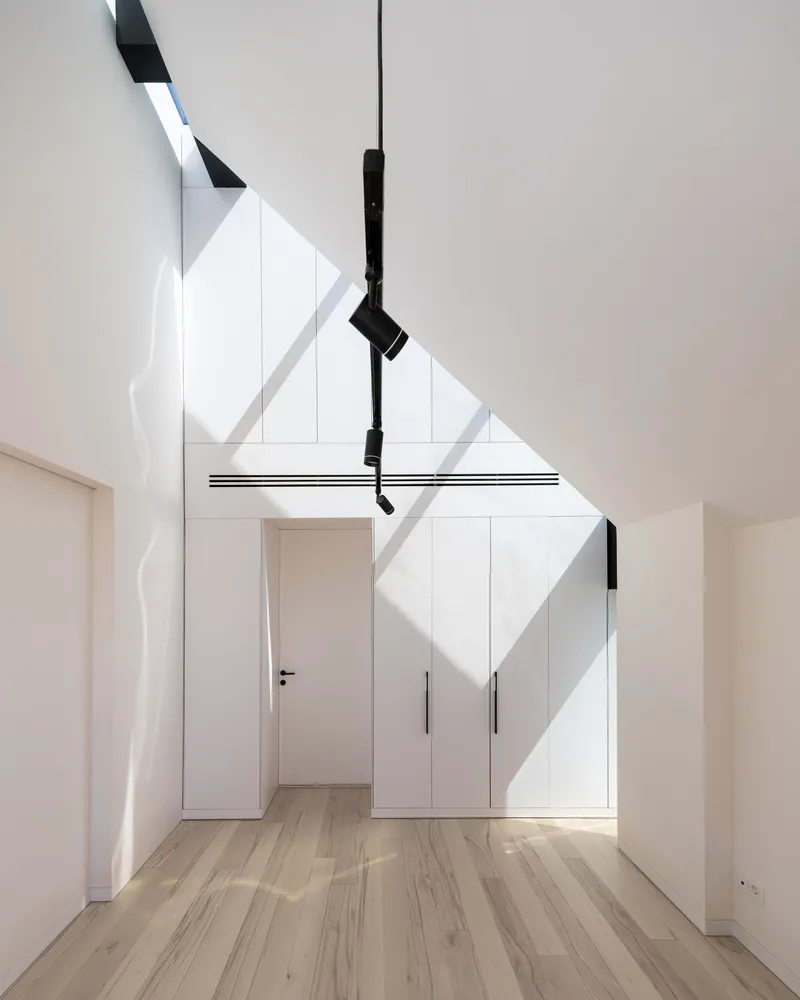
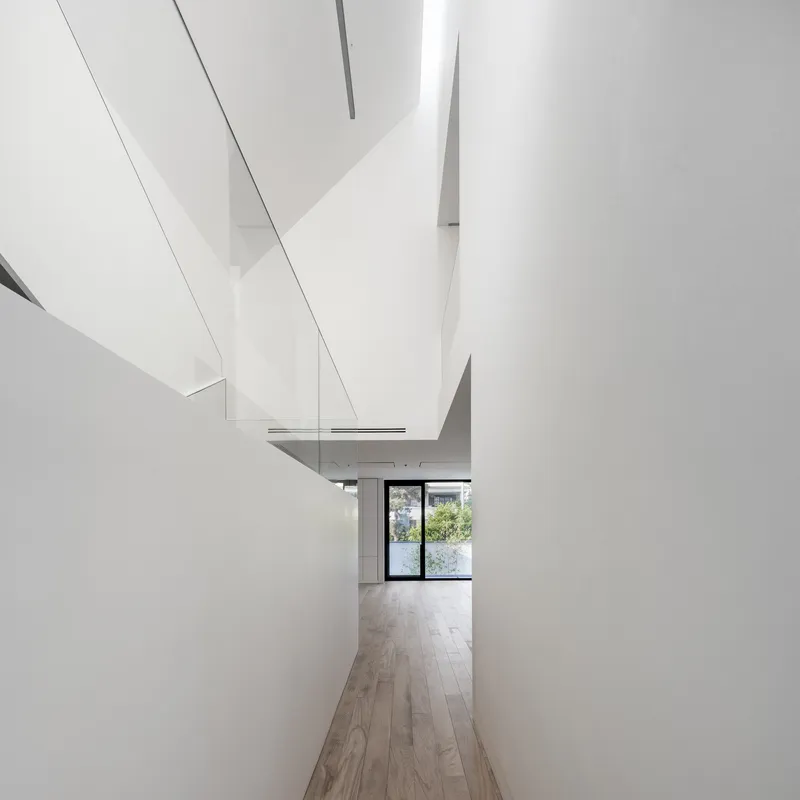
The palette inside is almost monastic: white walls, light wood, black steel. This austerity is not decorative minimalism; it is functional. The white surfaces act as reflectors, bouncing skylight into corridors and storage zones that would otherwise sit in darkness. Under the staircase, a white storage wall catches diagonal shadows cast by overhead skylights, turning a utilitarian surface into an incidental piece of light art.
Corridors with angled walls and overhead skylights lead toward glazed doors that frame garden views, creating a rhythm of compression and release. The architecture is always directing your eye toward light or green, ensuring that even the most enclosed moments in the plan feel connected to something beyond themselves.
Dusk and the Reveal
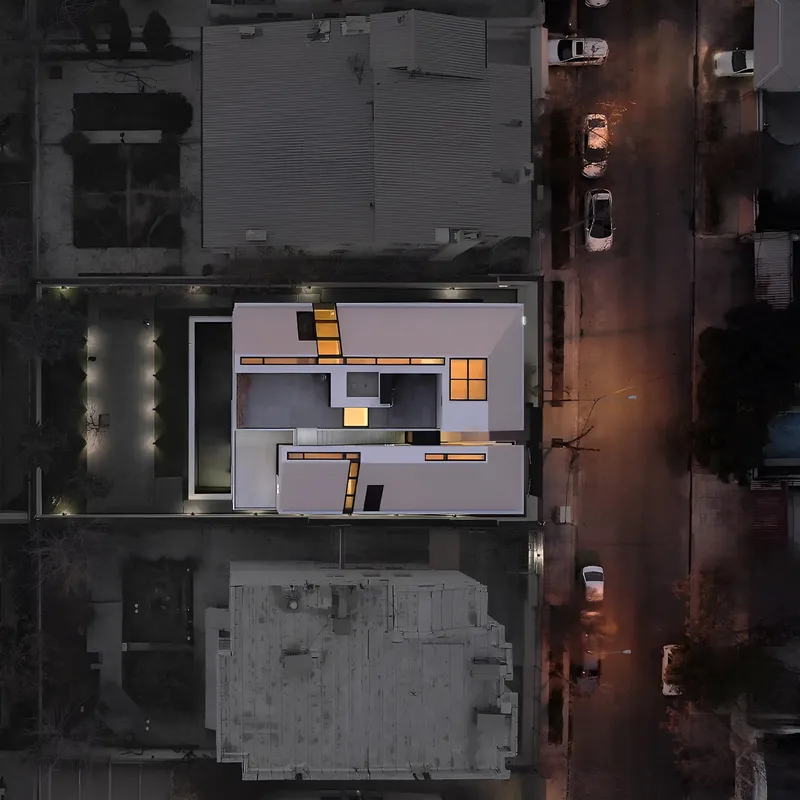
At dusk, the villa's concealed interior life becomes visible. The illuminated roof planes glow against the darkening sky, and the fenestration that appeared so restrained during the day now broadcasts warm light through mature trees. The aerial dusk image is perhaps the most honest representation of the project's dual identity: a building that belongs to its neighborhood in silhouette but operates on entirely different spatial principles within.
Plans and Drawings
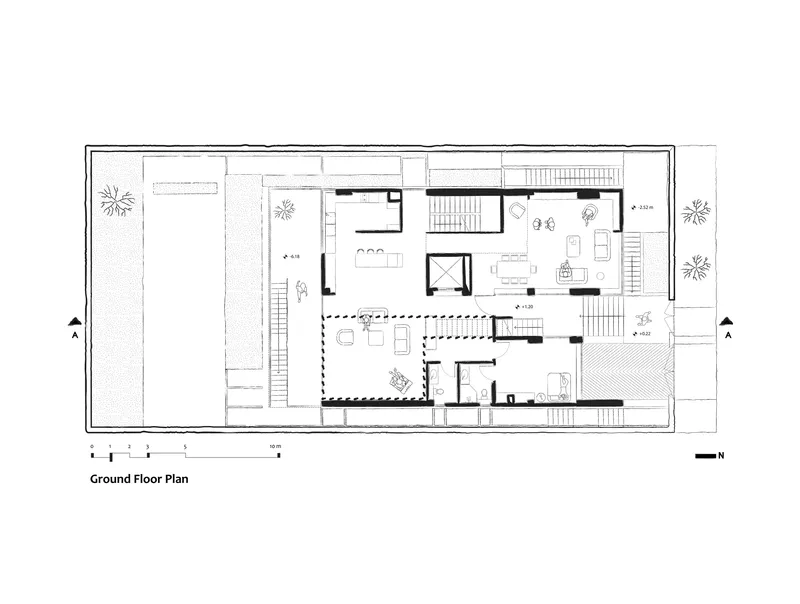
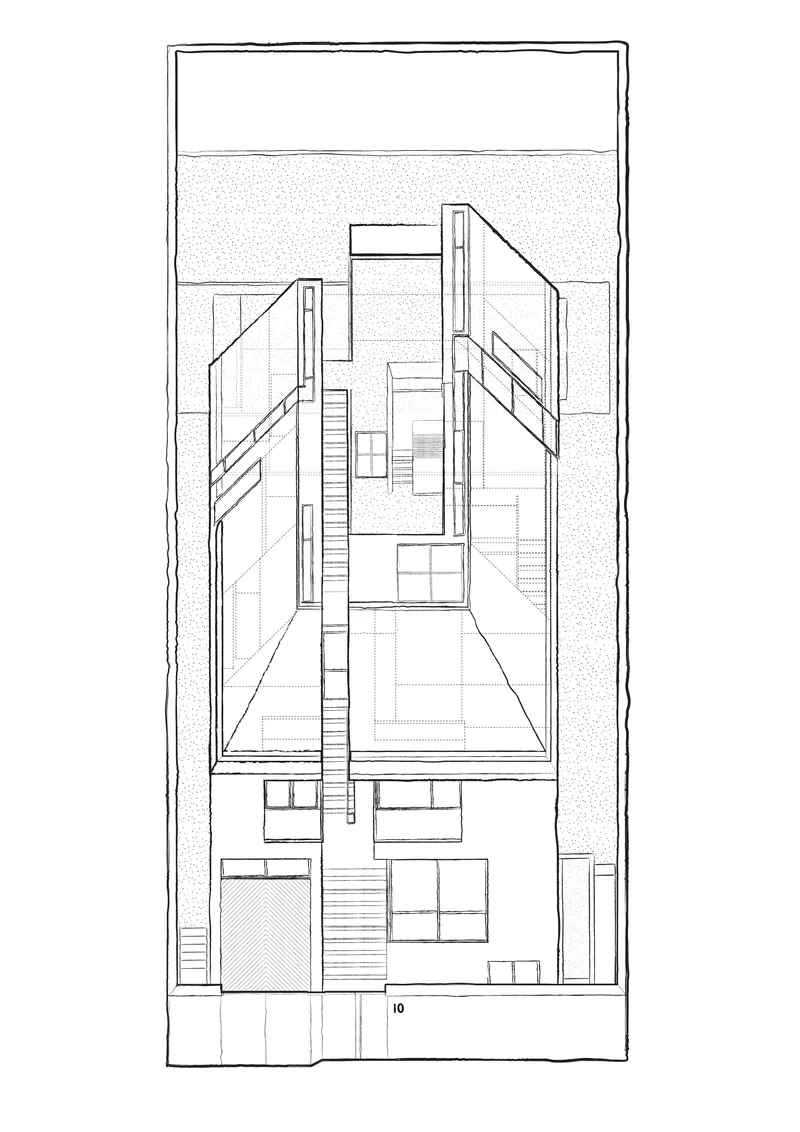
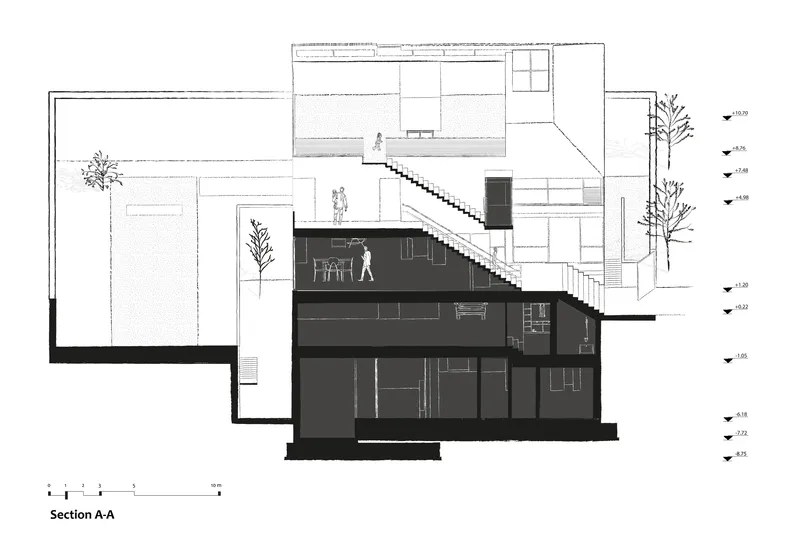
The ground floor plan reveals a strategy of twin residential units organized around central courtyards and staircases, confirming that the villa is not a single-family house in the conventional sense but a compact compound. The section drawings are where the project's logic becomes fully legible: the central void, the split-level arrangement, and the diagonal staircase connecting ground to upper floors all appear as a single, coherent spatial system. The vertical circulation is not layered on top of the plan; it generates the plan.
What the sections make clear is how aggressively the pitched roof has been repurposed. Rather than creating a conventional attic condition, the angled roof planes define the geometry of the skylight shafts, turning structure into light infrastructure. The roof is not a hat on the building; it is the engine of the interior.
Why This Project Matters
The Shahrak Villa matters because it demonstrates that working within a familiar typology is not a limitation but a discipline. Tehran's pitched-roof residential landscape is often treated as an embarrassment by architects eager to distinguish themselves. Taghaboni treats it as raw material, accepting the profile and transforming the interior through sectional invention. The result is a house that respects its context from the outside and reinvents domestic space from the inside.
More broadly, the project offers a model for how architecture can be radical without being conspicuous. The deep light wells, the glass floors, the split-level choreography: none of this is visible from the street. The ambition is spatial, not formal. In a discipline increasingly addicted to the photogenic facade, that is a position worth defending.
Shahrak Villa by Next Office–Alireza Taghaboni, Tehran, Iran. 910 m², completed 2021. Photography by Parham Taghioff.
About the Studio
Share Your Own Work on uni.xyz
If projects like this are the kind of work you want to make, uni.xyz is a place to publish your own, find collaborators, and enter design competitions.



Popular Articles
Popular articles from the community


Co-Life: Senior Housing Design That Reconnects Older Adults With the City
Co-Life reimagines senior housing design through healing gardens, shared streets, workshops, and a sustainable community across generations.

Conexión: Biophilic Design Reimagines High-Rise Living in Hong Kong
Conexión reimagines high-rise living in Hong Kong through biophilic design, green facades, shared spaces, daylight, water and nature within.

The Musturak Paradise: Senior Living Architecture for a Connected Future in Temara, Morocco
The Musturak Paradise reimagines senior living architecture in Temara via private homes, social spaces, culture, community, and shared care.

Play: Fragments of Their World
Familiar architecture becomes modular playground design, creating safe spaces where displaced children can learn, connect, imagine and play.


Similar Reads
You might also enjoy these articles

Bao Huynh Watercolor Atelier: A Serene Art Retreat in Hội An
Bao Huynh Watercolor Atelier in Hội An blends multifunctional art spaces, sustainable design, local materials, and family-friendly living in a serene environment.

Atelier Macri Concept Store Interior Design by CASE-REAL
Atelier Macri store features a "ko" counter, walnut wood details, cork displays, blending retail, gallery, and seamless customer experiences.

Manuel Vargas Izquierdo Stadium and High-Performance Sports Center: Architectural Excellence in Jalpa de Méndez
The Manuel Vargas Izquierdo Stadium blends sustainable design, inclusive sports facilities, and cultural-inspired architecture, revitalizing Jalpa de Méndez’s public spaces.

KAKR Buluh Awar Hall: Revitalizing Community and Ecology Through Bamboo Architecture
Community built bamboo hall revitalizes Buluh Awar village, empowering youth, restoring ecology, celebrating vernacular craftsmanship through sustainable architecture and culture.


Explore Office Building Competitions
Discover active competitions in this discipline



Challenge to design a barrier free sports center


Challenge to design an outdoor ice-rink and park
Comments (0)
Please login or sign up to add comments
No comments yet. Be the first to comment!