
Nguyen Khac Phuoc Architects Carve Light and Air into a Dark Hanoi Row House
A 20-year-old four-storey dwelling on Hoang Hoa Tham street sheds its damp interior for courtyards, arches, and terrazzo.


Row houses in Hanoi age fast. Narrow plots, shared party walls, and relentless humidity conspire to turn interiors into dark, airless corridors within a decade or two. Nhà Ngoc Hà House, a 300 m² four-storey dwelling on Hoang Hoa Tham street near B52 lake, had reached exactly that state: damp rooms, minimal daylight, and a street presence so anonymous you could walk past without registering it. Nguyen Khac Phuoc Architects, led by Nguyen Khac Phuoc and Tran Dan Truong, took on the renovation in 2022 and treated the problem not as a cosmetic refresh but as a surgical reimagining of section and circulation.
What makes the project genuinely interesting is how it weaponizes voids. Rather than maximizing floor area on every level, the architects punched vertical courtyards through the building's core, threading trees, staircases, and rope-net skylights through openings that pull light deep into the plan. Arched doorways soften the transition between rooms and gardens, giving a narrow tube house the spatial generosity of something twice its width. The result is a home that breathes, both literally and experientially.
A Street Presence Worth Noticing
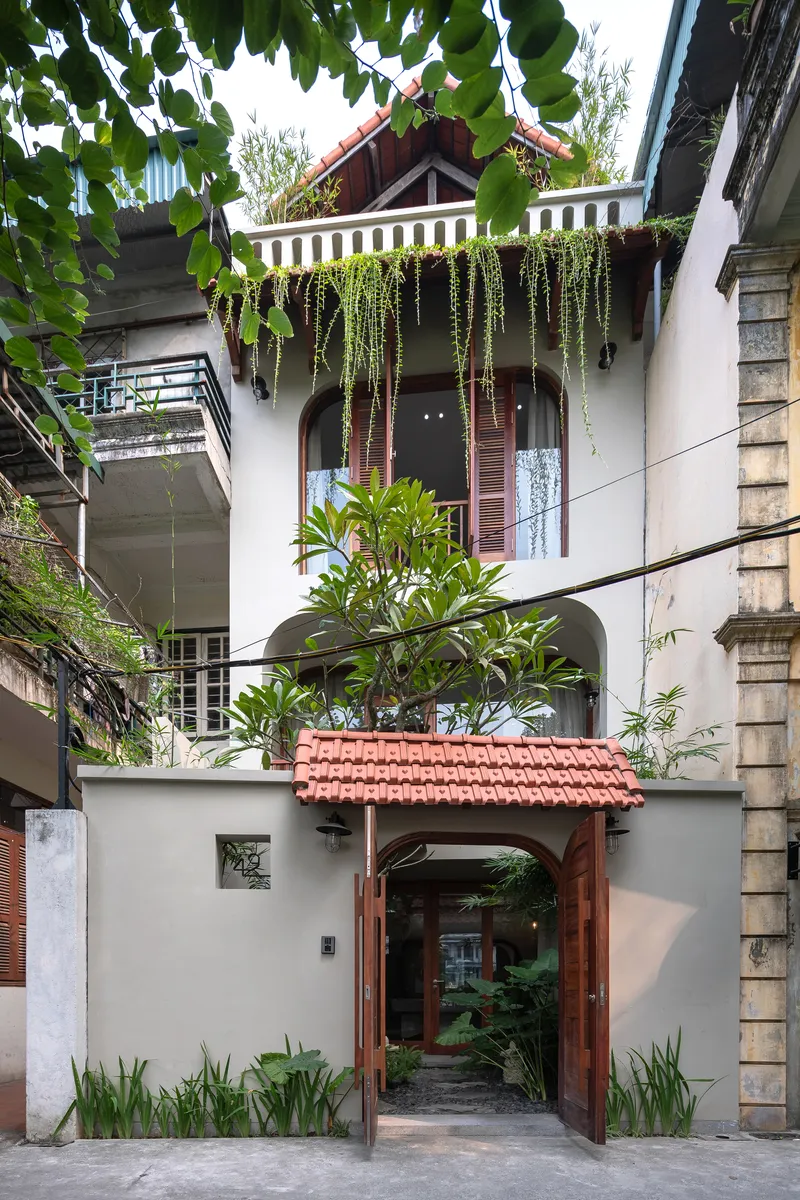
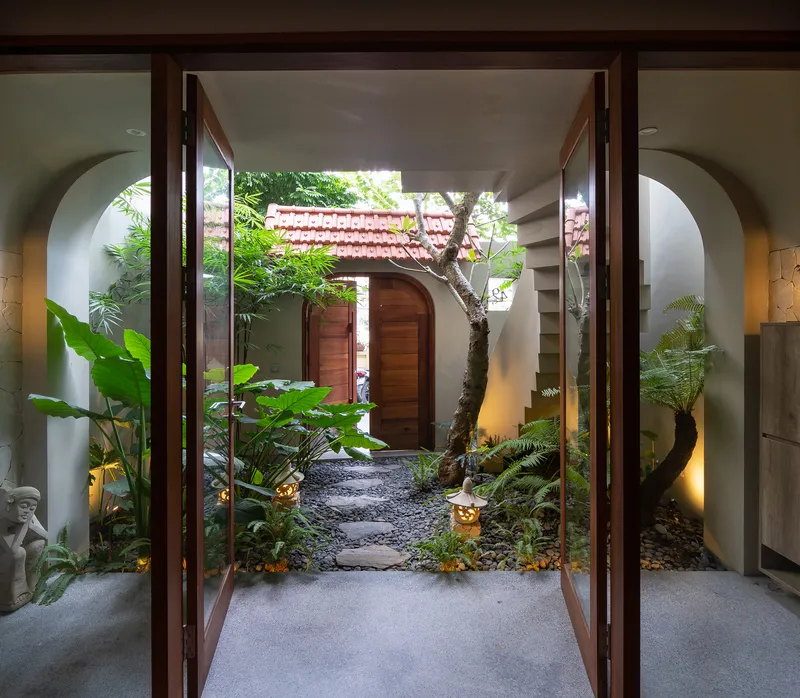
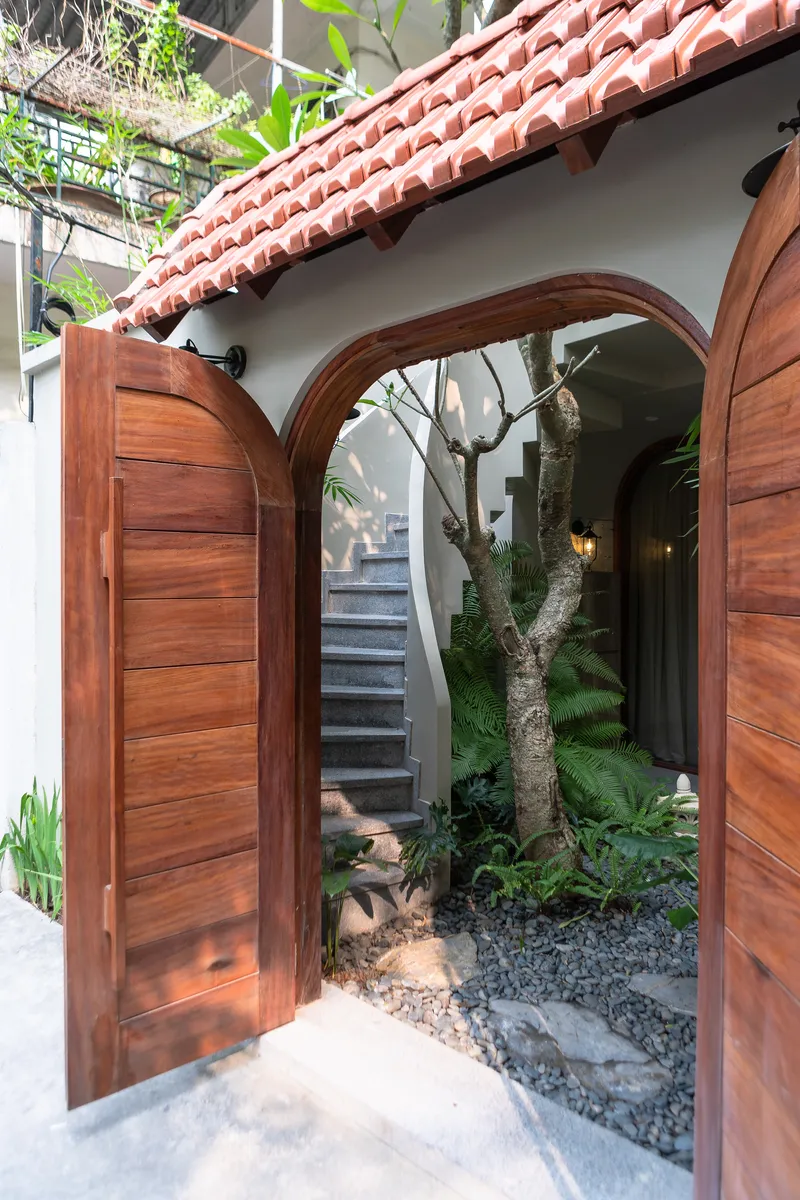
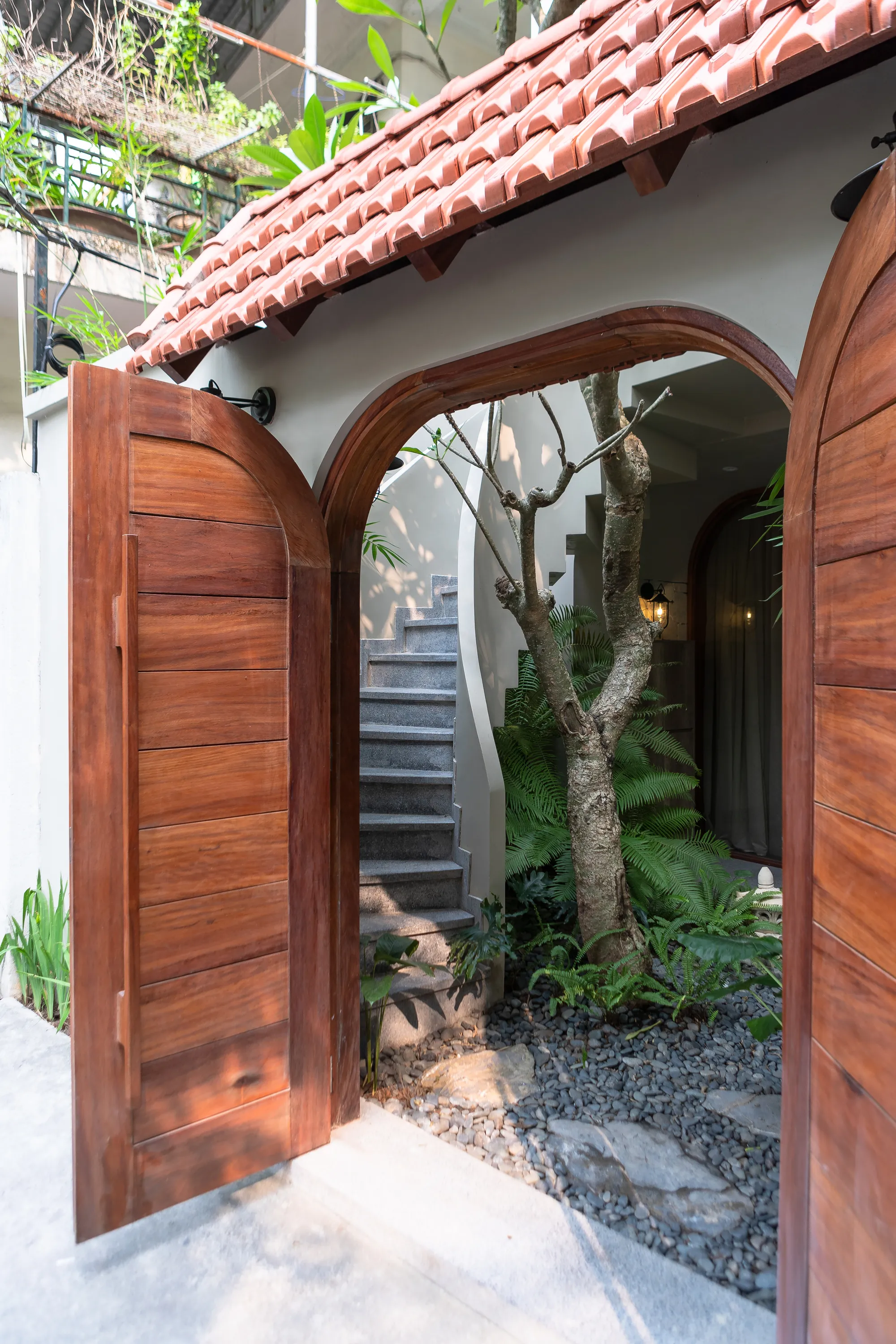
The original facade was forgettable. The renovation replaces it with a timber-framed entry gate capped by a terracotta tile roof, immediately signaling that something different happens behind the threshold. Cascading plants spill from upper balconies, softening the hard edge between house and street. The entrance sequence is deliberately slow: you pass through arched white walls and a terrazzo-floored courtyard before reaching any interior room, a compression-and-release strategy that makes the first interior space feel expansive by contrast.
Terracotta tile and timber framing root the facade in Hanoi's vernacular without resorting to pastiche. The arched openings recur at every scale, from the large courtyard portal down to bedroom doorways, giving the house a formal coherence that reads clearly even from the sidewalk.
Courtyards as Vertical Infrastructure
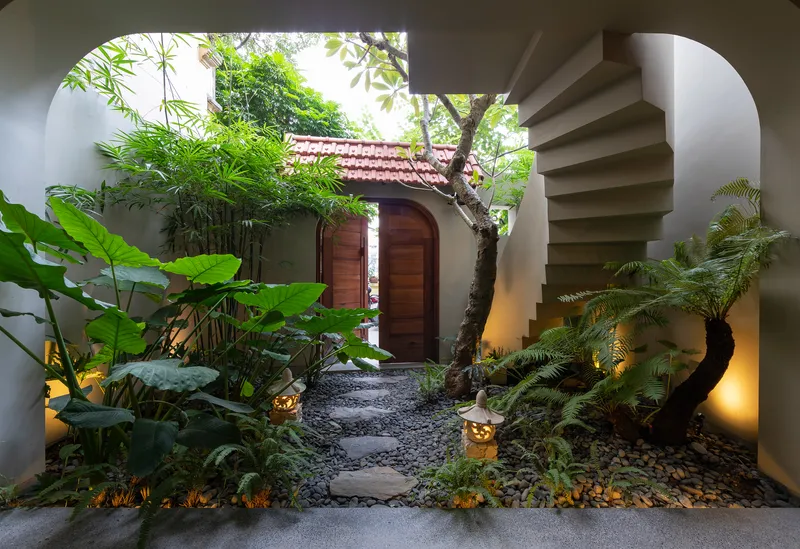
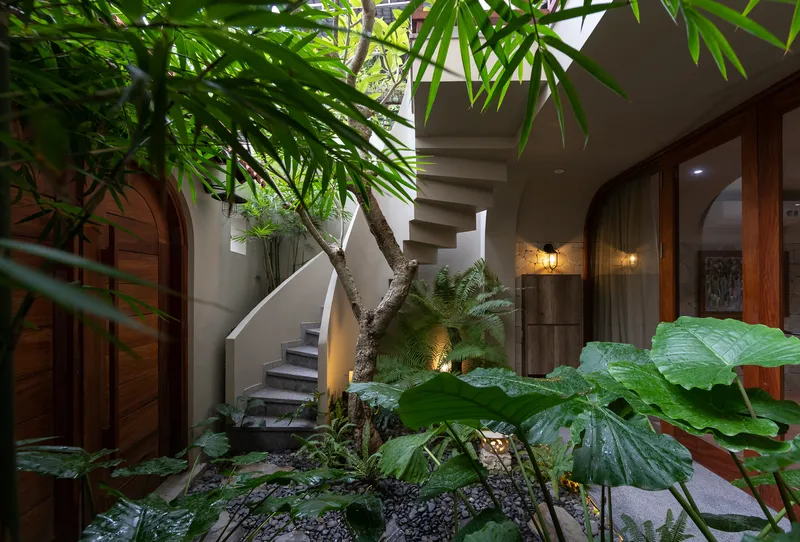
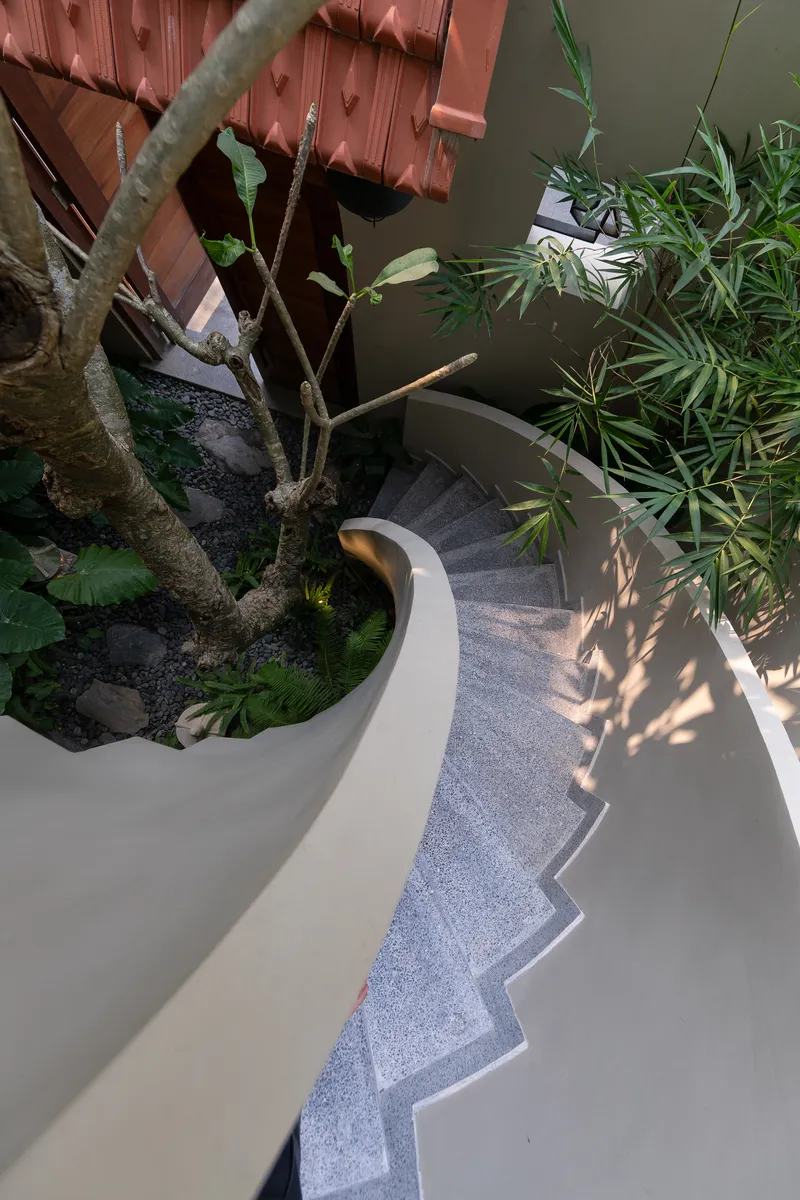
The courtyards do serious environmental work. In a humid tropical climate, carving open wells through multiple storeys creates a stack effect that pulls warm air up and draws cooler air in at ground level. But the architects treat these voids as inhabited space, not just shafts. Stepping stones wind through fern beds at ground level. A slender tree rises beside a cantilevered staircase. Dappled sunlight filters through planting and rope nets above, reaching a curved terrazzo stair that spirals around the void.
Seen from above, the central courtyard reads as a vertical garden with the staircase wrapped around it like a vine. It collapses the distinction between circulation and landscape: you are always walking through greenery, never simply past it. For a 300 m² house on a tight urban lot, this is a generous allocation of unbuilt space, and it pays dividends on every floor.
Living Spaces That Layer Material and Light
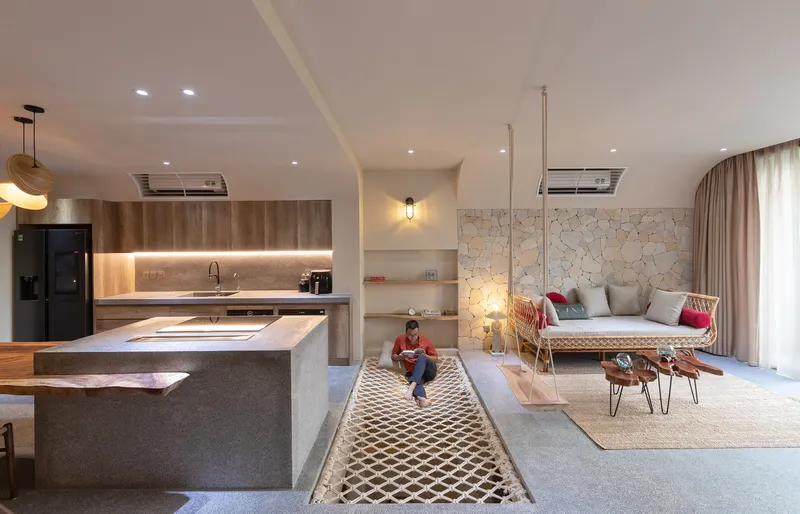
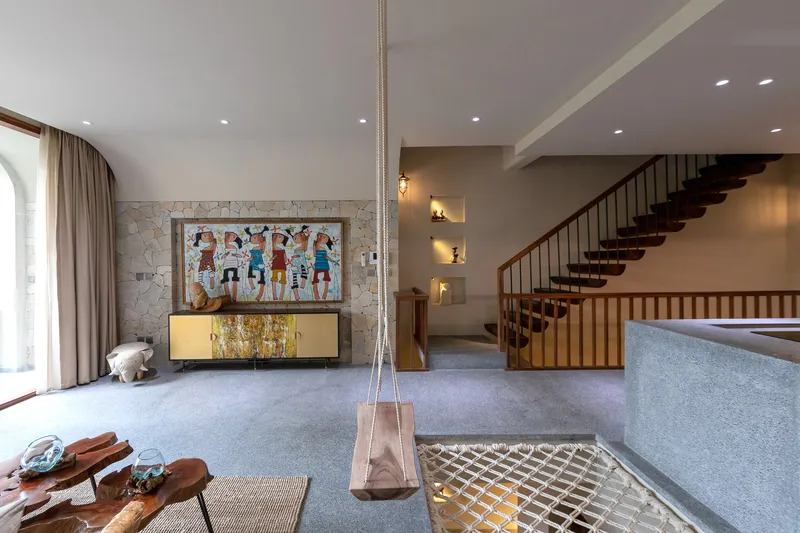
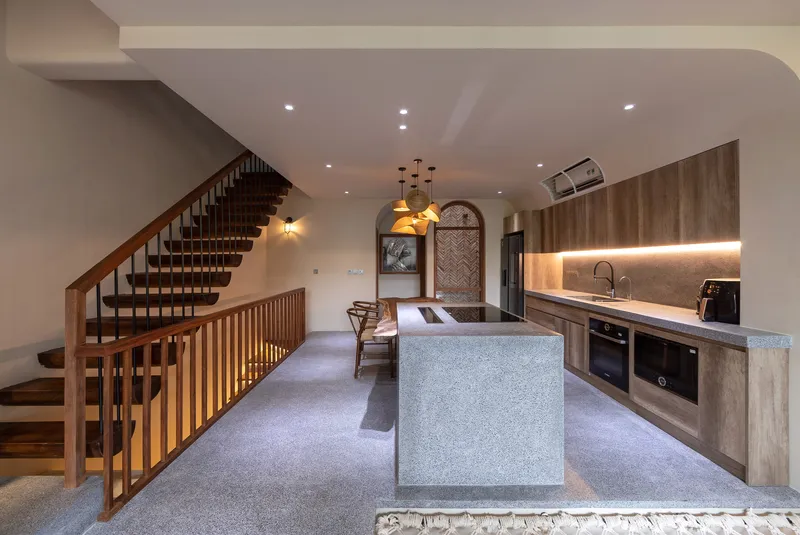
The main living level occupies the second floor, organized around a double-height volume with a timber staircase, a terrazzo kitchen island, and a glass floor panel that reveals the level below. The spatial trick here is continuity: the kitchen, dining, and lounge areas flow into one another without partition walls, defined instead by material shifts. Terrazzo surfaces mark the kitchen zone. Irregular stone walls anchor the seating area. Timber slat balustrades at the stair edge keep sightlines open while providing tactile warmth.
A patterned stone accent wall behind the living area adds texture without competing with the natural light pouring in from the courtyard. The material palette, concrete, brick, terrazzo, timber, stays deliberately restrained, letting each surface age and patinate in the Hanoi climate rather than fighting it.
Dining Under Sculptural Light
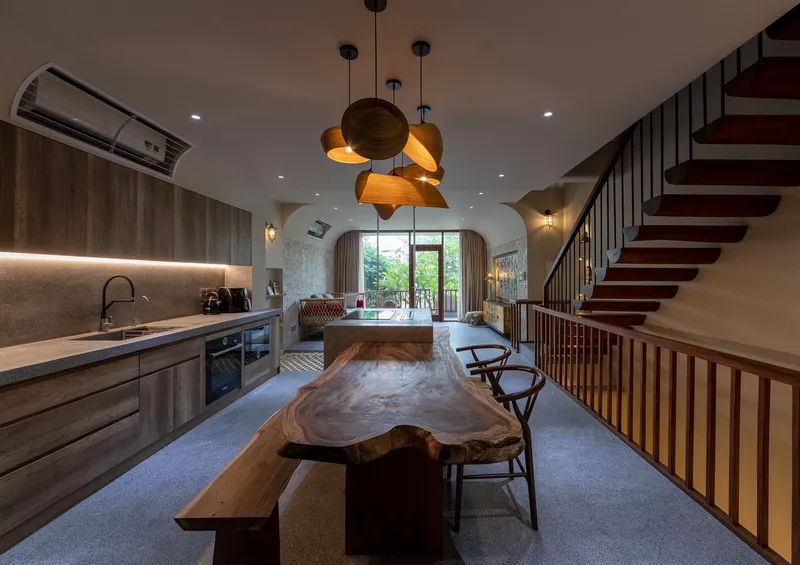
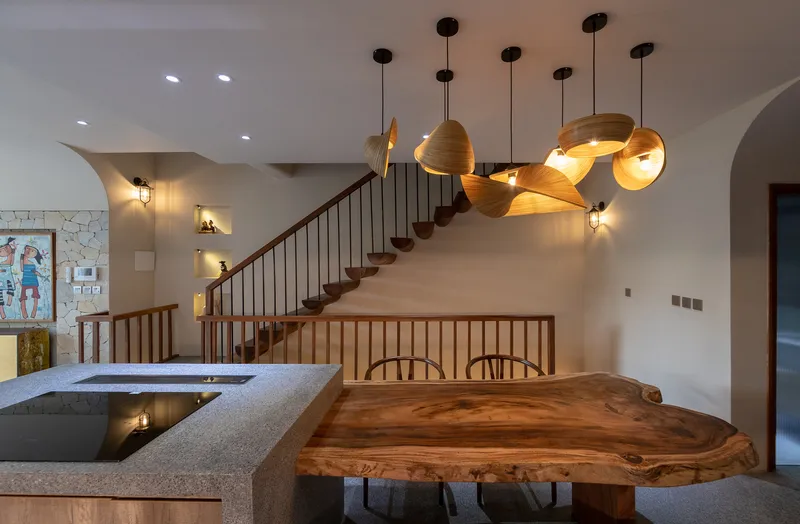
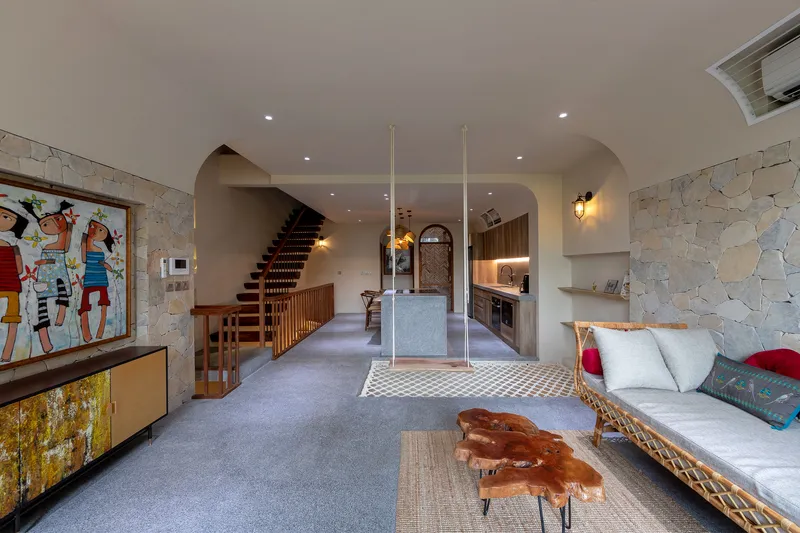
The dining area earns its own moment through a single detail: a cluster of laminated wood pendant lights suspended above a live-edge timber table. The fixtures are sculptural without being precious, their layered profile echoing the terrazzo counter beside them. Views to courtyard greenery frame the table on one side, while an irregular stone wall and a rope hammock define the adjacent lounge. It is a domestic interior that feels relaxed and crafted in equal measure.
Rope Nets, Arches, and the Game Room
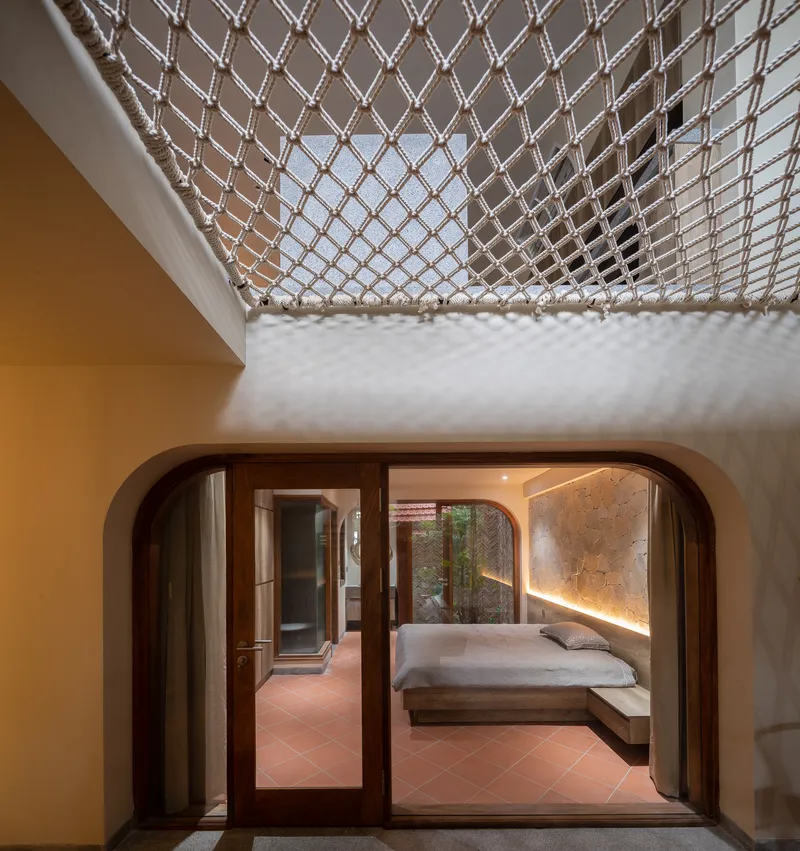
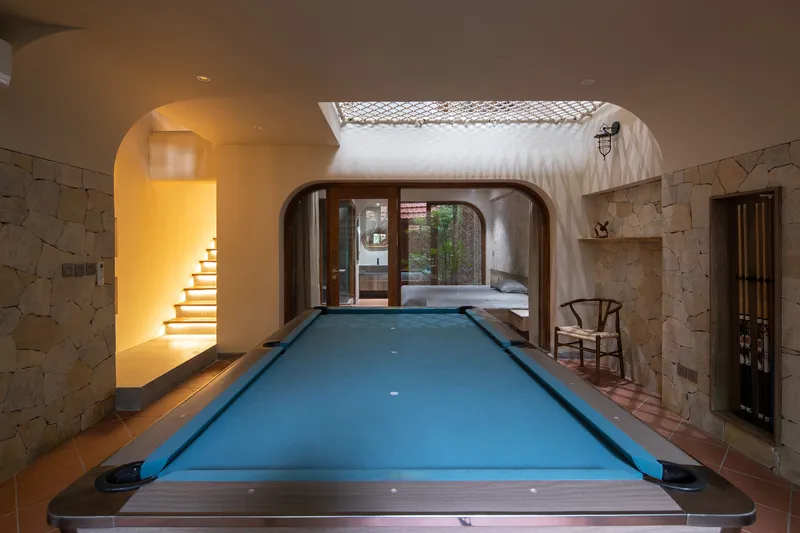
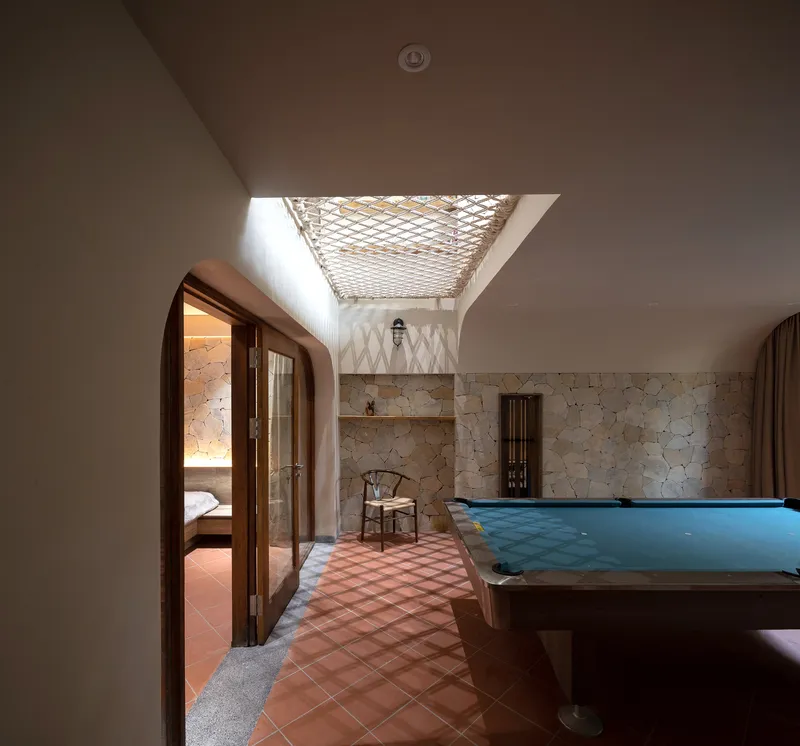
One of the project's most distinctive moves is the use of rope nets as horizontal skylights. Stretched across courtyard openings at upper levels, they filter daylight into corridors and the game room below while functioning as safety nets for the voids. The effect is a dappled, almost aquatic quality of light that shifts throughout the day. Beneath one of these nets sits a billiard table, framed by an arched opening to a bedroom on one side and a planted courtyard visible through glazing on the other.
The arched openings recur here as a spatial device that softens thresholds. Rounded timber doorways connect the game room to adjacent bedrooms, eliminating the hard corners that make narrow houses feel claustrophobic. Combined with the terracotta tile flooring in the corridor, the atmosphere reads less like a typical Hanoi tube house and more like a Mediterranean courtyard dwelling transplanted to Southeast Asia.
Private Rooms and Considered Details
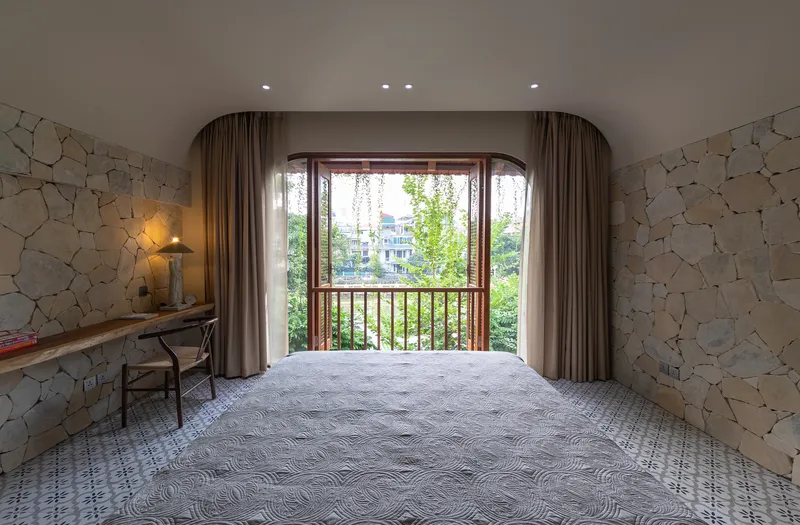
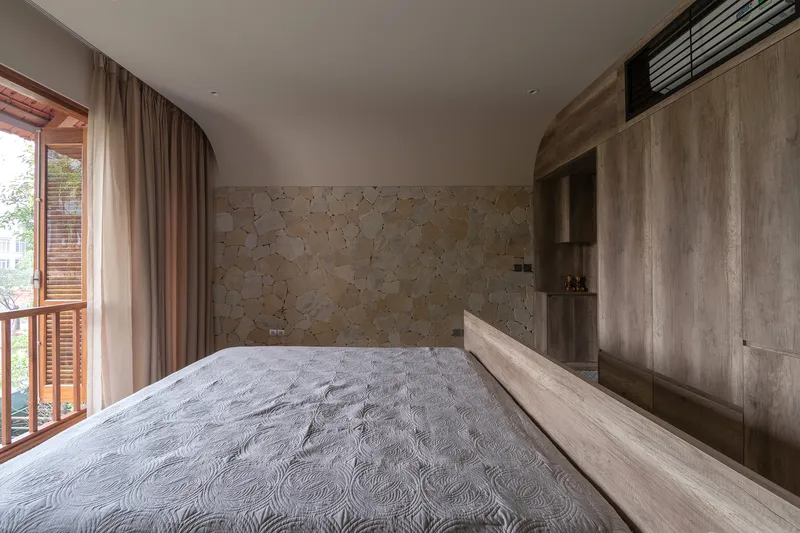
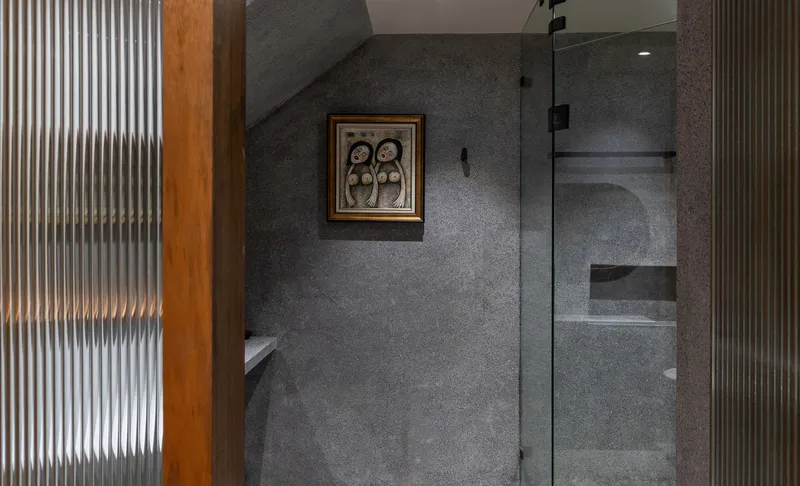
The bedrooms maintain the material language established below: patterned stone walls, timber balcony doors with operable louvers, and arched curtain recesses that frame sleeping areas. Every room opens to either a balcony or a courtyard view, ensuring that even the most enclosed spaces benefit from the ventilation strategy running through the building's core. The bathroom, with its fluted glass partition and recessed shower niche in grey terrazzo, is restrained and tactile.
Louvered doors do double duty as privacy screens and passive ventilation devices. When open, they connect bedrooms directly to planted terraces. When closed, airflow continues through the slats. It is a low-tech solution perfectly suited to Hanoi's hot, humid summers.
Stone, Timber, and Threshold
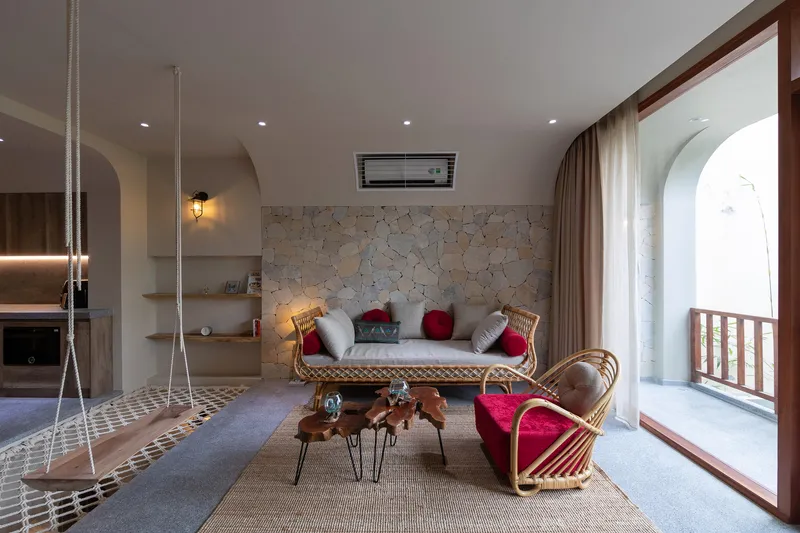
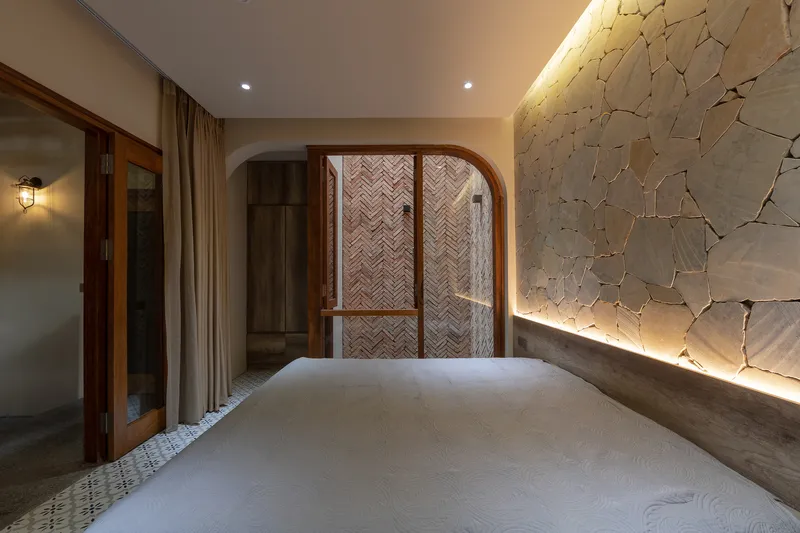
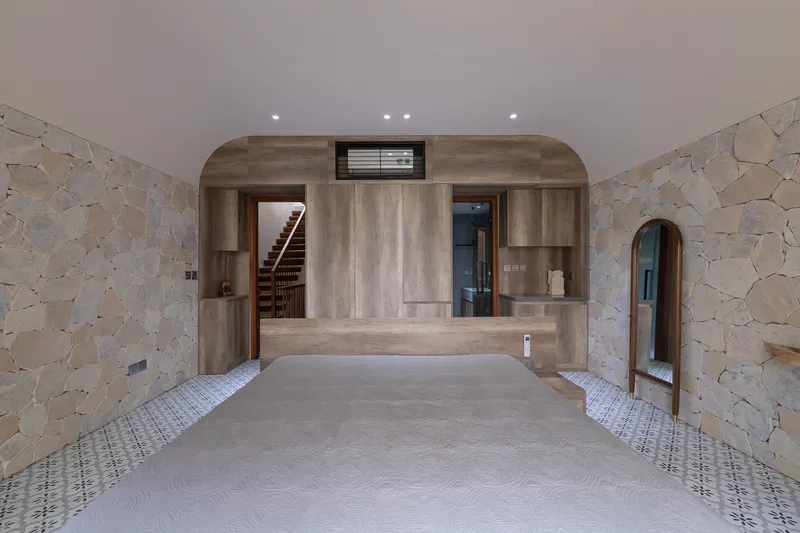
The renovation leverages a limited palette to maximum effect. Irregular stone walls appear at key moments, always flanking transitions: beside staircases, behind seating alcoves, framing the central elevator and stair core. An arched timber doorway with herringbone brick infill faces a backlit stone feature wall in one corridor, creating a sequence of textures that reward slow movement through the house. These are not decorative choices. They define spatial hierarchy, marking where you pause and where you pass through.
Plans and Drawings
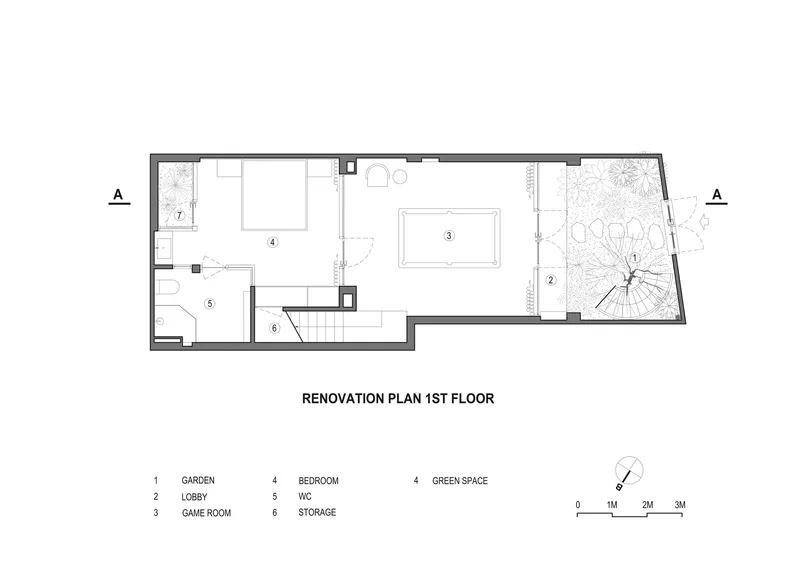
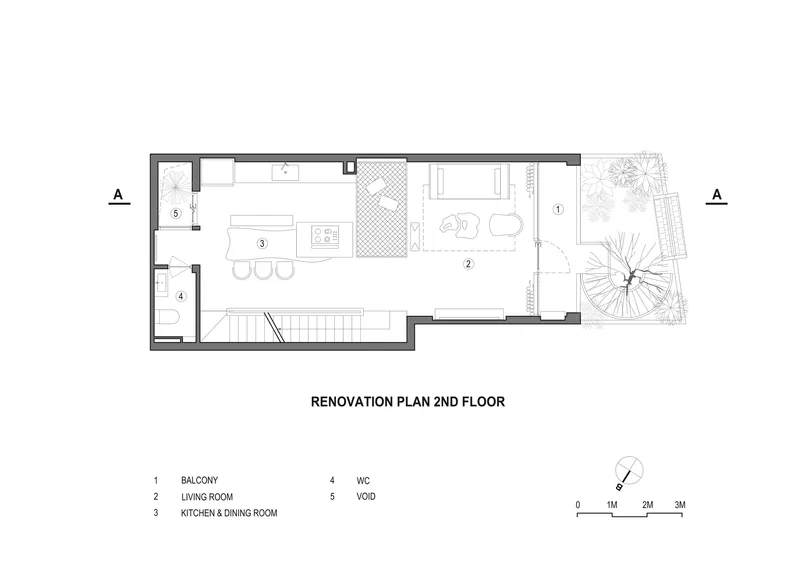
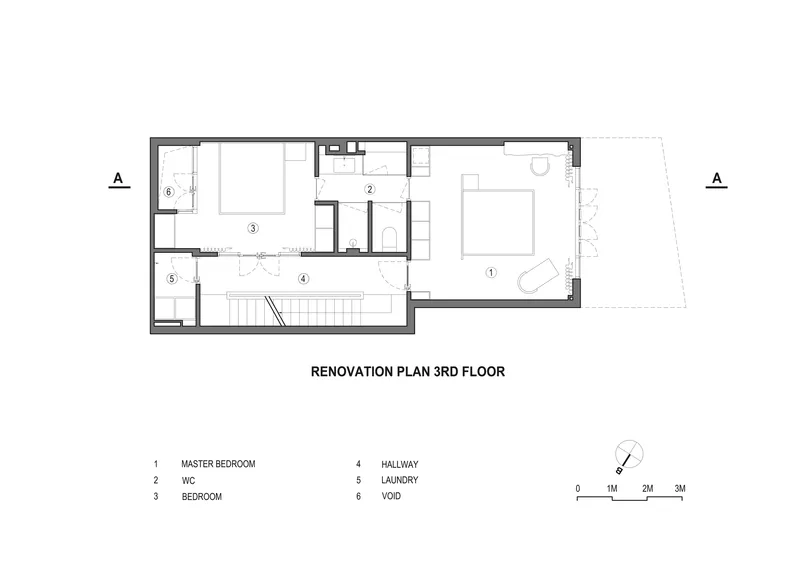
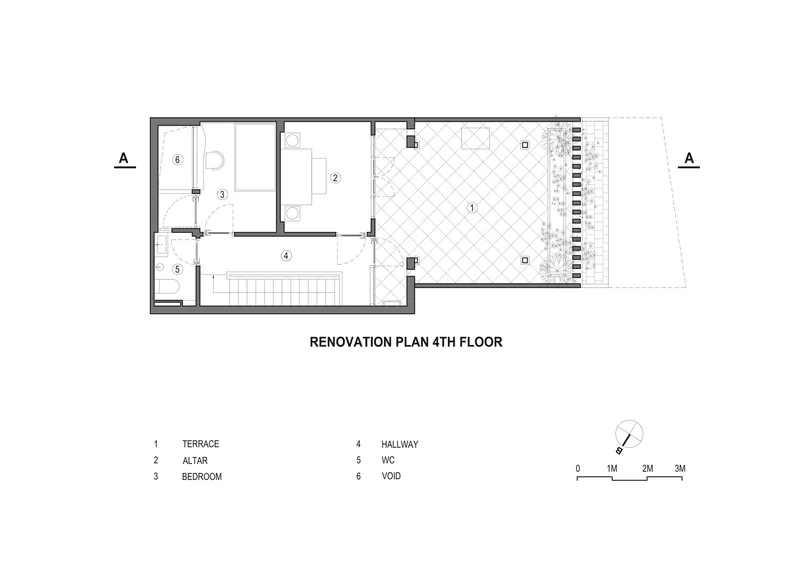
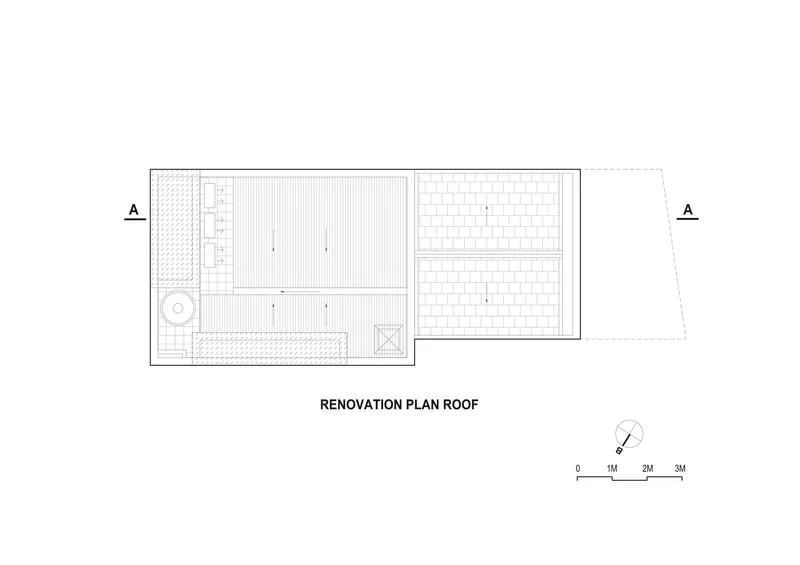
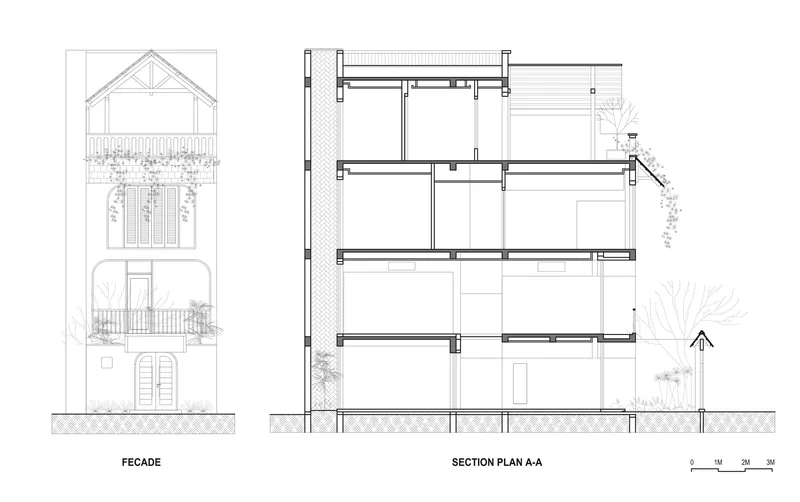
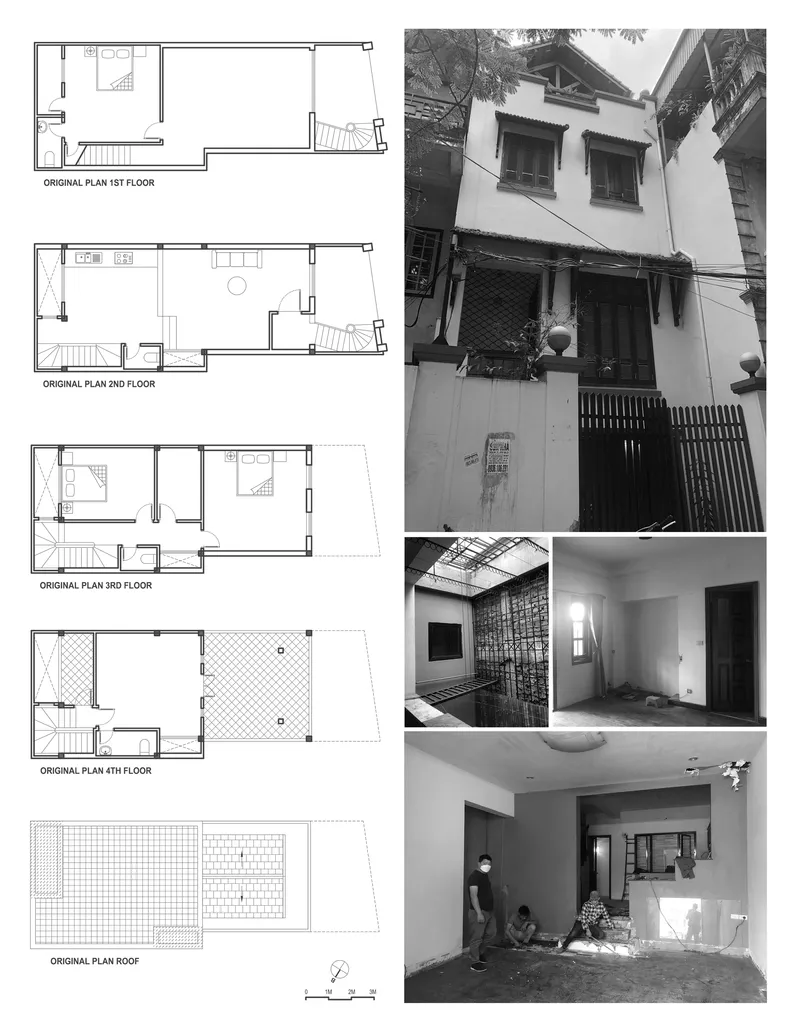
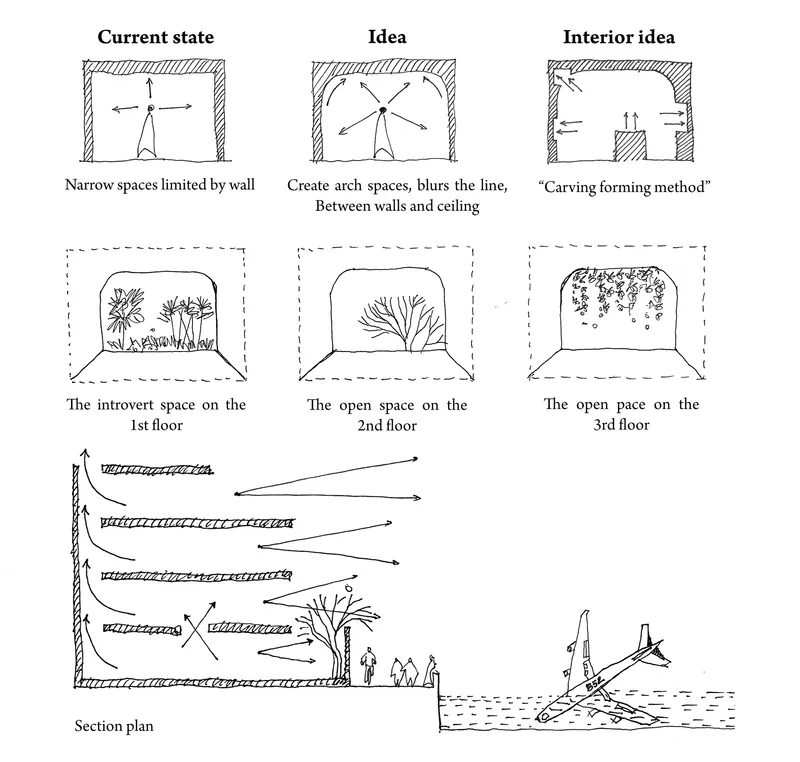
The floor plans reveal the logic behind the experience. The interior garden and spiral stair sit at the core of the first floor, with the game room and a bedroom wrapping around them. On the second floor, the open living room and kitchen-dining area occupy the full width, connected to a balcony overlooking the street. The master suite fills the third floor; the fourth floor adds a final bedroom and a terrace with diagonal paving. The section drawing makes explicit how the planted terraces step back at each level, creating a cascade of green that draws daylight progressively deeper into the plan.
The arched spatial diagrams in the conceptual drawings show how the architects thought about section as a design tool, not just a documentation convention. Voids, arches, and planting are treated as a single system, each one enabling the others. It is a compact thesis on how to renovate a tropical row house without surrendering floor area to pure pragmatism.
Why This Project Matters
Hanoi has tens of thousands of narrow tube houses, most built speculatively over the past three decades, and most suffering from the same problems: poor ventilation, minimal natural light, and street facades that blur into anonymity. Nhà Ngoc Hà House demonstrates that renovation can fundamentally alter a building's relationship with air and daylight without demolishing and rebuilding. The key insight is that subtracting floor area, carving courtyards, punching skylights, opening voids, often produces a more livable house than adding more rooms.
Nguyen Khac Phuoc Architects have produced a renovation that is specific to its climate, its site near B52 lake, and its urban context on Hoang Hoa Tham street. The arched vocabulary, terrazzo surfaces, and rope-net skylights give the house a distinct identity without resorting to spectacle. In a city where the default response to an aging house is to tear it down and start over, this project argues persuasively for the slower, more surgical alternative.
Nhà Ngoc Hà House by Nguyen Khac Phuoc Architects (lead architects: Nguyen Khac Phuoc and Tran Dan Truong). Ngọc Hà, Hanoi, Vietnam. 300 m². Completed 2022. Photography by Trieu Chien.
About the Studio
Share Your Own Work on uni.xyz
If projects like this are the kind of work you want to make, uni.xyz is a place to publish your own, find collaborators, and enter design competitions.




Popular Articles
Popular articles from the community


Co-Life: Senior Housing Design That Reconnects Older Adults With the City
Co-Life reimagines senior housing design through healing gardens, shared streets, workshops, and a sustainable community across generations.

Hill & Cross Opera: Sculptural Opera House Architecture Shaped by Tallinn’s Landscape and Identity
Hill & Cross Opera reimagines opera house architecture in Tallinn through its sculptural hill, civic plaza, glass wave and a luminous cross.

Lunar Spiral: Space Architecture Shaped by the Mathematics of the Universe
Lunar Spiral reimagines space architecture through Fibonacci geometry, lunar regolith, levitating habitats, and self-sustaining Moon living.

Riyadh For All: Intergenerational Urban Design for Active Aging in Rabat
Riyadh For All reimagines urban design in Rabat with intergenerational co-living, adaptive courtyards, and Moroccan cultural exchange today.


Similar Reads
You might also enjoy these articles

Bao Huynh Watercolor Atelier: A Serene Art Retreat in Hội An
Bao Huynh Watercolor Atelier in Hội An blends multifunctional art spaces, sustainable design, local materials, and family-friendly living in a serene environment.

Atelier Macri Concept Store Interior Design by CASE-REAL
Atelier Macri store features a "ko" counter, walnut wood details, cork displays, blending retail, gallery, and seamless customer experiences.

Manuel Vargas Izquierdo Stadium and High-Performance Sports Center: Architectural Excellence in Jalpa de Méndez
The Manuel Vargas Izquierdo Stadium blends sustainable design, inclusive sports facilities, and cultural-inspired architecture, revitalizing Jalpa de Méndez’s public spaces.

KAKR Buluh Awar Hall: Revitalizing Community and Ecology Through Bamboo Architecture
Community built bamboo hall revitalizes Buluh Awar village, empowering youth, restoring ecology, celebrating vernacular craftsmanship through sustainable architecture and culture.


Explore Residential Building Competitions
Discover active competitions in this discipline


Challenge to design mud housing for contemporary communities


Challenge to design luxury tourism on rails


VR headsets Storefront design competition


Designing a staircase for a client
Comments (0)
Please login or sign up to add comments
No comments yet. Be the first to comment!