
Nikken Sekkei Builds a 560,000 m² Innovation Hub for Subaru around a Giant Social Atrium
A new R&D campus in Ota, Japan, dissolves corporate silos by organizing engineering and office floors around open, interconnected voids.


The automobile industry runs on compartmentalization. Engineering, production, marketing, and management each occupy their own orbit, often in separate buildings or on separate floors that rarely share a corridor, let alone a conversation. The SUBARU Innovation Hub, designed by Nikken Sekkei at the automaker's main plant in Ota, Japan, is a deliberate attempt to break that pattern. At over 560,000 square meters, it is a massive facility, but its organizing principle is almost domestic in its ambition: get people into the same room.
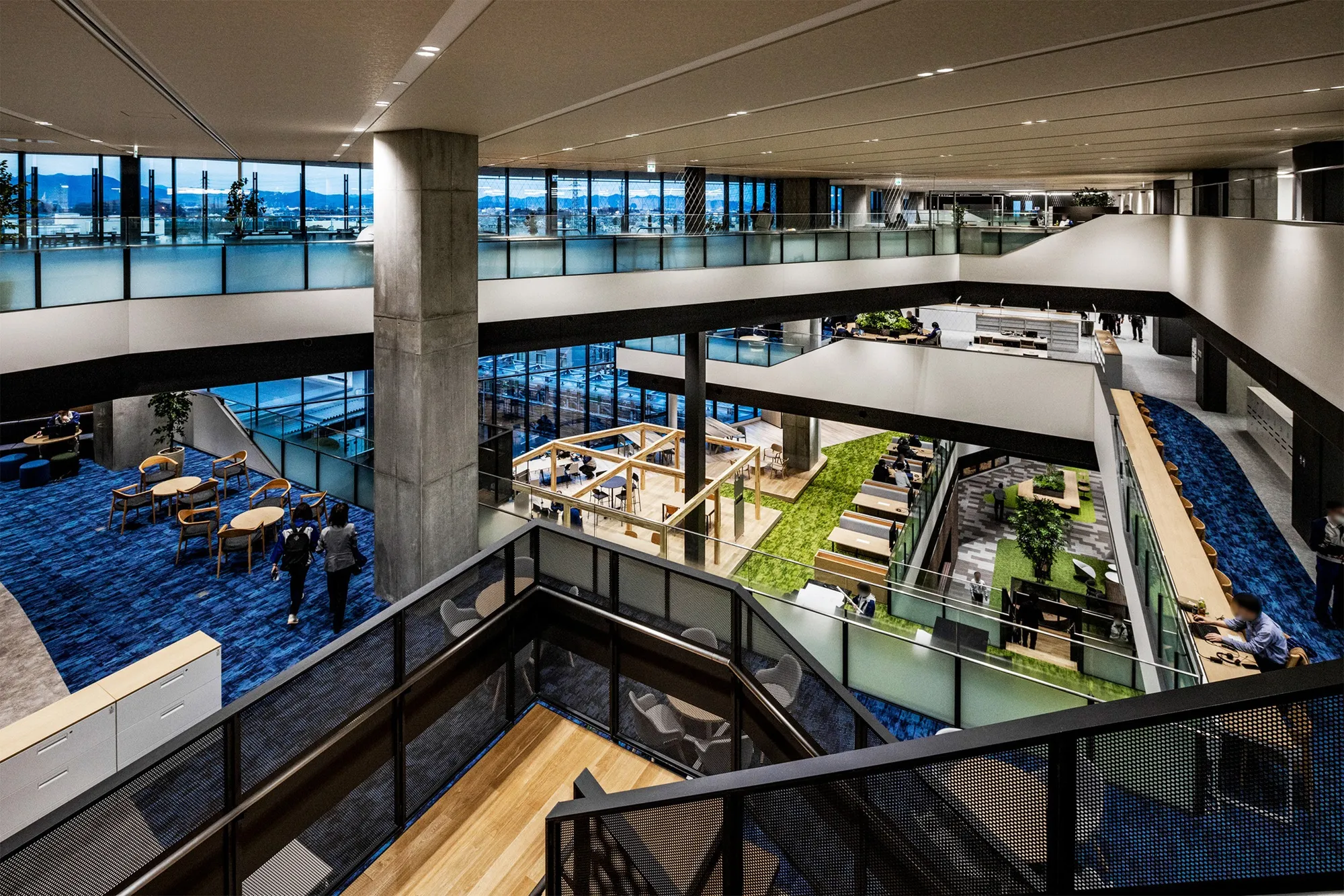
The concept revolves around what SUBARU calls "Obeya" activities, a term borrowed from Toyota's collaborative war-room methodology and scaled to the level of architecture. Rather than confining cross-functional dialogue to a conference room, Nikken Sekkei has built it into the building's section. A multi-story atrium punctures the horizontal floor plates, creating a continuous vertical space where engineers, designers, and managers can see each other, pass each other on interconnected staircases, and sit together at shared tables. It is a corporate campus that has internalized its own org chart and turned it inside out.
Horizontal Volumes in an Industrial Landscape
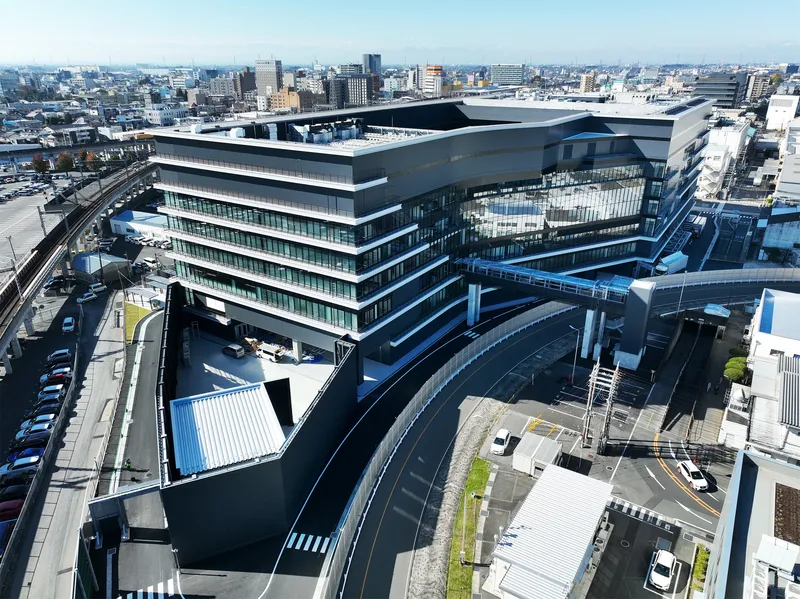
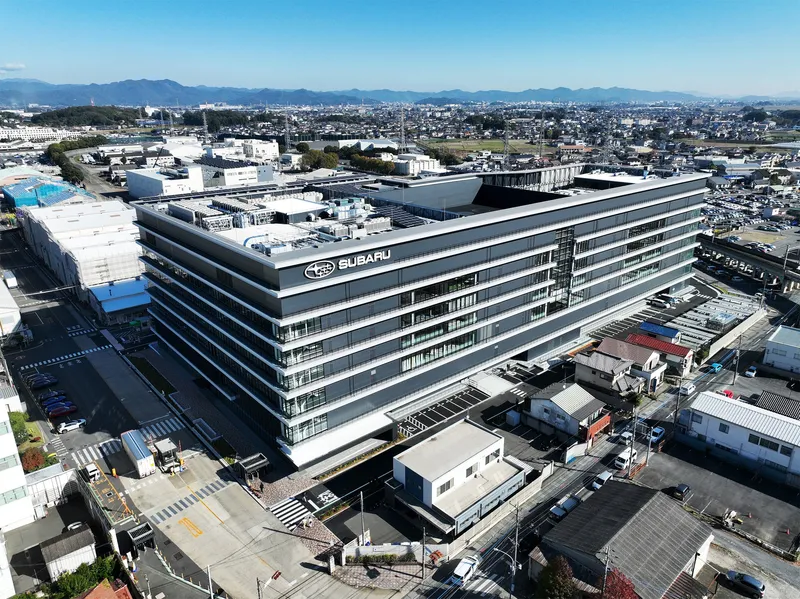
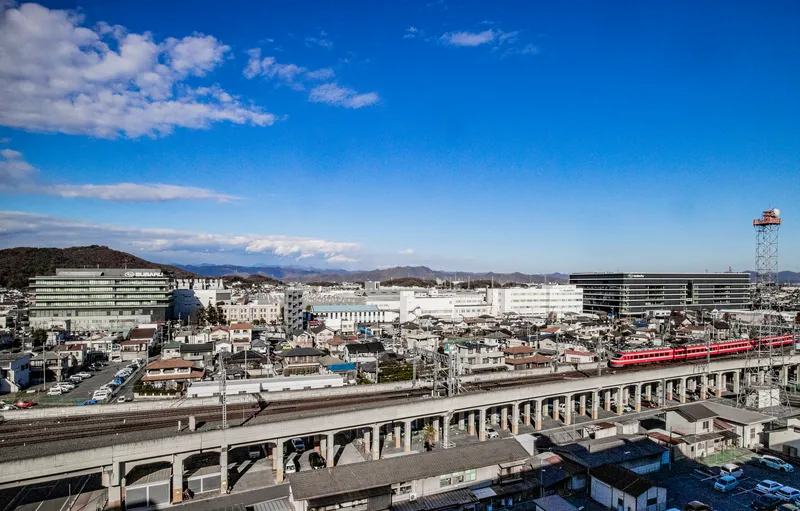
Seen from above, the Innovation Hub reads as a series of stacked horizontal bands set among the low-rise industrial sheds and residential rooftops of Ota. The building's mass is restrained despite its enormous program. Nikken Sekkei layered the floor plates with ribbon windows and opaque panels that give the elevations a calm, almost geological horizontality. An elevated steel bridge spans the access road, stitching the facility into the broader plant campus without disrupting ground-level logistics.
Against the backdrop of distant mountains and rail lines, the building asserts itself through proportion rather than spectacle. It is long, flat, and unapologetically functional, which is exactly what you want from a research facility that will house thousands of workers across disciplines. The decision to keep the profile low is smart: it reduces the sense of corporate imposition on a town whose identity is already deeply tied to the SUBARU factory.
The Facade as Climate Filter
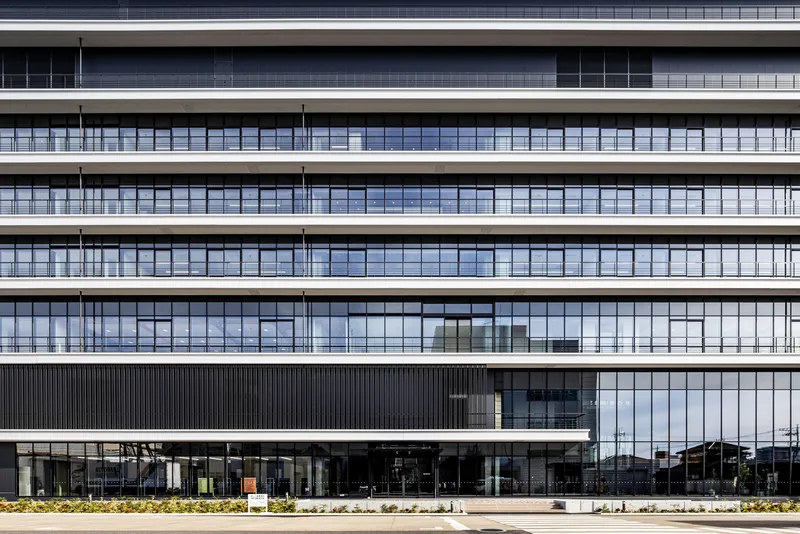
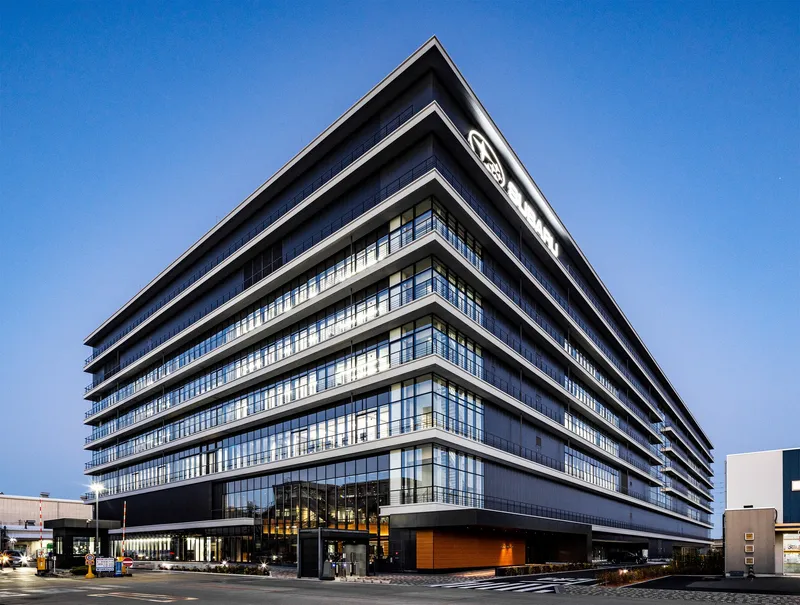
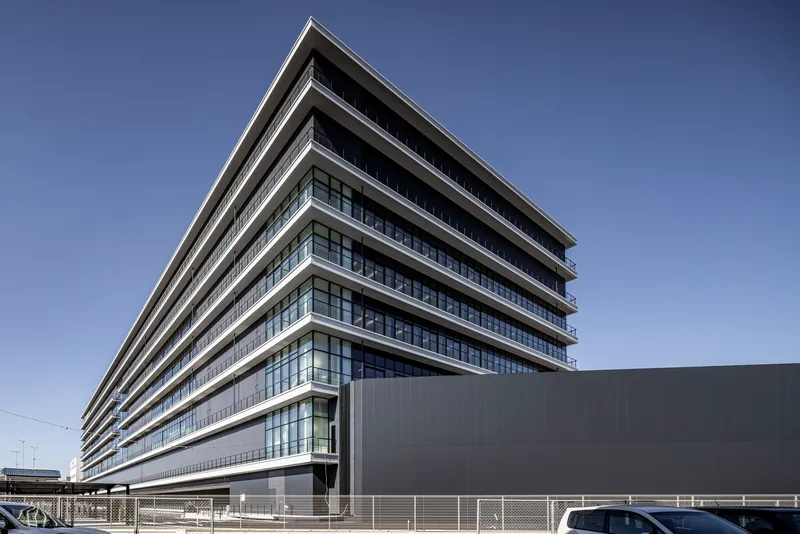
The elevations alternate between bands of glazing and solid cladding, creating a rhythmic pattern that serves double duty. The continuous horizontal glazing floods the office floors with daylight while slender vertical mullions provide solar control without resorting to heavy shading devices. On the lower levels, a planted base softens the building's relationship to the ground, and timber cladding introduces warmth to what could easily have been a monotone industrial shell.
Around the back and sides, stacked balconies with metal screening and continuous railings add depth to the facade. These outdoor zones function as decompression spaces for a workforce that spends long hours at screens and in meetings, but they also break down the building's scale visually. Rather than presenting a single monolithic wall, the layered edge reads almost like a cross-section of the activity inside.
The Atrium as Social Infrastructure
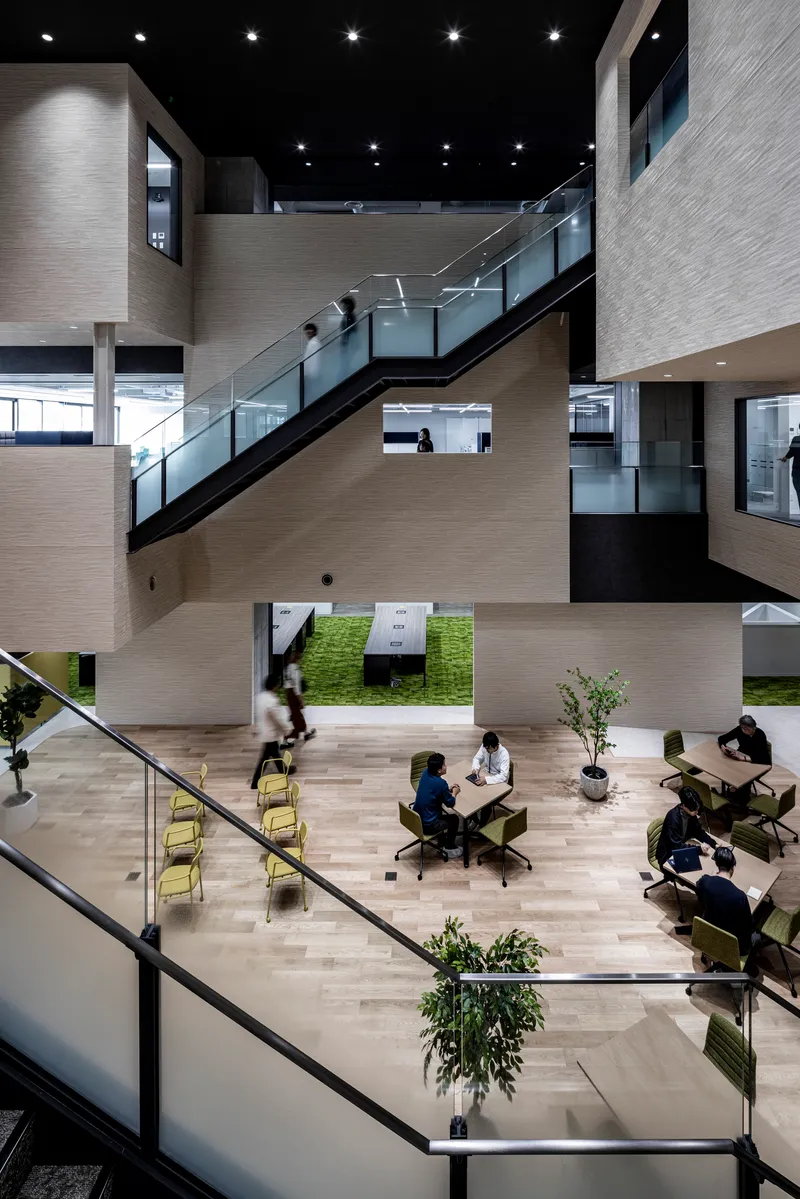
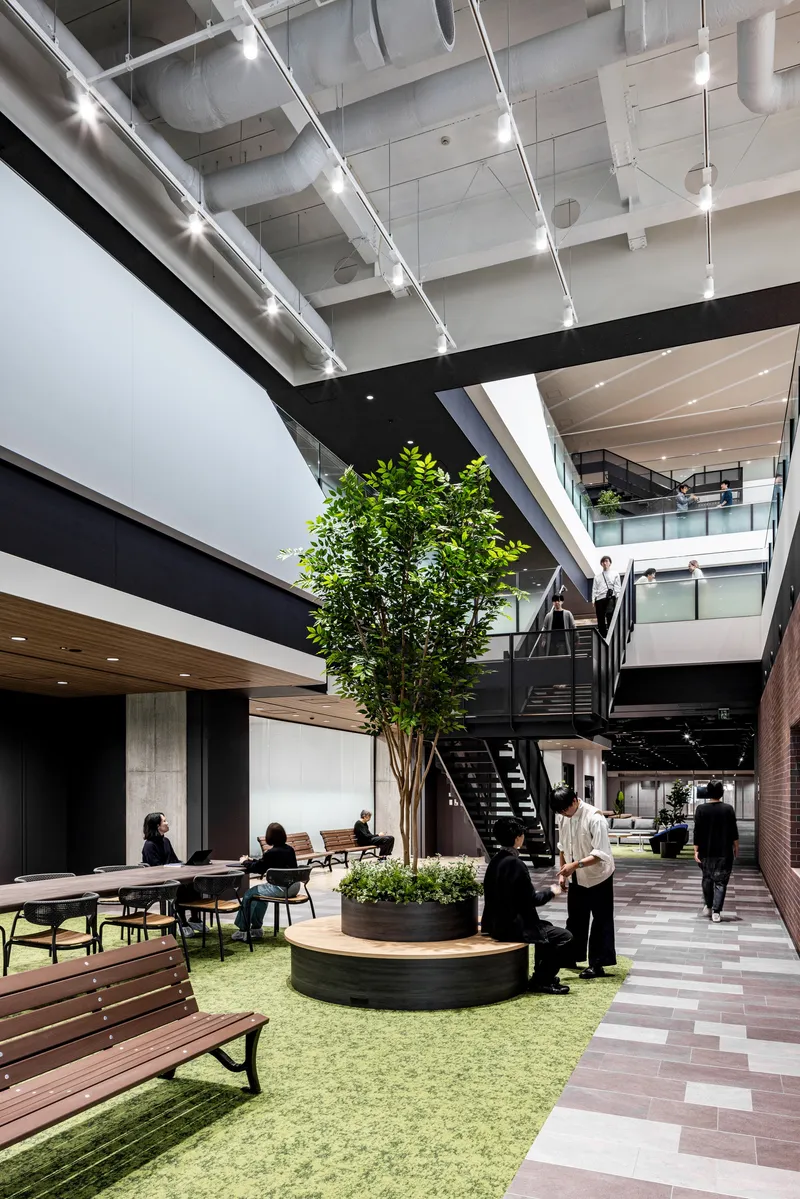
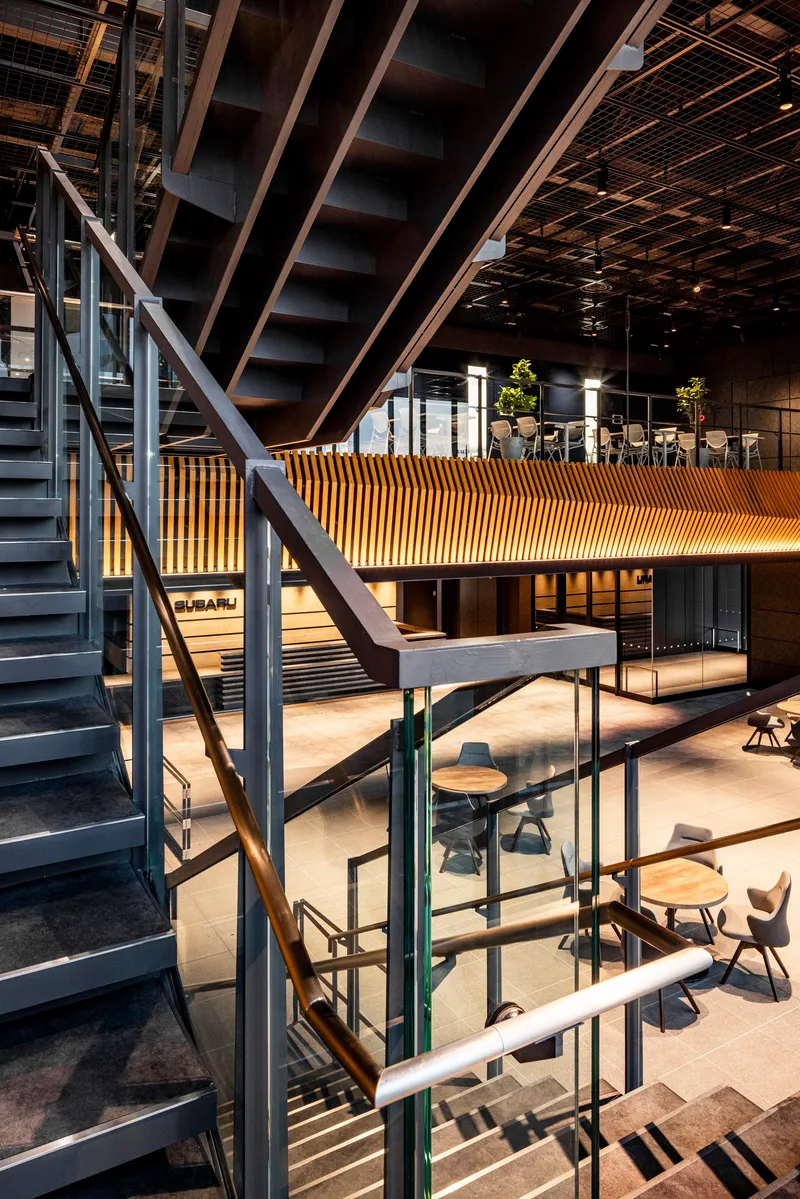
The heart of the project is a multi-story atrium that connects the building vertically. Black steel staircases, glass guardrails, and timber-slatted bridges link the floors, encouraging movement between levels. At the base, a grass-covered courtyard and tree planters bring greenery deep into the plan, creating informal gathering spots that feel closer to a university quad than a corporate lobby.
What makes the atrium work is its refusal to be purely decorative. People sit at scattered tables, walk between floors, and occupy the space at every level. The vertical sightlines are the point: an engineer on the fourth floor can see a colleague from another division two stories below. That kind of visual connectivity is the architectural equivalent of an open-door policy, and it is far harder to ignore than a memo about collaboration.
Timber, Turf, and Informality
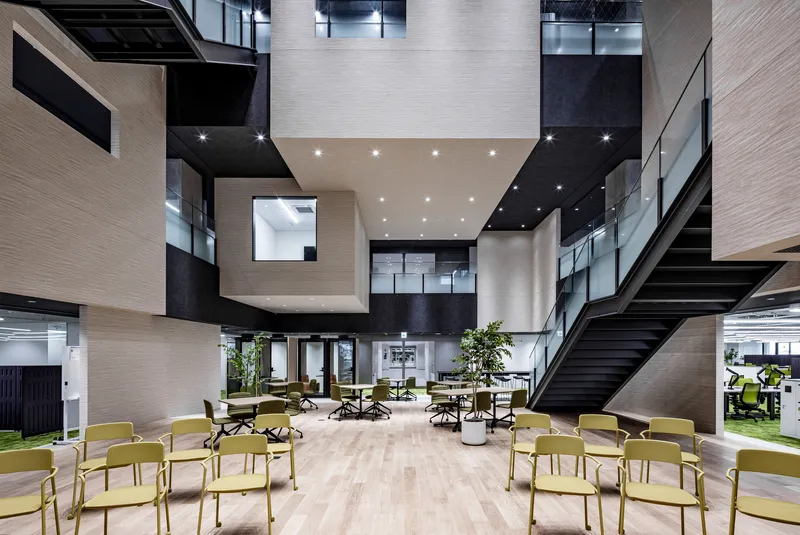
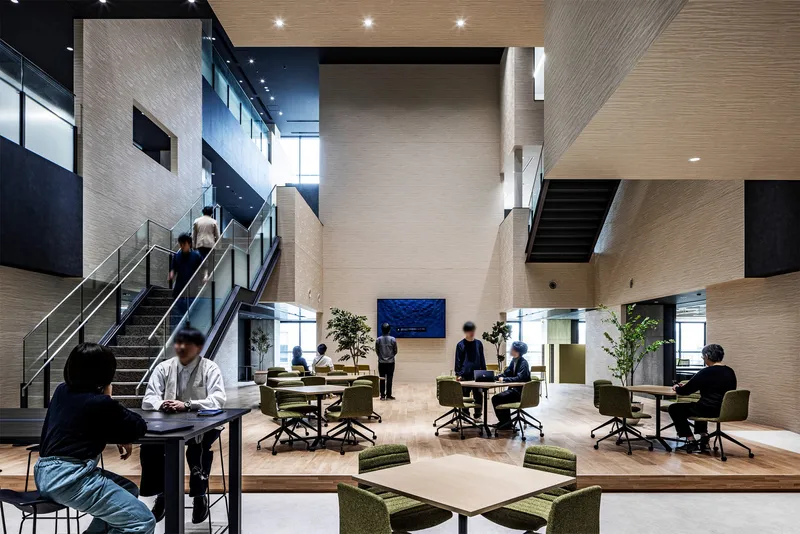
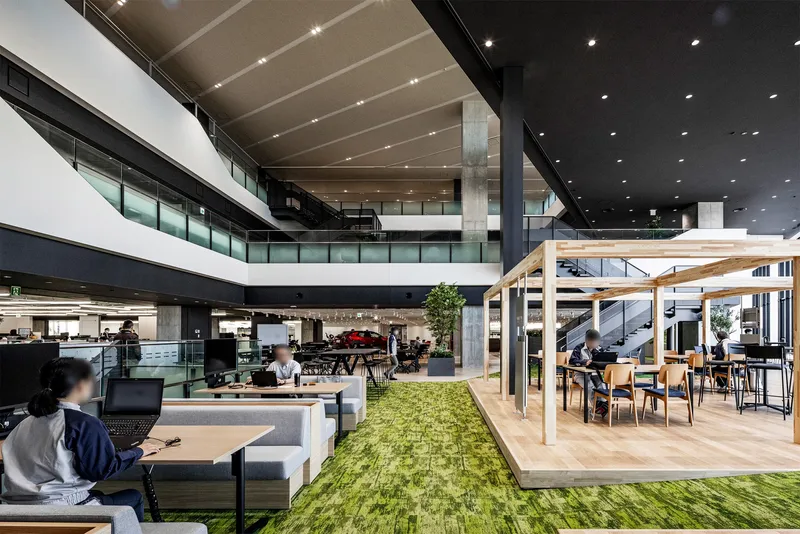
Throughout the interior, Nikken Sekkei deploys a material palette that deliberately avoids the sterility of a typical R&D facility. Light wood cladding wraps volumes and walls, softening acoustics and introducing tactile warmth. Artificial turf slopes create informal seating areas that blur the line between workspace and lounge. Yellow and red chairs punctuate the neutral tones, adding color without descending into tech-startup cliché.
The timber pergola structures overhead and the slatted ceiling treatments serve a practical purpose: they conceal services while maintaining a sense of openness. But they also signal a shift in corporate culture. A company that puts its employees on artificial grass hills and invites them to sit wherever they want is communicating something about hierarchy, or more precisely, its intention to flatten it.
Work Floors and the In-Between
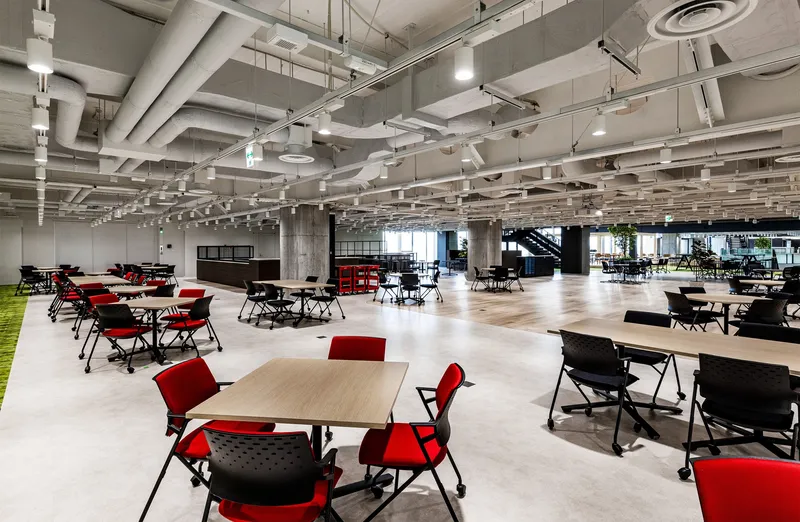
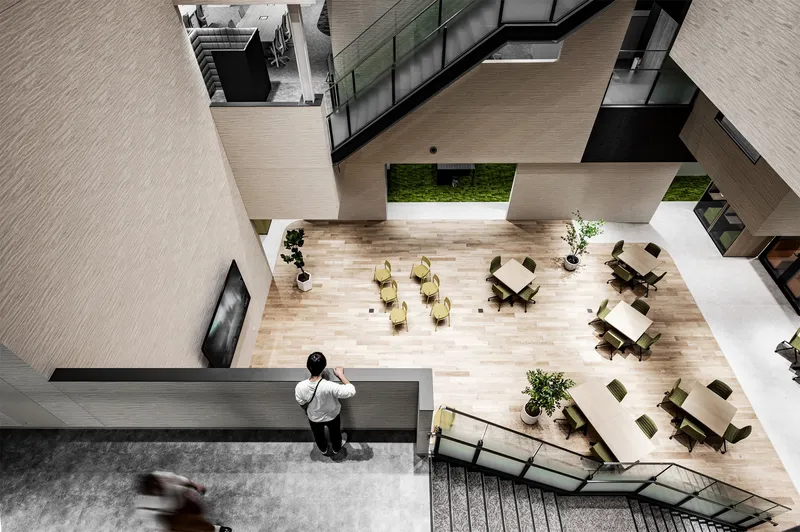
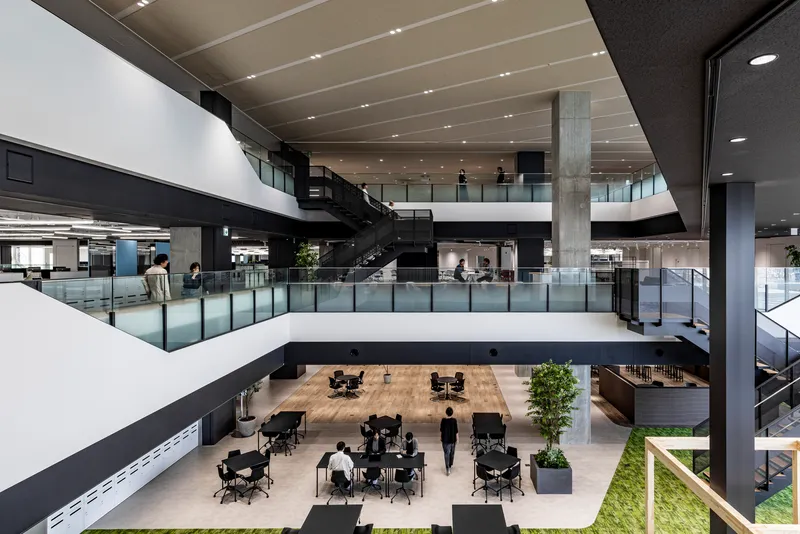
The open office floors feature exposed ceiling ductwork and simple furniture arrangements, with red and black chairs around light wood tables. There is nothing extravagant here, and that restraint is deliberate. The real investment is in the spaces between the workstations: the atrium voids, the stair landings, the ground-floor lobbies where people linger. Nikken Sekkei has calculated that productivity gains come not from fancier desks but from more frequent, accidental encounters.
The top-down views into the atrium reveal the spatial logic clearly. Concrete columns march in a regular grid, and the floor plates are cut away to create voids of varying size. Workers move through these spaces casually, suggesting that the architecture has already been absorbed into daily routine rather than remaining a novelty.
Gathering Rooms and Shared Tables
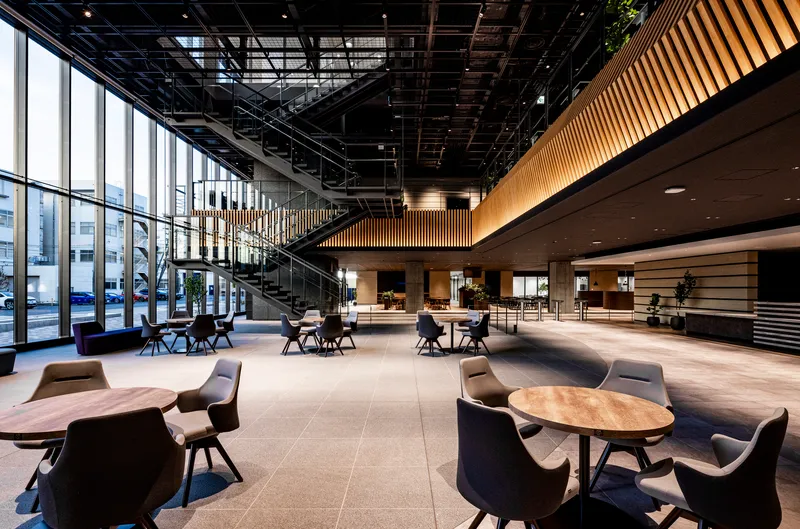
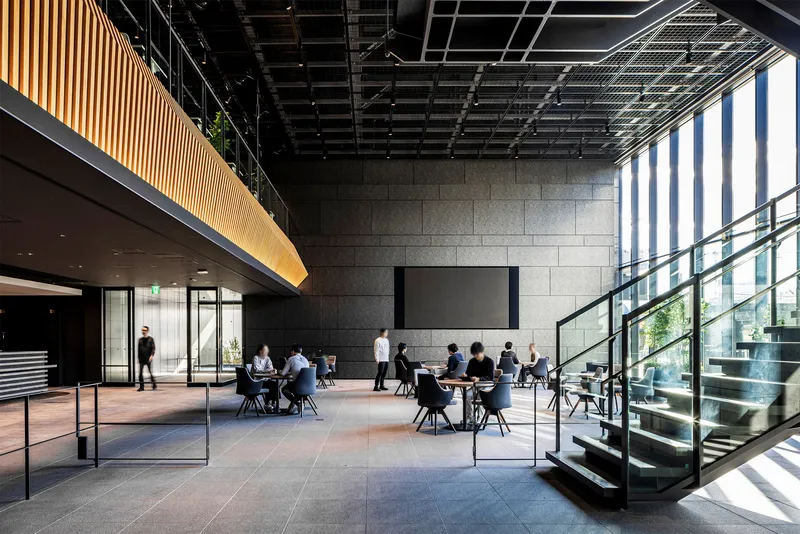
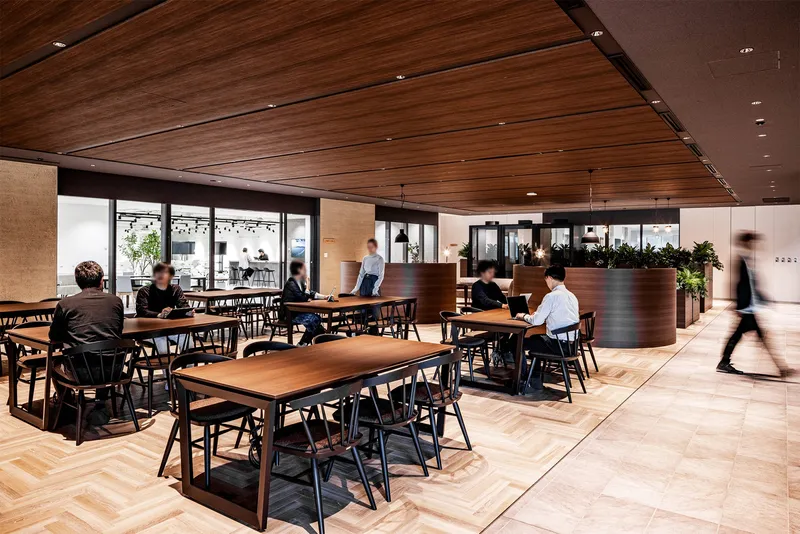
The ground floor functions as a social commons. Floor-to-ceiling glazing brings daylight deep into the lobby, where café tables sit beneath timber-clad mezzanine overhangs. A large-format stone wall anchors one zone, giving it a civic weight that elevates the space above a typical corporate canteen. The dining area, with its slatted timber ceiling and simple wooden tables, handles the daily rhythm of hundreds of meals while maintaining an atmosphere that encourages people to stay and talk.
Polished Halls and Flexible Event Space
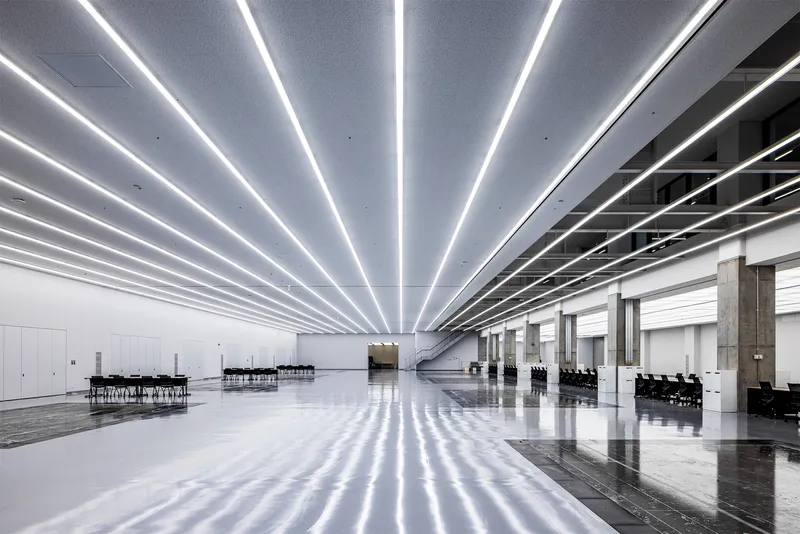
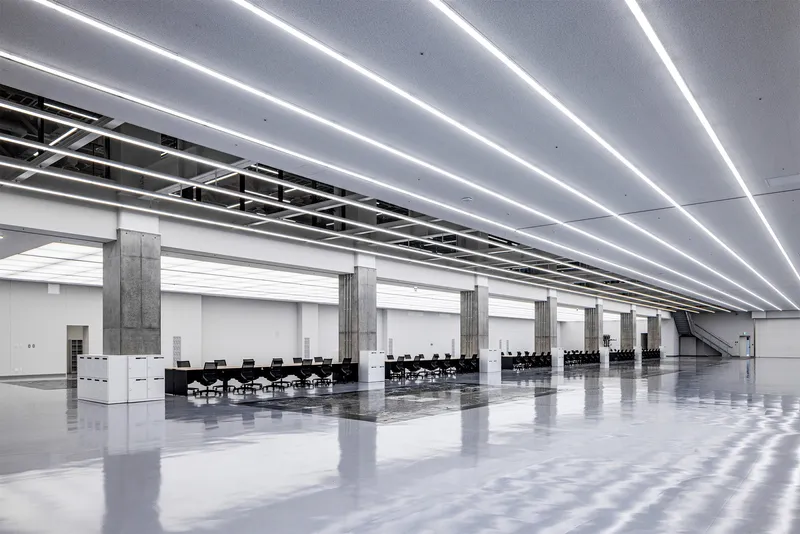
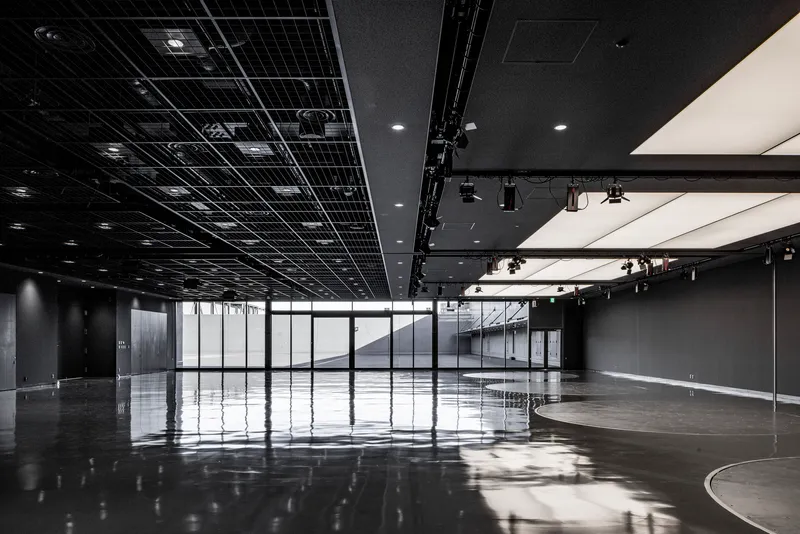
The building includes a series of expansive halls with polished floors and parallel LED light strips that give the spaces an almost cinematic quality. These rooms serve multiple functions: large-scale presentations, exhibitions, and the kind of cross-departmental meetings that the Obeya philosophy demands. Concrete columns provide structural rhythm while leaving the floor plans open for reconfiguration.
Corridors with backlit ceiling grids lead toward conference rooms, and open event spaces with exposed black ceiling grids overlook the interior staircases. These transitional zones are designed to be occupied, not just passed through. The architecture makes a quiet argument that the corridor is as important as the meeting room.
Terraces and Threshold Spaces
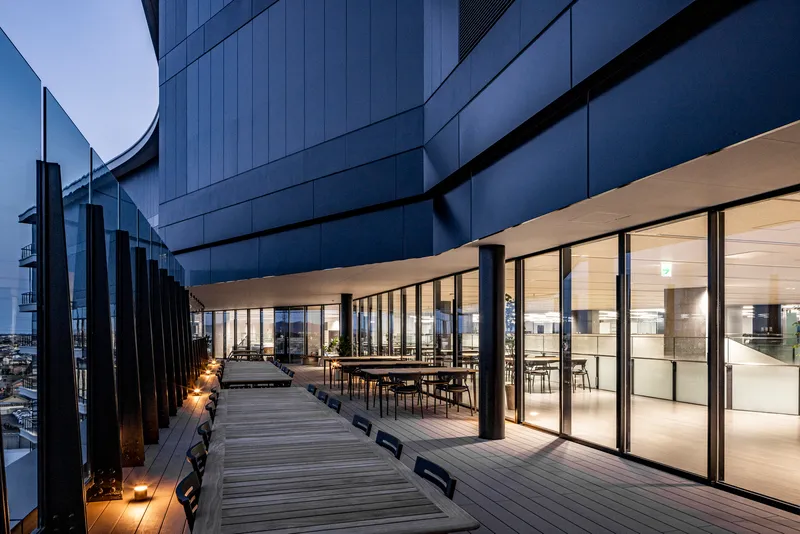
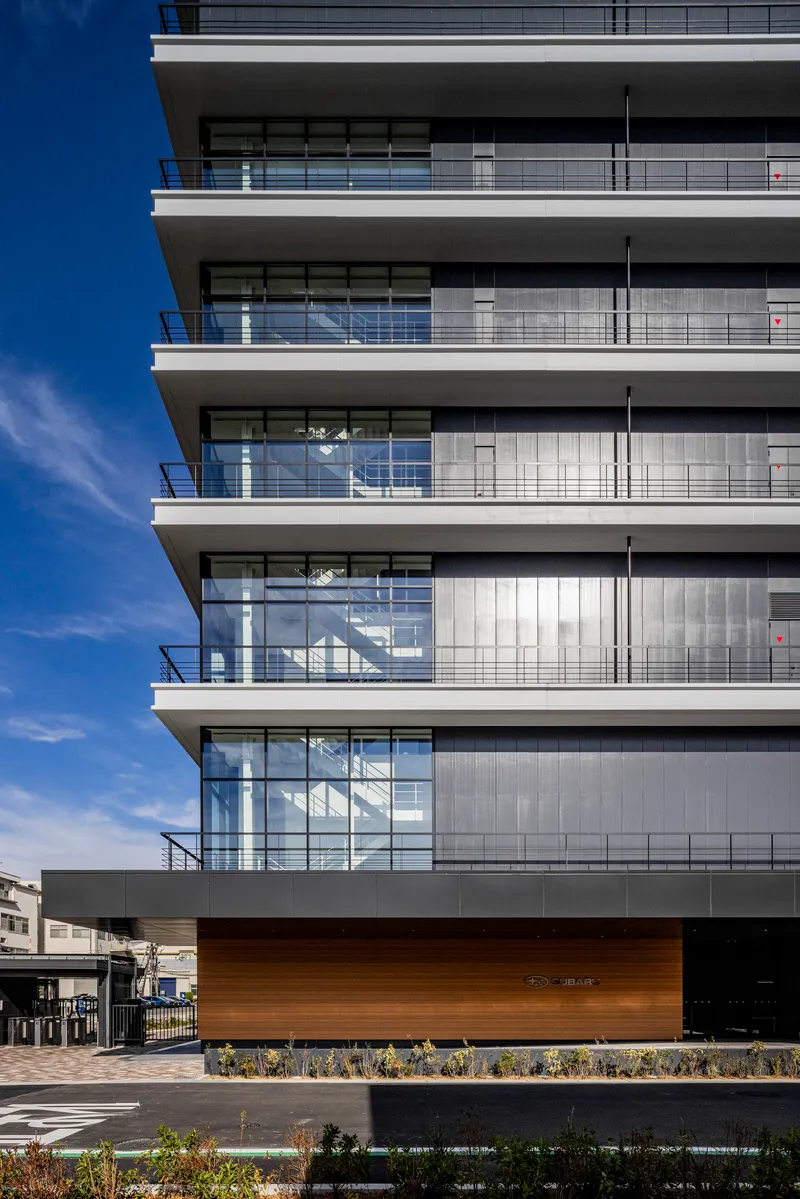
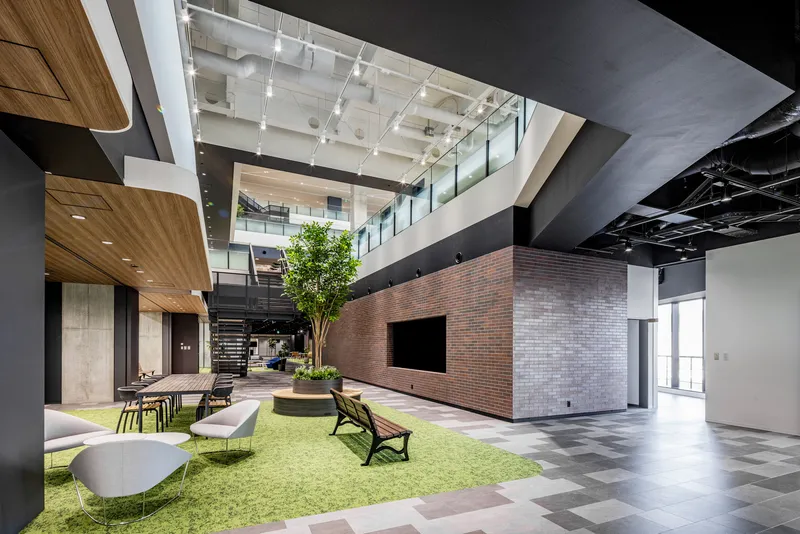
A timber deck terrace with vertical metal fins offers a transitional zone between interior and exterior, visible at dusk as a warm, lantern-like element against the building's cooler cladding. Stacked balconies with glass and solid panels rise above a timber-clad base, reinforcing the layered material strategy. Inside, red brick volumes punctuate the atrium spaces, introducing an unexpected texture that grounds the otherwise smooth palette of timber, glass, and steel.
Plans and Drawings
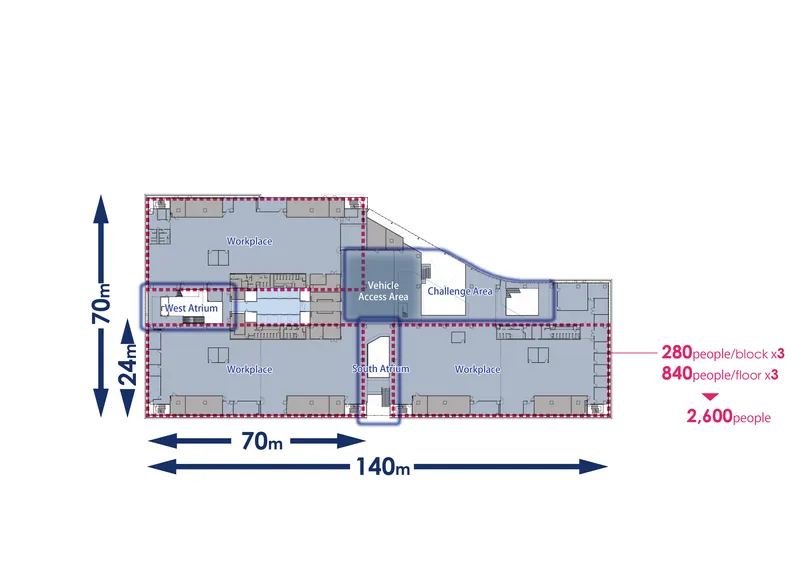
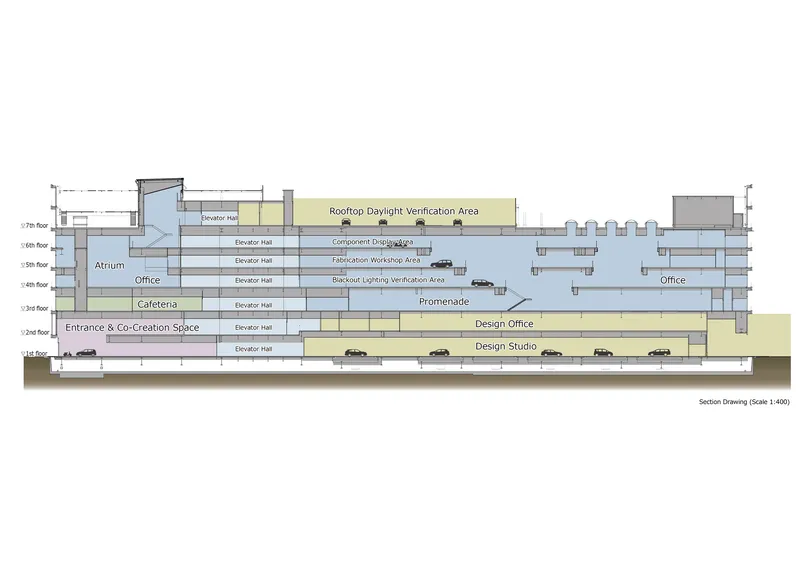
The floor plan reveals workplace zones arranged around a central atrium, confirming that the void is not incidental but the organizing principle of the entire layout. The section drawing is equally telling: it shows the multi-level program, from cafeteria and lobby at the base to offices and a rooftop daylight verification area at the top, threaded together by the continuous atrium space. The dimensional annotations indicate a building designed with industrial precision, which is fitting for a client whose products demand exactly that.
Why This Project Matters
Corporate R&D facilities rarely receive serious architectural attention. They are typically utilitarian boxes where the innovation happens inside the computers, not in the space around them. The SUBARU Innovation Hub challenges that assumption at an enormous scale. By making the atrium the centerpiece, Nikken Sekkei has created a building that treats spatial connectivity as a form of intellectual infrastructure. The architecture does not just house collaboration; it produces the conditions for it.
There is a risk, of course, that open atriums and informal seating become empty gestures, corporate wellness theater dressed up as design innovation. But the evidence here suggests otherwise. The spaces are occupied, the staircases are used, and the sightlines are real. For a car company navigating the transition to electric vehicles and new mobility paradigms, a building that structurally resists siloed thinking may turn out to be as important as any engineering breakthrough on the floors above.
SUBARU Innovation Hub, designed by Nikken Sekkei, Ota, Japan. 561,784 m². Completed 2023. Photography by Koji Horiuchi [Shin Shashin Kobo] and Ote Camera.
About the Studio
Share Your Own Work on uni.xyz
If projects like this are the kind of work you want to make, uni.xyz is a place to publish your own, find collaborators, and enter design competitions.




Popular Articles
Popular articles from the community


Play: Fragments of Their World
Familiar architecture becomes modular playground design, creating safe spaces where displaced children can learn, connect, imagine and play.

The Ocean Hive: Sustainable Architecture for a Self-Sufficient Civilization at Sea
The Ocean Hive imagines sustainable architecture at sea, where modular habitats, algae, wave power and ocean waste sustain a growing colony.

Riyadh For All: Intergenerational Urban Design for Active Aging in Rabat
Riyadh For All reimagines urban design in Rabat with intergenerational co-living, adaptive courtyards, and Moroccan cultural exchange today.

Hill & Cross Opera: Sculptural Opera House Architecture Shaped by Tallinn’s Landscape and Identity
Hill & Cross Opera reimagines opera house architecture in Tallinn through its sculptural hill, civic plaza, glass wave and a luminous cross.


Similar Reads
You might also enjoy these articles

Bao Huynh Watercolor Atelier: A Serene Art Retreat in Hội An
Bao Huynh Watercolor Atelier in Hội An blends multifunctional art spaces, sustainable design, local materials, and family-friendly living in a serene environment.

Atelier Macri Concept Store Interior Design by CASE-REAL
Atelier Macri store features a "ko" counter, walnut wood details, cork displays, blending retail, gallery, and seamless customer experiences.

Manuel Vargas Izquierdo Stadium and High-Performance Sports Center: Architectural Excellence in Jalpa de Méndez
The Manuel Vargas Izquierdo Stadium blends sustainable design, inclusive sports facilities, and cultural-inspired architecture, revitalizing Jalpa de Méndez’s public spaces.

KAKR Buluh Awar Hall: Revitalizing Community and Ecology Through Bamboo Architecture
Community built bamboo hall revitalizes Buluh Awar village, empowering youth, restoring ecology, celebrating vernacular craftsmanship through sustainable architecture and culture.




Comments (0)
Please login or sign up to add comments
No comments yet. Be the first to comment!