

Nikos Adrianopoulos Carves an 820 m² Estate from Rock and Ritual on Mykonos
Pantheon Estate House in Elia, Mykonos, rebuilds a hillside dwelling as a sequence of stone towers, terrazzo courts, and tensile canopies facing Paros and


On a 4,100 m² plot near Elia beach, roughly 250 meters from the water, Nikos Adrianopoulos Architecture has completely reconstructed an existing residence into something that reads less like a villa and more like a small Cycladic settlement growing out of exposed rock. Pantheon Estate House, completed in 2021, spreads 820 m² of living space across multiple volumes that wrap around a central courtyard and an 82 m² circular pool, with unbroken 180-degree views toward Paros and Naxos. Lighting design by Oculus Light Studio is threaded through the project so quietly that fixtures disappear inside columns, reinforcing the idea that the building's identity lives in details you have to look for.
What makes this project worth studying is not the luxury program (Mykonos has no shortage of that) but the discipline with which Adrianopoulos suppresses the house's apparent mass. Stone towers anchor the composition vertically while white-rendered volumes stretch horizontally, and the geometry references traditional Mykonian building proportions without mimicking them. A continuous terrazzo floor runs from interior to exterior without threshold interruptions, collapsing the distinction between inside and outside into a single material plane. Tensile membrane canopies, steel columns clad in teak, and leather-wrapped stainless steel ropes are all custom-manufactured prototypes, giving the estate a material vocabulary that is simultaneously rugged and meticulously engineered.
Growing from the Rock
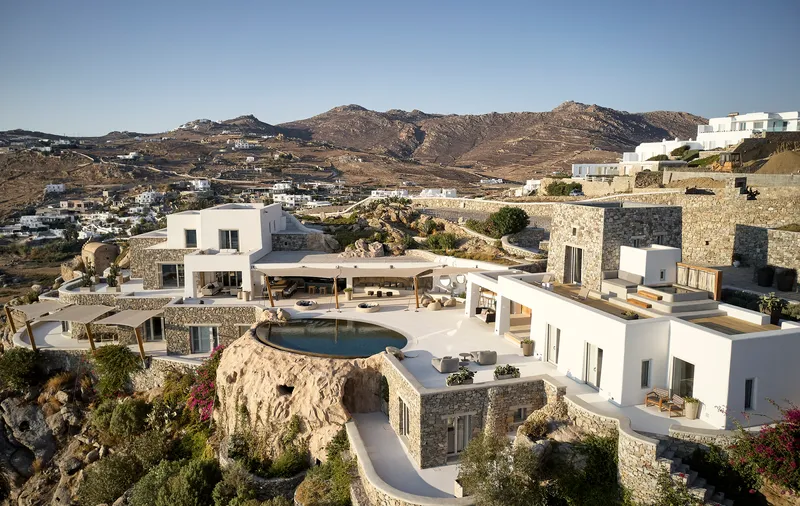


From above, the estate looks like a cluster of white geometries that have been poured between existing rock outcroppings rather than placed on top of them. The aerial views make the design strategy legible: multiple volumes of different heights and depths are distributed across the sloping terrain, minimizing any single dominant mass. A stone tower punctuates the roofline and acts as a vertical anchor, its rubble masonry visually continuous with the natural geology. The tactic of breaking a large program into fragmented pavilions is hardly new, but Adrianopoulos executes it with real conviction, letting boulders intrude into courtyards rather than bulldozing them for a cleaner plan.
The Central Court and Pool as Organizing Spine
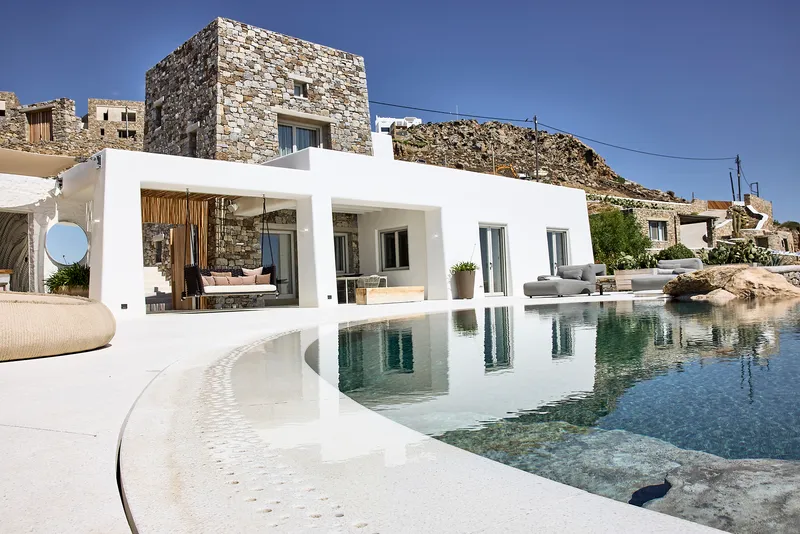
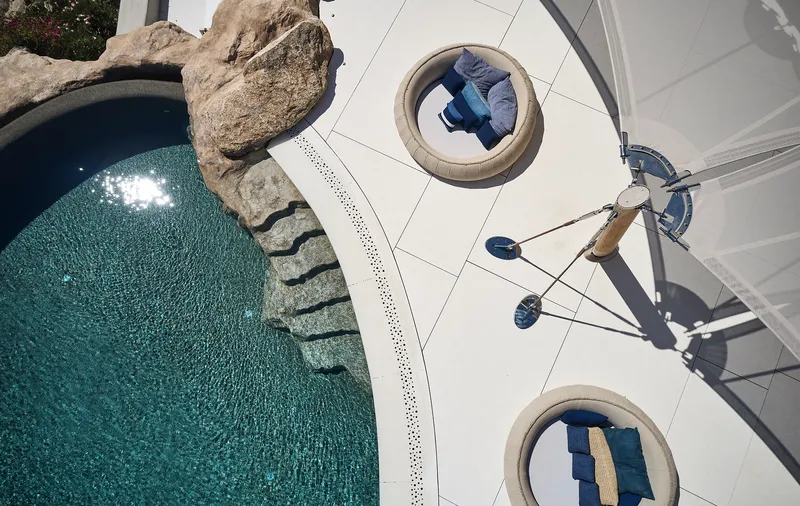

The circular pool and its surrounding terrace function as the social and spatial center of gravity. Every wing of the house either opens onto this court or frames a view through it to the sea beyond. The pool's curved mosaic edge steps down into the water in a detail that softens the typical sharp deck-to-pool transition, while recessed circular lounge pits cut into the terrace create secondary gathering nodes at ground level.
This courtyard strategy draws from the Cycladic tradition of introverted living spaces organized around a shared open room, but scales it up considerably. The continuous terrazzo floor that runs through the interiors extends seamlessly out to the pool deck, eliminating any threshold between domestic life and the outdoor platform. You move through rooms and terraces on a single unbroken surface, and the effect is one of a house that has no real walls, only varying degrees of enclosure.
Tensile Canopies and Teak Columns
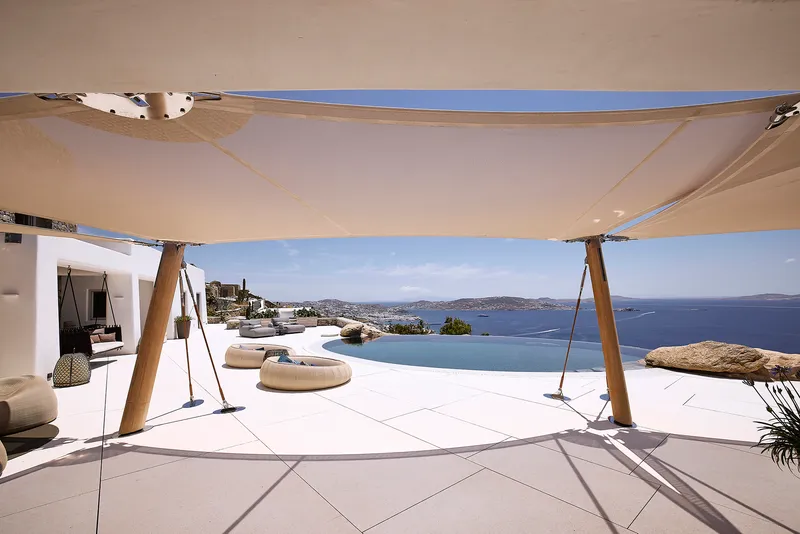


The most inventive structural element at Pantheon is the tensile fabric canopy system at the basement and ground floor levels. Steel columns clad in teak wood support billowing membrane shades that stretch between the built volumes and the rocky landscape, creating sheltered outdoor zones without the heaviness of masonry roofs. These are not off-the-shelf shade sails: the stainless steel tensile ropes are hand-stitched with leather covers, and the fittings are custom machined. The detail shots reveal a sailboat-like rigging logic, appropriate for a house that stares at open water.
More than a sunshade, the canopy reframes the landscape. By filtering direct Aegean light into soft, diffused illumination beneath, it turns the infinity pool terrace into an inhabitable room that is simultaneously exterior and protected. The tension between the fabric's ephemeral billow and the stone's geological permanence gives the estate a visual range that most Mykonos houses, locked into a single white-box register, simply lack.
Pool Edge and Horizon Line
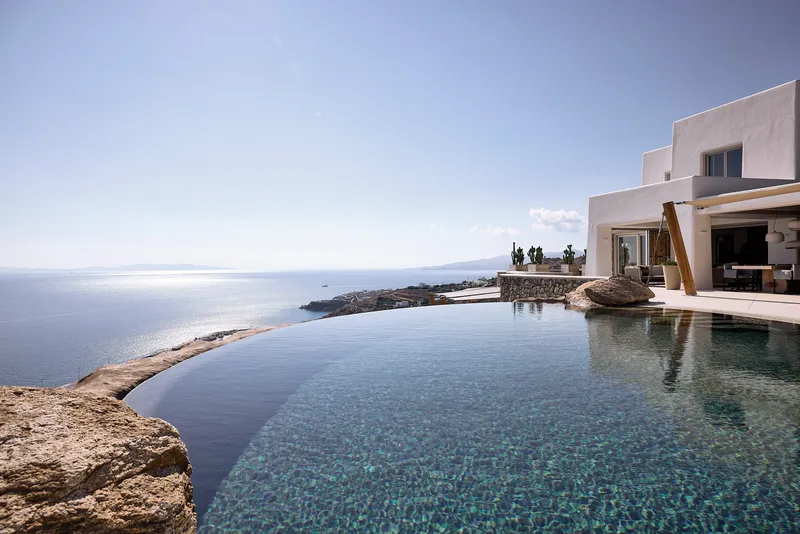
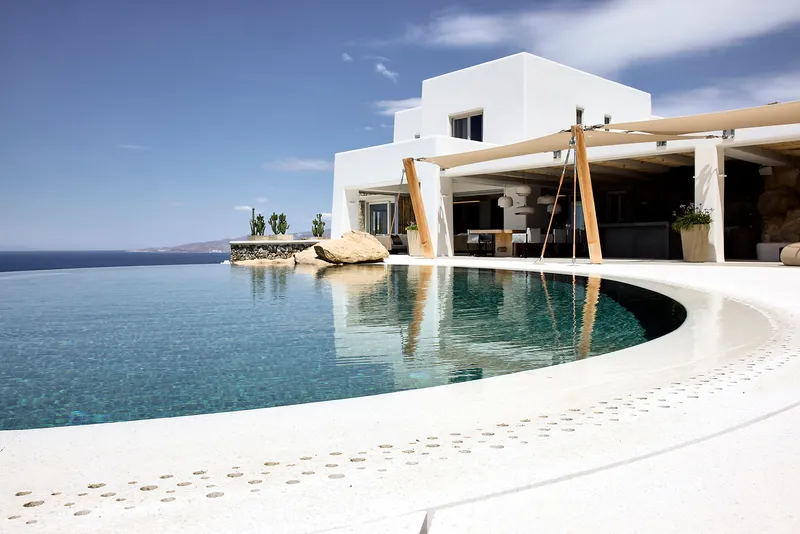
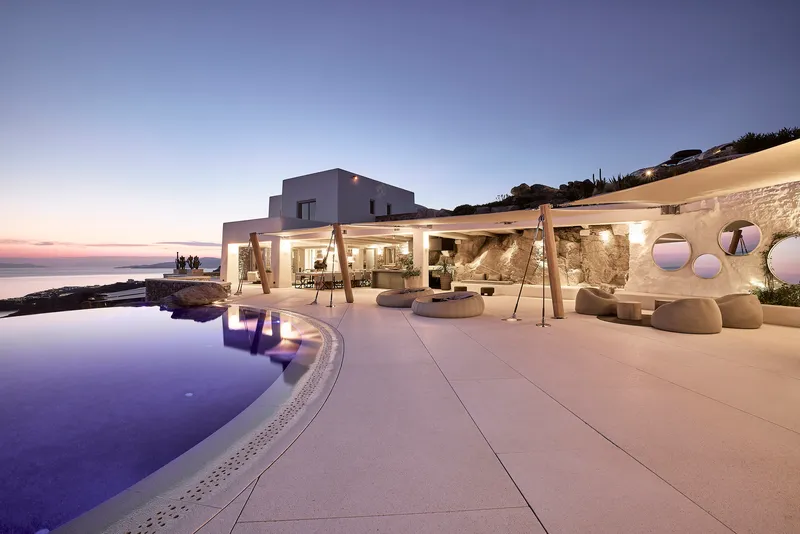
The infinity pool is calibrated to merge its water line with the Aegean horizon, and from multiple vantage points the pool's far edge simply disappears into the sea. Natural rock formations flank the pool on both sides, reinforcing the illusion that you are swimming in a geological basin rather than a constructed basin. At dusk, the teak pergola columns reflect in the still water, doubling the vertical rhythm and producing a calm symmetry that contrasts with the wild terrain just beyond the terrace.
Interiors: Terrazzo, Timber, and Borrowed Light
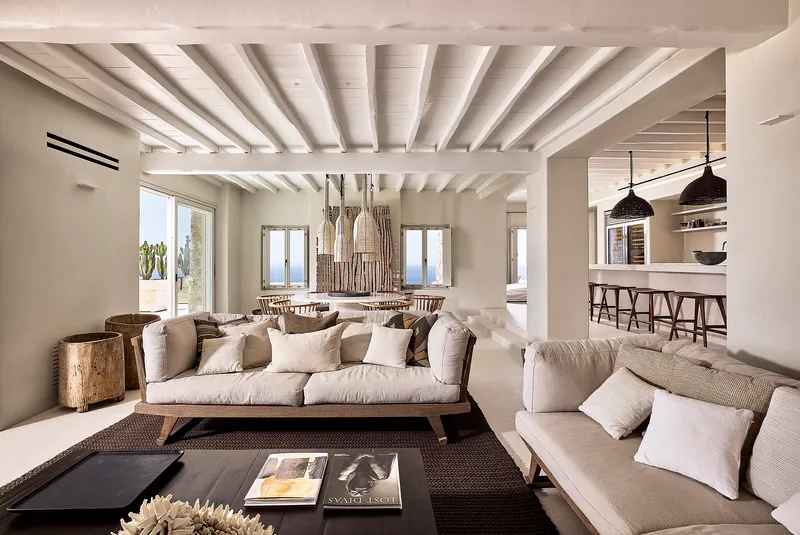


Inside, white-painted timber beams span the ceilings, and deep openings pull the sea view into every room. The open-plan living space reads as a continuation of the courtyard: folding glass doors retract entirely, and because the floor material does not change, the room's edges become ambiguous. The kitchen island introduces a curved stone edge that echoes the pool's geometry, topped with custom wooden stools and black woven pendant lights that are among the few dark accents in an otherwise luminous palette.
Solar tubes bring natural light into the deeper, darker zones of the plan, a pragmatic passive strategy that avoids the energy cost of artificial illumination during daytime hours. Where artificial light is necessary, Oculus Light Studio has embedded fixtures into columns and walls so that the source is invisible. The result is an interior where light seems to arrive from the architecture itself rather than from any identifiable fitting.
Private Rooms and the Grotto Bath
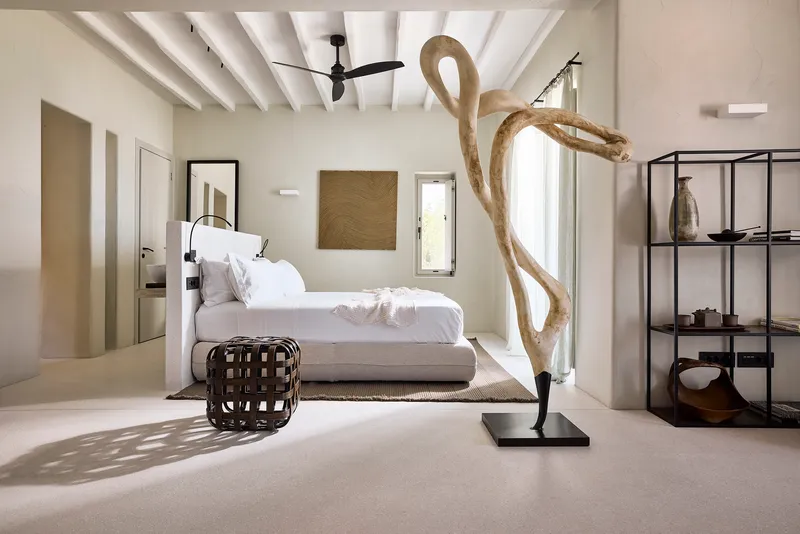
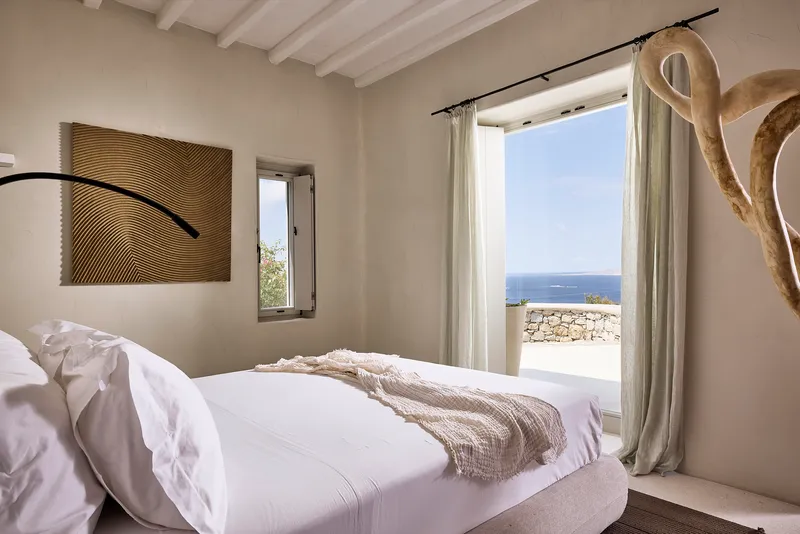
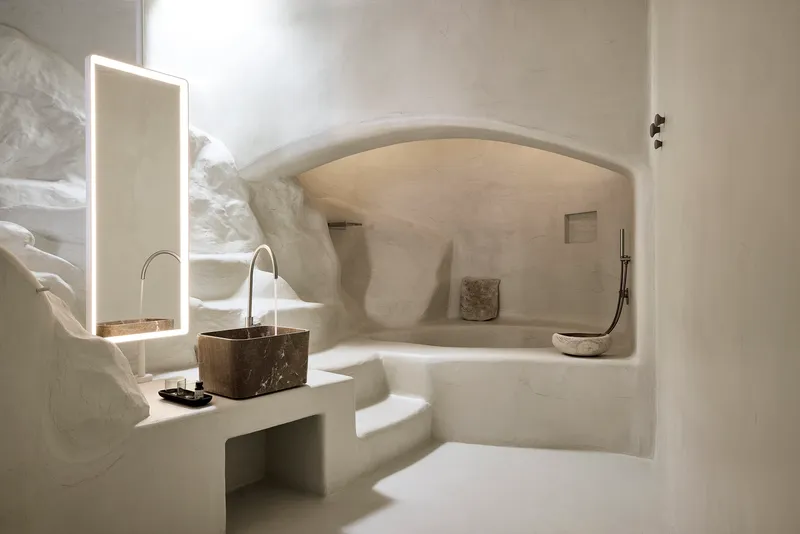
The bedrooms maintain the project's material discipline: exposed timber beams, linen curtains, and stone-framed views to the sea. A driftwood sculpture in one bedroom is a casual nod to the coastal context without tipping into themed decoration. The standout moment is a vaulted bathroom that reads like a plastered grotto, with a stone sink alcove carved into thick walls and soft shadows tracing the curved surfaces. It is the most intimate space in the house, and its cave-like compression provides a necessary counterpoint to the expansive terraces outside.
Outdoor Pavilions and Threshold Conditions


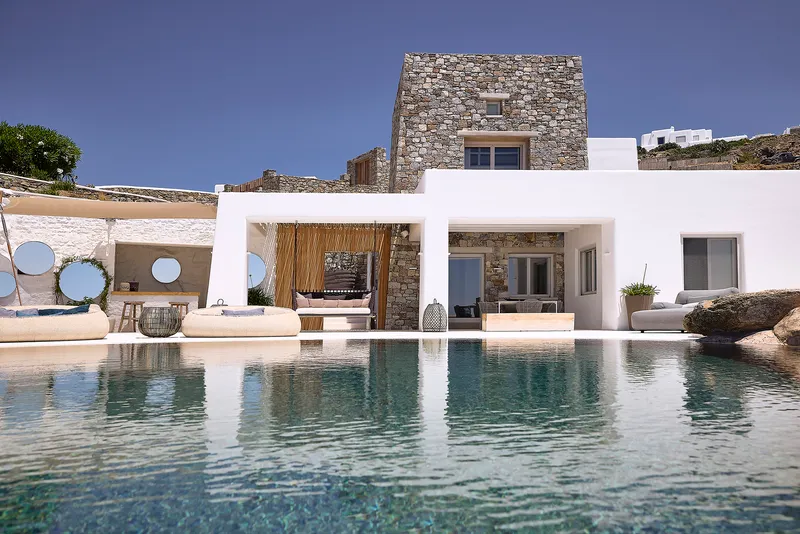
Scattered across the site are smaller outdoor pavilions: a timber deck terrace with a recessed seating niche beside a stone wall, a rooftop deck that frames distant islands through a masonry opening, and a white pergola with circular porthole screens that filters the view of the stone tower volume. These thresholds between fully interior and fully exterior space give the house a layered quality. You are never simply in or out; you are always passing through a graded sequence of shelter, shade, and exposure.
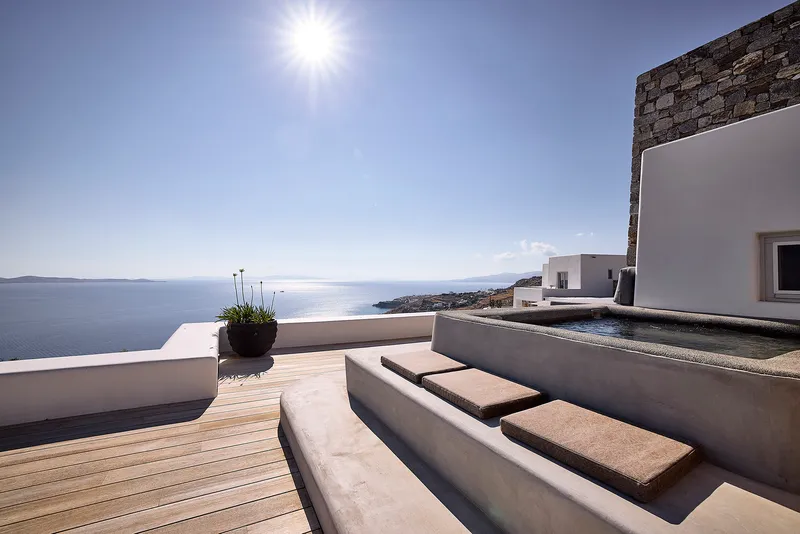


At dusk, the concrete steps descending from the timber deck to the pool terrace become sculptural, and the curved spiral staircase on the white facade reads as a freestanding gesture against the sea. These transitional moments are where Adrianopoulos's design is most assured: the house does not announce itself with a grand entrance but instead offers a sequence of small discoveries as you move through its topography.
Fitness Pavilion and Program Extension
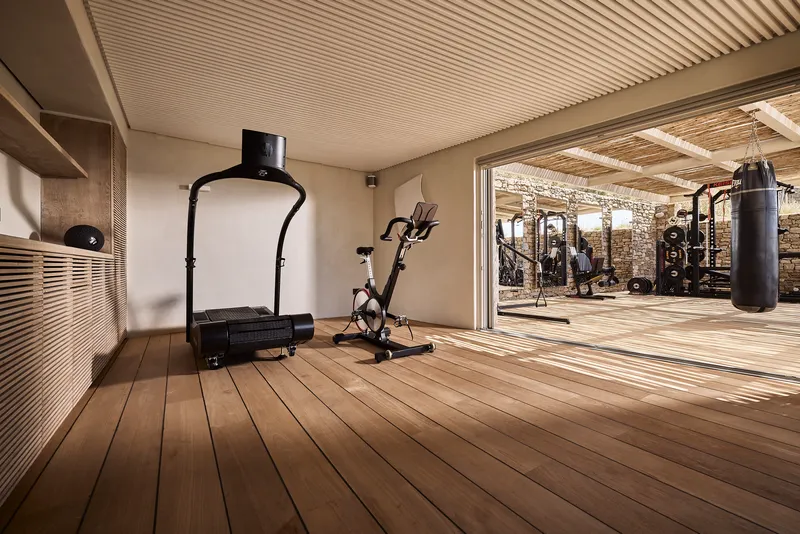
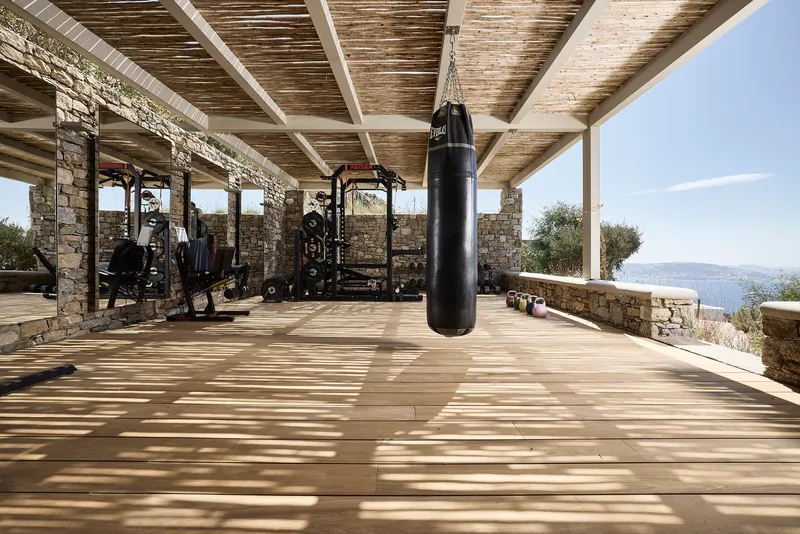
A covered outdoor gym pavilion with exposed timber beams and a hanging punching bag overlooks the distant hillside, while an interior fitness room with a slatted timber ceiling opens directly onto an outdoor exercise terrace enclosed by stone walls. These are not afterthought amenities tucked into a basement; they are designed with the same care as the living spaces, using the same material palette. By treating the fitness program as architecture rather than equipment, the project maintains its spatial coherence across every function.
Plans and Drawings

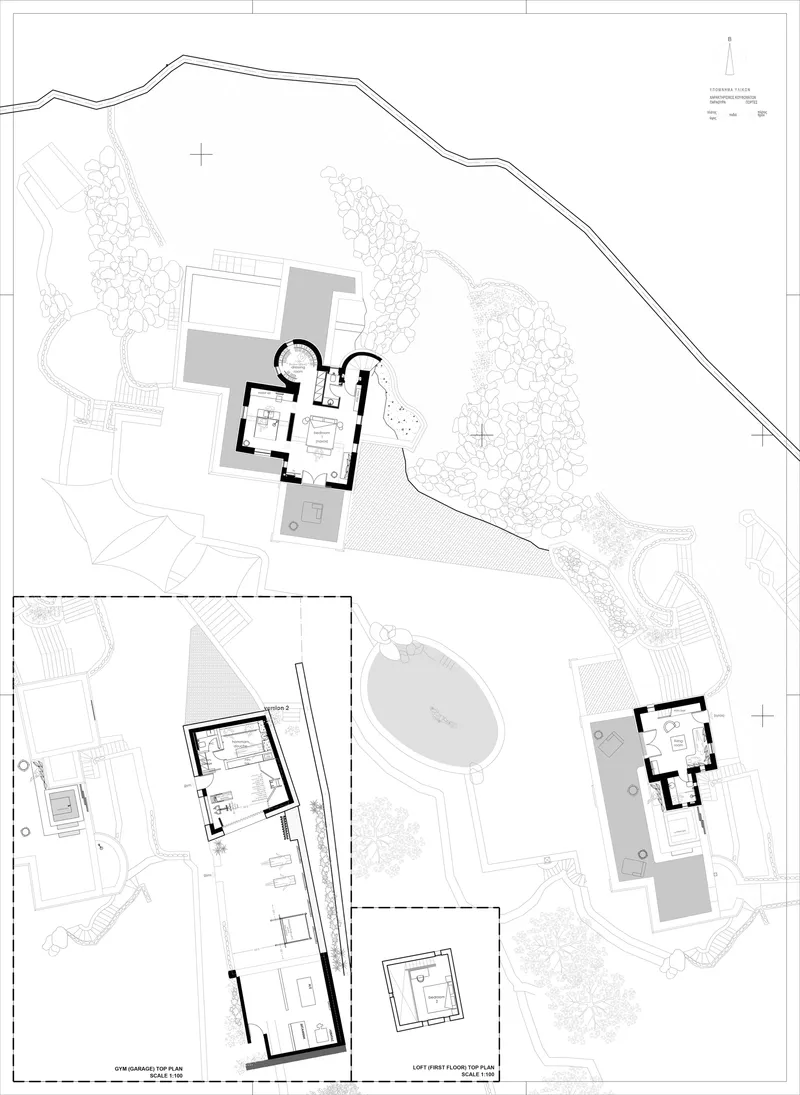

The site plan confirms what the aerial photographs suggest: the building volumes are distributed at irregular angles across the slope, wrapping around the oval pool and preserving existing rock formations and scattered trees. The floor plans reveal a linear bedroom and spa wing organized along one axis, while the public living spaces fan out around the central courtyard. The staggered arrangement means that no two rooms share exactly the same orientation, giving each space a distinct relationship to the landscape and the wind.
Why This Project Matters
Mykonos has become synonymous with a certain kind of luxury architecture: white boxes, infinity pools, sunset views, and not much else to distinguish one villa from the next. Pantheon Estate House operates within those constraints but pushes against them in almost every detail. The fragmented massing that defers to existing geology, the continuous terrazzo plane that erases the indoor/outdoor boundary, the tensile canopies that introduce a completely different structural and material logic, the embedded lighting that refuses to announce itself: these are design decisions that require both conviction and restraint.
What Adrianopoulos demonstrates here is that site-specific architecture on a Mediterranean island does not need to retreat into nostalgic pastiche or overcompensate with minimalist abstraction. The geometry is genuinely derived from Cycladic precedent, the materials are locally coherent, and the custom-fabricated elements (leather-wrapped cables, teak-clad steel columns, integrated light fixtures) give the house a material identity that cannot be replicated by specification alone. Pantheon is a house that earns its name not through grandeur but through the accumulated intelligence of its details.
Pantheon Estate House by Nikos Adrianopoulos Architecture, with lighting design by Oculus Light Studio. Mykonos, Greece. 820 m², completed 2021. Photography by Fotis Serfas.
About the Studio
Share Your Own Work on uni.xyz
If projects like this are the kind of work you want to make, uni.xyz is a place to publish your own, find collaborators, and enter design competitions.


Popular Articles
Popular articles from the community


The Amber Palace Opera: A Geological Fiction Surfaces on Tallinn's Baltic Waterfront
Pierre Brillard reimagines a Baltic legend as a public landscape, opera house, and waterfront promenade rooted in Tallinn's coastal identity.
Extended Shell: Retrofitting Kolkata's Balconies as Living Urban Thresholds
A modular retrofit system recovers the social and environmental intelligence of Kolkata's historic verandas for contemporary Park Street residents.
Manzana Morphosis: Stretching Barcelona's Grid into a Living Landscape for 2050
A radical reworking of the Eixample manzana turns density into a tool for generous public space, vertical ecology, and environmental performance.
Temporary Home for Dogs: A Reversed Zoo Rethinks Animal Shelter Architecture
In Bucharest, a sinuous corridor and freed landscape flip the logic of containment, designing a shelter that works to make itself unnecessary.

Similar Reads
You might also enjoy these articles

Bao Huynh Watercolor Atelier: A Serene Art Retreat in Hội An
Bao Huynh Watercolor Atelier in Hội An blends multifunctional art spaces, sustainable design, local materials, and family-friendly living in a serene environment.

Atelier Macri Concept Store Interior Design by CASE-REAL
Atelier Macri store features a "ko" counter, walnut wood details, cork displays, blending retail, gallery, and seamless customer experiences.

Manuel Vargas Izquierdo Stadium and High-Performance Sports Center: Architectural Excellence in Jalpa de Méndez
The Manuel Vargas Izquierdo Stadium blends sustainable design, inclusive sports facilities, and cultural-inspired architecture, revitalizing Jalpa de Méndez’s public spaces.

KAKR Buluh Awar Hall: Revitalizing Community and Ecology Through Bamboo Architecture
Community built bamboo hall revitalizes Buluh Awar village, empowering youth, restoring ecology, celebrating vernacular craftsmanship through sustainable architecture and culture.


Comments (0)
Please login or sign up to add comments
No comments yet. Be the first to comment!