

NORM Architects Build a Thatched Coastal Atelier Where Danish Craft Meets Japanese Stillness
Shoreline Studio is a retreat for creative work on Denmark's Odsherred coast, merging summerhouse tradition with teahouse sensibility.


On the windswept coast of Odsherred, Denmark, where meadow rolls into dune and bent pines mark the boundary between land and sea, NORM Architects have planted a small building with the quiet authority of something that has always been there. Shoreline Studio is a creative atelier, commissioned as a companion to an existing brick summerhouse, and it borrows its materials and proportions from the vernacular landscape: thatch from the coastal grasses, hardwood cladding that will silver to match the pines, brick underfoot, and reclaimed timber overhead.
What makes the project genuinely compelling is the specificity of its cultural cross-pollination. NORM Architects cite both the Danish summerhouse tradition and the Japanese teahouse archetype as equal sources, and the result is neither pastiche nor fusion. It is a building governed by material honesty and compressed spatial thresholds, where a single open volume hides its secondary functions behind curtains and joinery, and where every framed view of the dunes operates as borrowed scenery. The architecture is restrained enough that the landscape does most of the talking.
Rooted in the Meadow
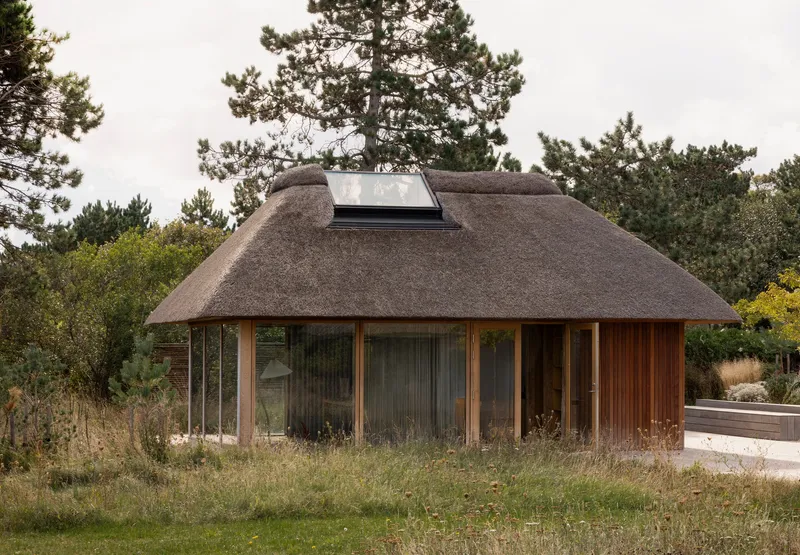
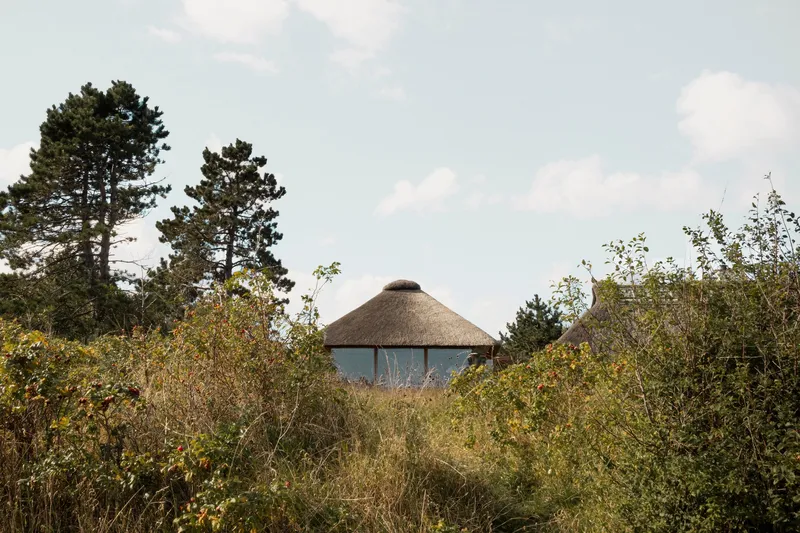
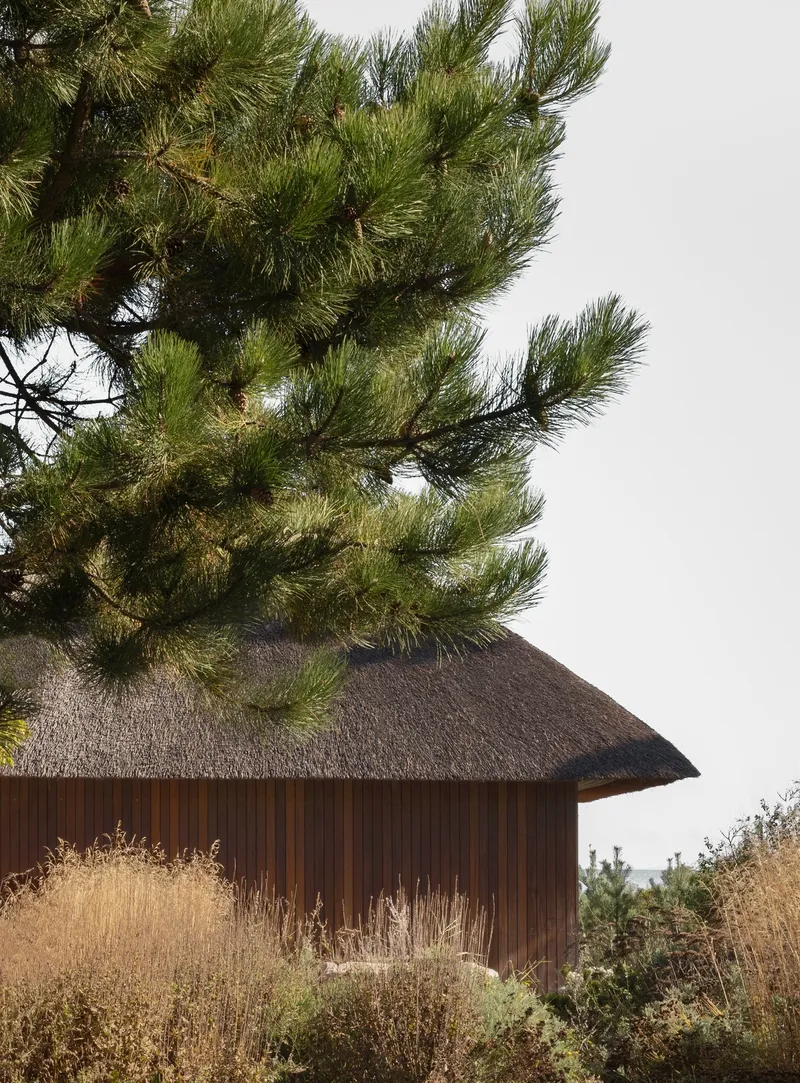
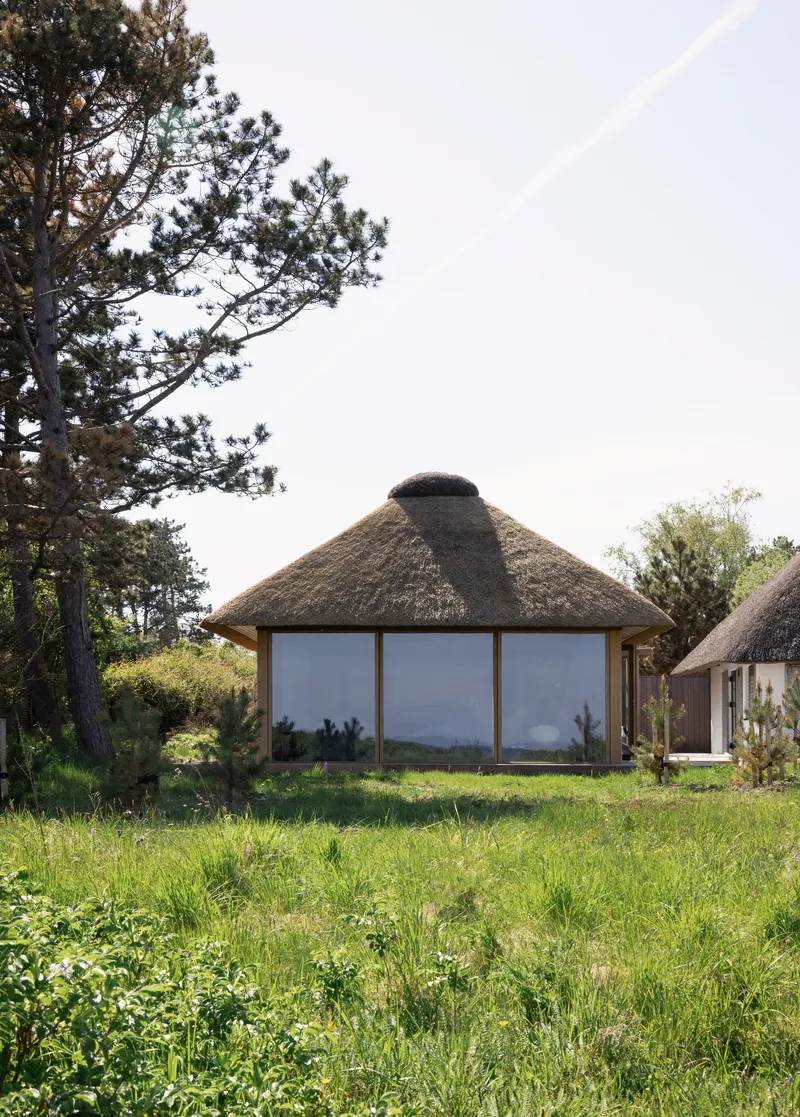
The studio sits low in the terrain, its conical thatched roof reading as a soft mound above the wild grasses and rose hips rather than an object imposed on the landscape. NORM Architects calibrated both the material palette and the building's profile to disappear seasonally: thatch mirrors the hues of dried coastal grass, and the hardwood cladding is designed to patinate toward the silvery tone of the surrounding pines. From a distance, the pavilion registers less as architecture and more as topography.
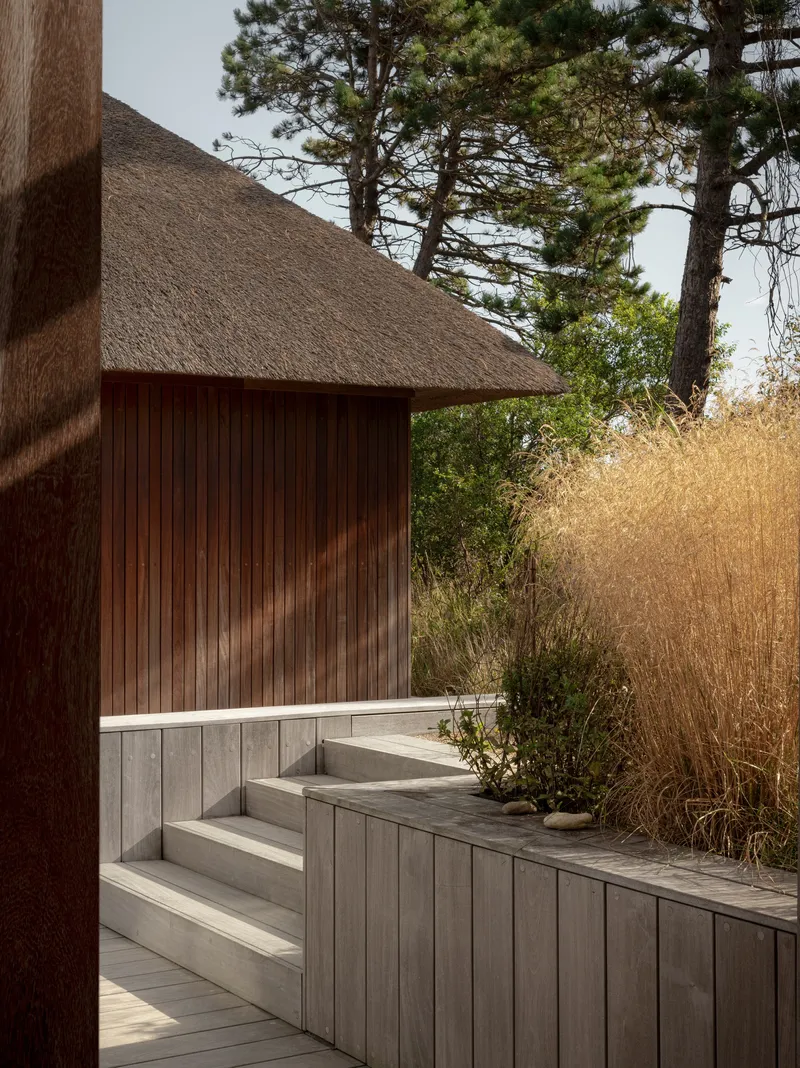
The site strategy is deliberate. The studio acts as a counterpart to the main brick house, linked by a shared terrace plane of brick pavers that extends outward and mediates between the two structures. The rhythm of the new building's cladding and columns is tuned to the cadence of the existing house, so the two read as a family rather than an awkward pairing.
The Thatched Envelope
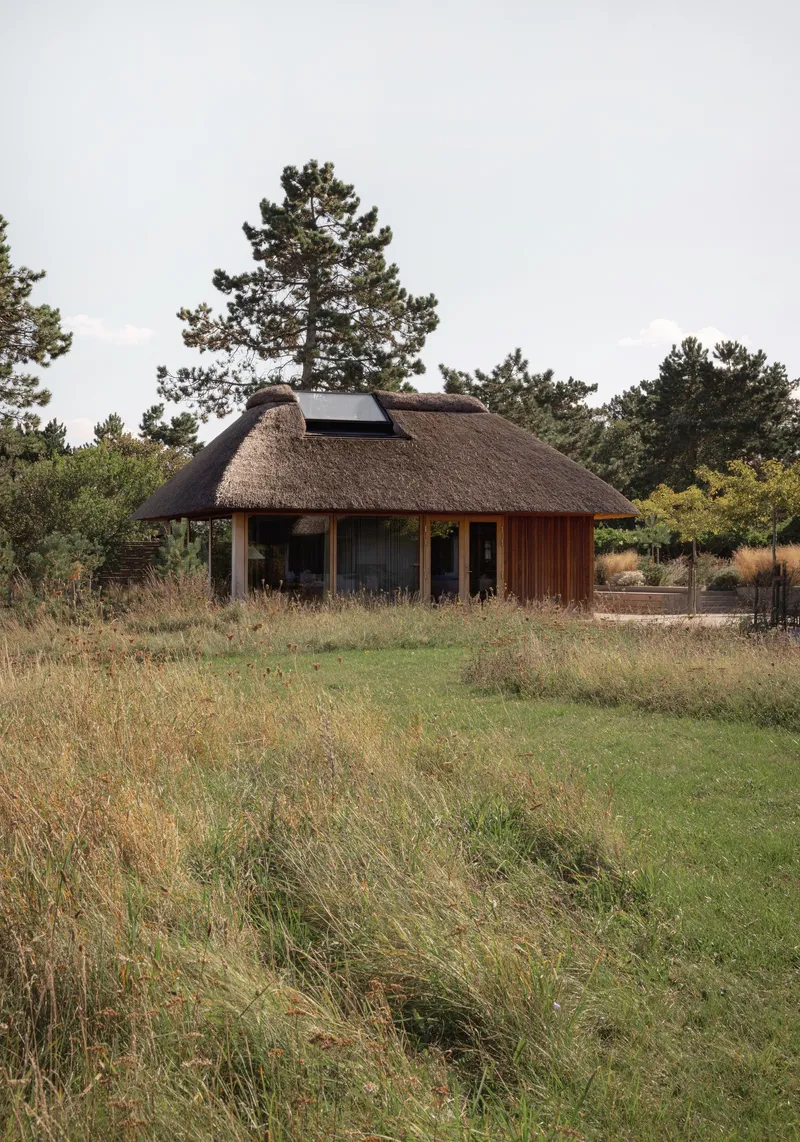
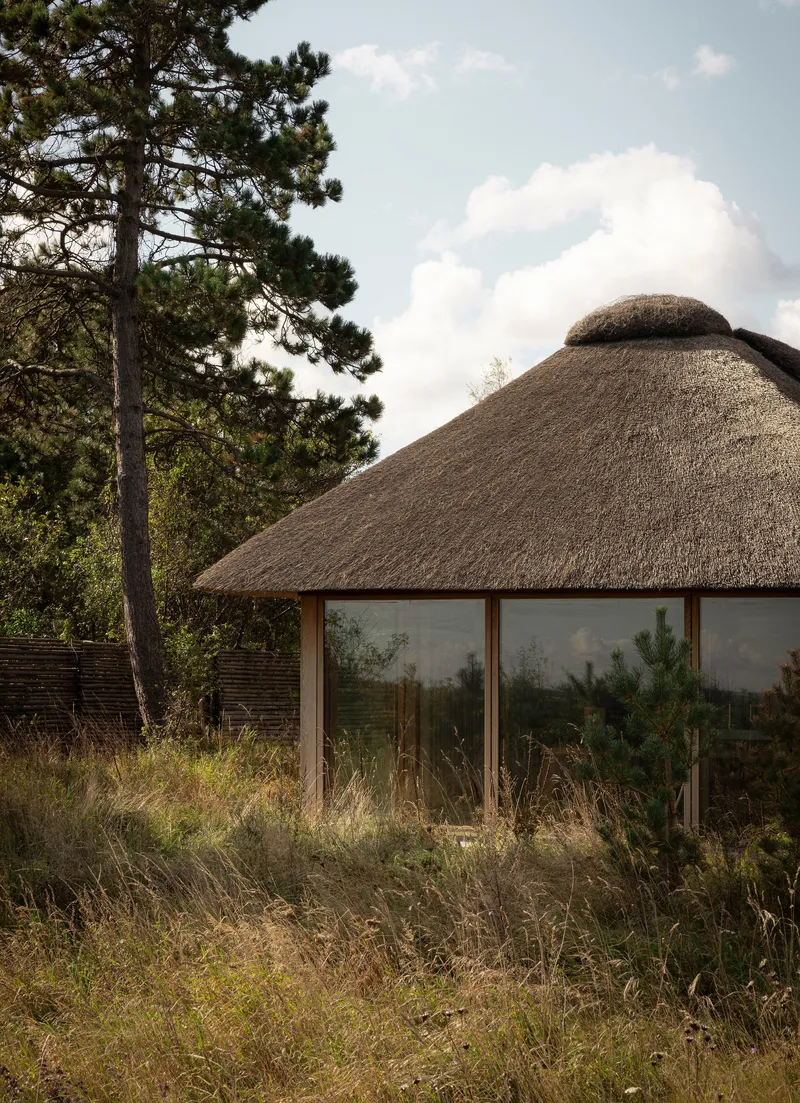
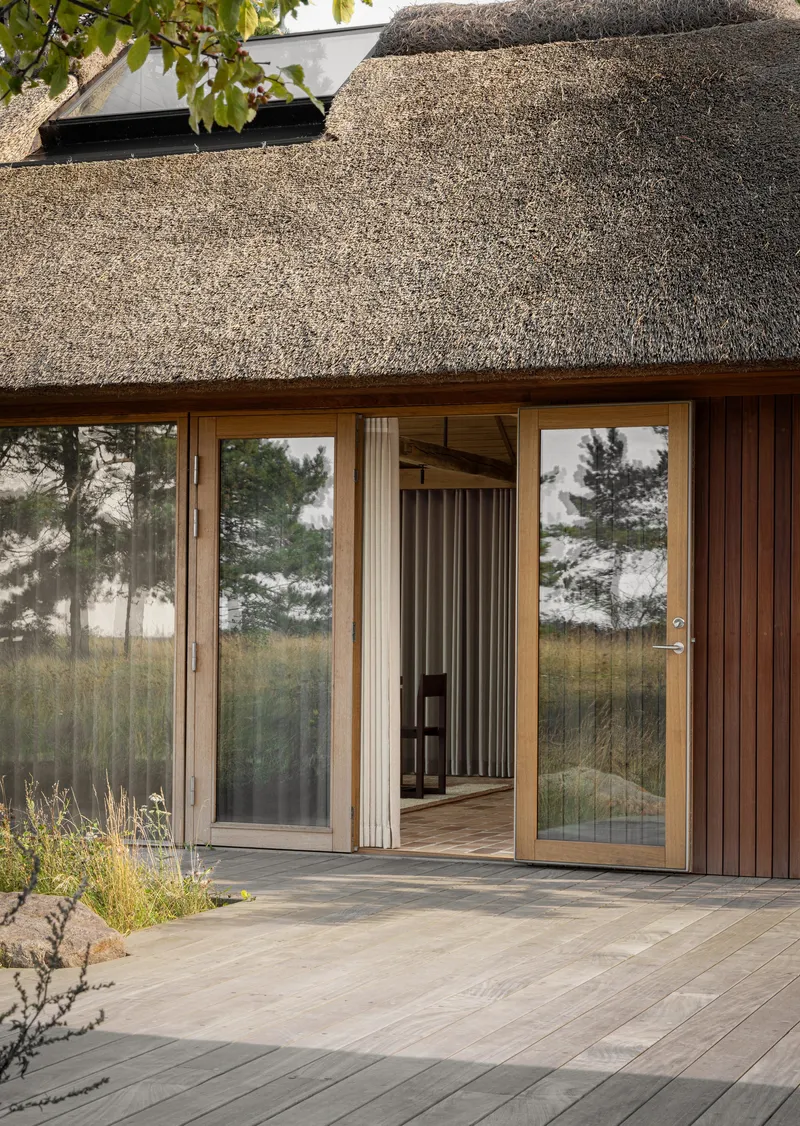
Thatch is one of the oldest roofing materials in the Danish building tradition, and NORM Architects deploy it here without irony or nostalgia. The roof is the dominant formal gesture: a generous, slightly conical volume that shelters the continuous glazing band below and produces deep eaves. Those eaves do real work, shading the interior from high summer sun while allowing low winter light to penetrate fully.
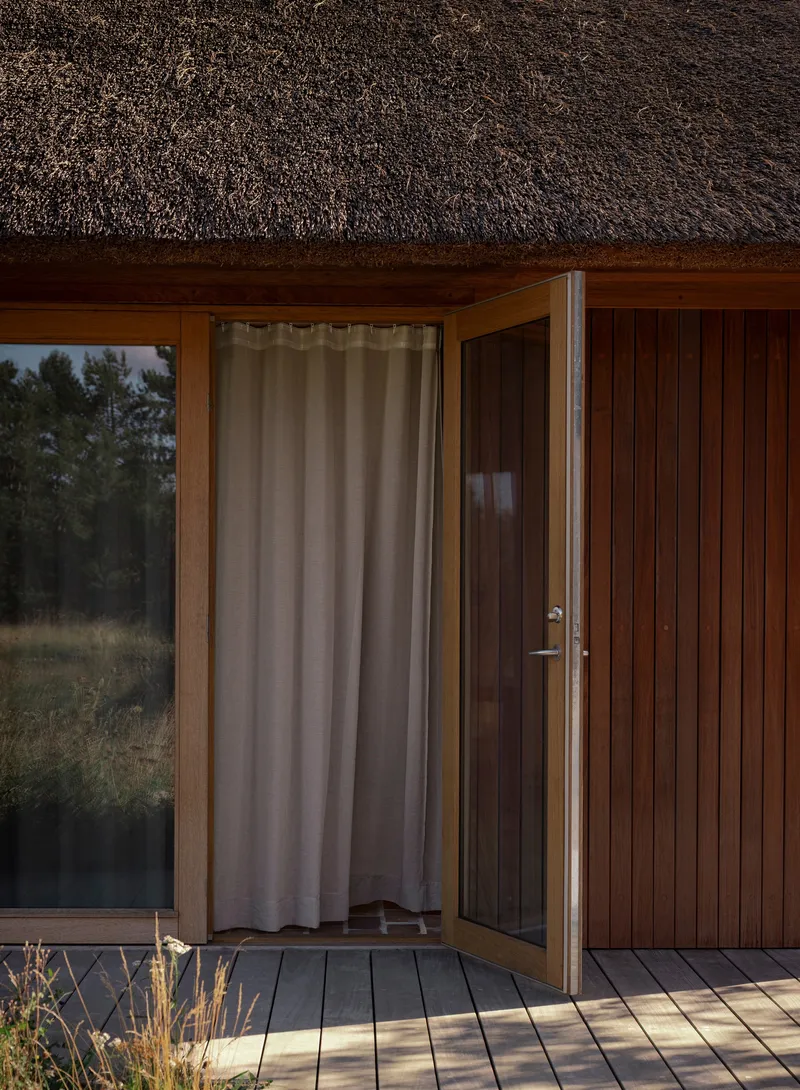
The vertical timber siding beneath the thatch line creates a taut, almost textile-like surface. Sliding glass doors dissolve the boundary between deck and interior, and a linen curtain at the threshold softens the transition further. The effect is a building that breathes, opening wide to the meadow in summer and closing down to a sheltered cocoon in the colder months.
Threshold and Terrace
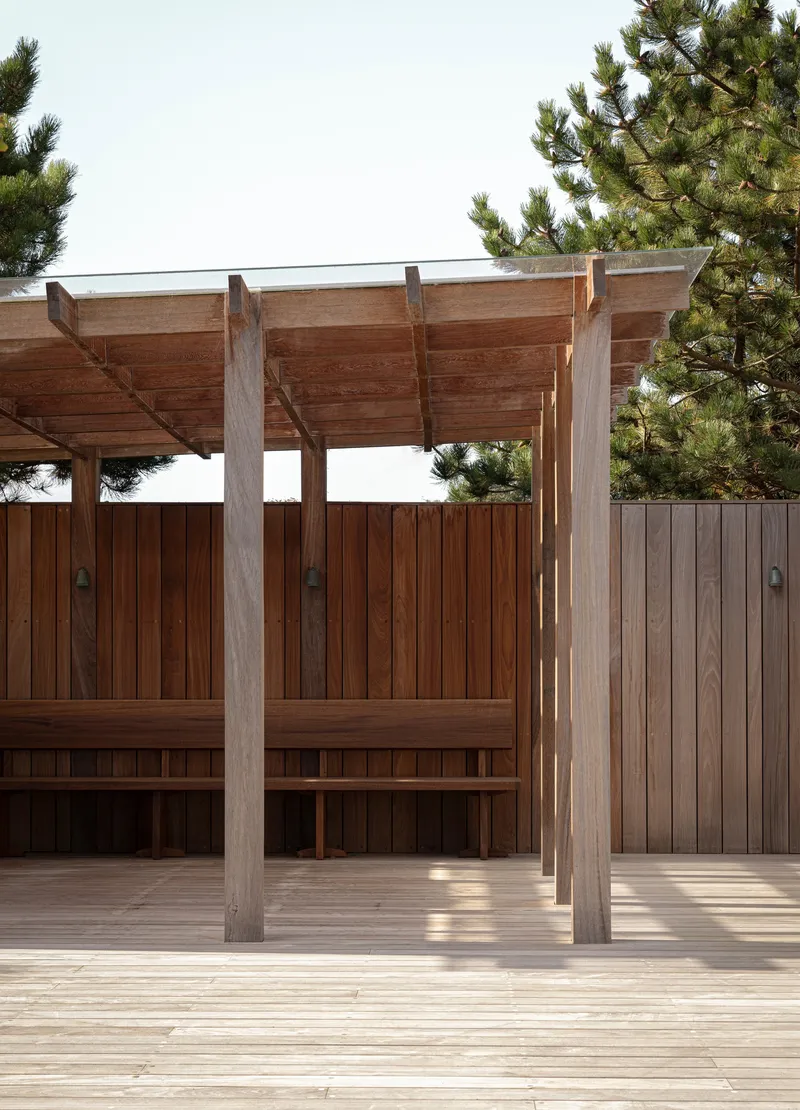
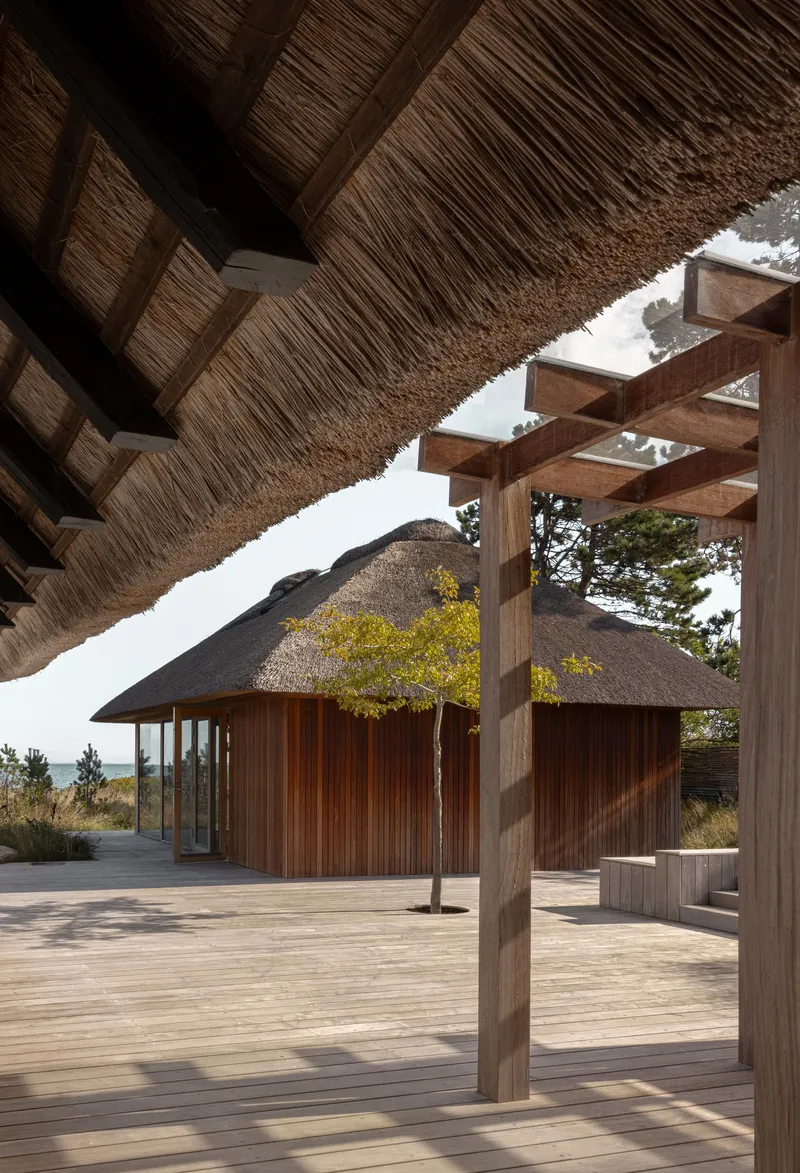
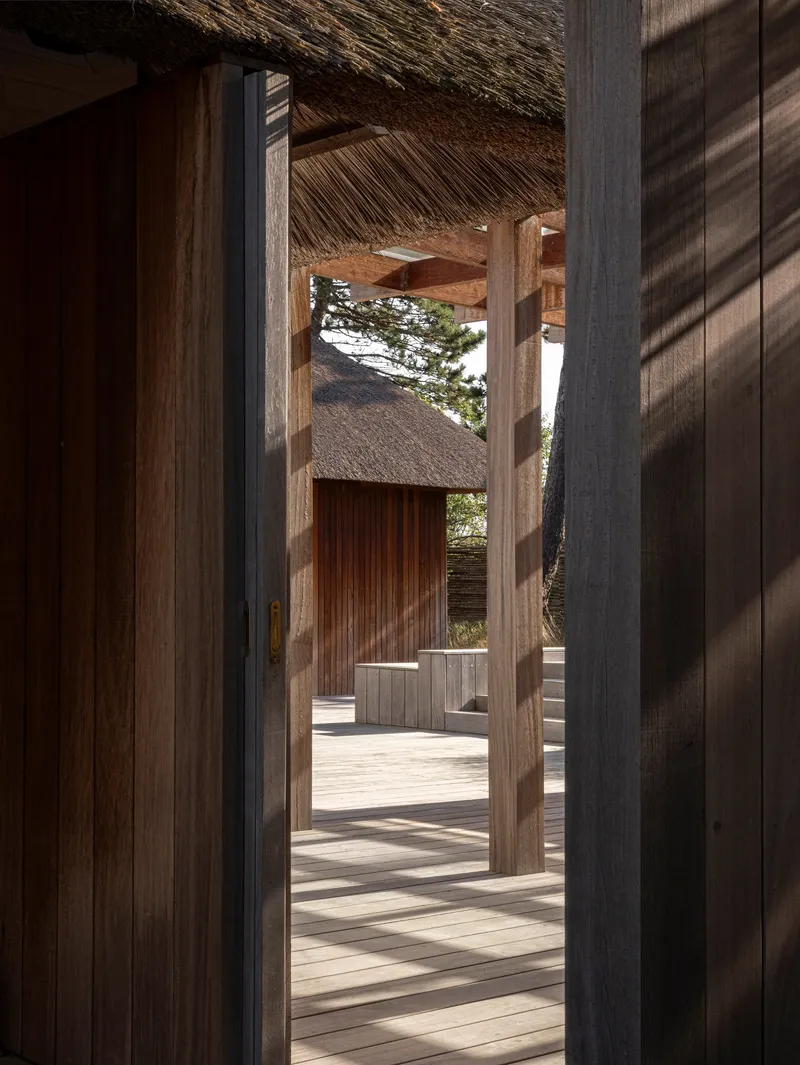
The timber pergola that extends from the thatched volume is more than a deck. It is a decompression chamber, a space of neither inside nor outside, where exposed rafters cast rhythmic shadows and the view is deliberately channeled between vertical wood screens. The pergola borrows from the Japanese concept of engawa, the in-between threshold zone that negotiates the passage from garden to room.
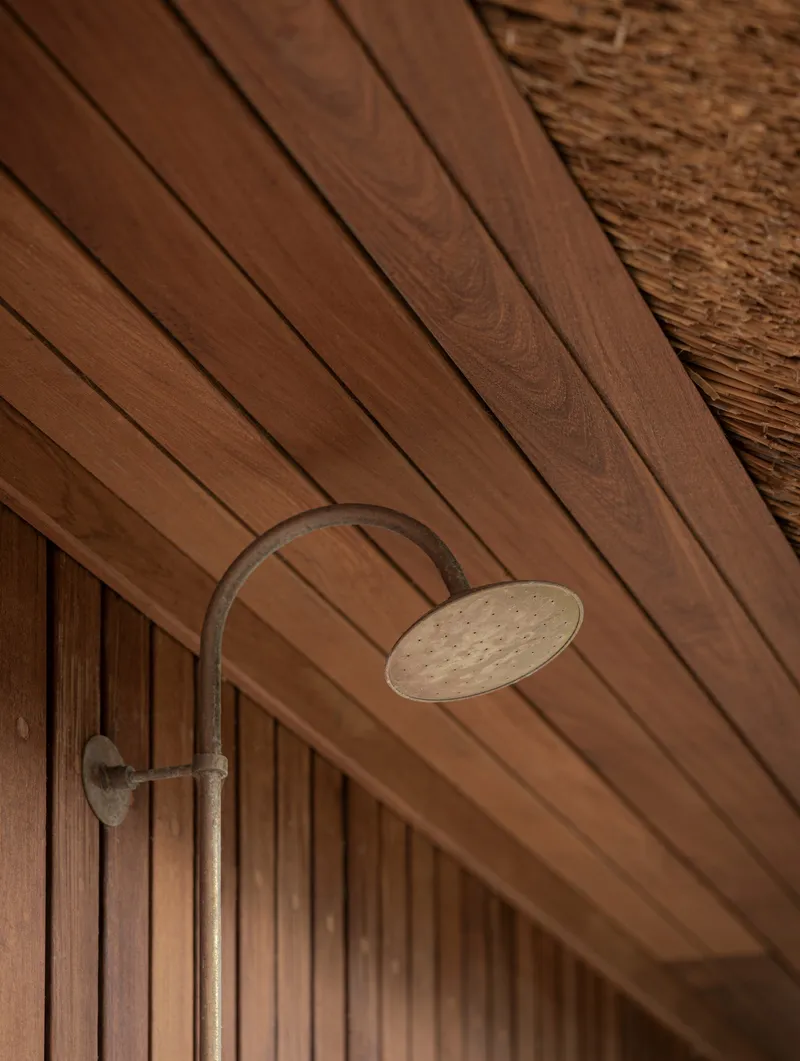
Brick flooring continues seamlessly from the interior outward, eliminating the typical domestic step-up and reinforcing the sense that the building is a grounded platform rather than an elevated object. An outdoor shower, mounted beneath the timber soffit, completes the idea of the terrace as a functional landscape rather than decoration.
A Single Room, Quietly Organized
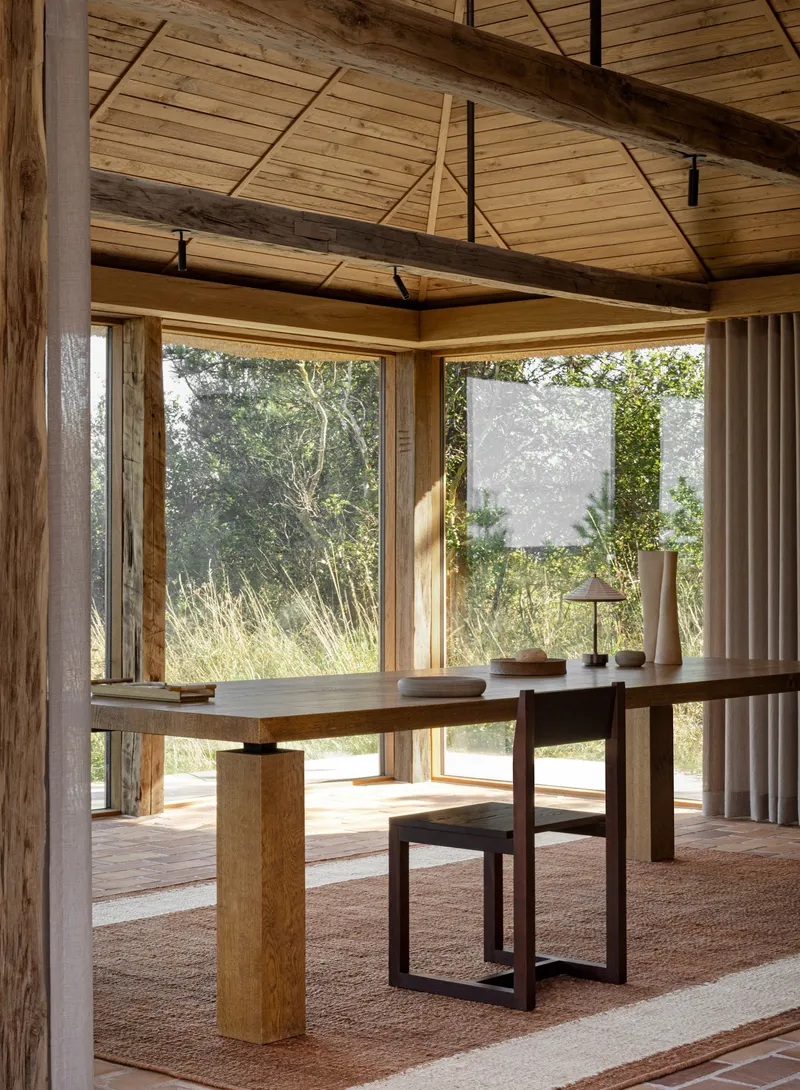
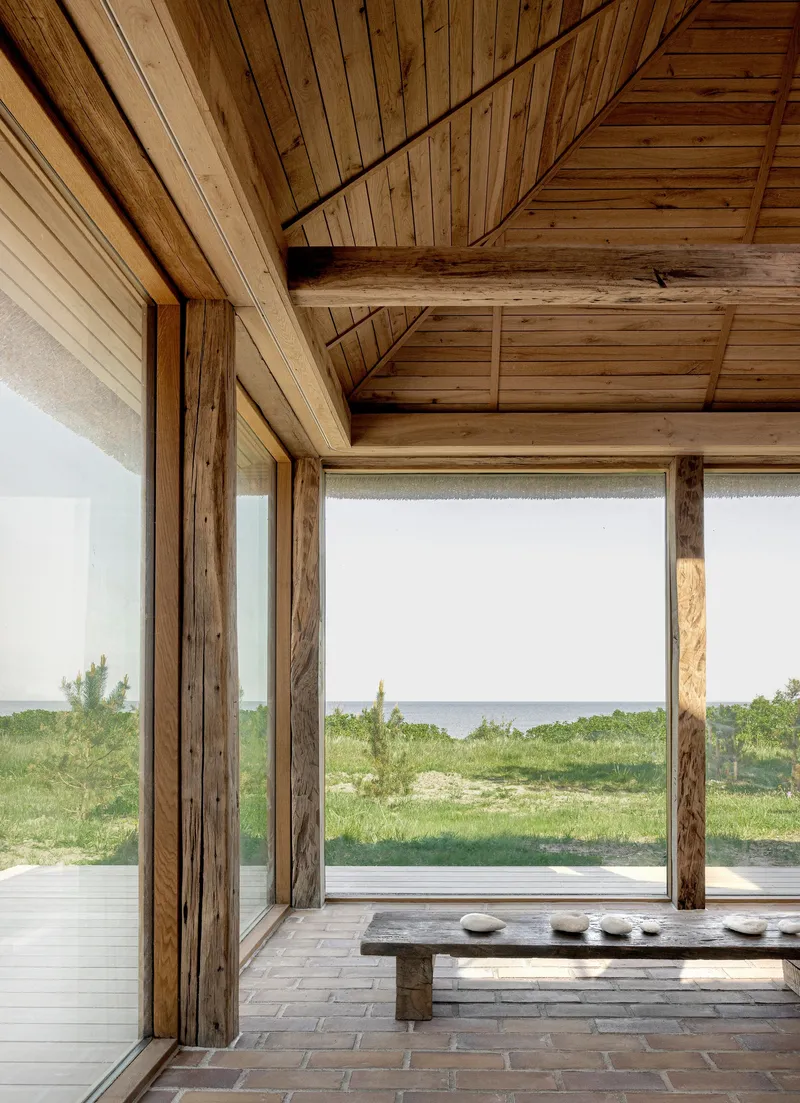
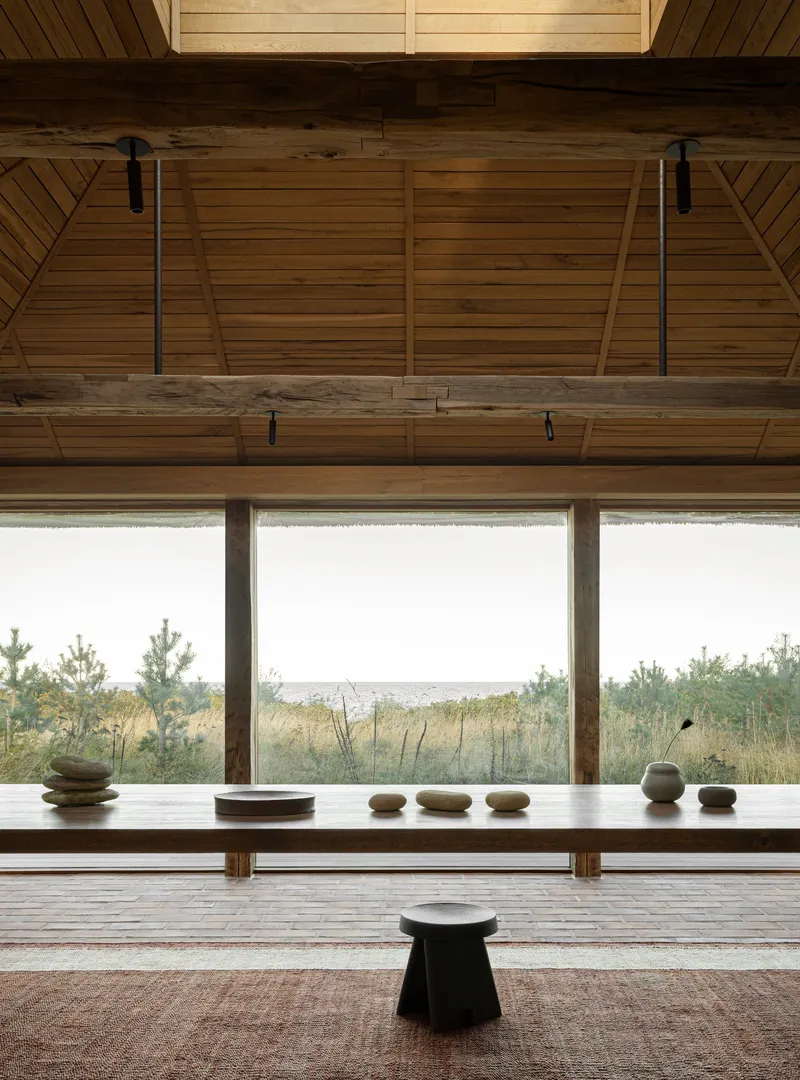
The interior is essentially one open volume, a flexible atelier governed by a post-and-beam structure of reclaimed timber. Secondary functions, kitchen, storage, sleeping alcove, are tucked behind bespoke joinery and linen curtains rather than fixed partitions. The result is a room that can be a studio, a dining hall, or a contemplative retreat depending on the hour and the season.
Floor-to-ceiling glazing wraps the perimeter, and every window is a deliberate composition: dunes, grasses, the distant coastline. The concept of borrowed scenery, shakkei, is at work here. The landscape is not merely visible; it is enrolled as interior finish. A built-in timber bench runs along one wall, low enough to sit on, wide enough to sleep on, and positioned so that the view from it becomes the room's focal point.
Light from Above
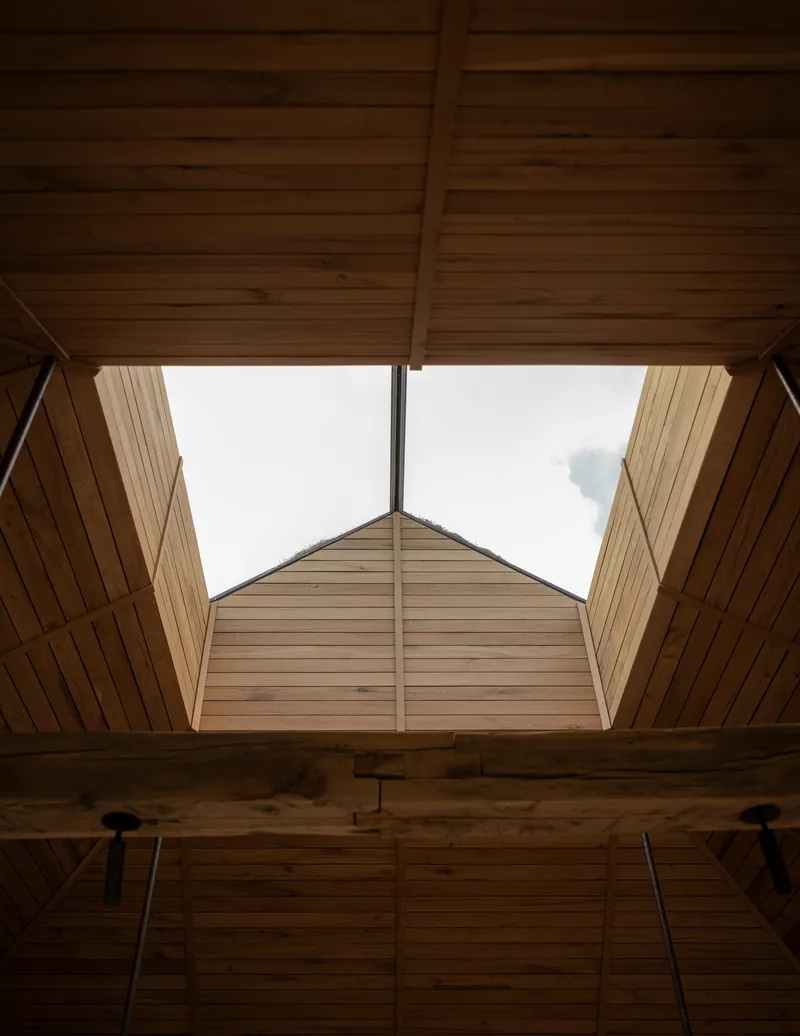
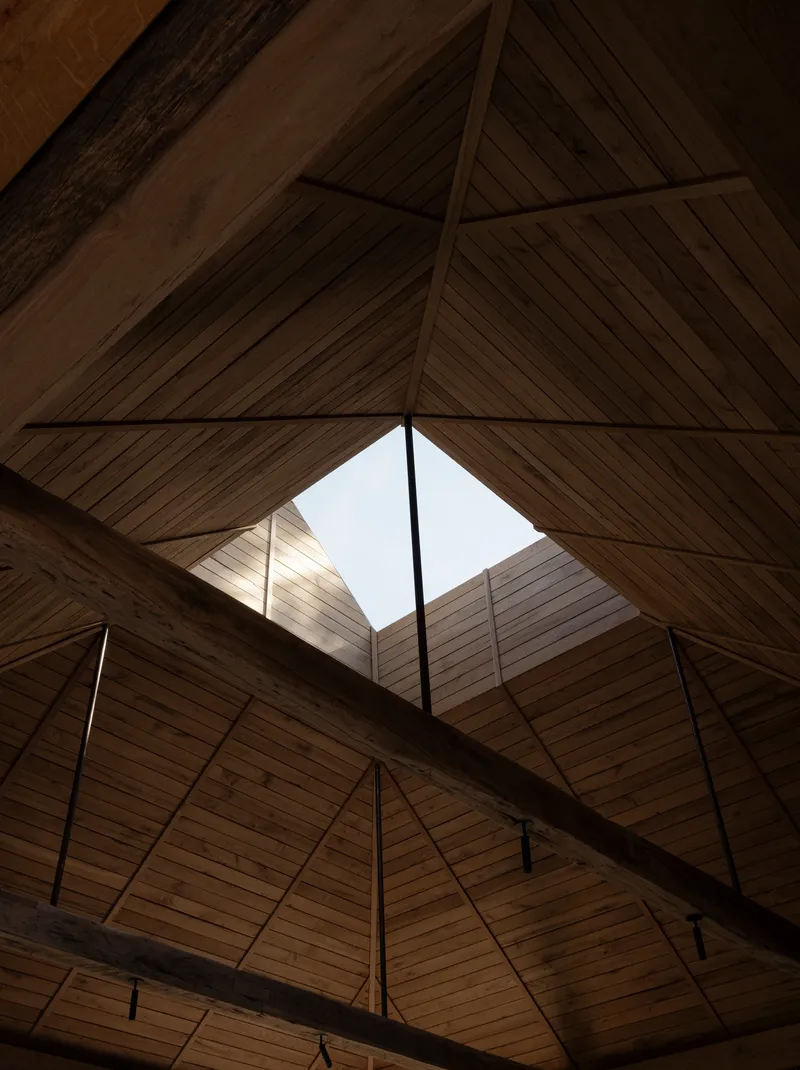
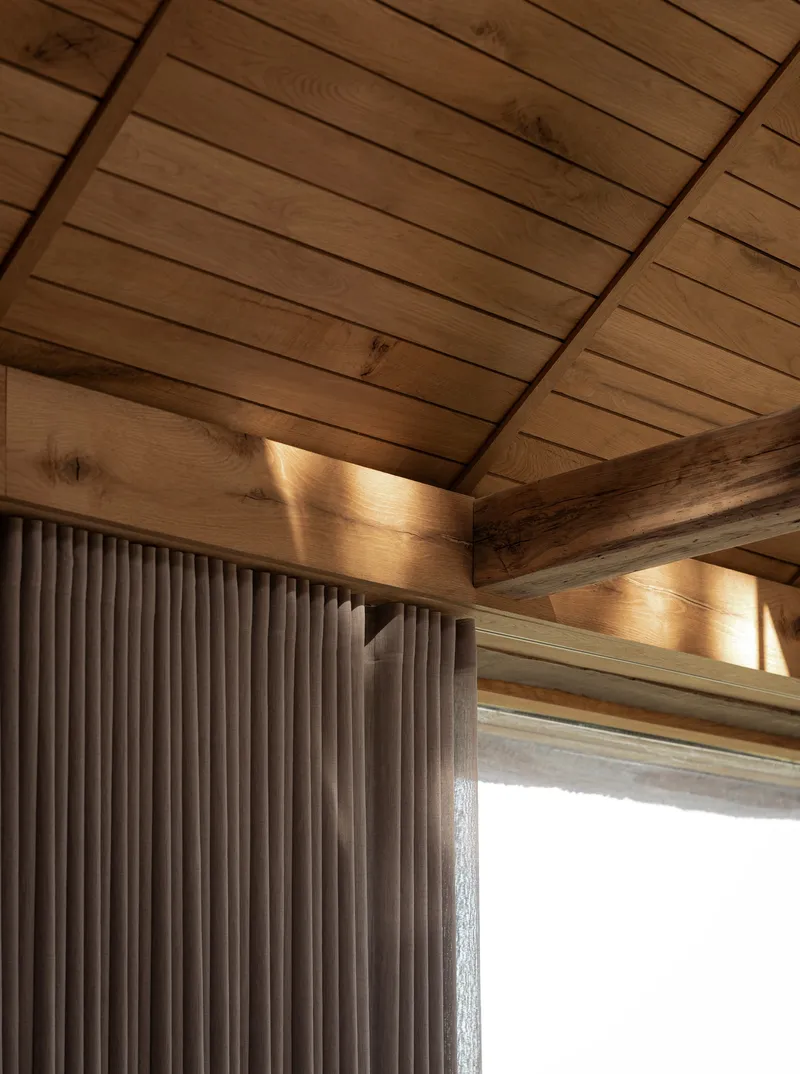
A central skylight punches through the pitched timber ceiling, drawing natural light deep into the core of the volume where the perimeter glazing alone cannot reach. The opening is lined with timber planks that glow warm in afternoon sun, and a single pendant light hangs from the apex, centering the room without dominating it. Exposed beams radiate outward from the skylight, making the ceiling structure legible and giving the space its vertical dimension.
Wooden louvers on select openings filter and modulate daylight throughout the day, creating shifting patterns across the brick floor. The interplay between zenithal light and lateral light is carefully tuned: mornings are bright and even, afternoons are dramatic and directional.
Material Honesty as Method
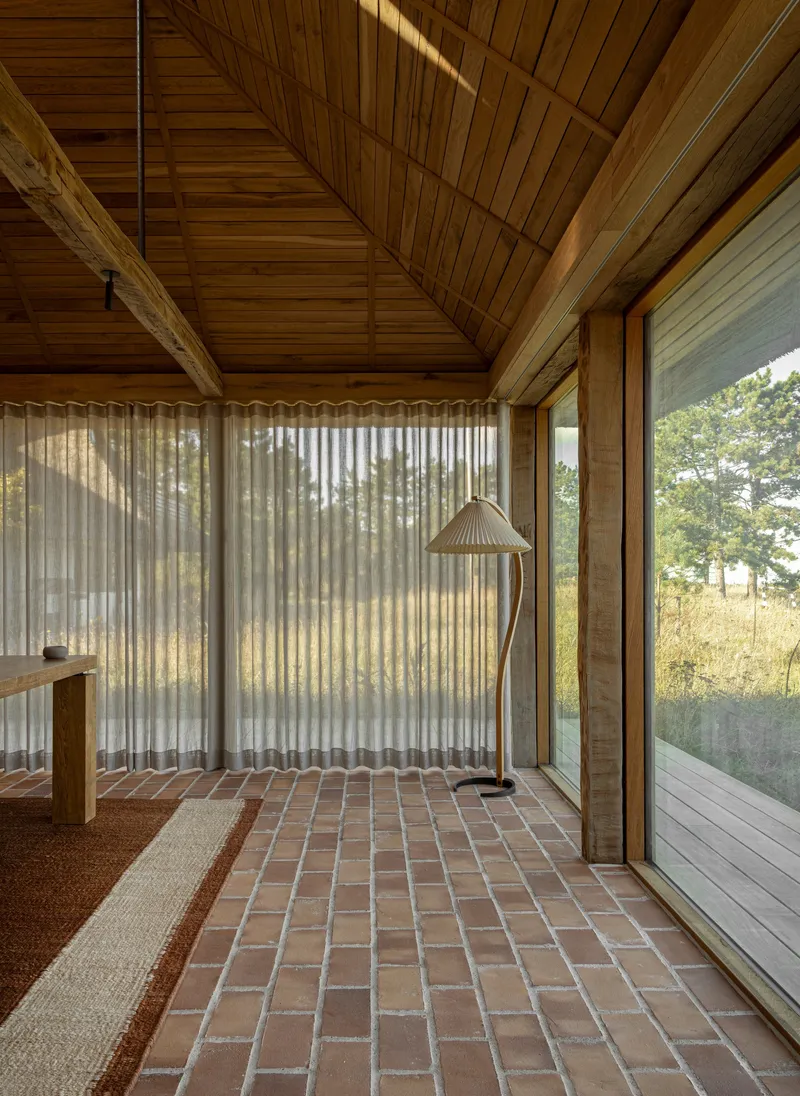
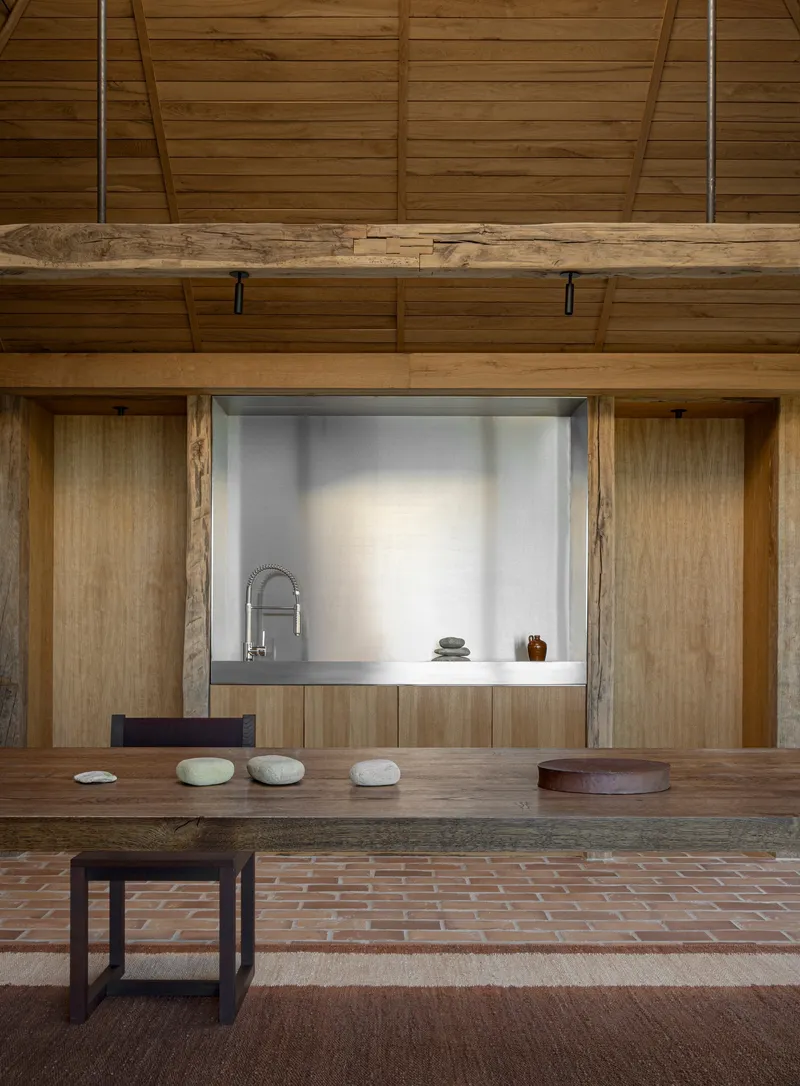
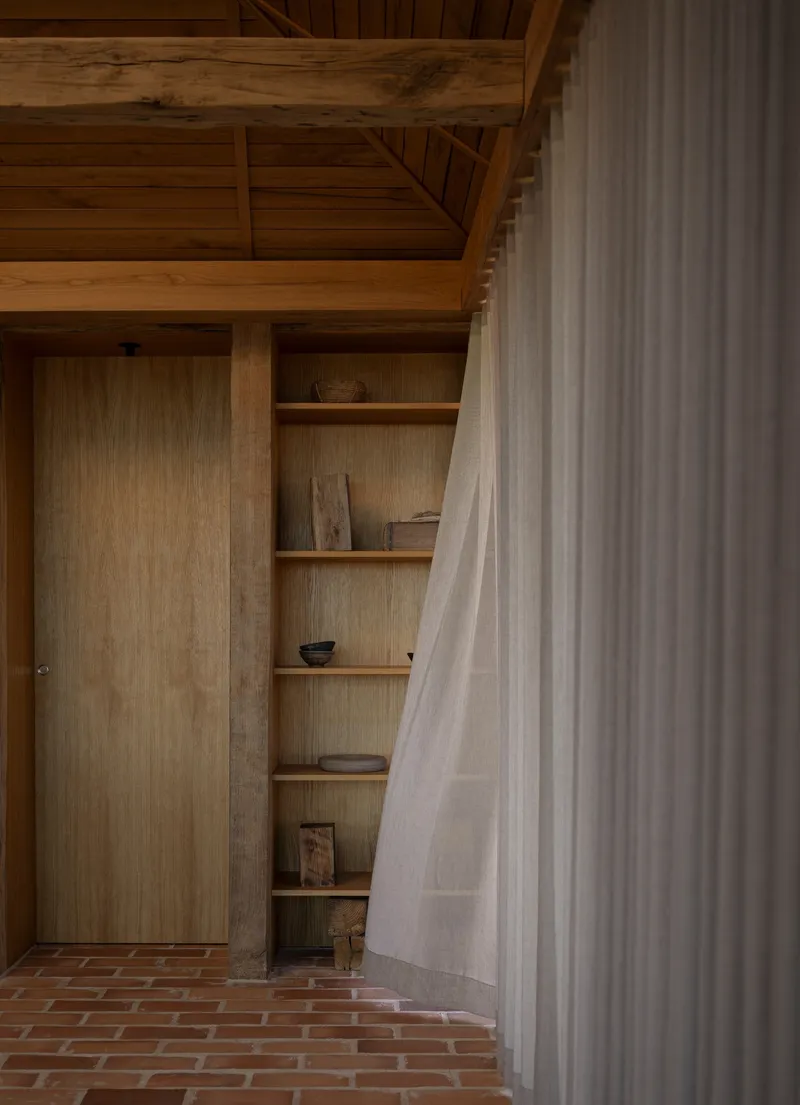
Every material in the building is chosen for its capacity to age. Brick pavers will darken with moisture and wear. Timber will gray. Thatch will compress and settle. Stainless steel at the kitchen pass-through provides a single moment of industrial precision against the softer craft surfaces, and it is the one material that will not change. The contrast is intentional: it locates the contemporary within the traditional without making a fuss about it.
Storage is concealed behind linen curtains in timber-framed alcoves, and shelving is built in rather than applied. Hand-thrown ceramics and natural stone objects populate surfaces without cluttering them. The overall sensibility owes as much to the Japanese wabi-sabi ethos of beauty in imperfection as it does to the Scandinavian functionalism that NORM Architects are known for.
The Integrated Landscape
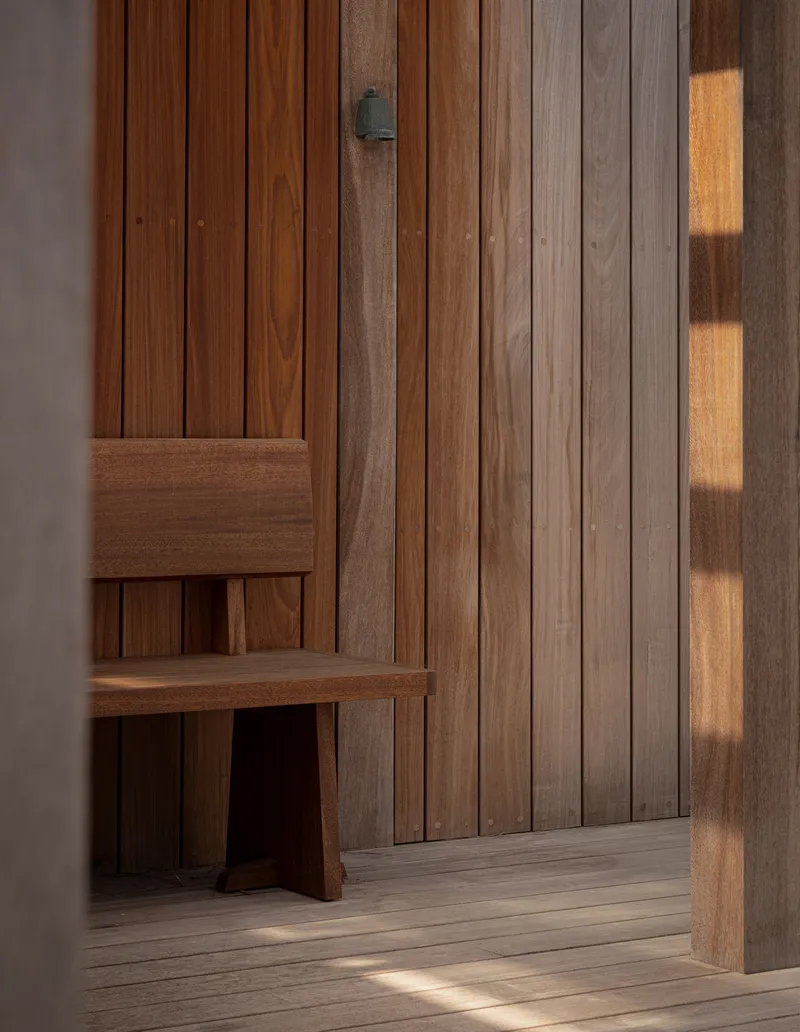
Late afternoon light entering through the cladding joints illuminates the interior bench and wall surfaces with a warm, raking glow. It is a deliberate atmospheric effect, not an accident. The orientation of the building, the spacing of the slats, and the depth of the reveals are all calibrated to produce this condition at the hours when creative energy tends to wane and contemplation takes over.
From any position inside the studio, the meadow and dunes are present. The architecture does not compete with the landscape; it instrumentalizes it. Grasses press up against the glass, pines frame the middle distance, and the sky fills the upper register of every opening. The building is a lens for seeing the coast more clearly than you would without it.
Why This Project Matters
Shoreline Studio is significant not because it revives thatch or borrows from Japan, but because it demonstrates how deeply a building can belong to its site when every decision, material, structural, spatial, is derived from a single coherent logic. The post-and-beam frame is honest. The thatch is functional. The brick floor is continuous. Nothing is decorative, and nothing is arbitrary. In a moment when residential architecture often defaults to either maximalist gesture or minimalist blankness, this project occupies a rare middle ground: it is specific, warm, and disciplined.
NORM Architects have shown that the summerhouse typology, one of Denmark's most culturally loaded building types, still has room for reinvention. By reading the existing brick house as a partner rather than a predecessor, and by importing the compressed threshold and material restraint of the Japanese teahouse without mimicry, they have produced a retreat that rewards slow looking. It is the kind of building that reveals its intelligence over seasons rather than in a single photograph.
Shoreline Studio by NORM Architects. Located in Odsherred, Denmark. Residential and office atelier. Photography by Jonas Bjerre-Poulsen and Karl Tranberg Knudsen.
About the Studio
Share Your Own Work on uni.xyz
If projects like this are the kind of work you want to make, uni.xyz is a place to publish your own, find collaborators, and enter design competitions.


Popular Articles
Popular articles from the community


Cloaked Colonization: A Mobile Underwater Habitat That Moves Like a Fish
Micah Abaya's shortlisted EHC Pacific entry reimagines ocean settlement as a dispersed network of self-sustaining architectural organisms.

Opera by the Sea Estonia: Three Shells Dissolving Architecture into Tallinn's Coastline
A winning opera house proposal replaces monumental form with interconnected shells that blur the boundary between building, park and Baltic Sea.
Tsunami Convergenics: Turning Catastrophic Ocean Forces into Underwater Housing Infrastructure
A speculative underwater settlement off the coast of Onagawa, Japan, treats tsunamis and typhoons as energy sources rather than threats.

The Amber Palace Opera: A Geological Fiction Surfaces on Tallinn's Baltic Waterfront
Pierre Brillard reimagines a Baltic legend as a public landscape, opera house, and waterfront promenade rooted in Tallinn's coastal identity.

Similar Reads
You might also enjoy these articles

Pixel Gardens: One Repeated Module Stacked Into a Terraced Social Housing Tower for Famagusta
Salem Bader's shortlisted housing tower builds a vertical neighbourhood from one repeated module, offsetting units to carve terraces, light and air.

Bao Huynh Watercolor Atelier: A Serene Art Retreat in Hội An
Bao Huynh Watercolor Atelier in Hội An blends multifunctional art spaces, sustainable design, local materials, and family-friendly living in a serene environment.

Atelier Macri Concept Store Interior Design by CASE-REAL
Atelier Macri store features a "ko" counter, walnut wood details, cork displays, blending retail, gallery, and seamless customer experiences.

Manuel Vargas Izquierdo Stadium and High-Performance Sports Center: Architectural Excellence in Jalpa de Méndez
The Manuel Vargas Izquierdo Stadium blends sustainable design, inclusive sports facilities, and cultural-inspired architecture, revitalizing Jalpa de Méndez’s public spaces.

Explore Seaside Competitions
Discover active competitions in this discipline

Challenge to design a portable theatre

Challenge to design a portable music platform

Challenge to design an open learning module for the elderly
Comments (0)
Please login or sign up to add comments
No comments yet. Be the first to comment!