

Objekt Architecten Pours a Concrete Disc Through an Aalst Weaving Mill Turned Showroom
A former textile factory on the Dender canal becomes a 2,045 m² kitchen and bath showroom structured by concrete, metal, and wood.


Aalst built its identity on thread and loom. The city's 18th-century textile boom left behind a constellation of brick warehouses along the Dender river, solid buildings whose scale was calibrated to industrial ambition rather than domestic comfort. The ark38 building on Pierre Corneliskaai is one of those survivors: a symmetrical three-aisle weaving mill that later housed a Tupperware plastics operation before going quiet altogether. Objekt Architecten and Hans Sterck have now given the 2,045 m² shell a third life as the showroom for Sterck NV, a kitchen and bathroom specialist. The conversion is anything but cosmetic.
What makes the project worth studying is the decision to treat material, not partition walls, as the primary organizing device. A poured-in-place concrete disc occupies the left and central aisles, resting on just three sculptural supports. A drawn-steel volume fills the rear zone with offices, storage, toilets, and a demonstration kitchen. A timber mezzanine floats inside the right-hand aisle, deliberately pulled away from both façades to keep the building's full height legible. Three materials, three programmatic zones, all held inside one brick envelope that has been meticulously cleaned and left to speak for itself.
Industrial Memory on the Canal
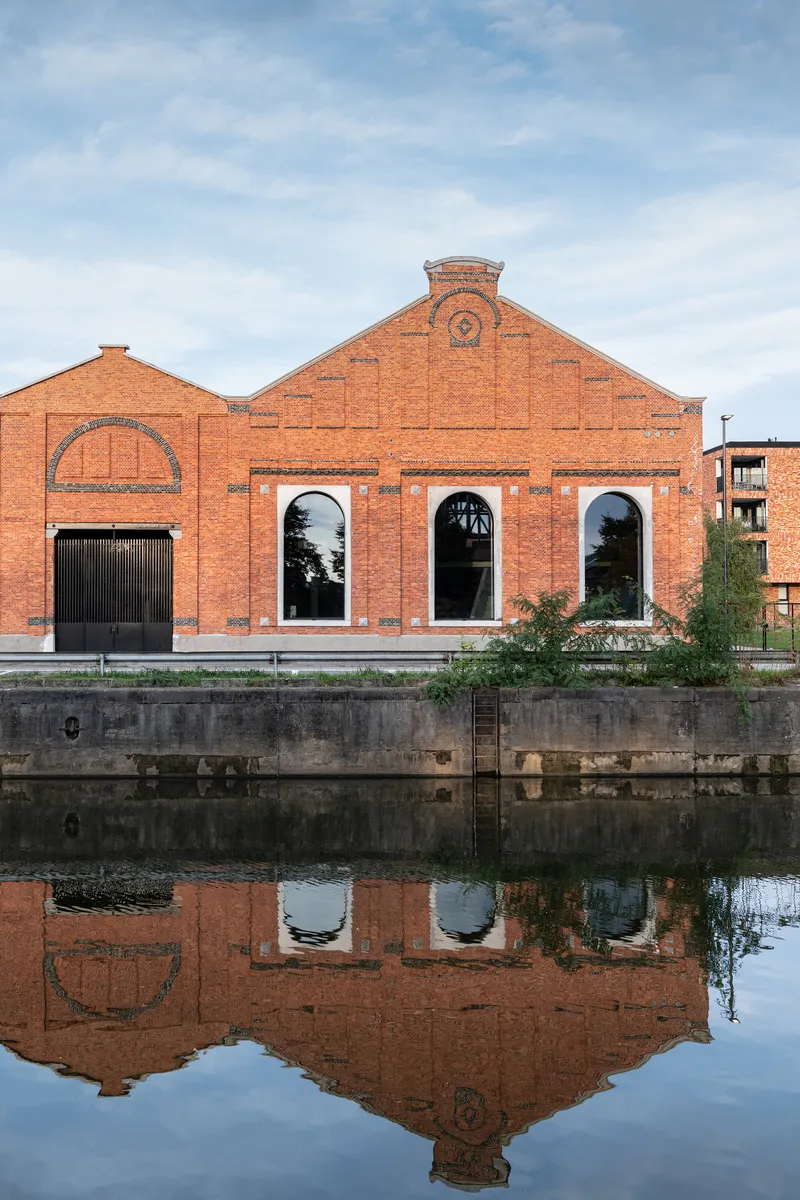
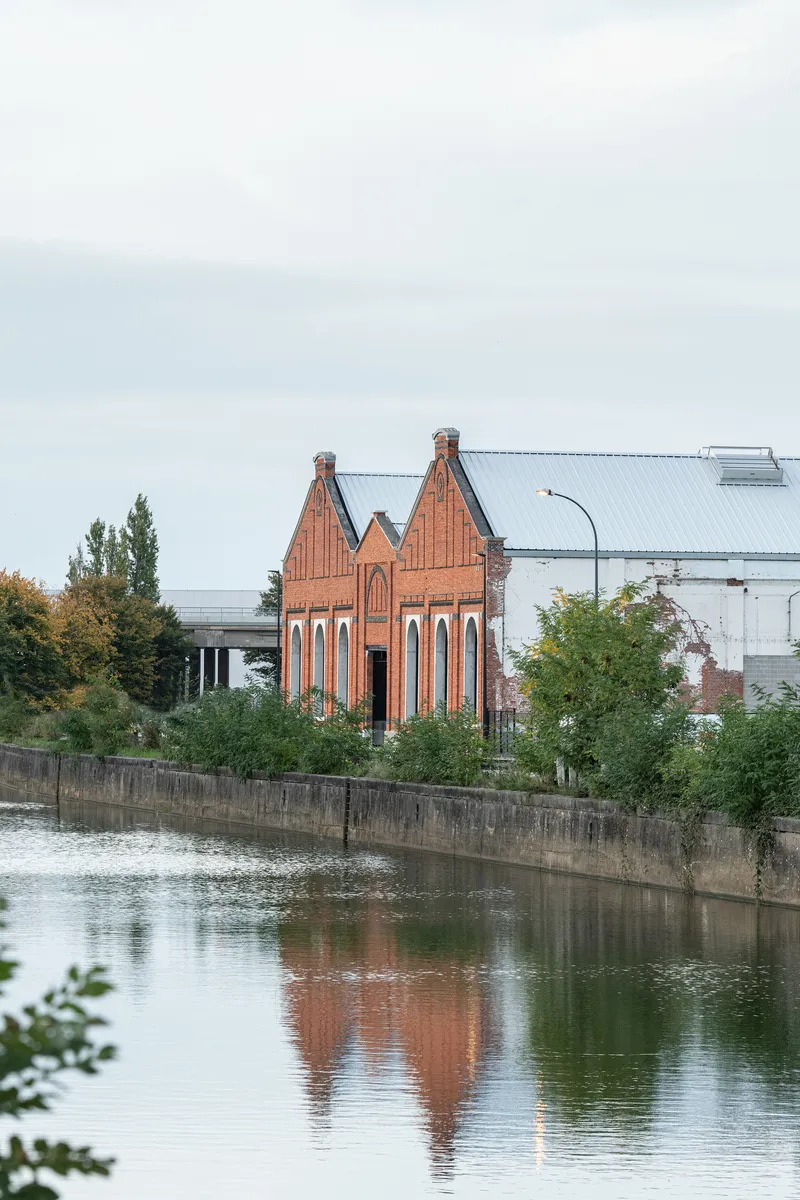
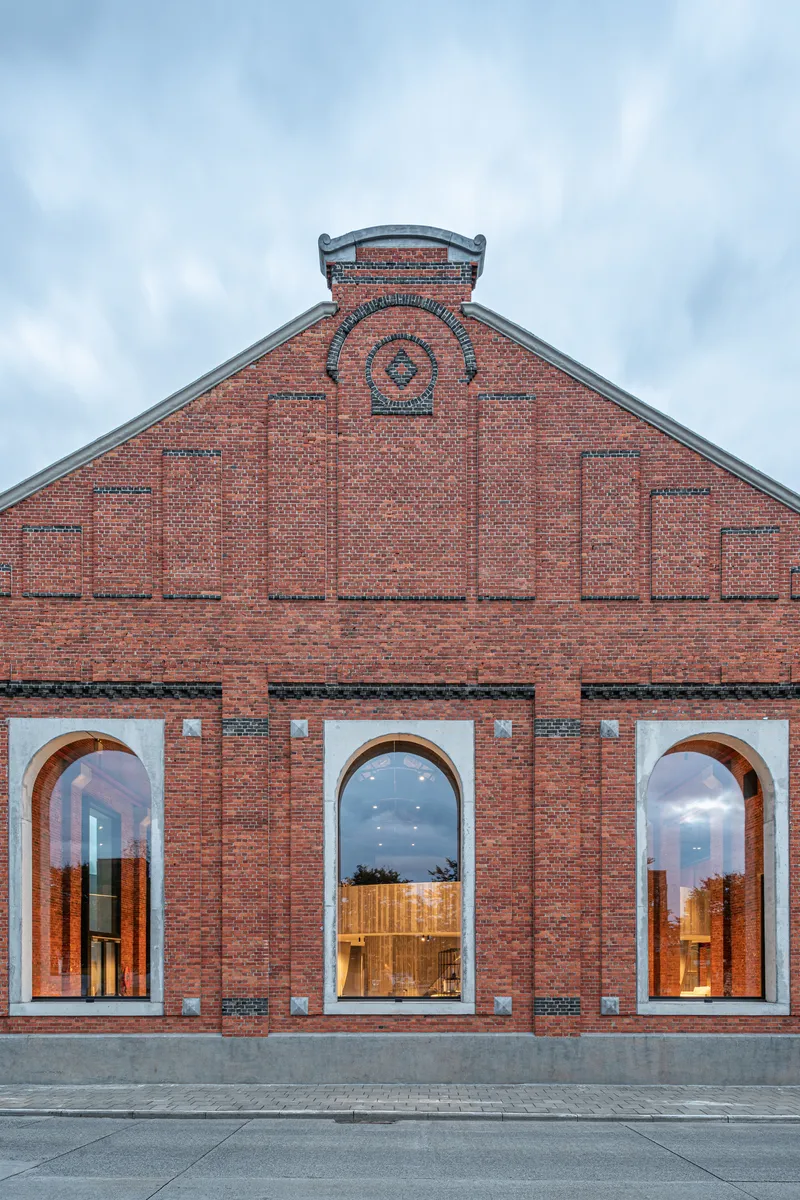
Seen from across the Dender, the mill reads as a civic monument. Twin chimneys flank a decorative medallion on the central gable, and the building's reflection doubles its presence on still water. Objekt Architecten resisted the temptation to puncture the façade with oversized glazing or signal modernity from the outside. A special cleaning process stripped years of grime to reveal the original brickwork, and new exterior joinery was placed behind the façade plane, partly concealed by the concrete structure within. The result is a building that still belongs to its 19th-century streetscape while harboring a radically different interior.
Arched Openings and a Restrained Exterior
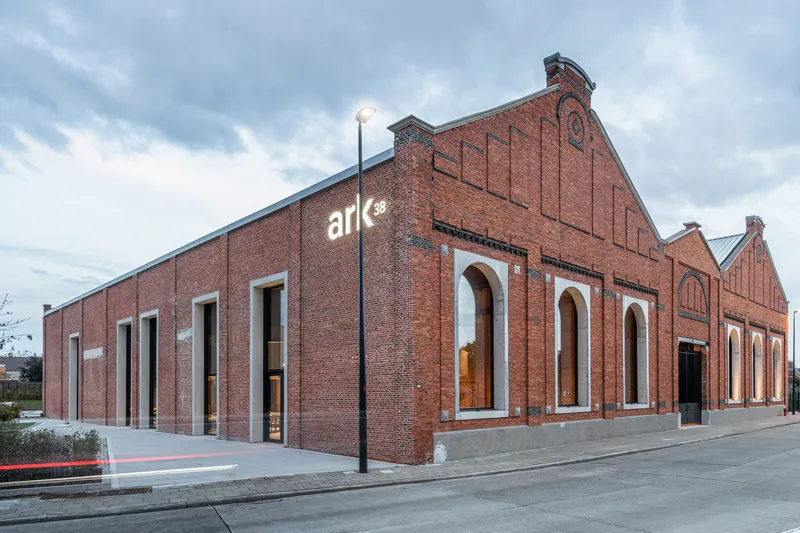
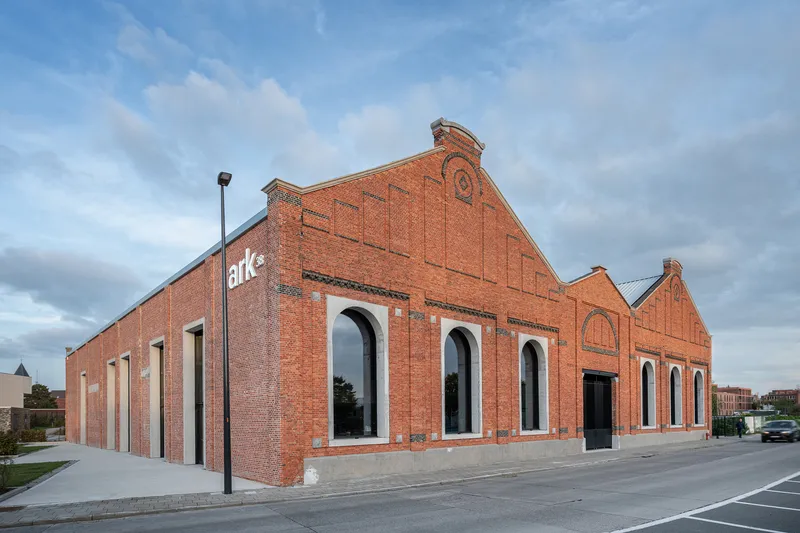
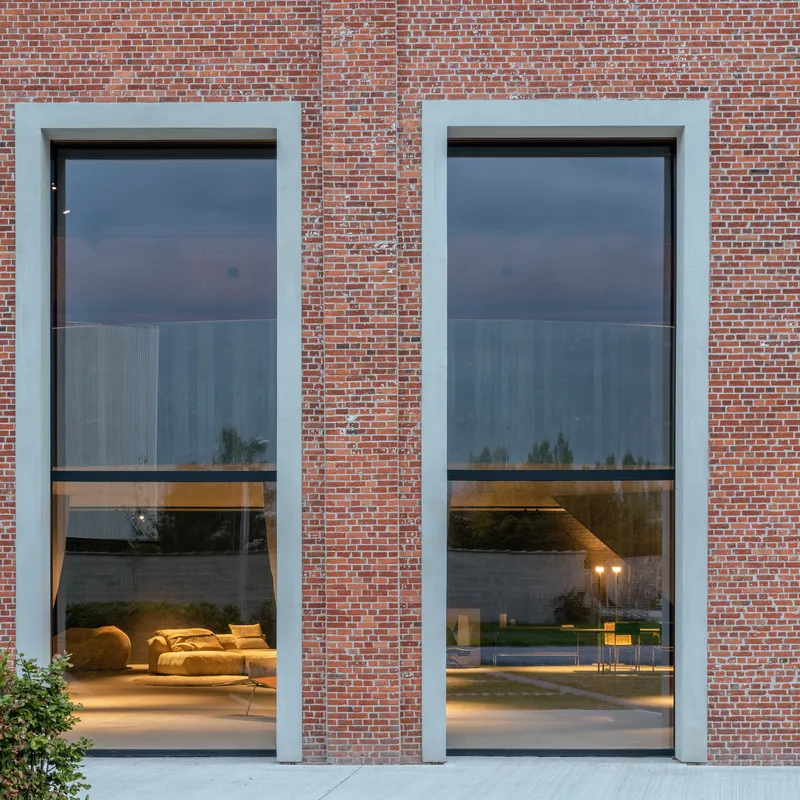
The street-facing elevations are defined by rhythmic arched openings, a motif the architects reinforced rather than overwrote. New concrete frames, poured with rounded tops to echo the original arches, stiffen the masonry where openings were enlarged. At dusk the showroom glows behind tall glazed panels framed in pale plaster, turning the building into a lantern without resorting to graphic signage or aggressive illumination. The approach is closer to restoration than renovation in spirit, yet the moments where new concrete meets old brick are left deliberately visible, marking the intervention as a dialogue rather than a disguise.
The Concrete Disc and Its Supports
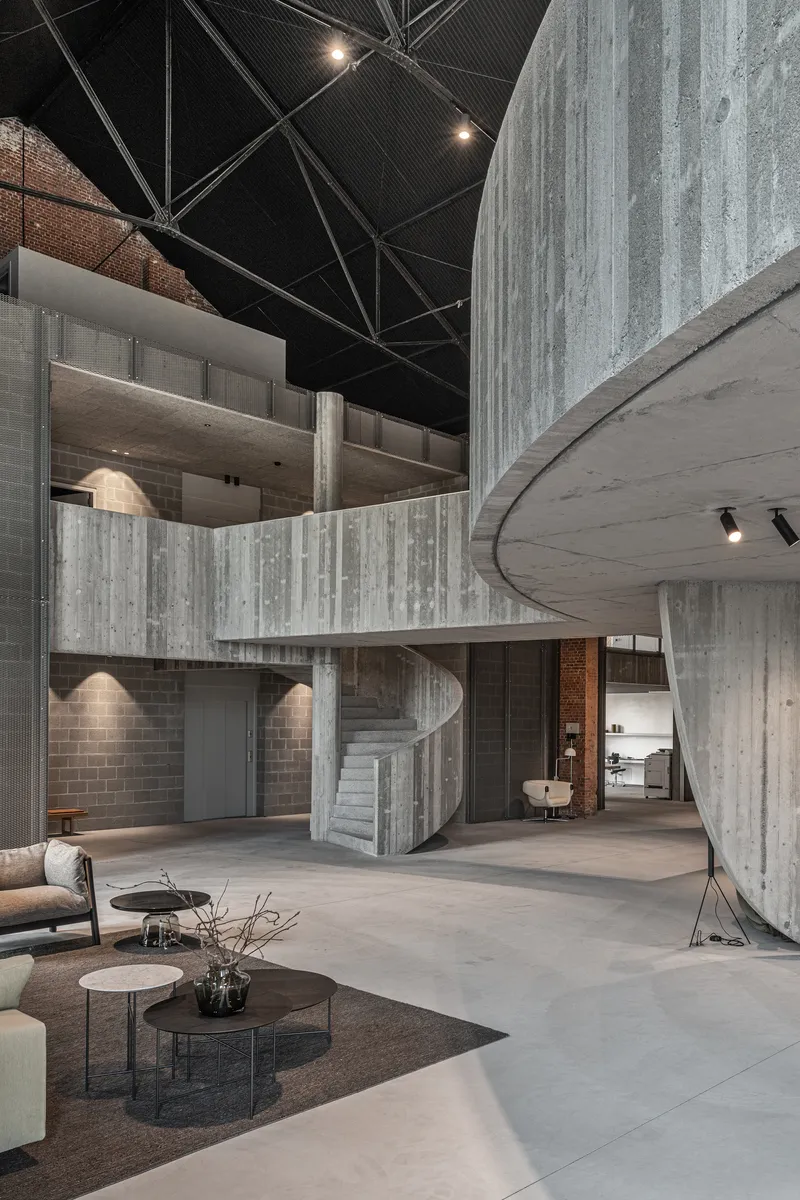
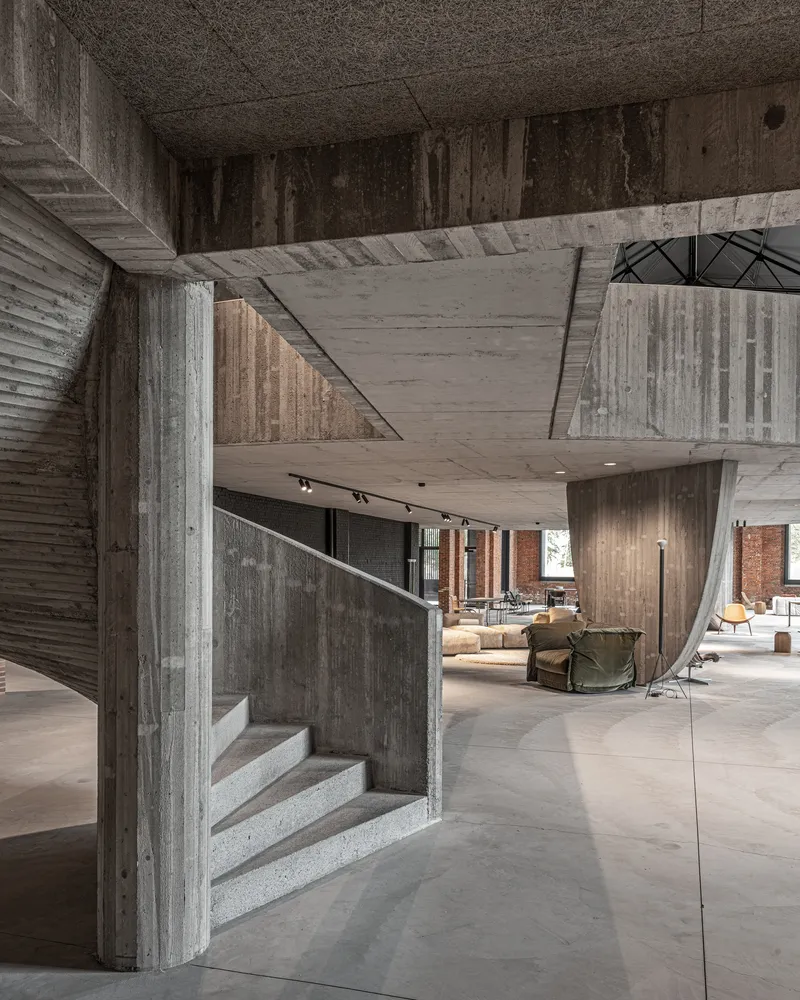
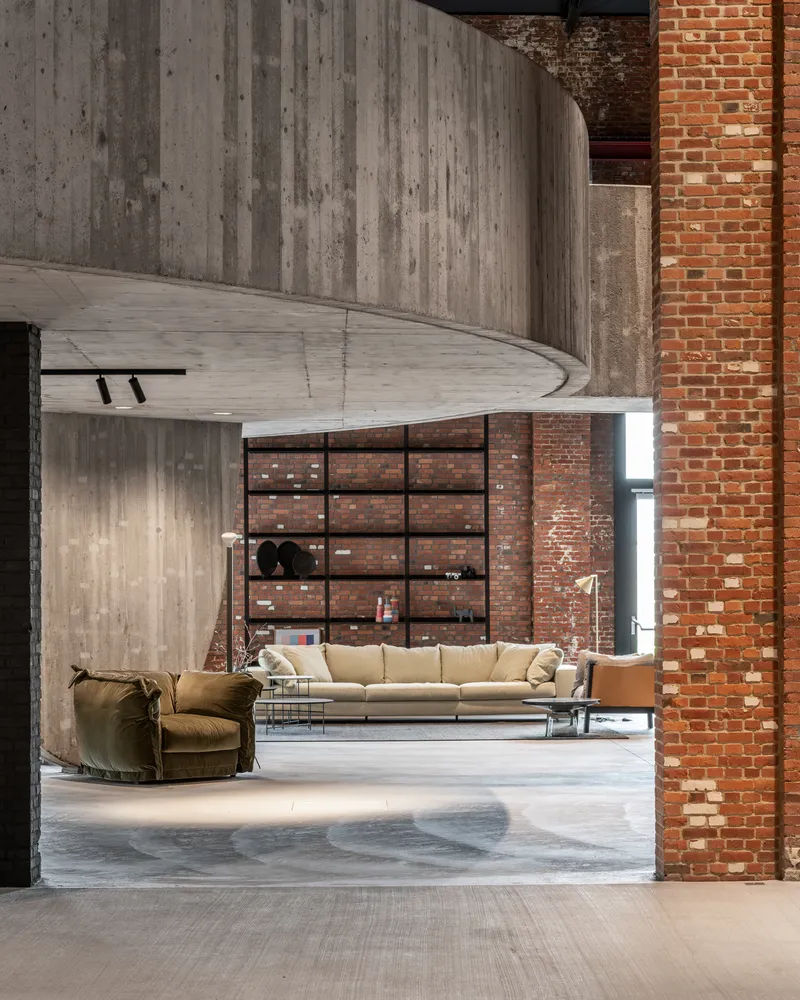
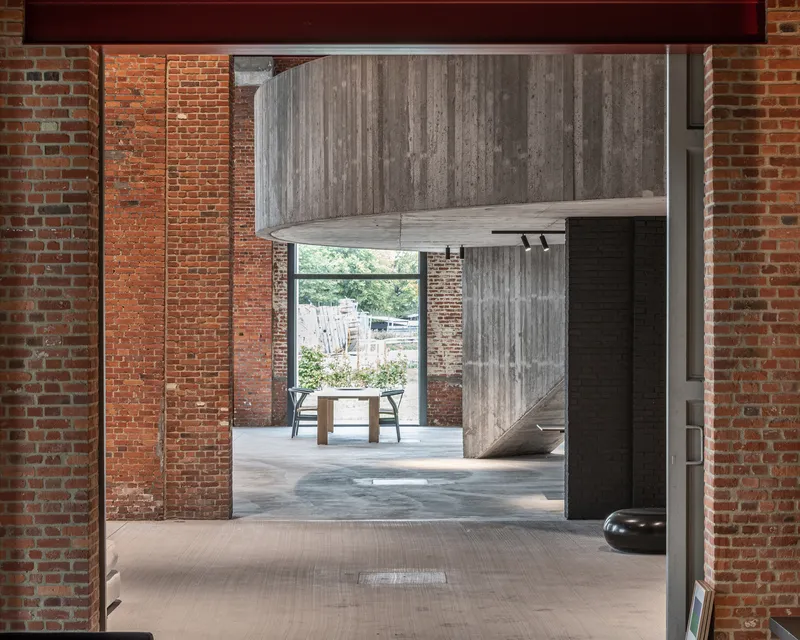
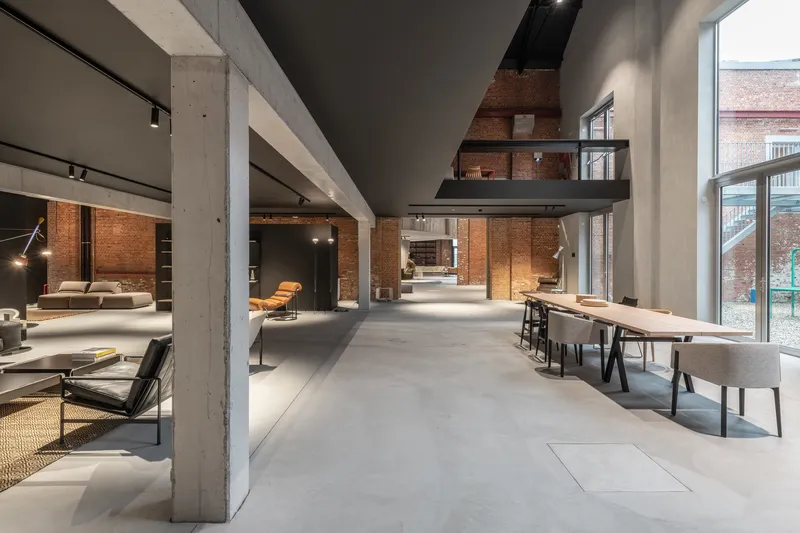
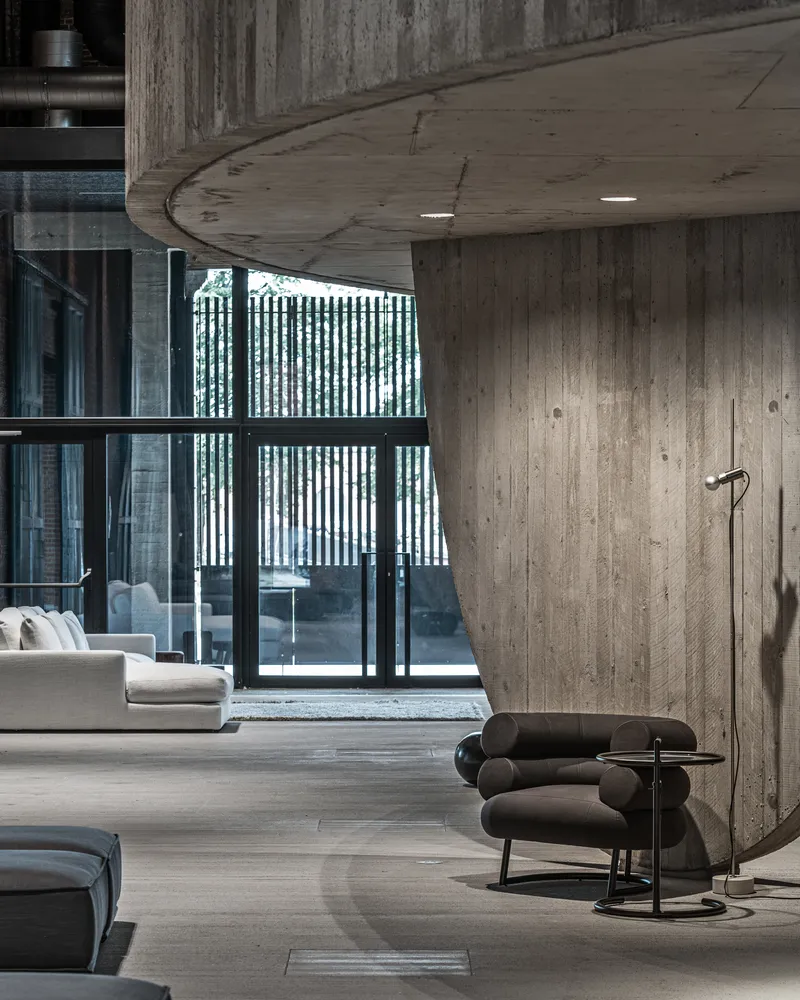
The defining gesture of the renovation is the concrete disc that spans the left and central aisles. Built on site by Jan De Nul, the disc functions as both a mezzanine floor and a spatial divider, carving the open warehouse into upper and lower worlds without erasing the sense of volume. It rests on three supports that are more architectural than structural in expression: thick, sculpted columns that also serve as display backs for furniture. The scale ratio between these supports and the merchandise they present was carefully calibrated so neither overwhelms the other.
Board-formed concrete surfaces carry the imprint of their shuttering, a deliberate choice that brings the material closer to craft than to smooth engineering. Where the disc's edge curves, the formwork grain follows, creating a continuous texture that softens what might otherwise feel brutally heavy. Two concrete staircases, a pitch stair and a spiral, provide access to the upper level and double as sculptural incidents visible from across the showroom floor.
Board-Formed Textures Against Old Brick
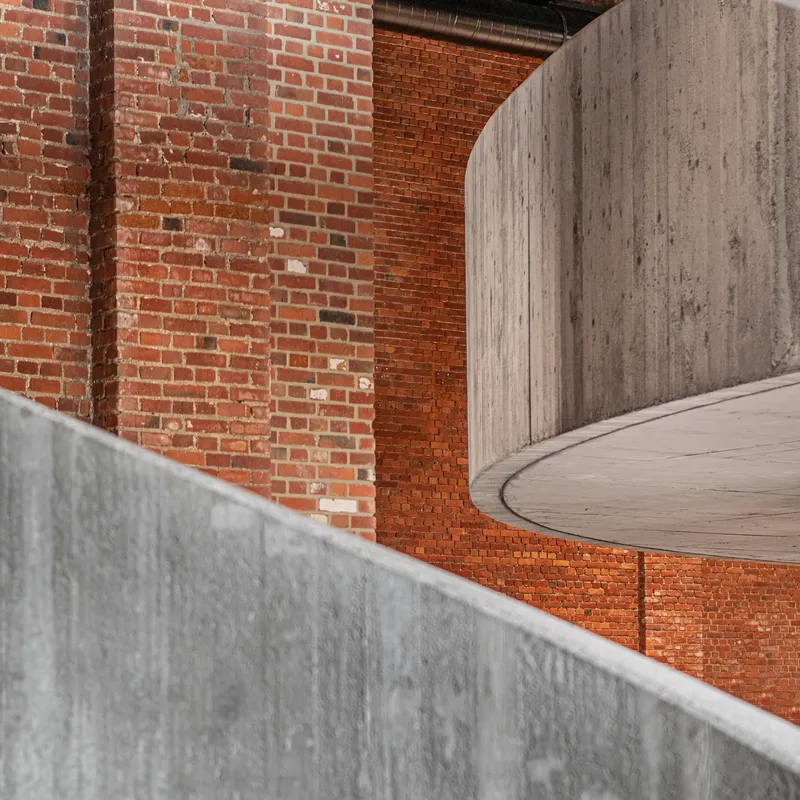
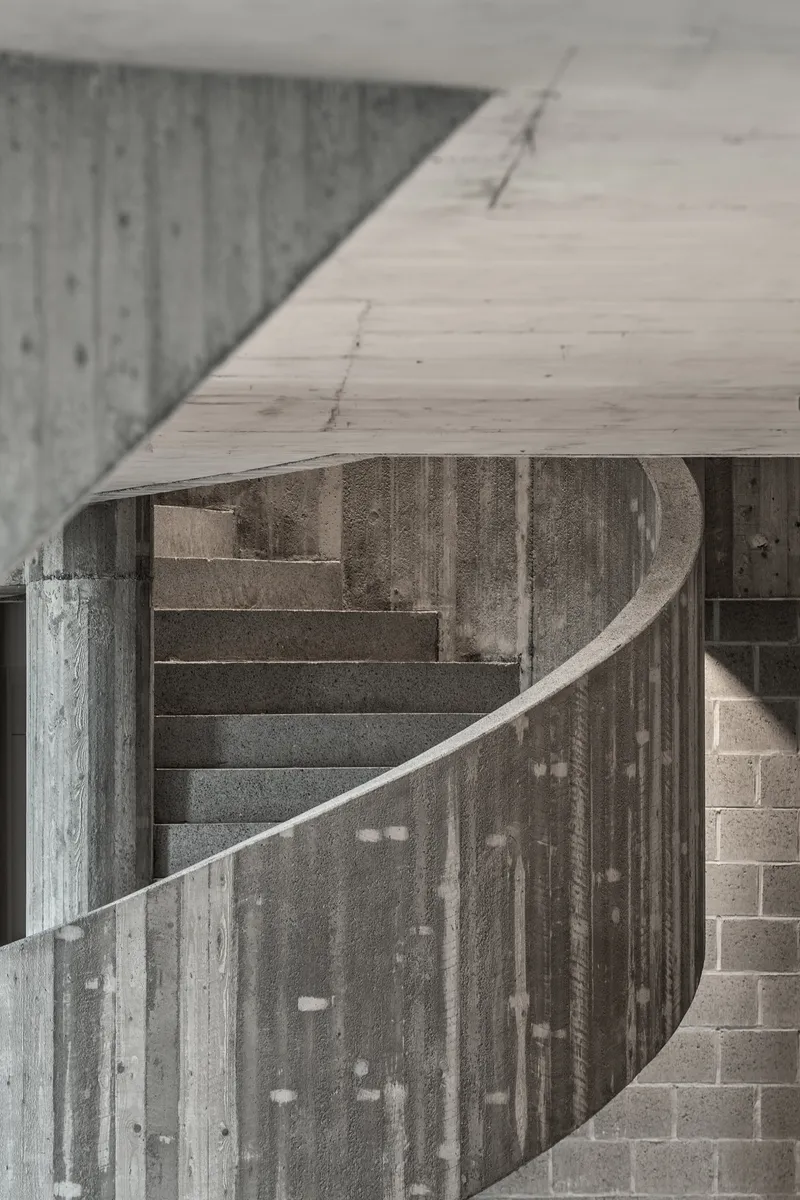
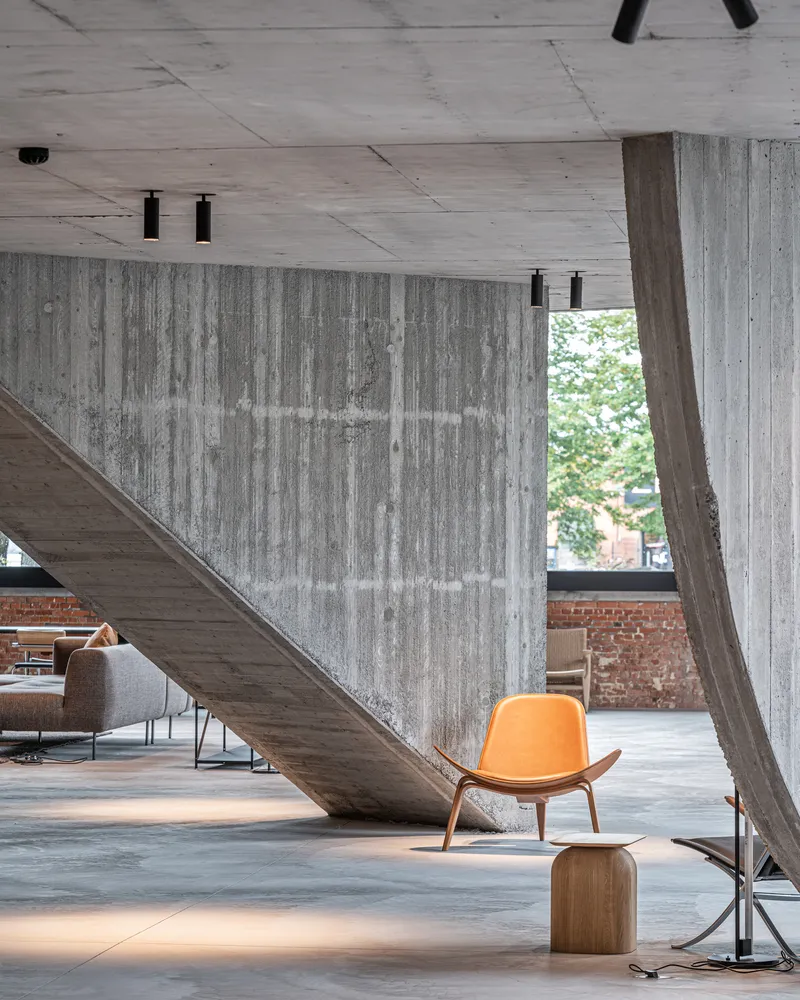
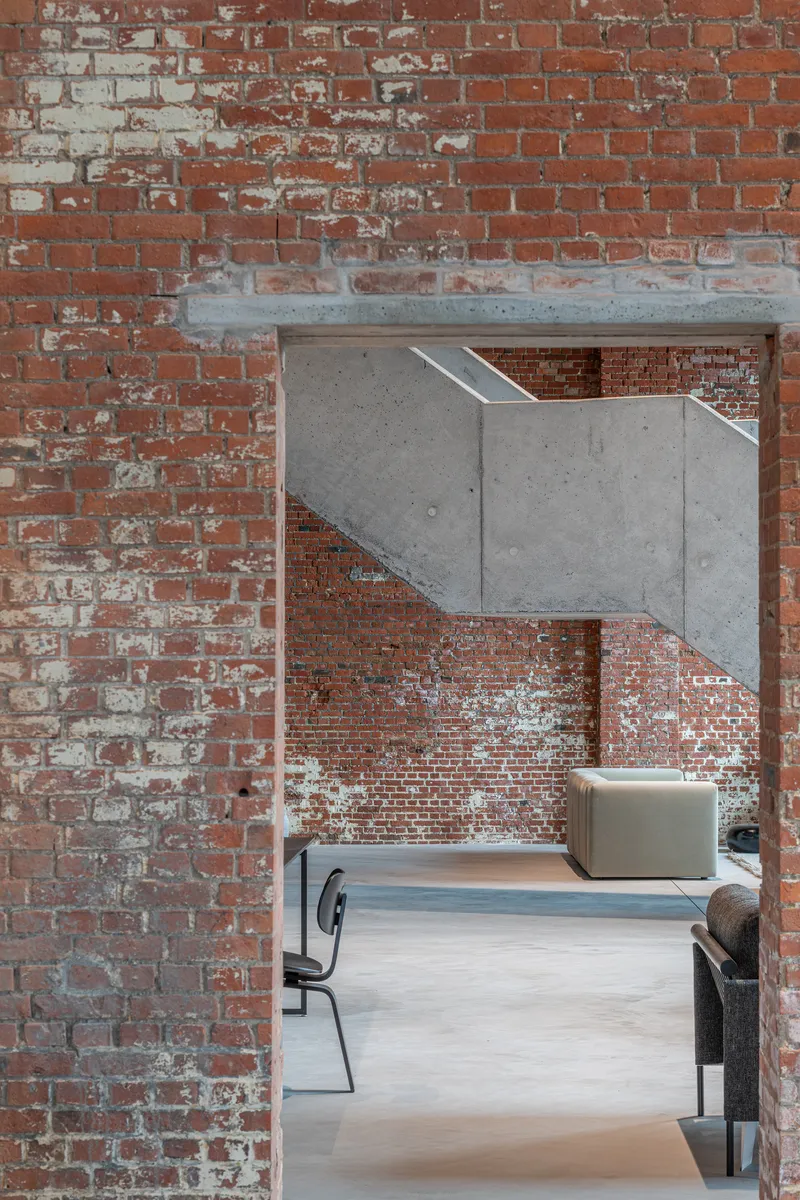
The meeting of new concrete and old brick is the project's richest detail. Neither material tries to imitate the other. The concrete curves arrive with horizontal formwork lines; the brick walls carry their own history of mortar stains, patched openings, and weathering. Objekt Architecten did not plaster over either surface, letting the junction become a legible seam that records the building's transformation. Stair soffits slice diagonally across brick walls, casting angular shadows that change through the day and pull the eye upward.
Steel and the Service Spine
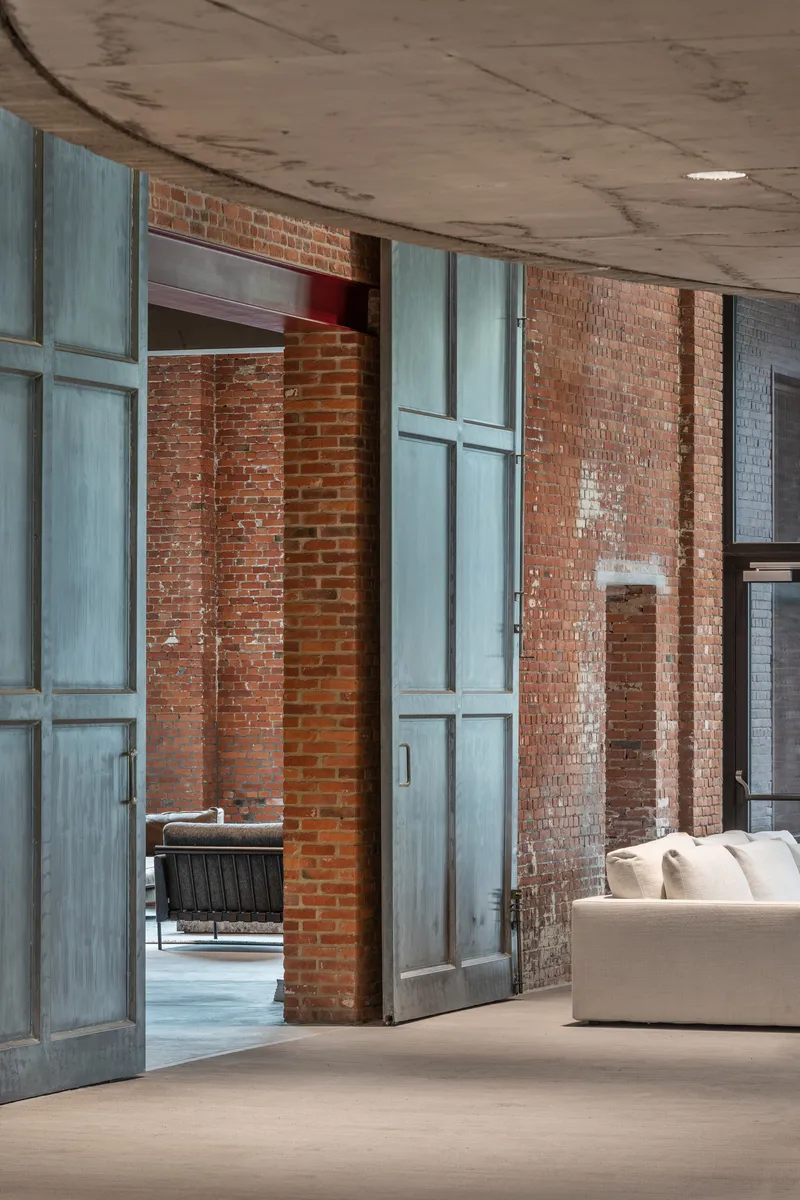
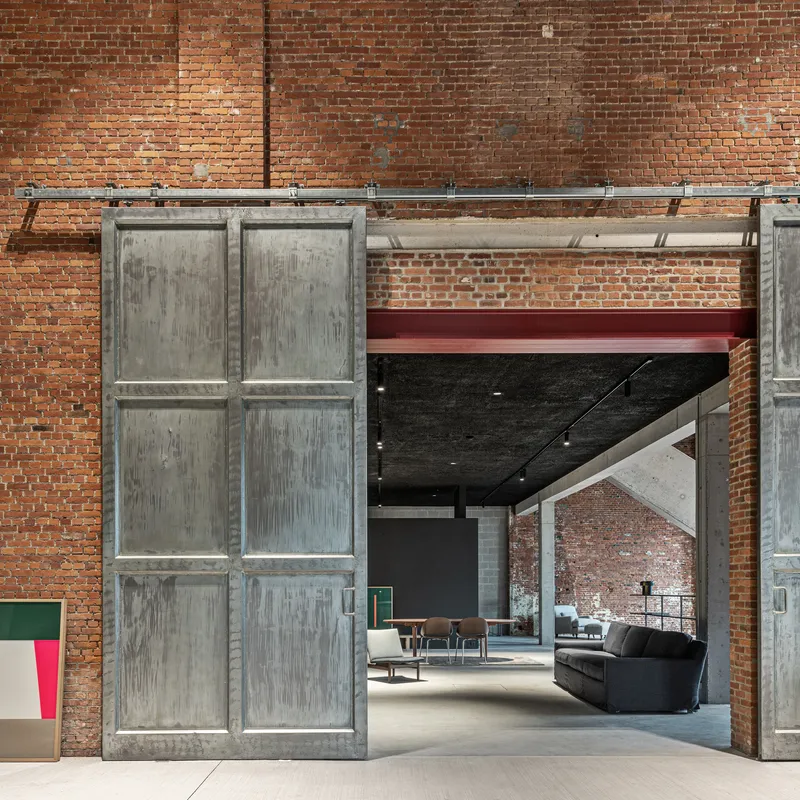
The rear zone of the building is wrapped in drawn steel sheet cladding, forming a self-contained volume that contains offices, storage rooms, toilets, technical rooms, and a small kitchen for cooking demonstrations. Tall patinated steel-framed sliding doors mediate between this service spine and the public showroom, their finish darkened to read against the brick piers. Concrete sliding panels on overhead tracks offer a second layer of enclosure, reinforcing the industrial palette while providing acoustic separation where needed.
Light, Courtyard, and the Timber Mezzanine
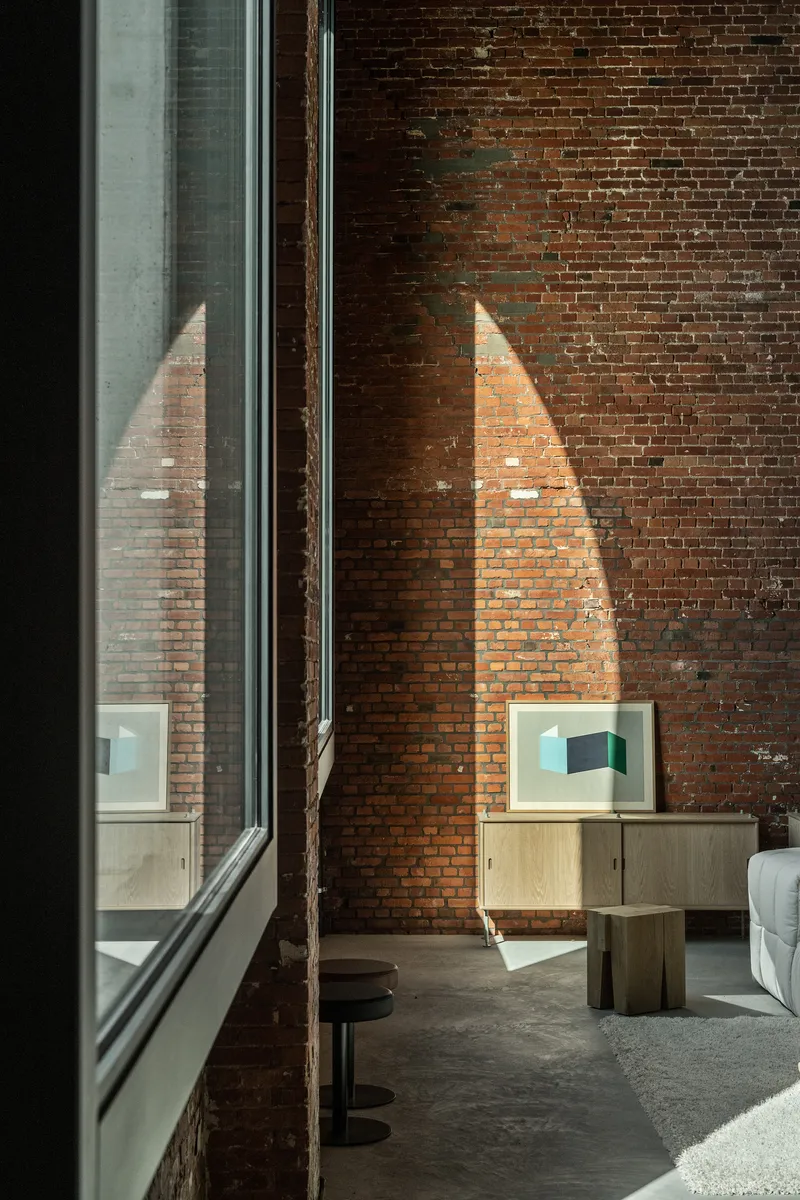
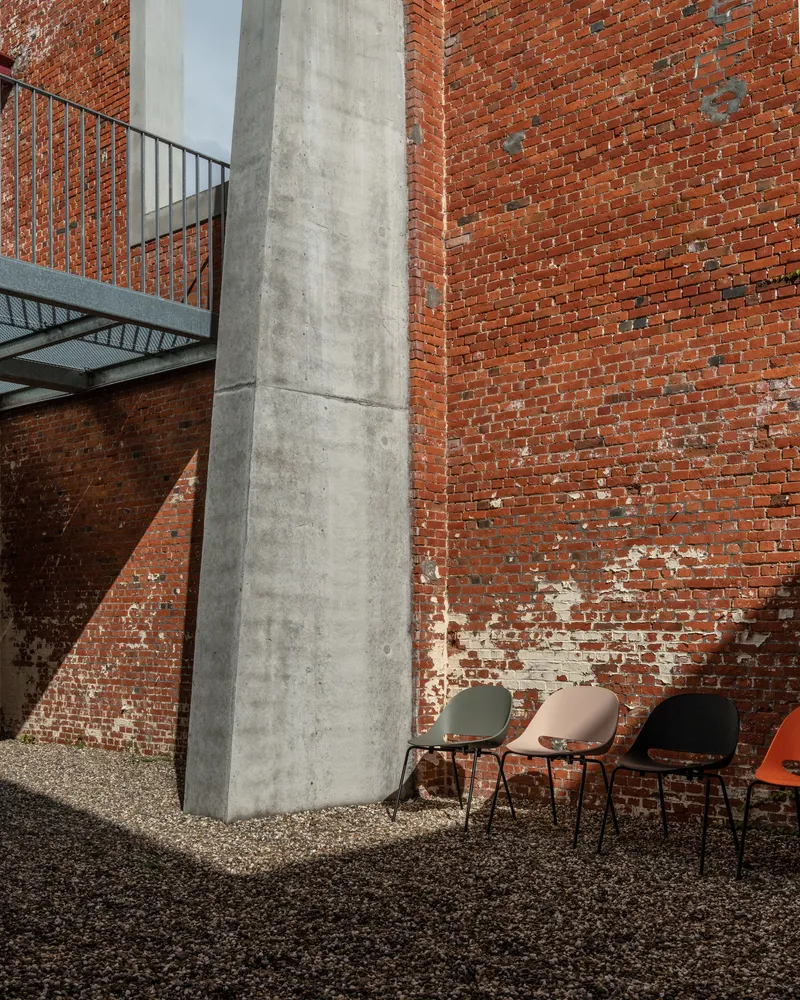
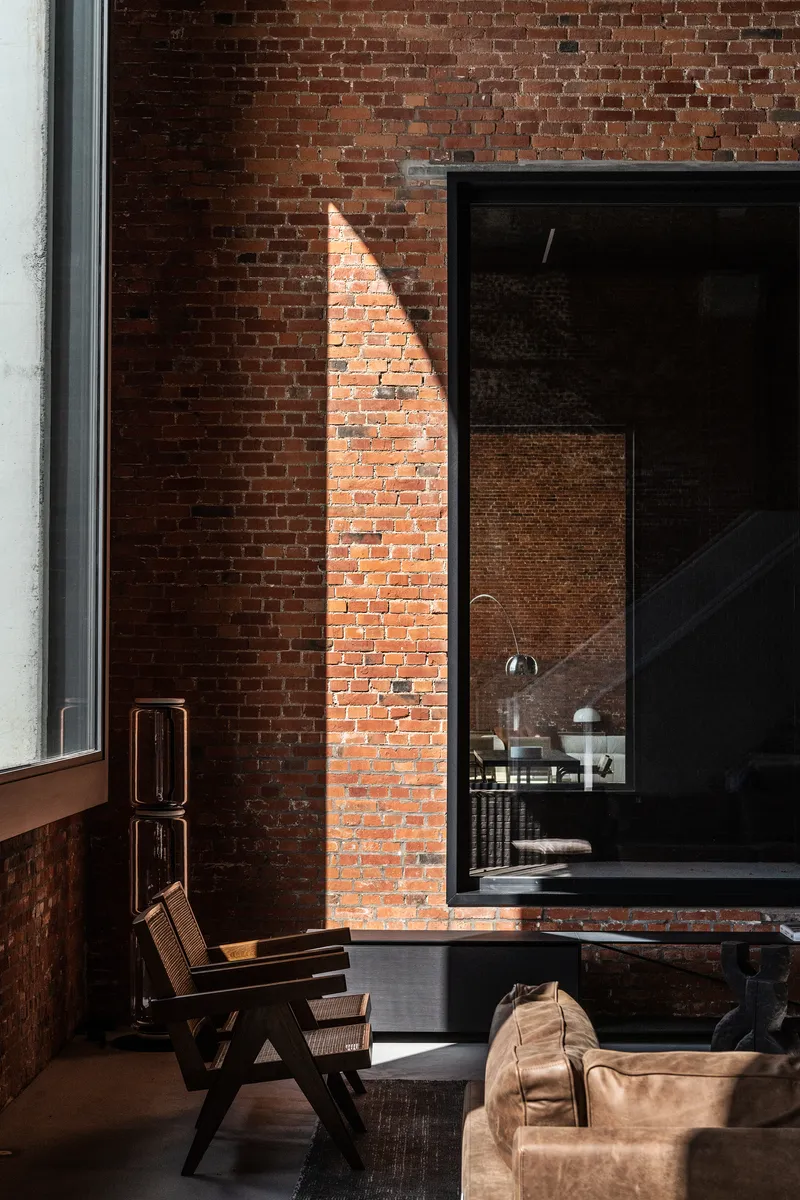
A large patio carved from the right-hand side of the building pulls daylight deep into what would otherwise be a dark interior. The courtyard operates within the original warehouse footprint, so the brick perimeter wall remains continuous from the street. Inside, triangular patches of afternoon sunlight travel across exposed brick walls, animating surfaces that artificial lighting alone could never reach. The timber mezzanine in the right aisle is set back from both the front and rear façades, preserving the full double-height volume at each end and allowing views across the courtyard from the upper level.
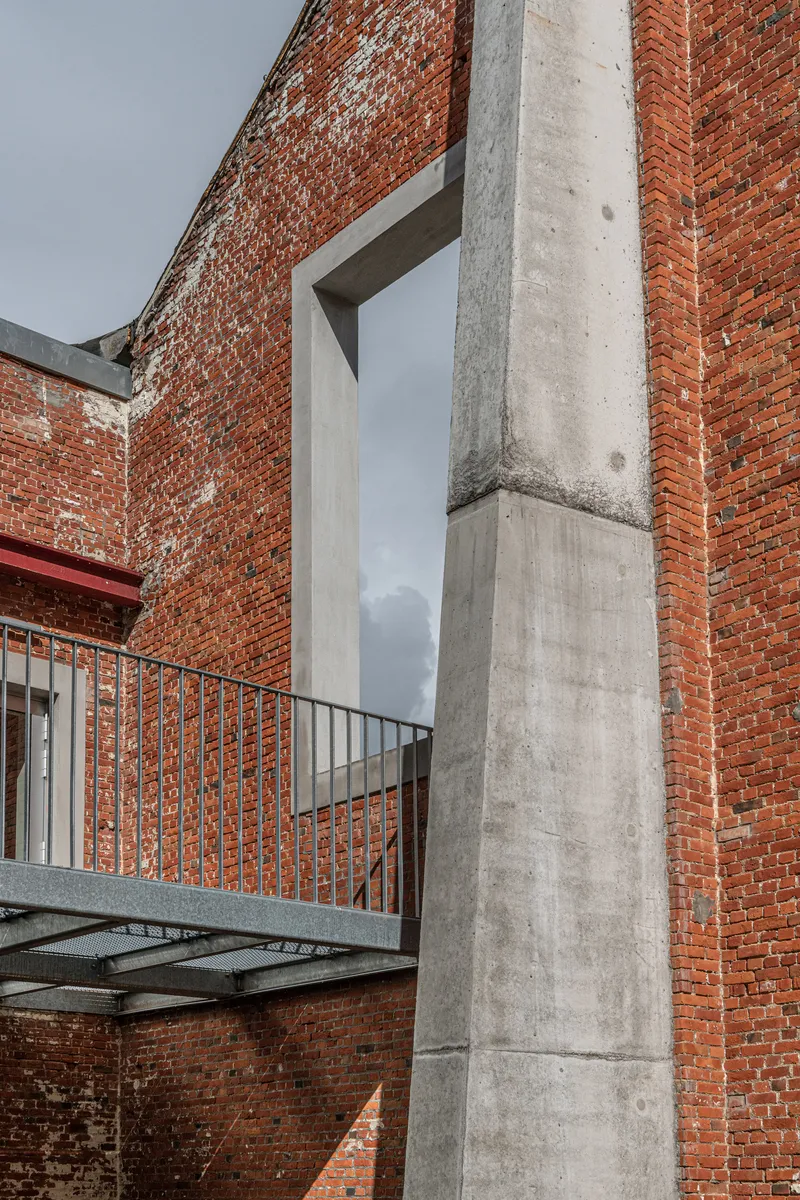
Steel footbridges and concrete columns frame the courtyard edge, establishing a threshold between interior exhibition space and exterior pause. The gravel floor and planted areas below the walkway soften the material palette just enough to mark this as a non-commercial zone within a commercial program. It is a generous move in a project where every square meter carries revenue potential, and it demonstrates confidence in the idea that spatial quality sells as effectively as product display.
Showroom as Architecture
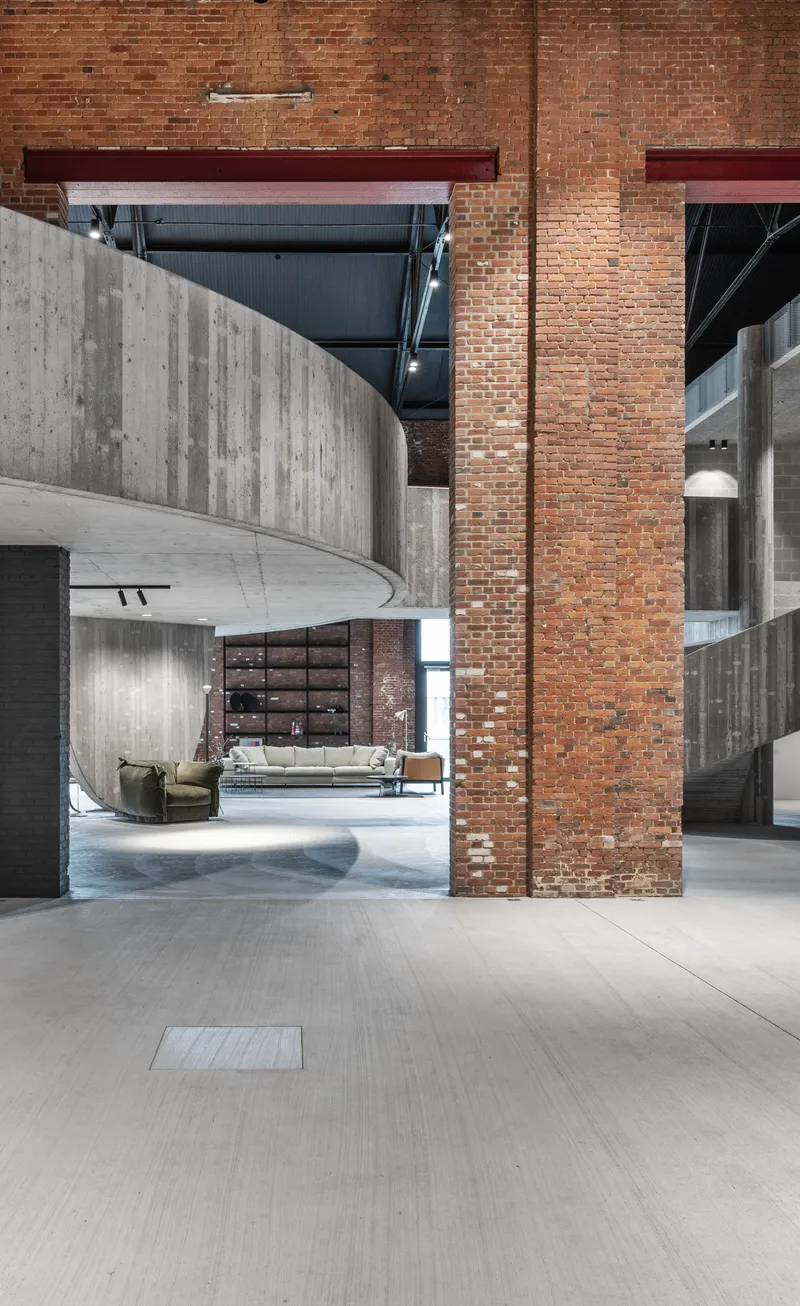
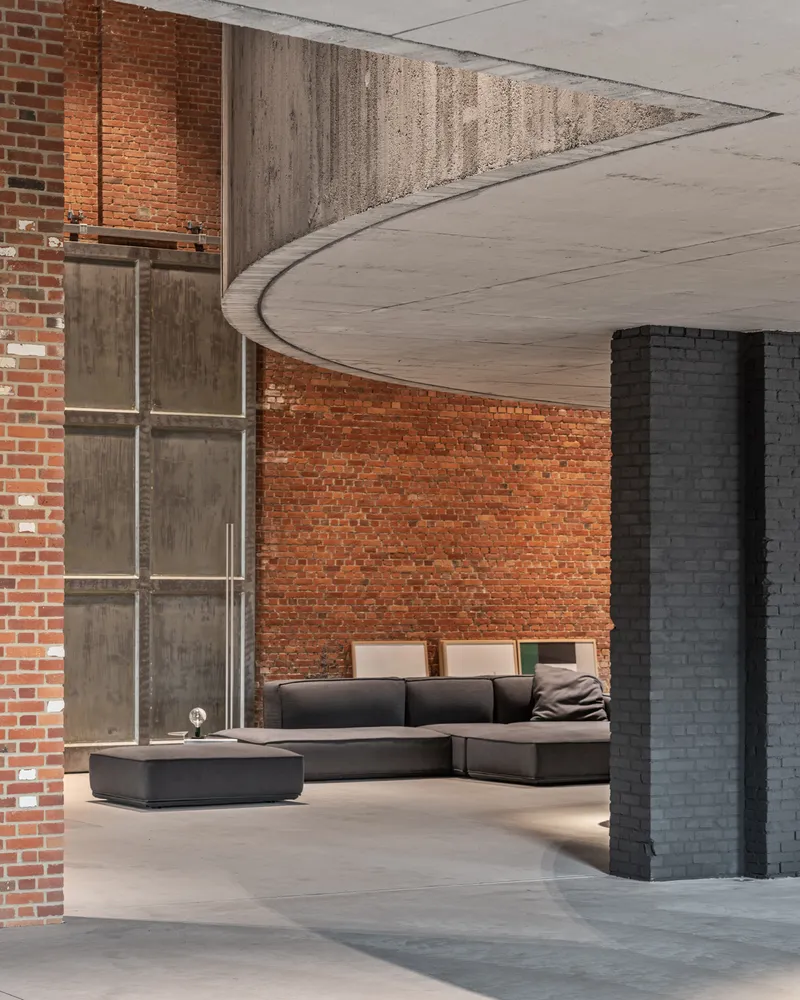
Most showroom conversions treat the building as backdrop. ark38 does the opposite: the architecture is the primary experience, and the products sit within it rather than on it. Curved concrete walls wrap around painted brick columns; cantilevered beams hover over seating clusters; sweeping ceiling edges draw visitors along circulation paths that feel choreographed rather than signposted. The three-material strategy, concrete, metal, wood, gives each zone a distinct atmosphere without requiring graphic wayfinding or color coding.
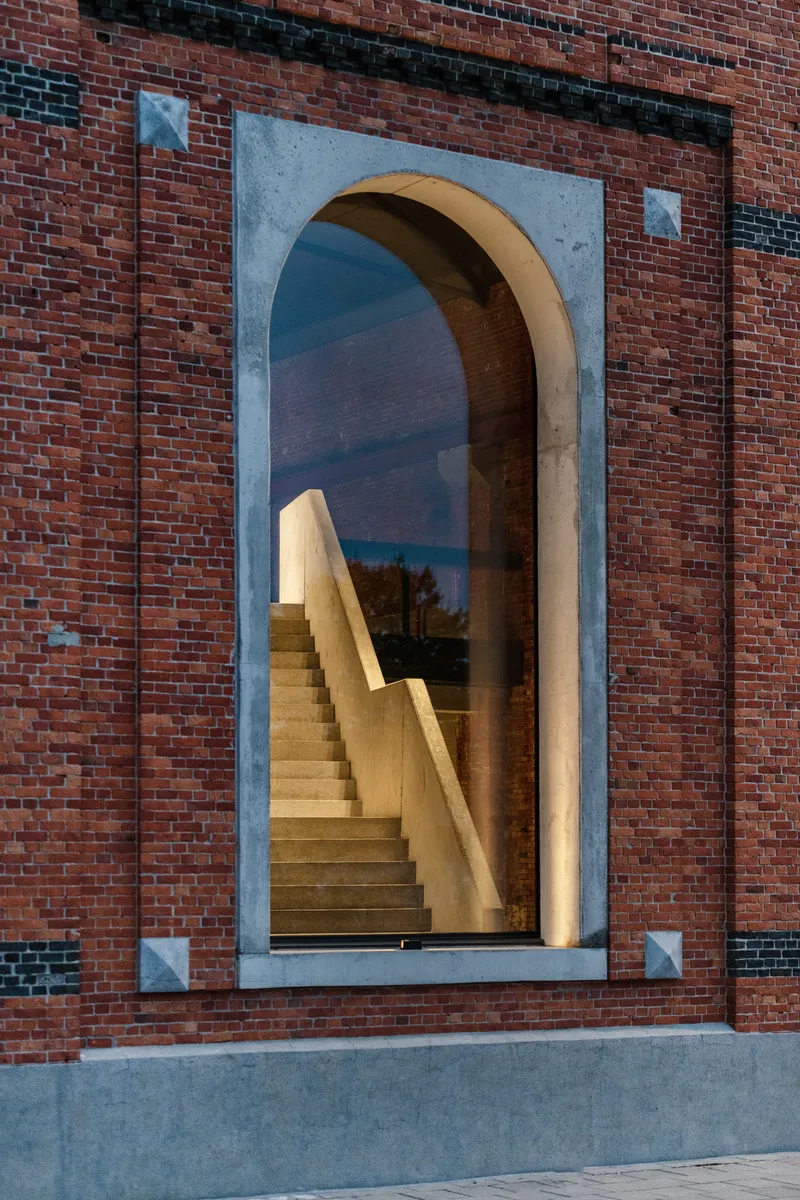
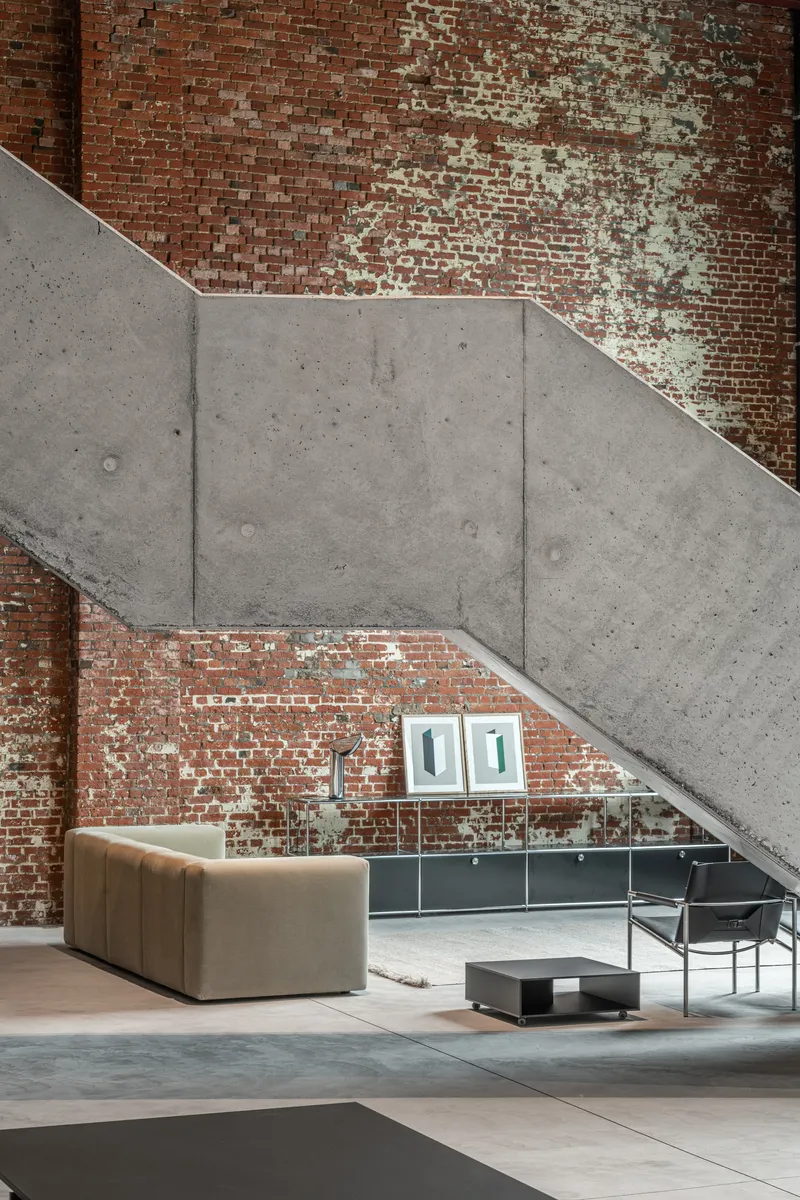
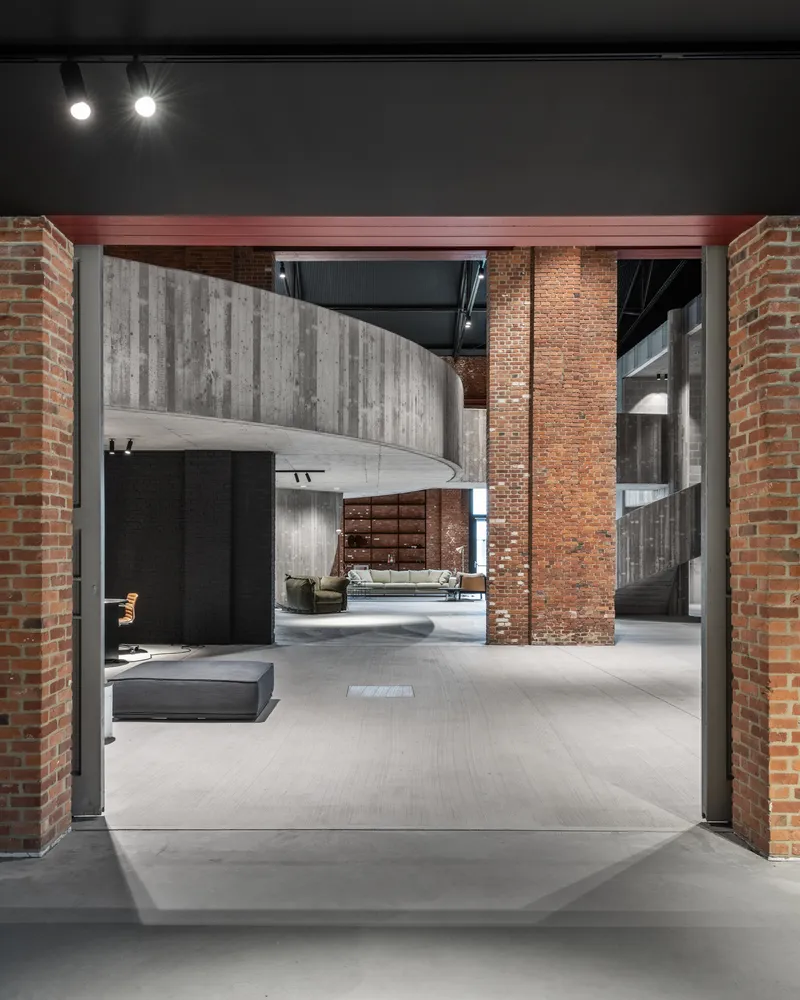
Arched windows reframed with pale concrete surrounds become vitrines, revealing timber staircases and interior vignettes to passersby. Inside, angular concrete stair soffits cut across brick walls to create unexpected backdrops for furniture groupings. These are spaces where photography and habitation overlap, and that is precisely the point for a business that sells domestic fittings. The showroom does not simulate a home; it offers something better: a heightened spatial experience that makes the products feel inevitable.
Plans and Drawings
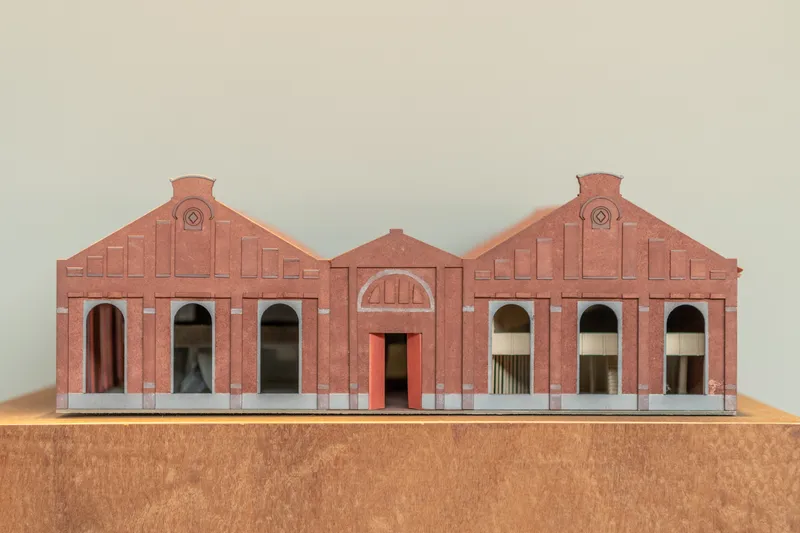
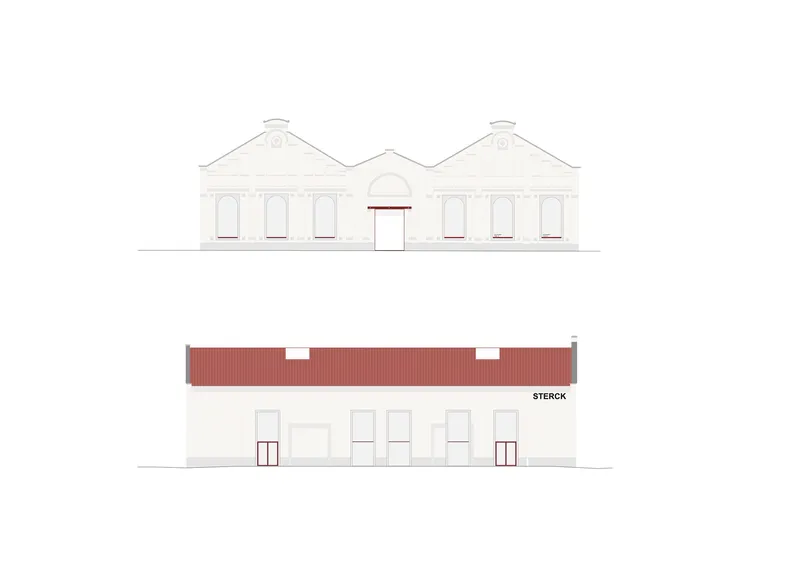
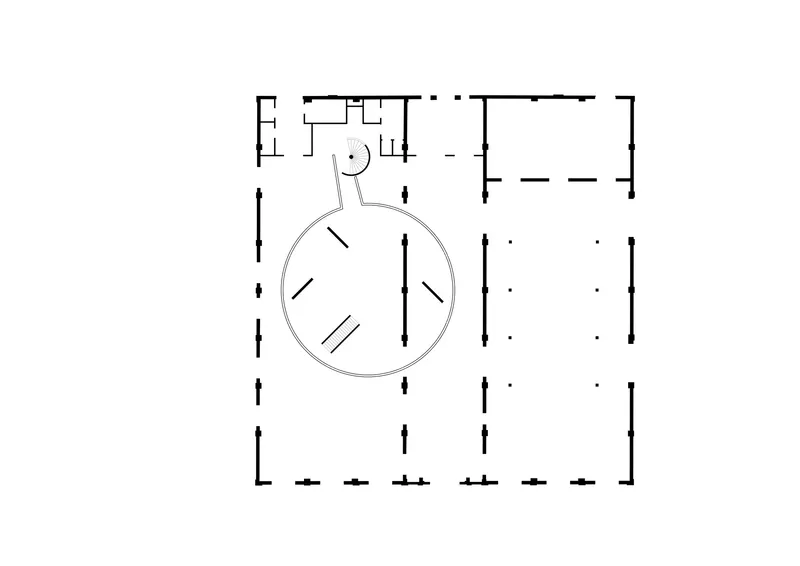
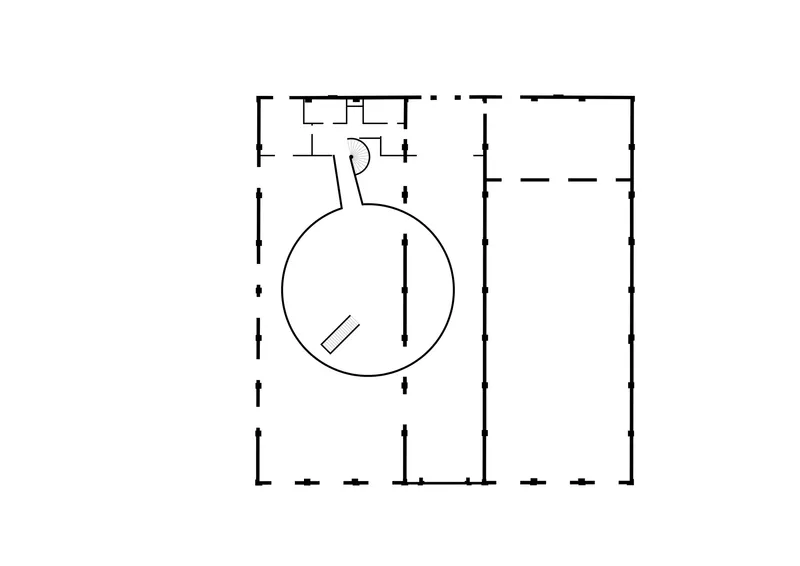
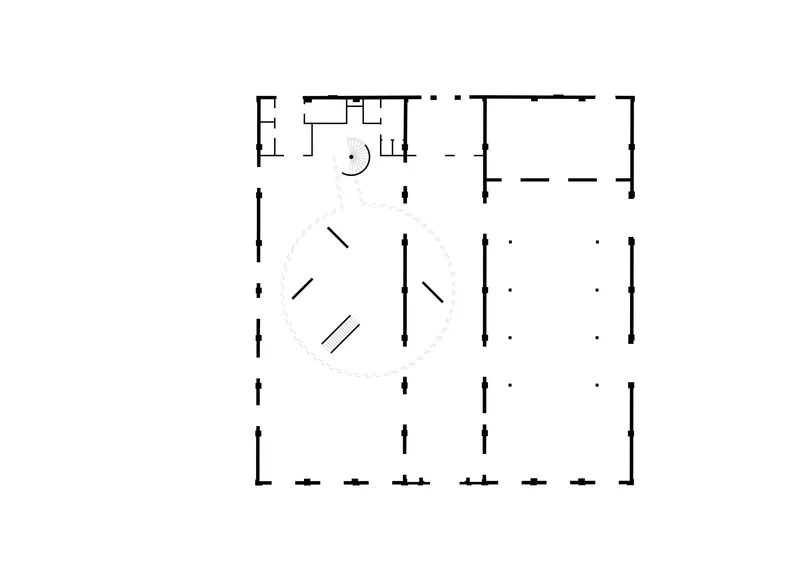
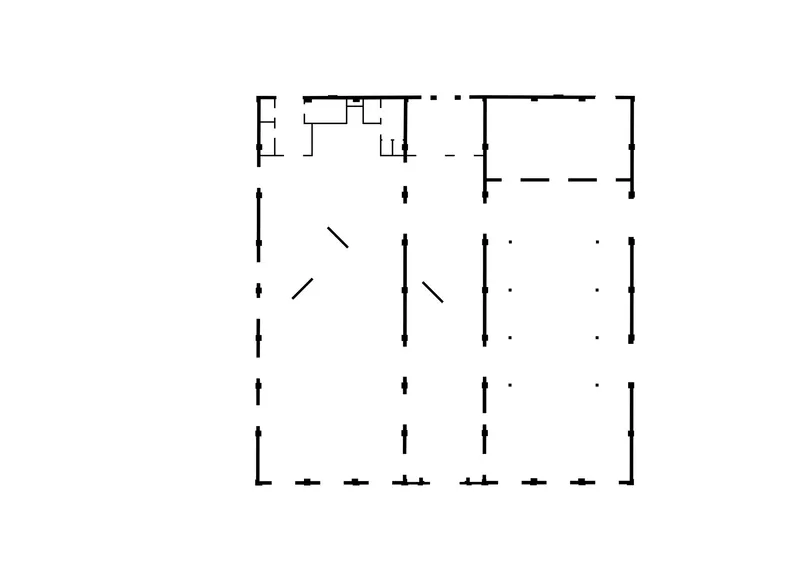
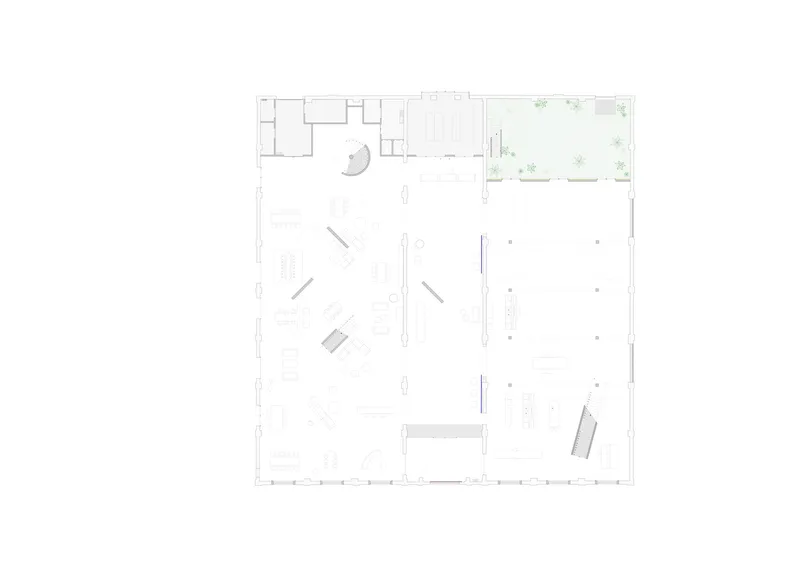
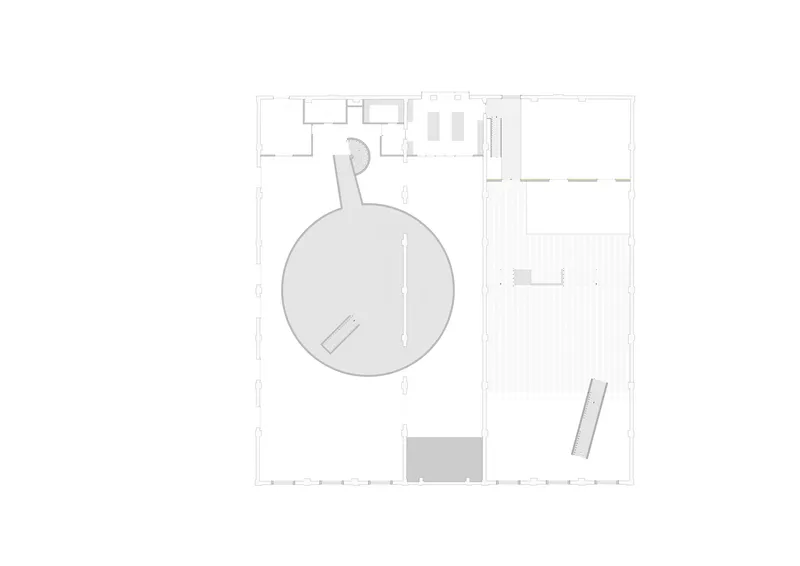
The plan drawings reveal the clarity of the three-aisle strategy. The circular concrete disc dominates the left and central bays, while the right-hand aisle operates with its own timber logic. Service rooms consolidate along the rear edge, and the courtyard reads as a void punched through the plan's mass. Diagonal display partitions on the upper levels break away from the column grid, introducing oblique sightlines that prevent the large floor plates from feeling monotonous. The elevation drawings confirm the architects' restraint: the pediment facade is preserved in full, while the rear elevation shows a corrugated metal roof that acknowledges its utilitarian role without apology.
Why This Project Matters
Industrial conversions in Belgium often fall into two traps: either the heritage fabric is treated as sacrosanct and the new program suffocates, or the intervention erases history in the name of contemporary branding. ark38 navigates between these extremes with unusual precision. The concrete disc is an unambiguously modern insertion, yet its formwork textures and curved geometry establish a material kinship with the handmade quality of the brick shell. The three-material strategy is simple enough to explain in a sentence but rich enough to sustain a 2,045 m² interior without repetition.
For architects thinking about adaptive reuse, the project offers a transferable principle: let the new materials do the spatial work so the old fabric can remain legible. Objekt Architecten did not need to demolish walls, add extensions, or wrap the building in a new skin. They poured a disc, inserted a steel box, and floated a timber floor. The weaving mill is still a weaving mill. It just happens to sell kitchens now.
ark38 Renovation, by Objekt Architecten and Hans Sterck. Aalst, Belgium. 2,045 m². Completed 2022.
About the Studio
Share Your Own Work on uni.xyz
If projects like this are the kind of work you want to make, uni.xyz is a place to publish your own, find collaborators, and enter design competitions.


Popular Articles
Popular articles from the community


David Macias Steps a Doorless Stone and Plaster House Down a Tropical Colombian Hillside
In the humid hills of Colombia, Threshold House replaces the front door with an open void and terraces its 850 m² down the slope instead of fighting it.

LT2A and OPEN Architectes Thread a Brick and Glass High School Through a Wooded Belgian Campus
In Braine-l'Alleud, a 3,000 m² wing for Collège Cardinal Mercier pairs pale brick with a glazed colonnade, deferring to a small chapel and a dense wood.

Jaramillo Van Sluys Arquitectura and Urbanismo Turn a Demolished Registry Lot in Quito into an Orchard Plaza
In Quito's Centro Histórico, a 2,800 m² plaza exposes the San Agustín convent wall and redraws its lost Augustinian orchard in volcanic stone.

Architekt Andreas Gruber Scatters 23 Dark Timber Chalets Across a South Tyrolean Forest Edge
In Molini di Tures, Amonti Chalets breaks a resort into a hamlet of gabled timber houses, with parking, storage and services pushed into the slope.

Similar Reads
You might also enjoy these articles


LAVA Architecten Gives Vocational Education a Sawtooth-Roofed Face on a Mechelen School Campus
In Mechelen, Belgium, a 2,053 m² STEM school on a 6×6 m grid turns workshops and classrooms into rooms that can be rearranged as teaching changes.

KEMA Studio Turns a Derelict Marvila Attic into a 60 m² Lighthouse Apartment Above Lisbon
In Lisbon's Marvila district, a rebuilt roof, four skylights and two plywood volumes turn an unlivable attic into a bright home facing the Tagus.

Pixel Gardens: One Repeated Module Stacked Into a Terraced Social Housing Tower for Famagusta
Salem Bader's shortlisted housing tower builds a vertical neighbourhood from one repeated module, offsetting units to carve terraces, light and air.

Bao Huynh Watercolor Atelier: A Serene Art Retreat in Hội An
Bao Huynh Watercolor Atelier in Hội An blends multifunctional art spaces, sustainable design, local materials, and family-friendly living in a serene environment.

Explore Renovation Competitions
Discover active competitions in this discipline

Challenge to design locus for the upliftment of human rights

Design challenge to reuse E-waste
Comments (0)
Please login or sign up to add comments
No comments yet. Be the first to comment!