
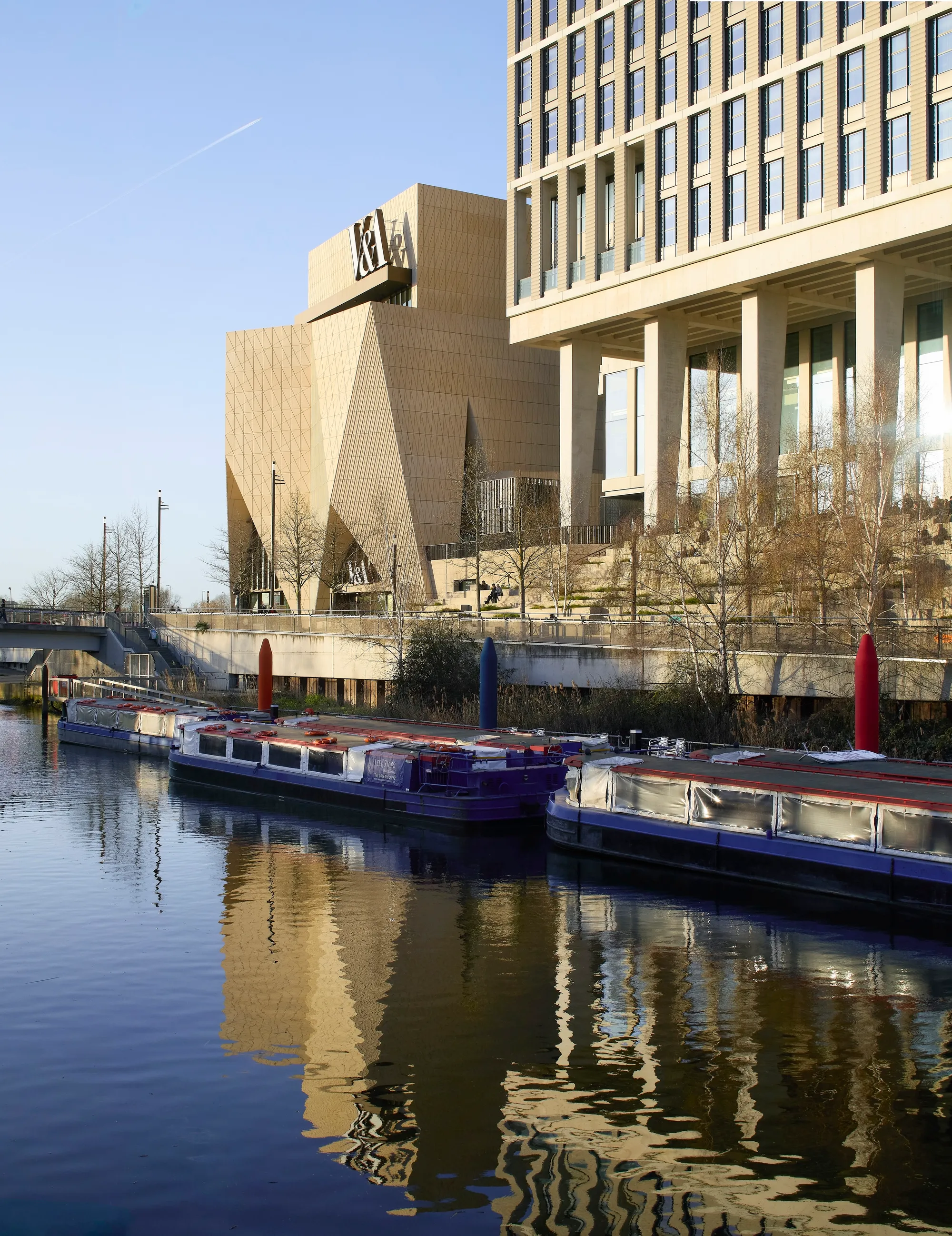
O'Donnell + Tuomey Wraps the V&A East Museum in 479 Precast Concrete Panels on the Stratford Waterfront
A five-storey cultural anchor in Queen Elizabeth Olympic Park treats its facade as a thick, inhabited zone of movement and light.


London has spent two decades trying to prove that the 2012 Olympics left something more than a stadium and a shopping centre in Stratford. The V&A East Museum, designed by O'Donnell + Tuomey and now open on the waterfront of Queen Elizabeth Olympic Park, is the strongest argument yet. At 42.5 metres tall and roughly 7,000 square metres in area, the building anchors the East Bank cultural district with a conviction that most post-Olympic projects have lacked. It sits at the heart of a masterplan by Allies and Morrison, plugged into a shared podium with the London College of Fashion next door, yet it leans sharply away from its neighbour above that datum, asserting its own identity through an envelope of sand-coloured precast concrete that reads as both monolithic and deeply crafted.
What makes the museum genuinely interesting is not the programme, which follows familiar institutional logic, but the wall itself. O'Donnell + Tuomey conceived the facade as a thick zone between a protective outer shell and a rational inner core. Circulation unfolds through this interstitial layer, carved from the building's own mass. The concept draws on the Japanese idea of Ma, the charged space between things, and on an X-ray image of a Cristóbal Balenciaga silk taffeta dress from the 1950s, where structure and surface are inseparable. That sounds like an architect's cocktail-party reference, but here it translates into something physical: 479 precast panels, each about two metres high and spanning up to 14 metres between structural columns, scored and shaped with profiles that reference the V&A's own logo. The panels are face-sealed with a 60-year design life, avoiding the cavity-and-replacement cycle of conventional rainscreen systems. The building is, in effect, a single material argument pursued to its logical end.
A Facade That Does Everything
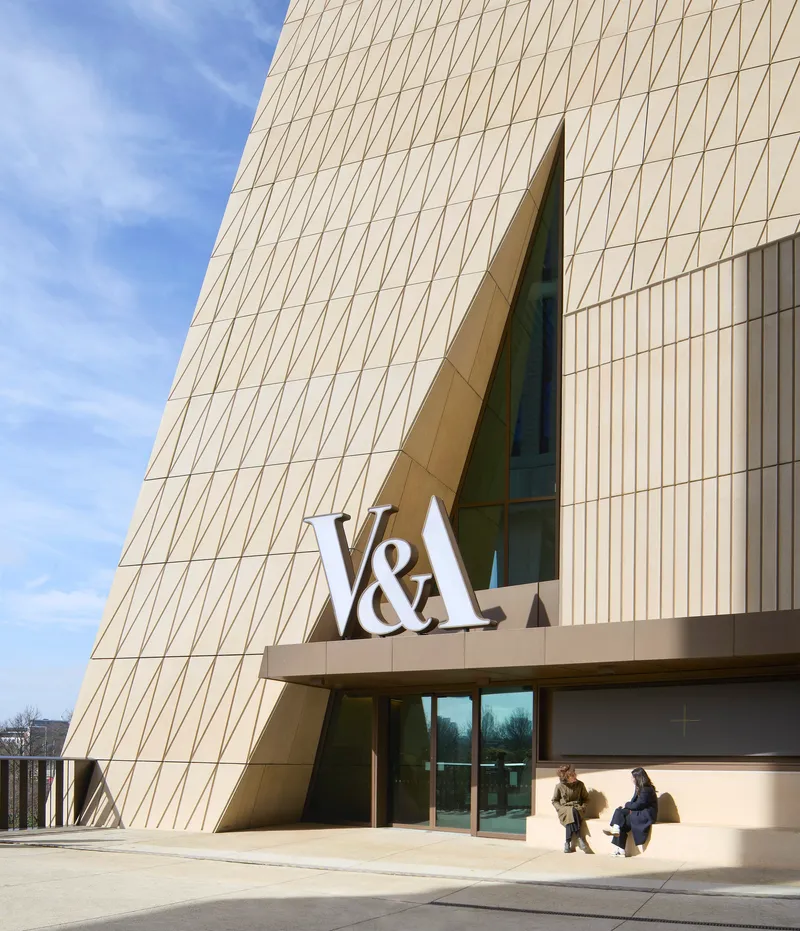
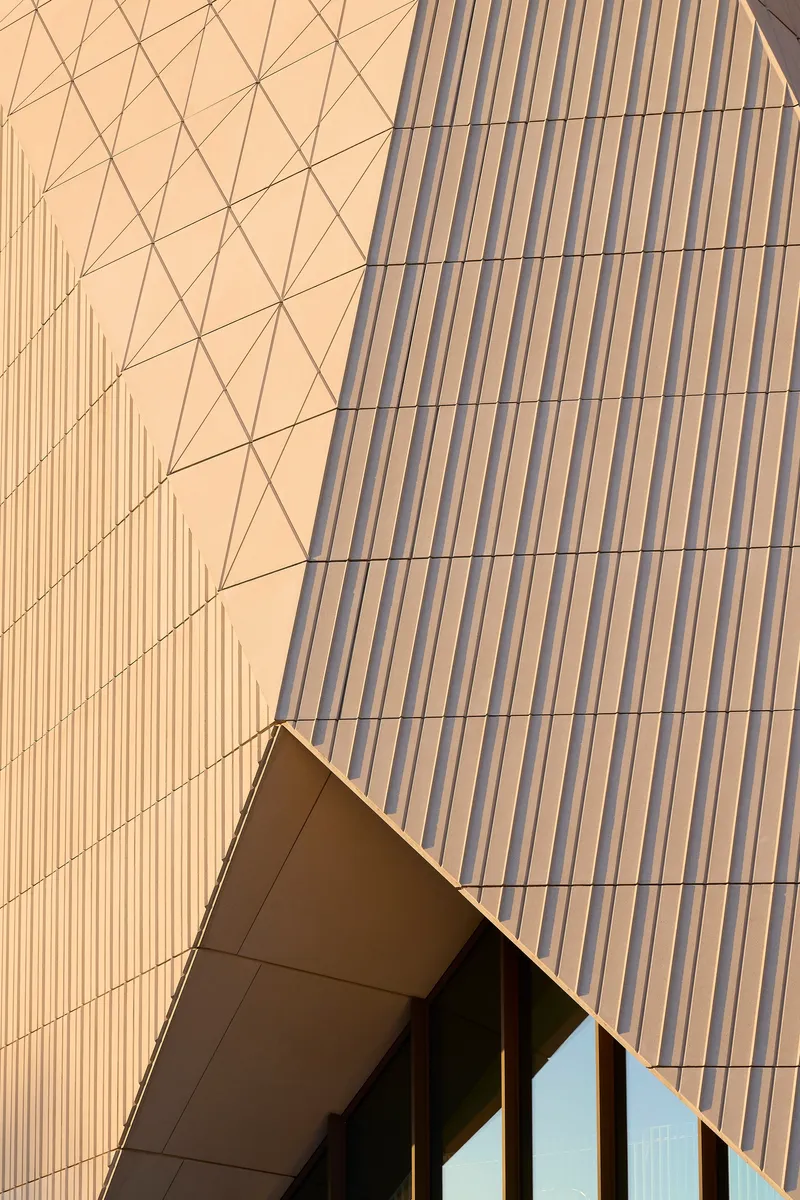
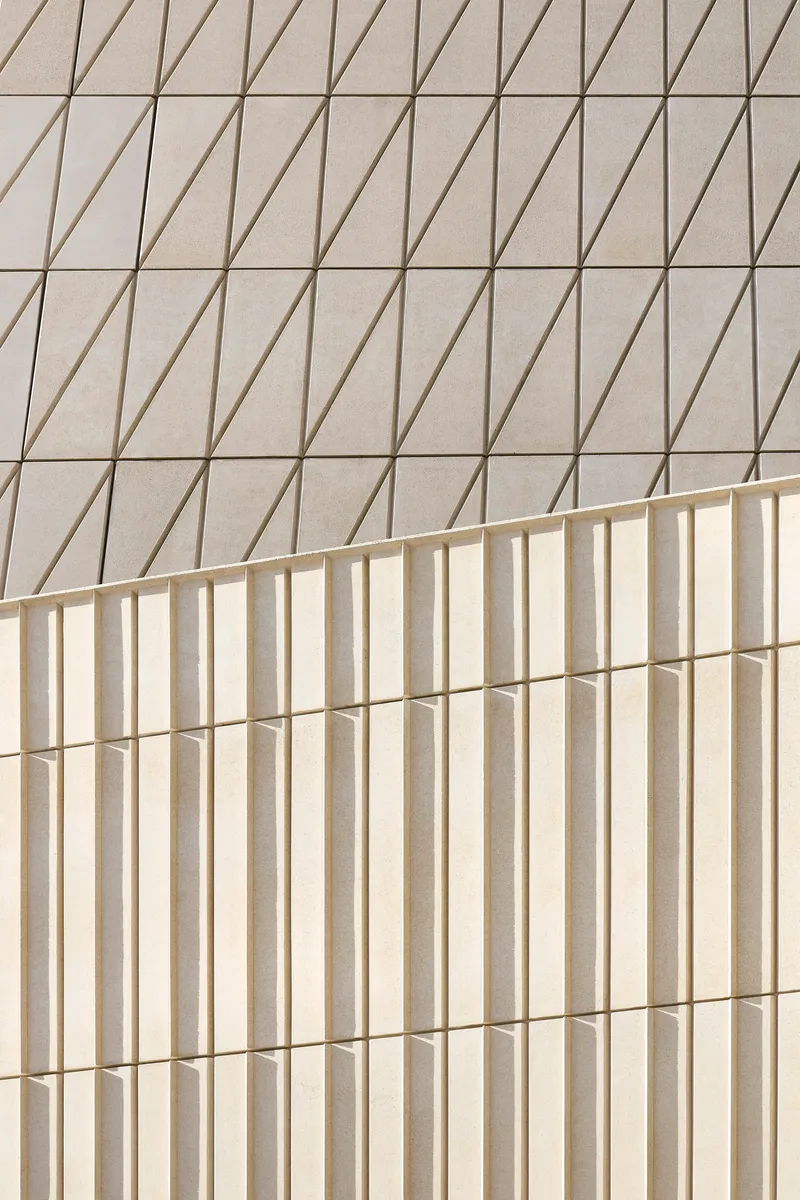
The 479 panels were manufactured by Techrete in North Lincolnshire, hung from a complex steel frame of 2,051 pieces fabricated by Bourne Steel. What is unusual, even for a high-spec institutional building, is how little secondary metalwork sits between panel and column. The precast elements are essentially self-supporting, spanning horizontally between structural points in a way that eliminates redundancy. Every panel is as thin as it could be. Waste was minimised by a material research programme that reduced concrete content wherever possible, and all steel in the frame is recycled.
The surface treatment varies across the volume: triangular geometric patterning, vertical fluting, diagonal grooves, and brass or bronze inlay all appear within a single envelope, yet the material palette stays disciplined. The agreement across the East Bank masterplan was that buildings would present a common stony texture, a cast-material urban edge that mediates between city and park. O'Donnell + Tuomey honoured this while making the V&A's skin unmistakably its own.
Detail and Texture at Arm's Length
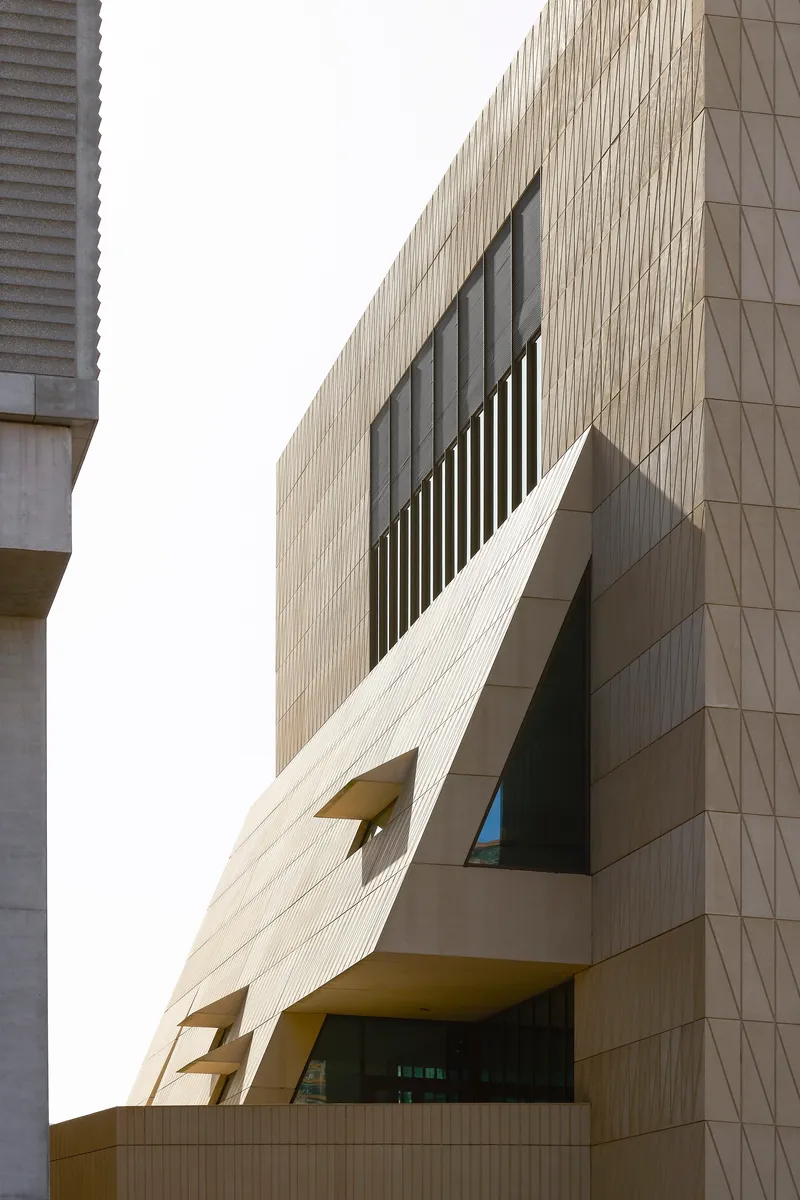
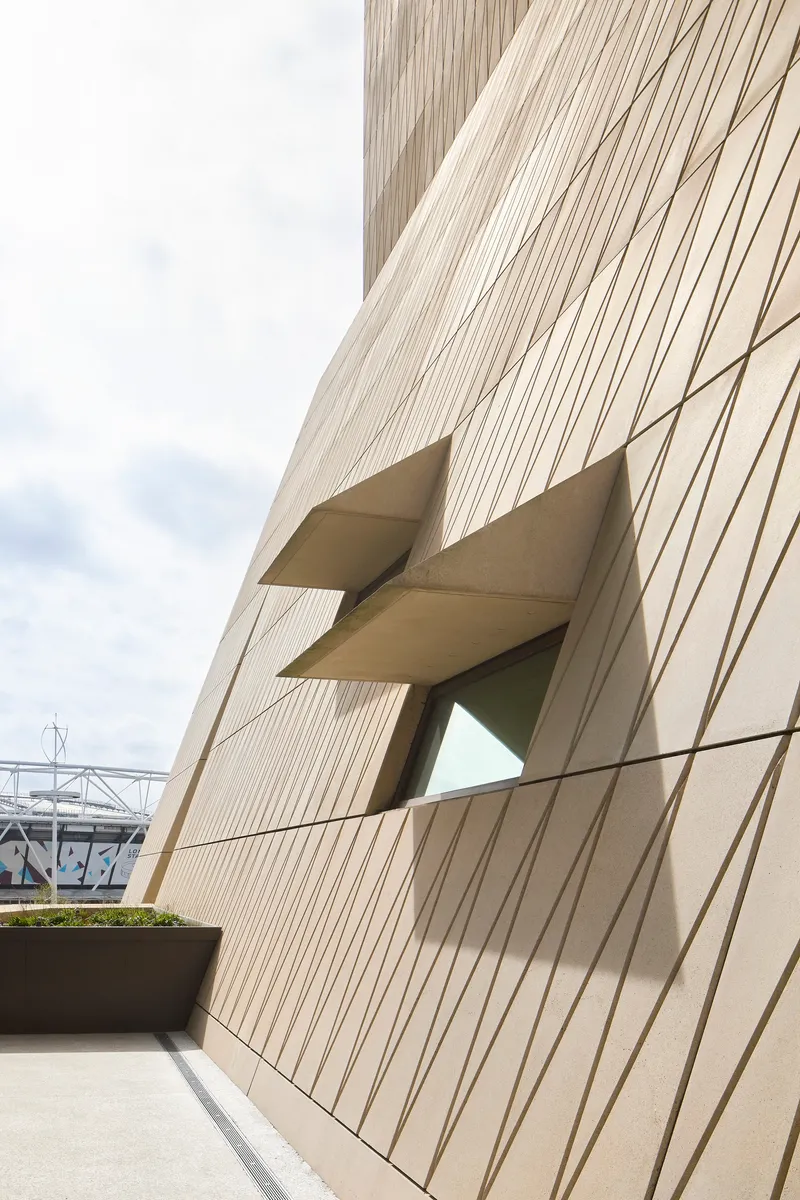
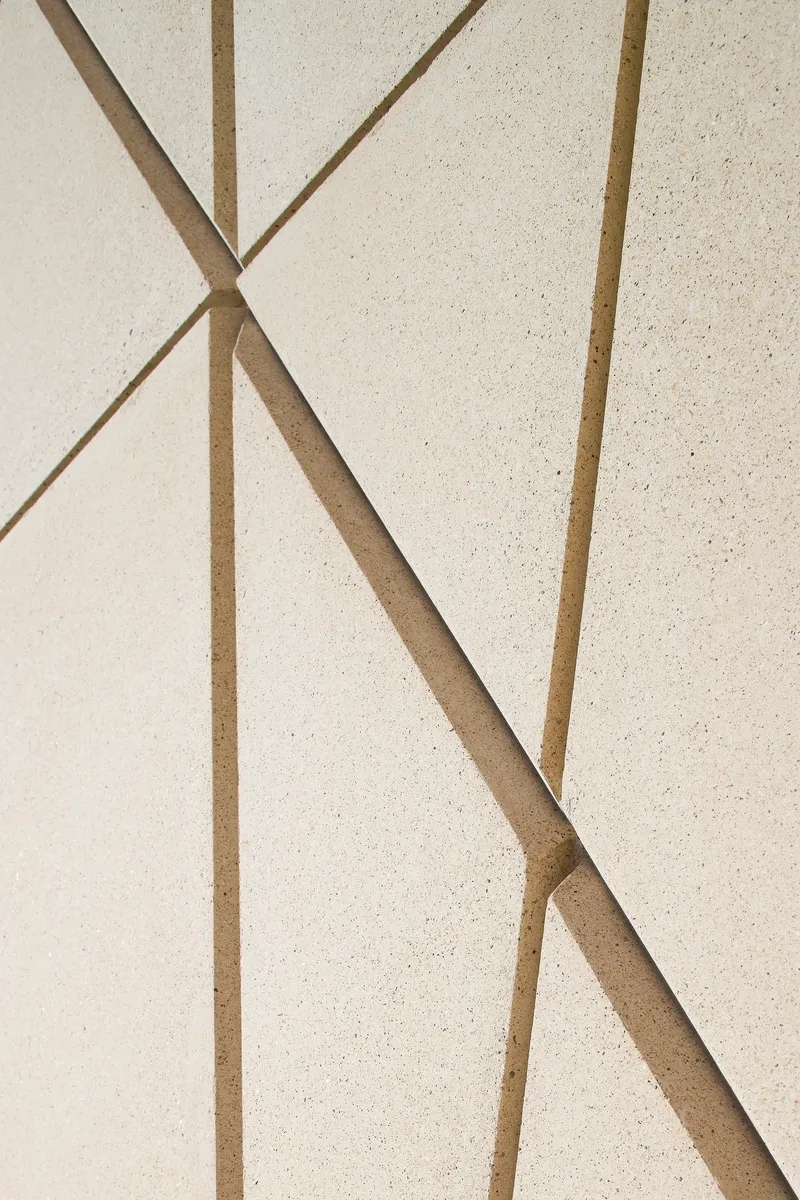
Zoom in and the building reveals a second register of detail. Vertical louvred window openings, projecting balconies, and deep angular recesses punctuate the precast shell, each one working as a punctual connection between interior circulation and the outside. These are not decorative gestures. They bring natural light deep into the plan through the interstitial zone and give visitors orientation within a building whose major exhibition space has been shifted to the top floor, a move driven by the need for secure truck access at ground level.
The facade catches changing light throughout the day. In warm afternoon sun the scored triangular profiles throw sharp shadows; under overcast skies the surface flattens to a uniform cream. The windows, produced by Schneider near Dresden, sit precisely in their angular openings, flush enough to preserve the monolithic reading of the wall but deep enough to signal that someone is inside, looking out.
Waterfront and Public Ground
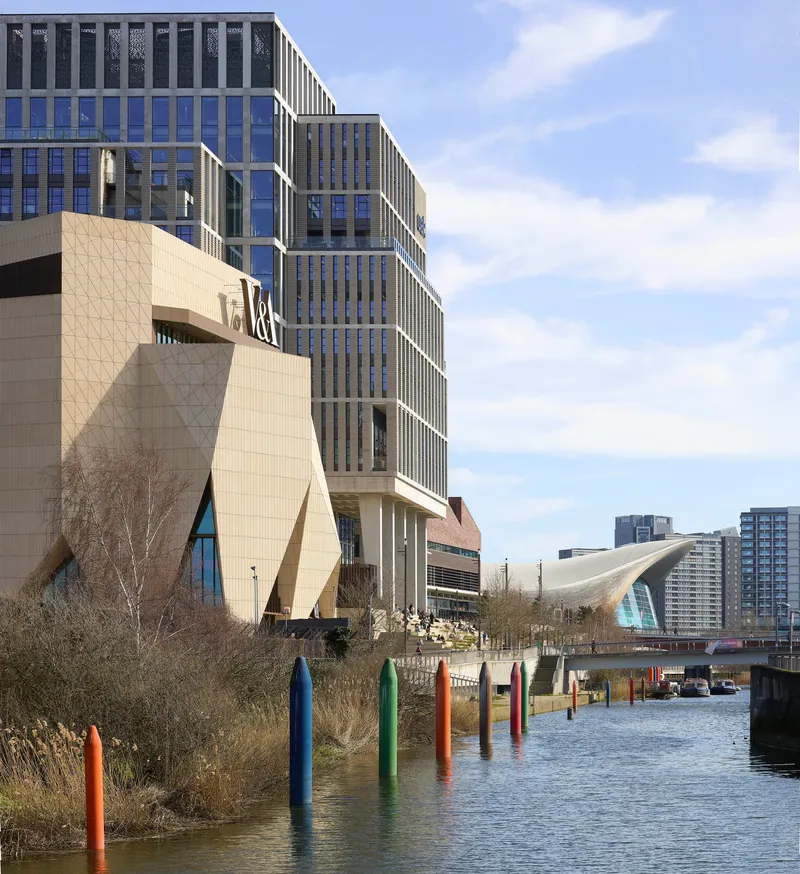
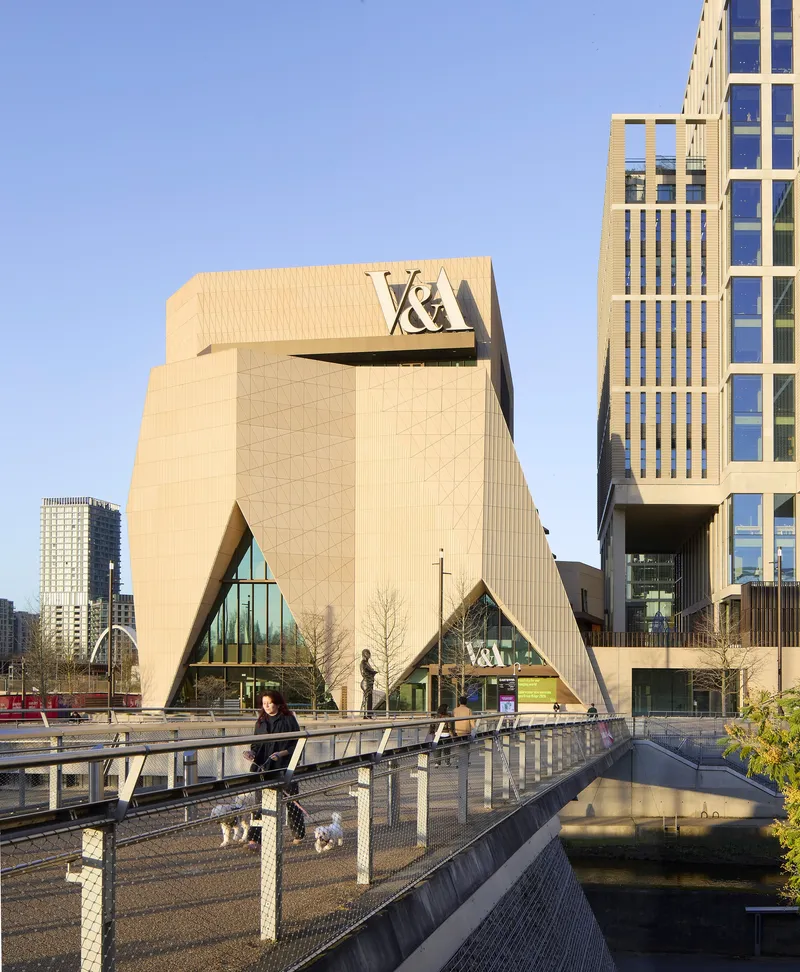
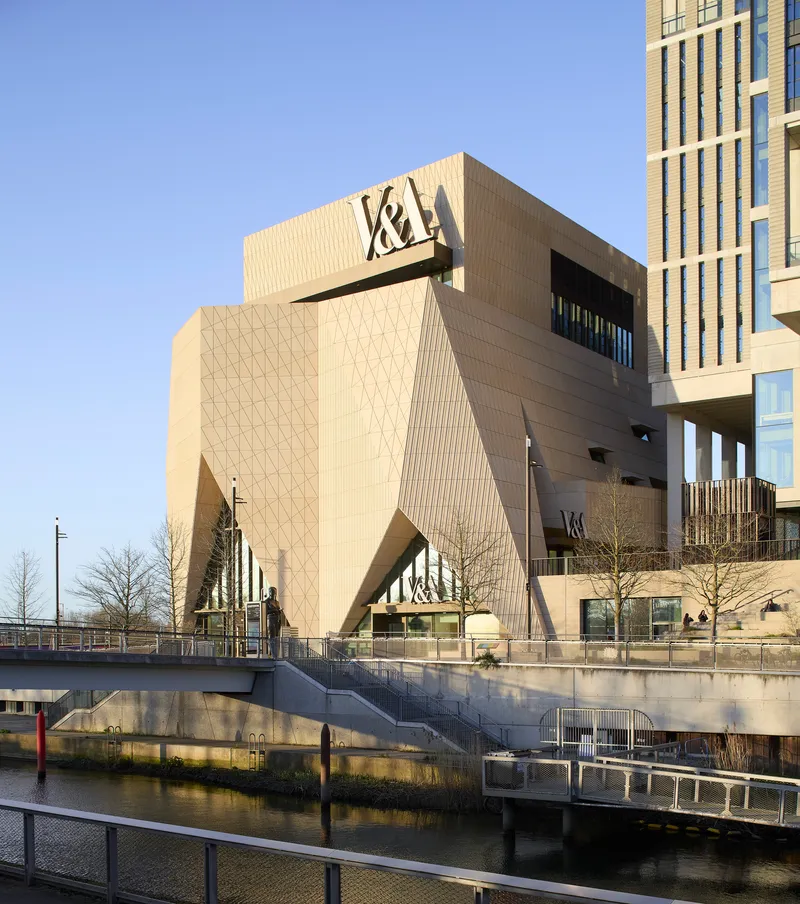
The museum has two entrances, one at waterfront level and one at the podium shared with its neighbours, and this dual address matters. At the canal, the faceted facade rises above narrowboats and colourful timber pilings, a collision of scales that is more convincing than most waterfront cultural buildings manage. Pedestrian bridges, towpaths, and planted terraces stitch the institution into a network of public movement that existed before the building arrived. The benches integrated into the facade at ground and podium levels extend the museum's threshold outward, blurring the line between institution and park.
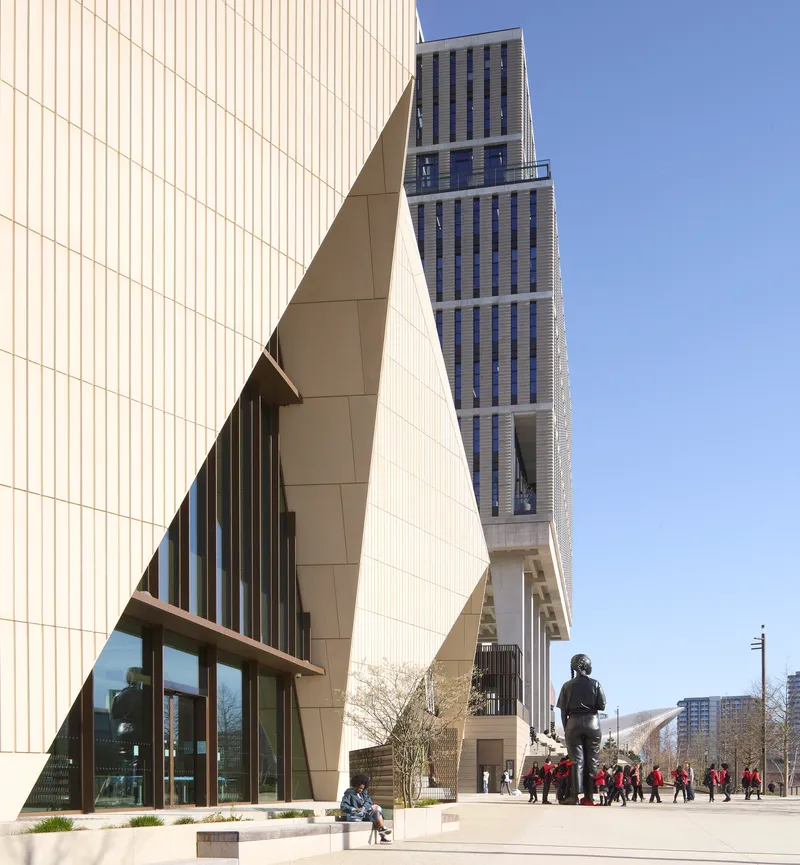
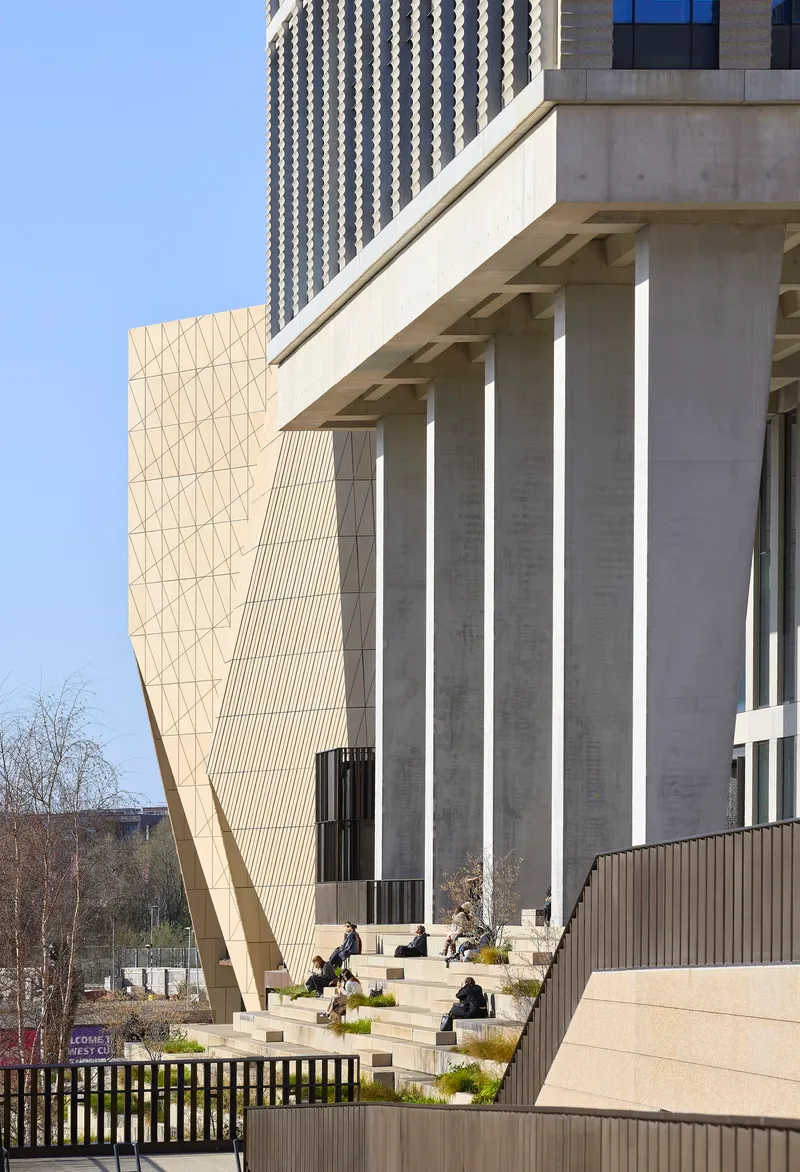
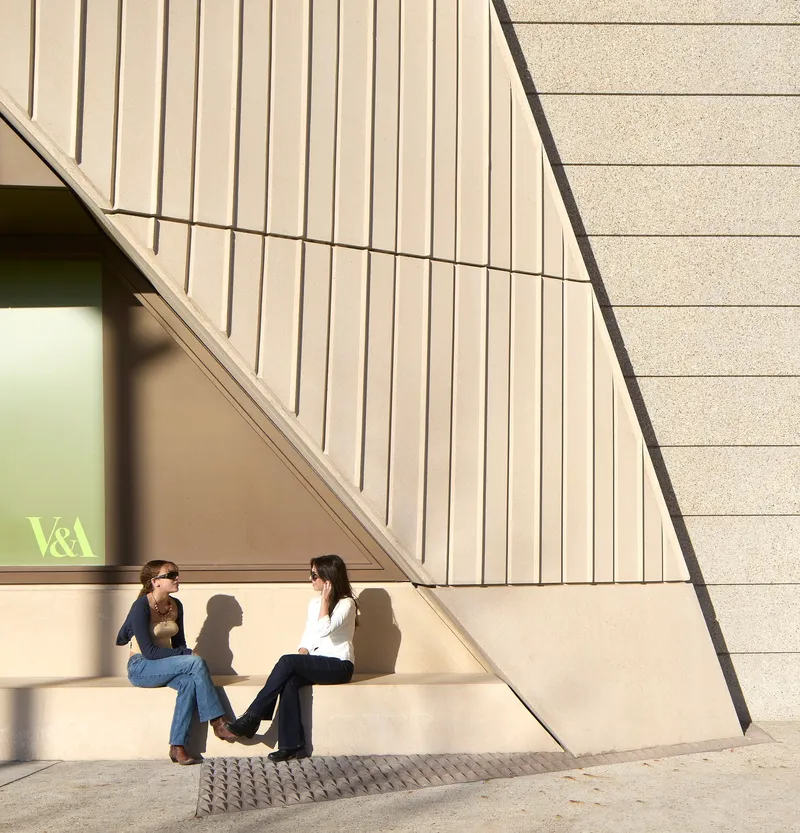
At the podium, a public plaza with bronze sculpture and seating colonnades creates an urban room where the V&A's gravitational pull meets the adjacent College of Fashion and the wider East Bank. The terrazzo concrete floors of the interior continue outside, eliminating the typical threshold break. Before 2007 this land was contaminated, underused Lower Lea Valley brownfield. That history makes the generosity of the ground plane feel less like a design choice and more like an obligation fulfilled.
Circulation as Architecture
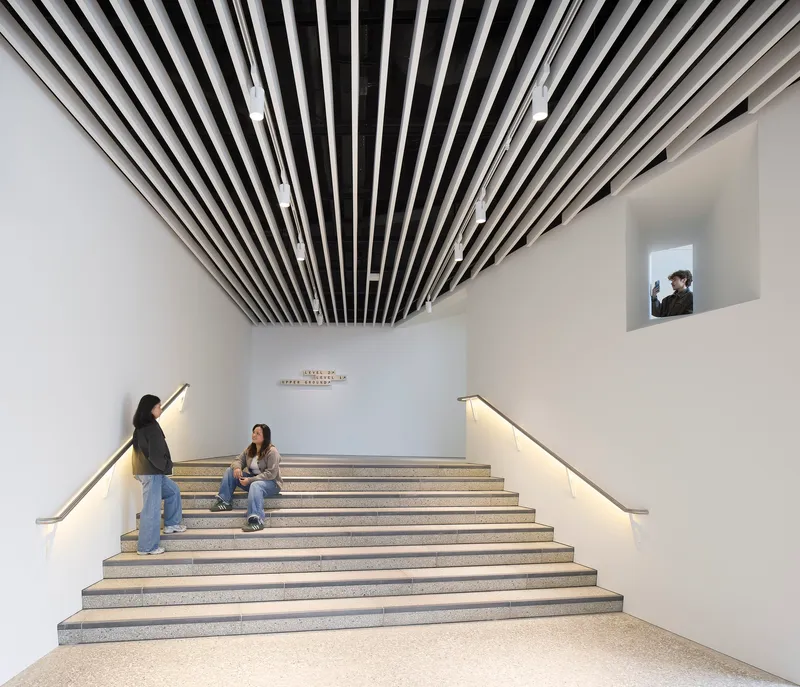
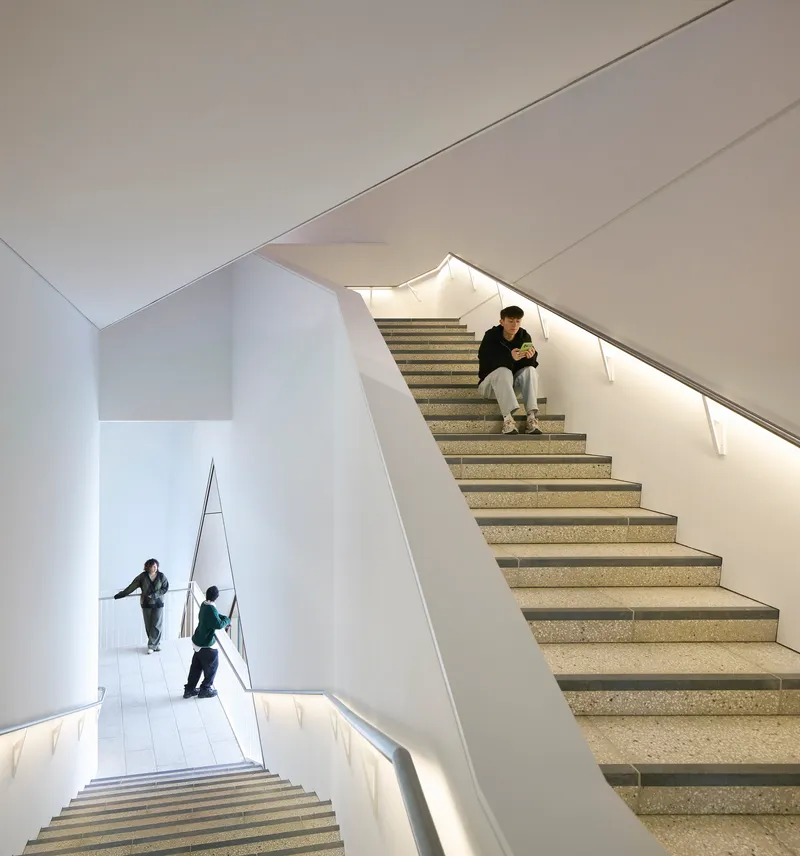
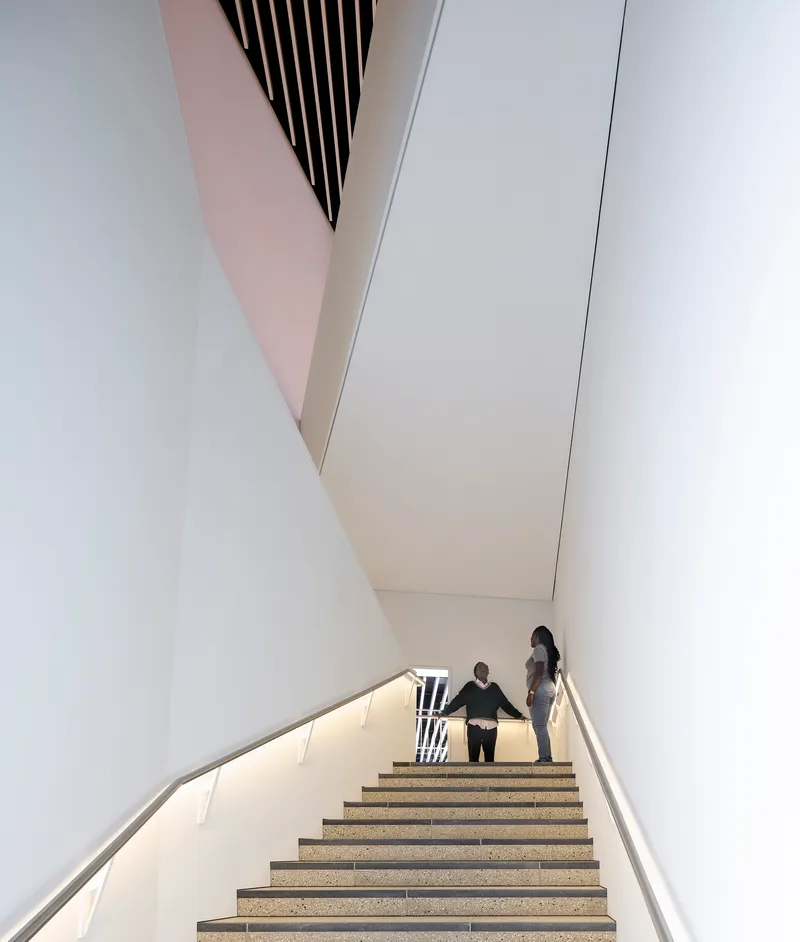
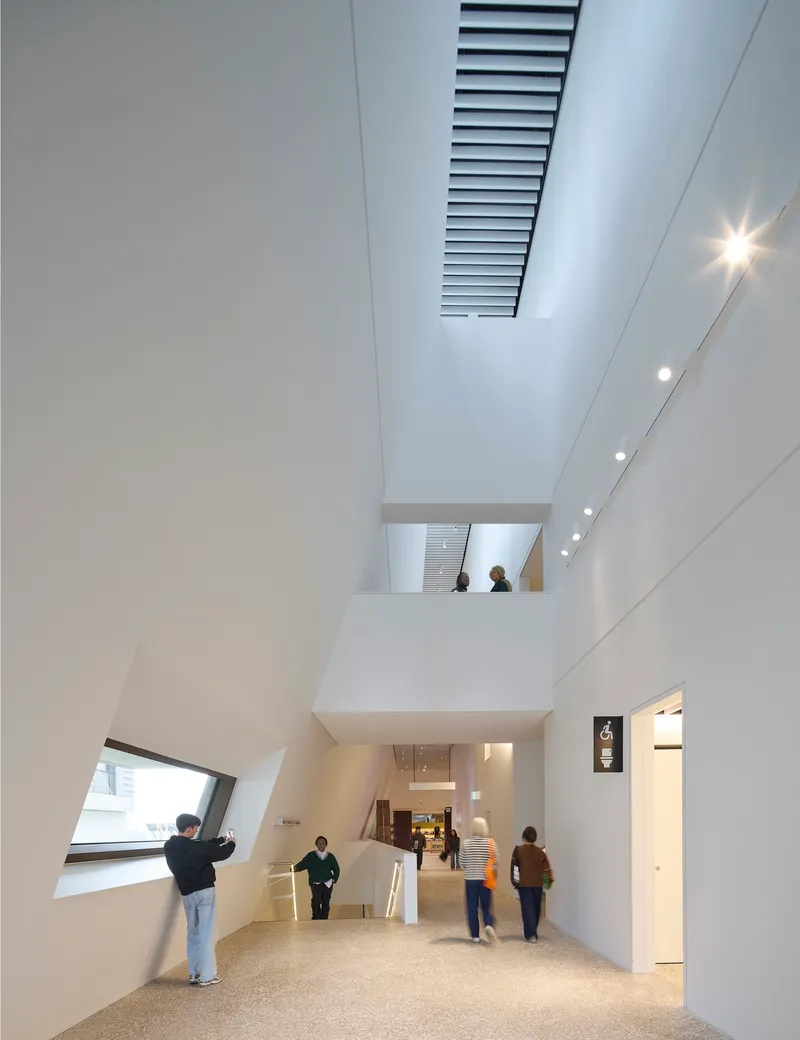
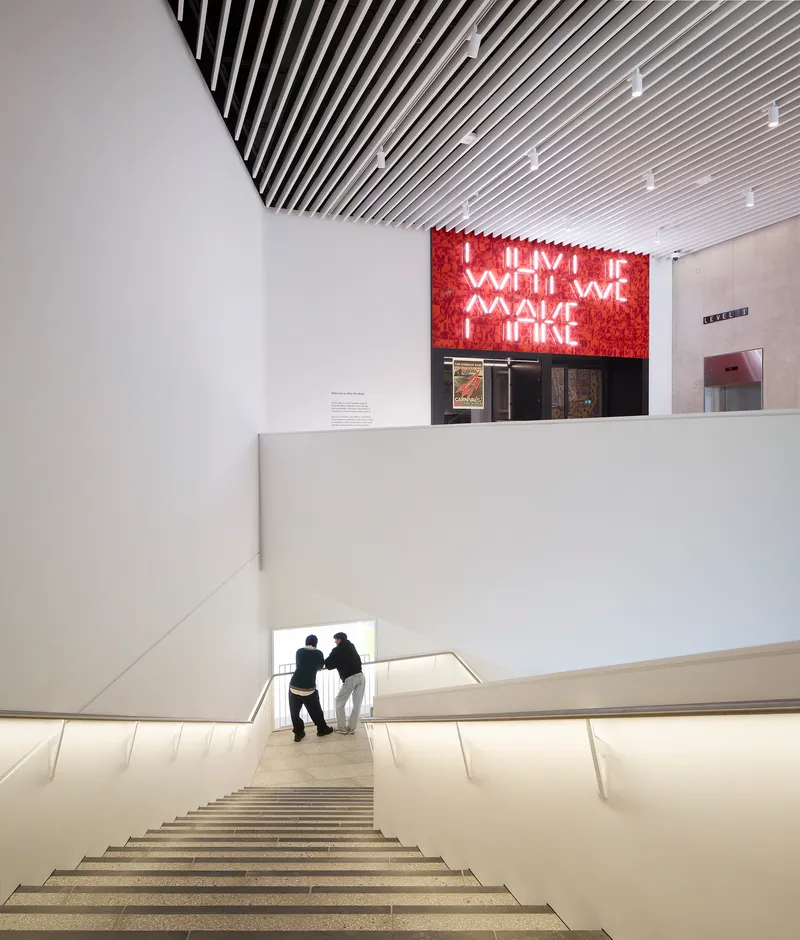
The continuous circulation route that winds through the interstitial layer is the building's strongest spatial idea. It connects five storeys vertically while constantly shifting in section, width, and light quality. Wide staircases with integrated LED handrails open onto double-height voids; tight corridors compress before releasing into terraces. The route is never purely functional. It is always offering a view, a bench, or a moment of orientation before the next gallery threshold.
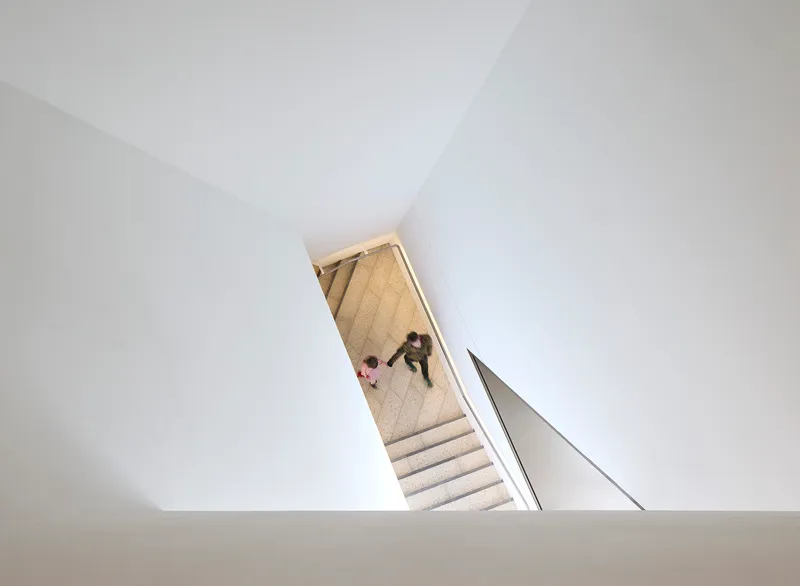
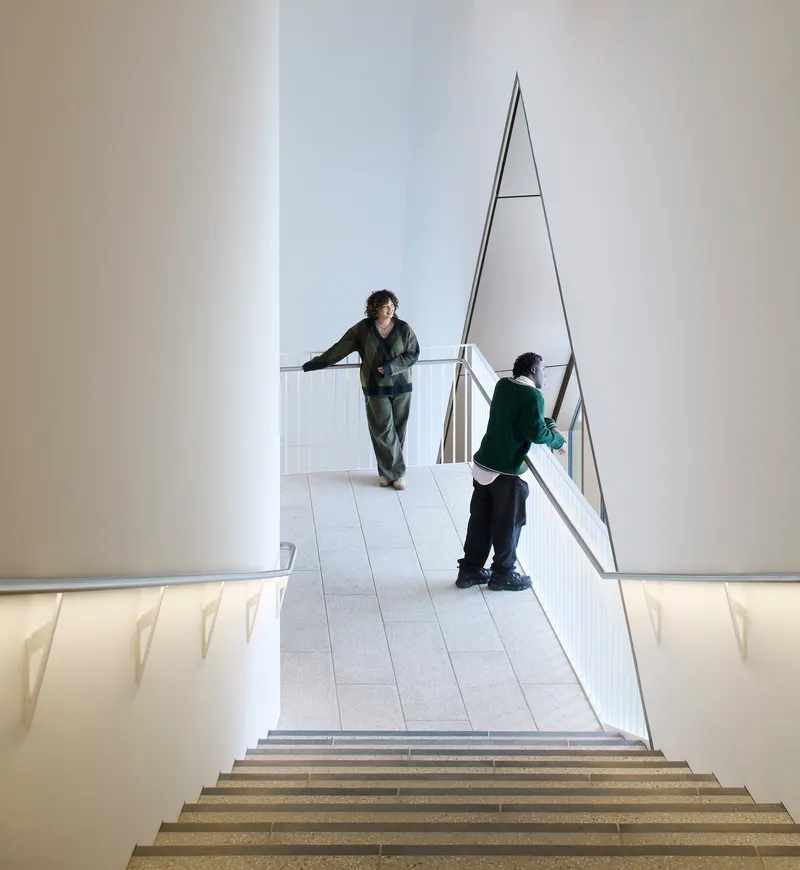
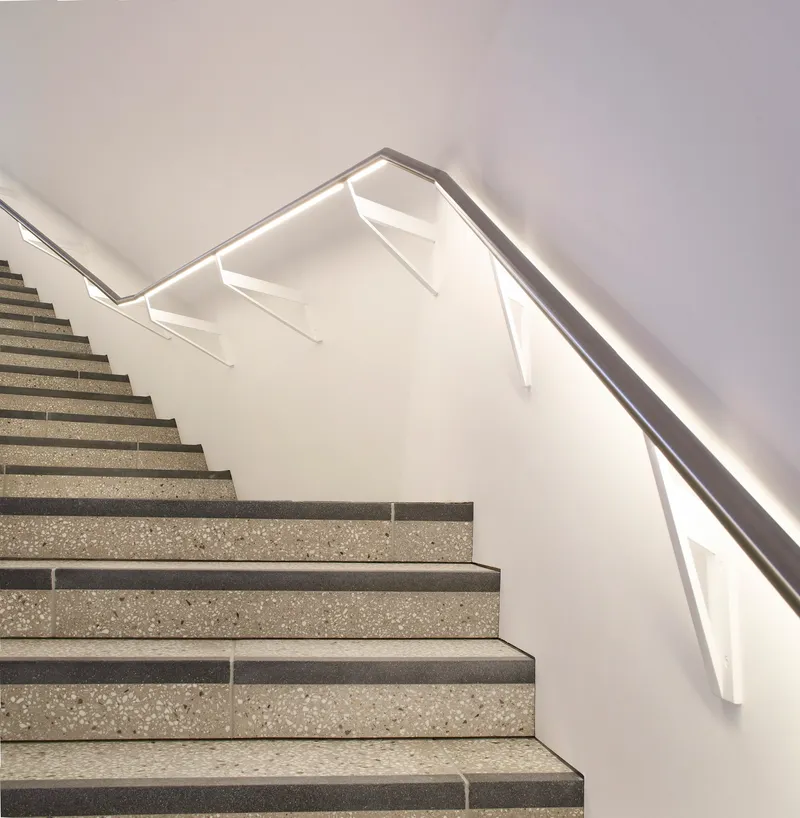
The terrazzo treads, angled walls tinted faintly pink, and folded metal handrails give the stairwells a sculptural weight that recalls the best mid-century museum interiors. But there is nothing nostalgic here. The geometry is angular, the lighting precise, and the spatial sequence deliberately disorienting in a way that keeps visitors curious rather than confused. Three public terraces punctuate the ascent, pulling daylight and views of the park into what could otherwise have been a sealed box.
Interior Volumes and Light
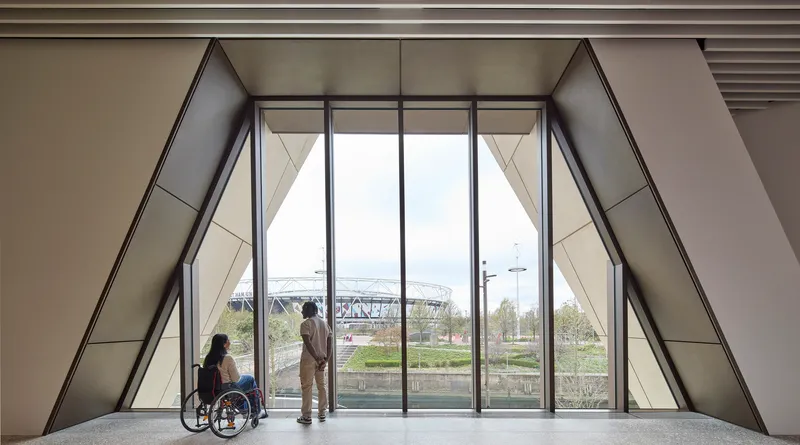
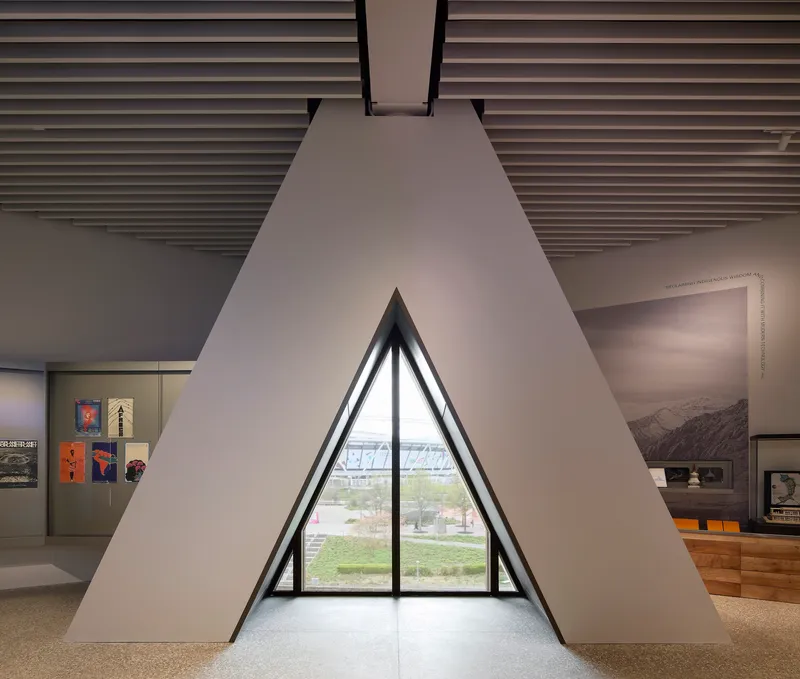
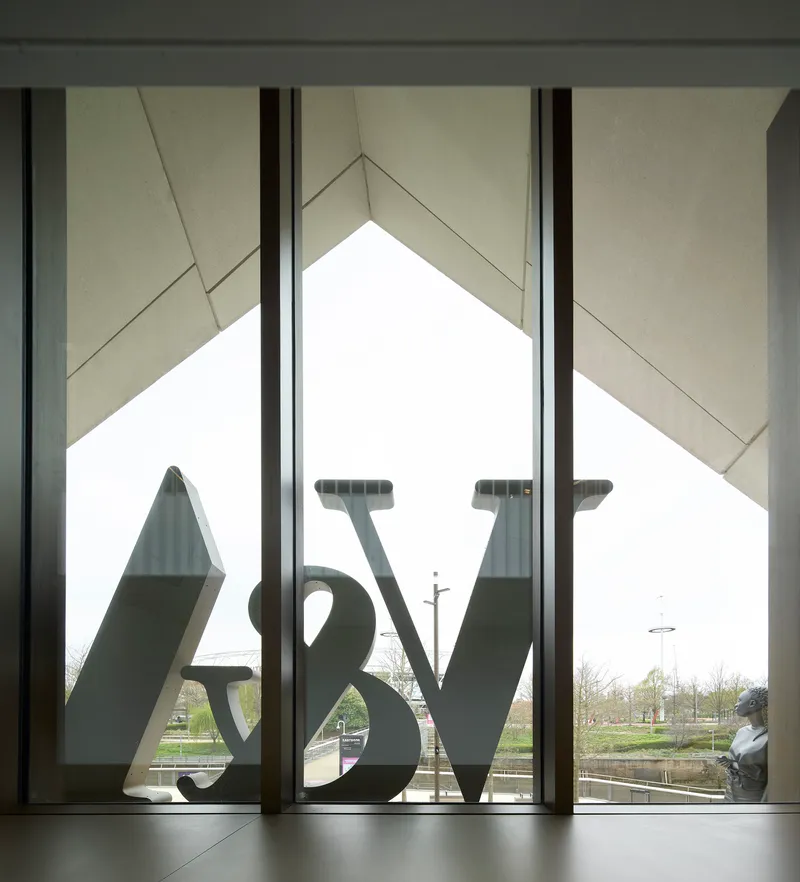
The triangular windows that define the facade from outside become, from within, framed views of extraordinary specificity. A floor-to-ceiling glazed triangle overlooks the landscape. A smaller triangular alcove frames gallery displays on adjacent walls. One window silhouettes the V&A logo sculpture against pale sky. These openings are not uniformly distributed; they appear where the architects wanted to interrupt the gallery experience with a moment of external awareness, a reminder that the building sits in a park, beside water, in a city.
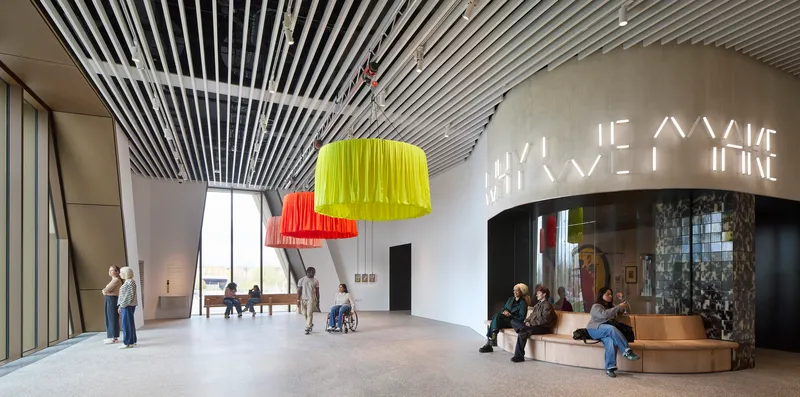
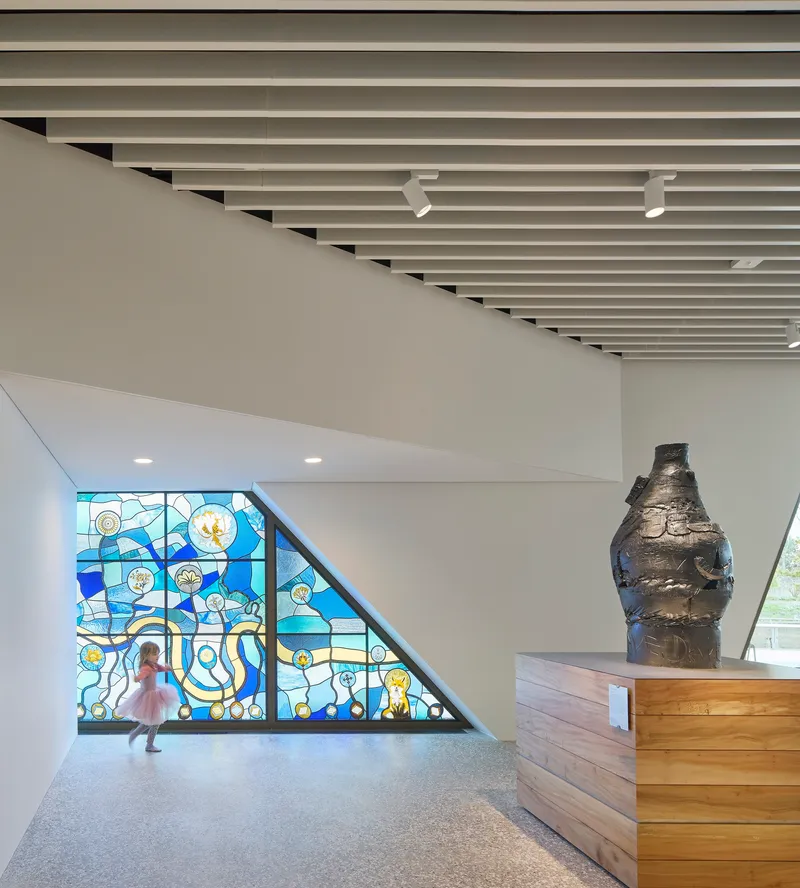
The double-height foyer, hung with yellow and orange pendant lights beneath a curved slatted ceiling, sets the tonal register for the interior: warm, generous, and unapologetically colourful. A stained glass window fills one triangular wall beside a timber reception desk and terrazzo floor, a medieval technique deployed with contemporary confidence. The atrium spaces, where angled windows meet internal balconies and terrazzo floors, demonstrate Buro Happold's structural engineering at its most invisible: the spans feel effortless.
Gallery and Programme Spaces
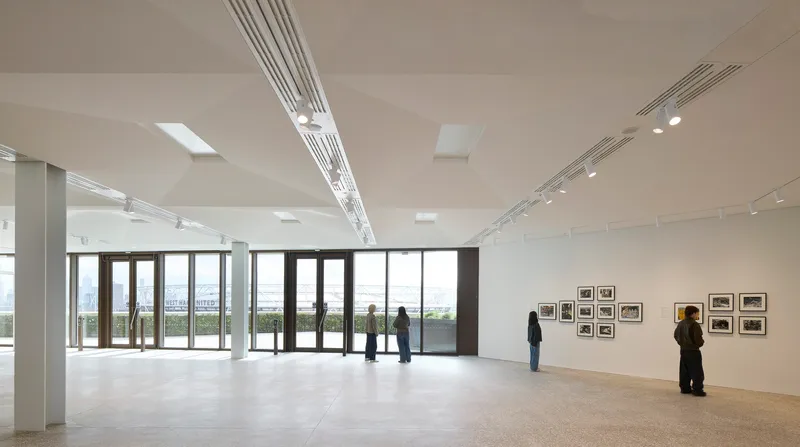
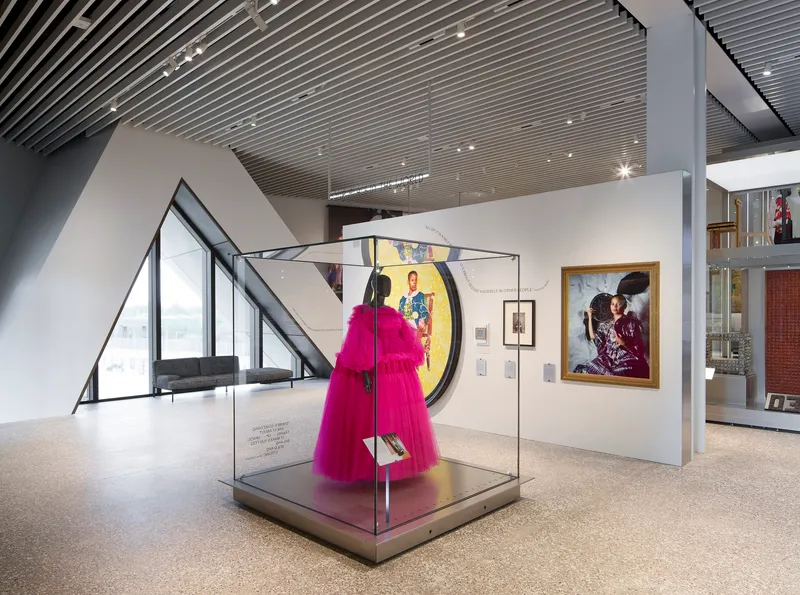
The permanent galleries, dedicated to global culture, art, and design, occupy relatively conventional white-walled rooms with polished concrete floors. This is intentional. The drama is in the circulation; the galleries themselves are calm, flexible, and properly lit. A magenta garment in a glass vitrine sits beside angled glazing. Framed photographs line a wall with the even illumination of professional museum lighting. The building does not compete with its contents.
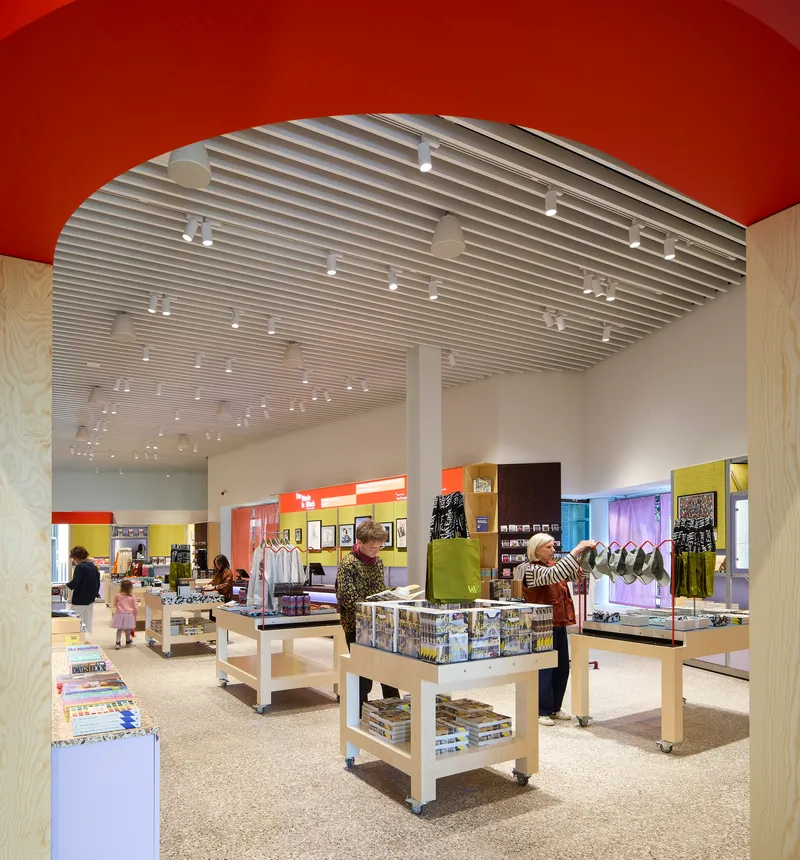
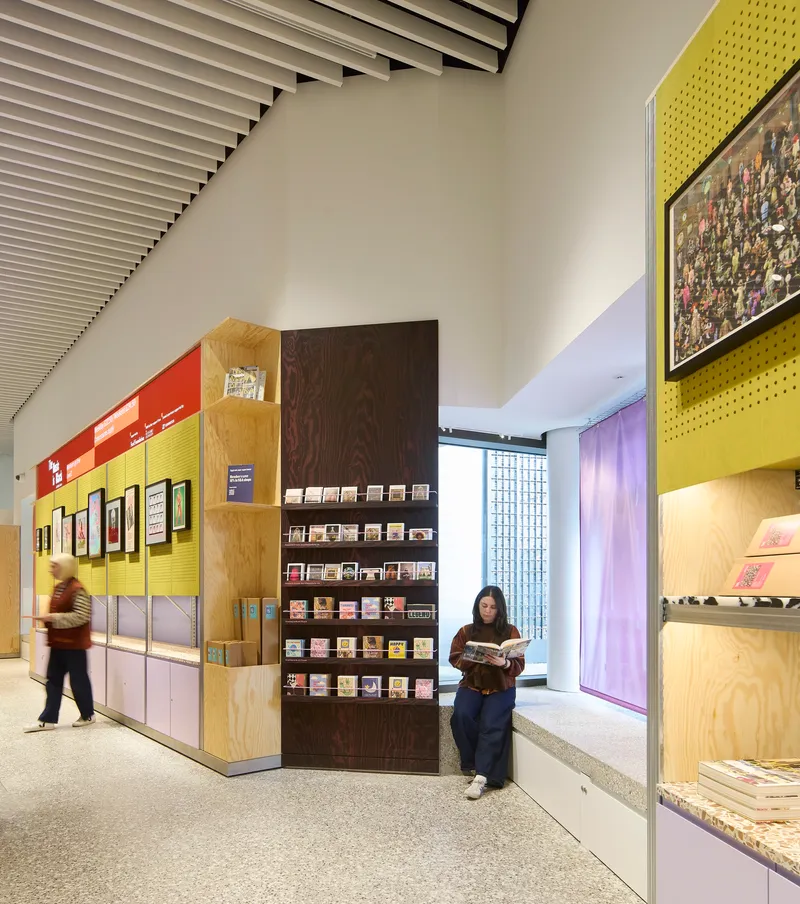
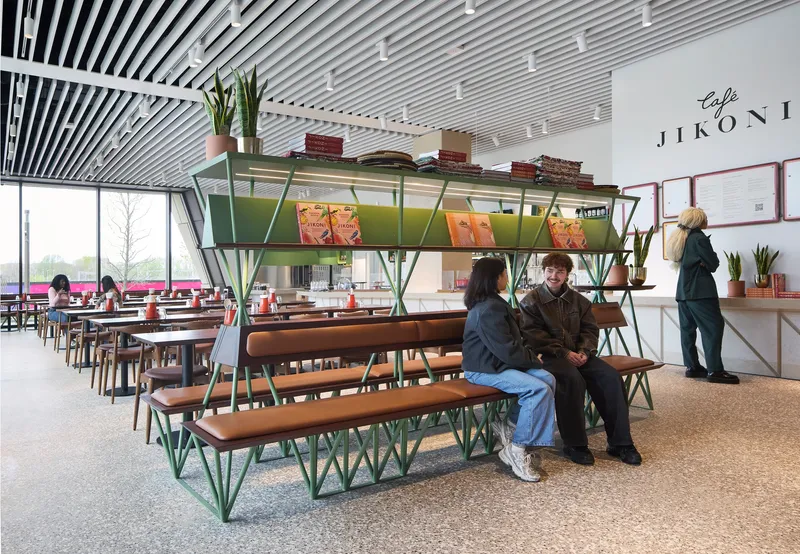
The supporting programme, a shop, a cafe, reading nooks, reinforces the idea that this is a building for spending time rather than ticking a cultural box. The shop sits under an archway framed by a red ceiling plane. The cafe uses green metal benches and slatted ceilings. A freestanding display wall with yellow pegboard and plywood shelving suggests a community workshop more than a retail environment. These are small decisions, but they signal that the institution wants to be used, not just visited.
Colonnades, Canopies, and Thresholds
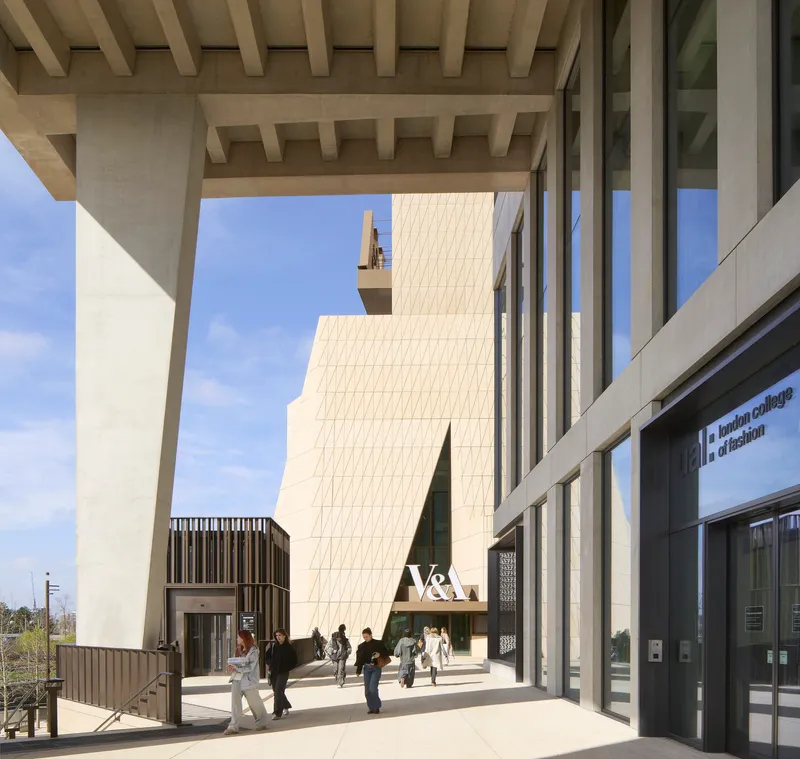
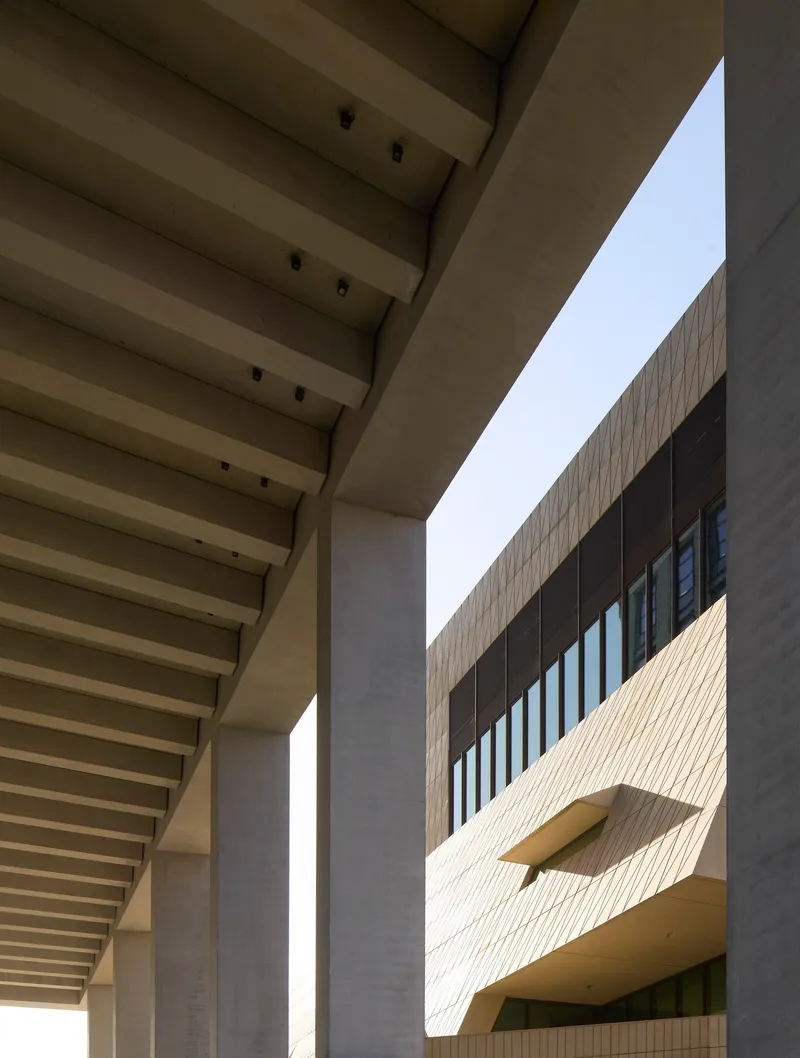
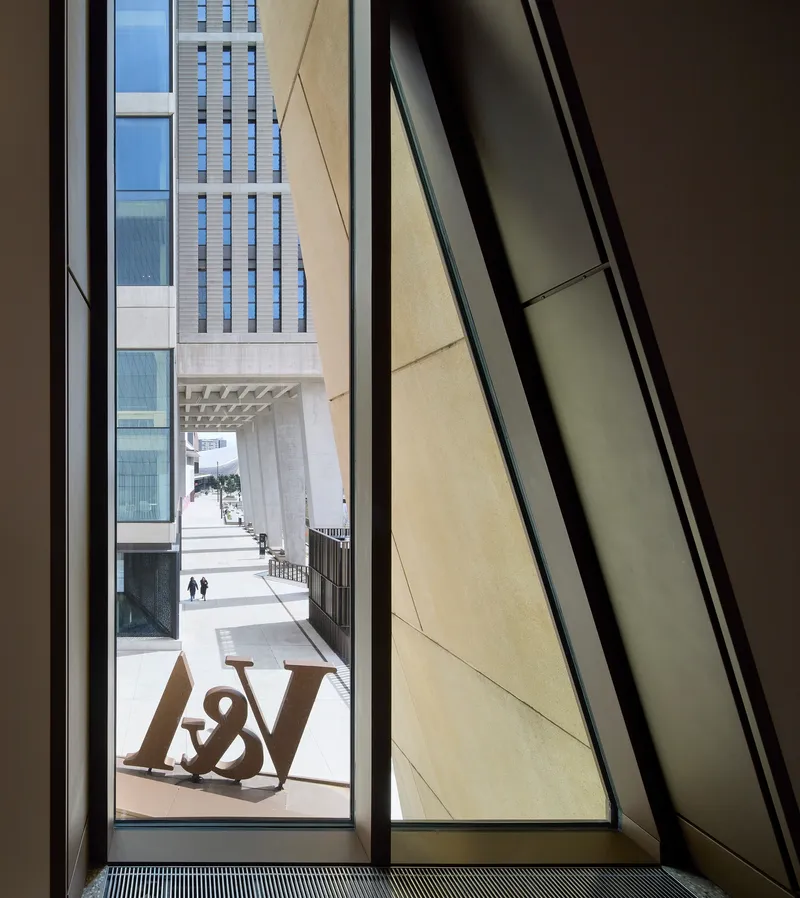
The covered colonnade at ground level, with exposed concrete beams framing views of the paneled facade, is one of the most effective moments in the building. It creates a sheltered public space that belongs neither to the interior nor to the park, a genuine in-between condition. The ribbed concrete canopy of the courtyard, the angular protruding window openings, and the angled views through to the chequered tower facade of neighbouring buildings all demonstrate O'Donnell + Tuomey's skill at composing thresholds. Every edge of this building is occupied, inhabited, activated.
Rooftop and Terraces
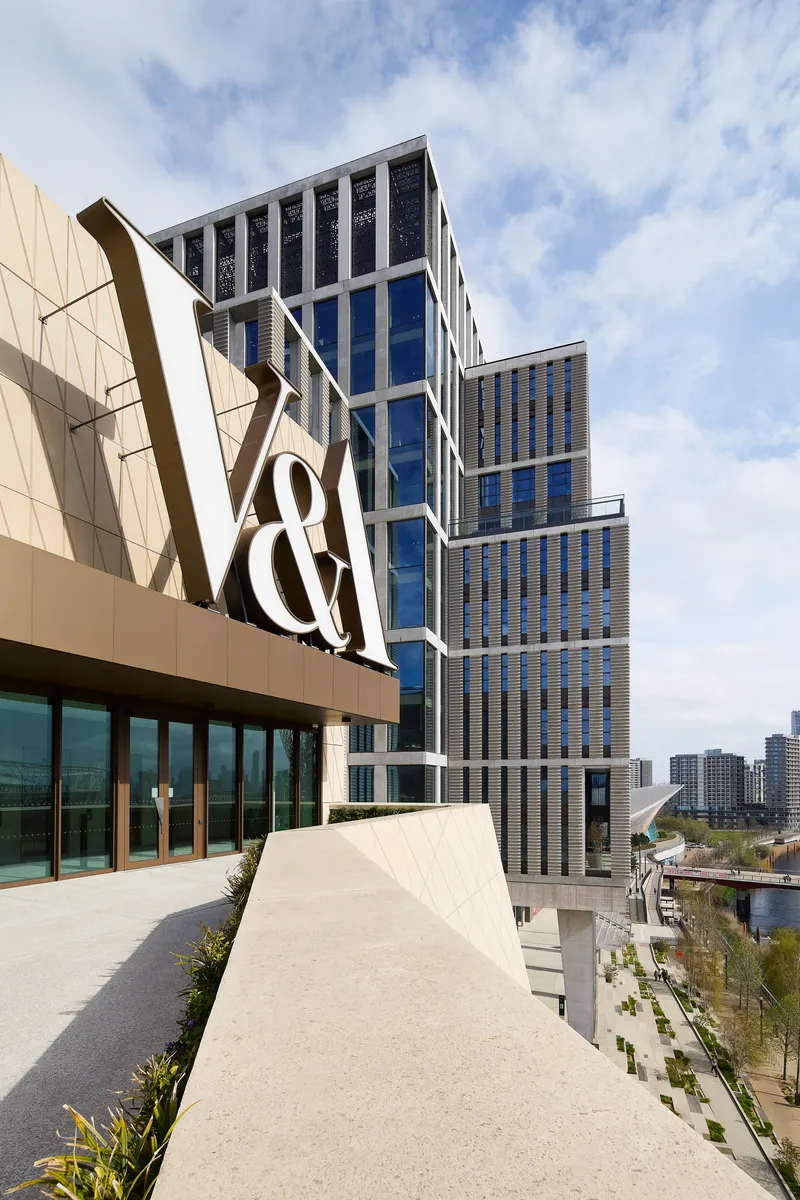
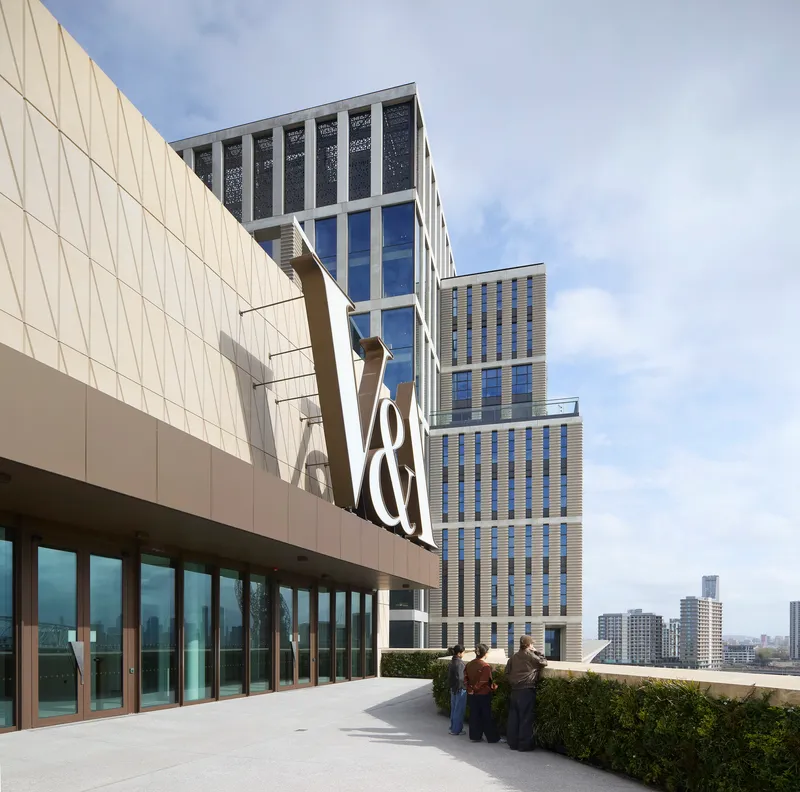
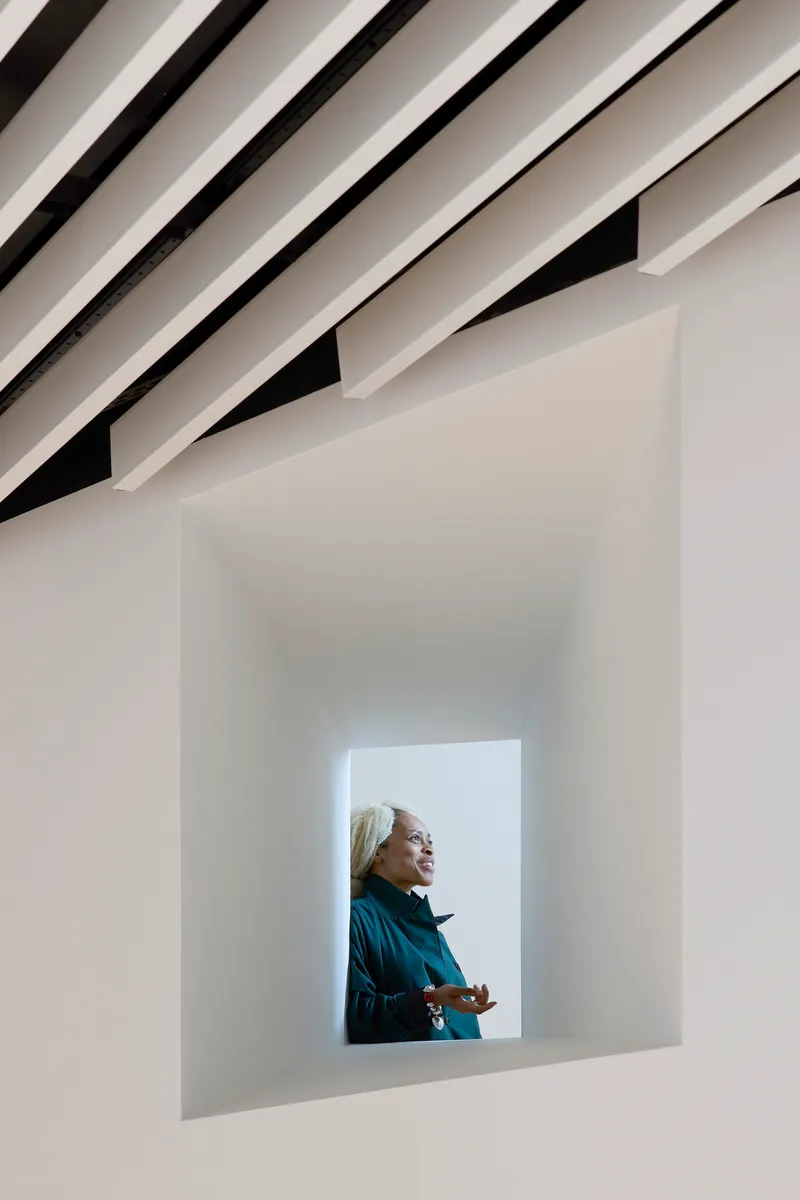
The three public terraces are not afterthoughts. The rooftop terrace, with geometric paving and angled facade forms rising beside it, offers views across the Olympic Park and toward the Stratford skyline. The planted terrace at a lower level gathers visitors near glazed walls. A deep framed window opening with a visitor looking outward beneath angled ceiling louvers turns the act of pausing into an architectural event. These outdoor spaces bring natural light deep into the plan and provide the sectional variety that prevents a five-storey museum from feeling like a stacked warehouse.
Why This Project Matters
O'Donnell + Tuomey won this competition in 2015, and the building opened in April 2026 after years of delay and cost escalation that tested the political will behind the entire East Bank project. That it arrived at all is significant. That it arrived with this level of material conviction is remarkable. The facade is not a veneer; it is the building's structural, environmental, and spatial strategy compressed into a single system. In an era when most institutional facades are thin assemblies of glass and metal panels clipped to a generic frame, this is a building where the wall does the work.
More broadly, the V&A East Museum demonstrates that a major cultural institution can occupy post-industrial land without defaulting to the Bilbao playbook of iconic sculptural form. O'Donnell + Tuomey's building is distinctive, but it earns its distinction through material logic and spatial generosity rather than formal gymnastics. It connects to its neighbours, opens to its waterfront, and invites people to sit on its benches before they decide whether to go inside. That restraint, pursued with intelligence and craft over more than a decade, is the real achievement.
V&A East Museum, designed by O'Donnell + Tuomey within the East Bank masterplan by Allies and Morrison. Located in Queen Elizabeth Olympic Park, Stratford, East London. Approximately 7,000 m². Completed 2026. Engineering by Buro Happold. Steel frame by Bourne Steel. Precast concrete panels by Techrete. Construction management by Mace.
About the Studio
Share Your Own Work on uni.xyz
If projects like this are the kind of work you want to make, uni.xyz is a place to publish your own, find collaborators, and enter design competitions.


Popular Articles
Popular articles from the community


Co-life: Sustainable Architecture for Age-Friendly Community Living
Co-life reimagines sustainable architecture for seniors through courtyards, rammed earth, shared gardens, and spaces designed for belonging.

Play: Fragments of Their World
Familiar architecture becomes modular playground design, creating safe spaces where displaced children can learn, connect, imagine and play.

The Earth Pod: 3D Printed Homes for Resilient Refugee Communities
The Earth Pod reimagines refugee housing through 3D printed homes made from clay, combining resilience, self-sufficiency, and rapid shelter.

Co-Life: Senior Housing Design That Reconnects Older Adults With the City
Co-Life reimagines senior housing design through healing gardens, shared streets, workshops, and a sustainable community across generations.

Similar Reads
You might also enjoy these articles

Bao Huynh Watercolor Atelier: A Serene Art Retreat in Hội An
Bao Huynh Watercolor Atelier in Hội An blends multifunctional art spaces, sustainable design, local materials, and family-friendly living in a serene environment.

Atelier Macri Concept Store Interior Design by CASE-REAL
Atelier Macri store features a "ko" counter, walnut wood details, cork displays, blending retail, gallery, and seamless customer experiences.

Manuel Vargas Izquierdo Stadium and High-Performance Sports Center: Architectural Excellence in Jalpa de Méndez
The Manuel Vargas Izquierdo Stadium blends sustainable design, inclusive sports facilities, and cultural-inspired architecture, revitalizing Jalpa de Méndez’s public spaces.

KAKR Buluh Awar Hall: Revitalizing Community and Ecology Through Bamboo Architecture
Community built bamboo hall revitalizes Buluh Awar village, empowering youth, restoring ecology, celebrating vernacular craftsmanship through sustainable architecture and culture.

Explore Cultural Architecture Competitions
Discover active competitions in this discipline


Challenge to design public laboratory

Bring back Drive In's
Comments (0)
Please login or sign up to add comments
No comments yet. Be the first to comment!