
OFFICE KGDVS Floats a Holiday House on 25 Columns Above a Swedish Hillside
A CLT cabin in Plintsberg, Sweden, lifts its entire program off a wooded slope and turns the roof into a reflective fifth facade.


The premise is so blunt it could be a caption: two horizontal slabs, 25 wooden columns, a slope left almost entirely alone. OFFICE Kersten Geers David Van Severen built this holiday house in Plintsberg, Sweden, as though they were writing an architectural haiku, each element counted and accounted for. The building sits on a wooded hillside that drops toward a lake, and the architects' first decision was to touch as little of that ground as possible. The columns land lightly, the CLT floor plane hovers, and the terrain beneath continues doing what it was doing before anyone showed up with a site plan.
What makes the project genuinely compelling is not the lightness alone but the way OFFICE deploys an almost absurdly rigorous grid to produce domestic informality. The 25 columns define a field, not a set of rooms. Four glazed boxes containing three bedrooms and a winter garden are placed within this field like furniture, while the kitchen, fireplace, and storage stand freestanding as objects. The roof, clad in aluminum, reflects the surrounding canopy and sky, dematerializing the one surface you see first when approaching from the road above. Nominated for both the Kasper Salin Award and the Mies van der Rohe Award, 25 Columns is a serious proposition wrapped in deliberate restraint.
Lifting Off the Landscape
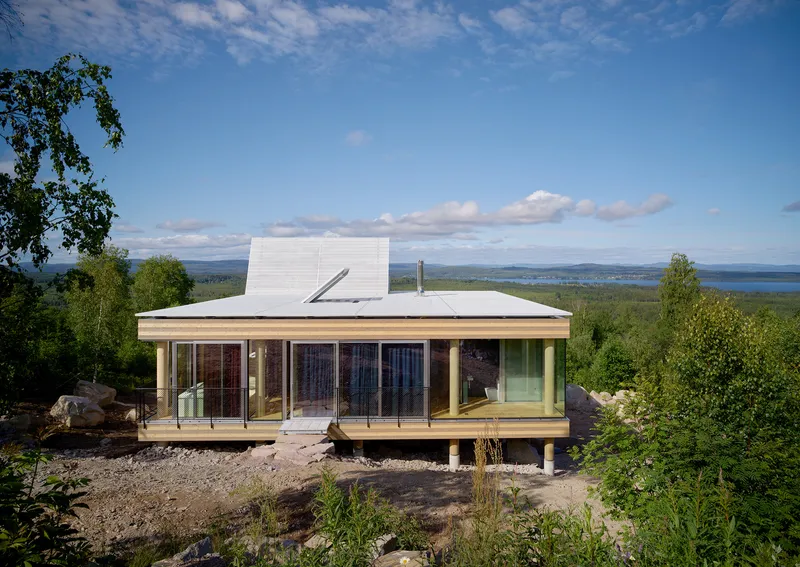
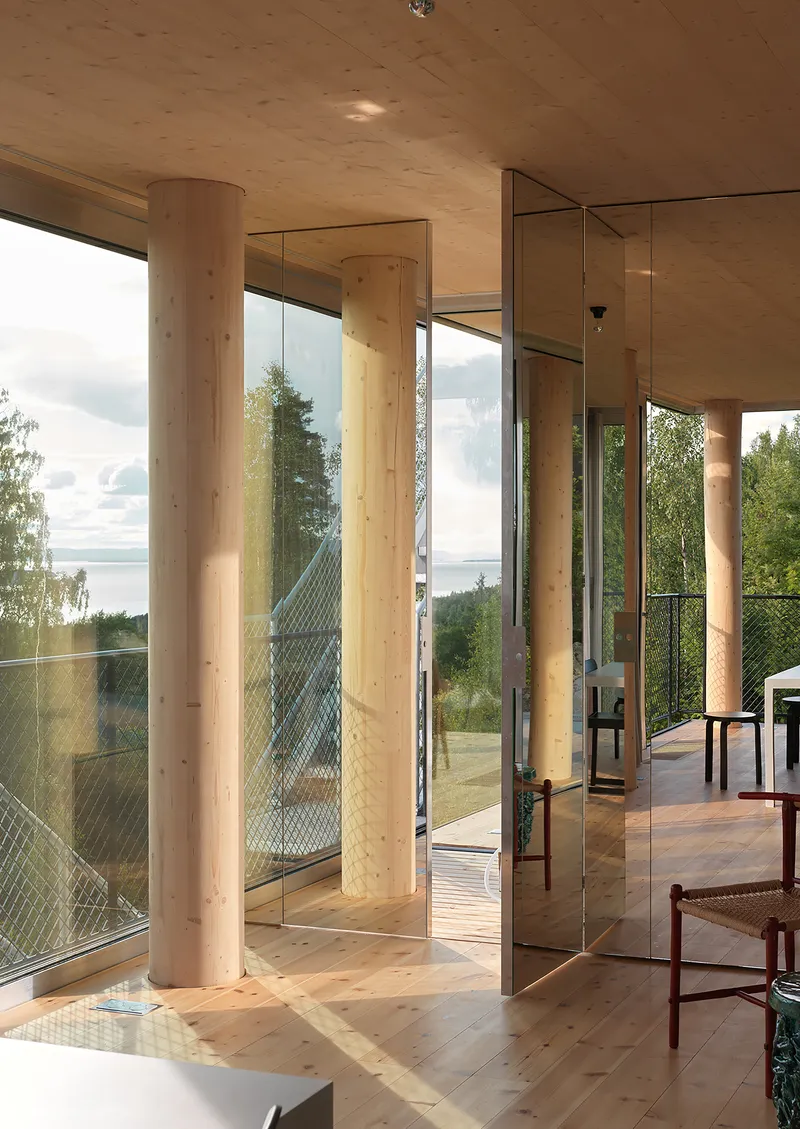
From below, the house reads as a slender horizontal band floating among pine and birch trunks. The column grid recalls a hypostyle hall more than a Nordic cabin, which is precisely the point. OFFICE has long worked with archetypal spatial figures, and here the colonnade is both structure and atmosphere, filtering views and light without enclosing them.
Positioned in the middle of its plot and set lower than the road, the building is only partly visible on approach. You discover it by descent, encountering the aluminum roof first and the living space second. A single straight outdoor stair in aluminum connects the roof terrace to the interior level and then down to the natural terrain, so movement through the house is also movement through the topography.
The Reflective Fifth Facade
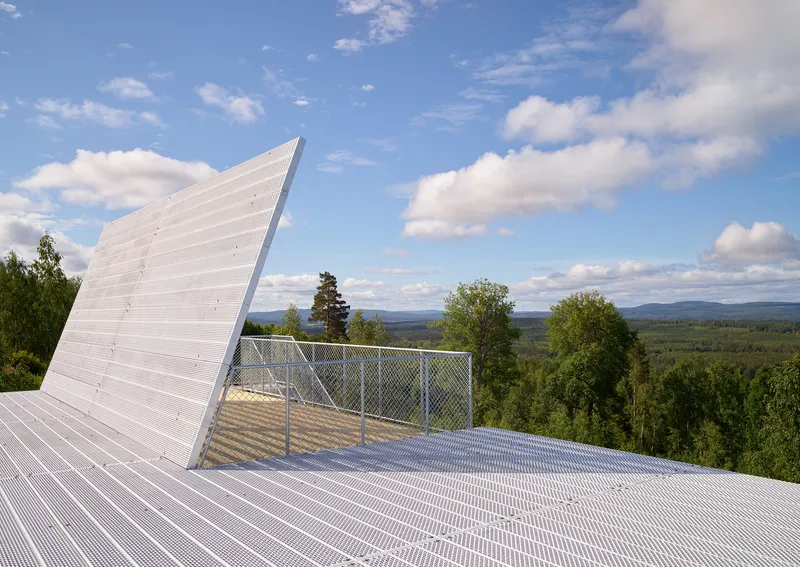
The aluminum roof is the building's most visible surface from the road, and it was designed to perform accordingly. Clad in reflective sheets, the roof picks up cloud cover, treetops, and the changing Scandinavian light, effectively dissolving the house's mass into its surroundings. A chimney and two folding aluminum screens break the plane. The screens serve double duty: they filter direct sunlight over a skylight and provide privacy for the roof terrace.
Treating the roof as a primary elevation is not new, but doing it with this degree of material honesty is rare. There is no green roof, no planted tray pretending the building is landscape. The aluminum will weather, the reflections will shift seasonally, and the house will register time the way its surrounding forest does, through slow, visible change.
Objects in a Field
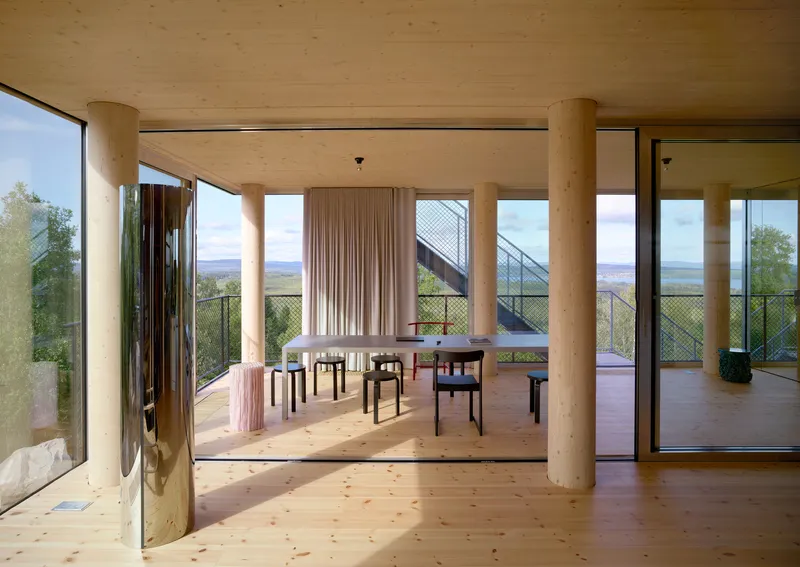
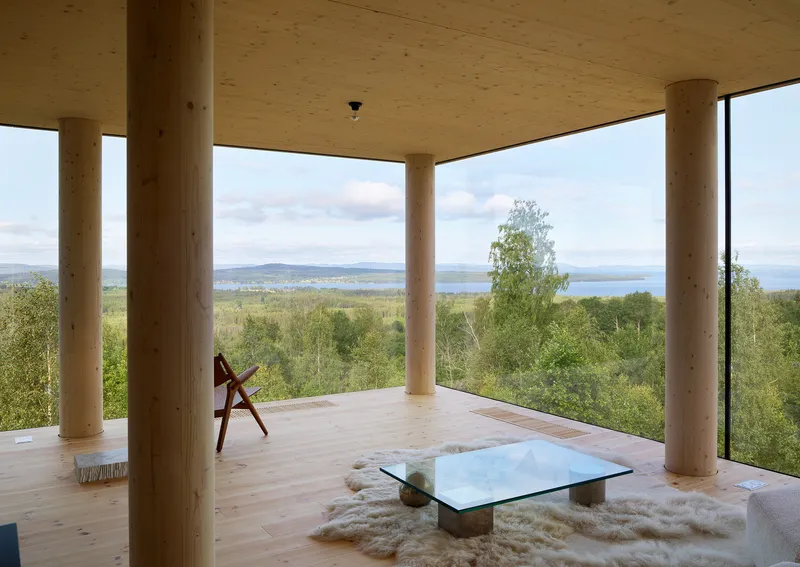
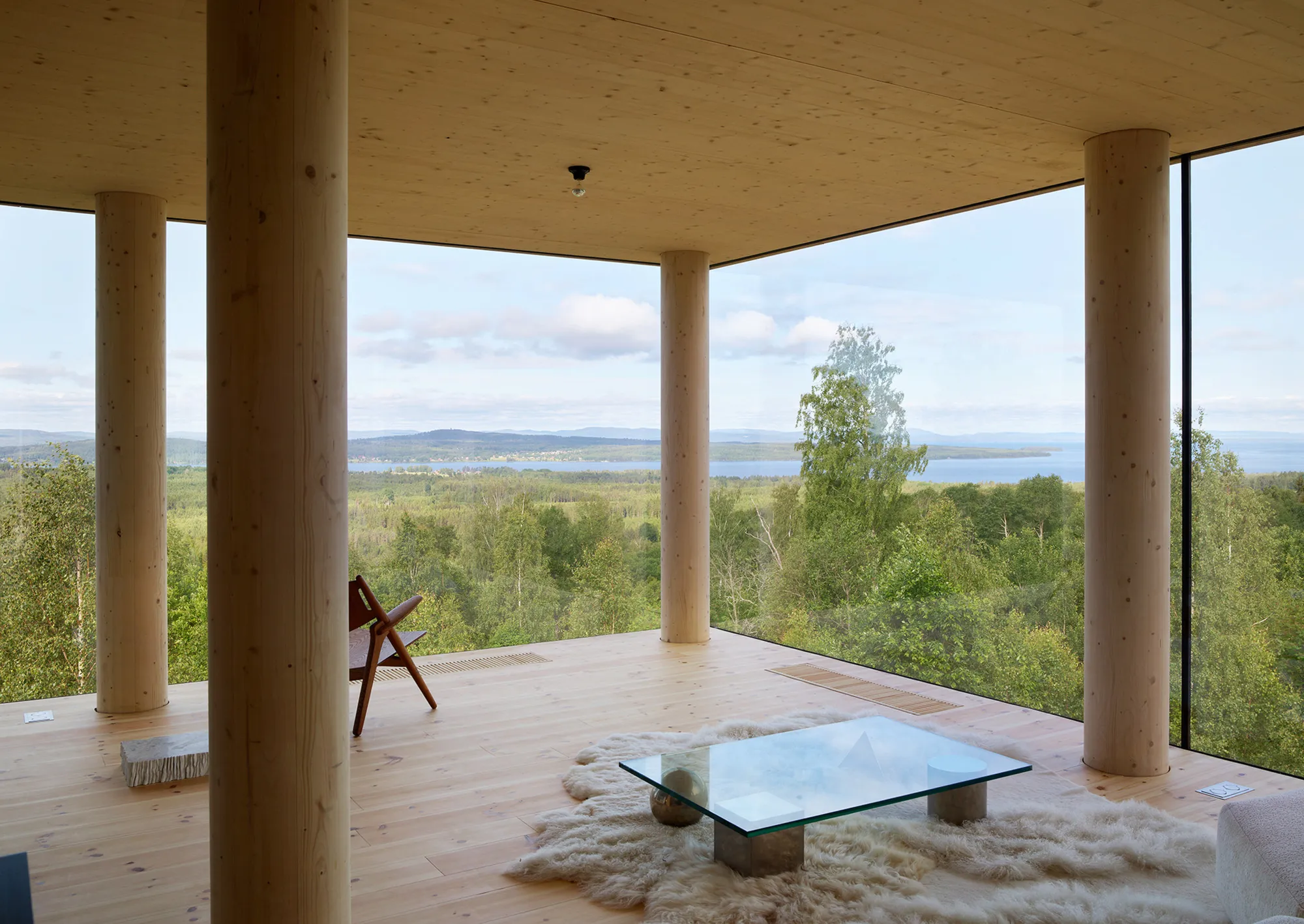
Inside, the 250 square meters feel substantially larger because no permanent partition runs wall to wall. The three bedrooms and winter garden are self-contained glazed boxes that occupy positions within the column grid without filling it. The rest of the program, a kitchen counter, a fireplace, storage volumes, sits freestanding. The result is a plan that reads more like a landscape of domestic objects than a sequence of rooms.
CLT slabs form both the floor and the ceiling, giving the interior a warm, pale timber quality that contrasts sharply with the cool aluminum exterior. Cylindrical wooden columns punctuate the space at a regular rhythm, framing panoramic views of the lake and surrounding hills. The glazing wraps the perimeter generously, so every position in the open plan connects to the forest. It is a holiday house that rewards sitting still.
Material Reduction as Strategy
The palette is deliberately narrow: CLT timber, glass, aluminum. No cladding system conceals the structure, and no applied finish mediates between material and eye. The architects clearly intended the building to be readable at a glance, its logic visible in every joint. The aluminum staircase, for instance, does not pretend to be anything other than a piece of bent metal connecting two levels.
This reductive approach carries risk. A holiday house stripped of texture can feel institutional, but the warmth of the timber interior and the constantly shifting views through the glass perimeter keep the space from tipping into austerity. The materials are also chosen for longevity in a harsh climate. Left exposed to weather, they are expected to patinate and converge visually with the forest over time.
Plans and Drawings
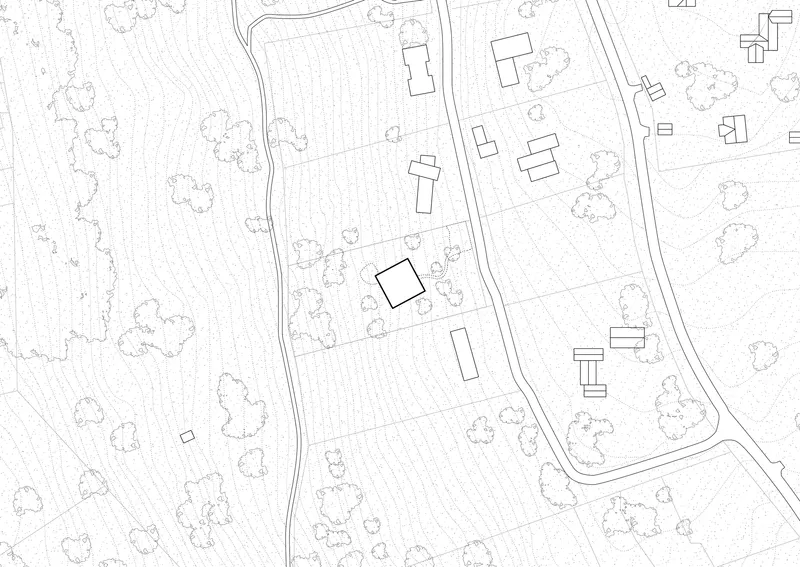
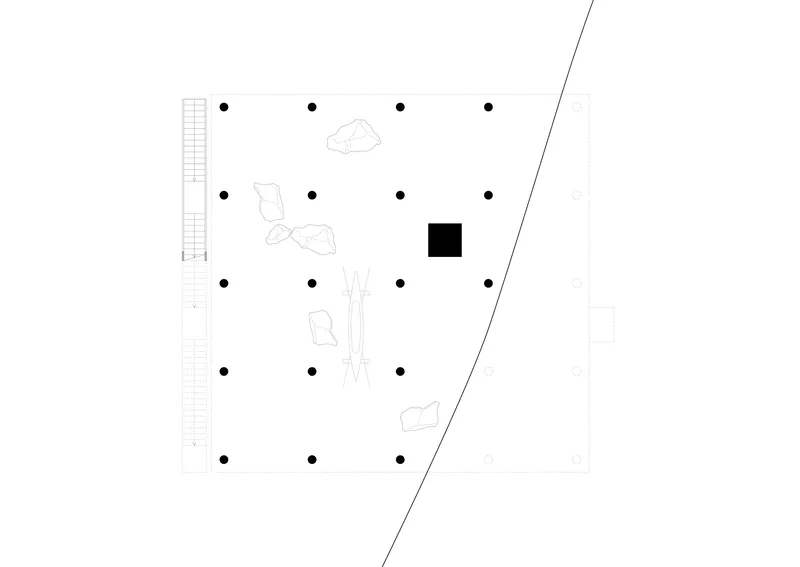
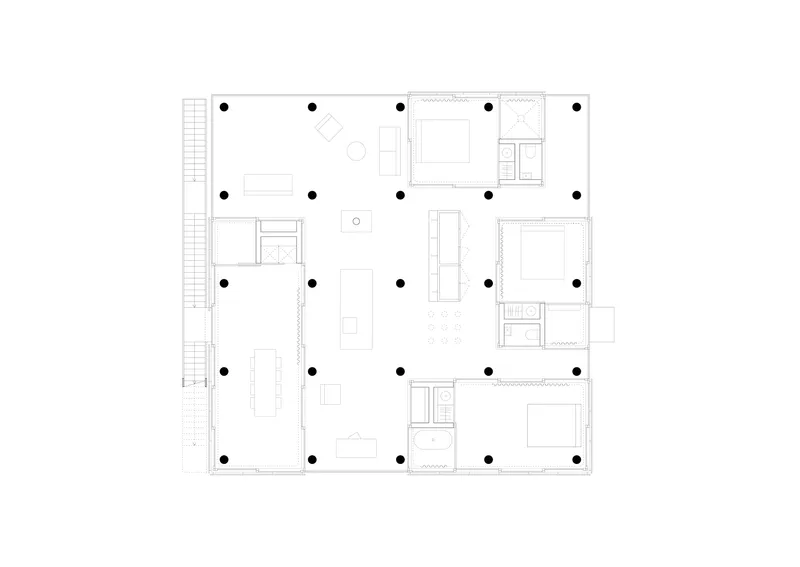
The site plan reveals the building's careful insertion into the wooded slope, rotated to align with the fall of the terrain rather than the curving road above. The floor plans confirm the open-field strategy: the column grid is relentless and regular, while the enclosed rooms and furniture appear as autonomous objects dropped into the matrix. One plan shows the bedroom boxes pushed to the perimeter, the other depicts the service core and open central space. The contrast between the grid's discipline and the plan's looseness is where the project's spatial generosity comes from.
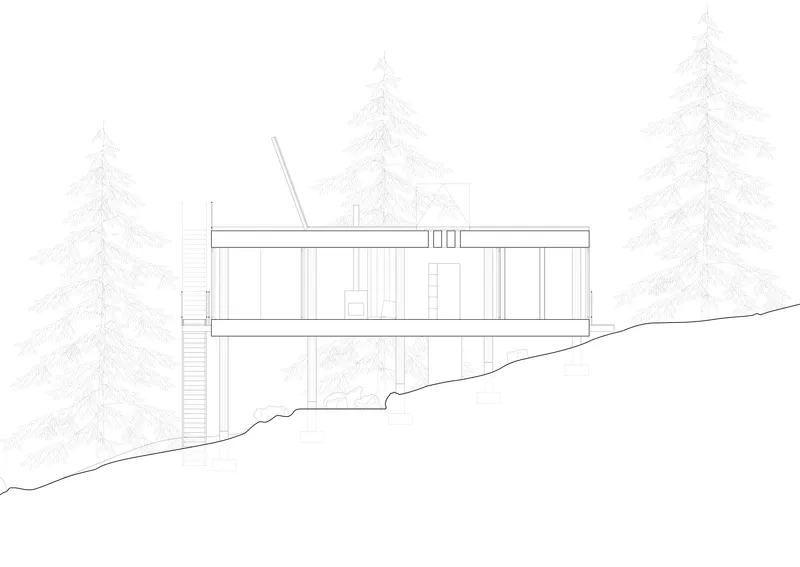
The section drawing is perhaps the most revealing. It shows the two horizontal slabs suspended above the sloping ground, the columns of varying exposed height marching down the hill. Evergreen trees bracket the composition, and the building reads as a thin datum line inserted into the landscape. The gap between the terrain and the floor slab is generous enough to preserve root systems and drainage patterns, reinforcing the architects' commitment to minimal site disturbance.
Why This Project Matters
25 Columns arrives at a moment when Nordic holiday houses are often overwrought, loaded with sustainability narratives and craft signifiers that can obscure the basic architectural question of how a building meets its site. OFFICE answers that question with structural directness. The grid is not decorative; it is the logic that allows the house to exist above its terrain without excavation or retaining walls. Every subsequent decision, the reflective roof, the freestanding boxes, the aluminum screens, follows from that initial structural commitment.
The nominations for the Kasper Salin Award and the Mies van der Rohe Award suggest the profession recognizes something significant here. What OFFICE has built is not a manifesto against comfort or a minimalist provocation. It is a precise demonstration that restraint, when it is genuinely structural rather than stylistic, can produce a house that is both intellectually rigorous and deeply pleasurable to inhabit. Twenty-five columns, two slabs, one slope, and nothing wasted.
25 Columns, designed by OFFICE Kersten Geers David Van Severen with local architect Agnas Ark and structural engineering by UTIL Struktuurstudies. Plintsberg, Sweden. 250 m². Completed 2024. Photography by Bas Princen.
About the Studio
Share Your Own Work on uni.xyz
If projects like this are the kind of work you want to make, uni.xyz is a place to publish your own, find collaborators, and enter design competitions.


Popular Articles
Popular articles from the community


Co-life: Sustainable Architecture for Age-Friendly Community Living
Co-life reimagines sustainable architecture for seniors through courtyards, rammed earth, shared gardens, and spaces designed for belonging.

Hill & Cross Opera: Sculptural Opera House Architecture Shaped by Tallinn’s Landscape and Identity
Hill & Cross Opera reimagines opera house architecture in Tallinn through its sculptural hill, civic plaza, glass wave and a luminous cross.

The Earth Pod: 3D Printed Homes for Resilient Refugee Communities
The Earth Pod reimagines refugee housing through 3D printed homes made from clay, combining resilience, self-sufficiency, and rapid shelter.

Riyadh For All: Intergenerational Urban Design for Active Aging in Rabat
Riyadh For All reimagines urban design in Rabat with intergenerational co-living, adaptive courtyards, and Moroccan cultural exchange today.
Similar Reads
You might also enjoy these articles

Bao Huynh Watercolor Atelier: A Serene Art Retreat in Hội An
Bao Huynh Watercolor Atelier in Hội An blends multifunctional art spaces, sustainable design, local materials, and family-friendly living in a serene environment.

Atelier Macri Concept Store Interior Design by CASE-REAL
Atelier Macri store features a "ko" counter, walnut wood details, cork displays, blending retail, gallery, and seamless customer experiences.

Manuel Vargas Izquierdo Stadium and High-Performance Sports Center: Architectural Excellence in Jalpa de Méndez
The Manuel Vargas Izquierdo Stadium blends sustainable design, inclusive sports facilities, and cultural-inspired architecture, revitalizing Jalpa de Méndez’s public spaces.

KAKR Buluh Awar Hall: Revitalizing Community and Ecology Through Bamboo Architecture
Community built bamboo hall revitalizes Buluh Awar village, empowering youth, restoring ecology, celebrating vernacular craftsmanship through sustainable architecture and culture.



Comments (0)
Please login or sign up to add comments
No comments yet. Be the first to comment!