

Olgga Architects and Atelier CAMBIUM Weave Military Ruins into 63 Homes on Bordeaux's Right Bank
A palimpsest of barracks walls, ceramic cladding, and tinted concrete gives Bastide-Niel a neighborhood scaled to memory and light.


Bordeaux's right bank has long lived in the shadow of the grand stone quays across the Garonne. The Bastide-Niel district, once home to rail embankments, warehouses, and the barracks of the 18th Crew Train Squadron completed in the late 1870s, is the proving ground for whether that imbalance can finally tip. Into this charged terrain, Olgga Architects and Atelier CAMBIUM have placed six pale volumes that read less like new construction and more like geological strata, each layer encoding a different era of the site's past.
What makes this project genuinely interesting is its refusal to treat heritage as decoration. The stone walls of the former military complex are absorbed into the building envelope without carrying structural load, functioning instead as a material memoir. Where the barracks once stood, the concrete shifts in tint. Where long-demolished sheds once cast their shadows, a change in tone at the base of the facade marks their absence. The result is a housing block that operates as a palimpsest: you can read each century if you know where to look, but the architecture never insists on the lesson.
An Archipelago of Six
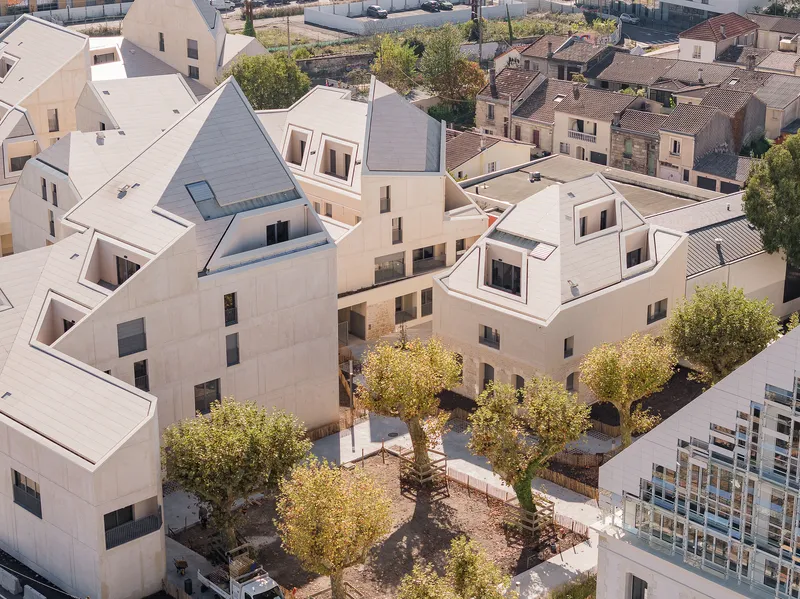
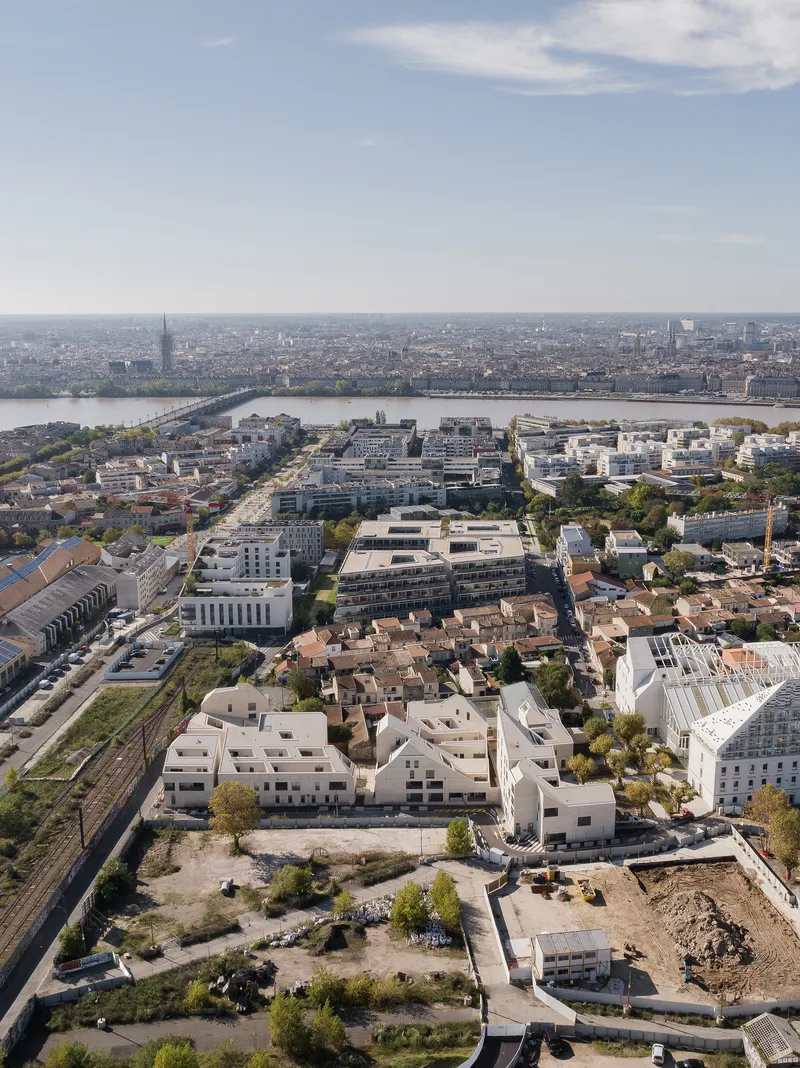
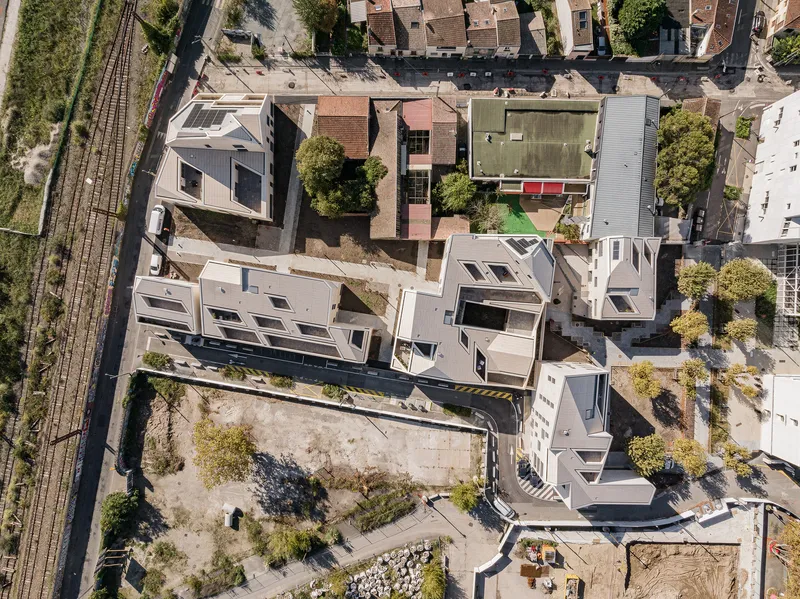
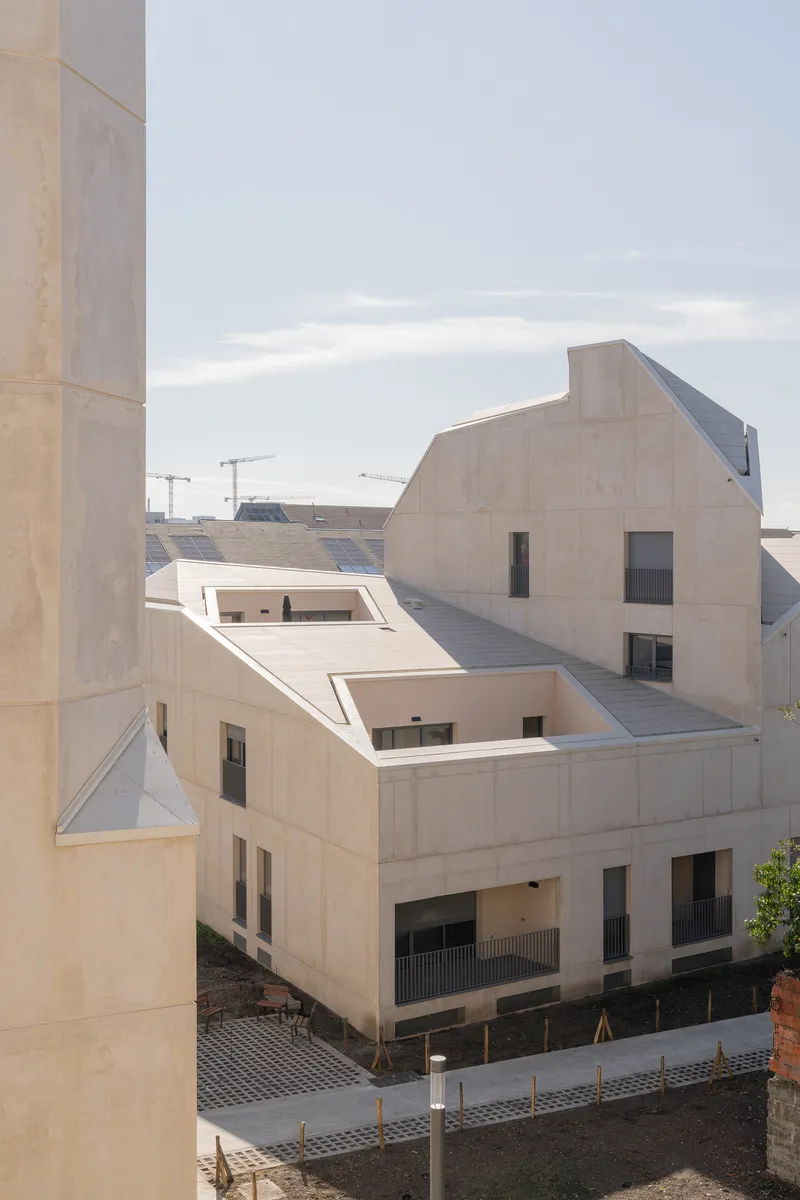
Seen from above, the six blocks register as a loose archipelago rather than a single monolithic slab. Their arrangement generates a network of courtyards and planted passages that recreate something close to neighborhood life at the scale of a single city block. The varied rooflines, pitched and staggered in response to solar access calculations, give each volume a distinct silhouette while the consistent palette of pale concrete and stone-tinted ceramic ties them together.
The aerial views also reveal the site's edges: railway tracks to the south, the river beyond, and the historic city across the water. The low-rise massing keeps the complex subordinate to the skyline, a deliberate concession that lets the right bank develop without competing with the left bank's limestone grandeur.
Materiality as Memory
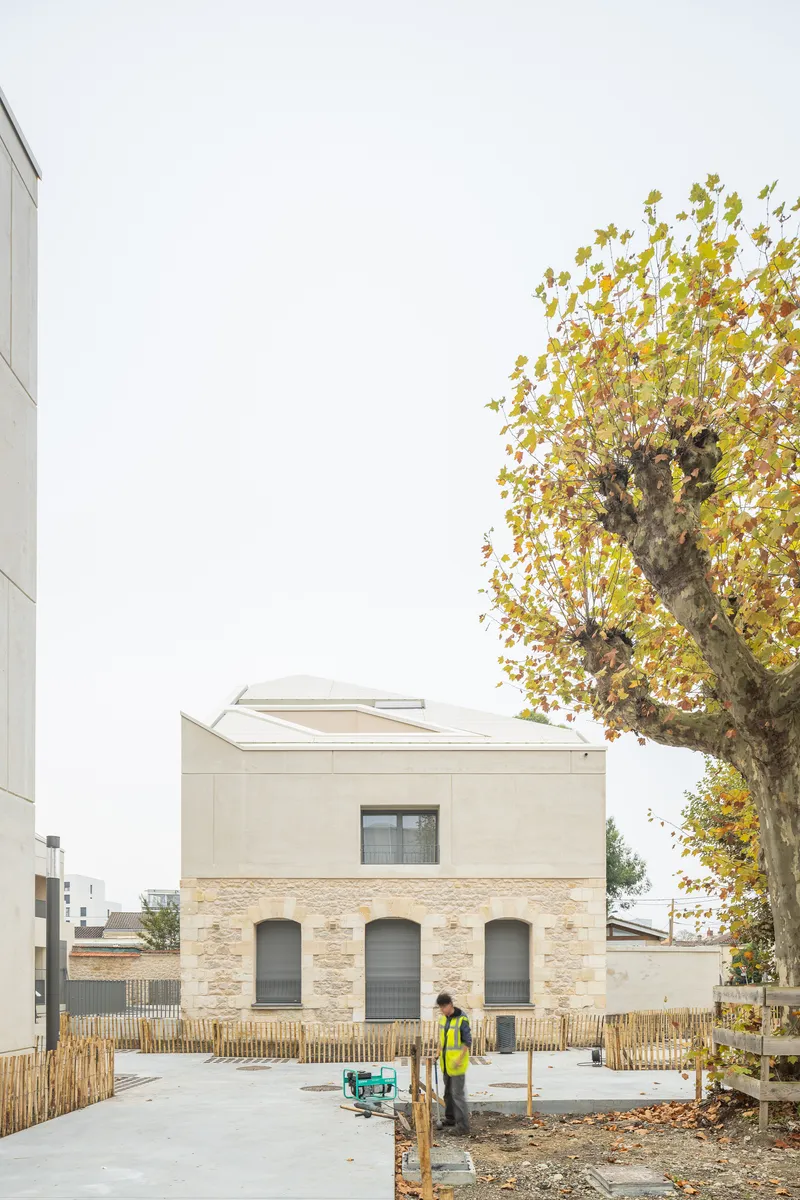
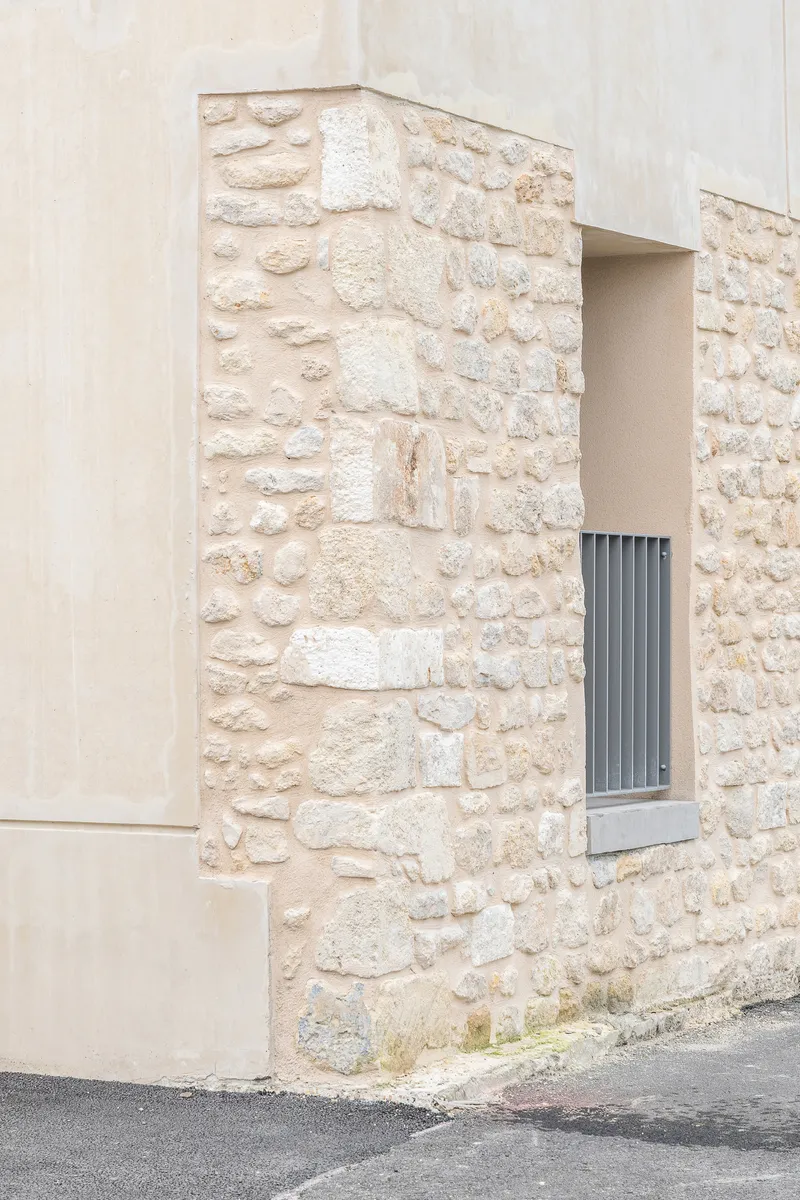
The facade strategy is the project's most considered move. Stone walls salvaged from the 1878 barracks are folded into the building envelope as a continuous surface, so the transition from historic masonry to new construction is deliberately ambiguous. A smooth grey-tinted concrete renders the ghost of vanished building volumes, while a shift in tint at the base evokes the footprints of demolished sheds. Stone-tinted ceramic cladding wraps chamfered corners, catching light differently from the flat planes and reinforcing the reading of each volume as a carved solid.
The close-up of the limestone corner, where rough-cut stone meets a precise plaster edge and a deeply recessed window, is the detail that tells the whole story. There is no trim piece mediating between old and new. The two materials simply meet, and the joint is the narrative.
Courtyards and the Space Between
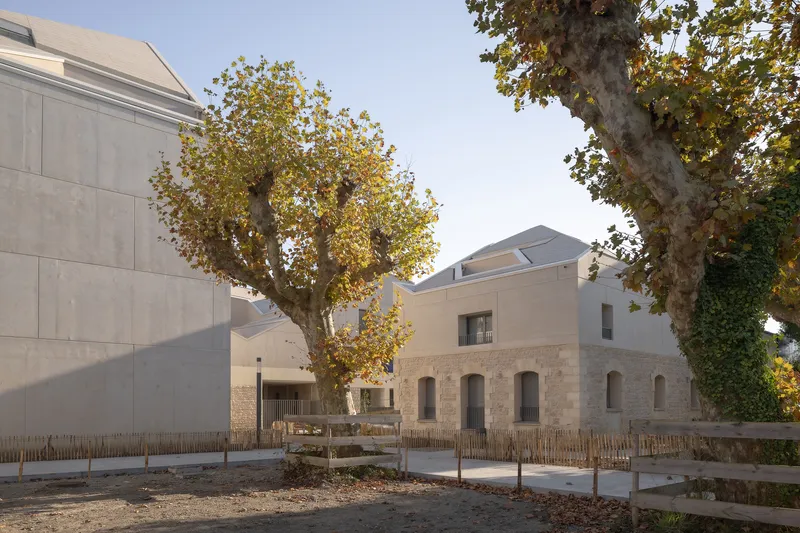
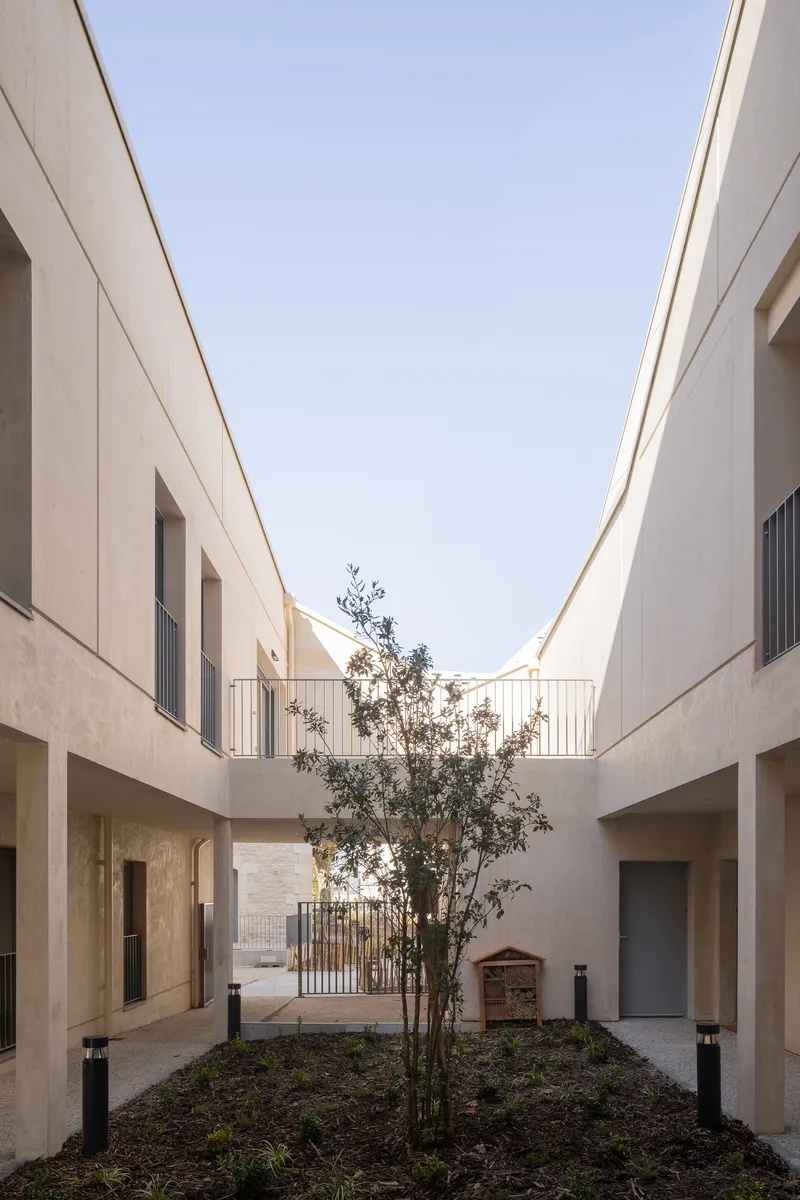
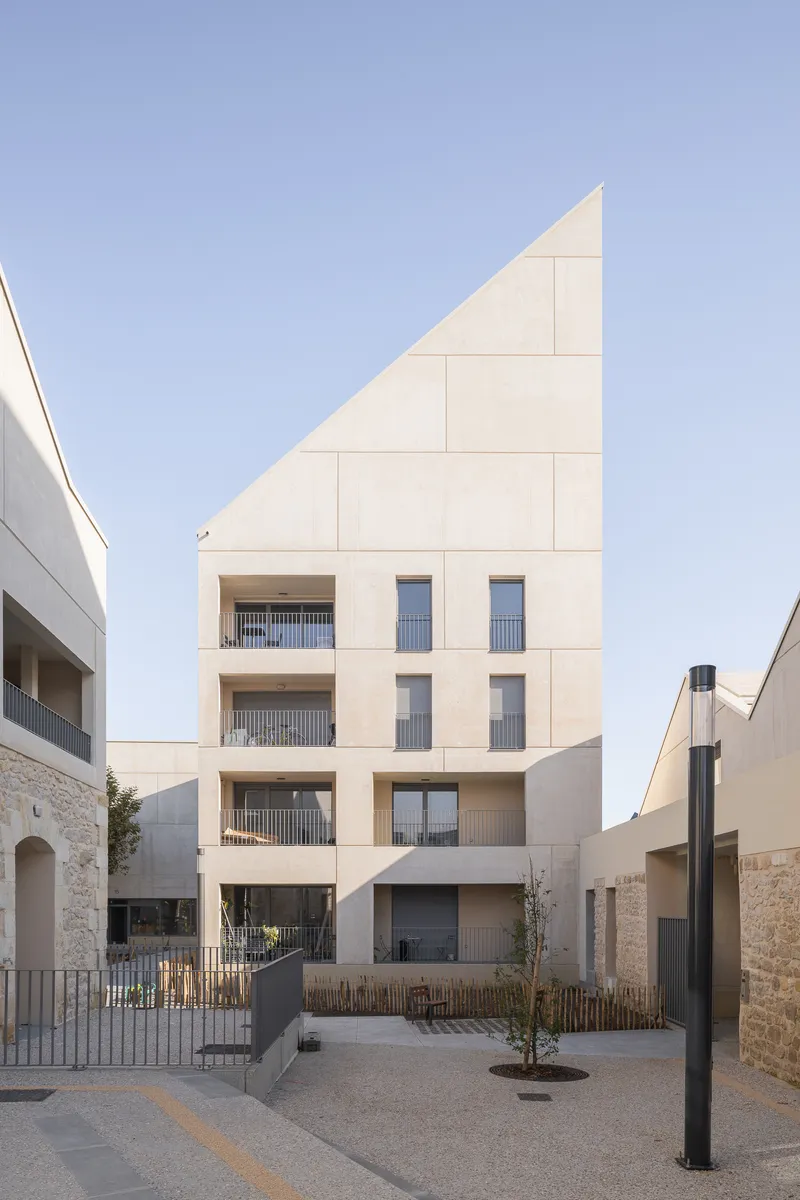
Between the six volumes, the landscape does quiet, essential work. Young deciduous trees in gravel courtyards, planted beds lining narrow passages, and open plazas framed by stone and render create a gradient of privacy from the public street to the domestic threshold. The courtyards are generous enough to feel communal without being so large that they become impersonal.
The narrow passage between two-story facades, lined with metal railings and a single young tree, is the kind of space that conventional housing development would have eliminated for efficiency. Here it survives because the architects understood that the gaps between buildings are as important as the buildings themselves. The angled facades with recessed balconies facing the gravel courts offer residents a direct, tangible relationship with outdoor space, something more intimate than a view and more useful than a Juliet balcony.
Light as a Design Rule
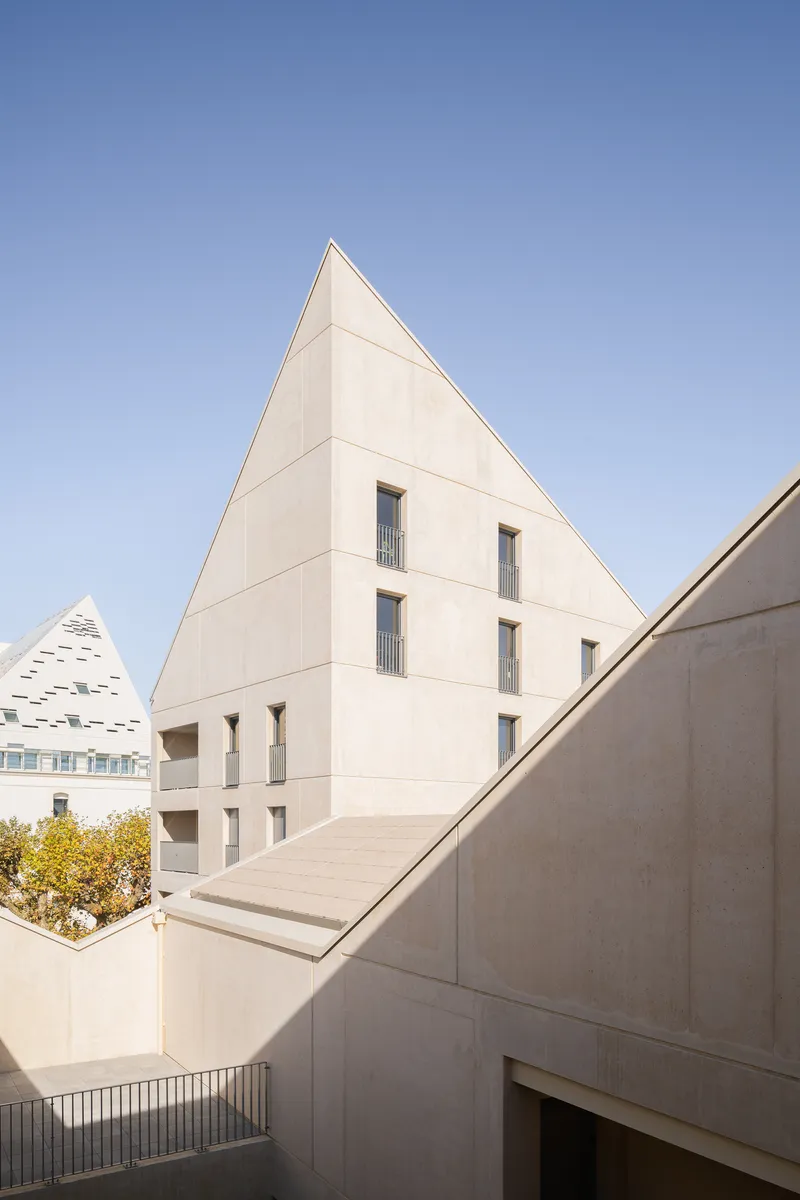
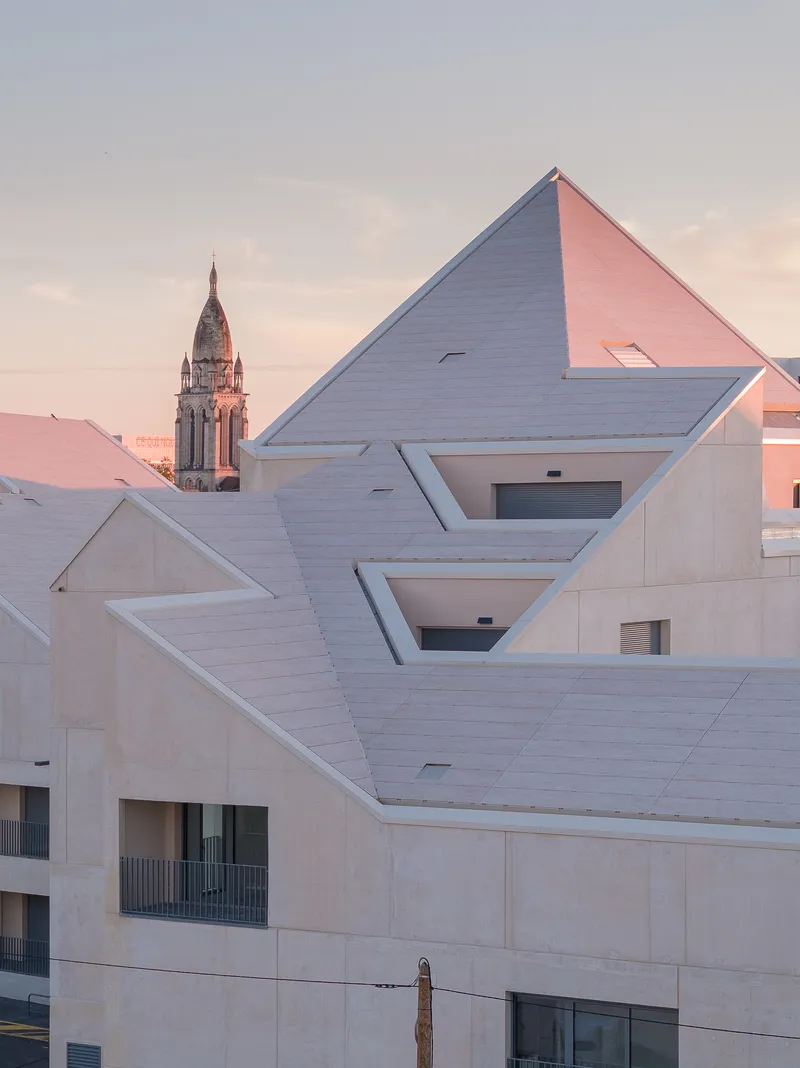
The pitched rooflines and staggered gables are not stylistic choices. They are the direct output of a strict solar access protocol that guarantees every building receives daylight at ground level and a minimum of two hours of direct sun. The triangular gable rising above the courtyard, with its tall windows punched into the facade, is the most visible expression of this logic. It reads as a village silhouette, but it is actually an envelope optimized for photons.
At dusk, when the stepped roofline catches the last light against a church tower in the distance, the solar logic becomes atmospheric. Light-colored surfaces reflect sunlight back into the courtyards, reducing heat island effects while giving the complex a luminous quality that distinguishes it from the darker stone of the historic city across the river. Solar panels and rooftop greenery complete the climate strategy without competing visually.
Inside the Volumes
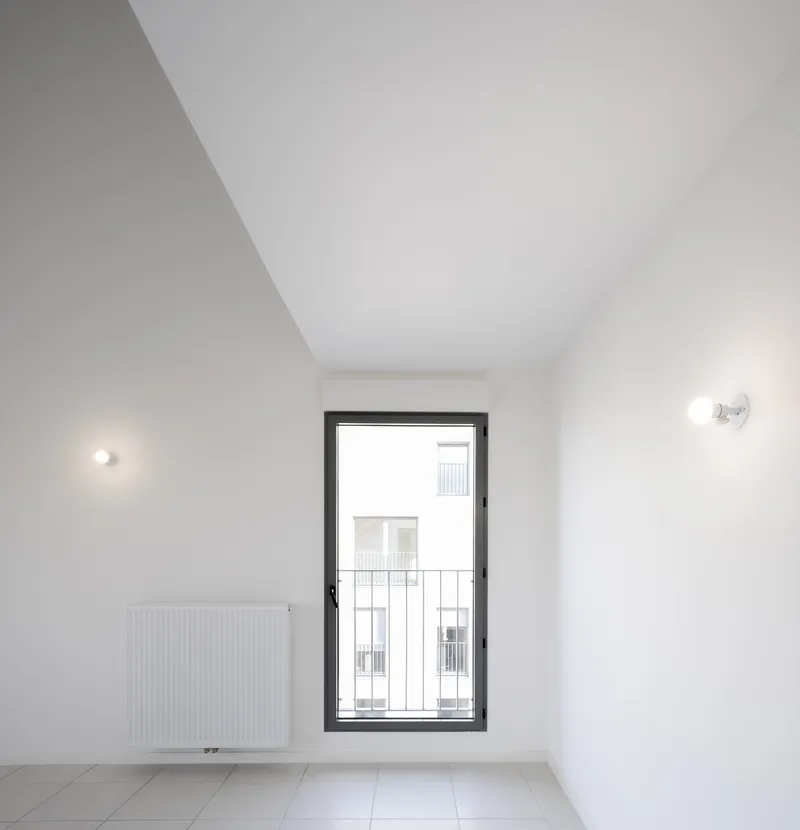
The interiors are restrained to the point of austerity, and that is entirely correct. A white room with a tall, narrow window, simple sconces, and a panel radiator is all that is shown, but it communicates the essential proposition: generous ceiling heights, carefully proportioned openings, and a quality of light that justifies the complex geometry required to produce it. The housing units balance plan rationality with the spatial richness that comes from inhabiting volumes shaped by solar rules rather than by floor-plate repetition.
Plans and Drawings
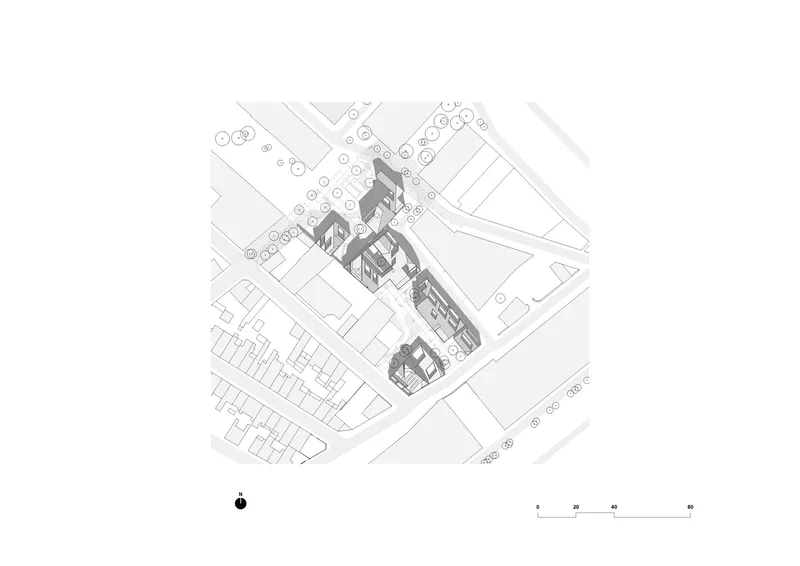
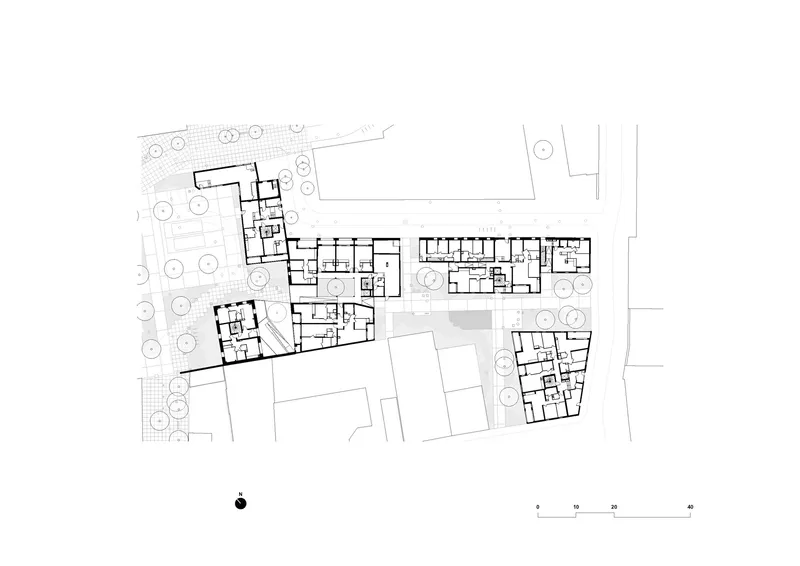
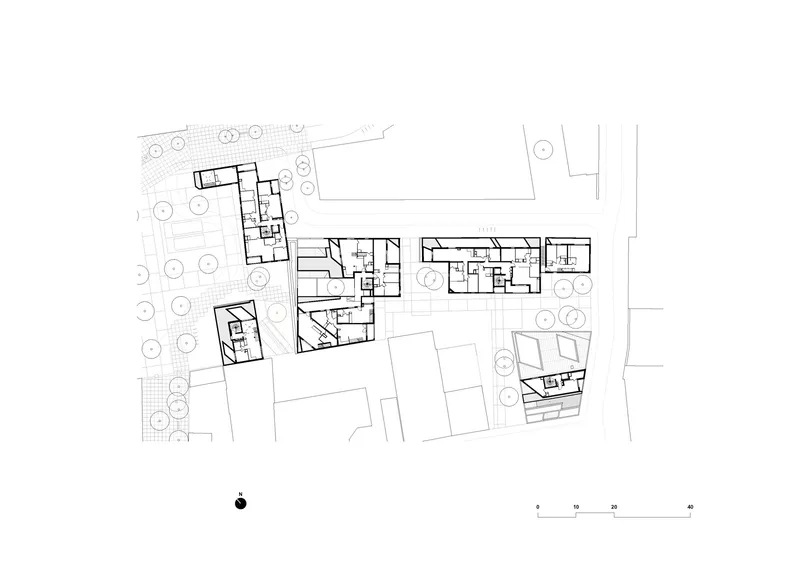
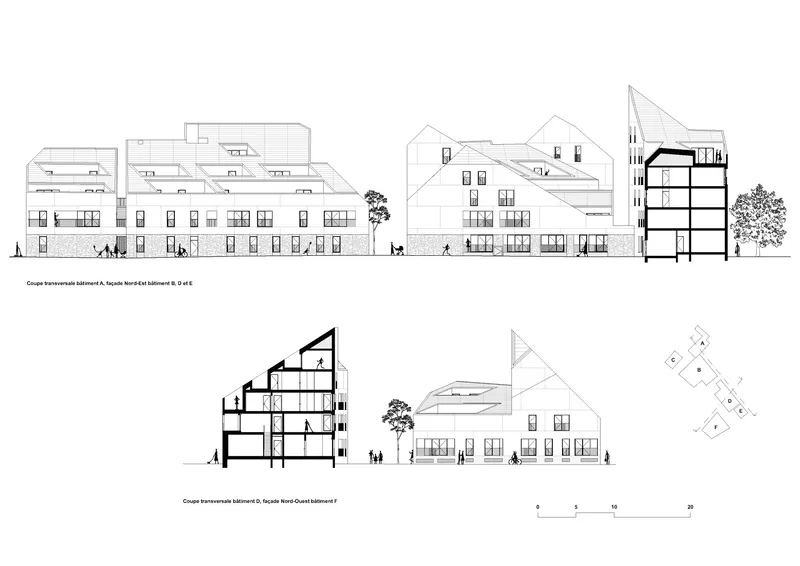
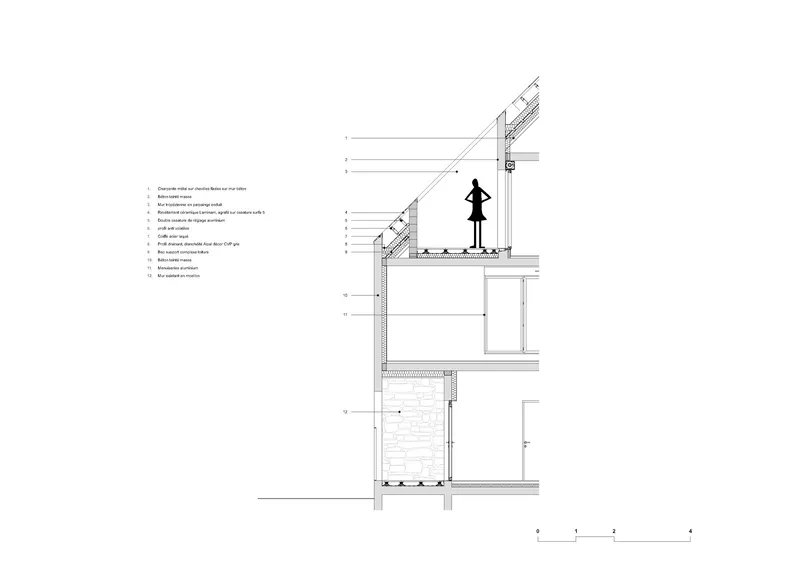
The axonometric site plan makes the archipelago logic immediately legible: six blocks, loosely clustered, each rotated slightly to maximize solar exposure and create varied courtyard conditions. The ground and upper floor plans reveal how 63 units distribute across these volumes, with corridors kept short and most apartments gaining dual aspect. The section drawings are where the technical ambition becomes clear. Maintaining visual continuity between roof and facade, treating them as a single continuous envelope, posed serious challenges for waterproofing and rainwater management. The detail section through the roof assembly shows insulation layers, structural connections, and the precise point where the pitched form meets the flat, a junction that required collaboration between facade consultants C3 and structural engineers KHEPHREN Ingénierie.
Why This Project Matters
Housing projects rarely attempt to carry a site's history forward without falling into pastiche or tokenism. What Olgga Architects and Atelier CAMBIUM have achieved at Bastide-Niel is something more disciplined: a material strategy where the old walls are neither celebrated nor hidden but simply absorbed, becoming part of a continuous envelope that owes as much to climate modeling as to archaeology. The palimpsest metaphor is overused in architecture, but here it is literally built into the concrete.
More broadly, the project demonstrates that solar access rules, when taken seriously and applied rigorously, can produce varied, characterful urban form rather than the repetitive sawtooth profiles that typically result. Bordeaux's right bank needed housing that could anchor a new neighborhood without either mimicking the left bank's heritage or ignoring it. These 63 units, pale and pitched and layered with trace evidence of a military past, suggest that the two ambitions are not in conflict.
63 Housing Units for the Bastide-Niel Urban Development by Olgga Architects and Atelier CAMBIUM. Bordeaux, France. 4,348 m². Completed 2025. Photography by Stephane Aboudaram | WE ARE CONTENTS.
About the Studio
Share Your Own Work on uni.xyz
If projects like this are the kind of work you want to make, uni.xyz is a place to publish your own, find collaborators, and enter design competitions.


Popular Articles
Popular articles from the community


graciastudio Turns a Viewless Tijuana Lot Inward Around a Courtyard of Concrete, Timber and Trees
In Tijuana, Jorge Gracia's GA2 House stacks a timber-clad private floor over exposed concrete and replaces a missing view with a planted interior patio.

ETEH Reworks the Shared Spaces of São Domingos School in Brazil Around Timber, Color and Hanging Plants
At São Domingos School in Brazil, 436 m² of hall, refectory and library are recast with timber joinery, a yellow and blue code and trailing greenery.

David Ortega Stacks a Two-Story Mexico City Penthouse Around a Steel Stair and a Pergola-Shaded Roof Terrace
In Colonia Roma, a 300 m² penthouse uses oak joinery, a planted steel stair and a slatted roof pergola to make a new-build apartment feel like a house.


The Amber Palace Opera: A Geological Fiction Surfaces on Tallinn's Baltic Waterfront
Pierre Brillard reimagines a Baltic legend as a public landscape, opera house, and waterfront promenade rooted in Tallinn's coastal identity.

Similar Reads
You might also enjoy these articles

LAVA Architecten Gives Vocational Education a Sawtooth-Roofed Face on a Mechelen School Campus
In Mechelen, Belgium, a 2,053 m² STEM school on a 6×6 m grid turns workshops and classrooms into rooms that can be rearranged as teaching changes.

KEMA Studio Turns a Derelict Marvila Attic into a 60 m² Lighthouse Apartment Above Lisbon
In Lisbon's Marvila district, a rebuilt roof, four skylights and two plywood volumes turn an unlivable attic into a bright home facing the Tagus.

Pixel Gardens: One Repeated Module Stacked Into a Terraced Social Housing Tower for Famagusta
Salem Bader's shortlisted housing tower builds a vertical neighbourhood from one repeated module, offsetting units to carve terraces, light and air.

Bao Huynh Watercolor Atelier: A Serene Art Retreat in Hội An
Bao Huynh Watercolor Atelier in Hội An blends multifunctional art spaces, sustainable design, local materials, and family-friendly living in a serene environment.

Comments (0)
Please login or sign up to add comments
No comments yet. Be the first to comment!