
OMA Grows a Concrete Egg for Mushroom Cultivation on the Oaxacan Coast
Shohei Shigematsu's ellipsoidal pavilion at Casa Wabi uses mycology to generate form, not the other way around.


Architecture rarely takes its cues from fungi. OMA, led by partner Shohei Shigematsu, did exactly that for a new pavilion at Casa Wabi, the artists' foundation north of Puerto Escondido in Oaxaca, Mexico. The building is an ellipsoid, a shape that was not selected for sculptural effect but derived from the environmental requirements of mushroom cultivation: a high volume-to-surface-area ratio that holds stable temperature and humidity with minimal mechanical intervention. Shigematsu has described the geometry as an incubating egg, and the analogy is apt. The 200 square meter volume sits lightly on the coastal landscape, its base curving inward to avoid disturbing the roots of native guayacán trees.
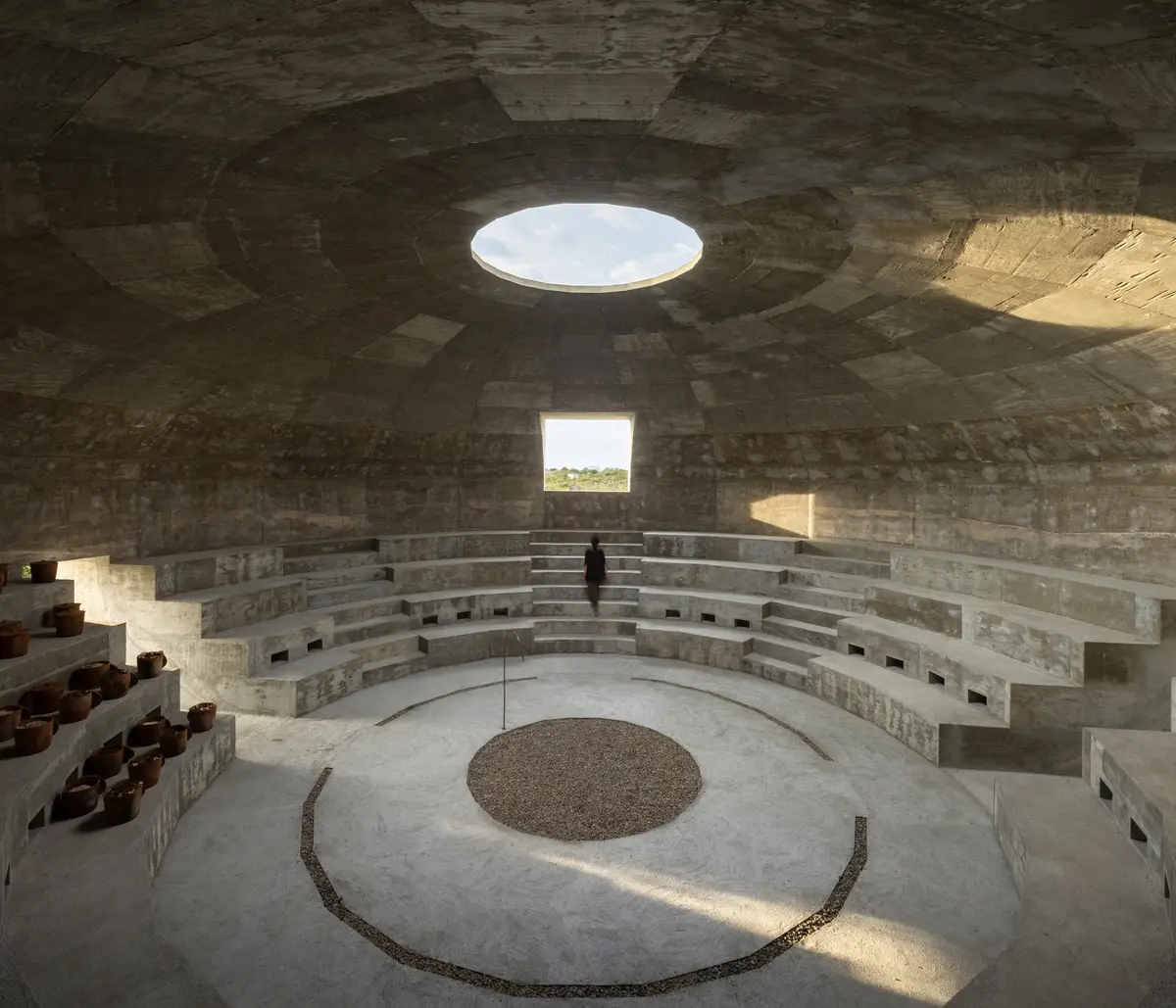
Casa Wabi's campus already hosts pavilions by Tadao Ando, Kengo Kuma, and Alberto Kalach, each calibrated to a specific craft or communal function. OMA's contribution is the most programmatically unusual of the group: three dedicated chambers for fruiting, incubation, and storage ring a central amphitheater open to the sky through an oculus. The pavilion is simultaneously a working agricultural building and a gathering space, collapsing the boundary between production and social life. That duality is the project's real subject.
An Ellipsoid Born from Mycology
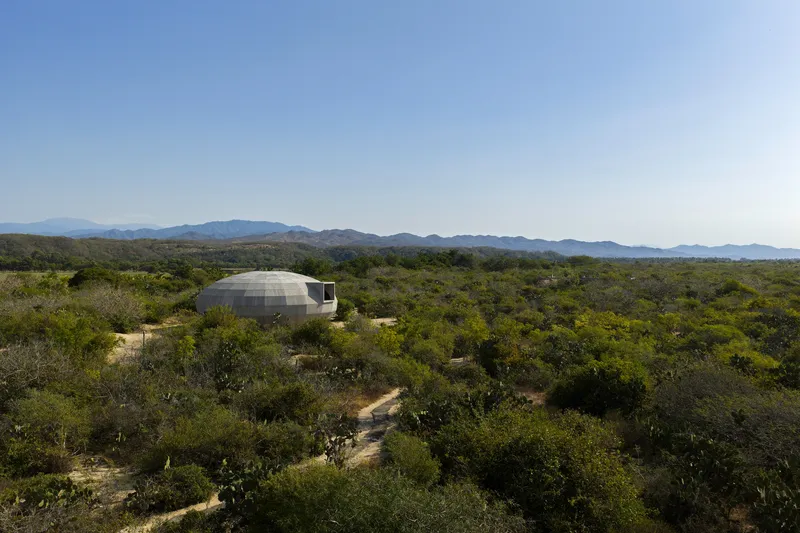
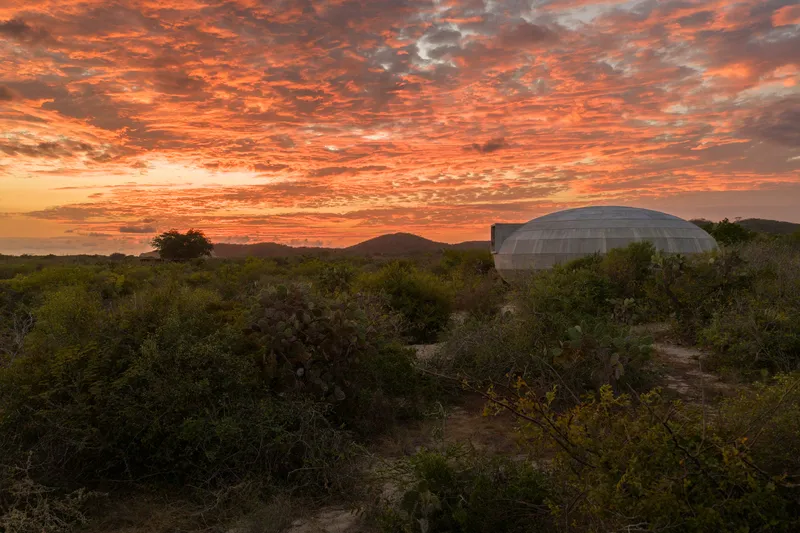
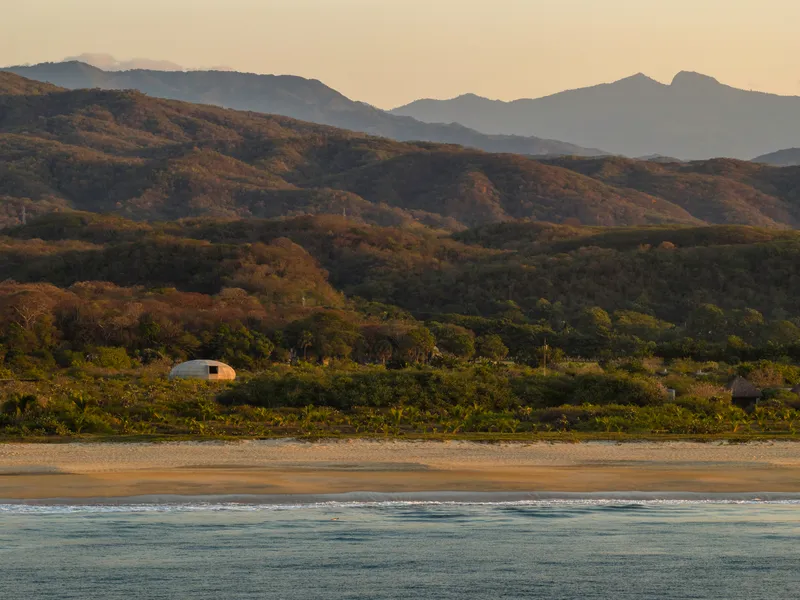
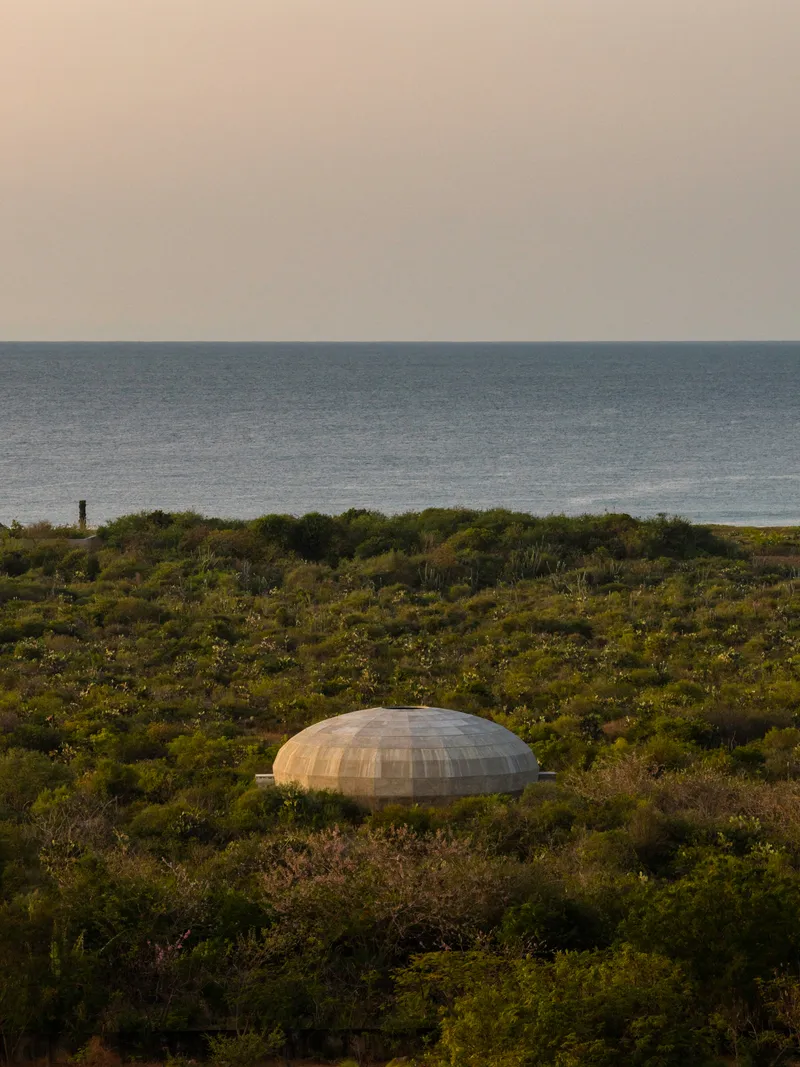
The form is striking from every distance. Approached from the beach at golden hour, the dome registers as a low geological mound, almost indistinguishable from the hillside behind it. Move closer and the precision of the concrete shell becomes legible: radial panels converging on a central opening, the surface neither smooth nor rough but textured with the imprint of burlap that was pressed into the wet concrete during construction. That fabric ghost is not decoration. It is a trap for water, specifically the iron-rich water present on the site, which will gradually stain the exterior and shift its color over time.
Shigematsu's claim that the ellipsoid emerged from mycology rather than formal ambition is credible precisely because the shape works so well as infrastructure. The curved enclosure minimizes thermal exchange, while openings at the base permit the cross-ventilation needed to regulate CO₂ levels during mushroom fruiting. Geometry here is not metaphor; it is performance specification rendered in concrete.
The Amphitheater Within
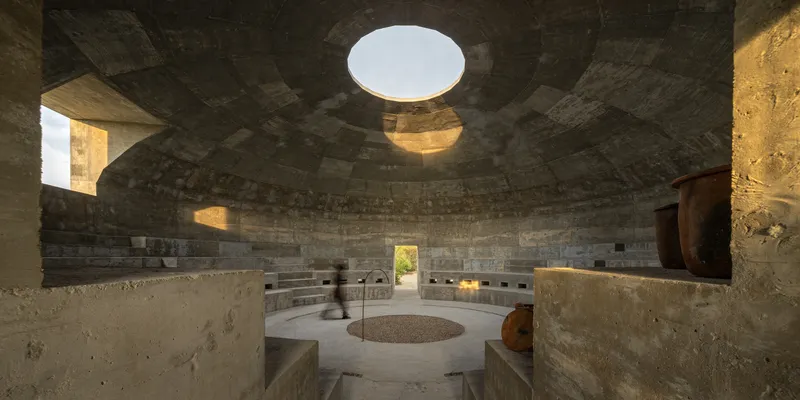
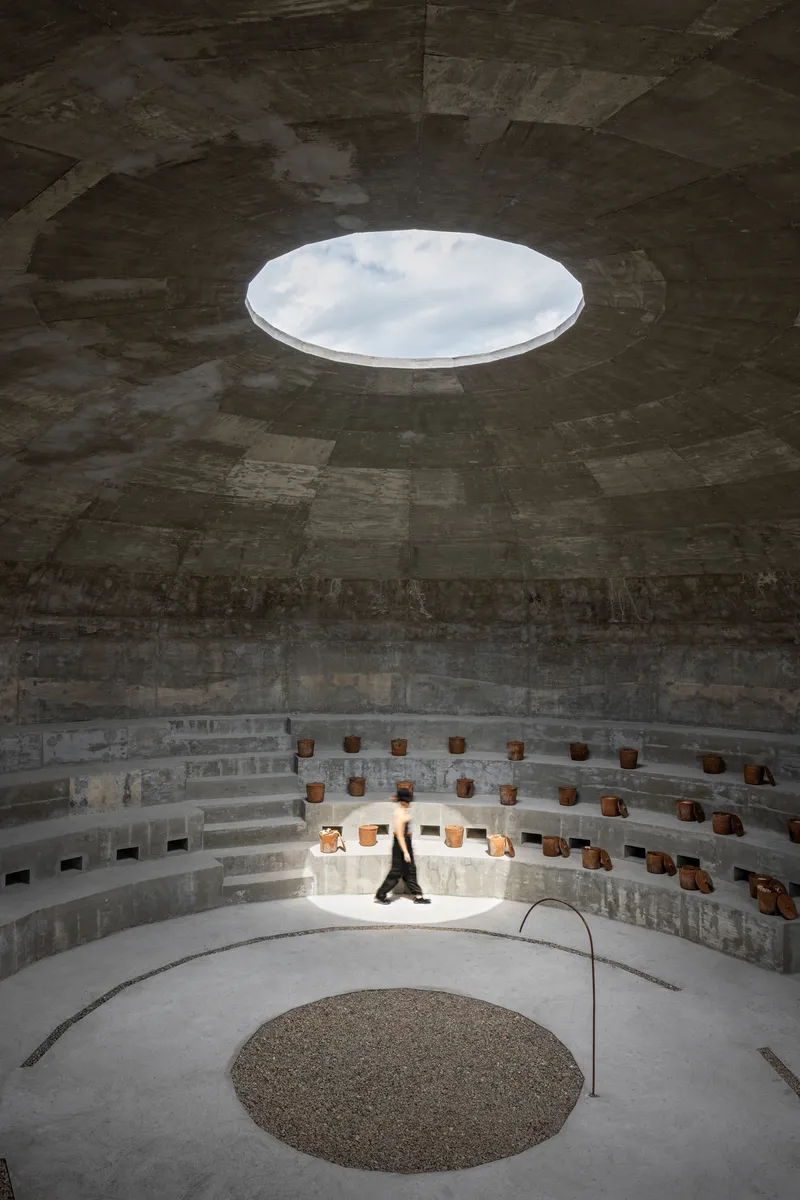
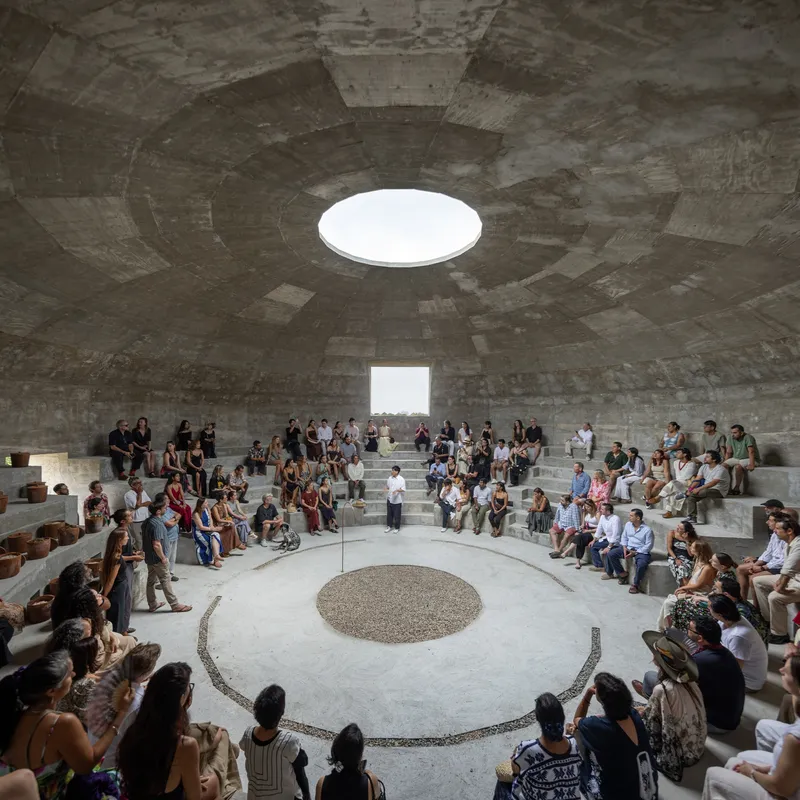
Step inside and the ellipsoid reveals its second life. The lower portion of the shell steps inward in concentric rings to form a circular amphitheater, oriented upward toward the oculus. Afternoon light drops through the opening and washes down the concrete terraces, which double as shelving for handmade terracotta pots crafted by local artisans. The space accommodates a crowd comfortably, as photographs of community gatherings confirm, but it feels equally powerful when occupied by a single seated figure.
The program is genuinely hybrid. The ring of cultivation chambers wraps the perimeter while the center belongs to the collective. There is no corridor separating the two; you move from mushroom incubation into a social forum in a few steps. That adjacency makes the pavilion's argument legible without any signage or explanation: food production and communal gathering are not separate activities to be zoned apart.
Light, Oculus, and Pacific Views
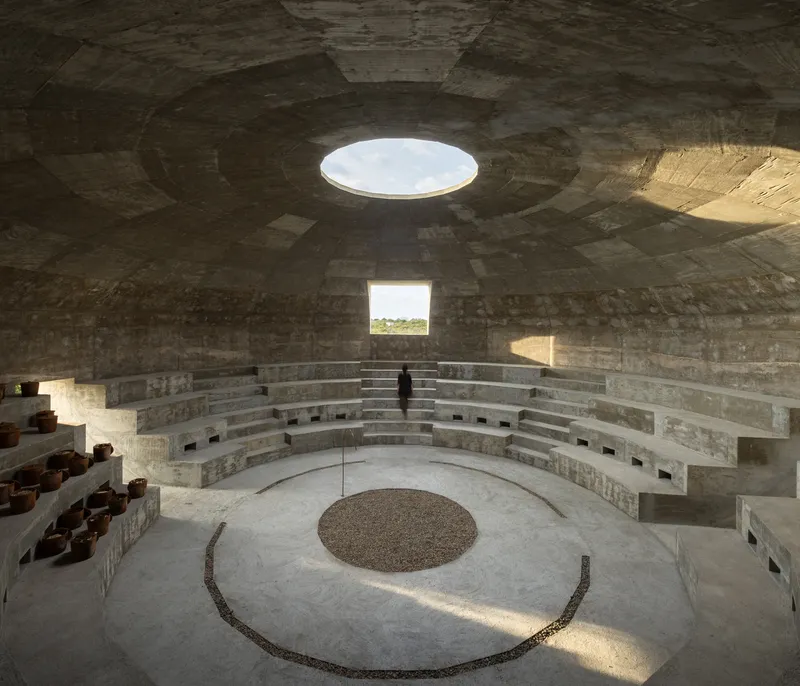
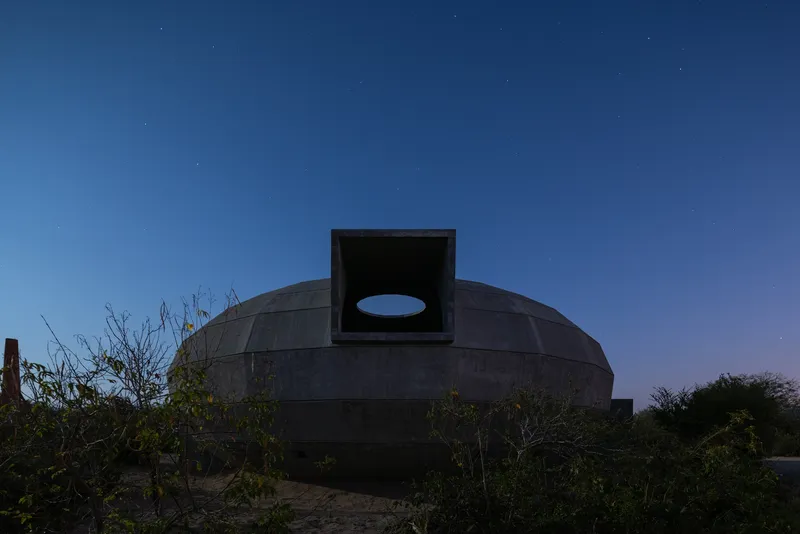
The oculus is the building's spatial engine. It introduces a column of daylight that tracks across the amphitheater floor throughout the day, and it frames a perfect disc of sky from below. At dusk, the opening glows against the darkening concrete shell, giving the structure the appearance of a dormant volcano. A portal at the upper level aligns with the Pacific horizon, threading a sight line from the interior directly to the ocean. These two apertures, one vertical and one lateral, anchor the occupant simultaneously in sky and landscape.
The control of light is also functional. Mushroom cultivation demands specific light conditions, and the radial arrangement of chambers means each can be tuned independently while the central space remains open to the elements. The oculus ventilates as much as it illuminates, pulling warm air upward and drawing cooler air in through the perimeter slots at the base.
Concrete, Burlap, and the Logic of Aging
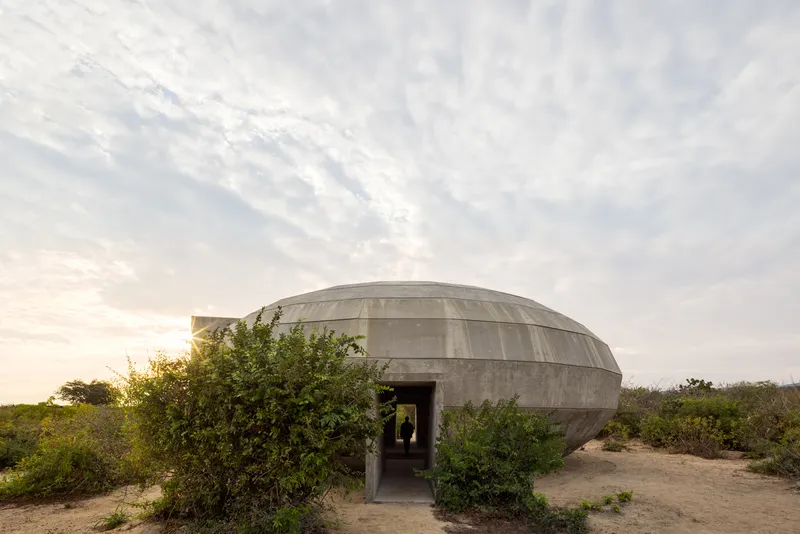
The construction method is deliberately low-tech for an OMA project. The shell is poured-in-place concrete, self-supporting, with no internal frame. The burlap texture on the exterior is the key material decision: it gives the surface a woven grain that captures dust, moisture, and iron oxide from the site's water supply. Over months and years the pavilion will darken unevenly, acquiring a patina that aligns with Casa Wabi's philosophical foundation in wabi-sabi, the Japanese principle that locates beauty in impermanence and the inherent imperfections of natural processes.
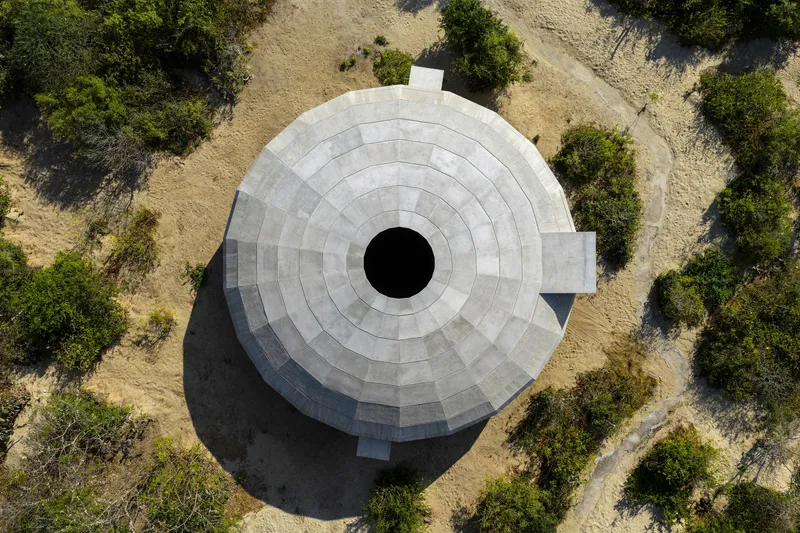
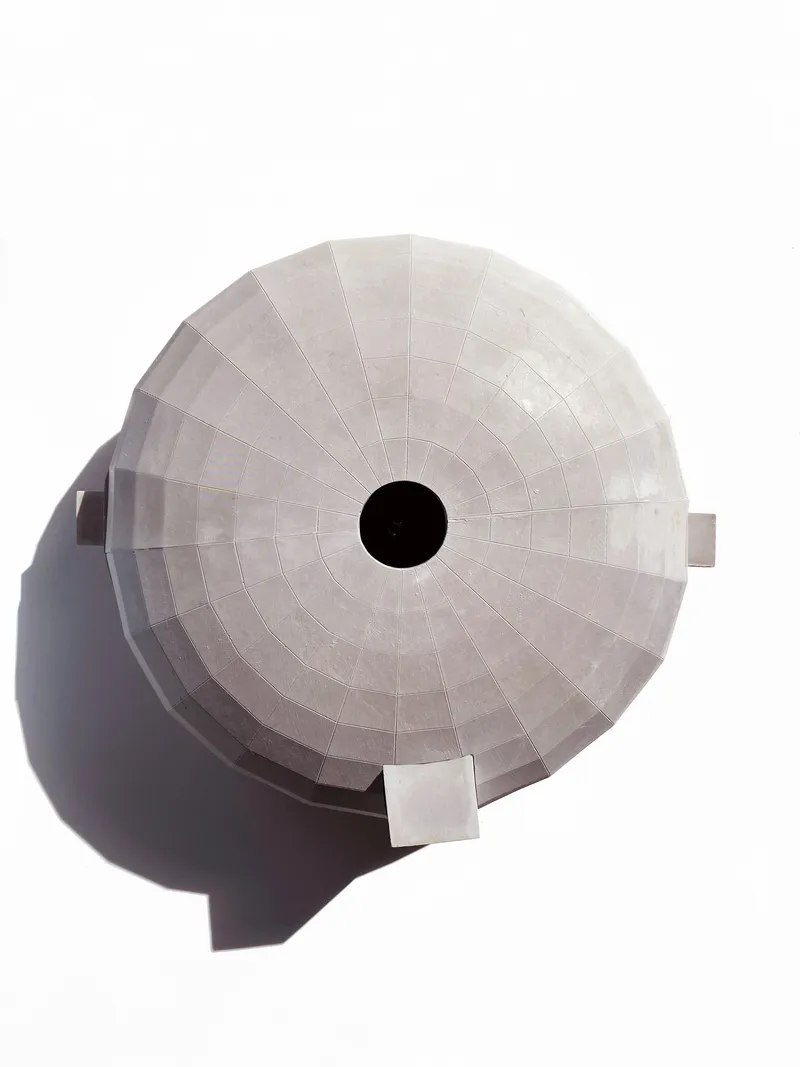
Seen from above, the radial panel joints converge on the oculus like the segments of an orange. The geometry is legible and repetitive, which is what makes the construction achievable with local labor and without specialty formwork. It is a smart structural decision disguised as an aesthetic one.
Sitting Lightly on 65 Acres
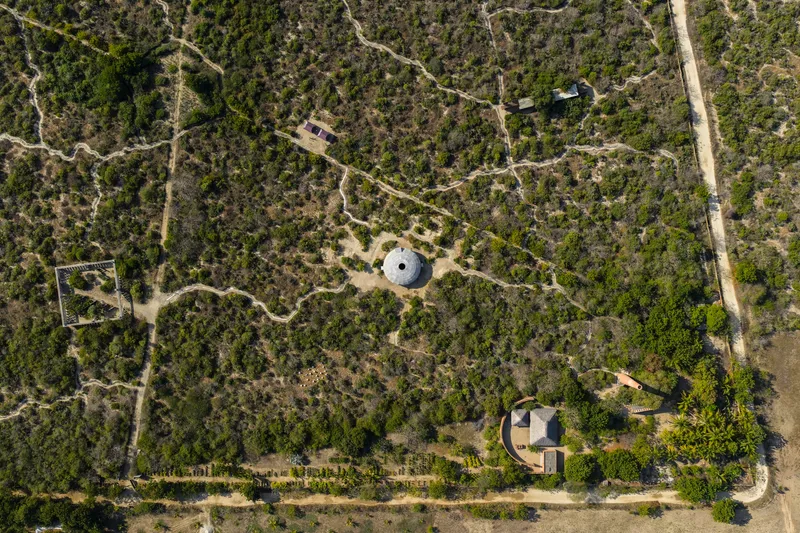
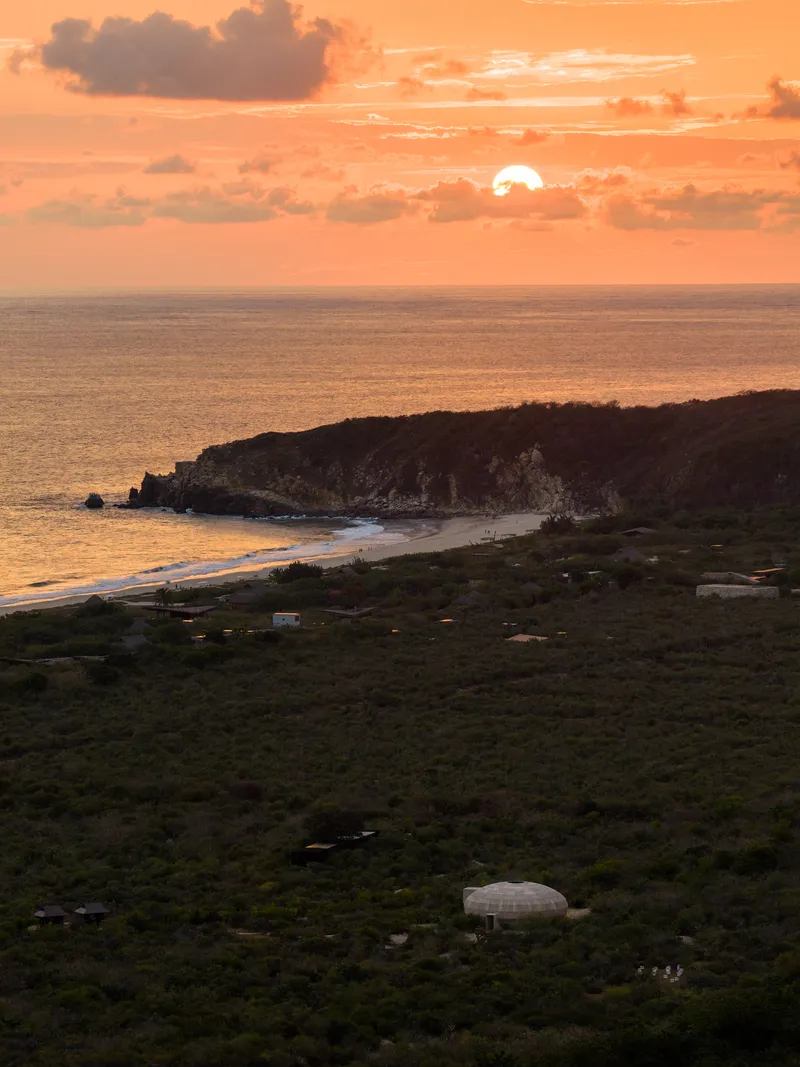
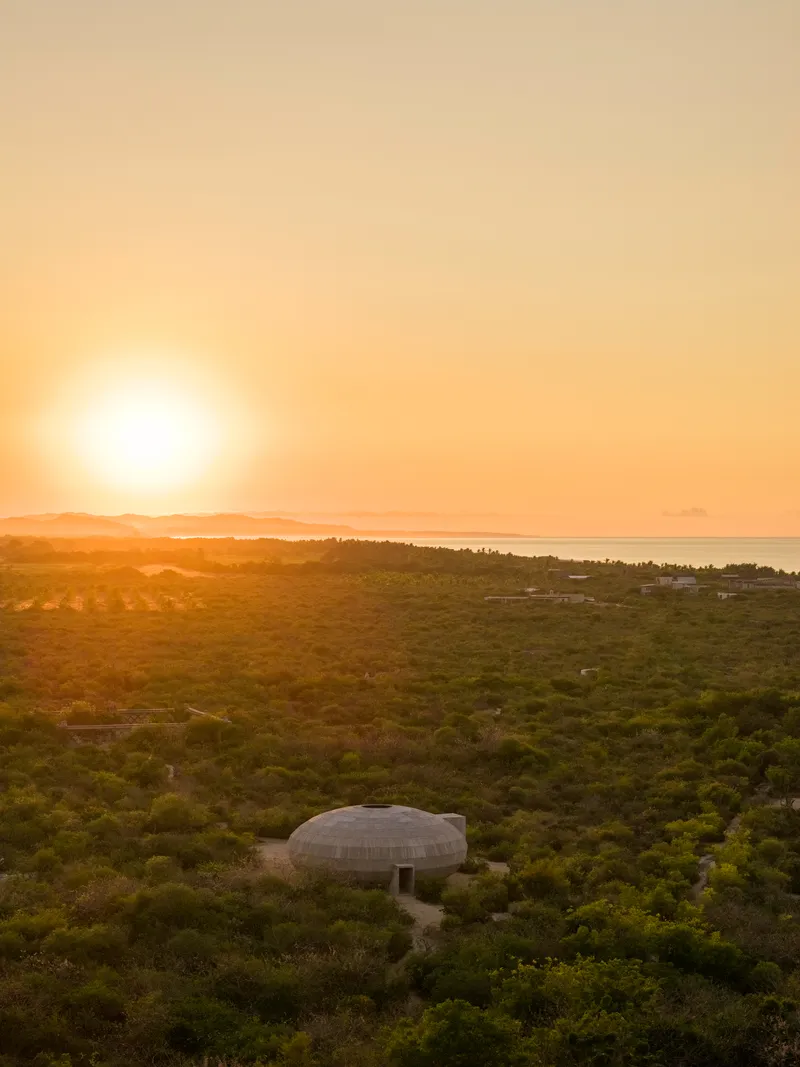
Casa Wabi occupies 65 acres between the Sierra Madre del Sur and the Pacific coast, and its master plan distributes pavilions sparingly through the landscape. OMA's contribution is sited in dense scrubland, reachable by dirt footpaths that wind through native vegetation. The ellipsoidal form minimizes the building's ground contact, allowing plants and root systems to continue growing uninterrupted beneath the curved base. The inward sweep at the base that protects the guayacán trees is visible in aerial photographs: the structure appears to hover just above the terrain, touching down on a narrow ring.
From the coastline, the pavilion is a subtle presence, its concrete tones blending with the dry grassland. From directly above, the oculus reads as a dark pupil in a pale iris of radiating panels. These shifting readings at different scales are the mark of a form that was optimized for environmental performance but happens to reward the eye at every distance.
Timber Cladding and the Second Skin
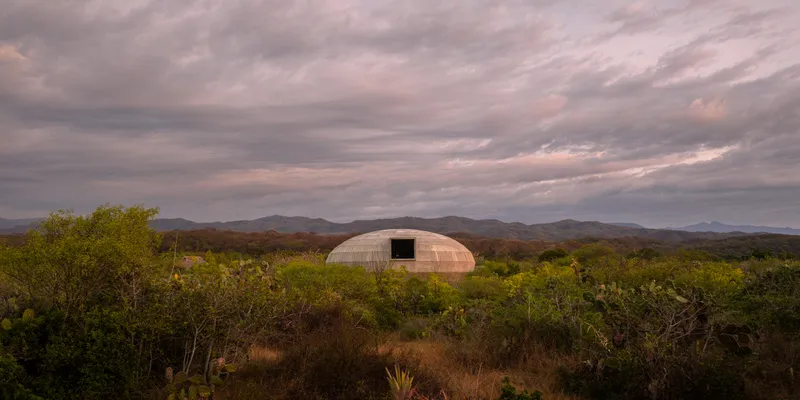
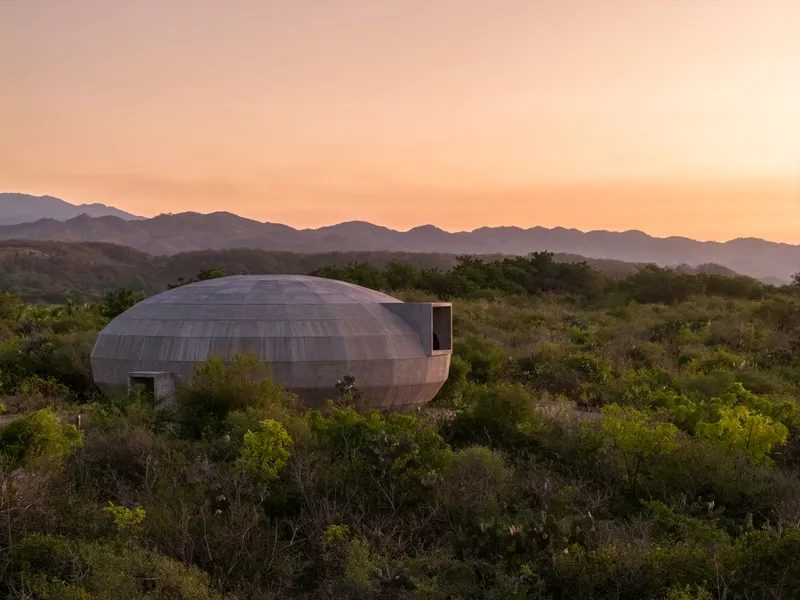
A set of images reveals a second reading of the pavilion's exterior: a timber-clad skin of horizontal slats wrapping portions of the ellipsoid and punctuated by rectangular apertures. Whether this represents a construction phase, a secondary enclosure for the cultivation chambers, or an adjacent structure on the campus, the timber layer introduces a warmth and grain that contrasts sharply with the monolithic concrete. The slats filter light and air while giving the building a softer silhouette against the coastal brush.
The rectangular openings in the timber skin frame the distant mountain range at sunset, turning each aperture into a landscape painting. This layering of materials, concrete core and timber wrapper, echoes the project's layering of programs: cultivation inside community, agriculture inside art.
Why This Project Matters
The Mushroom Pavilion is one of the few contemporary buildings whose form can be honestly traced to a non-architectural discipline. Mycology dictated the ellipsoid; the amphitheater is the spatial dividend of that geometric choice. OMA and Shigematsu resisted the temptation to impose a signature gesture on a campus that already collects them, opting instead for a shape that is rigorous, functional, and ultimately strange in a way that formal ambition alone rarely produces.
More broadly, the pavilion makes a case for architecture that treats food production as a cultural program worthy of the same design attention given to galleries and studios. At Casa Wabi, mushrooms are cultivated in a concrete shell open to the Pacific sky, tended in terracotta pots made by local hands, and harvested steps away from a gathering space that hosts the community. That continuity between growing, making, and convening is the real project here, and it is one that most institutions would never think to commission.
Mushroom Pavilion at Casa Wabi, designed by OMA / Shohei Shigematsu. Located north of Puerto Escondido, Oaxaca, Mexico. 200 m².
About the Studio
Share Your Own Work on uni.xyz
If projects like this are the kind of work you want to make, uni.xyz is a place to publish your own, find collaborators, and enter design competitions.


Popular Articles
Popular articles from the community


GROUP A Strips a 1969 Rotterdam Harbor Headquarters to Its Frame and Wraps It in Timber Louvers
In Rotterdam's M4H harbor district, Ferro Offices reuses a 1969 frame, adds one timber storey and reaches BREEAM-NL Outstanding.

U.GA Architects Wraps an Oval Rooftop Pool in Curved Board-Formed Concrete on Busan's Jeollidan-gil
In Busan's Jeonpo-dong, a 454 m² mixed-use block stacks a neighborhood facility, guest rooms and an oval rooftop pool inside spiraling concrete walls.

David Ortega Stacks a Two-Story Mexico City Penthouse Around a Steel Stair and a Pergola-Shaded Roof Terrace
In Colonia Roma, a 300 m² penthouse uses oak joinery, a planted steel stair and a slatted roof pergola to make a new-build apartment feel like a house.

Cube Design Draws an Ecological Corridor Between Two Shenzhen Hills with the Nankai Building
Beside Shenzhen's container docks, the Nankai Building pairs stacked balconies with a climbing green screen to connect two hillsides across its height.

Similar Reads
You might also enjoy these articles


LAVA Architecten Gives Vocational Education a Sawtooth-Roofed Face on a Mechelen School Campus
In Mechelen, Belgium, a 2,053 m² STEM school on a 6×6 m grid turns workshops and classrooms into rooms that can be rearranged as teaching changes.

KEMA Studio Turns a Derelict Marvila Attic into a 60 m² Lighthouse Apartment Above Lisbon
In Lisbon's Marvila district, a rebuilt roof, four skylights and two plywood volumes turn an unlivable attic into a bright home facing the Tagus.

Pixel Gardens: One Repeated Module Stacked Into a Terraced Social Housing Tower for Famagusta
Salem Bader's shortlisted housing tower builds a vertical neighbourhood from one repeated module, offsetting units to carve terraces, light and air.

Bao Huynh Watercolor Atelier: A Serene Art Retreat in Hội An
Bao Huynh Watercolor Atelier in Hội An blends multifunctional art spaces, sustainable design, local materials, and family-friendly living in a serene environment.


Comments (0)
Please login or sign up to add comments
No comments yet. Be the first to comment!