
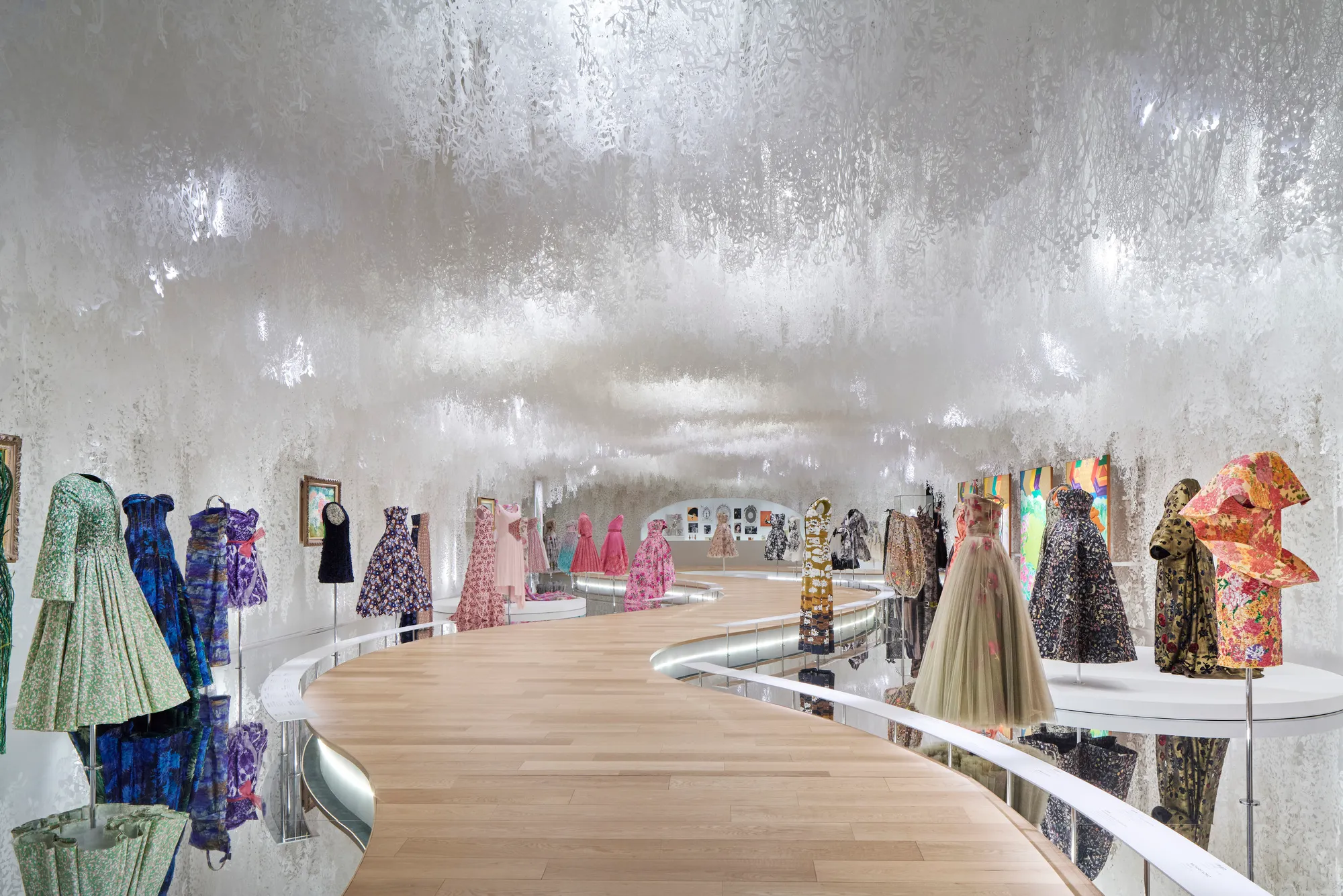
OMA Wraps 75 Years of Dior in Washi Paper and Infinite Mirrors at Tokyo's MOT
A 2,000 square meter exhibition transforms the Museum of Contemporary Art Tokyo into 22 immersive rooms that fuse Japanese craft with haute couture.


Fashion exhibitions have become a genre unto themselves, and the better ones are not really about fashion at all. They are about scenography, about the manipulation of sequence and atmosphere, about how a space can reframe an object so thoroughly that you forget you are looking at a dress on a mannequin. OMA's design for the Christian Dior: Designer of Dreams exhibition at the Museum of Contemporary Art Tokyo is one of the more ambitious entries in this category: 22 curatorial themes deployed across two floors and 2,000 square meters, each room a distinct spatial and material world.
What makes the Tokyo iteration genuinely interesting, rather than merely spectacular, is its governing conceit. OMA did not simply transplant an existing travelling exhibition into a Japanese museum. Instead, the firm used each thematic room as an opportunity to locate common ground between Dior's legacy and Japanese material culture. Awagami washi paper from Tokushima prefecture, shoji screen geometries, the raised garden paths of traditional tea gardens, the luminous paper lanterns of Nebuta festival floats: these references are not decorative but structural, shaping how visitors move through and perceive the garments on display.
Paper and Light
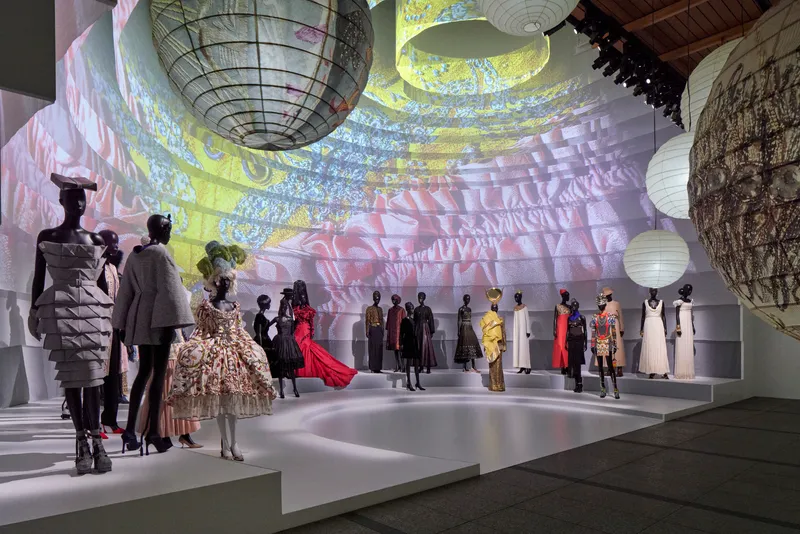

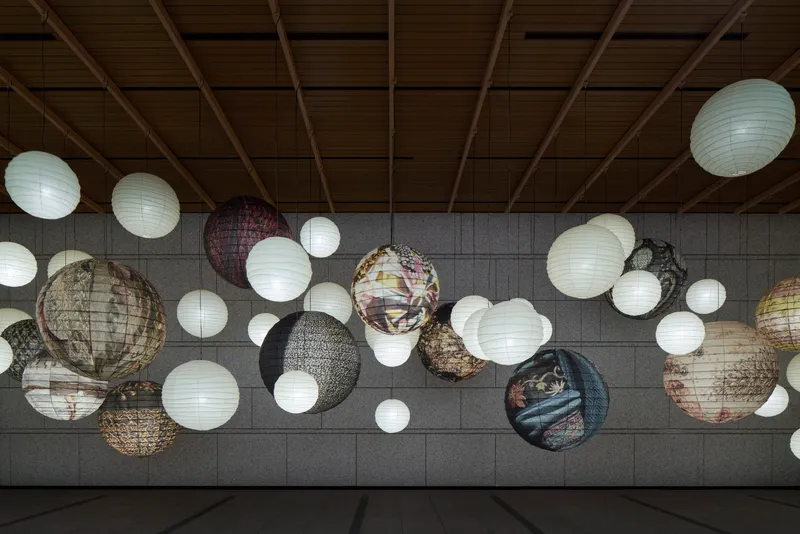
The most immediately striking rooms rely on paper as both surface and structure. Oversized spherical lanterns, inspired by Nebuta festival floats, hang from timber ceilings and glow with internal light, casting soft patterns across stepped platforms below. The lanterns vary in scale and pattern, some gridded, some organic, and they establish a visual logic that recurs throughout the exhibition: craft as atmosphere.
Washi paper, stretched over metal armatures, becomes the primary architectural material in several rooms. Its translucency allows for backlit effects that dissolve the boundary between wall and light source, while its texture gives each surface a haptic warmth that polished gallery walls never achieve. The reference to shoji screens is unmistakable, but OMA pushes the material into three-dimensional forms that owe nothing to tradition.
Tiled Topographies

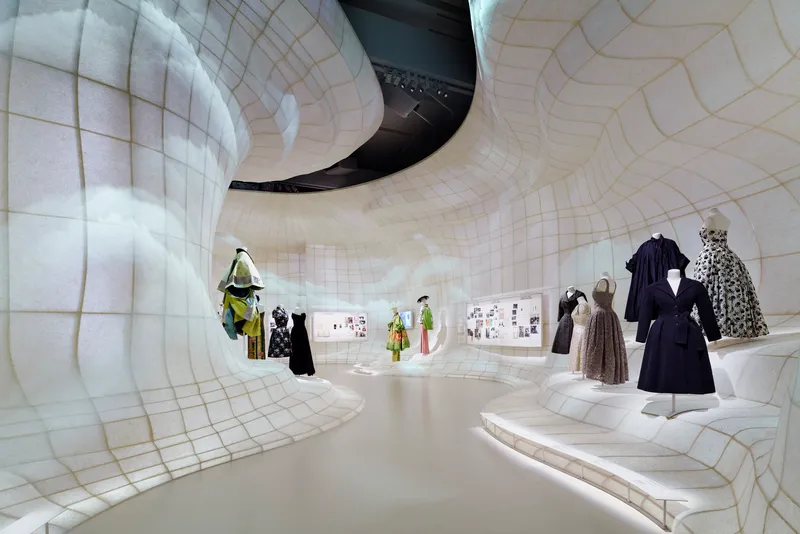

Several galleries deploy a continuous white-tiled surface that wraps floor, wall, and ceiling into a single undulating topography. Recessed alcoves punctuate these surfaces, creating individual shrines for garments. The effect is somewhere between a grotto and a laboratory: clinical in its repetition, sensual in its curves. Projected imagery washes across the tile, animating surfaces that would otherwise read as sterile.
The gridded dome ceilings in these rooms introduce a geometric counterpoint. Where the walls flow, the ceilings assert order, and this tension keeps the rooms from tipping into pure spectacle. Individual garments benefit enormously from the alcove treatment. Isolated and backlit, each piece commands its own spatial territory rather than competing for attention on a shared platform.
Silver and Spiral

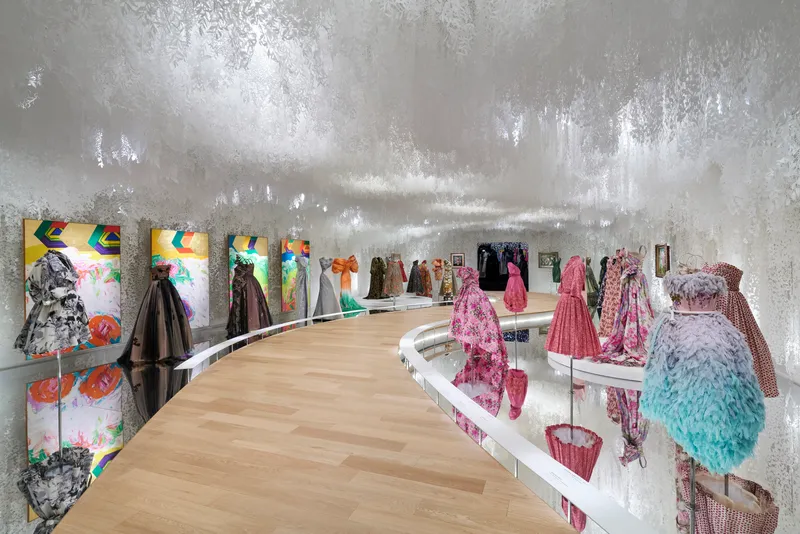

The silver-leaf and metallic-foil rooms mark a tonal shift. Where the paper rooms are warm and diffuse, these spaces are sharp and reflective, their walls catching and multiplying the light from display platforms. The curved geometry persists, but the material swap transforms the experience from contemplative to theatrical.
Circular white platforms float against these reflective surfaces, isolating garments in pools of controlled illumination. The mirrored glass surrounding certain platforms extends the visual field infinitely, a trick OMA uses to considerable effect in the exhibition's larger atrium spaces. Here, the museum floor is lifted and sloped to bisect the lofted volume diagonally, with an angled mirror at the top of the slope continuing the geometry into apparent infinity.
The Garden Path
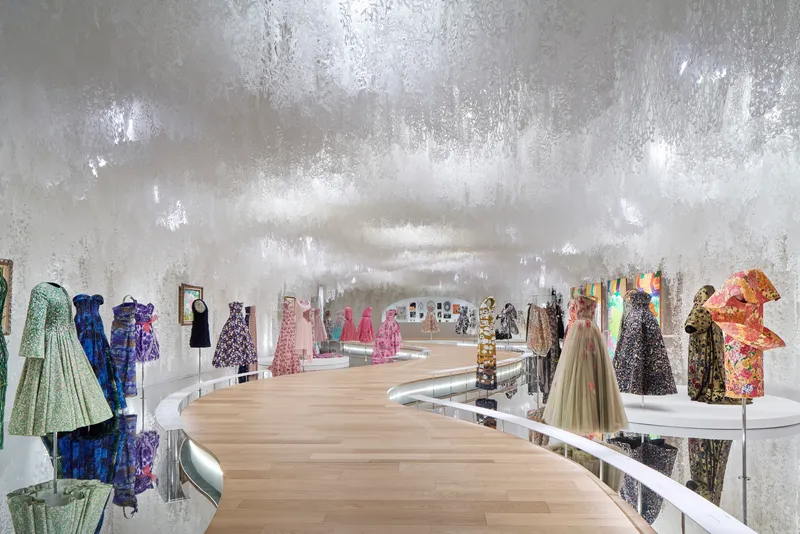
One of the exhibition's strongest rooms borrows from the spatial logic of the Japanese tea garden. A spiraling light wood walkway, raised eight inches above ground, winds through a field of garden-inspired garments displayed on a reflective surface evoking water. Five garments occupy raised circular platforms as focal points along the path. The raised walkway enforces a specific pace and sequence, turning the act of viewing into something closer to a ritual stroll.
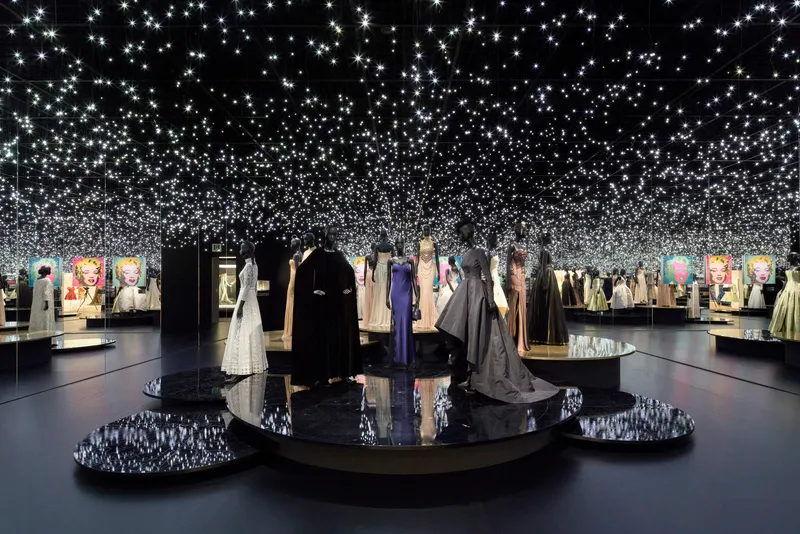
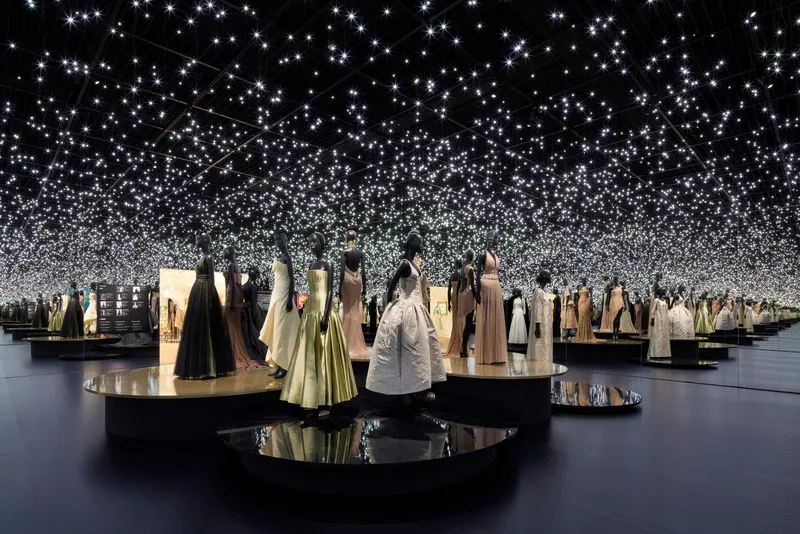
Adjacent to this, a black gallery space deploys a ceiling of thousands of fiber optic points, creating a convincing approximation of a night sky. Garments on circular platforms below are individually lit, and the resulting effect is cosmic rather than domestic. The transition from garden path to starfield is one of the exhibition's best sequential moves, a shift in register that resets the visitor's expectations entirely.
Color, Archive, and Grid
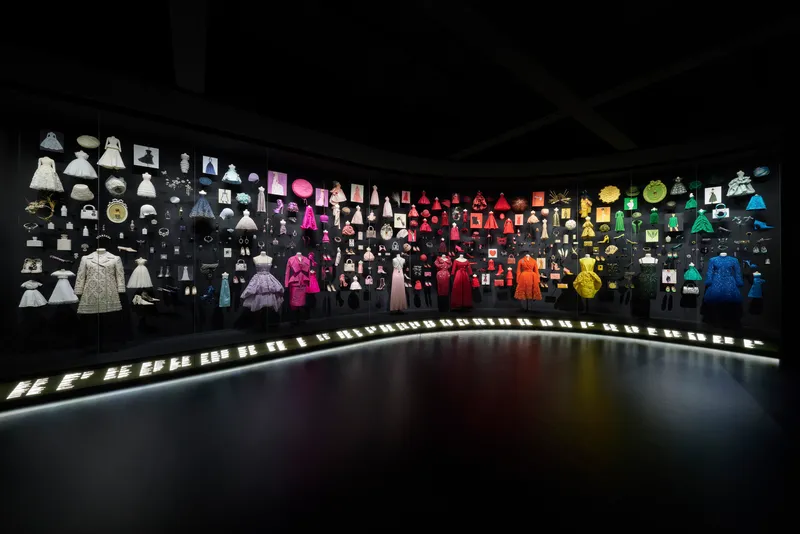
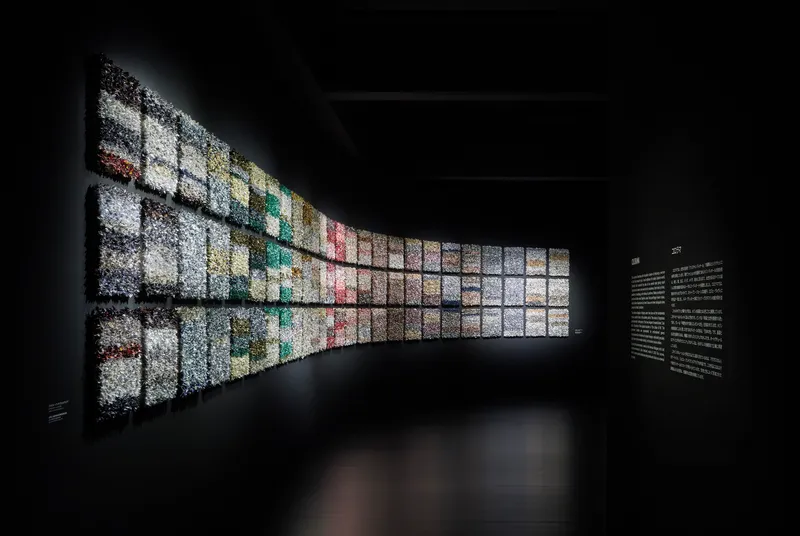

The panoramic color-gradient wall is a curatorial set piece: garments, swatches, and objects arranged in a seamless spectrum from white through blue, mounted on a curved backlit surface composed of gridded image panels. It works as both taxonomy and artwork, a way of cataloguing 75 years of chromatic output while producing a single, overwhelming visual statement.
The coffered black ceiling above this room absorbs upward light, keeping attention pinned to the wall. A facing bank of garments on mannequins provides physical depth, so the room reads as both flat archive and inhabited gallery. OMA is careful throughout the exhibition to vary the relationship between two-dimensional and three-dimensional display, and this room is among the most successful negotiations between the two.
The Burgundy Cabinet

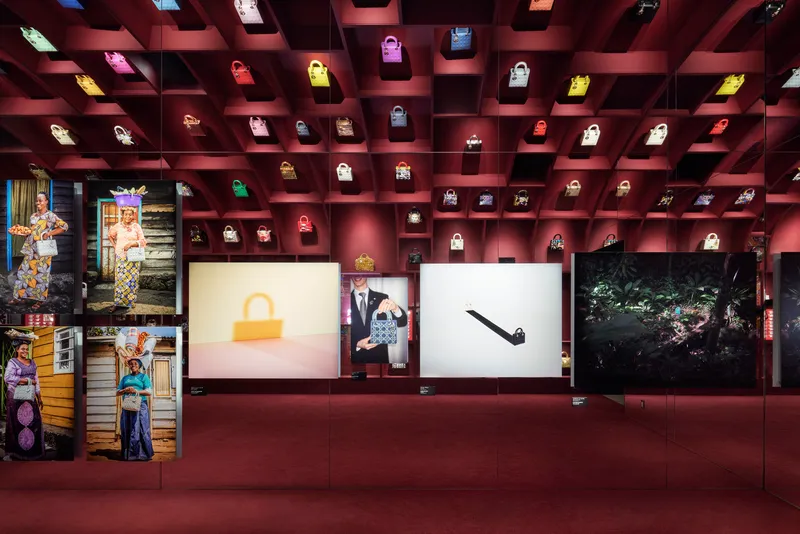
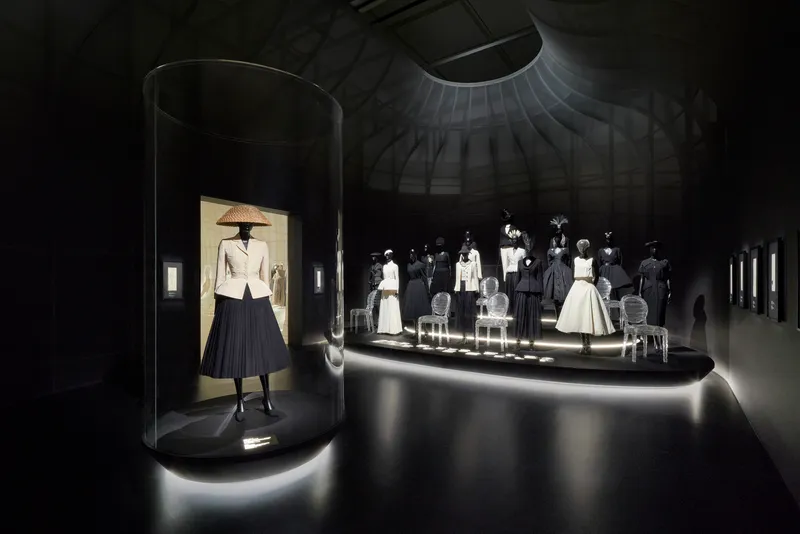
The Lady Dior room takes a different approach entirely. A barrel-vaulted gallery is lined with burgundy gridded shelving, each cell holding a handbag in its own illuminated niche. The reference point here shifts from Japanese craft to the red lacquerware cabinetry associated with both French and East Asian decorative traditions. A cylindrical vitrine at the room's center spotlights a single object, anchoring the composition.
The coffered ceiling above doubles as a display surface, with handbags mounted overhead in a grid that mirrors the wall shelving below. Looking up becomes part of the experience, a disorienting inversion that transforms a familiar retail typology into something architecturally engaging.
Projection and Shadow

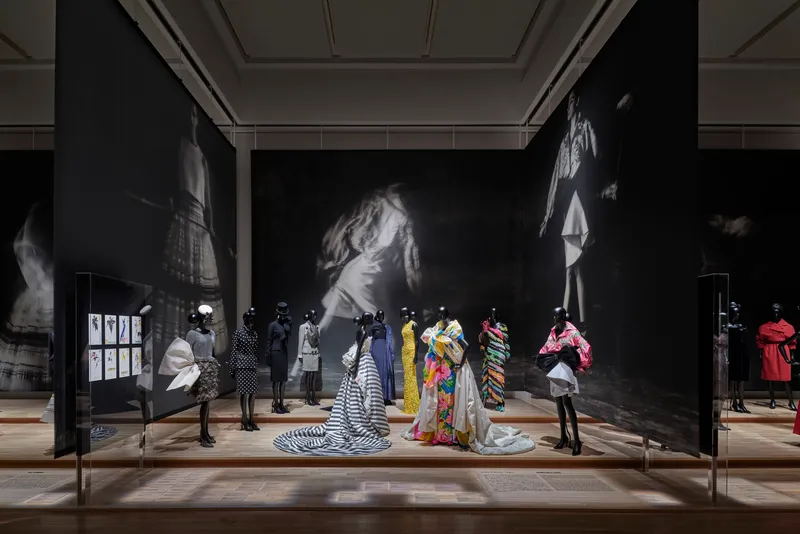
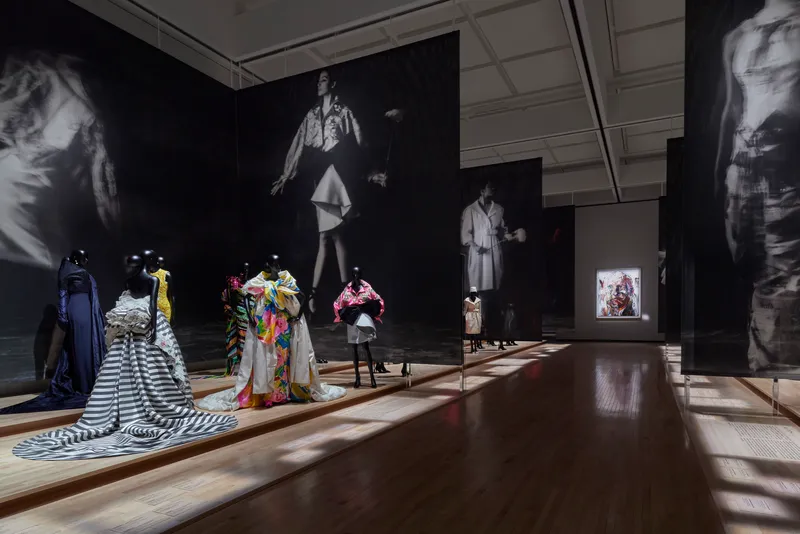
Large-scale black-and-white photographic projections dominate several rooms, their scale dwarfing the mannequins at floor level. The effect establishes a dialogue between the historical image and the physical garment, the flat and the dimensional. In one room, portraits of Dior himself preside over a field of illuminated mannequins in colorful garments, the monochrome past literally towering over the polychrome present.
OMA uses timber flooring and warm overhead lighting to counterbalance the immateriality of the projections. Without these grounding elements, the rooms would risk feeling like theme-park tunnels. The wood provides acoustic warmth too, softening footfall and encouraging the kind of slow, reverent movement the exhibition demands.
Threshold and Sequence
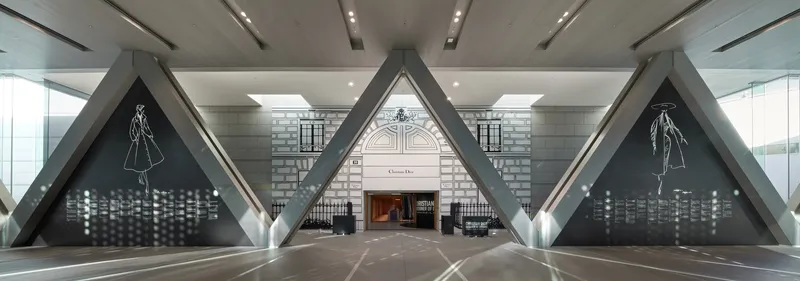
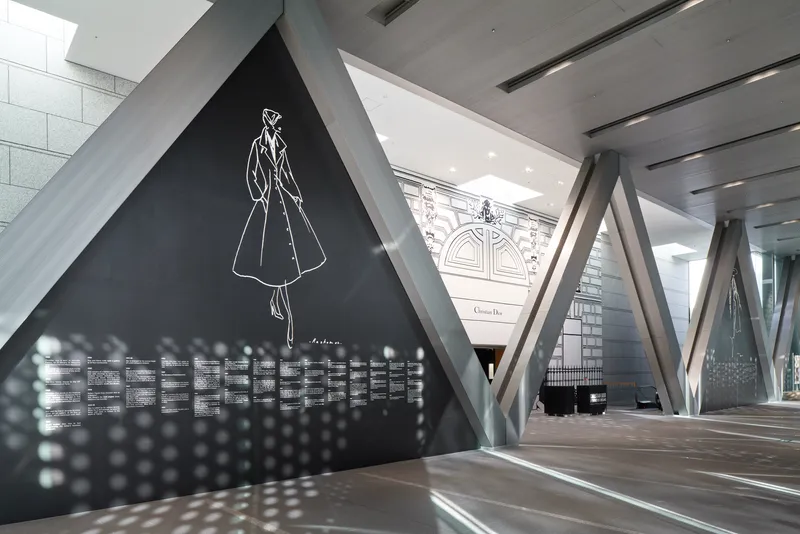

The transitions between rooms deserve attention on their own terms. Triangular steel portals frame corridor views with geometric precision, while diagonal concrete columns create off-axis sightlines that pull the visitor forward. These threshold moments are where the exhibition's architectural ambition is most legible: each doorway is calibrated to compress and then release the visual field, a classic scenographic technique that OMA executes with characteristic rigor.
The linear procession across two floors ensures a narrative arc that builds from intimate to monumental and back again. Framed display cases flanking central corridors reinforce axiality, while side galleries offer moments of digression. The sequencing recalls the enfilade arrangement of fusuma sliding panels in traditional Japanese interiors, rooms revealing themselves in succession rather than all at once.
Plans and Drawings

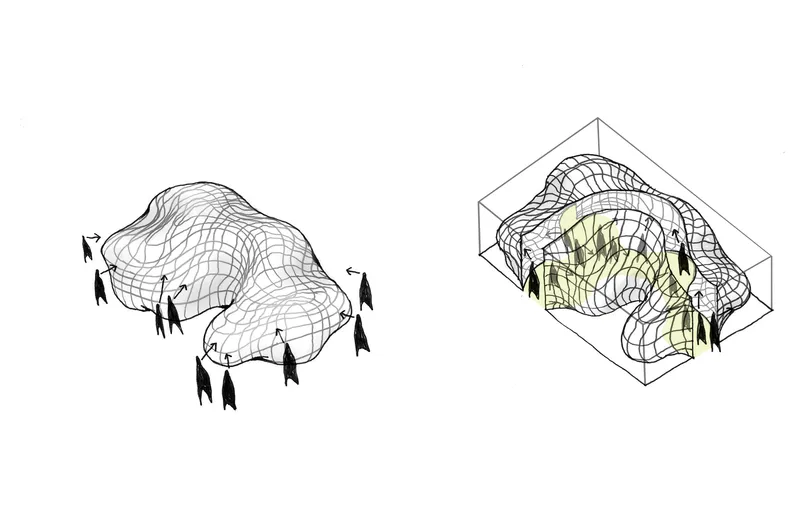

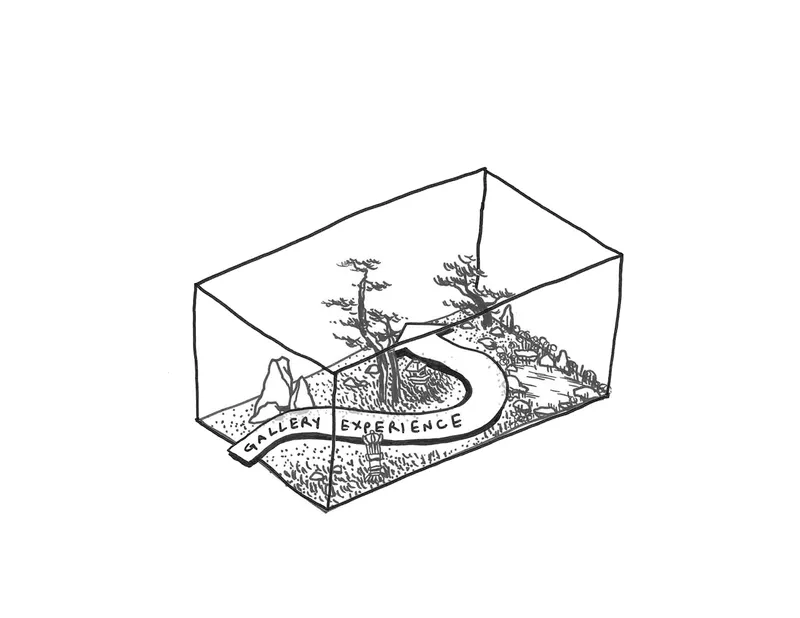
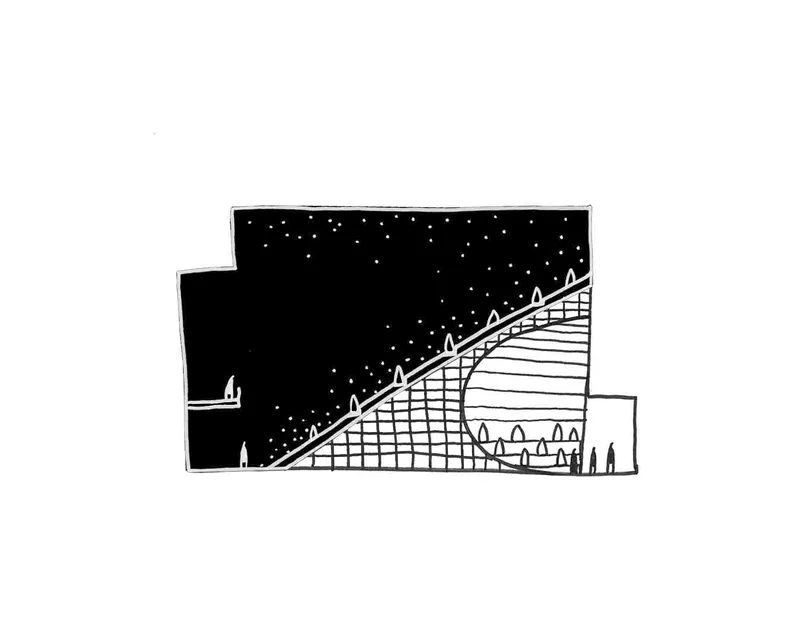
The axonometric cutaway reveals the exhibition's organizational logic: discrete gallery volumes arranged around internal circulation, each room geometrically distinct yet linked by a continuous visitor path. Wireframe diagrams of organic three-lobed forms hint at the curvilinear geometries that govern several of the rooms, while section sketches show how stacked galleries exploit the museum's vertical dimension. A sketch of the garden room makes the raised-path strategy explicit, with trees and landscaped terrain occupying the interstitial space between walkway and wall. The section through a curved lattice roof illustrates how even the most fluid forms are resolved into buildable structural systems.
Why This Project Matters
Exhibition design occupies an awkward position in architectural discourse. It is temporary, client-driven, and often subordinated to the objects on display. OMA's work for Dior at MOT pushes back against that marginalization by treating each room as a genuine architectural proposition rather than a backdrop. The firm's decision to root the scenography in Japanese material traditions, from washi paper to tea garden circulation, gives the Tokyo iteration a specificity that distinguishes it from earlier versions in Denver and Dallas. This is not a franchise exhibition bolted into a new building; it is a site-responsive design that takes its host culture seriously.
The broader lesson is about the productive overlap between fashion and architecture. Both disciplines deal in surface, structure, and the body's relationship to enclosure, and the best fashion exhibitions make that overlap tangible rather than metaphorical. OMA's 22 rooms at MOT succeed because they are genuinely spatial experiences: rooms where the architecture does not merely house the garments but actively reframes how you see, approach, and understand them. As museum exhibitions continue to absorb enormous institutional investment, this project stands as evidence that architectural ambition and curatorial clarity can coexist.
Christian Dior: Designer of Dreams Exhibition by OMA. Located at the Museum of Contemporary Art Tokyo, Japan. 2,000 m². Completed in 2022. Photography by Daici Ano.
About the Studio
Share Your Own Work on uni.xyz
If projects like this are the kind of work you want to make, uni.xyz is a place to publish your own, find collaborators, and enter design competitions.




Popular Articles
Popular articles from the community


AL-JANNAH: Sustainable Architecture and Permaculture for Afghan Widows
AL-JANNAH uses sustainable architecture and permaculture to create resilient oasis of housing, learning, work and renewal for Afghan widows.

The Earth Pod: 3D Printed Homes for Resilient Refugee Communities
The Earth Pod reimagines refugee housing through 3D printed homes made from clay, combining resilience, self-sufficiency, and rapid shelter.
EW PARK: Sustainable Architecture Reimagines the Future of Urban Parking
EW PARK reimagines city parking as a modular wooden tower combining automation, solar energy, electric mobility, and adaptable urban design.

Conexión: Biophilic Design Reimagines High-Rise Living in Hong Kong
Conexión reimagines high-rise living in Hong Kong through biophilic design, green facades, shared spaces, daylight, water and nature within.
Similar Reads
You might also enjoy these articles

Bao Huynh Watercolor Atelier: A Serene Art Retreat in Hội An
Bao Huynh Watercolor Atelier in Hội An blends multifunctional art spaces, sustainable design, local materials, and family-friendly living in a serene environment.

Atelier Macri Concept Store Interior Design by CASE-REAL
Atelier Macri store features a "ko" counter, walnut wood details, cork displays, blending retail, gallery, and seamless customer experiences.

Manuel Vargas Izquierdo Stadium and High-Performance Sports Center: Architectural Excellence in Jalpa de Méndez
The Manuel Vargas Izquierdo Stadium blends sustainable design, inclusive sports facilities, and cultural-inspired architecture, revitalizing Jalpa de Méndez’s public spaces.

KAKR Buluh Awar Hall: Revitalizing Community and Ecology Through Bamboo Architecture
Community built bamboo hall revitalizes Buluh Awar village, empowering youth, restoring ecology, celebrating vernacular craftsmanship through sustainable architecture and culture.


Explore High Fashion Design Competitions
Discover active competitions in this discipline



Challenge to reimagine the Iron Throne


Photograph architecture without architects


Illustrate the lost glory of Angkor Wat - Render Challenge


Bring back Drive In's
Comments (0)
Please login or sign up to add comments
No comments yet. Be the first to comment!