
Omar Gandhi Architect Wraps a Six-Bedroom Coastal Home Around a Triangular Lot in Nova Scotia
Jib House uses terraced limestone walls and cantilevered cedar volumes to connect a Chester Village hillside to the sea below.


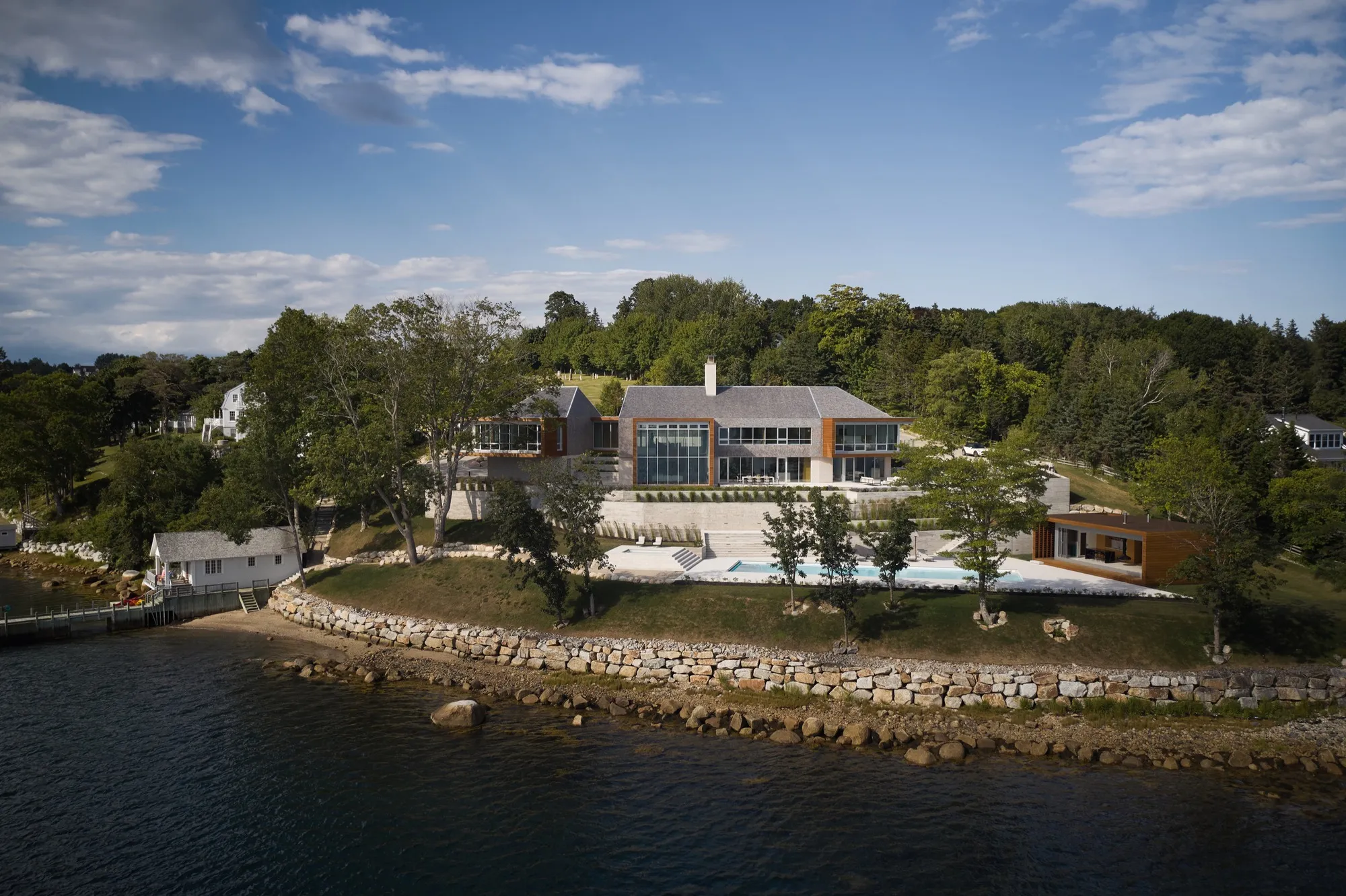
Chester, Nova Scotia, is a village where modesty is part of the architecture. The houses are gabled, clad in pale cedar, and scaled to the tight streets that wind down to the water. Omar Gandhi Architect understood that context and, rather than fighting it, used it as the starting point for Jib House: a six-bedroom residence on a dramatically steep, triangular coastal lot that takes its name from the jib sail of the traditional boats that have raced in Chester's harbour for over 150 years.
What makes the project genuinely interesting is its reversal of the typical coastal mansion playbook. From the street, Jib House reads as a modest gabled volume. Step inside, and a spiral staircase drops you into a living area that opens across 270 degrees of ocean views, with cantilevered cedar shadowboxes pushing outward over a terraced landscape that steps down to a pool, a hot tub, and eventually the pre-existing dock at the water's edge. The building does not announce itself; it reveals itself. That tension between discretion and spectacle is what holds the whole composition together.
A Sail-Shaped Site as Design Generator
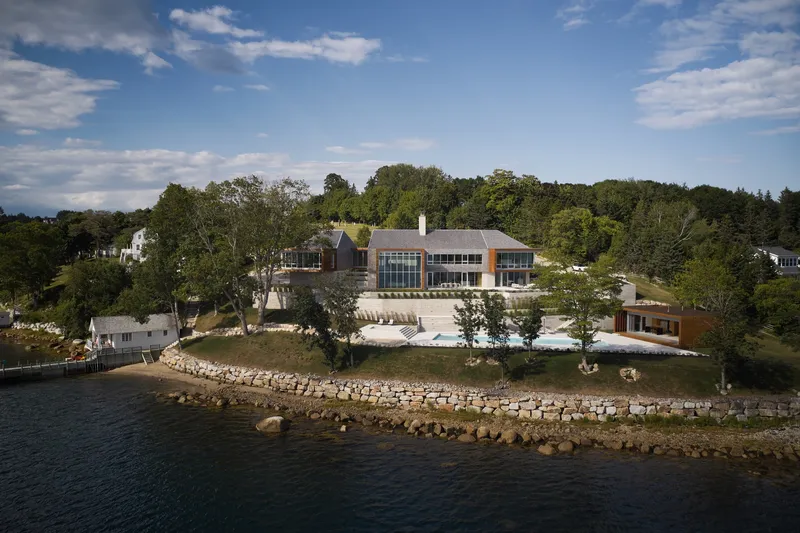


Seen from above, the logic is immediately legible. The triangular lot juts into Chester Basin like the prow of a boat, and the building stretches along its waterfront edge in an elongated configuration of angled volumes. The steep topography, which might have been a liability, becomes the project's primary design opportunity. Board-formed concrete retaining walls terrace the land in a controlled descent from house to pool to shoreline, each level offering a different relationship to the water.
The aerial views reveal how Omar Gandhi organized the compound: four distinct volumes pivot around a central spiral staircase, fanning out to capture south-facing views and wrap the terrace around the common spaces. A pool house with sauna and wood-burning fireplace anchors the lower level, while the upper terrace connects to the main living quarters. The pre-existing boathouse and dock are left intact, knitting the new construction into the site's existing nautical infrastructure.
Cedar and Limestone: A Material Palette Rooted in Place
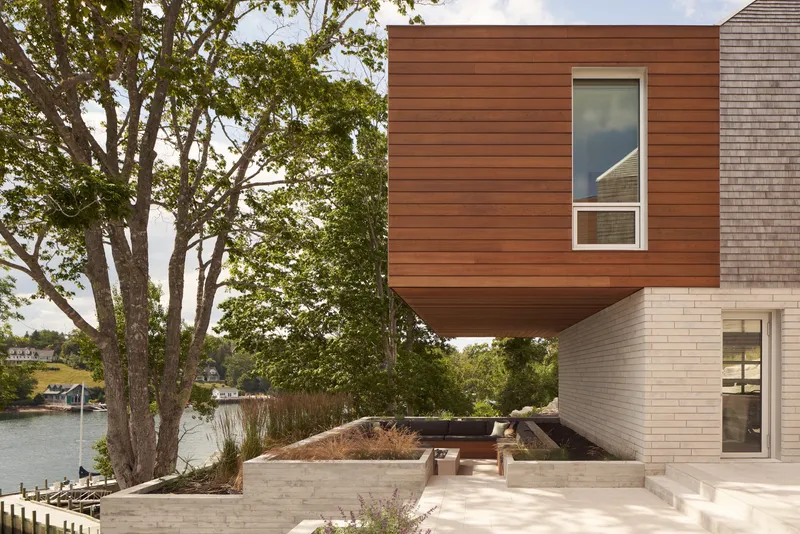

Eastern white cedar is described by the firm as the most ubiquitous regional material on Nova Scotia's south shore, and it dominates the project's upper volumes. Pale cedar cladding wraps both walls and roofs, deliberately echoing the weathered tones of the village's older buildings. Below this, a limestone base anchors each volume to the ground, creating a clear tectonic reading: heavy stone below, light wood above.
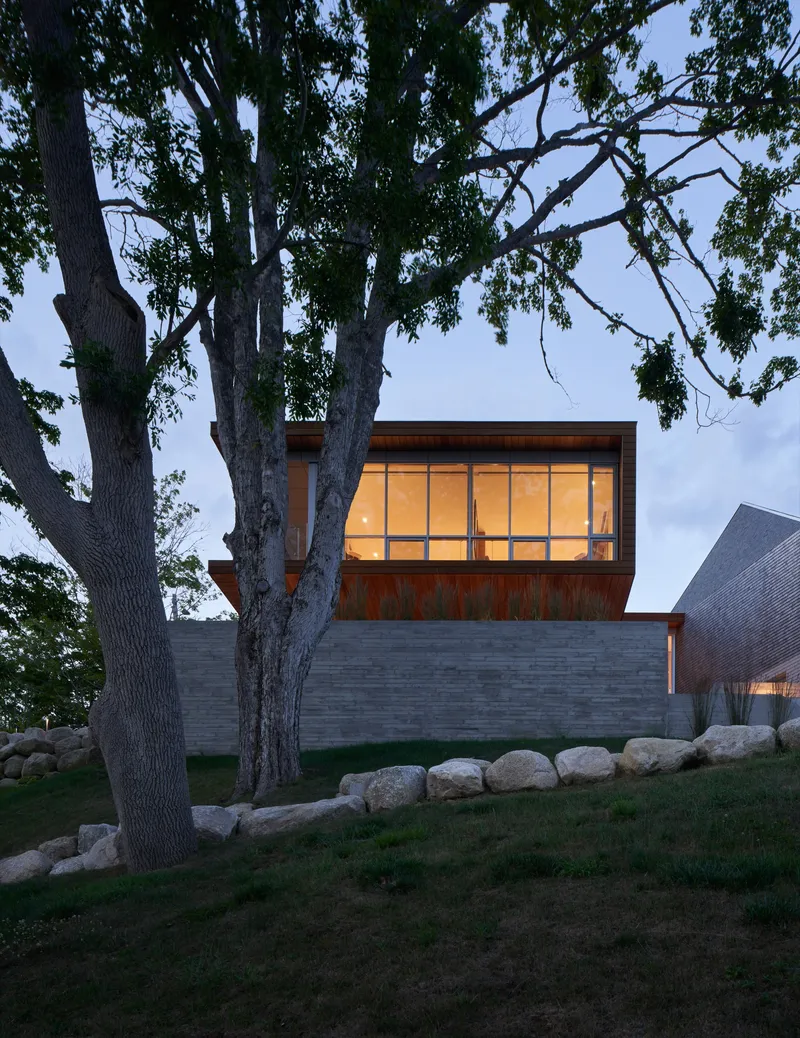
The cantilevered shadowboxes, clad in western red cedar to distinguish them from the primary gable forms, are the building's most assertive gesture. These projecting volumes, each a different size and proportion, slide into the pale cedar gables like lenses trained on specific views. It is a sophisticated move that gives each room its own framed relationship to the landscape while maintaining the overall composition's allegiance to traditional gable roof forms.
The Cantilever as Viewing Device


At dusk, the cantilevered volumes become lanterns. Floor-to-ceiling glazing wraps their corners, and the warm interior light spills outward, turning each box into a beacon above the planted concrete terraces. The effect is theatrical, but it serves a spatial purpose: by projecting the living spaces beyond the building's footprint, Gandhi creates the sensation of hovering over the landscape without actually building on the steep terrain below.
The sunken conversation pit, placed directly over one of the cantilevered red-cedar window boxes, is the most committed expression of this idea. You sit below floor level, surrounded by glass, with the water visible beneath and in front of you. It is a room that could only exist because of the cantilever, and it collapses the distance between interior and ocean in a way that a conventional window wall never could.
Terraced Landscape as Architecture
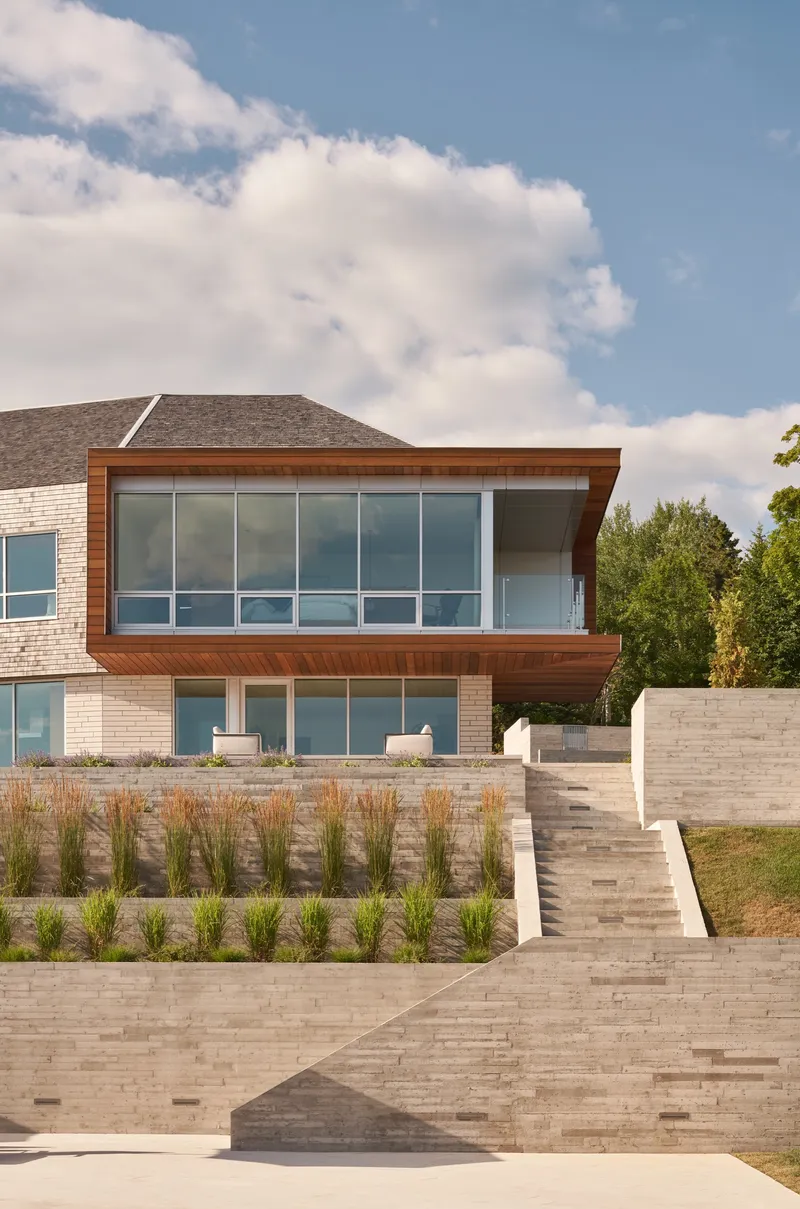
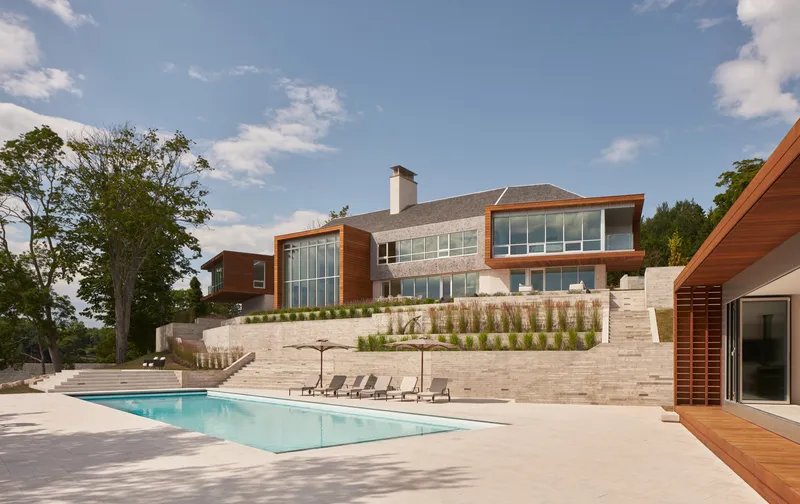
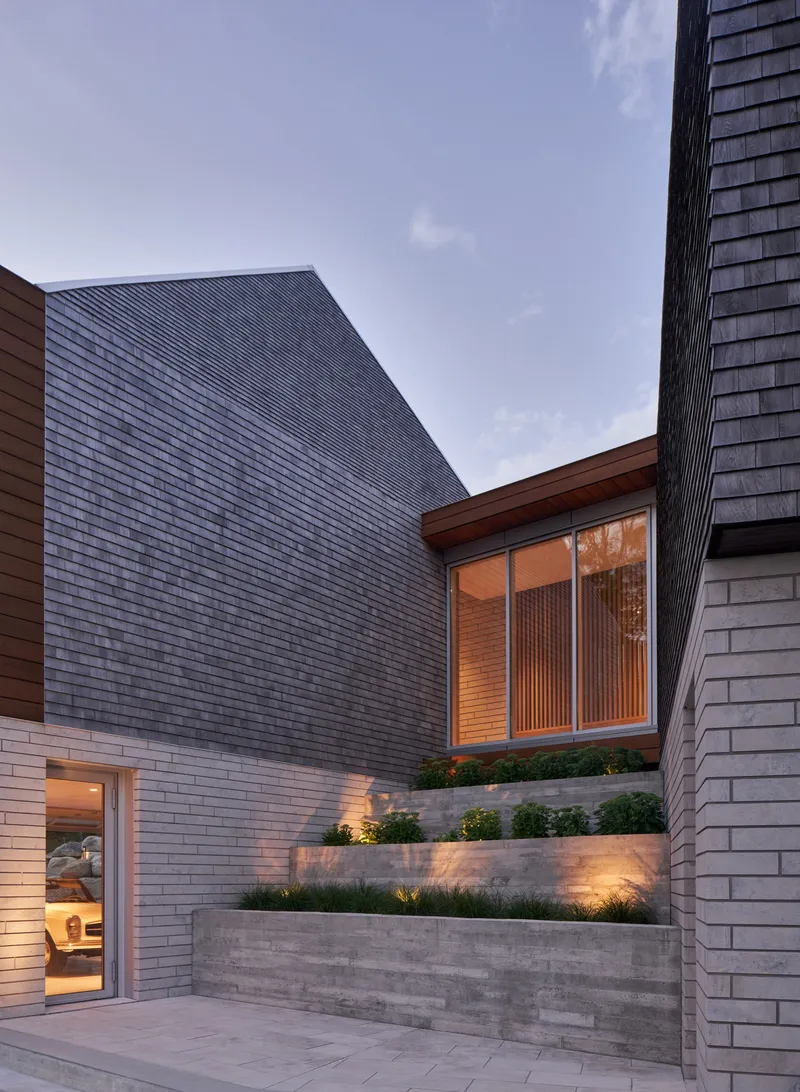
The tiered limestone retaining walls are not merely functional; they are the building's ground-level facade. Planted with ornamental grasses and lit from below at night, the walls transform the steep grade change into a processional sequence. Board-formed concrete adds texture and warmth to what could have been austere engineering, and the planted beds soften each level into something closer to a garden than a retaining structure.
The rectangular pool sits within this terraced system, occupying a platform roughly halfway between the house and the waterline. It reads as part of the landscape rather than as an addition to it, its still surface echoing the basin beyond. The sequence from upper terrace to pool to dock creates a gradient of domesticity, moving from fully enclosed to fully exposed in a matter of steps.
A Spiral Staircase Carved by Machine
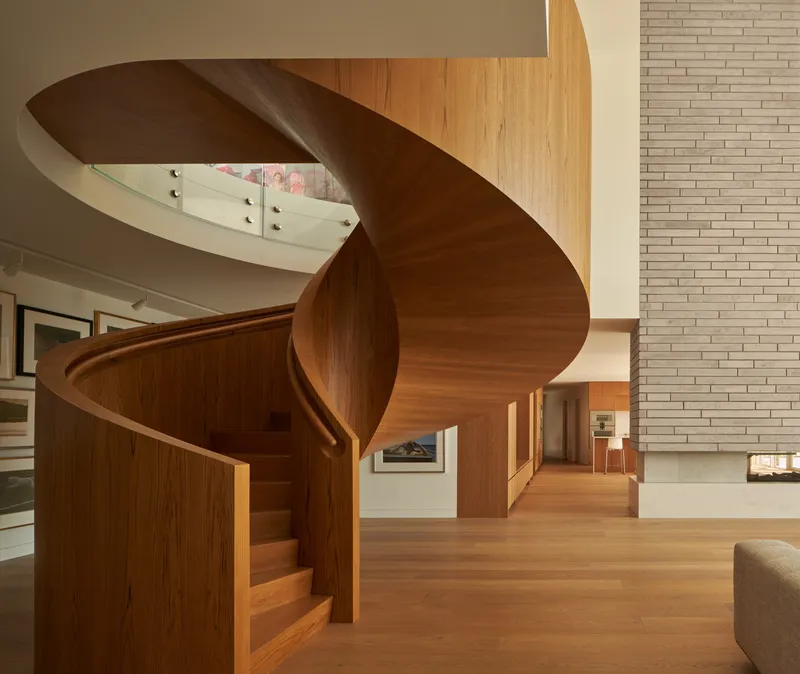


The helical staircase at the center of the plan is the project's interior set piece, and deservedly so. Composed entirely of solid wood and manufactured using five-axis CNC machining techniques, it spirals through a double-height space beside the brick fireplace volume. Each tread radiates outward from a central column, and the handrail curves continuously without any visible joints or connections. Viewed from above, the geometry is hypnotic: a tight spiral of warm timber grain descending into soft afternoon light.
What elevates this staircase beyond mere craftsmanship is its role in the spatial sequence. The entry is deliberately modest, scaled to the street. Then the staircase pulls you down, rotating your orientation as you descend until you arrive at the living level facing the sea. It is a threshold device that uses the steep topography to theatrical effect, and it earns its complexity by solving a genuine problem of circulation and spatial drama.
Interior Warmth: Brick, White Oak, and Open Plans

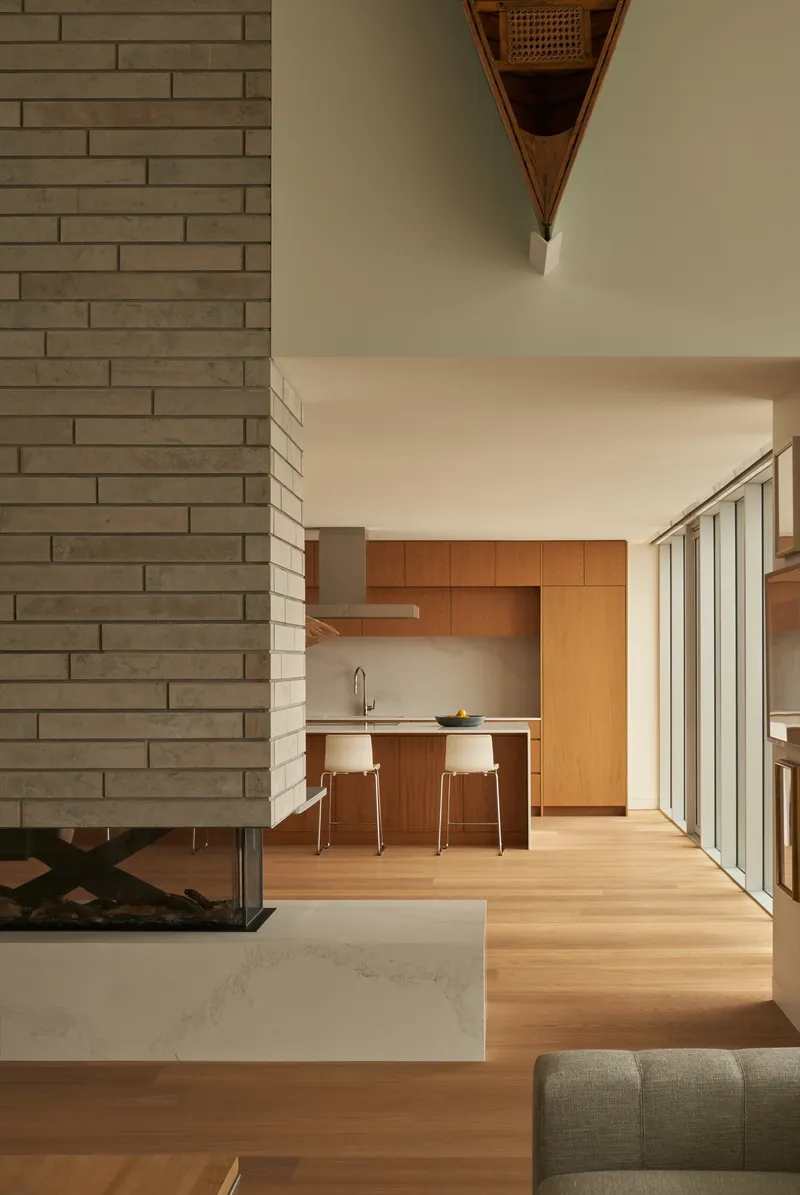
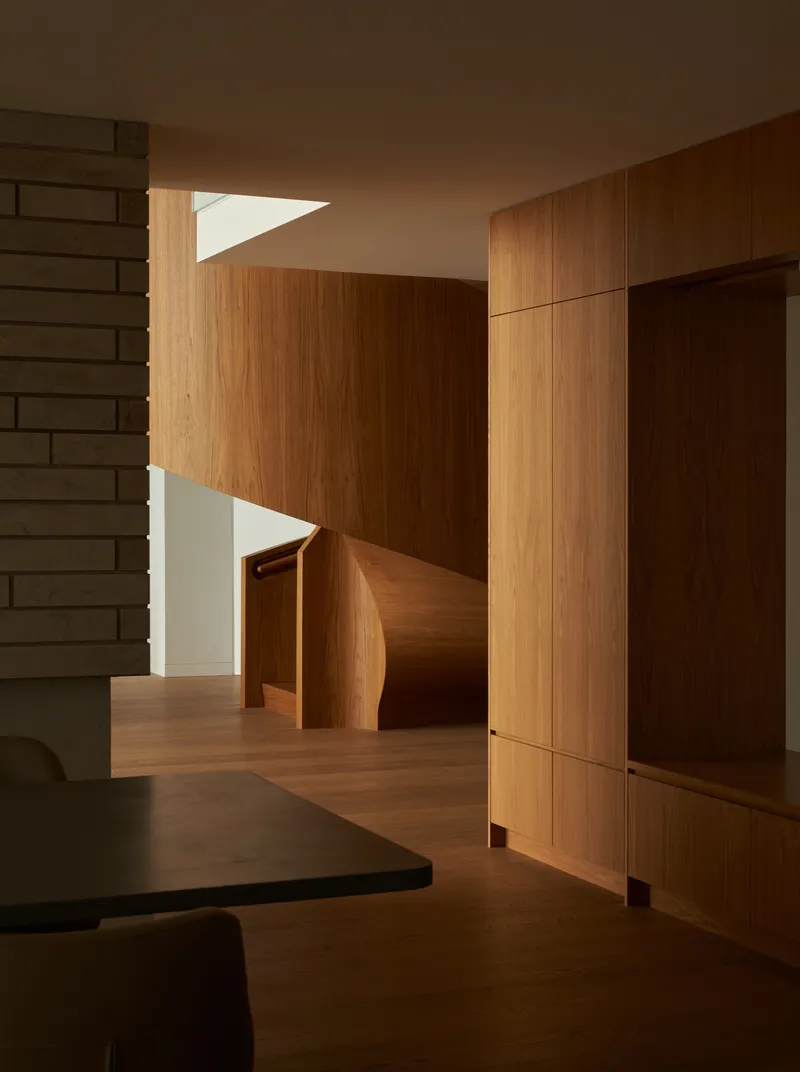
Inside, the material palette shifts from cedar and limestone to white oak and brick. The arched brick fireplace chimney, rising through the double-height living space, is the room's anchor. A suspended wooden canoe on the wall beside it serves as both art and cultural reference, a nod to the maritime identity that permeates the project. The kitchen, visible beyond the fireplace volume, is fitted with timber cabinetry that matches the warmth of the oak floors.
The timber-clad walls and ceilings in the stairwell create a cocoon-like transition between the bright, glass-wrapped living spaces and the more intimate upper bedrooms. Skylights wash the curved stair with natural light, ensuring that the circulation spine never feels like a corridor. It is a house where the connections between rooms are as carefully designed as the rooms themselves.
Outdoor Rooms and the Pool Pavilion
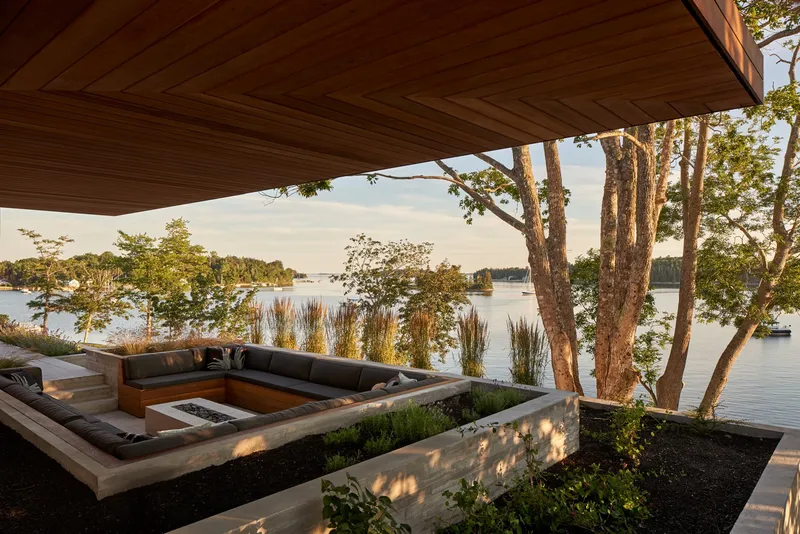

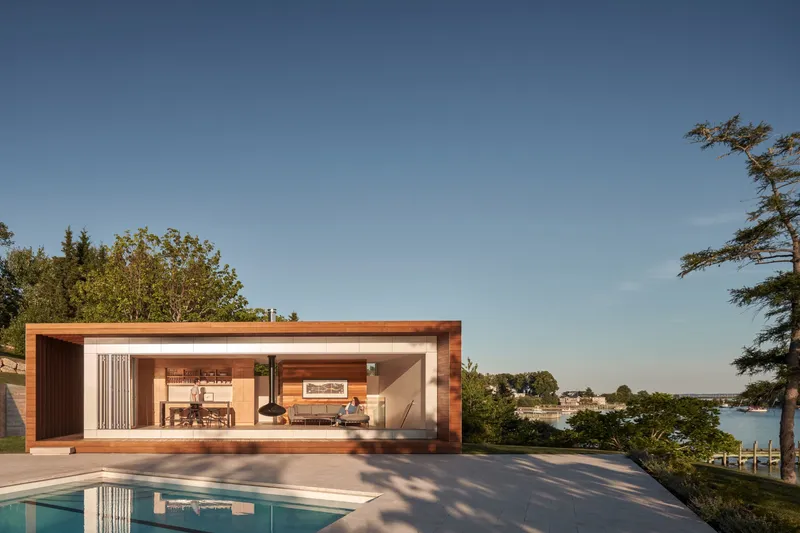
The covered terraces, with their timber ceilings and sunken seating areas, function as true outdoor rooms. A fire pit anchors the lower terrace, positioned to frame views through the mature trees to the lake beyond. In clear daylight, the timber soffit glows warm against the cool blue of the water. At dusk, the firelight takes over, and the terrace becomes the kind of space that holds a dinner party well past dark.
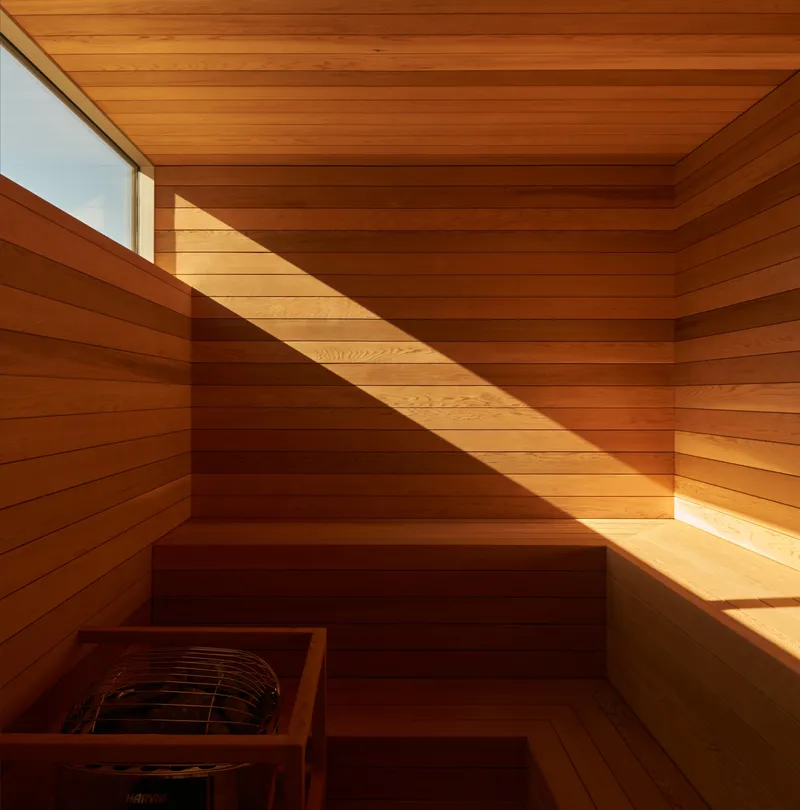
The pool house, visible at the water's edge, includes a sauna with cedar-lined benches and a clerestory window that draws diagonal sunlight across the interior. An outdoor shower with dark tile walls and a timber ceiling open to the sky completes the sequence of bathing experiences. These are compact, precisely detailed spaces that reward close attention, a counterpoint to the expansiveness of the main house.


The corner bedroom, wrapped in floor-to-ceiling glass, frames tree branches and water in a composition that changes with every season. It is a room where the architecture steps back and lets the site do the talking. That restraint, applied consistently across the private spaces, keeps the house from becoming relentless in its pursuit of views. Some rooms look out; others look through. The difference matters.
Nightfall and the Architecture of Light
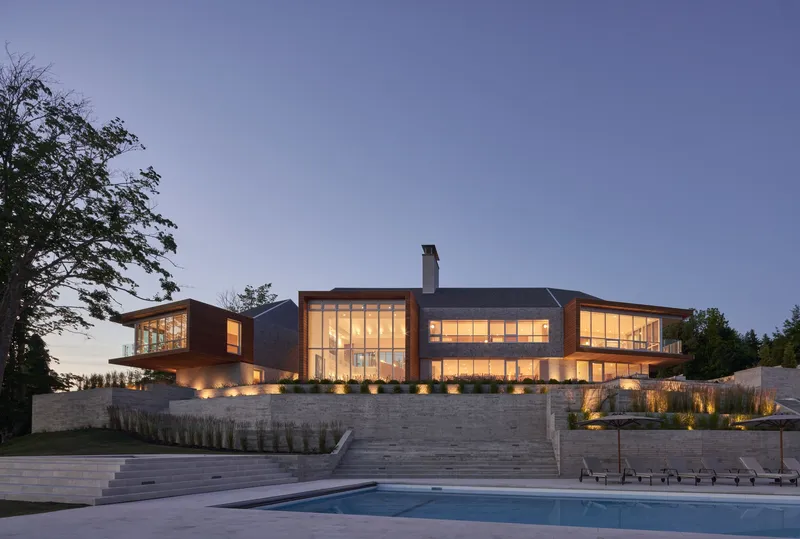
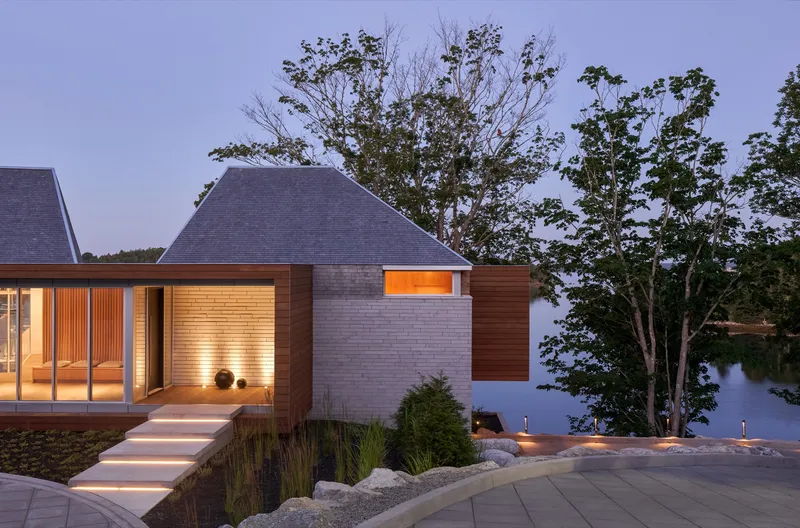
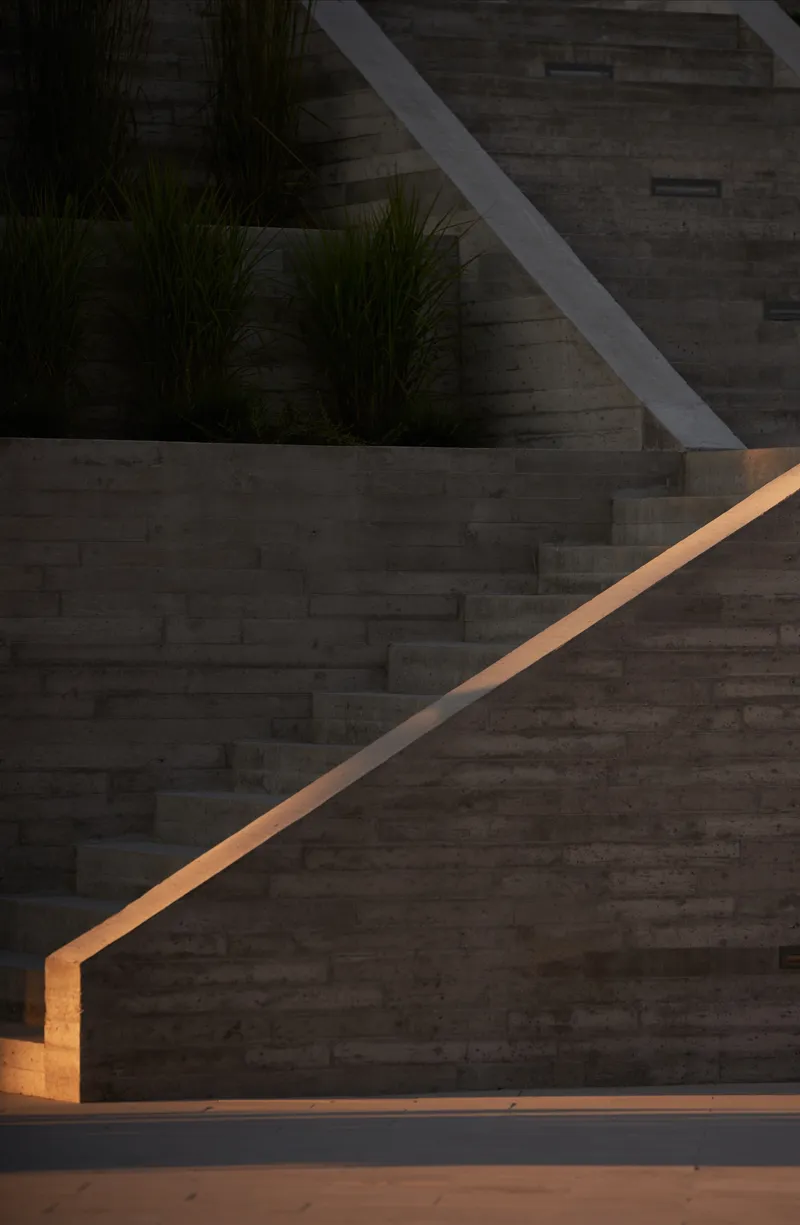
At night, Jib House becomes a different building. Uplighting along the limestone terraces turns the retaining walls into luminous bands, and the illuminated glass pavilions float above them like navigational markers. The bronze handrail on the exterior concrete stair catches the light, its warm metallic glow a small but telling detail that speaks to the level of care applied throughout.
The nocturnal views are revealing because they strip away the material texture and leave only the volumetric composition: a series of glowing boxes, staggered across a dark hillside, stepping down to a still pool and the black water beyond. It is a house that was clearly designed with both states in mind, and it holds its own in both.
Plans and Drawings


The floor plans confirm what the photographs suggest: four angled volumes pivot around the central spiral staircase, each oriented to a different slice of the 270-degree panorama. The main living level places kitchen, dining, and lounge spaces along the waterfront edge, with the stair acting as both vertical circulation and spatial hinge. The geometry is disciplined, with each wing angled just enough to prevent the plan from reading as a simple bar, creating pockets of enclosure and moments of unexpected openness between the volumes.
Why This Project Matters
Jib House matters because it demonstrates that a large, luxurious coastal residence can still be contextually responsible. Omar Gandhi took the vernacular elements of Chester Village, its gable roofs, cedar cladding, and modest street presence, and used them as a framework for a building that is anything but modest once you cross the threshold. The trick is that the modesty is genuine on the street side, and the exuberance is genuine on the water side. There is no pretending.
The project also makes a compelling case for topography as a design partner rather than an obstacle. The terraced landscape, the cantilevered volumes, the spiral staircase that reorients you as you descend: all of these moves grow directly from the steep, triangular site. Remove the slope, and the building loses its logic. That kind of site-specificity is increasingly rare in high-end residential work, where so many houses could be lifted off their lots and dropped anywhere without losing meaning. Jib House could only be here, and that is exactly the point.
Jib House by Omar Gandhi Architect. Chester, Nova Scotia, Canada. Completed 2022. Photography by Adrian Ozimek.
About the Studio
Share Your Own Work on uni.xyz
If projects like this are the kind of work you want to make, uni.xyz is a place to publish your own, find collaborators, and enter design competitions.




Popular Articles
Popular articles from the community


Co-Life: Senior Housing Design That Reconnects Older Adults With the City
Co-Life reimagines senior housing design through healing gardens, shared streets, workshops, and a sustainable community across generations.

The Ocean Hive: Sustainable Architecture for a Self-Sufficient Civilization at Sea
The Ocean Hive imagines sustainable architecture at sea, where modular habitats, algae, wave power and ocean waste sustain a growing colony.

Co-life: Sustainable Architecture for Age-Friendly Community Living
Co-life reimagines sustainable architecture for seniors through courtyards, rammed earth, shared gardens, and spaces designed for belonging.

The Musturak Paradise: Senior Living Architecture for a Connected Future in Temara, Morocco
The Musturak Paradise reimagines senior living architecture in Temara via private homes, social spaces, culture, community, and shared care.


Similar Reads
You might also enjoy these articles

Bao Huynh Watercolor Atelier: A Serene Art Retreat in Hội An
Bao Huynh Watercolor Atelier in Hội An blends multifunctional art spaces, sustainable design, local materials, and family-friendly living in a serene environment.

Atelier Macri Concept Store Interior Design by CASE-REAL
Atelier Macri store features a "ko" counter, walnut wood details, cork displays, blending retail, gallery, and seamless customer experiences.

Manuel Vargas Izquierdo Stadium and High-Performance Sports Center: Architectural Excellence in Jalpa de Méndez
The Manuel Vargas Izquierdo Stadium blends sustainable design, inclusive sports facilities, and cultural-inspired architecture, revitalizing Jalpa de Méndez’s public spaces.

KAKR Buluh Awar Hall: Revitalizing Community and Ecology Through Bamboo Architecture
Community built bamboo hall revitalizes Buluh Awar village, empowering youth, restoring ecology, celebrating vernacular craftsmanship through sustainable architecture and culture.




Comments (0)
Please login or sign up to add comments
No comments yet. Be the first to comment!