

One Square Block: Tetris-Inspired Modular Housing for Budget-Conscious Urban Living
Sixteen modular blocks, five unit types, and a shared amenity core give young professionals the autonomy to build only the home they need.


What if residents could assemble their apartment the way they snap Tetris blocks into place? One Square Block takes that question seriously, proposing a modular housing system where five distinct unit types, drawn directly from the geometry of the iconic puzzle game, let occupants pay only for the program they actually want. No gym membership folded into your rent if you never lift weights. No performance hall surcharge if you prefer quiet evenings. The result is a housing model built around financial transparency and spatial autonomy, two things conspicuously absent from most urban developments targeting young professionals.
Designed by Sung Lee, Grace Kim, Heidi Buchberger, and Hualeah Engelhardt, the project organizes 16 blocks into a layered community framework: units group into blocks, blocks cluster into neighborhoods, and neighborhoods coalesce into a single cohesive development. At the center sits a shared amenity core containing a gym, community center, performance hall, local market, and cafés. The logic mirrors organic city growth, scaling from the intimate to the collective without losing coherence at any level.
Yellow Accents and a Civic Street Edge
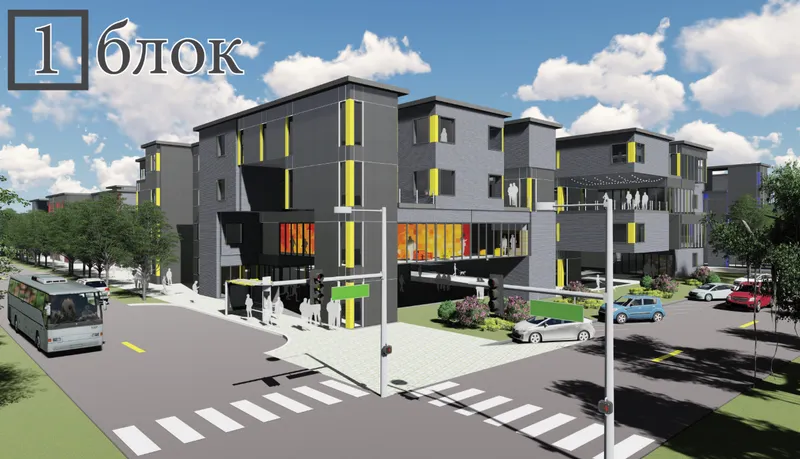
The street-level rendering reveals how One Square Block meets the city. Punctuated by bright yellow window frames, the façade avoids the gray anonymity that plagues so much affordable housing. Pedestrians cross at grade, and the building's massing steps back and forth to create varied sightlines. The color strategy is more than decorative; it signals the individuality the designers want each unit to carry. Where conventional housing blocks enforce uniformity, these accents telegraph difference, hinting at the customizable interiors behind each opening.
Sixteen Blocks, One Landscape Armature

From above, the organizational strategy becomes legible. The 16 blocks sit within a generous field of landscaped green space and scattered trees, creating breathing room between structures that many modular housing schemes sacrifice for density. Each block carries a unique configuration of the five Tetris-derived unit types, deliberately mixed to prevent demographic monotony and encourage cross-pollination between residents. The aerial view also makes clear how the shared amenity programs, clustered at the development's core, serve as a gravitational center pulling all neighborhoods together.
This masterplan decision is critical. By focusing community functions inward rather than distributing them along a perimeter, the designers ensure that every resident's walk to the market or café is also a walk through their neighbors' territory. Encounter becomes unavoidable, and that is the point.
Ground-Level Commerce Under Dappled Light
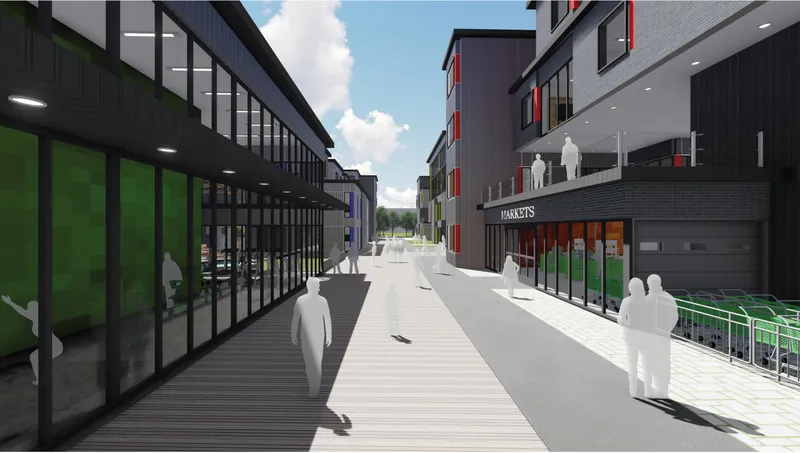
Between the residential volumes, pedestrian walkways lined with glass storefronts form the social spine of each neighborhood. Figures move through dappled sunlight filtered by the buildings above, a quality of light that suggests the designers paid attention to massing orientation and gap dimensions. These semi-public corridors host the cafés, gathering spaces, and retail that the team positions as catalysts for cultural exchange. The transparency of the storefronts blurs the line between public passage and interior program, making ground-floor activity visible and inviting.
The walkway is also where the modular logic pays dividends at the urban scale. Because units can expand or contract based on demand, the ground-floor program can evolve too. A café today could become a co-working space next year without requiring structural overhaul, just reconfiguration of the same Tetris-derived modules.
A Window Seat That Earns Its Keep
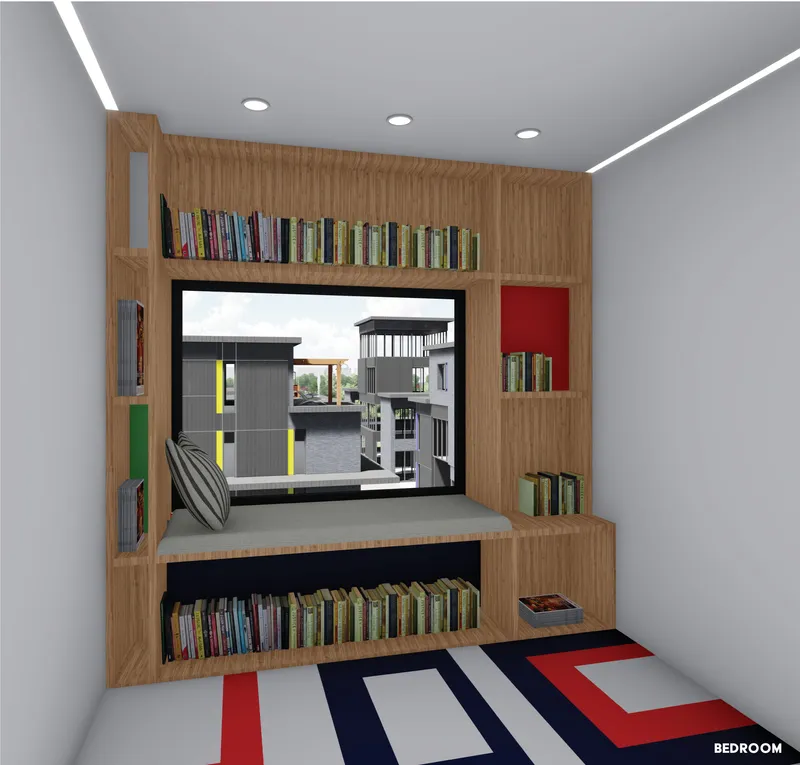
At the unit scale, a built-in window seat with integrated timber shelving and book storage demonstrates how carefully the designers considered interior efficiency. Overlooking the courtyard below, this nook doubles as reading corner, storage wall, and vantage point. It is exactly the kind of multitasking detail that modular housing demands: every square meter must justify itself. The warm timber finish and generous glazing transform what could feel like a cramped efficiency unit into something genuinely livable.
The courtyard view from this seat matters, too. It connects the private interior back to the collective landscape, reinforcing the project's central thesis: autonomy and community are not opposing forces. You choose your unit, you customize your space, and then you look out the window and see the neighborhood you belong to.
Why This Project Matters
One Square Block challenges a persistent assumption in affordable housing: that cost efficiency requires standardization. By inverting that logic, offering a kit of parts that residents assemble according to their own priorities, the team reframes budgetary constraint as a design generator rather than a limitation. The Tetris analogy is more than a clever reference; it structures the entire organizational hierarchy, from the five unit types through the 16-block masterplan to the shared amenity core.
Lee, Kim, Buchberger, and Engelhardt demonstrate that modularity, when taken beyond the structural module and extended into program, finance, and community planning, can produce housing that is simultaneously affordable and socially rich. In a market that too often asks young professionals to choose between cheap and good, One Square Block argues they should not have to.
View the Full Project
About the Designers
Designers: Sung Lee, Grace Kim, Heidi Buchberger, Hualeah Engelhardt
Enter a Design Competition on uni.xyz
uni.xyz runs architecture and design competitions year-round that reward proposals with spatial conviction and real site intelligence.
Project credits: One Square Block by Sung Lee, Grace Kim, Heidi Buchberger, Hualeah Engelhardt.


Popular Articles
Popular articles from the community


Jaramillo Van Sluys Arquitectura and Urbanismo Turn a Demolished Registry Lot in Quito into an Orchard Plaza
In Quito's Centro Histórico, a 2,800 m² plaza exposes the San Agustín convent wall and redraws its lost Augustinian orchard in volcanic stone.

LT2A and OPEN Architectes Thread a Brick and Glass High School Through a Wooded Belgian Campus
In Braine-l'Alleud, a 3,000 m² wing for Collège Cardinal Mercier pairs pale brick with a glazed colonnade, deferring to a small chapel and a dense wood.

Juan García Correa, John González and Claudia Rueda Sink a Circular Amphitheater into a Manizales Engineering Building
On the La Nubia campus in Manizales, Colombia, the S1 Building folds labs and offices into a hillside of ramped lawns that double as a campus route.

David Ortega Stacks a Two-Story Mexico City Penthouse Around a Steel Stair and a Pergola-Shaded Roof Terrace
In Colonia Roma, a 300 m² penthouse uses oak joinery, a planted steel stair and a slatted roof pergola to make a new-build apartment feel like a house.

Similar Reads
You might also enjoy these articles


Aquadapt: An Underwater Habitat That Rewrites Its Rooms by the Hour
Curved modules ring the seabed while one shell shifts from breakfast room to cinema, farm and football pitch as residents' needs change.

Play: Fragments of Their World: Remembered Architecture Rebuilt as a Modular Playground for Refugee Camps
Tom Gardner abstracts domes, arches and towers from the homelands of displaced families into a kit of child-scaled play parts for camp settlements.
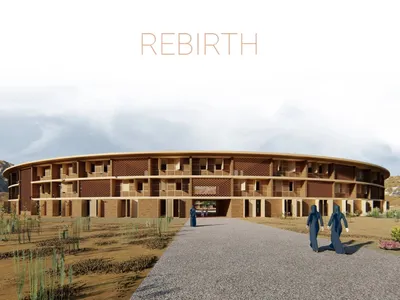
REBIRTH: A Circular Settlement Where Afghan Widows and Their Children Rebuild Life Together
A shortlisted Resile entry turns the circle into a protective ring of timber and brick, gathering homes, classrooms and gardens around a shared landscape.
The Main Dream: A Recycled Plastic Kit That Lets Refugee Children Build Their Own Playground
Thirty-centimetre interlocking cubes that connect on three axes turn play into construction, letting children author the spaces they occupy.

Comments (0)
Please login or sign up to add comments
No comments yet. Be the first to comment!