

Opera Truck: A Modular Steel Chassis That Turns Madrid's Street Map into Stage, Seat and Playground
A shortlisted Opera Truck entry where interchangeable bentwood, net and light fillings slot into steel cubes, letting Madrid plazas host art every day.


Most mobile performance structures arrive, unfold a stage, and leave the plaza exactly as they found it. This proposal works differently. It takes the tangled lines of Madrid's street map, bends them into timber and light, and locks them inside a black steel cube. The result is a piece of urban equipment that serves as theatre seating at eight in the evening and as a bench, climbing frame or lounge the next morning. The core argument is simple and persuasive: if cities are losing their appetite for shared cultural experience, the answer is to make art part of the ordinary furniture of the street rather than an occasional event.
Designed by Magdalena Smieja, the project was shortlisted in the Opera Truck competition, which asked for a movable architecture that could bring performance into the centre of Madrid. Smieja frames her entry against a city drifting into dense digital routines, where public interaction with art and performance fades into the background. Her response is a flexible installation that can transform plazas into immersive cultural settings while fitting into the everyday rhythm of the city, so that it supports gathering, artistic expression and community life as much as scheduled shows.
Madrid's Street Pattern, Bent into Timber Inside a Steel Cube

The opening rendering sets out the whole system in one frame: a black steel cube carrying a curved timber ramp, with white folded panels beside it under the trees of a Madrid square. The flowing lines inside each module come directly from the city map, so the movement of streets and avenues becomes a sculptural surface you can sit on, climb or perform from. Placing these organic pathways inside a strict cubic frame is the project's smartest move. The cube gives the system order, transportability and repeatability, while the curves inside give each unit a distinct character and a reason to be touched.
Behind this sits a clear technical logic: a universal chassis paired with interchangeable fillings. Smieja lists bentwood surfaces, tensile net structures, greenery, lighting systems and artistic skins as possible inserts. The frame stays constant and the content changes with context, event type and audience. That separation of structure and infill is what moves the project from a single pavilion design toward a kit of parts that a city could actually deploy across many locations.
A Frame That Draws in Light After Dark

At night the dark frame almost disappears, and the glowing white wavy lines take over, drawn against the illuminated facade of a hotel. This view shows the lighting filling at work and makes a strong case for the module as a landmark. During the day the structure reads as open and lightweight furniture; after dark it becomes a line drawing of the city hanging in the plaza. The contrast with the formal, brightly lit facade behind it is useful: the installation does not compete with its historic surroundings in mass, only in gesture.
Here the idea of the artistic skin earns its place. Because the chassis accepts lighting and graphic layers as easily as timber or nets, the same frame can shift identity for a festival, a concert or a quiet evening. The recognisable visual identity Smieja aims for comes less from a fixed form and more from the consistency of the steel cube and the map-derived line, whatever material happens to carry it.
Seats, Stages and the Blurred Line Between Audience and Performer

The square rendering shows the system populated: cube-framed timber ramps and white curved seats, with people sitting, chatting and playing guitar under a clear sky. Nobody here is clearly audience or clearly performer, and that is the point. Smieja rejects the passive spectator of conventional theatre and arranges modules so they can operate at once as seating, stage platforms, exhibition areas, playgrounds and urban lounges. The guitarist on a ramp is both using a bench and occupying a stage.
Height is the tool that makes this work. Lower platforms provide comfortable seating for elderly visitors and children, while raised surfaces lift performers and create more dynamic spatial experiences. Layering the section this way gives different groups their own place within one cluster, an approach to inclusivity that is built into the geometry rather than added as a separate accessible zone.
Everyday Infrastructure Between the Performances

The final image strips away any event: three black steel cubes holding curved plywood ramps among fallen autumn leaves, with a skateboarder passing in front. This is the project in its off-hours, and it may be its most convincing view. Opera Truck is not limited to scheduled programming. When nothing is staged, the modules continue as street infrastructure for spontaneous use: places to stop, rest, climb or simply watch the plaza go by.
The seasonal setting and the casual passer-by suggest a structure that can settle into a neighbourhood instead of appearing as a temporary set piece. Smieja describes the intervention as a way to create moments of pause within a fast-moving city, and this image shows that pause happening without any performance at all.
Why This Project Matters
Many mobile pavilion proposals stop at an attractive object. Opera Truck goes further by thinking in systems: a universal steel chassis, a family of interchangeable fillings, and a geometry drawn from the host city. That combination lets a single design respond to a concert, an exhibition, a children's afternoon or an empty Tuesday without needing to be redesigned. For a competition centred on bringing opera to the street, Smieja's most valuable insight is that the building must earn its place on the days when there is no opera.
The project also offers a measured argument about public space in digitally saturated cities. Rather than staging spectacle to win back attention, it lowers the threshold to participation, using varied heights and tactile surfaces so that sitting, climbing and performing all happen on the same timber line. As a shortlisted entry, it shows how a young designer can turn a city map into a kit of civic furniture, and why adaptable, human-scaled infrastructure may do more for urban culture than any single grand venue.
View the Full Project
About the Designers
Designer: Magdalena Smieja
Enter a Design Competition on uni.xyz
uni.xyz runs architecture and design competitions year-round that reward proposals with spatial conviction and real site intelligence.
Project credits: Opera Truck by Magdalena Smieja Opera Truck (uni.xyz).


Popular Articles
Popular articles from the community


Manzana Morphosis: Stretching Barcelona's Grid into a Living Landscape for 2050
A radical reworking of the Eixample manzana turns density into a tool for generous public space, vertical ecology, and environmental performance.

Singing Woman: An Opera House That Performs Before the Curtain Rises
Ovidiu Cristian Pavel's conceptual opera house translates Estonia's choral identity into a sculpted waterfront landmark facing the Baltic Sea.

Opera on the Sea: Driftwood Logic Shapes a Timber Opera House on Estonia's Coast
Trevor Orgill's opera house translates the entangled drift of floating timber into a civic building where wood, water, and music converge.


ETEH Reworks the Shared Spaces of São Domingos School in Brazil Around Timber, Color and Hanging Plants
At São Domingos School in Brazil, 436 m² of hall, refectory and library are recast with timber joinery, a yellow and blue code and trailing greenery.

Similar Reads
You might also enjoy these articles
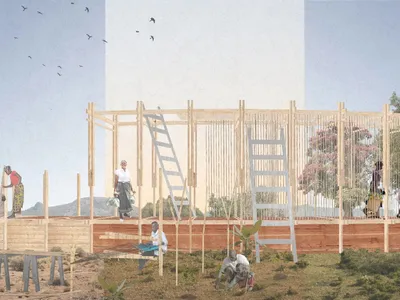
Healing Façade: A Modular Chapel System That Restores Ethiopia's Sacred Forests
Winner of the Eco-Chapel competition, this circular timber façade collects water from air to rebuild soil and reforest degraded Ethiopian landscapes.
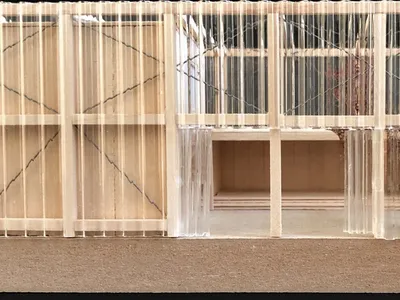
Kaffeebühnen: Where Coffee Shop Architecture Becomes a Civic Stage in Vienna
A linear sequence of timber boxes, transparent shells, and open yards turns the Viennese café tradition into a public performance space.
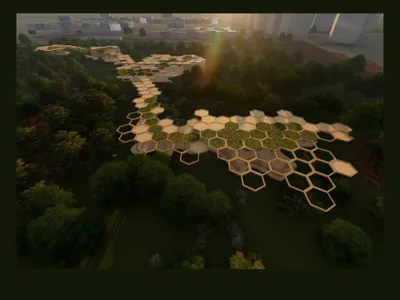
Eco Chapel: A Modular Forest Pavilion That Grows Like the Landscape It Protects
Hexagonal timber modules weave through existing trees, turning a chapel into a living system for prayer, education, and reforestation.


Urban Forest: A Vertical Ecosystem for 5,000 Workers in Singapore's Changi Business Park
Radially stacked pods and layered green decks turn a 7-acre plot into 47 acres of ecological workspace projected for 2040.

Explore Urban Installation Competitions
Discover active competitions in this discipline

Challenge to reimagine the Iron Throne

Photograph architecture without architects

Illustrate the lost glory of Angkor Wat - Render Challenge

Design challenge to reuse E-waste
Comments (0)
Please login or sign up to add comments
No comments yet. Be the first to comment!