

Organic Design Inc Shapes a Suburban Commercial Building as a Community Perch in Saitama
A three-story mixed-use building with organic timber eaves and wrapped balconies draws pedestrians off a quiet Saitama side street.


Commercial buildings in Japanese suburbs rarely get to be generous. Set a block off the main road and a fifteen-minute walk from the nearest station, most developers would default to a tidy box and call it a day. Organic Design Inc took a different position with Enhako Building, treating the site on the border between a residential neighborhood and a mixed commercial-government district as an opportunity to give something back to the street. The result is a 784-square-meter steel structure whose most conspicuous feature is a continuous system of wooden eaves and wrapped balconies that turn every floor into a veranda.
What makes the project genuinely interesting is its refusal to behave like a commercial asset in the conventional sense. The building houses shops and a clinic, and its interior can be rented as a whole, by floor, or by individual unit, a flexibility that keeps it responsive to the rhythms of a small community. But the architecture's real argument is on the outside: curving timber soffits, gabion walls, and open terraces that face north toward a tree-lined street, a public park, and the city hall, inviting the sounds of summer festivals and plant fairs into the building's everyday life. Enhako, loosely translated, is a perch, and the building earns the name.
A Layered Facade That Earns the Street
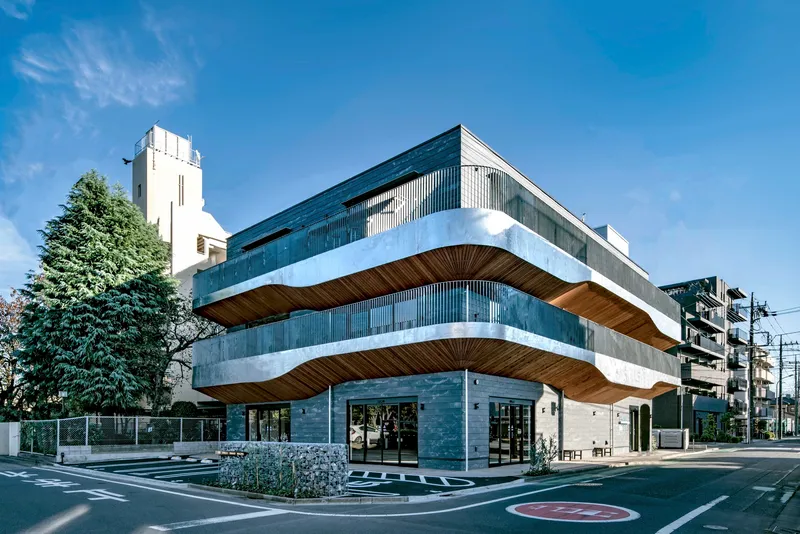
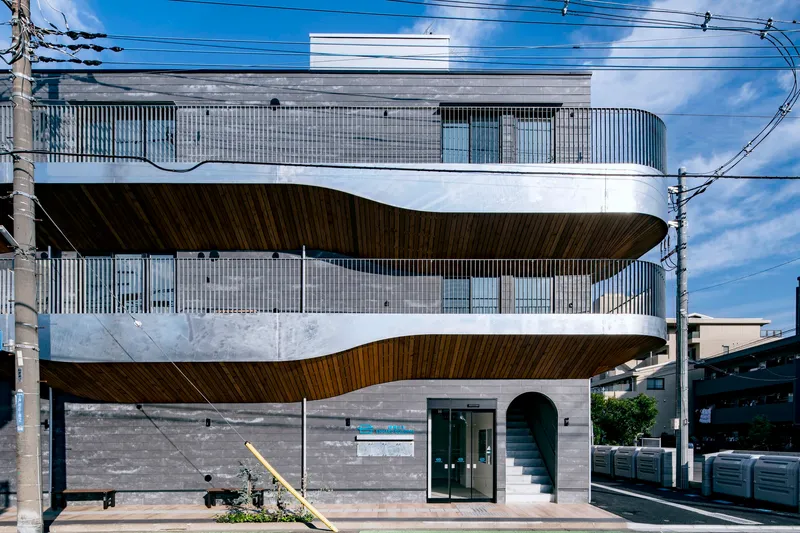
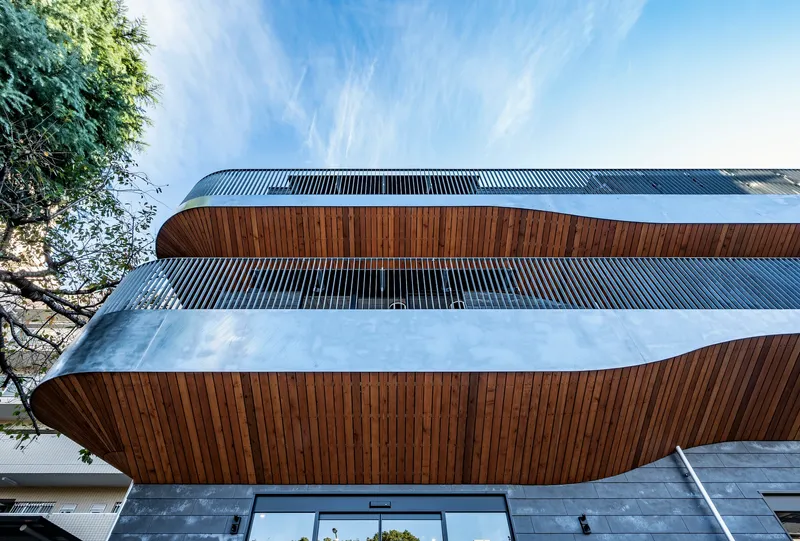
The facade reads as a stack of cantilevered trays, each one rimmed with warm timber soffits and separated by bands of corrugated metal screening and vertical wood slats. At street level, a gabion retaining wall anchors the composition with raw, mineral weight, while the upper stories seem to float forward. The curves are deliberate: the building rounds its corners rather than terminating them, pulling the eye around the volume and softening the relationship between structure and sidewalk.
From a distance, the alternating material bands give the elevation a horizontal rhythm that keeps the three stories from reading as a single block. Up close, the organic shapes of the timber eaves become the dominant experience, drawing pedestrians under the canopy and into the building's orbit.
Timber Soffits and the Invitation to Linger
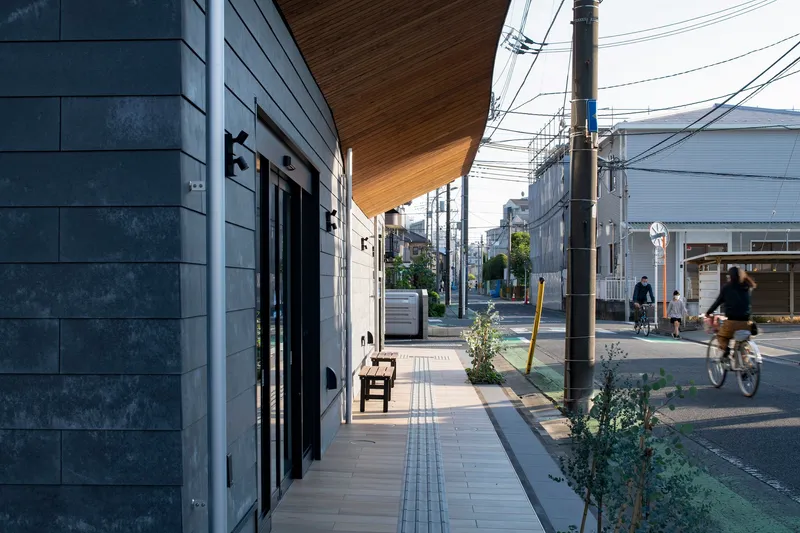
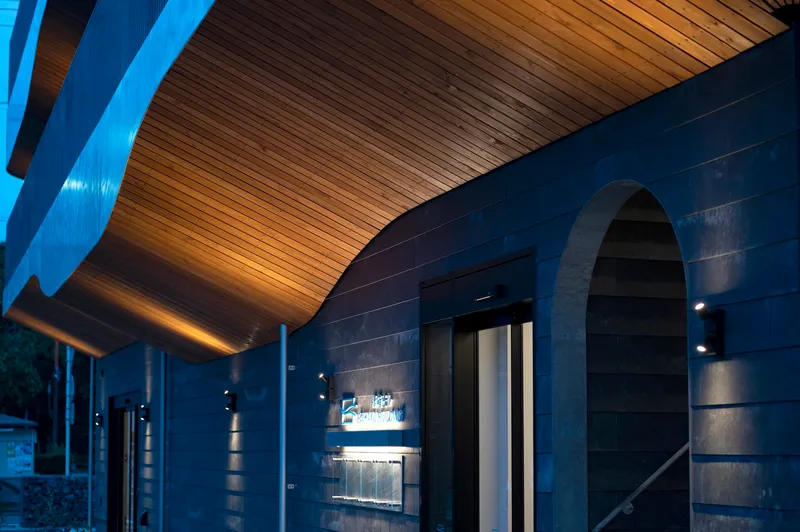
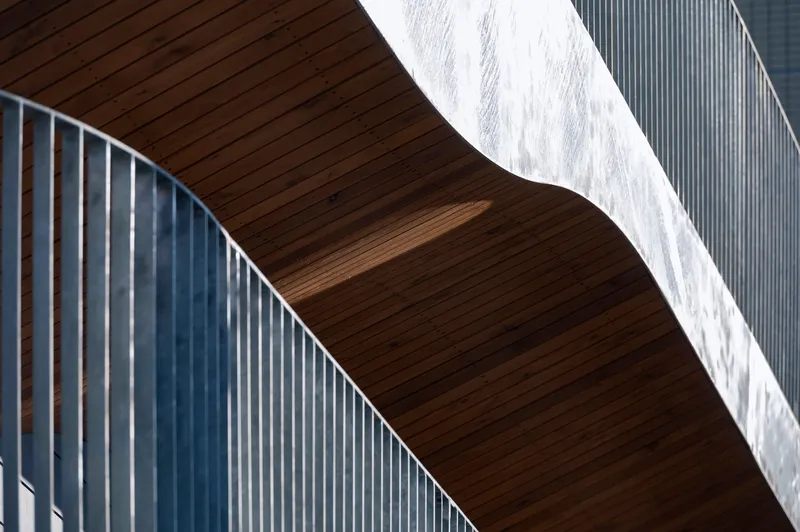
The underside of each balcony becomes the ceiling of the space below, and those ceilings are finished in warm timber slats that glow at dusk. Walking beneath the ground-level canopy, you are already inside the building's atmosphere even though you are still on the public sidewalk. Cyclists pass. Neighbors stop. The soffit does what the best overhangs do: it blurs the threshold between owned and shared space without ambiguity about where the building begins.
The detail where curved wood meets vertical metal slat walls is handled cleanly, with a precision that makes the organic geometry feel intentional rather than arbitrary. Dark horizontal cladding at the entrance plane contrasts with the pale timber overhead, reinforcing the sense of shelter.
Wrapped Balconies as Inhabited Edges
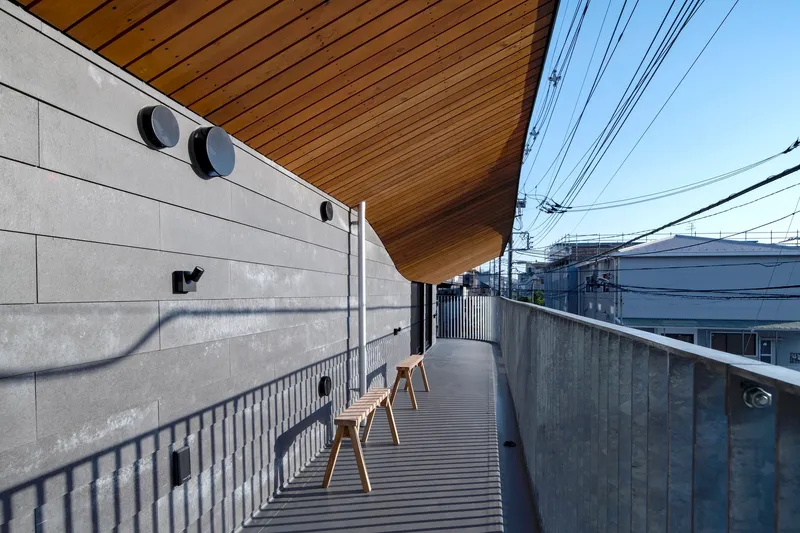
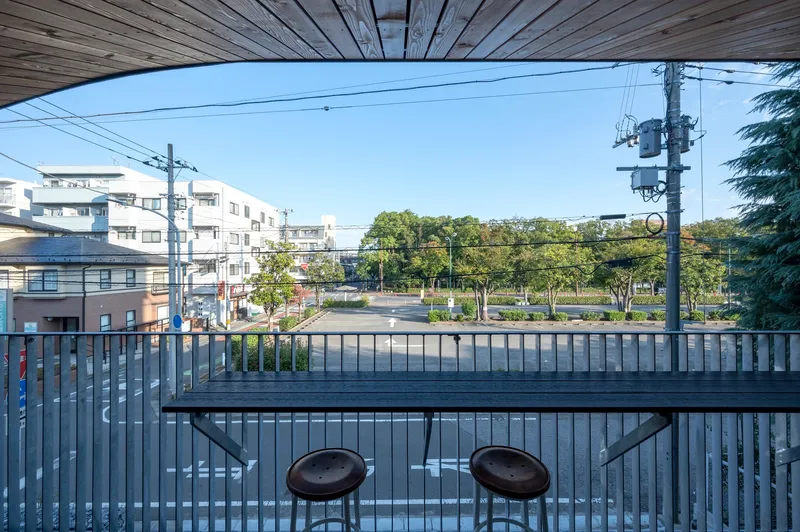
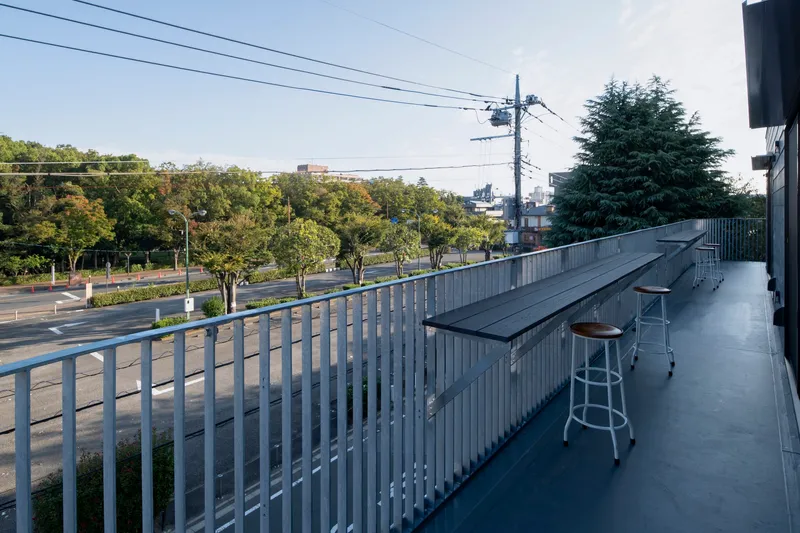
The second and third stories wrap themselves in continuous balconies that function as outdoor rooms. Timber slat decking, wooden stools, metal railings with built-in counters: these are not token balconies tacked on for ventilation compliance. They are sized and furnished for people to sit, look out over residential rooftops and tree canopies, and participate in the life of the street below.
Facing north toward the park and city hall, the terraces capture exactly the view the architects wanted. The orientation trades direct sunlight for a constant, even light and an unobstructed connection to the neighborhood's public landscape. For a clinic or a small shop, that outward gaze matters: it signals openness and civic participation, not retreat.
Materiality at the Detail Scale
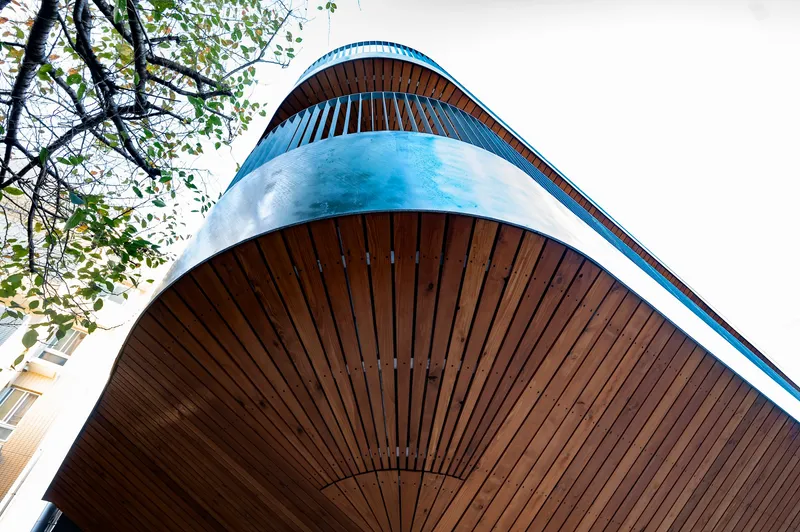
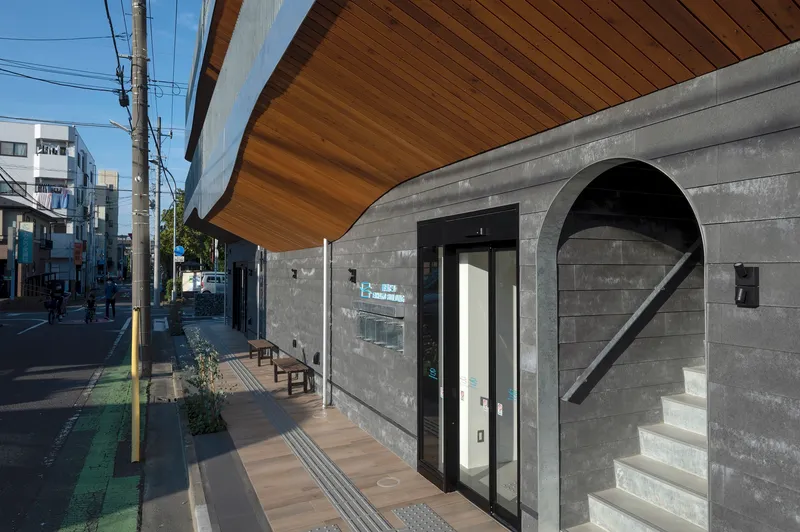
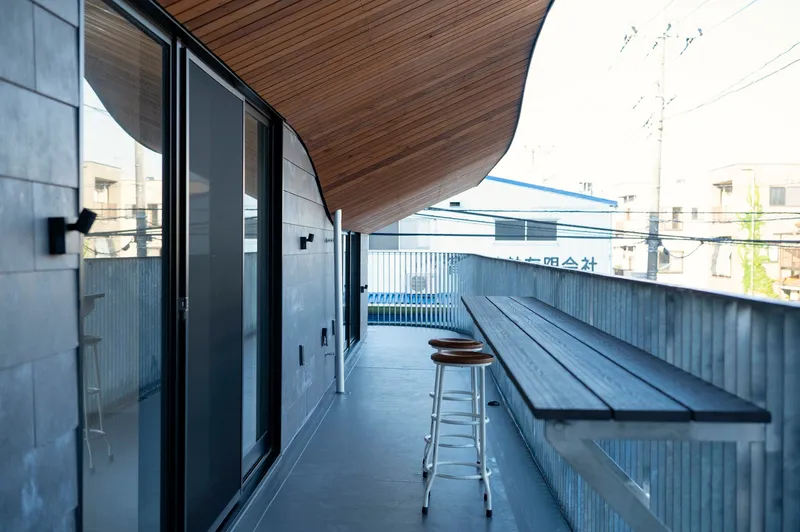
The rounded balcony corners are clad in vertical wood slats capped with metal edge trim, a detail that resolves the geometry cleanly and gives the facade its distinctive softness. At street level, a concrete block wall frames an arched opening to a stair, introducing a masonry language that grounds the lighter materials above. The narrow terrace on the upper floors pairs corrugated metal walls with a simple black bench and glass doors, keeping the palette tight and the maintenance straightforward.
Steel provides the primary structure, but the architecture goes to great lengths to ensure that metal never dominates the sensory experience. Wood, stone, and concrete take the foreground, and the steel frame recedes into the logic of the cantilevers. The gabion wall at grade is a particularly effective choice: it reads as landscape infrastructure rather than building facade, further dissolving the boundary between site and structure.
Interior Flexibility and Neutral Volumes
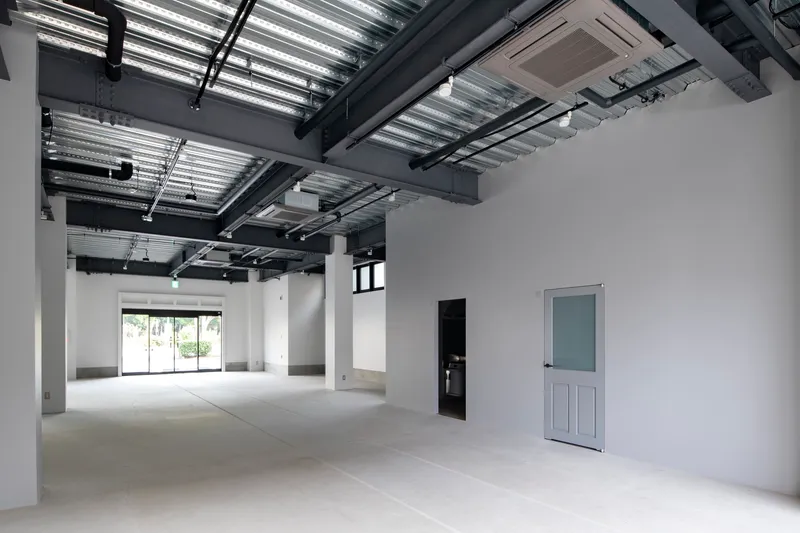
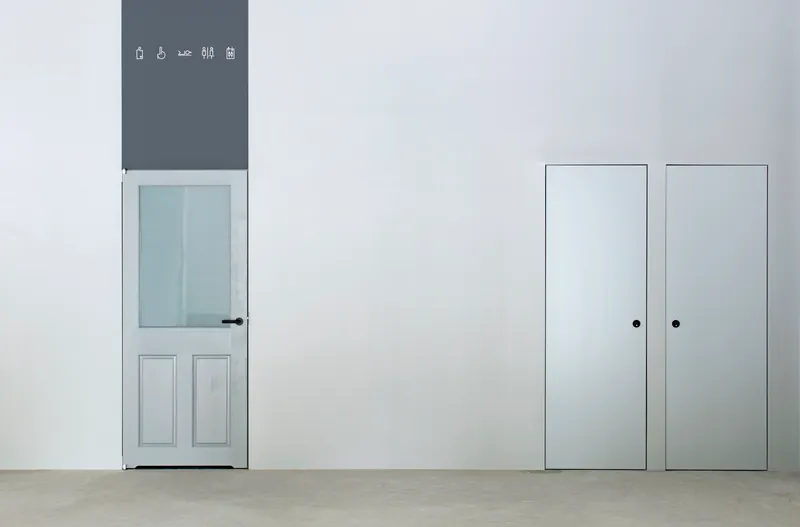
Inside, the architecture deliberately steps back. Exposed structural ceilings, white partition walls, polished concrete floors: the interiors are neutral containers designed to accommodate whatever tenants the community produces. The ability to rent by the whole building, by floor, or by unit means the plan must be legible at multiple scales, and the central service core with stair and elevator keeps the open areas on either side uninterrupted.
It is a pragmatic choice, and an honest one. The building's personality lives on its exterior, in the verandas and the timber eaves. The interior simply needs to work. For a suburban commercial building that depends on local tenants, that restraint is exactly right.
Reading the Neighborhood
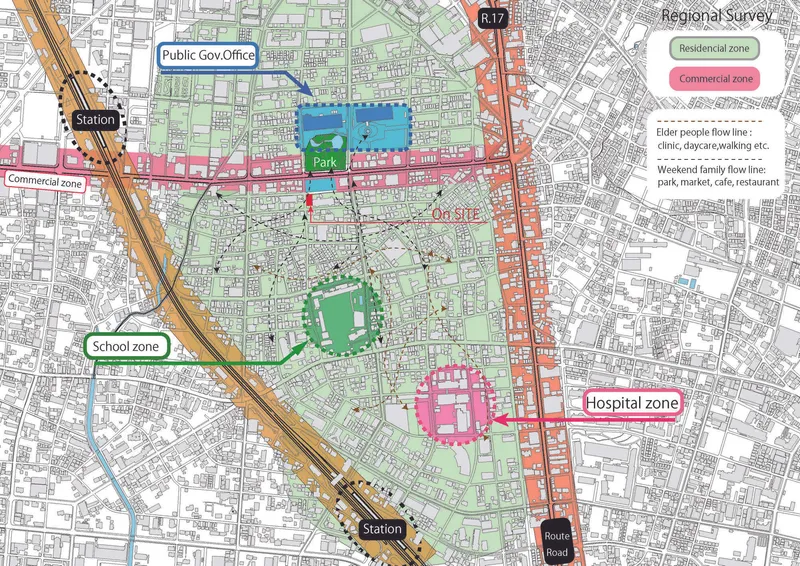
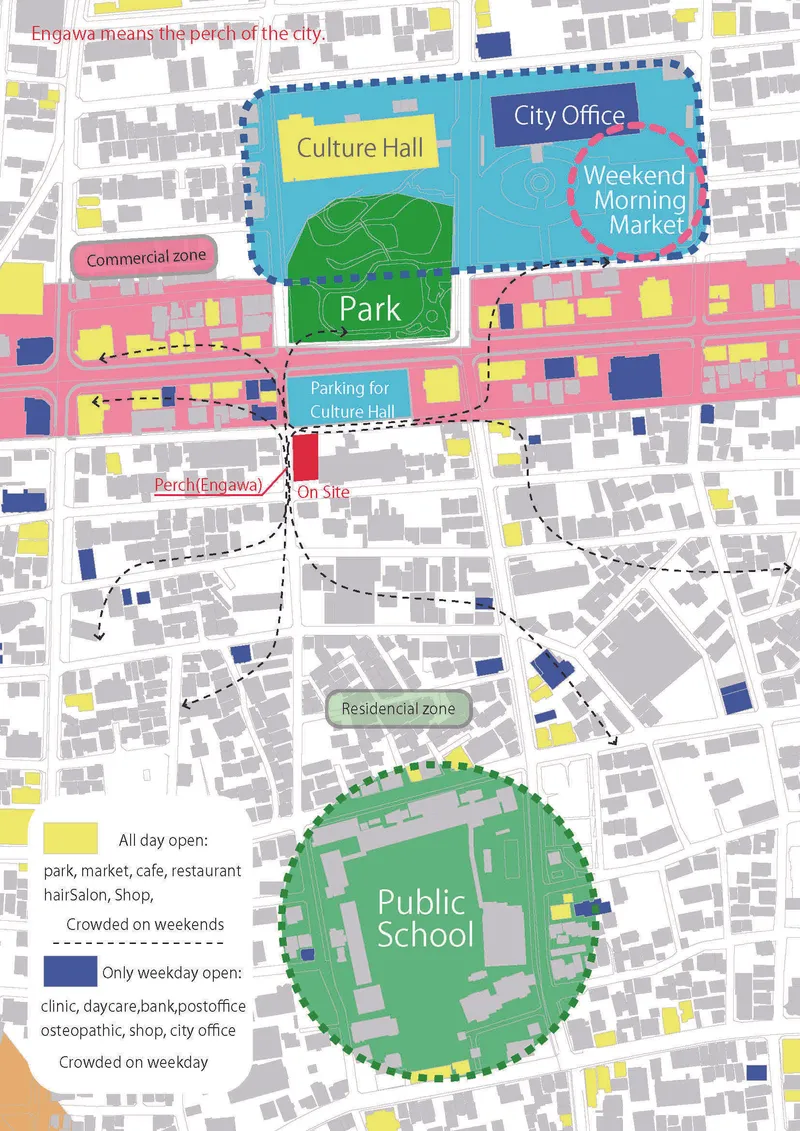
The urban planning diagrams reveal how carefully Organic Design Inc studied the pedestrian flows and programmatic zones around the site. The building sits at a crossing point between residential fabric, a school, a park, and civic facilities, and the architects mapped those circulation lines to understand who would pass and why. The diagrams show a community that moves on foot and by bicycle, not by car, and that insight drives the building's ground-level porosity.
Positioning the verandas to face the park and city hall was not a scenographic decision. It was a strategic one, aligning the building with the paths and destinations that generate foot traffic. A block off the main road, the building needed to pull people in rather than waiting for them to arrive. The site analysis made that pull legible.
Plans and Drawings
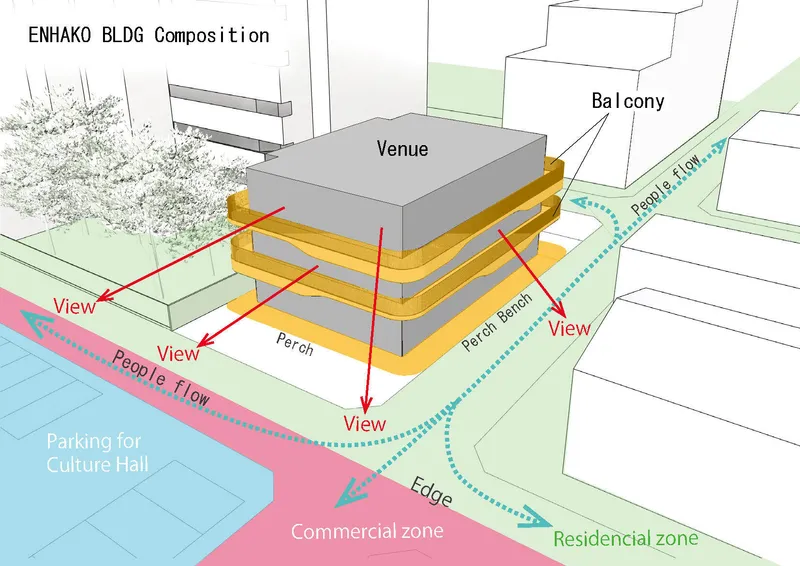
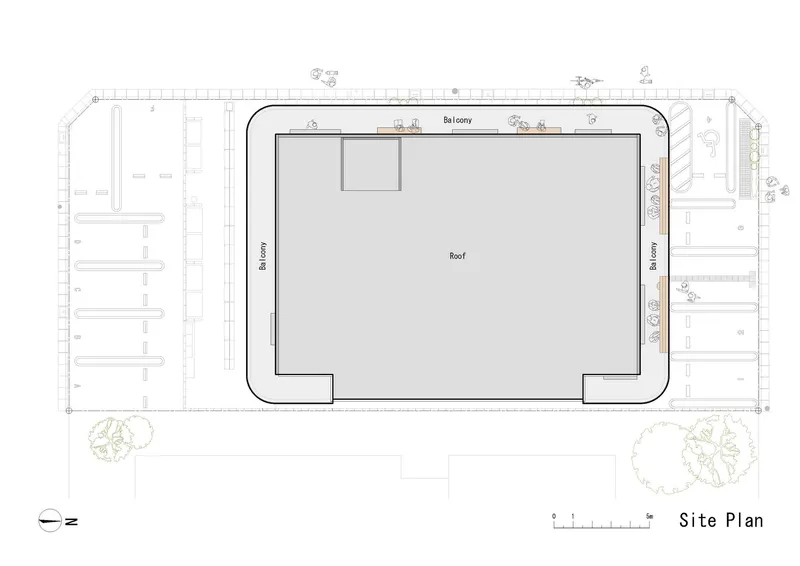
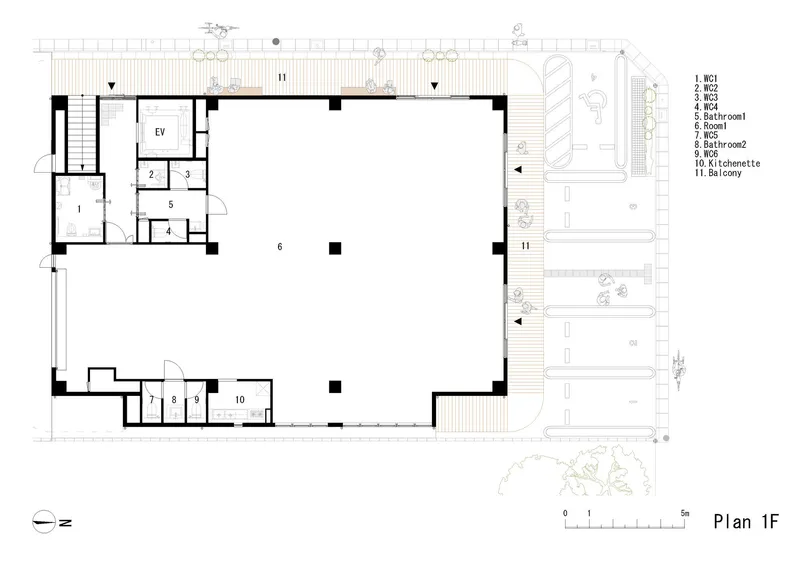
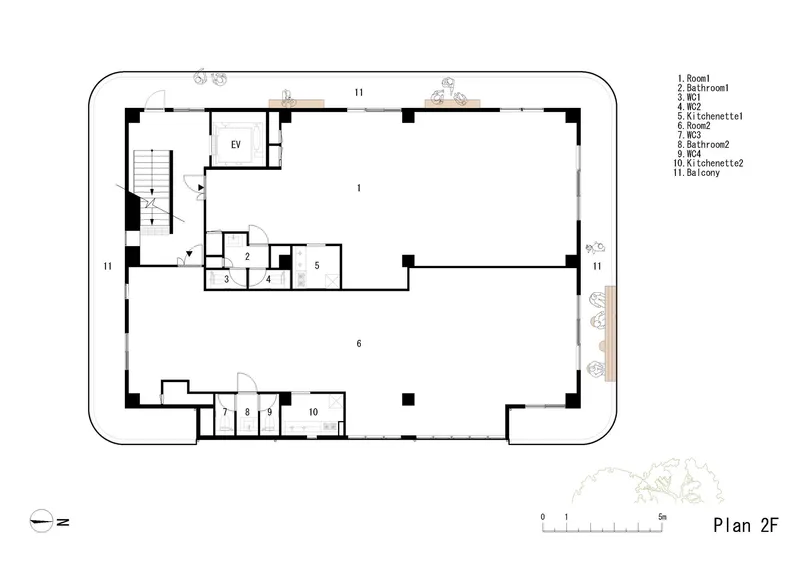
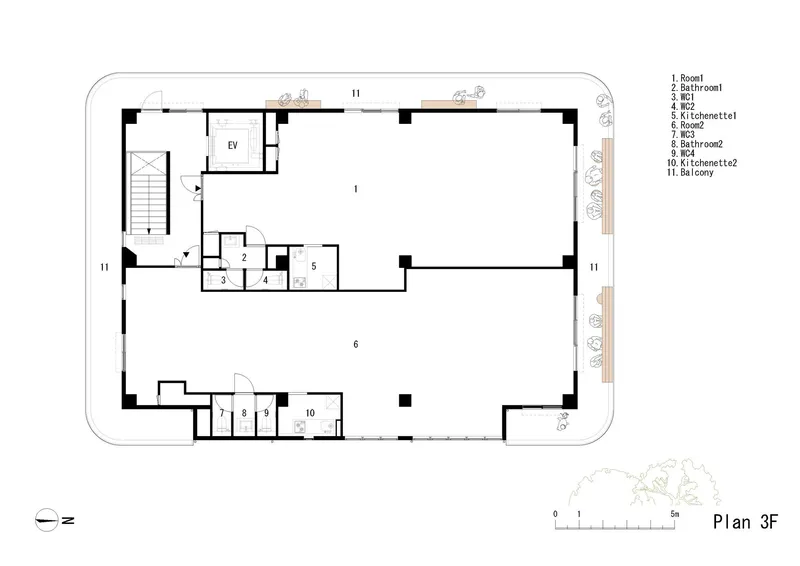
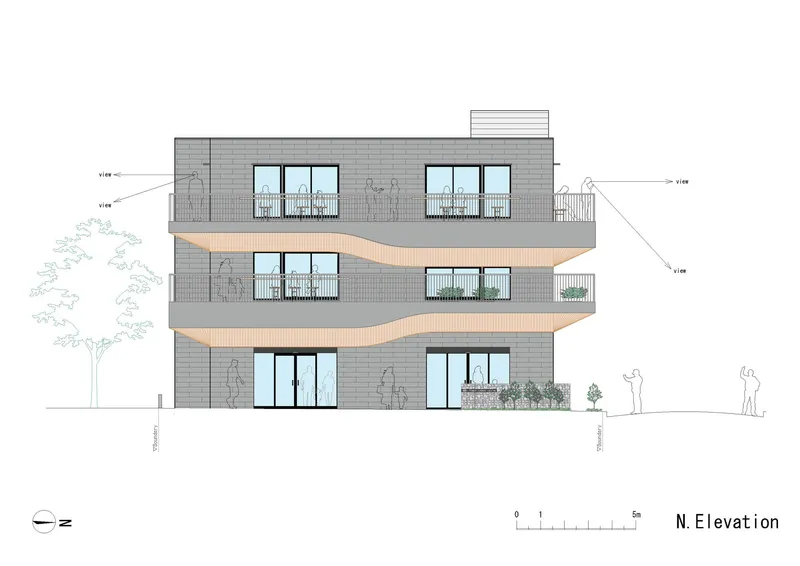
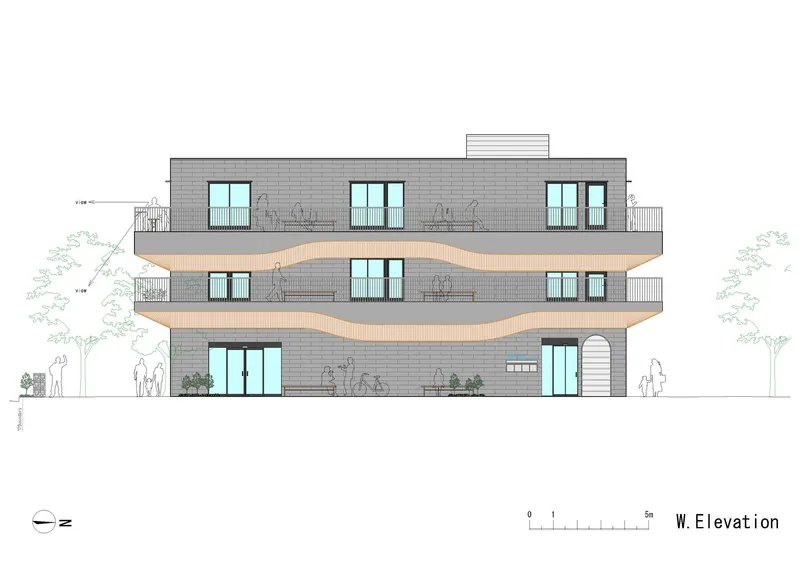
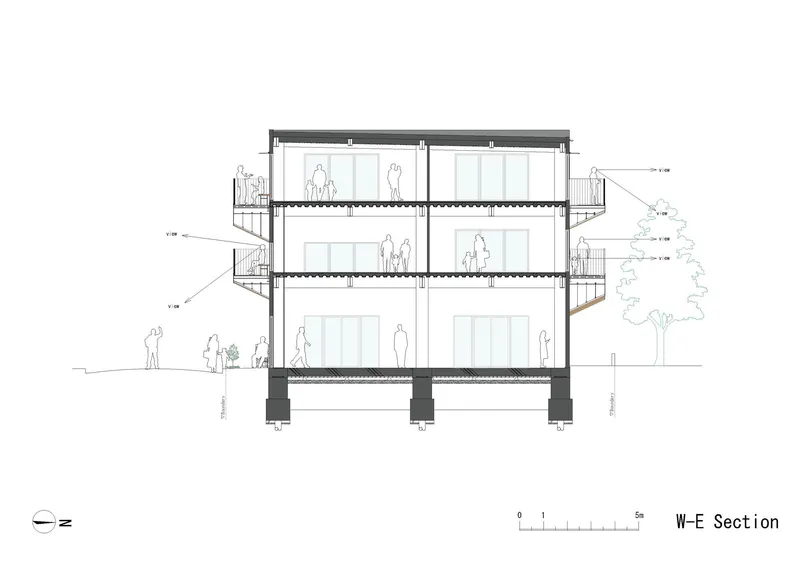
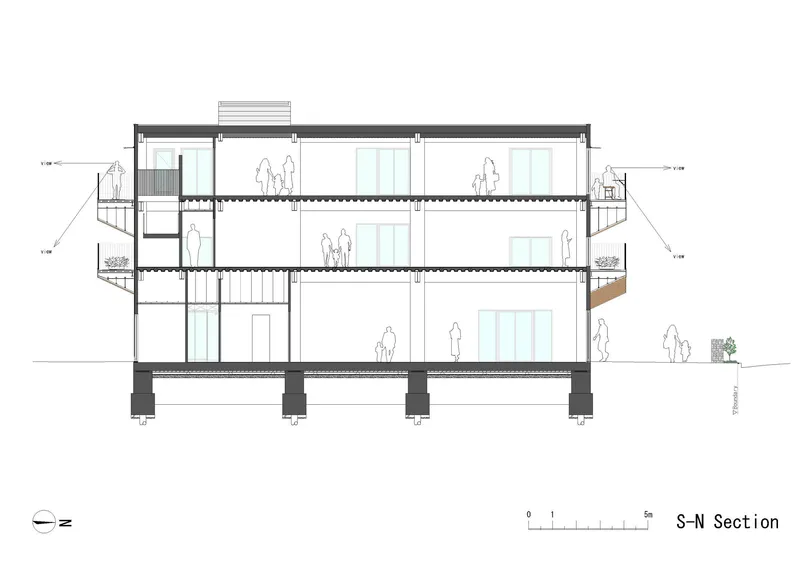
The axonometric diagram makes the veranda concept immediately clear: each floor steps outward, creating the stacked perch effect that defines the building from the street. Floor plans confirm the flexible dual-zone layout on the second and third stories, with the central core providing vertical circulation without consuming usable floor area. The sections are the most revealing drawings: the south-north cut shows how the staggered balconies create sheltered outdoor space on every level, while the west-east section exposes the depth of the cantilevers and the scale of the timber eaves relative to the steel structure beneath.
The north elevation drawing, with its undulating timber bands set between grey brick and glazed openings, captures the facade's rhythmic logic in a way that photographs cannot. The wavy floor plates are not decorative: they are the direct expression of the organic eave geometry read in section, and they give the building its character.
Why This Project Matters
Enhako Building is a quiet argument that suburban commercial architecture does not have to be indifferent to its surroundings. In a context where a strip of shops or a utilitarian clinic building would be the default, Organic Design Inc invested the architectural effort where it counts most: at the edge between building and street. The wrapped balconies and timber eaves are not gestures of formal ambition. They are tools for making a building that belongs to its neighborhood, a familiar perch where people stop, rest, and participate in the daily life of a community that moves on foot.
The project also demonstrates that flexible commercial interiors and expressive architecture are not mutually exclusive. By concentrating material richness on the exterior and keeping the interior volumes neutral, the building can adapt to changing tenants over decades without losing its identity. That is a rare quality in speculative development, and it suggests a model worth studying for suburban sites elsewhere: spend the budget on the public face, and let the private spaces stay open to change.
Enhako Building by Organic Design Inc. Located in Saitama, Japan. 784 m². Completed 2022. Photography by Yukinori Okamura.
About the Studio
Share Your Own Work on uni.xyz
If projects like this are the kind of work you want to make, uni.xyz is a place to publish your own, find collaborators, and enter design competitions.


Popular Articles
Popular articles from the community


Jaramillo Van Sluys Arquitectura and Urbanismo Turn a Demolished Registry Lot in Quito into an Orchard Plaza
In Quito's Centro Histórico, a 2,800 m² plaza exposes the San Agustín convent wall and redraws its lost Augustinian orchard in volcanic stone.

LT2A and OPEN Architectes Thread a Brick and Glass High School Through a Wooded Belgian Campus
In Braine-l'Alleud, a 3,000 m² wing for Collège Cardinal Mercier pairs pale brick with a glazed colonnade, deferring to a small chapel and a dense wood.

Cube Design Draws an Ecological Corridor Between Two Shenzhen Hills with the Nankai Building
Beside Shenzhen's container docks, the Nankai Building pairs stacked balconies with a climbing green screen to connect two hillsides across its height.

David Ortega Stacks a Two-Story Mexico City Penthouse Around a Steel Stair and a Pergola-Shaded Roof Terrace
In Colonia Roma, a 300 m² penthouse uses oak joinery, a planted steel stair and a slatted roof pergola to make a new-build apartment feel like a house.

Similar Reads
You might also enjoy these articles


LAVA Architecten Gives Vocational Education a Sawtooth-Roofed Face on a Mechelen School Campus
In Mechelen, Belgium, a 2,053 m² STEM school on a 6×6 m grid turns workshops and classrooms into rooms that can be rearranged as teaching changes.

KEMA Studio Turns a Derelict Marvila Attic into a 60 m² Lighthouse Apartment Above Lisbon
In Lisbon's Marvila district, a rebuilt roof, four skylights and two plywood volumes turn an unlivable attic into a bright home facing the Tagus.

Pixel Gardens: One Repeated Module Stacked Into a Terraced Social Housing Tower for Famagusta
Salem Bader's shortlisted housing tower builds a vertical neighbourhood from one repeated module, offsetting units to carve terraces, light and air.

Bao Huynh Watercolor Atelier: A Serene Art Retreat in Hội An
Bao Huynh Watercolor Atelier in Hội An blends multifunctional art spaces, sustainable design, local materials, and family-friendly living in a serene environment.
Explore Assembly Building Competitions
Discover active competitions in this discipline

Challenge to reimagine the Iron Throne

Photograph architecture without architects

Illustrate the lost glory of Angkor Wat - Render Challenge

Design challenge to reuse E-waste
Comments (0)
Please login or sign up to add comments
No comments yet. Be the first to comment!