
This is how planet earth’s first space habitat might look like
'Origyn' of Space Habitats

Introduction to the Competition
Origyn, is an international architecture competition that urged the participants to develop the planet earth’s first-ever space habitat. Stephen Hawking has previously predicted that climate change, epidemics, and population growth all pose major threats to our survival on Earth. In November of 2016, he said humans would need to find a new planet within the next thousand years
As the world is entering into space race 2.0, the challenge here is to design a space habitat for 2000 Astronauts / Space travellers / Recreationers which should be expandable to 10000 codename: Origyn.
The Jury
The jury for the competition consisted of esteemed designers, professionals and academicians from around the world. The Lead Jurors for the competitions were as follows:
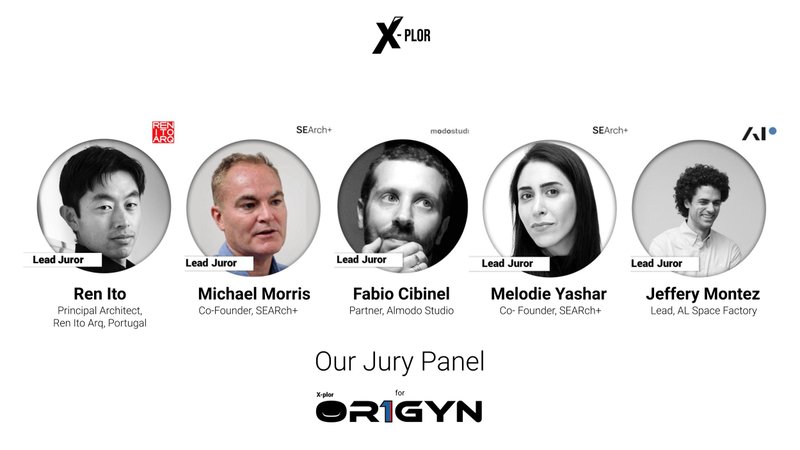
Ren Ito, Principal Architect, Ren Ito Arq (www.ren-ito.com), Michael Morris, Co-Founder SEArch+, (http://www.spacexarch.com/), Fabio Cibinel, Partner, Modo Studio (http://www.modostudio.eu/index.html), Melodie Yashar, Co-Founder, SEArch+ / Space Exploration Architecture (http://www.spacexarch.com/), Jeffrey Montes, AI SpaceFactory, (www.spacefactory.io)
Here are the best of competition projects are as follows:
Winning project: MANHATTAN
By: Weiyan Deng, Nongquan Yang
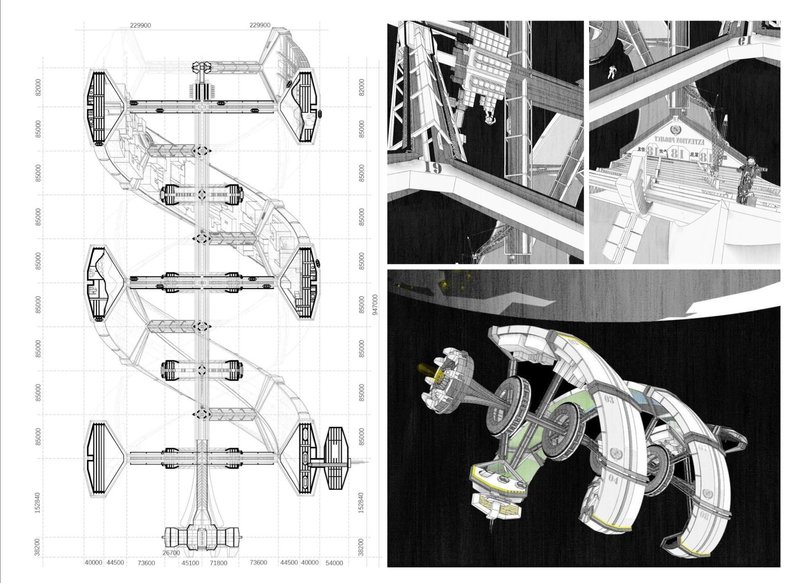
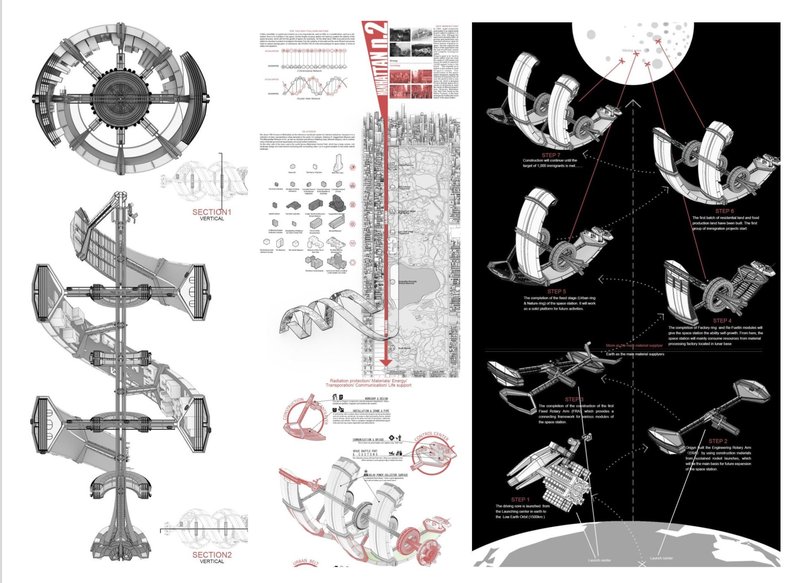
Description: Habitat when tarnished disrupts lifestyle causing emotional, mental and financial losses which creates scars forever. So, it is necessary to heal from the beginning by converting the exhausting period of struggle into a motivating environment with an interactive neighbourhood. Our system unites the community by the various incremental measures at different levels. In 1991, eight scientists participated in an experimental project called Ecosphere 2 in Arizona, USA. Although the experiment ultimately failed, its process and results have very important reference value for future human migration to space. The main reason for the failure of the experiment was the lack of sufficient volume and a complex ecological system.
Origyn's goal is to "build a space station that can meet the needs of 1,000 people and ensure the ability to expand to 10,000 people living in the future". This requires us to submit a new system to meet Origyn's needs. The construction of the space station necessarily requires the collection of resources from all over the world to form a new space city, which is designed to have enough space and a variety of structures to meet the needs of different people's lives. Obviously, Manhattan City, New York, known as the Ethnic Furnace, is the best prototype for building the social system of the space station.
Jury Comments: “Dynamic way to challenge the ubiquitous artificial torus form and invent new possibilities for urban and interior space. Very convincing sectional drawings. As a New Yorker I love the idea of New York inspired city in space” - Jeffery Montes
“Excellent presentation work in addition to good and achievable solutions.” - Fabio Cibinel
-----------------
Runner Up: ORIGYN SPACEPORT
By: Terry Thackeray
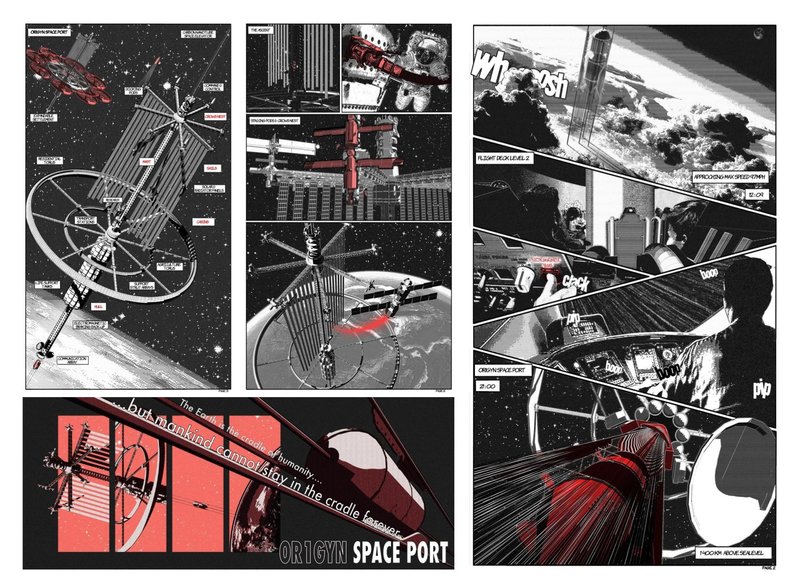
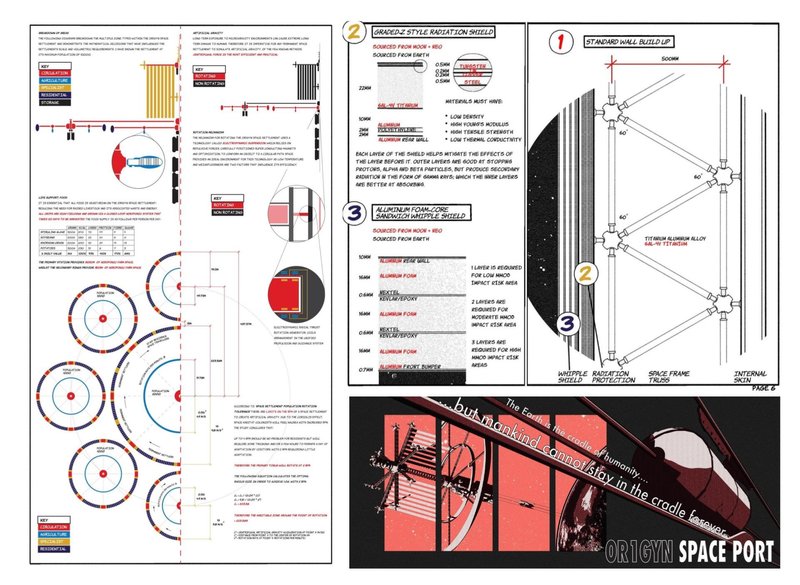
Description: The year is 2040, and after winning a highly sought after role in helping to establish a second human settlement on MARS, young astronaut 'Ralph' embarks on his journey to Or1gyn Space Port, before launching into deep space.
Jury Comments: “Your presentation style is a fun twist. I appreciate that you exited the comic strip format when appropriate and returned to it when you needed to use narrative again. The multi-ring design is interesting. Finally, I would have loved to feel what it would be linked to be in the residences.” -Jeffery Montes
-----------------
Organizers Choice: NEW HOUSTON
By: Chenghai Hu, Xiangyuan Li, Congyue Zhou, Qihong Wang
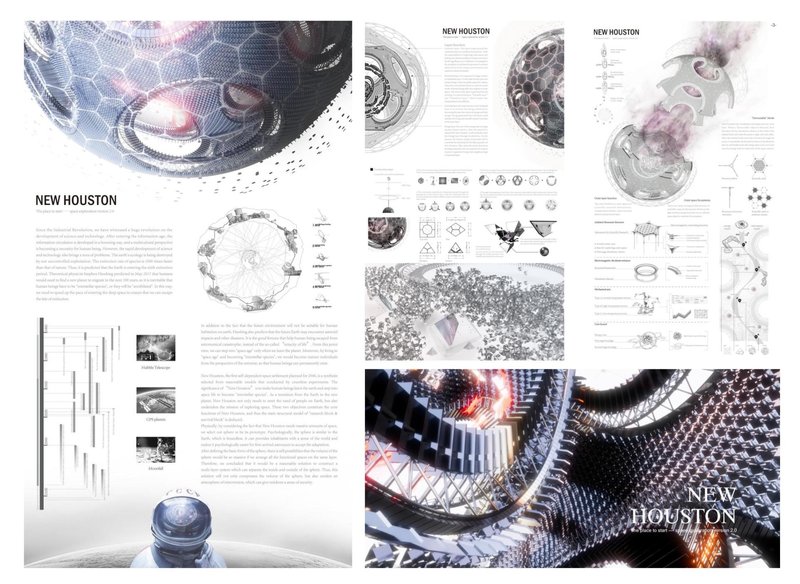
Description: New Houston, the first self-dependent space settlement planned for 2040, is a synthesis selected from reasonable models conducted by countless experiments. The significance of New Houston is to make human beings leave the earth and step into space life to become "interstellar species"
Jury Comments: “Very inventive approach to the challenge. I appreciate the urban ideas for space and manufacturing. With a great outcome of the final image..” -Micheal Morris
-----------------
Honourable Mention: THE ARK OF KNOWLEDGE
By: Sofya Tutsenko, Mariya Shchekotikhina, Vlad Shapovalov
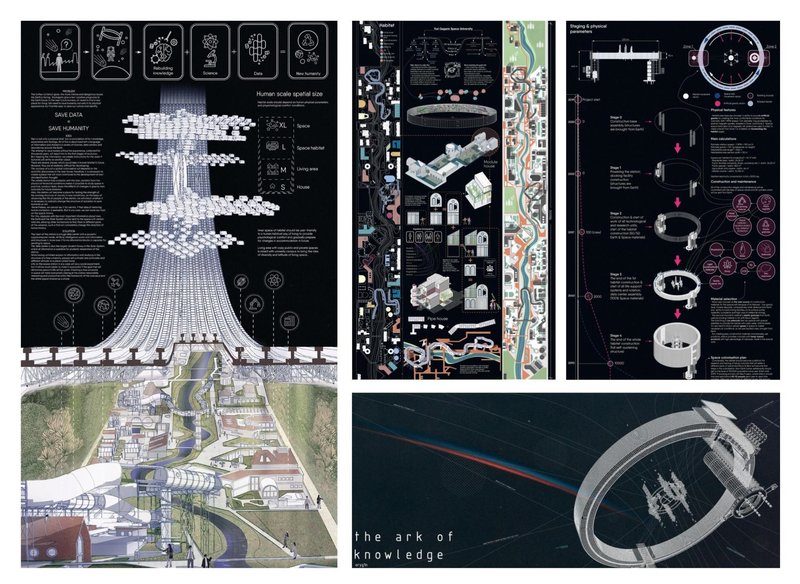
Description: The more civilization develops, the more dangerous and intense issues the Earth is facing. Ecologists give a non-positive prognosis to the Earth's future. In the near future humanity will need to find a new place for living. We need not only to save humanity in its physical appearance, but we must find ways to save our culture and identity.
Discover the full results here: https://uni.xyz/competitions/origyn/entries
Discover the design brief here: https://uni.xyz/competitions/origyn/info/about
Follow us on social media: Facebook | Instagram | LinkedIn | Twitter | Youtube
Discover other design competitions to participate here: https://uni.xyz/competitions



Popular Articles
Popular articles from the community

Atelier Macri Concept Store Interior Design by CASE-REAL
Atelier Macri store features a "ko" counter, walnut wood details, cork displays, blending retail, gallery, and seamless customer experiences.
Inverted Architecture Installation by Studio Link-Arc: Exploring the Intersection of Architecture and Living Organisms
Inverted Architecture Installation by Studio Link-Arc blends mycelium, sustainability, inverted design, ecological cycles, and urban adaptive architecture in Shenzhen.


The Ken Roberts Memorial Delineation Competition (Krob)
As the most senior architectural drawing competition currently in operation anywhere in the world, it draws hundreds of entries each year, awarding the very best submissions in a series of medium-based categories.
Treehouse Apartment: A Warm Timber Interior Blending Craft, Play, and Contemporary Living
Warm timber apartment with integrated treehouse, combining natural materials, craftsmanship, and playful design to create a flexible, family-oriented living environment.

Similar Reads
You might also enjoy these articles
ORACLE: A Sustainable Memorial Architecture Responding to Climate Urgency
A sustainable memorial architecture in Cairo that transforms climate urgency into spatial experience, urging collective reflection and action
Suspended: Reimagining Paris Through Adaptive Reuse Architecture
A suspended intervention transforms abandoned Paris railways into inclusive, adaptive reuse architecture bridging heritage, mobility, and public life.

Solar Steam: A Climate-Responsive Architecture That Redefines the Monument
A climate-responsive memorial architecture that transforms heat, decay, and time into a living system reflecting humanity’s ecological impact.
Rolly: A Modular Approach to Urban Regeneration Architecture on Paris’ Petite Ceinture
A modular urban regeneration architecture project transforming Paris’ abandoned railway into a dynamic, movable and community-driven public space

Explore Space Architecture Competitions
Discover active competitions in this discipline




The Global Benchmark for Architecture Dissertation Awards


The Global Benchmark for Graduation Excellence
Comments (0)
Please login or sign up to add comments
No comments yet. Be the first to comment!