
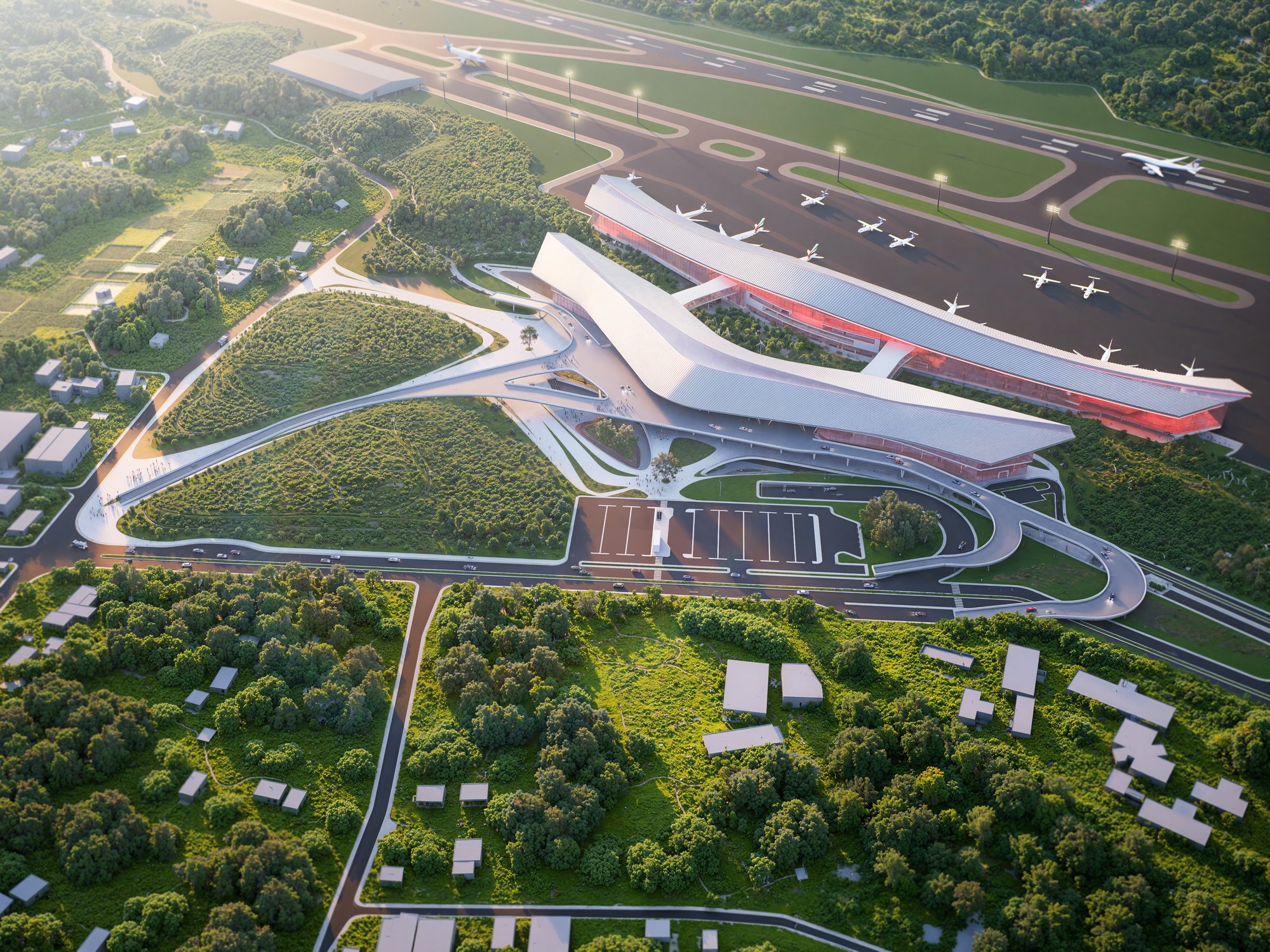
Osmani International Airport: A Dialogue of Place and Passage
Holistic approach to designing an Airport in Bangladesh

Airports are often regarded as the gateway to a city. They are often the first and last place a person sees when entering or leaving a city. As such, airports generally give us an idea of the place we, as tourists, are visiting. Yet, in Bangladesh, most airport terminals do not embody the essence of the cities they serve. Instead, they remain generic, disconnected from their surroundings and context. One such case is the existing international terminal at Osmani International Airport in Sylhet; a structure that, despite its function, fails to communicate with the landscape, identity, or heritage of the region.
The project aims to rethink an airport by enabling public accessibility within its terminal building. The main challenge was to incorporate smooth public flow without disrupting the day-to-day functions and services of the terminal building, all the while maintaining proper security in accordance to the guidelines as set by the Federal Aviation Administration (FAA) and Civil Aviation Authority of Bangladesh (CAAB). It proposes a rethinking of what an airport terminal can be in Bangladesh; transforming it from a purely functional space into a multi-layered public space. Set within a lush natural context and an increasingly commercial suburban zone, the design embraces both local topography and public interaction. The aim is to introduce a new paradigm in airport architecture in Bangladesh; one that allows for dialogue between people and place.
The project site is located approximately 15 kilometers north of Sylhet’s city center. Surrounded by expansive green fields and modest hillocks (tilas), the site is nestled within a landscape that is distinctly Sylhet. Over time, the presence of the airport has catalyzed development in the surrounding areas. What was once a largely rural edge has gradually evolved into a growing commercial zone featuring hotels, restaurants, and recreational parks. This transformation has turned the area into a vibrant public destination on the city's outskirts, offering the perfect condition to rethink the airport as more than a node of transit.
“What do we generally think of an airport? Is it a space for transition, or a space for public interaction? Why not both?” These questions led to the main goal of the project; to utilize the demand for enabling public access to the terminal and design a proper functioning airport terminal that would also cater to the general public to allow them to enjoy a generally controlled space. The idea was to think of the building as an airport and a park. This idea was achieved through the philosophy of Osmosis; when translated to architecture; acts as a piece of construction that allows for controlled movement. Additionally, the project seeks to revive the site's lost hillocks by incorporating tea gardens into the new artificial landscape. These gardens, rooted in Sylhet’s cultural identity, serve two purposes; offering scenic public spaces and generating additional revenue for the airport. As tea gardens are a major attraction in Sylhet, these tea gardens in combination with the airport will become a huge point of interest for tourists as well as locals.
The terminal’s architectural form draws directly from the undulating terrain of the surrounding tilas. A super-roof with standing seam metal cladding and steel trusses mimics the organic rise and fall of the land. Tree-like structural columns, inspired by Sylhet’s rich heritage with tea and tea cultivation, define the building’s skeletal system—merging symbolism with functionality.
The Ground level at 0’ features mainly the public accessible area (a.k.a the retail space) and the VIP area on the landside alongside the necessary baggage carousels & storage, remote drop-off and boarding halls, and maintenance areas on the airside. On this level the general public movement and relation with the existing context at the entrance node of the complex have been focussed. Pedestrian movement and walkability was the main focus when designing the building and its landscape allowing for seamless and controlled access to the terminal building and also the open-to-all spaces of the airport.
The Basement level or -20’ cuts through the ground under an artificial hillock converted into a tea garden and features the immigration hall, access from the arrival hall, baggage claim area, customs and other necessary amenities and services. Once the building has been exited, passengers are greeted to the huge sunken courtyard space that acts as the official meet & greet area with multiple retail and amenities allowing for public interaction and recreation.
The First floor or +15’ features the main Arrival hall and other necessary amenities. Passengers are greeted with a multi-tiered lobby space that overlooks the tea gardens and includes rest zones and indoor zen gardens.
The Second floor or +30’ is the floor where passengers begin their journey for departure. This floor features the check-in areas, lounge spaces and other amenities on the landside. And the main departure hall area on the airside. This floor is also directly connected to the main entrance node of the site through a pedestrian skywalk further enabling general public movement and accessibility. The immigration booths on the Third Floors or +45' are directly accessible from the second floor. The third floor features two bridges which overlook the central tea garden spine and connect the landside to the airside.
To conclude, the project aims to rethink an airport by enabling public accessibility within the building, and has been designed with an emphasis on the contextual forces allowing the building to harmoniously blend with its surroundings, despite it being a massive construction. The design’s plan and zoning ensures smooth circulation and movement within the building, all the while maintaining necessary control and public accessibility. This proposed terminal of the Osmani International Airport is more than a transportation hub; it is a civic space as well as a cultural statement. Rooted in Sylhet’s topography and heritage, the design facilitates both controlled access and open engagement, offering a new model for how terminals can serve their cities. Airports shouldn’t just be restricted to a manual and should be spaces that blend with the city, inherit its identity and cater to its intended audience; the people.




Popular Articles
Popular articles from the community

An Miên Lumière Cafe by xưởng xép, Ho Chi Minh City, Vietnam
An industrial-inspired café where layered steel and warm light create a dynamic, immersive environment shaped by reflection, depth, and perception.
Louis Malle Cinema: A Limestone Cultural Landmark Revitalizing Community Life in Prayssac
Limestone cinema extension with public forecourt, blending heritage and modern design to create flexible cultural spaces and strengthen community interaction.


The Ken Roberts Memorial Delineation Competition (Krob)
As the most senior architectural drawing competition currently in operation anywhere in the world, it draws hundreds of entries each year, awarding the very best submissions in a series of medium-based categories.
Atelier Macri Concept Store Interior Design by CASE-REAL
Atelier Macri store features a "ko" counter, walnut wood details, cork displays, blending retail, gallery, and seamless customer experiences.


Similar Reads
You might also enjoy these articles
The Ken Roberts Memorial Delineation Competition (Krob)
As the most senior architectural drawing competition currently in operation anywhere in the world, it draws hundreds of entries each year, awarding the very best submissions in a series of medium-based categories.
A Contemporary Take on Iranian Residential Architecture
A modern interior design in Mashhad that reinterprets brick, light, and spatial flow to create a warm, contemporary residential architecture.
Franche-Comté Advanced School of Engineering by Dominique Coulon & associés, Besançon
A flexible engineering school immersed in woodland, combining concrete minimalism, adaptable spaces, and natural light to support evolving educational environments.


Waterfront Redevelopment and Urban Revitalization in Mumbai: Forging a New Dawn for Darukhana
A transformative waterfront redevelopment project reimagining Darukhana’s shipbreaking heritage into an inclusive urban future.


Explore Architecture Competitions
Discover active competitions in this discipline




The International Standard for Design Portfolios


The Global Benchmark for Architecture Dissertation Awards


The Global Benchmark for Graduation Excellence


Challenge to reimagine the Iron Throne
Comments (0)
Please login or sign up to add comments
No comments yet. Be the first to comment!