
Max Tsybin and Greywoods.pro Slip a Minimalist Restaurant Beneath a Corrugated Canopy in Bali
On a corner plot in Pecatu, a 200-square-meter dining room plays bold geometry against Balinese village texture and tropical light.

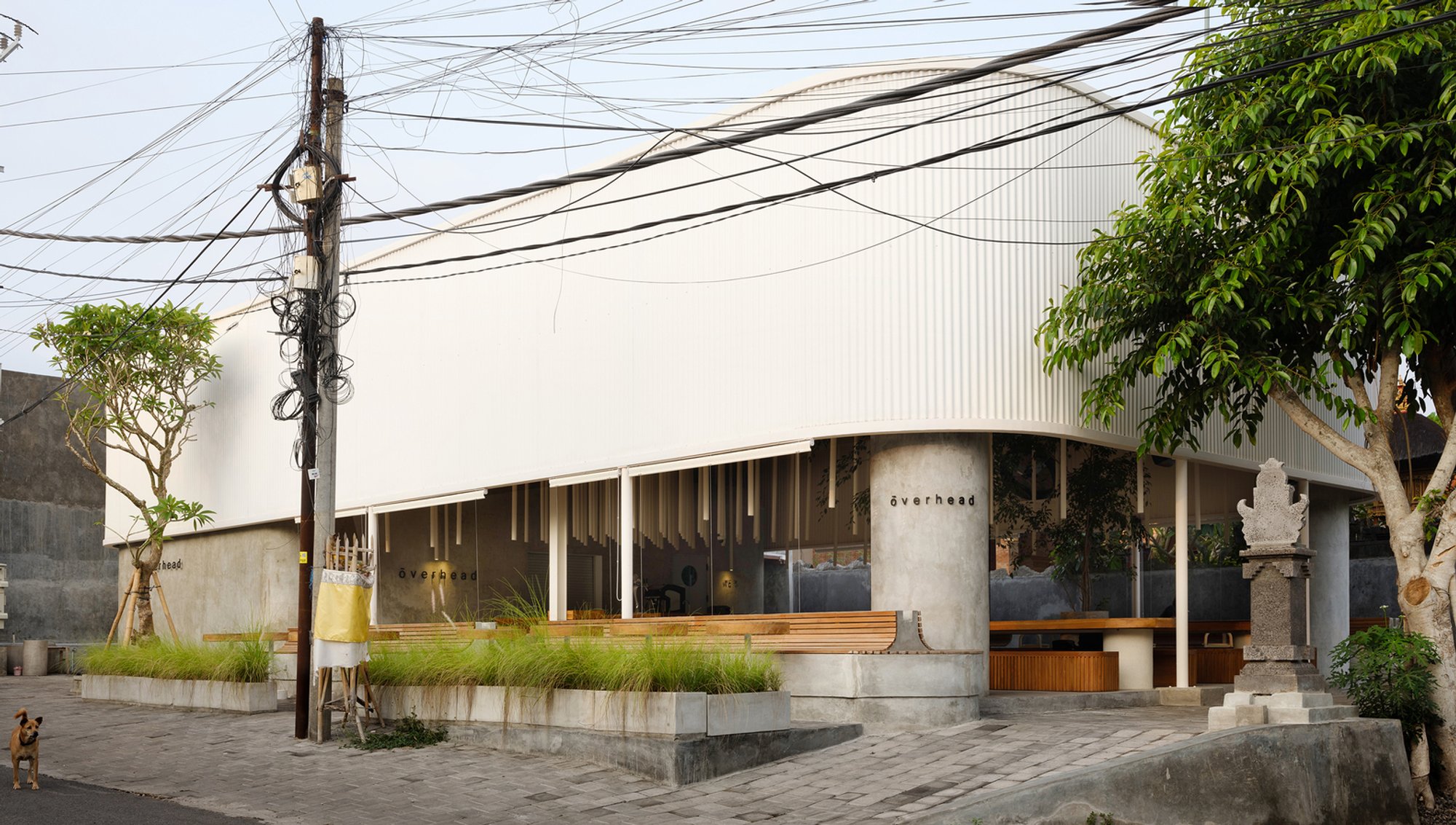
Bali's Bukit Peninsula is dense with contradiction: house temples abut scooter repair shops, frangipani canopies tangle with overhead power lines, and every corner lot carries the weight of ceremony and commerce in equal measure. Overhead Restaurant, a 200-square-meter project completed in 2024 by Max Tsybin and Greywoods.pro, treats that contradiction not as a problem to solve but as a condition to amplify. The building is deliberately plain, a few large geometric moves rendered in corrugated metal, concrete, and glass, so that everything around it, the thatched shrines, the tangled cables, the cascading green, reads more vividly by contrast.
What makes the project genuinely interesting is its refusal to perform exoticism. Plenty of Bali hospitality architecture borrows vernacular motifs as decoration. Tsybin and the Greywoods.pro team, led alongside Yoga Wismawan and Tirzha Dewi Sudarsono, go the other way: strip the building down to an almost industrial shell, then let the surrounding village do the atmospheric work. The corrugated canopy floats on round columns, the ribbed facades catch equatorial light, and a frangipani tree paints the entrance wall every morning with shadow. The restaurant becomes a frame for its own context.
A Corner Plot, a Curved Canopy
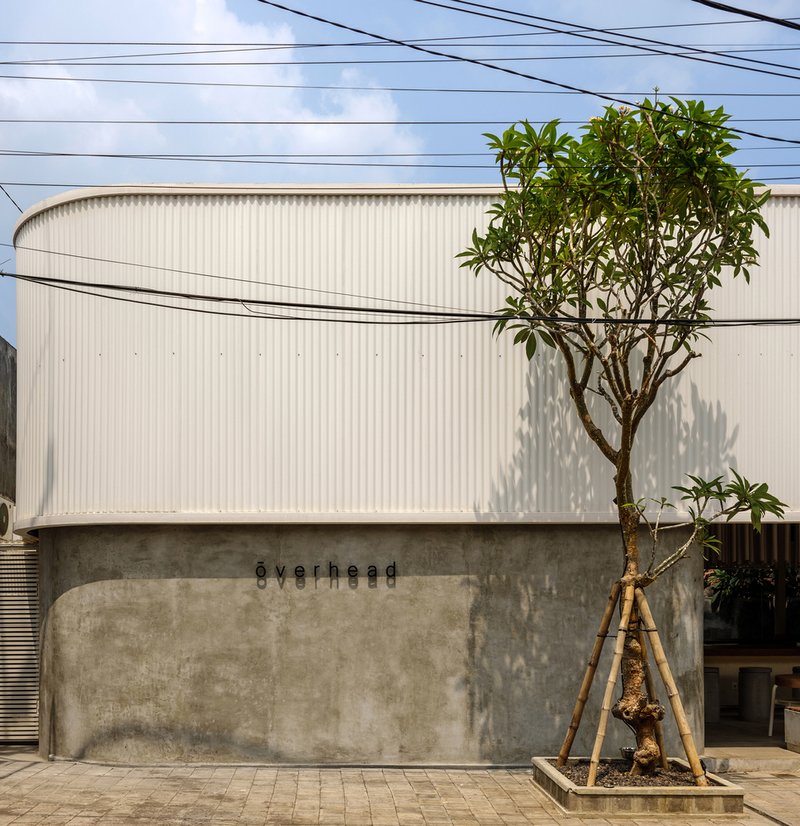
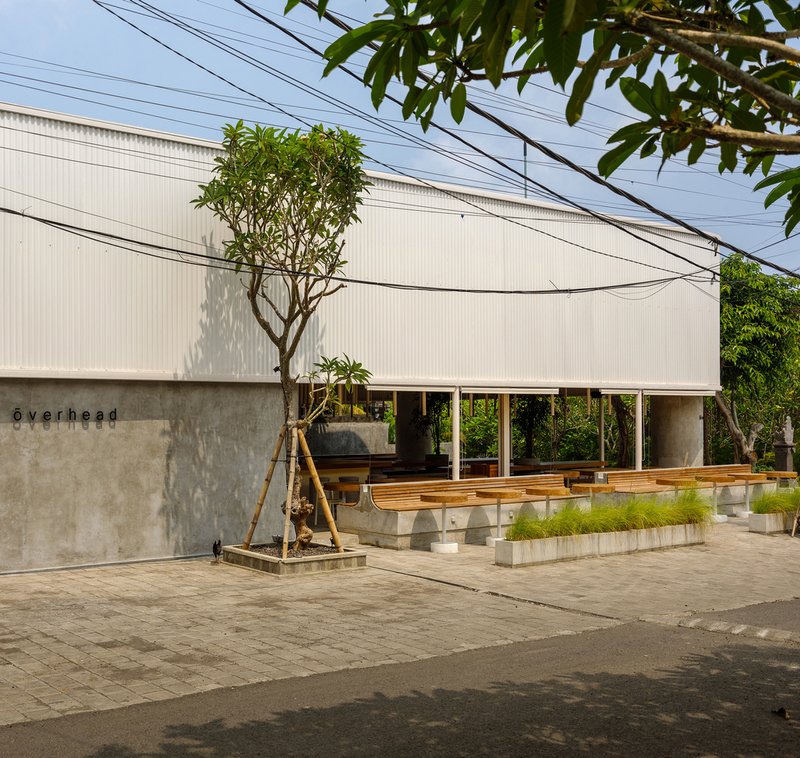
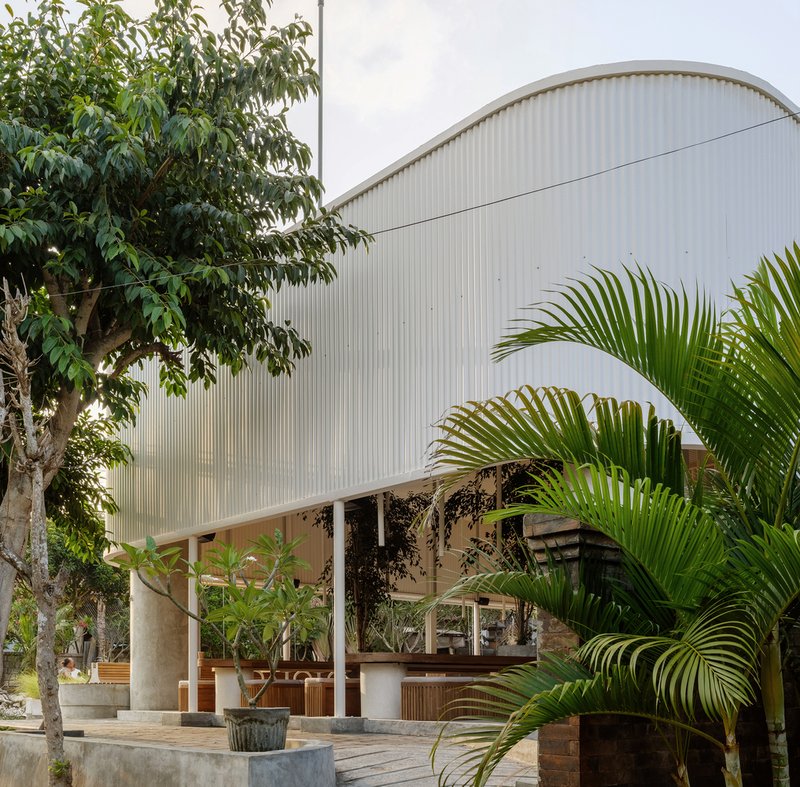
Sitting at the intersection of two narrow Pecatu streets, the building reads first as a sweeping curve of corrugated metal lifted above a concrete base. Power lines slice across the frame, motorbikes drift past, and the architecture makes no effort to hide any of it. The arched roof canopy extends well beyond the enclosed volume, sheltering outdoor zones and creating deep overhangs that are critical in a climate where monsoon rain and equatorial sun arrive with equal force.
The corrugated cladding is a quiet provocation. It is an industrial material more associated with warehouses than with resort dining, yet its ribbed texture gives the facade a scale and grain that catches light in a way smooth render never could. Paired with the cylindrical columns, it produces a building that feels both monumental and provisional, a structure that could have been here for decades or arrived last week.
Dialogue with the Village
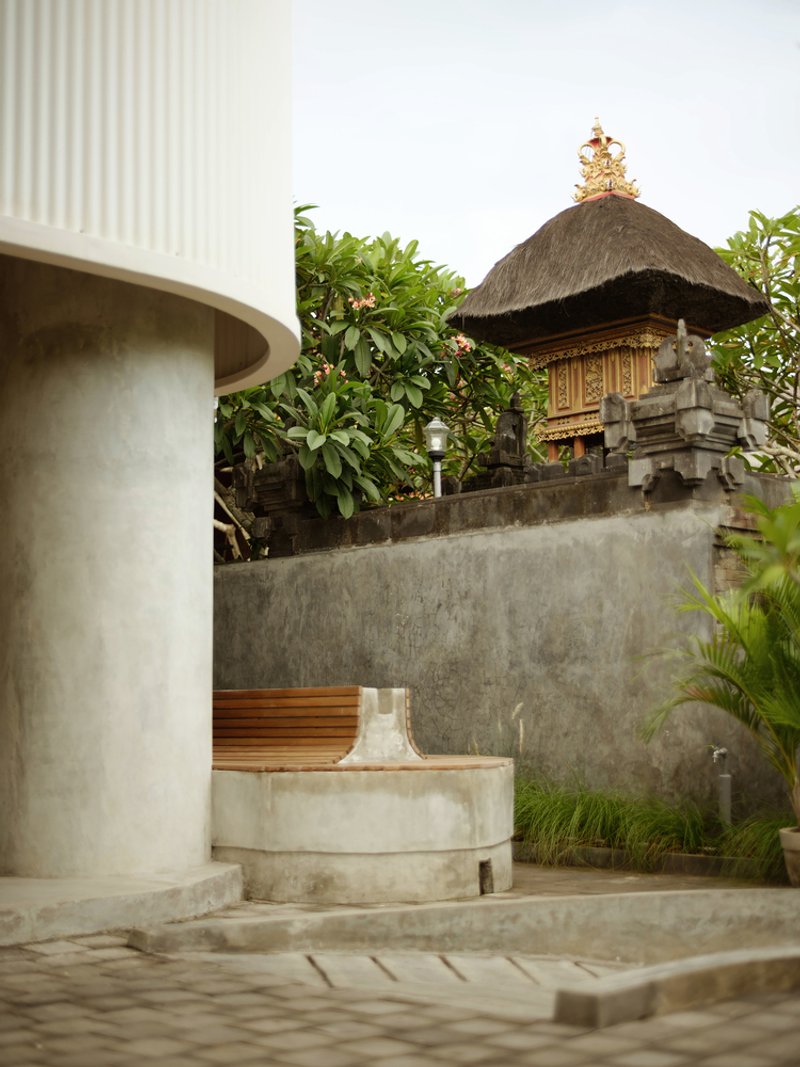
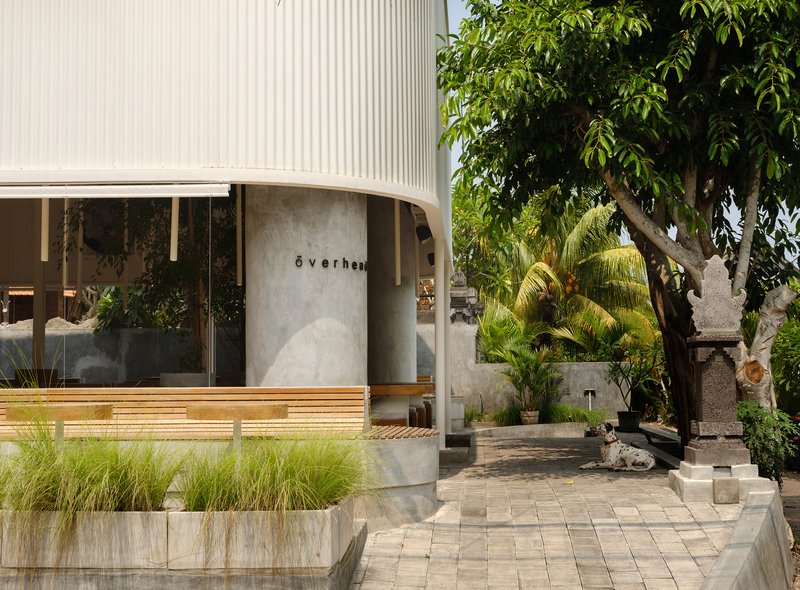
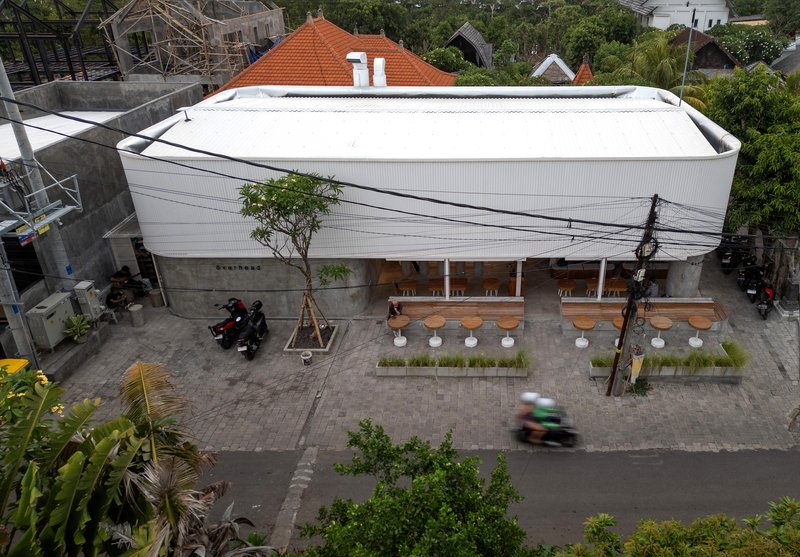
The most telling photograph in the series shows a curved concrete bench looking directly onto a traditional thatched shrine surrounded by greenery. The restaurant does not turn its back on the village; it seats you facing it. That decision is architectural and ideological. Rather than erecting walls to manufacture a controlled atmosphere, the design keeps boundaries porous. Planted beds of tropical grasses line the concrete base, blurring the edge between restaurant and street.
From above, the rooftop terrace and passing traffic share the same visual field. The building acknowledges that it is a guest in a neighborhood organized around domestic ritual and devotion, and it adjusts its posture accordingly: low concrete walls instead of fences, open corners instead of sealed facades, vegetation that rhymes with the gardens next door.
Interior: Timber, Trees, and a Floating Ceiling
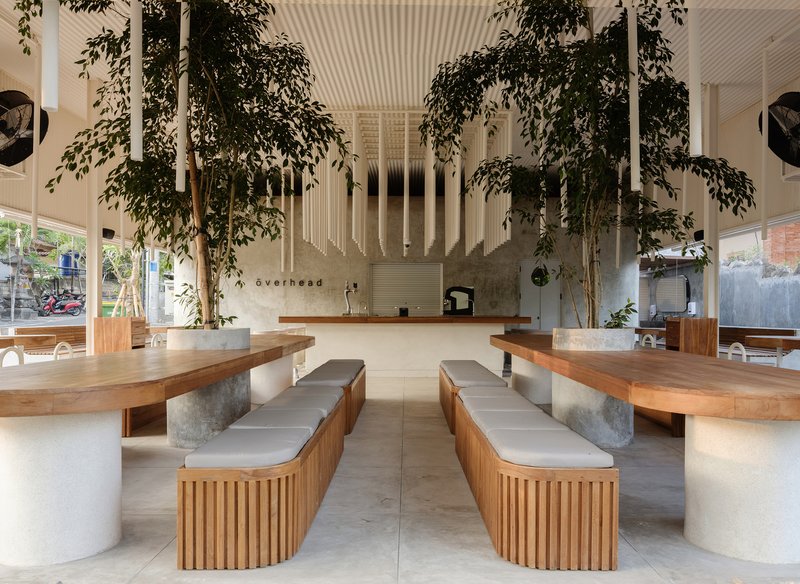
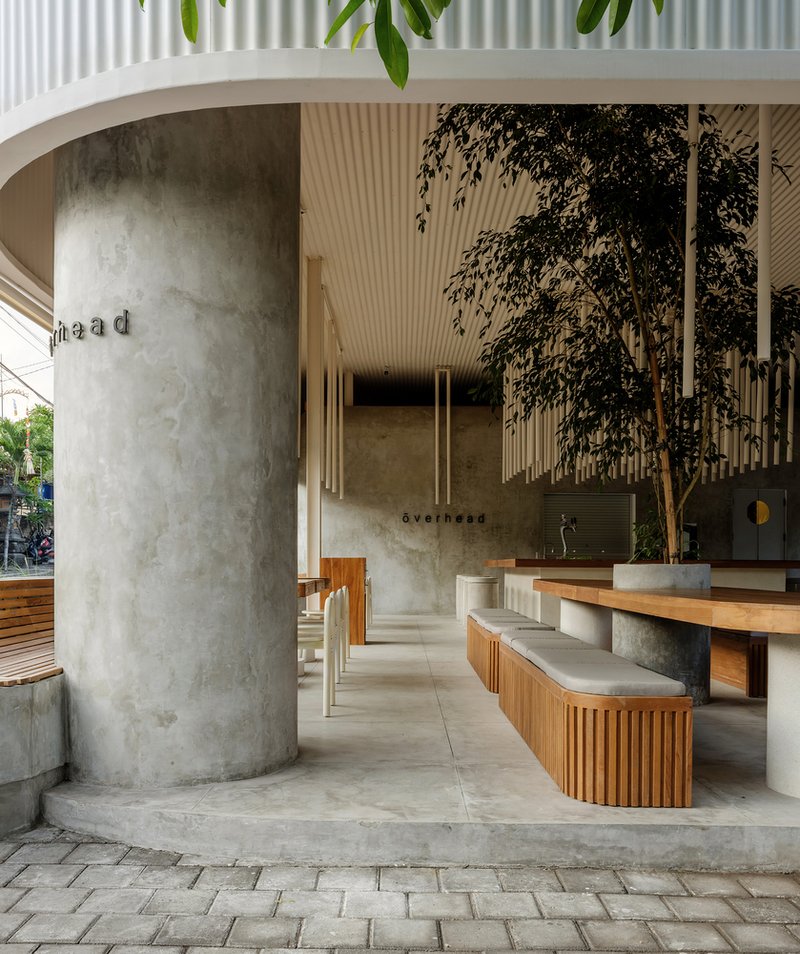
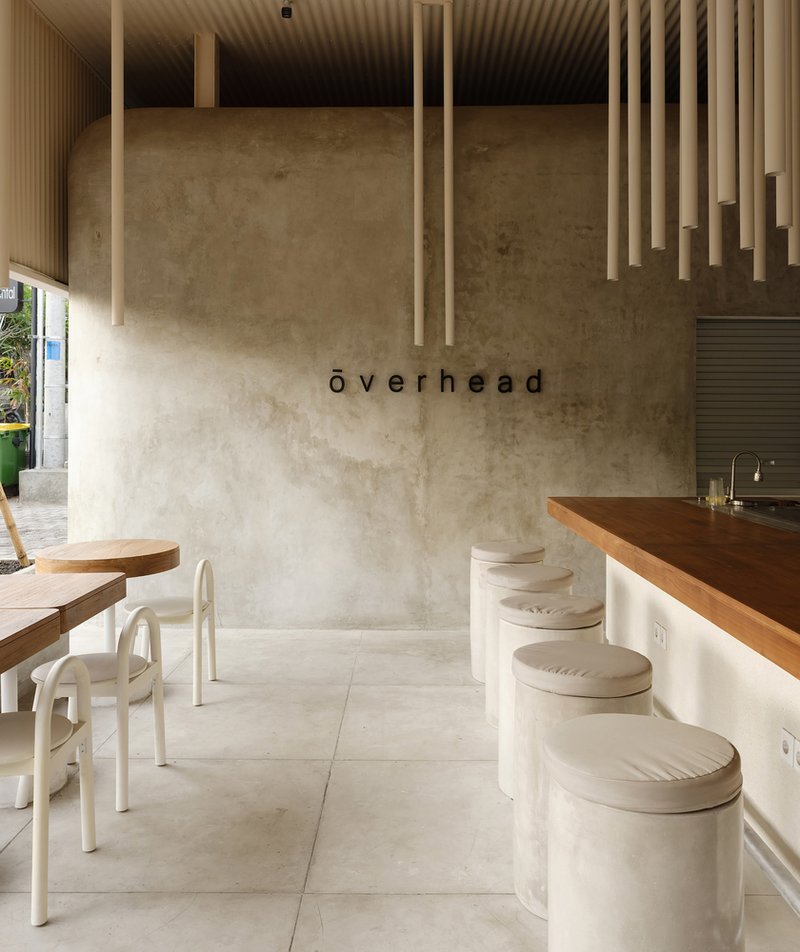
Inside, the material palette narrows to timber slatted benches, concrete planters, and that ever-present ribbed metal ceiling overhead. Tall trees puncture the dining floor and rise toward the canopy, collapsing the boundary between inside and out. The effect is less polished restaurant and more covered garden, a reading reinforced by the semi-outdoor seating zones where the ceiling continues but walls disappear.
At the service counter, cylindrical white stools and suspended cylindrical light fixtures echo the round columns outside, creating a vocabulary of circles and curves that softens the otherwise rectilinear plan. The color palette stays neutral: warm timber, grey concrete, white fixtures. Nothing competes with the green of the trees or the food on the table. It is restraint deployed with genuine purpose, not minimalism as style but minimalism as strategy for directing attention.
Light as a Material
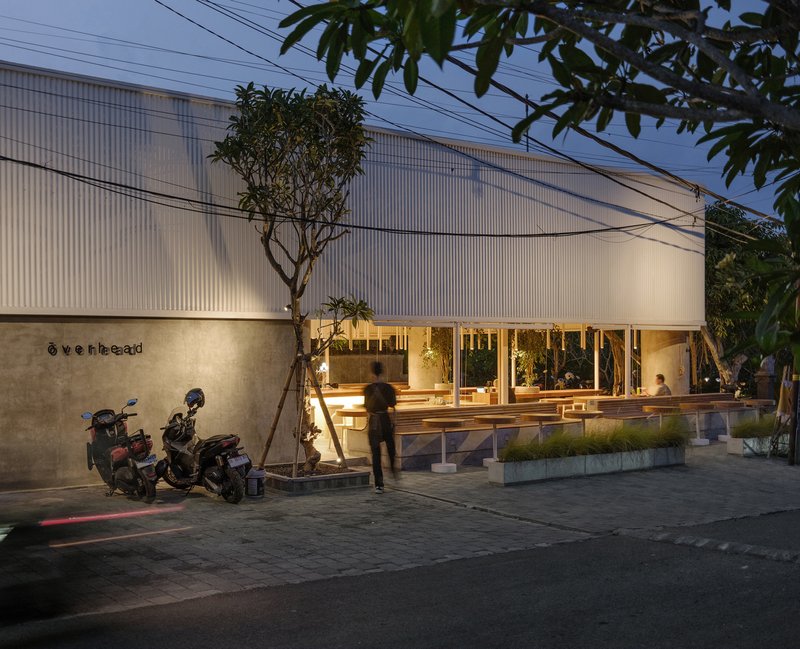
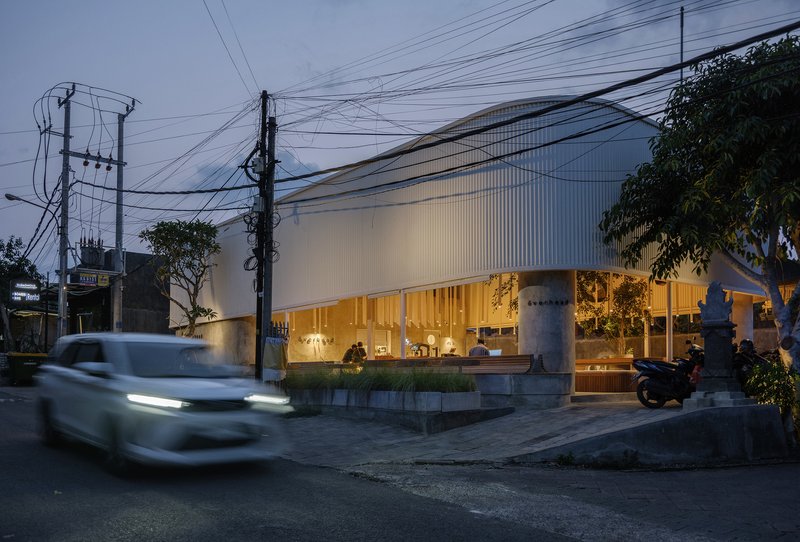
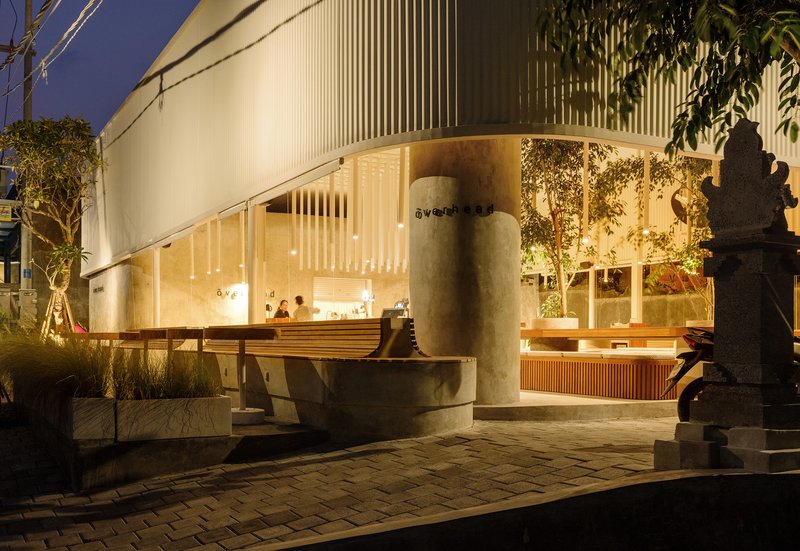
The project's relationship to light shifts entirely between day and night. During the day, the deep overhangs and ribbed surfaces produce sharp, graphic shadows that migrate across the facade as the sun moves. Morning light filters through the frangipani tree and dapples the entrance wall, a free piece of decoration that changes with the seasons and the wind.
After dark, the building reverses its logic. The corrugated shell recedes into the night sky while the interior glows through full-height glazing, turning the restaurant into a lantern on the corner. Lighting is soft and targeted: fixtures accent the ribbed ceiling, the bar counter, the planted trees, and nothing else. The architects describe this as an "outside-in" strategy, and it works. From the street, you see people, food, and foliage before you see architecture. The building gets out of its own way.
Plans and Drawings
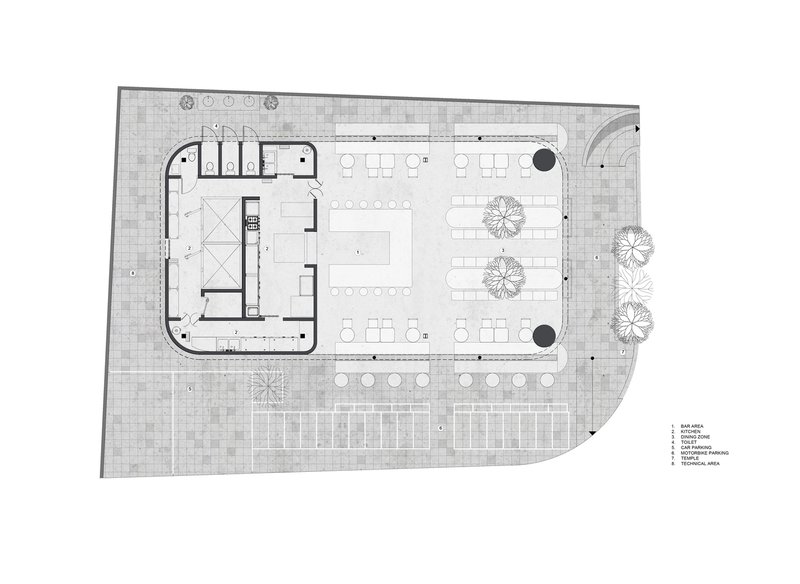
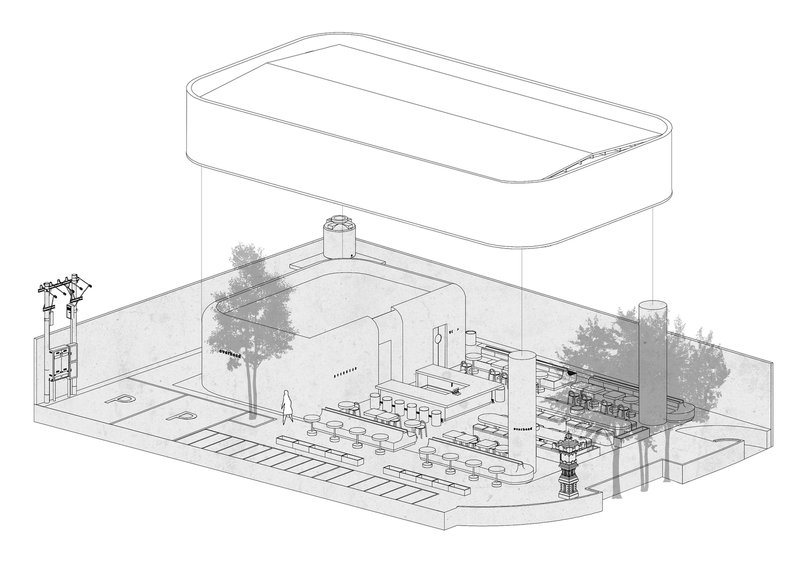
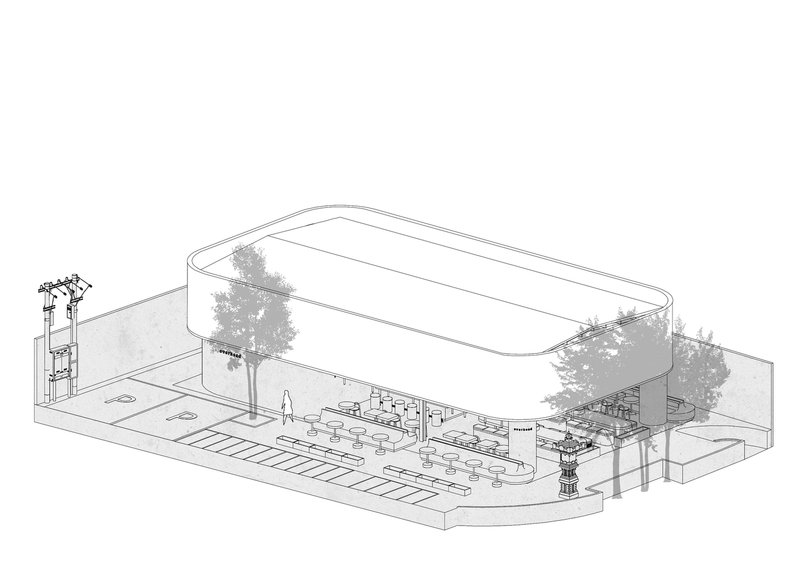
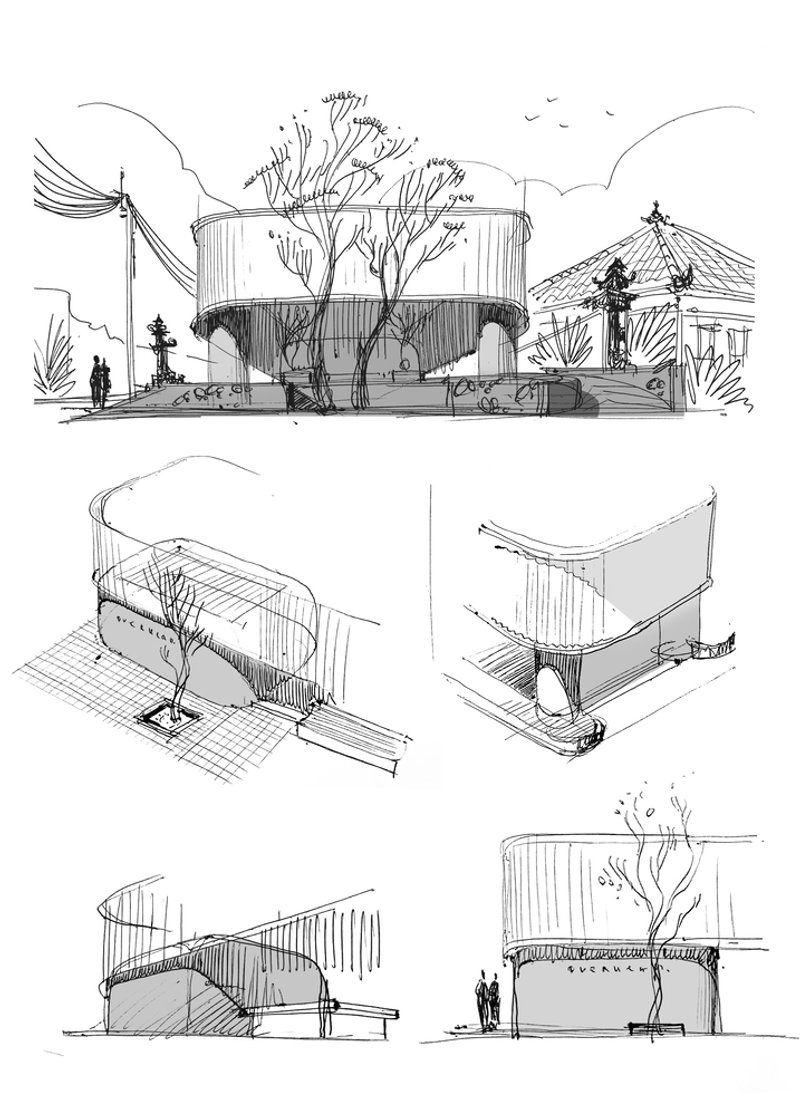
The floor plan reveals a compact organizational logic: a single enclosed service core, likely housing the kitchen and back-of-house functions, sits against one edge while the dining area flows freely around planted trees and out onto the terrace. There is no corridor, no vestibule, no spatial waste. The axonometric drawings make the floating roof canopy legible as a separate element hovering above the ground-level program, a tectonic separation that explains the building's lightness when seen from the street.
The sketch compilations are worth studying for the way they test the curved roof profile against different elevations and vegetation scenarios. You can see the designers working through the tension between the arched canopy and the vertical louvers at the entrance, trying to balance enclosure and openness. These are process drawings, not presentation renders, and they show a team thinking through proportions by hand before committing to construction.
Why This Project Matters
Bali's hospitality architecture has a credibility problem. Too much of it treats the island as a backdrop for imported aesthetics, whether that means thatched-roof pastiche or concrete-box minimalism with no relationship to climate or context. Overhead Restaurant charts a third path: genuinely minimal in form, deeply engaged with its specific site, and honest about its materials. The corrugated canopy does not pretend to be anything other than corrugated metal, yet it achieves a presence that more expensive facades rarely manage.
At just 200 square meters, the project also demonstrates that small-footprint commercial architecture can carry real ideas. The decisions here, keeping trees inside the dining room, framing the neighbor's shrine, letting the frangipani paint the wall, are not expensive moves. They are attentive ones. Max Tsybin and Greywoods.pro have built a restaurant that respects the village it sits in, and that respect, more than any formal gesture, is what gives Overhead its quiet authority.
Overhead Restaurant, designed by Max Tsybin and Greywoods.pro. Pecatu, Bukit Peninsula, Bali, Indonesia. 200 m². Completed 2024.
About the Studio
Greywoods.pro
Official website of Greywoods.pro, one of the studios behind this project.
greywoods.proShare Your Own Work on uni.xyz
If projects like this are the kind of work you want to make, uni.xyz is a place to publish your own, find collaborators, and enter design competitions.


Popular Articles
Popular articles from the community

20 Most Popular Office Building Projects of 2025
From biophilic workspaces in India to net-positive energy offices in New Delhi, 20 office building projects that defined architecture in 2025.

LABarq Builds an Entire House in Querétaro from a Single Custom Concrete Block
Casa Capuchinas uses one sand-colored block as structure, finish, and sunscreen across 477 square meters of suburban Mexico.
Prokop Hartl Turns a 1930s Prague Corner Apartment into a Lesson in Structural Honesty
A 115 m² renovation on the Vltava River celebrates exposed concrete, restored parquet, and a mirrored column as its centerpiece.
MAVA Design Turns a Column-Riddled Shell into a Serene Hair Extension Salon in Kyiv
Inside a former motorcycle factory campus, a 110 square metre beauty atelier treats structural obstacles as spatial anchors.

Similar Reads
You might also enjoy these articles
Olio Towers: A Mid-Rise for Performers That Fuses Housing, Rehearsal, and Stage
Located blocks from Houston's Theater District, this modular tower stacks living units around a central performance atrium.
Oasis: Modular Green Housing Carved into Dhaka's Urban Fabric
A shortlisted Plugin Housing entry reclaims unauthorized settlements in Dhaka with stepped concrete volumes, green roofs, and ventilation-driven design.

Black Hole: A Floating Megastructure for the Post-Physical Era
Emiliano Mazzarotto envisions a spherical, self-scaling arena where e-sports, digital hotels, and holographic stadiums replace traditional public space.
Compact & Sustainable Living in Piraeus: A Four-Level Family Home Built Around Light and Air
A narrow townhouse in one of Greece's densest port cities uses a central atrium and passive strategies to house three generations under one roof.
Explore Architecture Competitions
Discover active competitions in this discipline




The International Standard for Design Portfolios


The Global Benchmark for Architecture Dissertation Awards


The Global Benchmark for Graduation Excellence


Challenge to reimagine the Iron Throne
Comments (0)
Please login or sign up to add comments
No comments yet. Be the first to comment!