
Padilla Nicás Arquitectos Builds a Playground in the Clouds Atop a Madrid Maternity Hospital
Floating concrete canopies shelter a rooftop garden designed to accelerate the recovery of hospitalized children in Madrid.


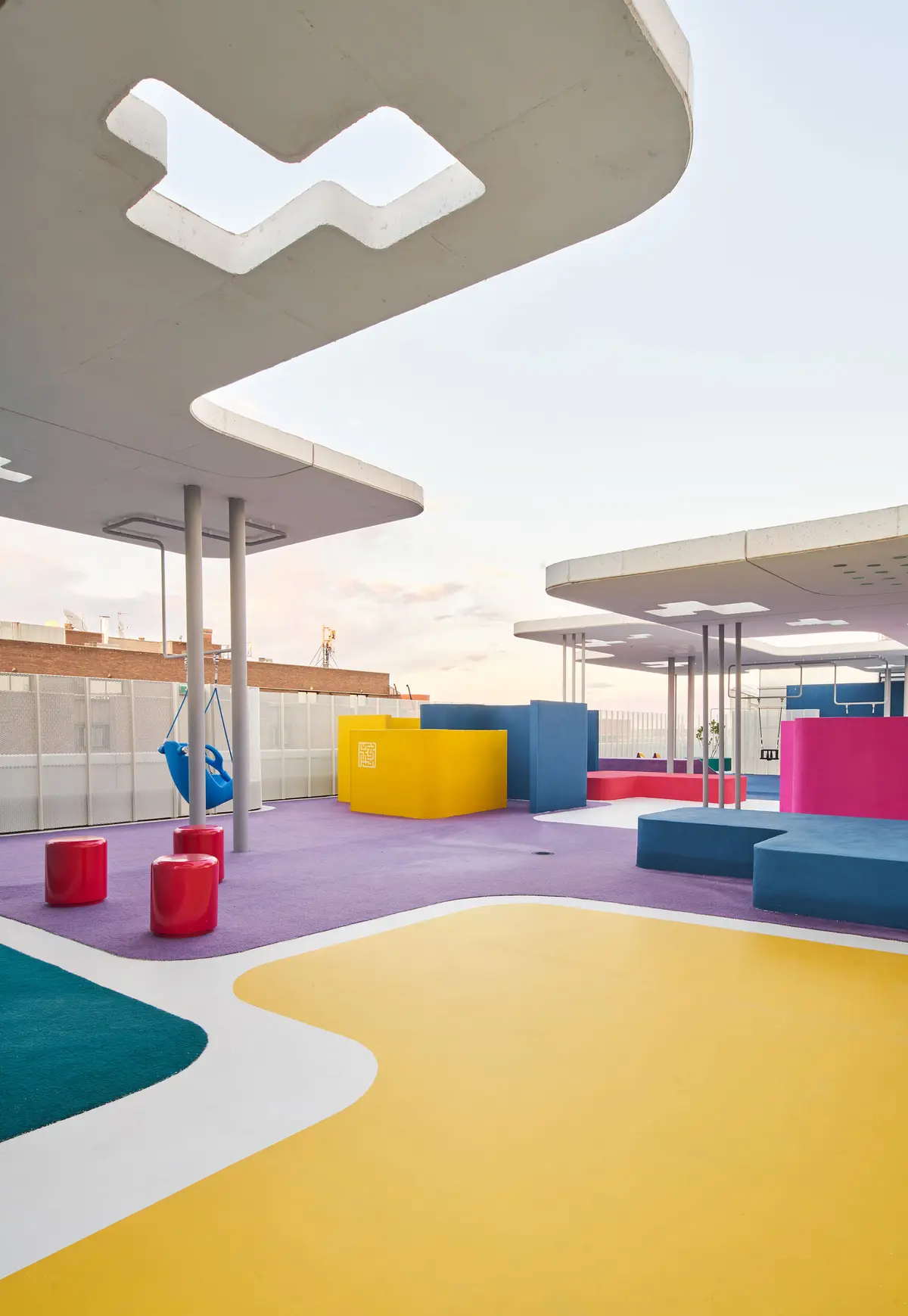
Placing a playground on the roof of a hospital is already an unusual move. Placing one atop Rafael Moneo's Gregorio Marañón Maternity and Pediatric Hospital in Madrid, and doing so with sculptural white concrete canopies that hover above fields of saturated color, turns the unusual into something genuinely poetic. Padilla Nicás Arquitectos, led by Francisco José Padilla and Juan Manuel Nicás, delivered this 1,240 m² rooftop garden in 2021, initiated by the Juegaterapia Foundation with one clear goal: give hospitalized children a reason to go outside and play.
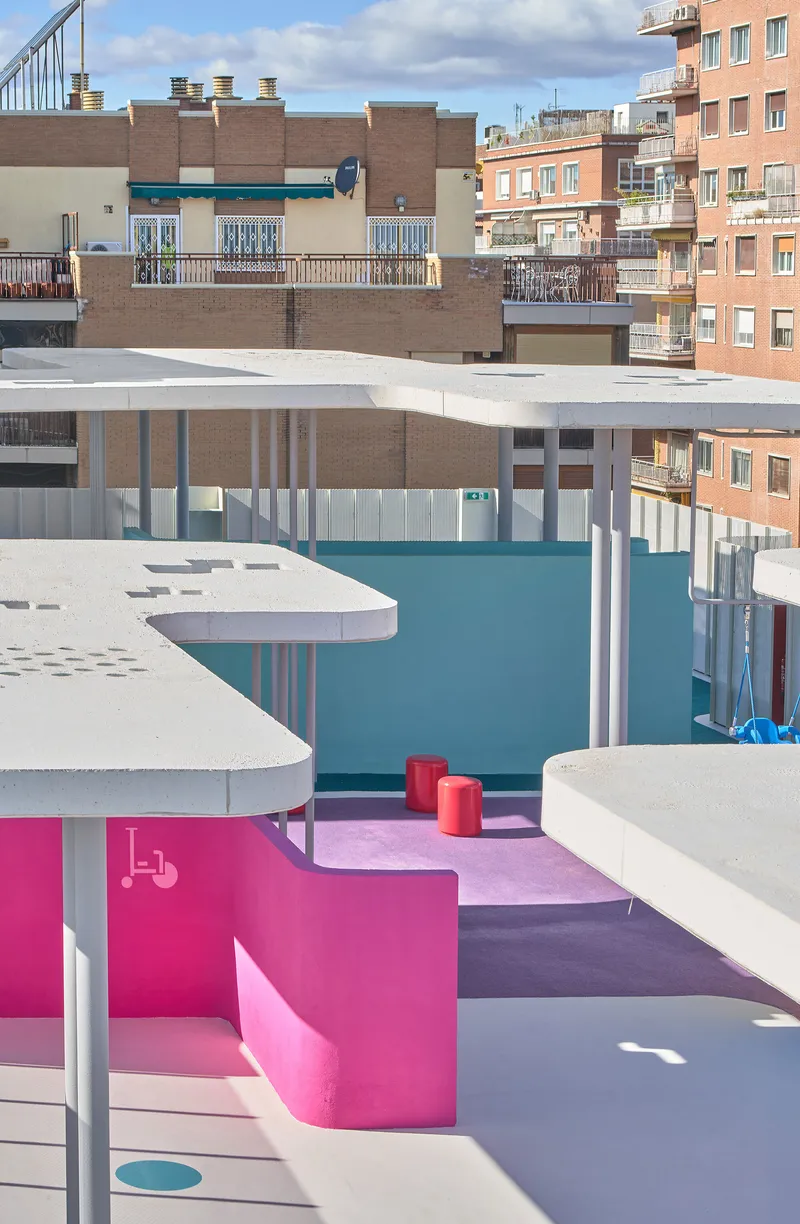
What makes this project worth studying is not the program, which is generous but simple, but the way architecture is mobilized as a therapeutic instrument. The curvilinear concrete structures, nicknamed "the clouds," are designed to appear weightless despite their material heft. Their undersides are perforated, lined with ceramic mosaics and glass, and they cast dappled light onto surfaces of teal, pink, yellow, and purple. The garden is split into two zones of distinct character: one noisy, one calm, connected by a mirrored hall that refracts both light and the children's sense of space. The intent is not decoration. It is disorientation from the clinical, a deliberate architectural estrangement that makes a hospital roof feel like somewhere else entirely.
Concrete Clouds and Engineered Weightlessness
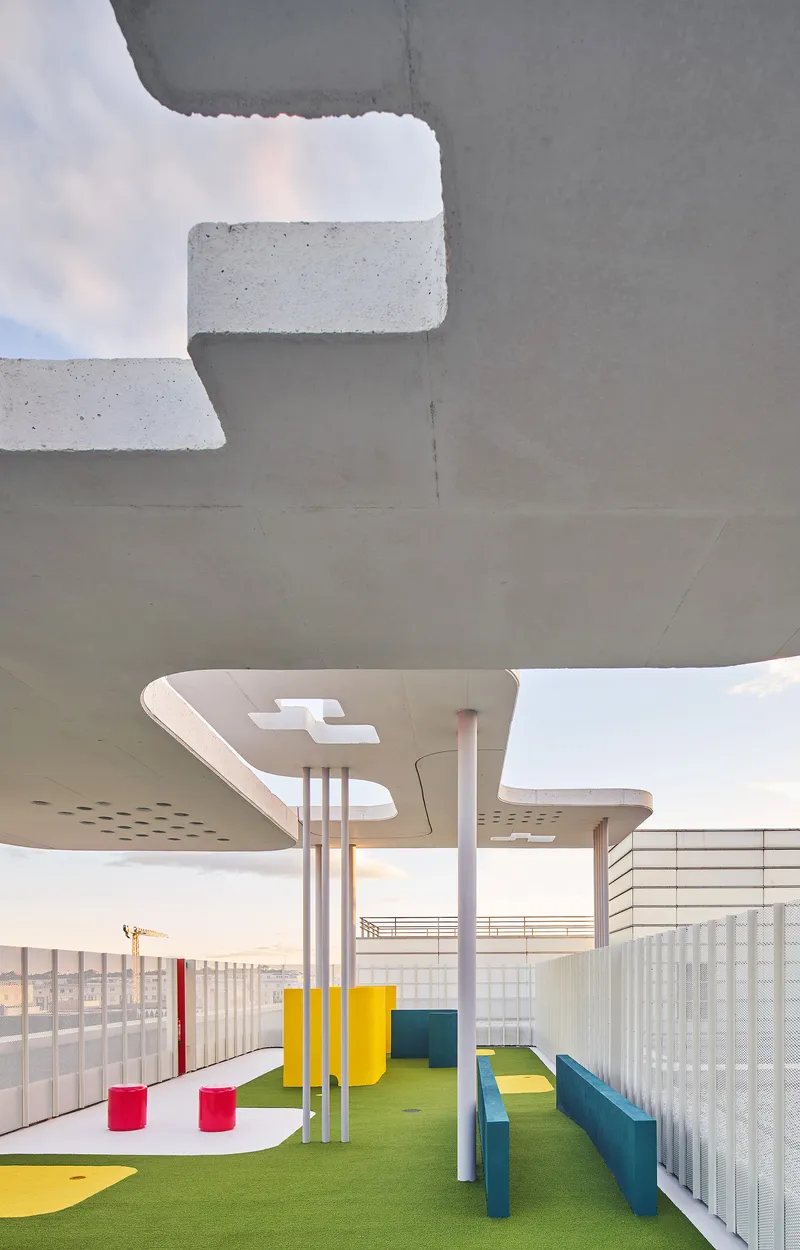
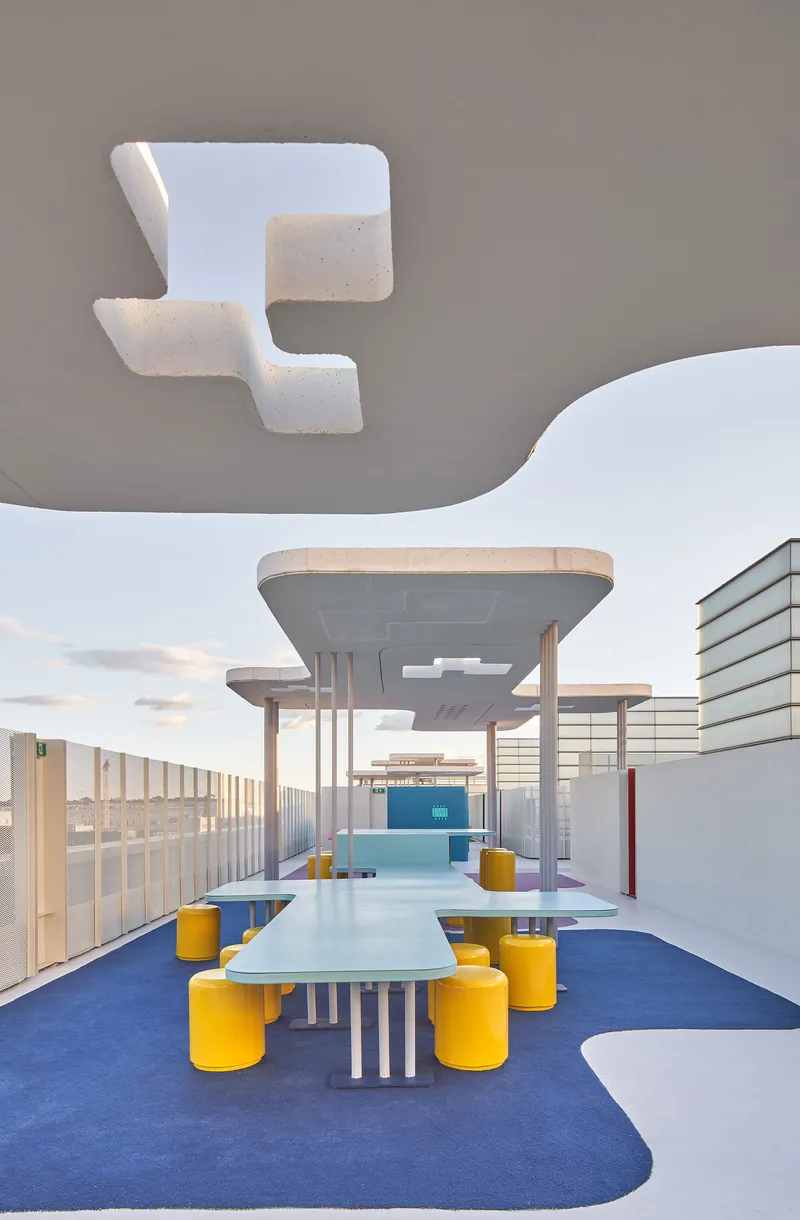
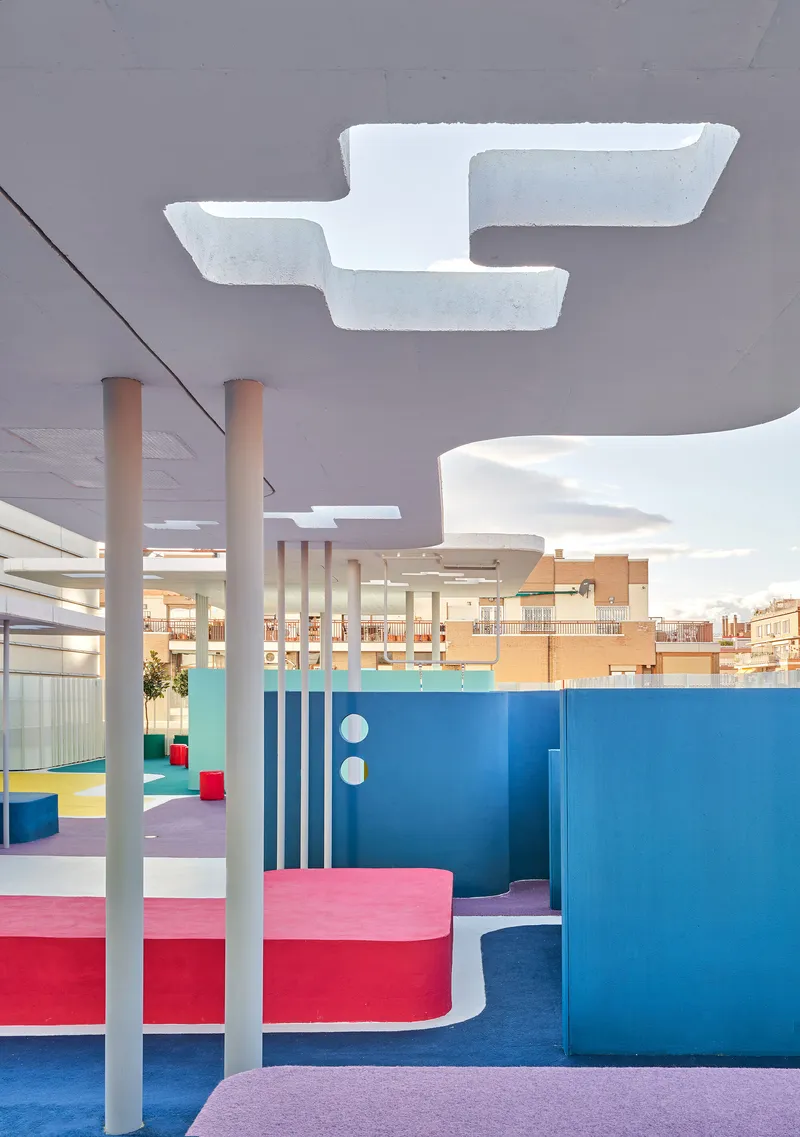
The canopy structures are the project's most legible gesture. White concrete panels, supported on slender circular columns engineered by Bernabéu Ingenieros, are shaped with freeform cutouts that admit controlled daylight. Their undersides feature perforations, ceramic mosaics, and reflective glass that bounce color back onto the play surfaces below. The structural ambition here is real: concrete is heavy, blunt, institutional. Making it appear to float above a children's playground requires both formal daring and serious engineering coordination.
The canopies also serve a straightforward climatic purpose. Madrid summers are brutal, and a rooftop with no shade is unusable. Rather than defaulting to tensile fabric or pergolas, Padilla Nicás chose permanent concrete forms that double as sculpture. They protect from sun, frame views of the city, and define spatial thresholds between activity zones without the need for walls.
Two Zones, Two Temperaments
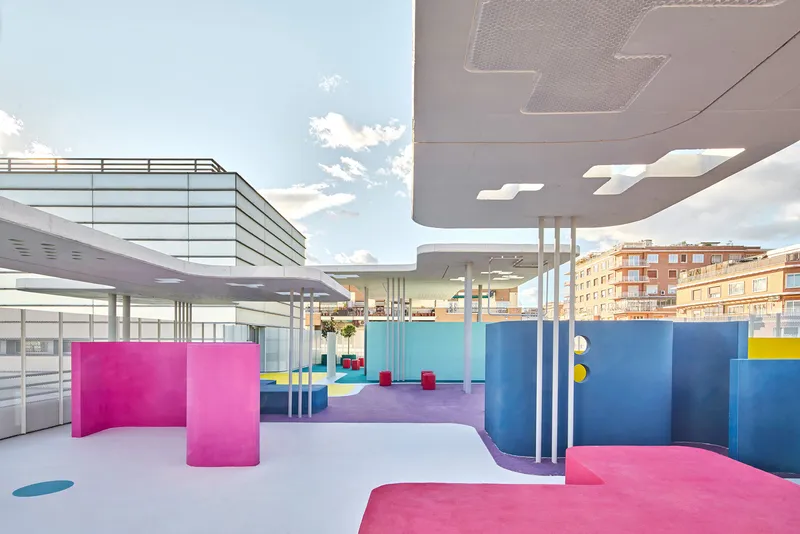
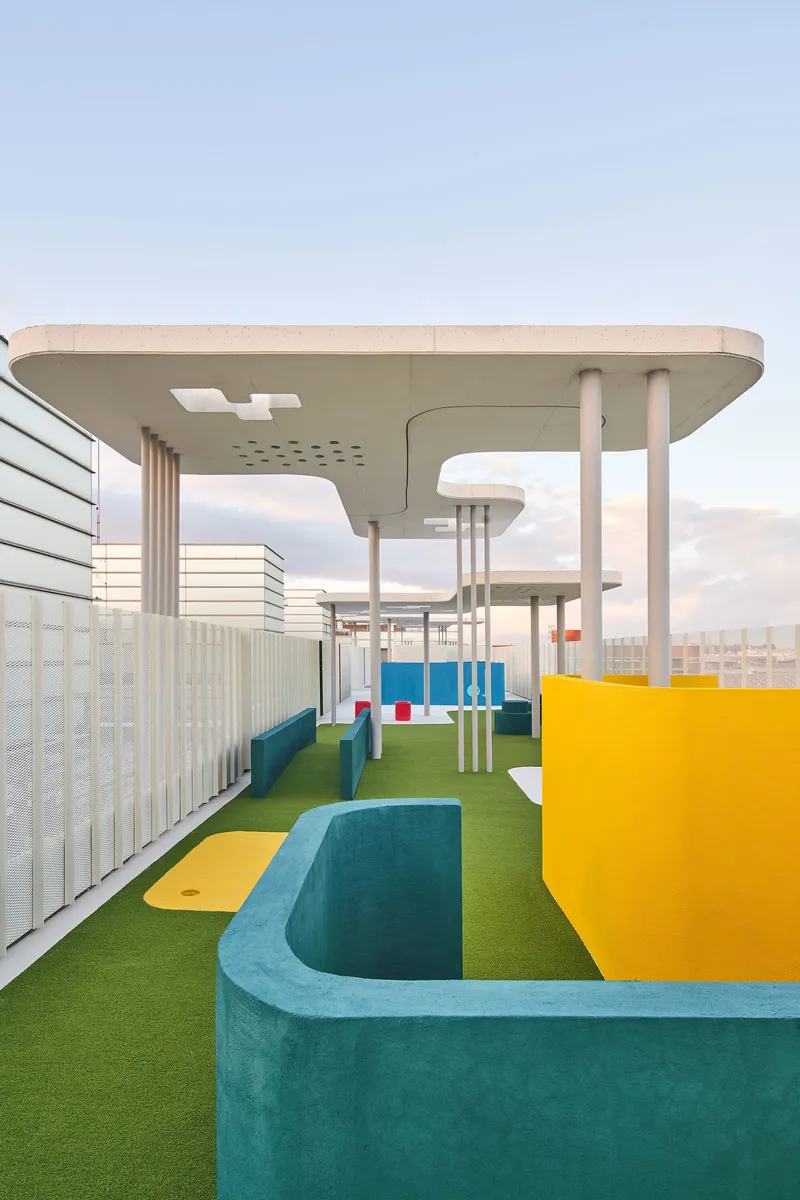
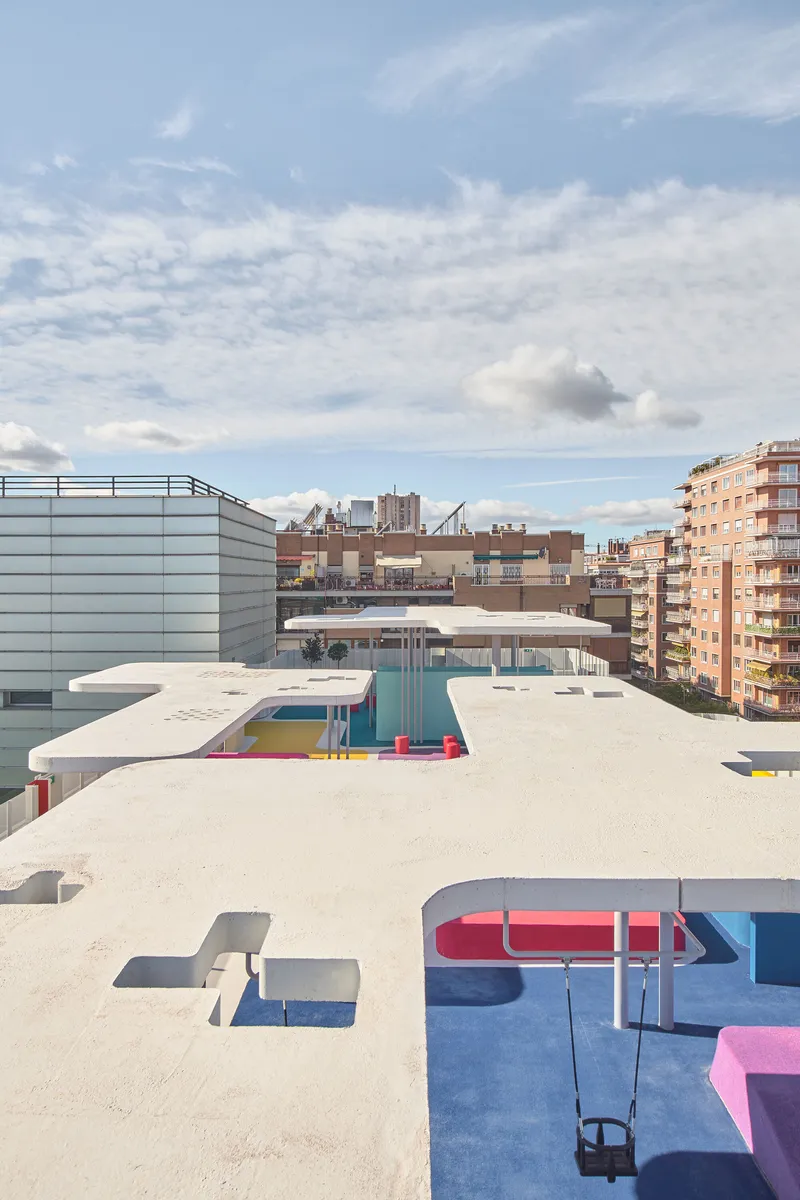
The garden is organized as two distinct environments connected by a mirrored transitional hall. The first zone, adjacent to the noise of O'Donnell Street, absorbs that energy: it contains a small stage, swings, slides, bicycles, and a maze. A teen corner with a ping-pong table and small soccer goal acknowledges that hospitalized adolescents need something other than toddler equipment. The second zone is elongated, overlooking a park, and consciously quieter. Here a large irregular double-height table, a telescope, table football, tangram puzzles, baskets, and mini-golf offer engagement without overstimulation.
The division is intelligent because it recognizes that not all play is the same, and not all children in a hospital are in the same condition. Some need to burn energy. Others need distraction at a gentler pace. The architecture accommodates both without making the distinction feel clinical or segregating.
Color as Spatial Signal
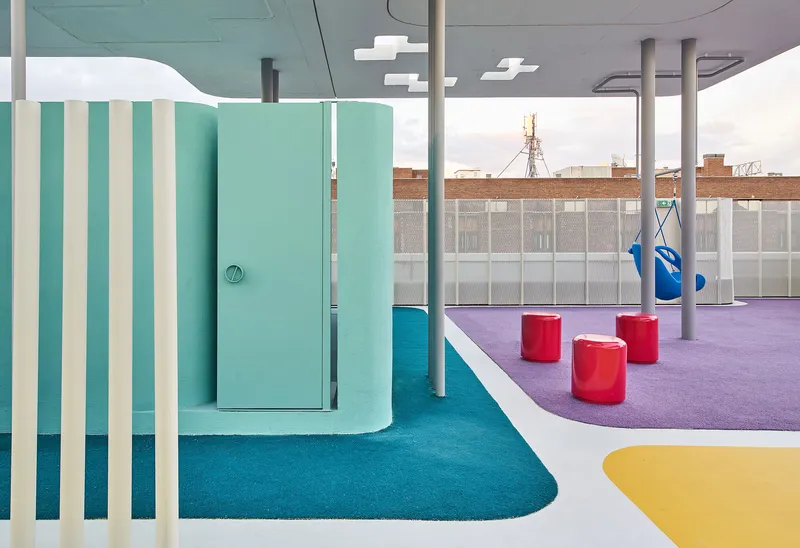
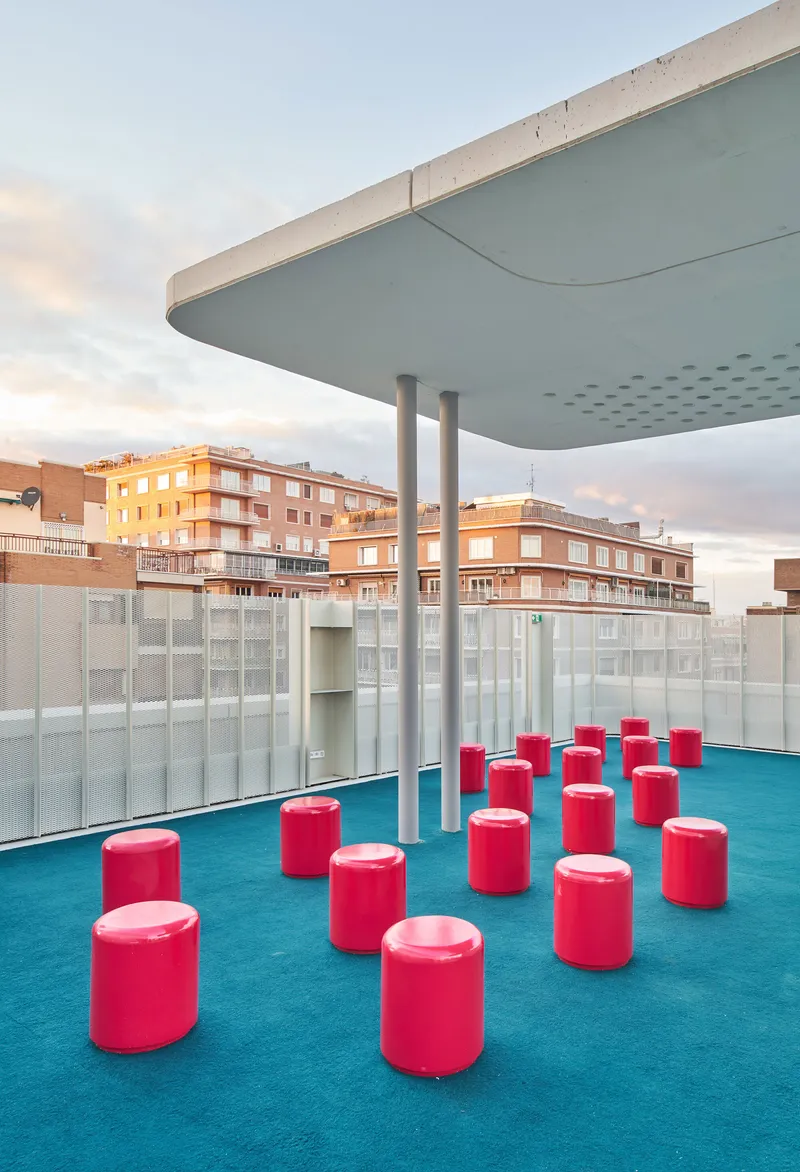
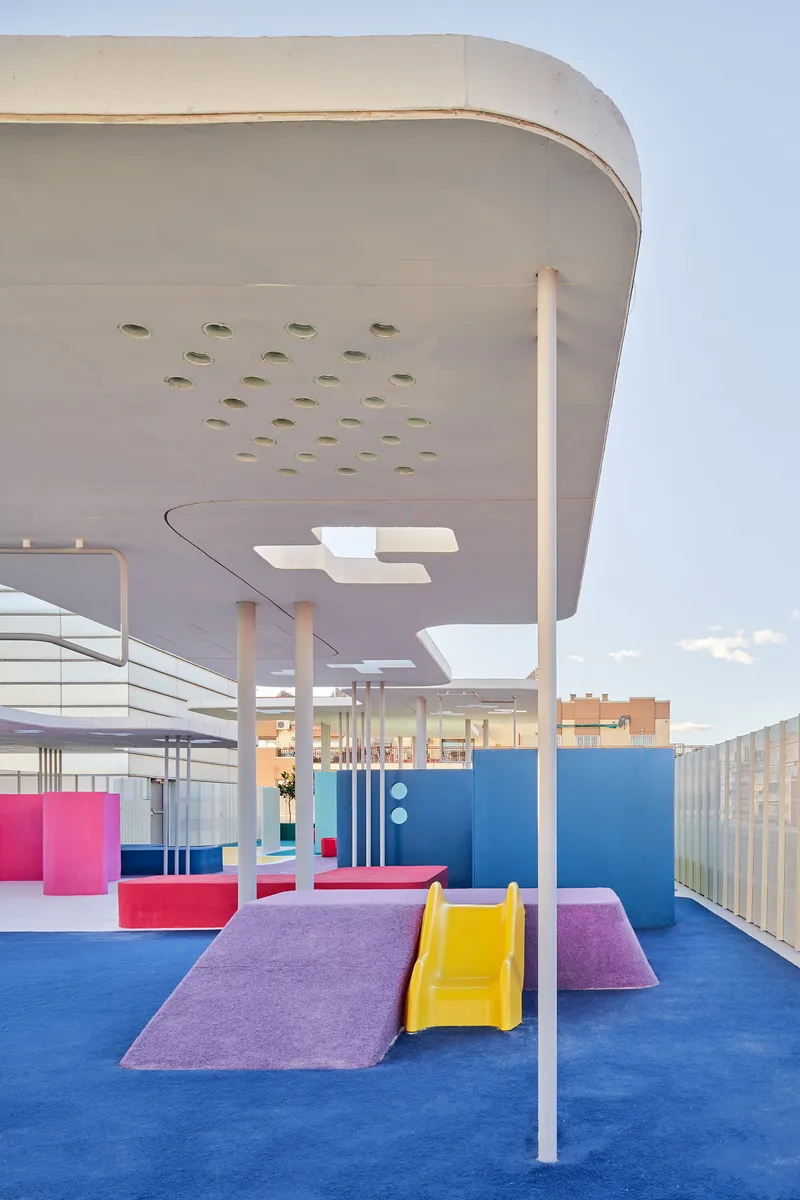
Color is not incidental here. Colored spots on the pavement mark the location of different activities, partially hidden behind curved walls to encourage exploration. Teal, magenta, yellow, and purple rubber surfacing create a ground plane that reads as a map, guiding children from one zone to the next without signage or instruction. The palette is saturated but not chaotic; each hue is assigned to a specific function or territory.
The colored surfaces also serve a practical role as safety flooring, cushioning falls around play equipment. But Padilla Nicás treats them as a design material on equal footing with the concrete above. The result is a vertical dialogue between the heavy, white canopy overhead and the vivid, soft ground below, a deliberate contrast that keeps the space from feeling monolithic.
The Hall of Mirrors and Threshold Spaces
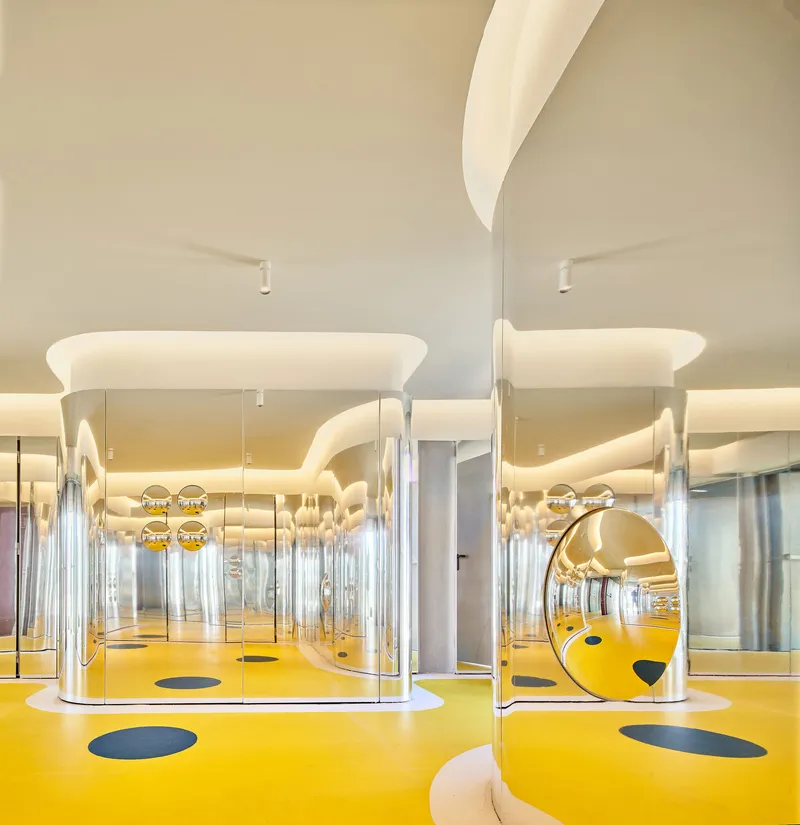
The mirrored hall that links the two zones is the project's most conceptually ambitious interior moment. Mirrored glass enclosures and a yellow resin floor transform a simple corridor into a disorienting passage. For children who spend their days in hospital rooms, this kind of spatial surprise is not frivolous; it is precisely the sort of stimulus that clinical environments systematically strip away. The mirrors multiply the already vivid color palette and dissolve the boundaries between inside and outside, reflection and reality.
Semi-transparent mesh screens wrap the perimeter of the garden, providing enclosure and safety without blocking long views over the Madrid skyline. The mesh allows wind and light through while maintaining a visual connection to the city. Children are enclosed but not contained, a distinction that matters when your daily environment is a ward.
Play Equipment as Architecture
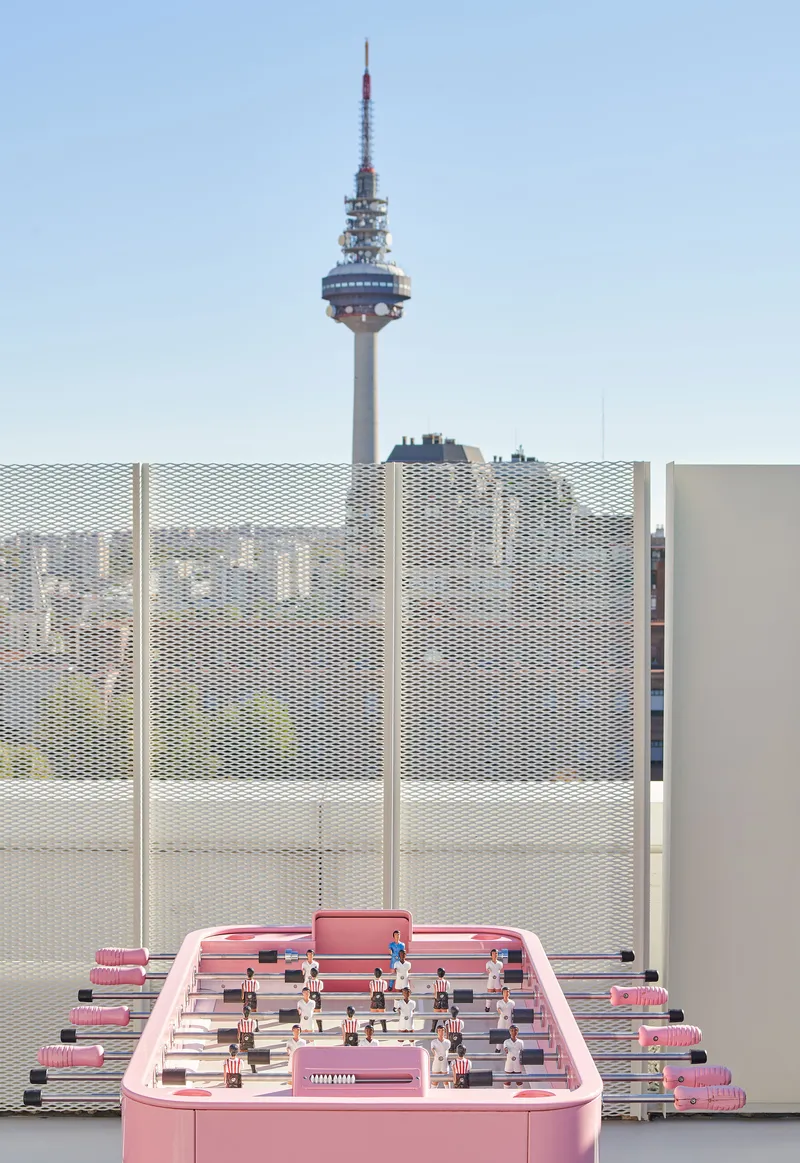
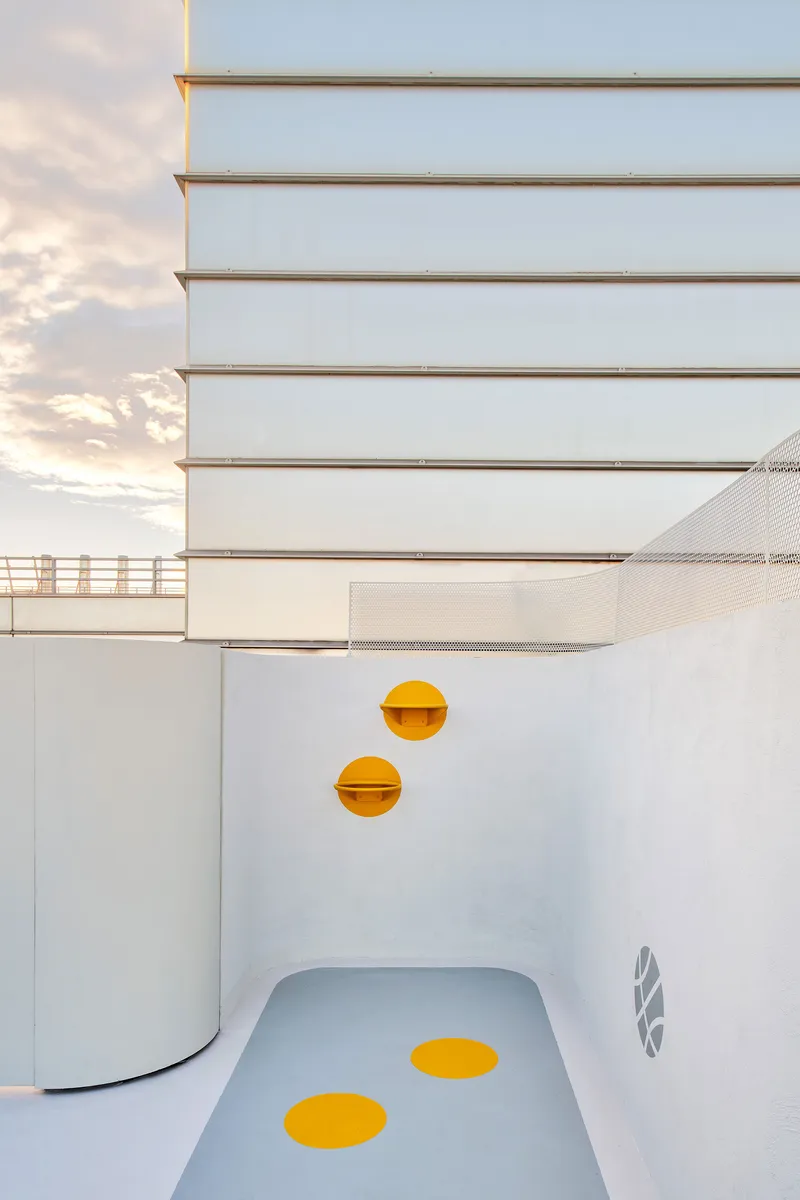
The play elements, a pink foosball table, a white slide with yellow accents, curved seating walls, are designed as integral components of the architecture rather than catalogue items dropped onto a surface. Their forms echo the curvilinear language of the canopies and partitions. The slide, for instance, is clad in the same horizontal metal banding used on the perimeter screens, tying it visually to the enclosure.
This integration matters because it creates coherence. A rooftop playground could easily become a jumble of brightly colored plastic. Here, every object participates in the same formal vocabulary. The effect is a space that feels authored, complete, and deliberate rather than assembled.
Moneo's Hospital Below
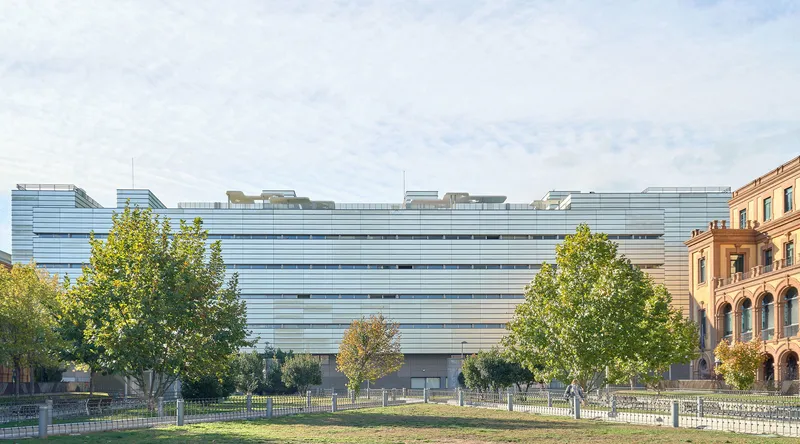
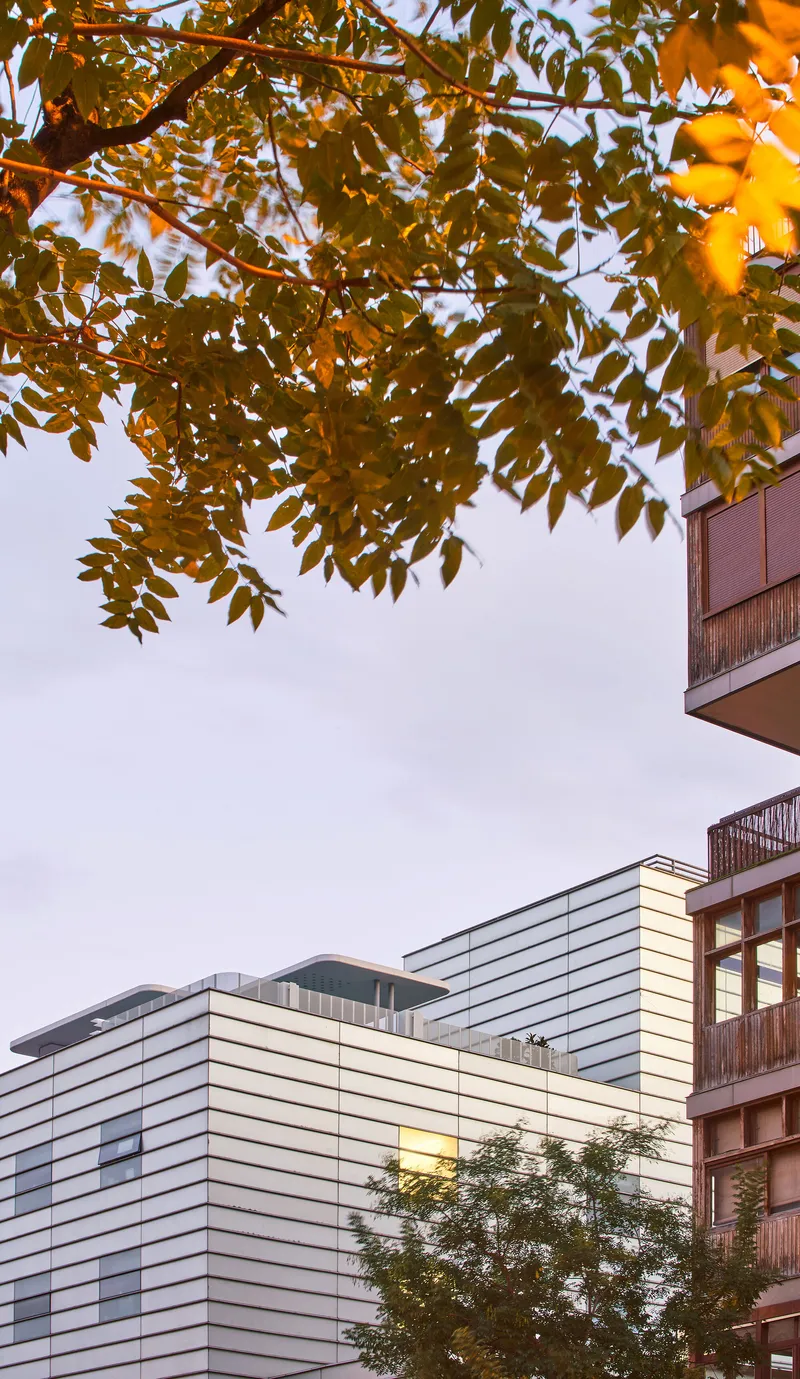
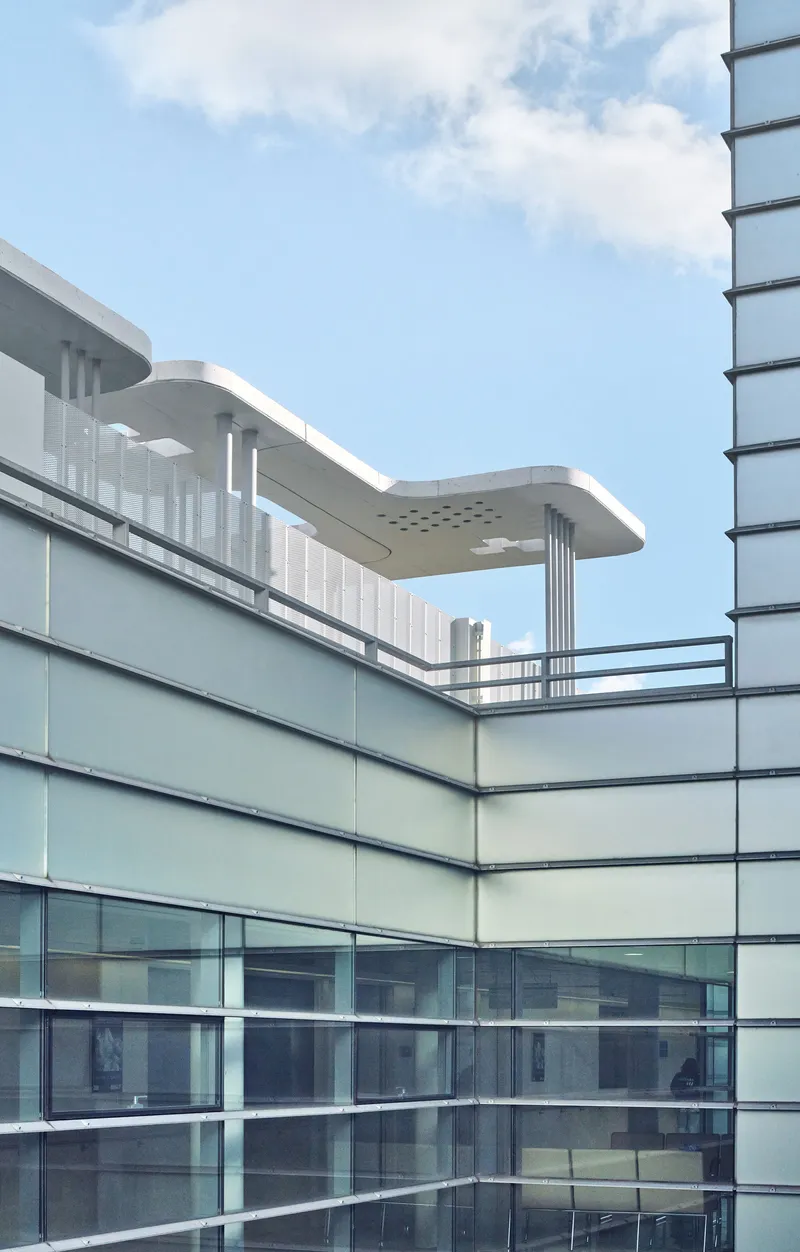
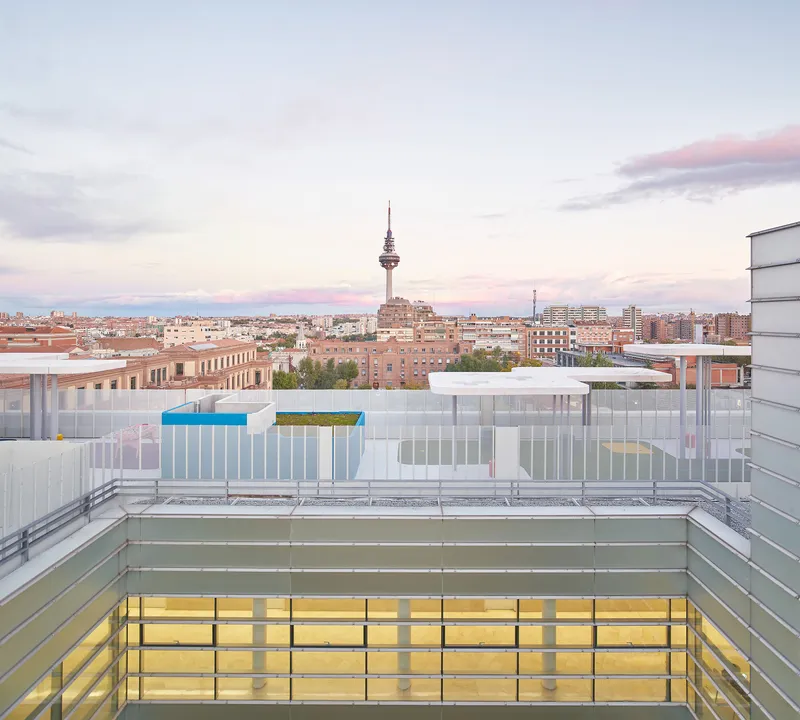
The host building, designed by Rafael Moneo with José Mª de la Mata in 2003, is a model of International Style restraint: horizontal louvered facades, a glazed skin, neutral tones. Padilla Nicás had to work on top of this without undermining it. The rooftop garden is visible from the surrounding city, and its exuberant forms could easily have clashed with the sober base. Instead, the white concrete canopies mediate between the two languages, reading as an extension of Moneo's palette when seen from street level while revealing their colorful undersides only to the children who use them.
The relationship is respectful without being deferential. Padilla Nicás clearly wanted the garden to feel like a separate world, and the contrast between the measured horizontality of the hospital facade and the floating, perforated canopy forms above reinforces that separation.
Dusk and the City
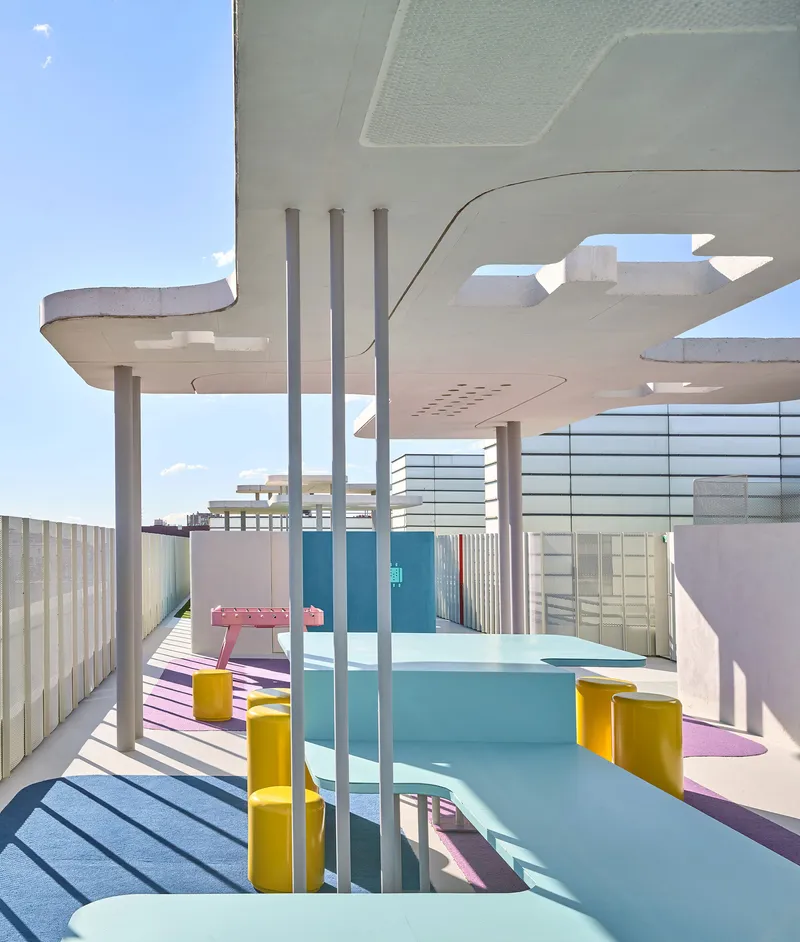
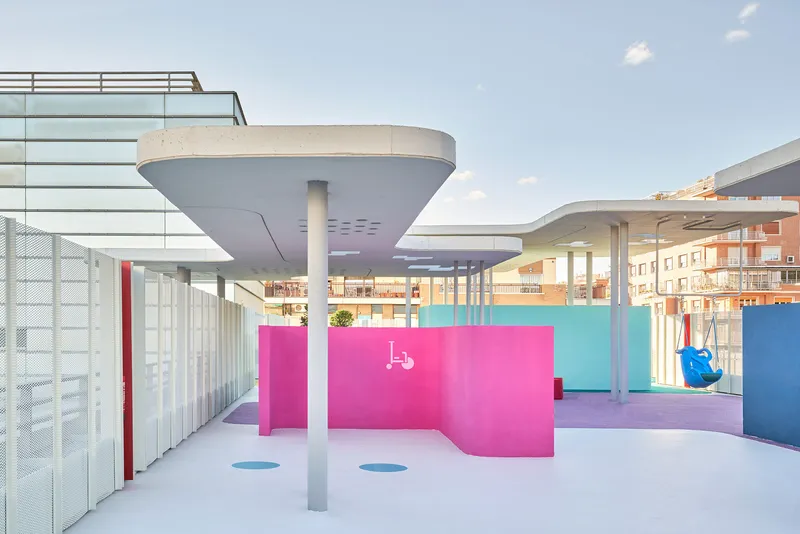
At dusk, the garden transforms. The cylindrical columns cast long shadows across the colored surfaces, and the mesh screens glow with the last light filtering through from the Madrid skyline. José Hevia's photography captures this shift well: the space reads differently depending on the hour, suggesting that children who use the garden across different times of day encounter subtly different environments. This temporal richness is a quality often absent from healthcare architecture, where lighting tends to be flat and unchanging.
Plans and Drawings
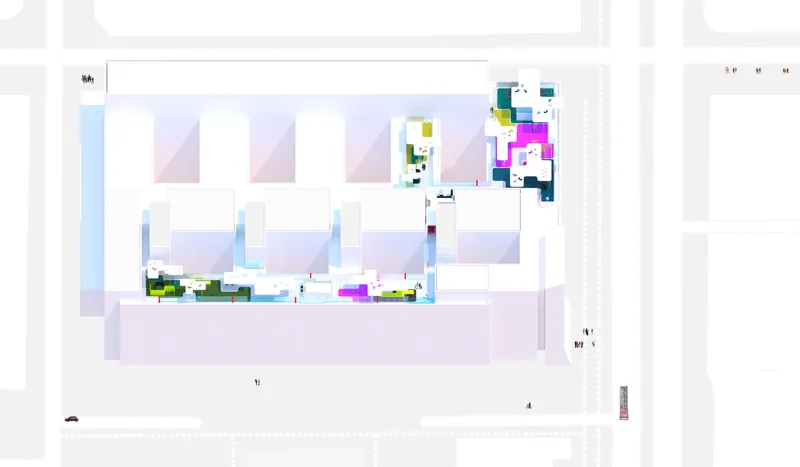
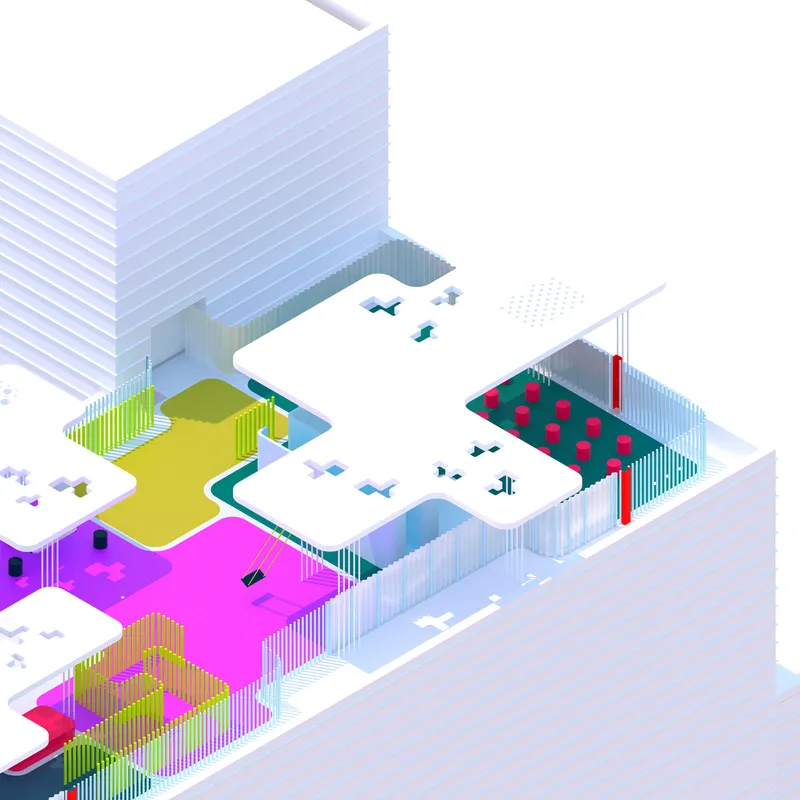
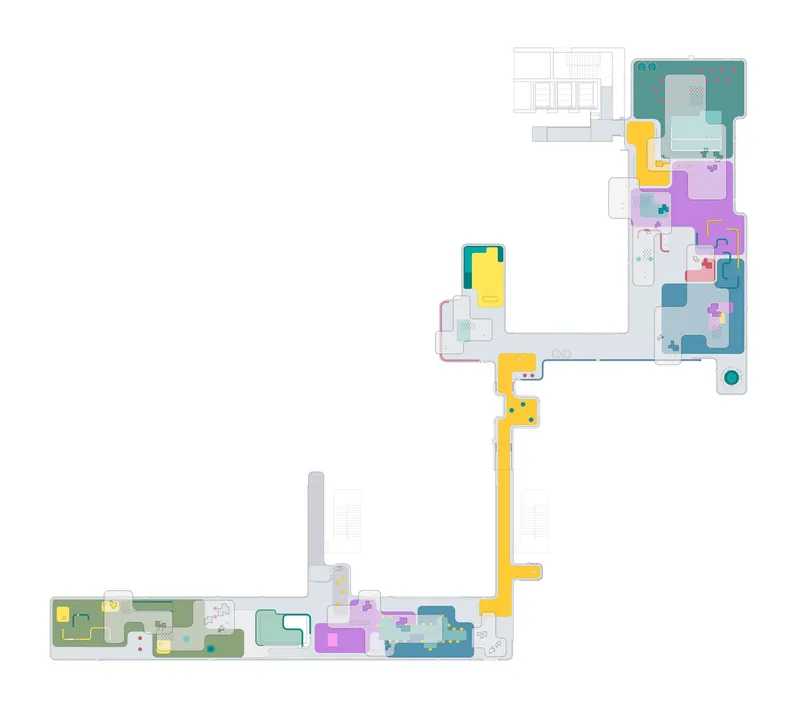
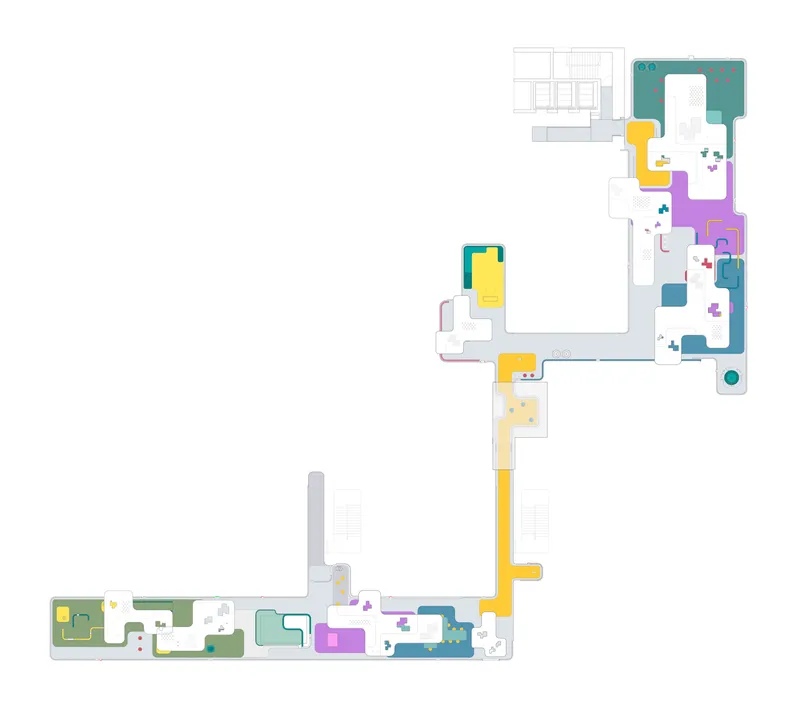
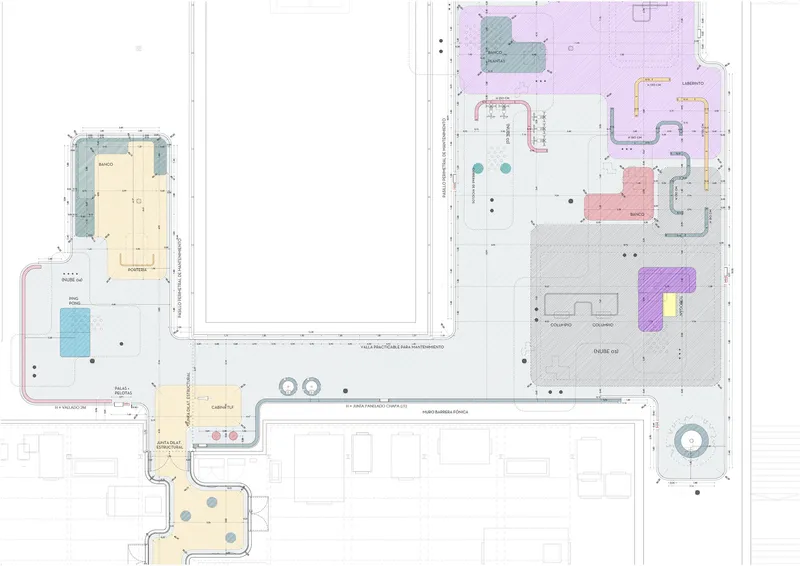
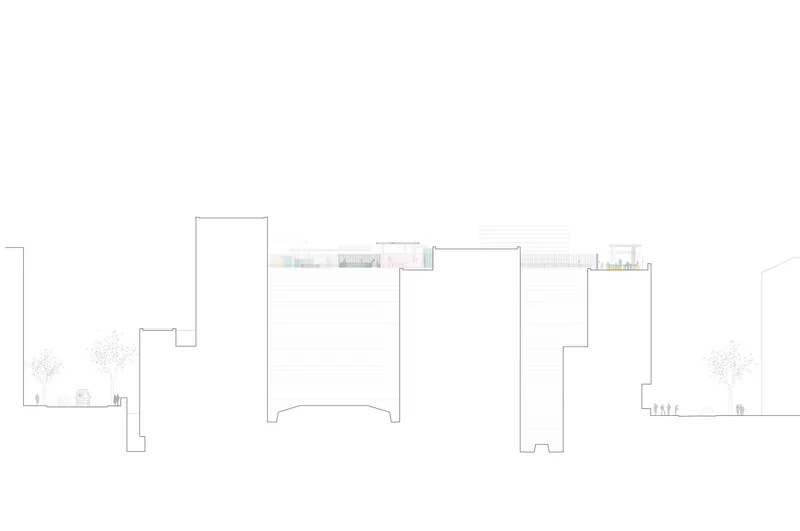
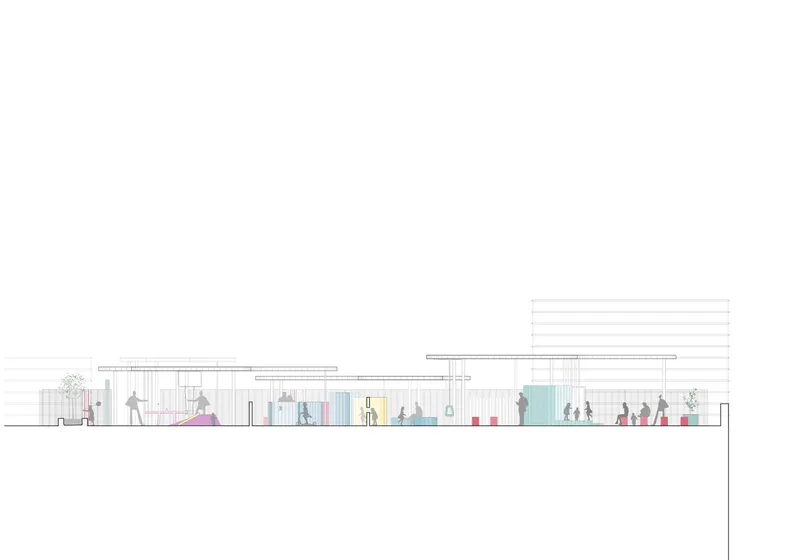
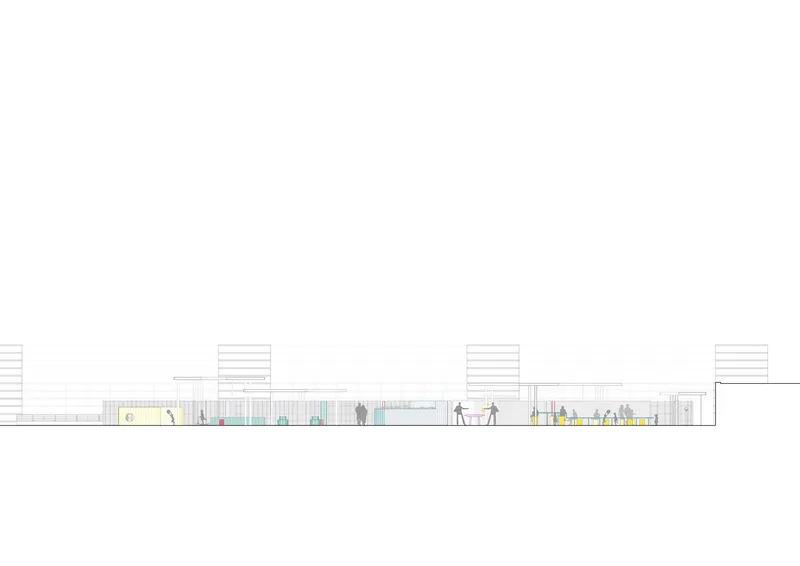
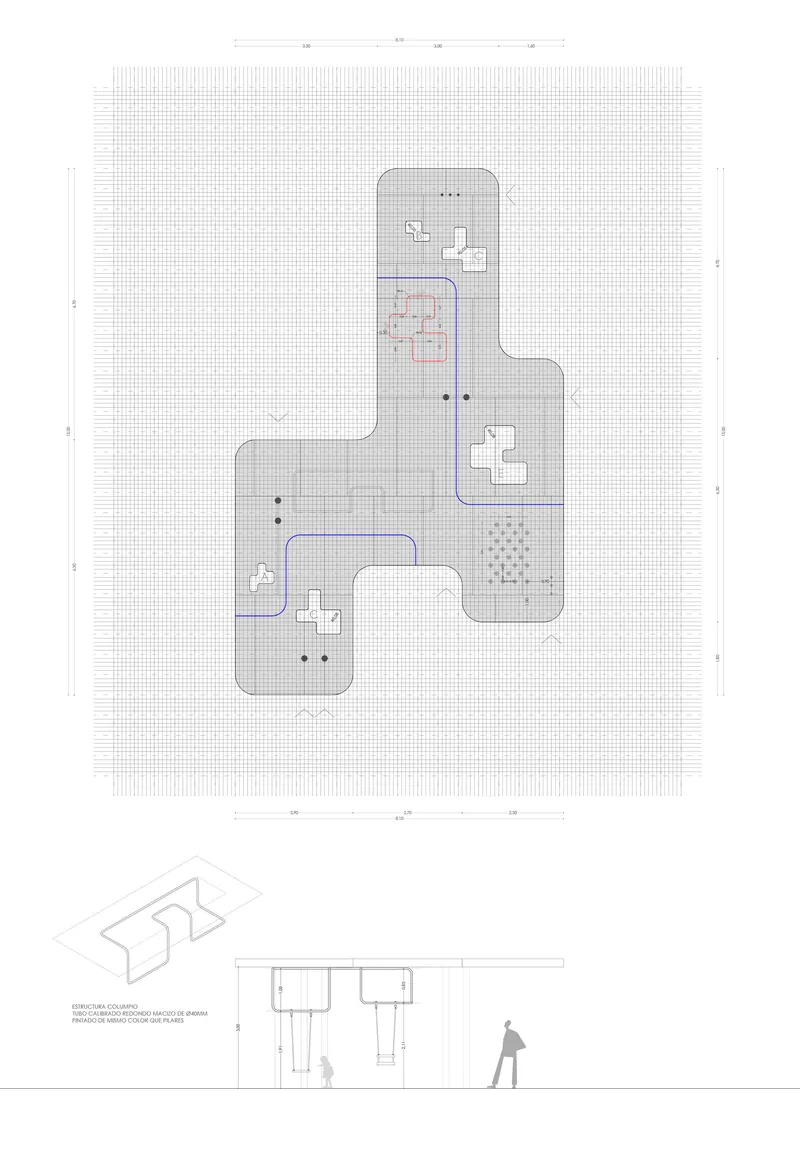
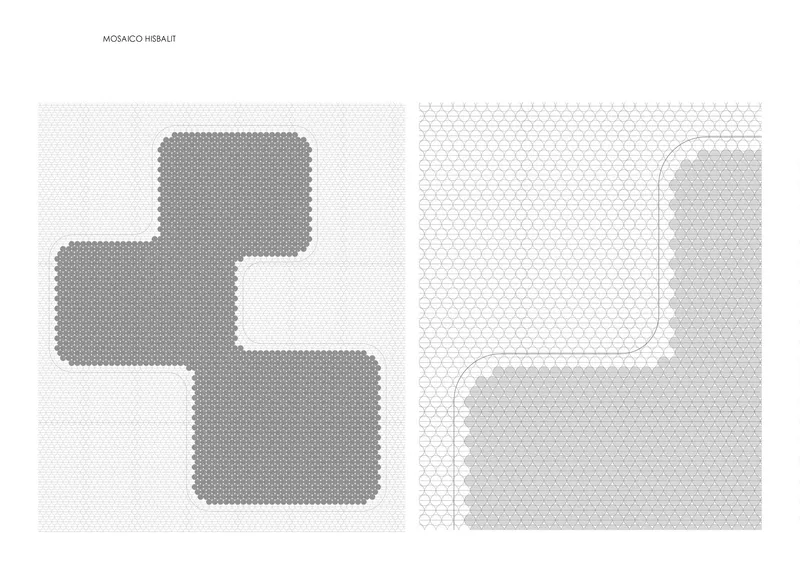
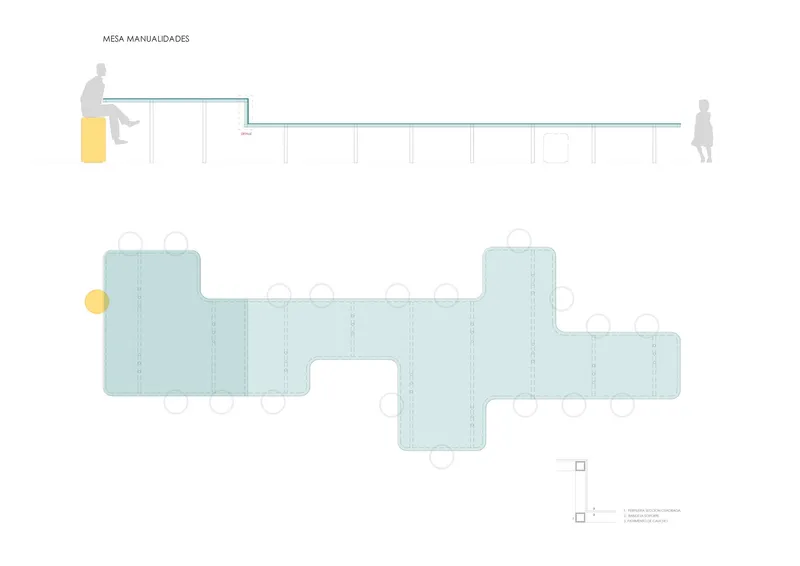
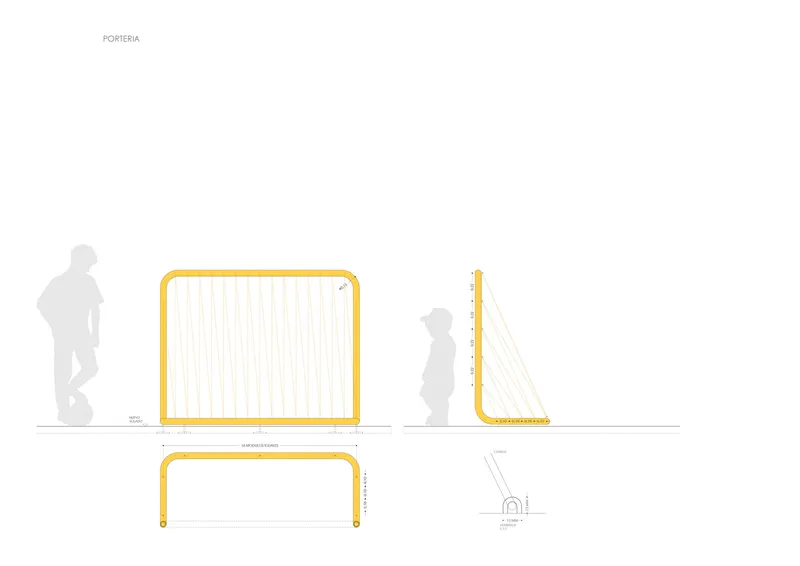

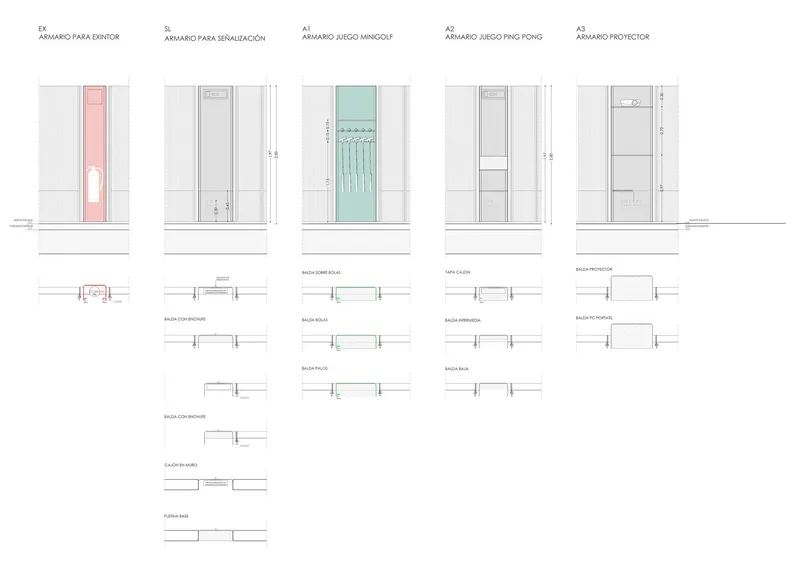
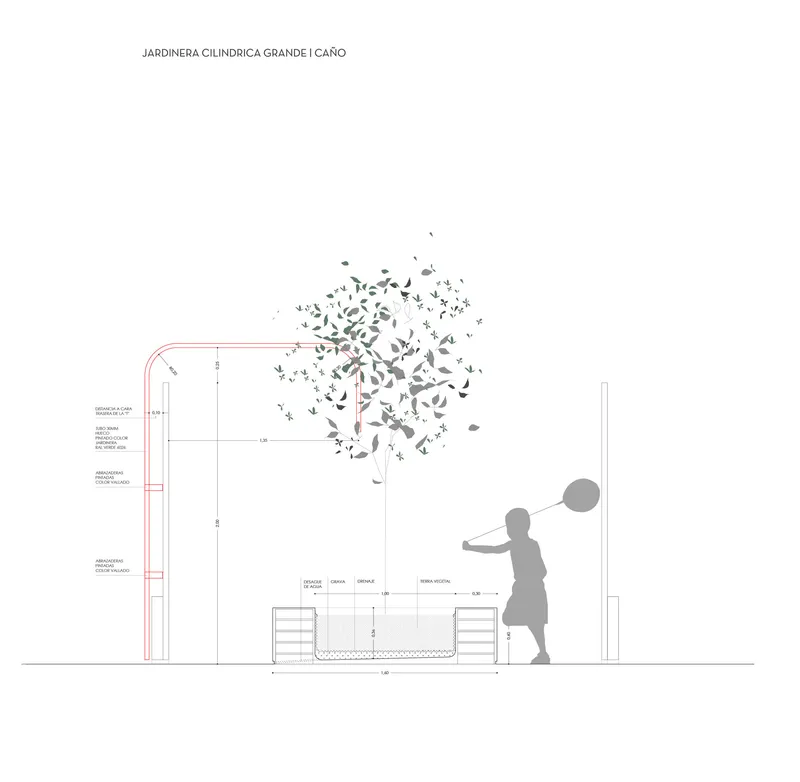
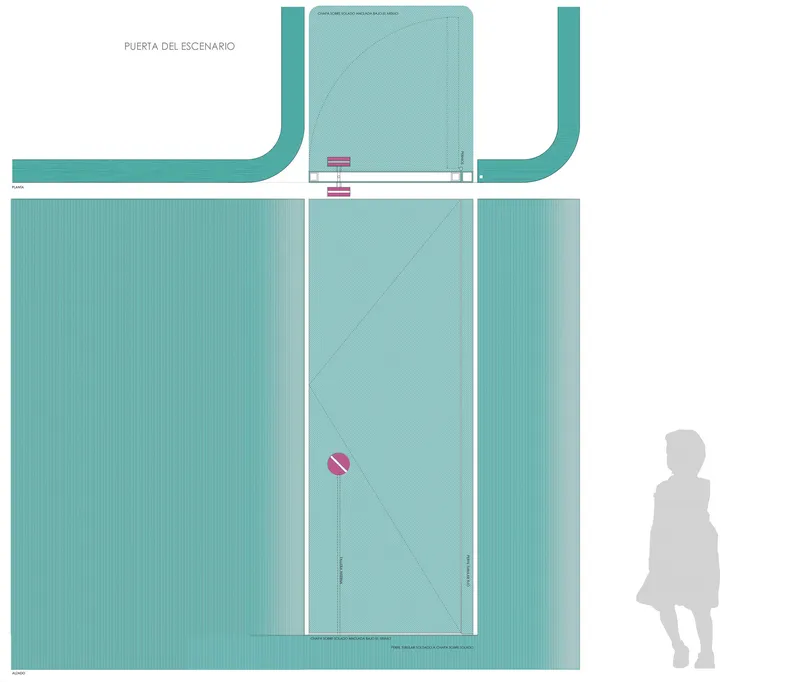
The drawing set reveals the precision behind the apparent playfulness. The site plan and axonometric views show how the colored zones are distributed across the L-shaped rooftop, with each activity pocket carefully located relative to the two perimeter conditions. Sections through the canopy structures illustrate how the cutouts are positioned to admit light without direct solar exposure. Detail drawings of individual play elements, from the hinged stage door to the cylindrical planter and modular furniture, demonstrate that every object was custom-designed. The mosaic tile pattern drawings, showing hexagonal grids fitted to cruciform plans, confirm the level of craft invested in the canopy soffits.
Why This Project Matters
Healthcare architecture almost never gets this level of design attention on the spaces patients actually inhabit. Hospitals invest in operating theaters, imaging suites, and clinical workflows. The places where people, especially children, spend their anxious, boring, frightening hours tend to be afterthoughts. Padilla Nicás Arquitectos, working with the Juegaterapia Foundation, treated a rooftop playground with the same seriousness an office would bring to a museum or concert hall. The concrete canopies, the mosaic soffits, the mirrored hall, the custom play equipment: none of these were necessary in the strictly functional sense. All of them are necessary in the therapeutic sense.
The project also demonstrates that designing for children does not require infantilizing architecture. The forms are abstract, not cartoonish. The color is strategic, not gratuitous. The spatial sequence, from noisy to calm, from enclosed to panoramic, from reflective to open, is as sophisticated as anything you would find in a cultural building. The difference is that the users are four-year-olds recovering from surgery, and the architecture is doing something that medicine alone cannot: giving them a reason to go outside and feel, for a few minutes, that they are somewhere extraordinary.
Rooftop Garden of the O'Donnell Maternity Hospital by Padilla Nicás Arquitectos (Francisco José Padilla, Juan Manuel Nicás). Madrid, Spain. 1,240 m². Completed 2021. Structural engineering by Bernabéu Ingenieros. Construction by Ferrovial Servicios, S.A. Initiated by Juegaterapia Foundation. Photography by José Hevia.
About the Studio
Share Your Own Work on uni.xyz
If projects like this are the kind of work you want to make, uni.xyz is a place to publish your own, find collaborators, and enter design competitions.


Popular Articles
Popular articles from the community


Cloaked Colonization: A Mobile Underwater Habitat That Moves Like a Fish
Micah Abaya's shortlisted EHC Pacific entry reimagines ocean settlement as a dispersed network of self-sustaining architectural organisms.

The Amber Palace Opera: A Geological Fiction Surfaces on Tallinn's Baltic Waterfront
Pierre Brillard reimagines a Baltic legend as a public landscape, opera house, and waterfront promenade rooted in Tallinn's coastal identity.

Singing Woman: An Opera House That Performs Before the Curtain Rises
Ovidiu Cristian Pavel's conceptual opera house translates Estonia's choral identity into a sculpted waterfront landmark facing the Baltic Sea.

Temporary Home for Dogs: A Reversed Zoo Rethinks Animal Shelter Architecture
In Bucharest, a sinuous corridor and freed landscape flip the logic of containment, designing a shelter that works to make itself unnecessary.

Similar Reads
You might also enjoy these articles

Pixel Gardens: One Repeated Module Stacked Into a Terraced Social Housing Tower for Famagusta
Salem Bader's shortlisted housing tower builds a vertical neighbourhood from one repeated module, offsetting units to carve terraces, light and air.

Bao Huynh Watercolor Atelier: A Serene Art Retreat in Hội An
Bao Huynh Watercolor Atelier in Hội An blends multifunctional art spaces, sustainable design, local materials, and family-friendly living in a serene environment.

Atelier Macri Concept Store Interior Design by CASE-REAL
Atelier Macri store features a "ko" counter, walnut wood details, cork displays, blending retail, gallery, and seamless customer experiences.

Manuel Vargas Izquierdo Stadium and High-Performance Sports Center: Architectural Excellence in Jalpa de Méndez
The Manuel Vargas Izquierdo Stadium blends sustainable design, inclusive sports facilities, and cultural-inspired architecture, revitalizing Jalpa de Méndez’s public spaces.

Explore Playground Competitions
Discover active competitions in this discipline

Challenge to design locus for the upliftment of human rights

Design challenge to reuse E-waste
Comments (0)
Please login or sign up to add comments
No comments yet. Be the first to comment!