
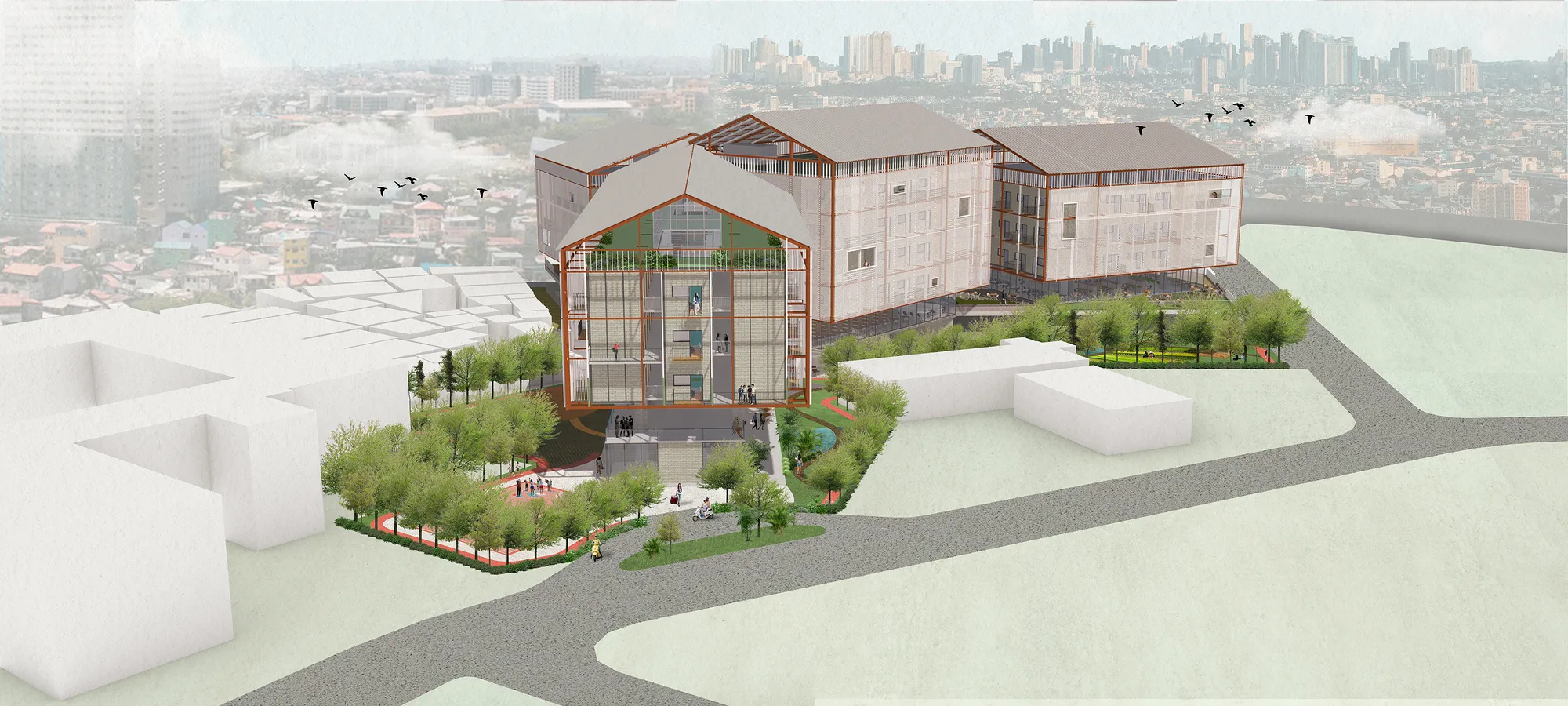
PANDACAN STUDENT HOUSING
Living as a community in a midst of the urban jungle.

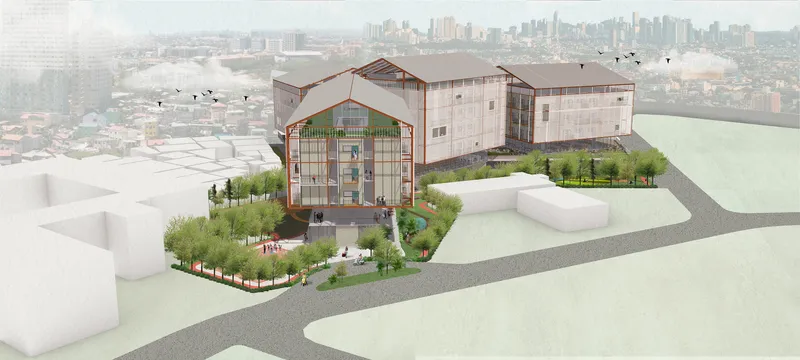
INTRODUCTION
Located in the dense neighbourhood of Pandacan region in Manila, the site itself is surrounded by rich and diverse cultural activities of the local community that had existed for many years. The urban scale and building typologies of the city led us to rethink on what makes an interesting urban scale intervention that is modernly new yet has a sense of familiarity for the locals to engage with.
The whole premise of this project revolves around creating student accommodation and academic spaces that are safe, engaging with nature, self-sustainable, and economical. The project in nature must provide these qualities that we believe can benefits not just the students, but also the neighbourhood. Imagine a public space where students can learn how to grow their food, selling it, developing various crafting skills, engage in community-led programmes, a placemaking space, aside from just providing conventional student accommodation. We are reshaping what makes creative learning spaces and accommodation that could regenerate the neighbourhood as well as its people.
Context
The site is well connected to the main highway and major road, as well as public transportation routes. This is an advantage as having two frontages that are facing the main road enable us to separate the access for pedestrians and vehicles, resulting in a more pleasant arrival point for pedestrians to enter the site. As it is situated next to a school and housing area, the public realm of the project is designed to allow the programmes to spill over into the site, and vice versa. Activities such as markets, fairs, public events, sports are able to take place in order to cater to both the community and the students.
DESIGN INTENTION
1. Massing Cluster
The massing and layout of the design took their cue from the existing typology of the houses around it. The close proximity between the existing houses and overlapping of spaces created this unique juncture that became a non-formal gathering space, which ultimately became the essence of the urban fabric. Therefore, the building massing was clustered together in such a way that it creates these unexpected open spaces between them for students to utilize it accordingly.
2. Raised Massing and Public Programme
The overall massing was raised to allow for a public programme to take place on the ground floor, in order to create a continuous flow of activities from the main street, the building, the school as well as the housing area next to it. Public spaces such as half basketball court, event and market space, community hall, urban farming, retail, cafés, food court and mart are located throughout the site in order to activate all site frontages.
3. Green Spaces and Connectivity
Green space is one of the most essential aspects of the whole project and is significantly lacking within the immediate context of the neighbourhood. The project aims to become a green catalyst for the community, by providing the students and community with shared urban farming that they can grow together. Various kind of gardens is located along the green trails as well as jogging path that interweaves between the other programmes, creating a sense of journey for the user by transversing through different space typologies, observing different range of activities at the same time. Pockets of green spaces are located across all levels to promote interaction between the students and nature.
4. Communal Spaces
Communal spaces are equally as important for this project in order to protect and enhance the physical and mental wellbeing of the students. Plenty of co-working spaces are located throughout the site in order to promote interaction between the students themselves. These learning spaces were designed such the students will have the opportunity to choose between a private or shared communal space, indoor or outdoor, to see or to be seen. Through this, students themselves can learn how to engage with one another as well as reduce the risk of being in a stressful isolated environment.
5. Unit Type and Modular Design
The project used a modular design approach by only allowing two unit types with uniform sizes across the building. This is important in order to promote equality between the users as well as being economical for the project. The customization of the interior spaces is also up to the users based on their own preferences.
6. Facade System
The building façade has steel frames that wrap around the building in a vernacular form. It is then infilled with louvres or perforated panels in order to provide the views yet at the same time protecting the privacy of the students.
SOCIAL IMPACT ON THE SITE
The aim of the project is to become a catalyst that could regenerate the neighbourhood socially and economically. The engagement and interaction between the community and the students are vital in creating an interdependent society, as it could become both an economic and learning space for them. Community-led programmes are vital for this project as they could create a sense of placemaking, a place where they can gather for recreational purposes, for learning, doing businesses and such.


Popular Articles
Popular articles from the community


The Ocean Hive: Sustainable Architecture for a Self-Sufficient Civilization at Sea
The Ocean Hive imagines sustainable architecture at sea, where modular habitats, algae, wave power and ocean waste sustain a growing colony.

Co-life: Sustainable Architecture for Age-Friendly Community Living
Co-life reimagines sustainable architecture for seniors through courtyards, rammed earth, shared gardens, and spaces designed for belonging.

The Musturak Paradise: Senior Living Architecture for a Connected Future in Temara, Morocco
The Musturak Paradise reimagines senior living architecture in Temara via private homes, social spaces, culture, community, and shared care.

Lunar Spiral: Space Architecture Shaped by the Mathematics of the Universe
Lunar Spiral reimagines space architecture through Fibonacci geometry, lunar regolith, levitating habitats, and self-sustaining Moon living.
Similar Reads
You might also enjoy these articles
The Rhythm of Seasons
A Farmers' Market Connecting Nature and the City

More Than a Building-Designing a Living System
More Than a Building-Designing a Living System
Base Beyond
DESERT COMPOUND ARID: TOURISM OF ABSENCE AND ABUNDANCE




Comments (0)
Please login or sign up to add comments
No comments yet. Be the first to comment!