

Parametricism and Pavilions
Inventing Ori - A Pavilion - Terra x Terra

Ori was parametrically designed using Rhino and Grasshopper. In order to turn this proposal into a feasible project, the design was heavily inspired by modular origami. The construct features a base module that may be altered to create 3 variations and a light steel frame that is capable of receiving these modules.

Located in the heart of the Portland Japanese Garden Cultural Village, Ori functions as an outdoor tea bar. Its adjacency with the Umami Cafe opens up outdoor dining options, and its proximity to the Jordan Schnitzer Japanese Arts Learning Center allows for curious guests to become directly involved in its construction and maintenance. The skin of this origami-inspired pavilion is made up of water-proofed cardboard panels that can easily be assembled from flat sheets by following 4 sets of simple folds.
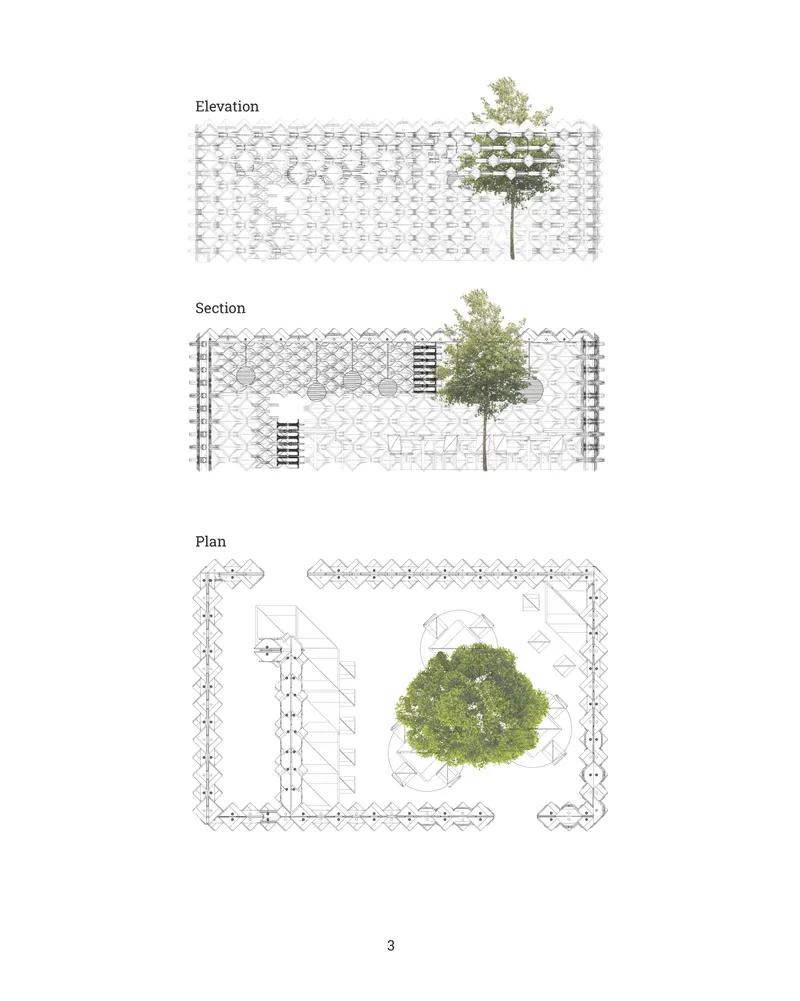
Not only does the structure’s use of this easily accessible material make the construction of the facade cheap, sustainable, and friendly for public engagement, but it also allows for this structure to easily be stored or transported in an efficient manner when flattened. In addition, the lightness of the cladding allows for the structural steel frame to span the length of the tea bar with little need for interior columns or additional structural members. The openness of the plan and the porosity of the facade allows for light and the visual exterior to bleed into the structure, blurring the boundary of interior and exterior.

Popular Articles
Popular articles from the community


ETEH Reworks the Shared Spaces of São Domingos School in Brazil Around Timber, Color and Hanging Plants
At São Domingos School in Brazil, 436 m² of hall, refectory and library are recast with timber joinery, a yellow and blue code and trailing greenery.

Cube Design Draws an Ecological Corridor Between Two Shenzhen Hills with the Nankai Building
Beside Shenzhen's container docks, the Nankai Building pairs stacked balconies with a climbing green screen to connect two hillsides across its height.


Aquadapt: An Underwater Habitat That Rewrites Its Rooms by the Hour
Curved modules ring the seabed while one shell shifts from breakfast room to cinema, farm and football pitch as residents' needs change.

LT2A and OPEN Architectes Thread a Brick and Glass High School Through a Wooded Belgian Campus
In Braine-l'Alleud, a 3,000 m² wing for Collège Cardinal Mercier pairs pale brick with a glazed colonnade, deferring to a small chapel and a dense wood.

Similar Reads
You might also enjoy these articles

The Rhythm of Seasons
A Farmers' Market Connecting Nature and the City


More Than a Building-Designing a Living System
More Than a Building-Designing a Living System
Base Beyond
DESERT COMPOUND ARID: TOURISM OF ABSENCE AND ABUNDANCE

Explore Prefabricated Architecture Competitions
Discover active competitions in this discipline


Challenge to design a portable theatre

Challenge to design a portable music platform

Challenge to design an open learning module for the elderly

Challenge to reimagine the Iron Throne
Comments (0)
Please login or sign up to add comments
No comments yet. Be the first to comment!