
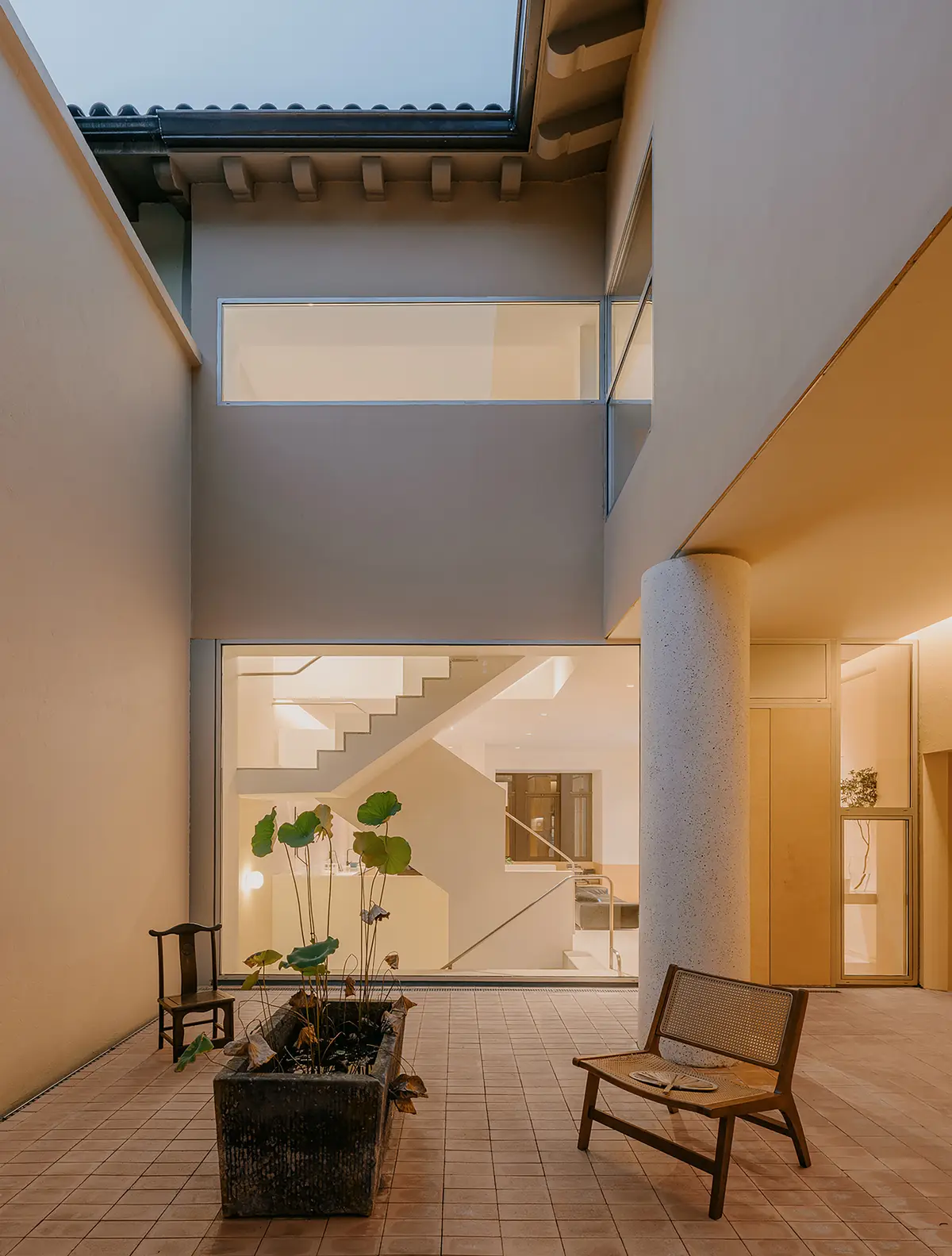
A Chongqing Home Where Terrain Becomes Architecture
YES.ARCH transforms a three-story terraced house in Chongqing into a warm, layered home organized around courtyards, timber, and terrazzo.


Chongqing is a city defined by its topography. Buildings cling to hillsides, streets fold over themselves, and the idea of a flat site is practically fiction. When YES.ARCH took on the renovation of a three-story house for their clients' parents, the existing terraced condition was not a constraint to solve but a logic to amplify. The result is PARENTS' House: 350 square meters organized vertically across multiple levels, connected by courtyards, clerestories, and a staircase that functions as the building's spine.
What makes this project genuinely interesting is its refusal to treat domesticity as a single-plane experience. Lead architects Luo Ren and Zhao Yao have structured everyday life as a series of transitions: from terracotta courtyards to timber-lined interiors, from the compression of a hallway to the release of a double-height living space. Every material shift signals a change in use or mood, yet nothing feels overwrought. The house reads as a single, continuous gesture of care.
Courtyards as Connective Tissue
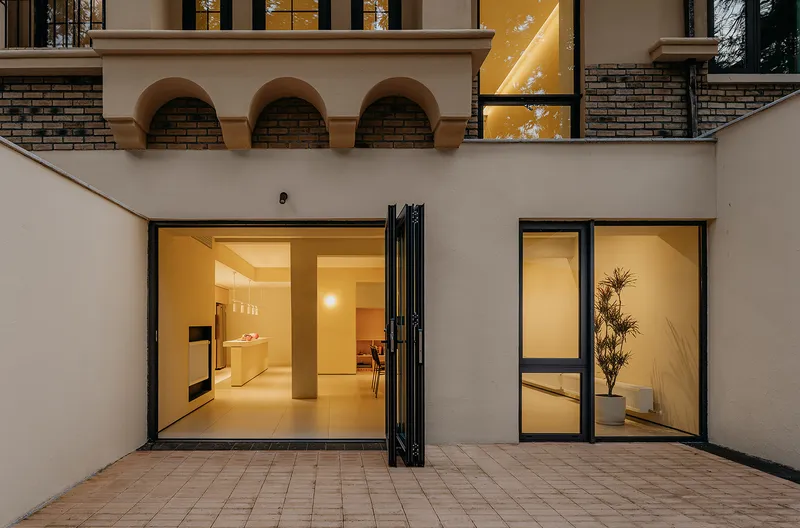
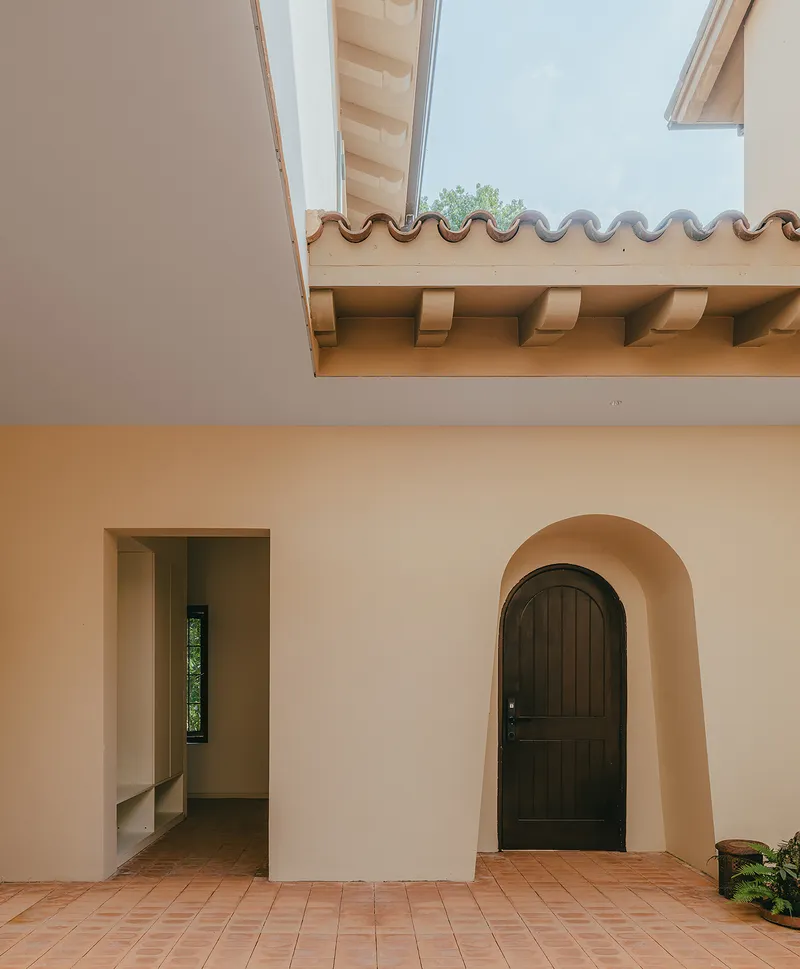
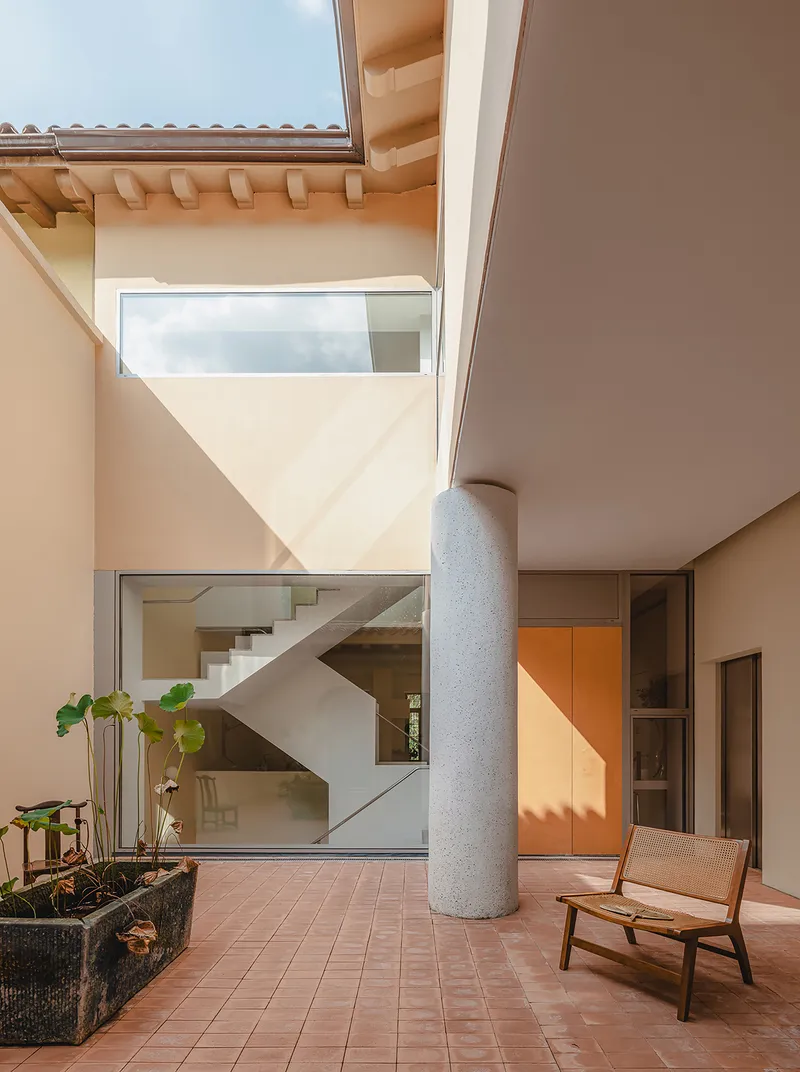
The courtyards are not ornamental. They do real work, pulling light into the center of the plan, ventilating interior rooms, and creating thresholds between public and private zones. At dusk, the brick-paved courtyard with its black-framed glazing becomes a lantern, radiating warmth outward. During the day, the terracotta-tiled courtyard with its cylindrical concrete column and ochre stucco walls feels almost Mediterranean, though the arched doorway and exposed timber eaves are firmly rooted in Chinese vernacular construction.
The potted lotus plants visible in one courtyard are not just decoration. They signal habitation, a landscape tended over time rather than installed for photographs. This is a house designed for people who will stay.
The Terrazzo Staircase as Protagonist
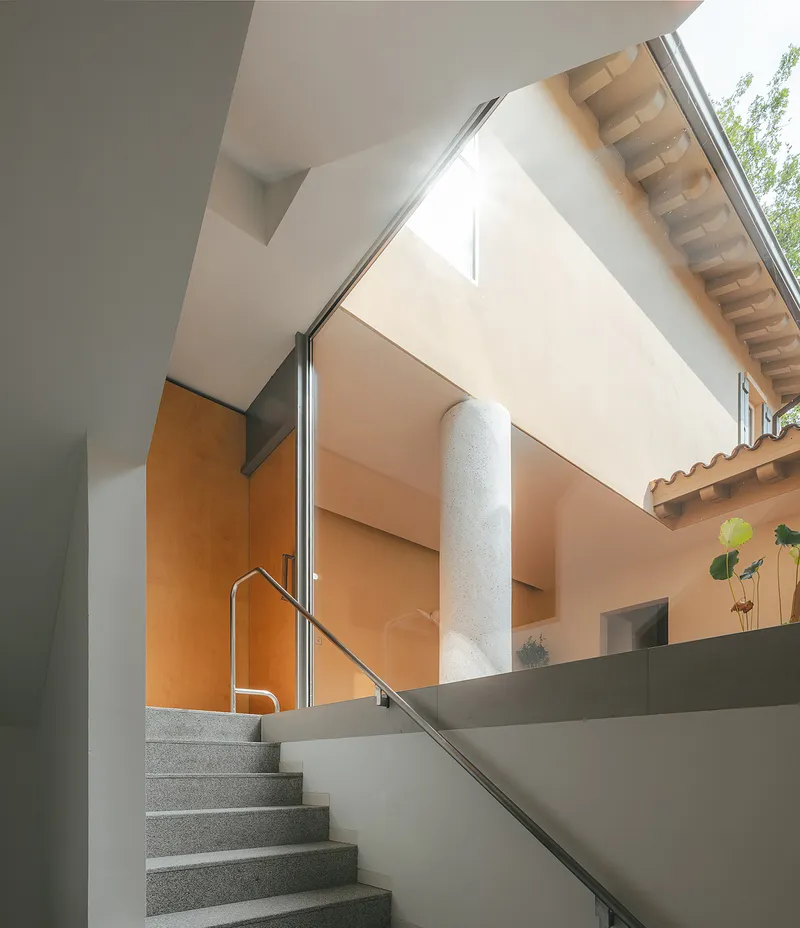
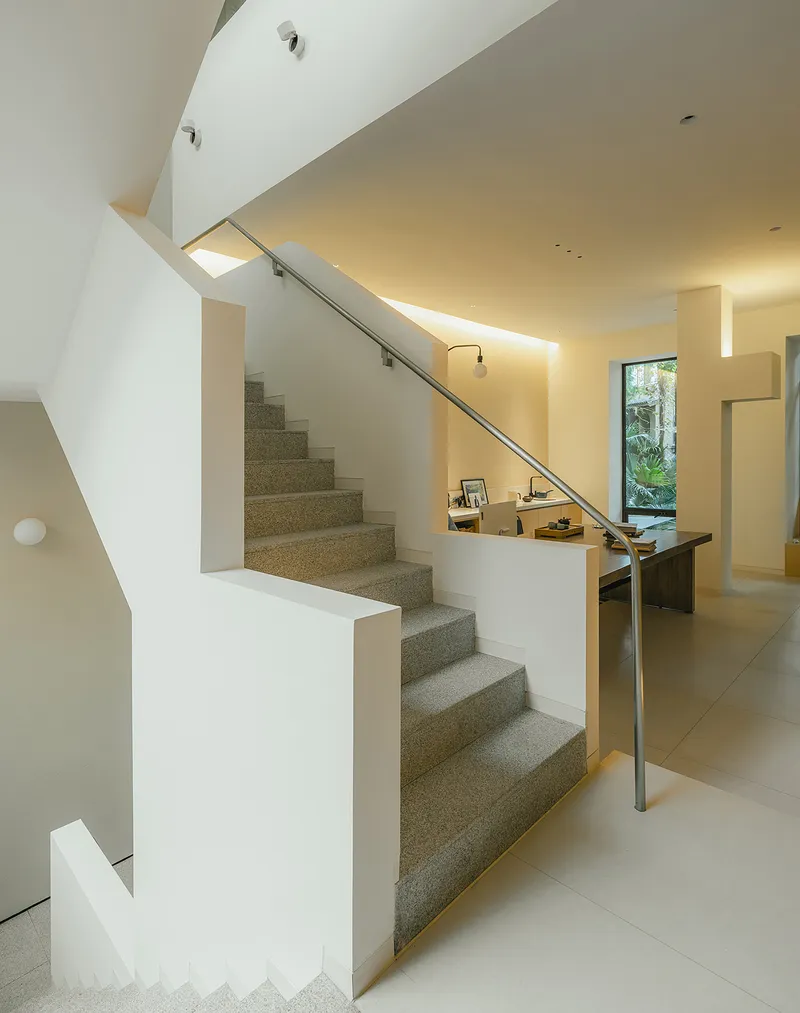
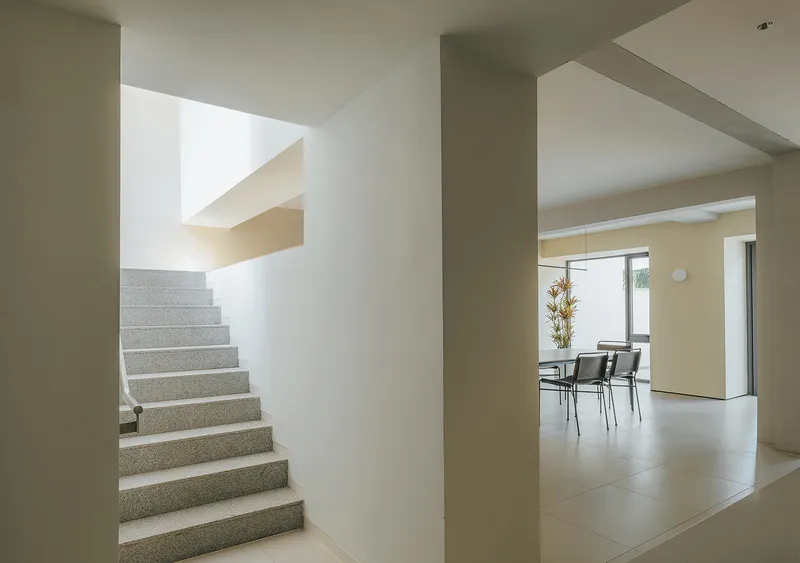
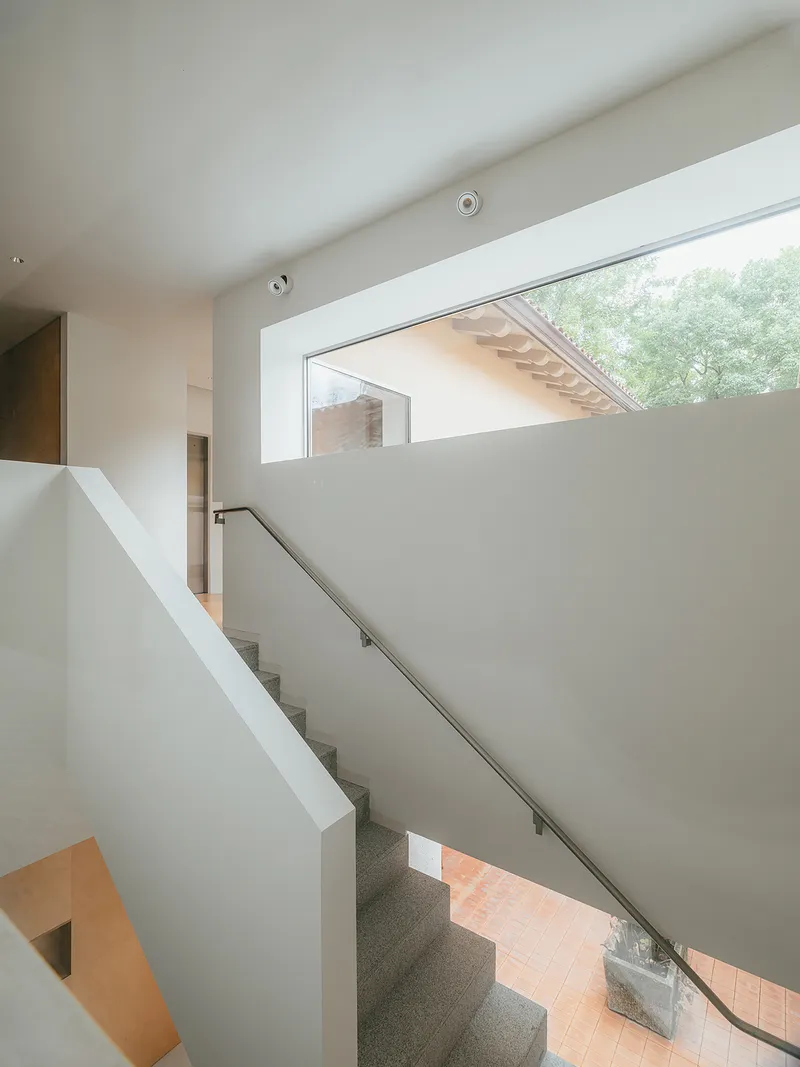
In a multi-level house built on terraced terrain, the staircase is never an afterthought. YES.ARCH treats it as the project's central architectural element. The terrazzo treads, paired with a stainless steel handrail, rise through a double-height stairwell illuminated by cove lighting along the ceiling edges. The material is honest and tactile: cool underfoot, visually dense, and durable enough for decades of daily use.
From certain angles, the staircase frames views into the dining area beyond, establishing visual connections between floors that keep the house feeling open despite its compact footprint. Angled white walls and indirect lighting turn what could be a utilitarian shaft into a sequence of carefully composed moments.
Timber and Warmth in the Shared Spaces
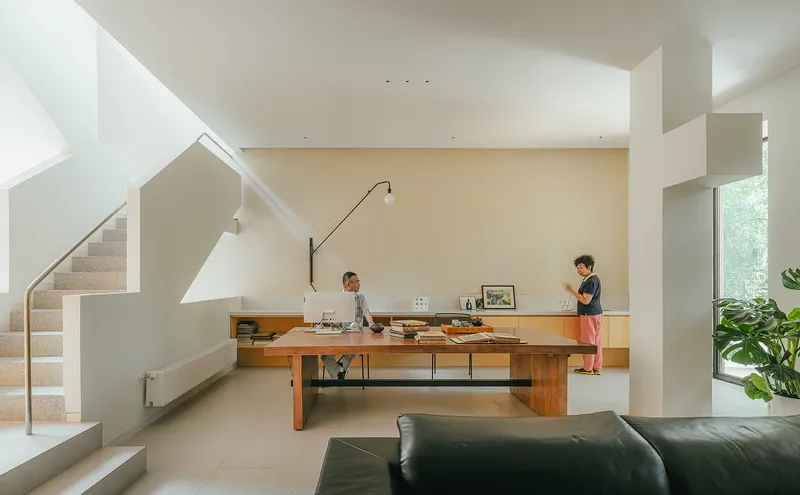
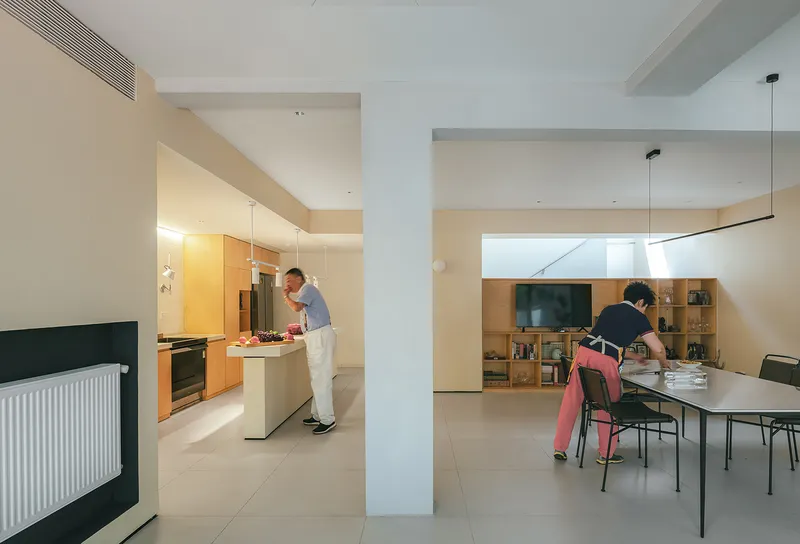
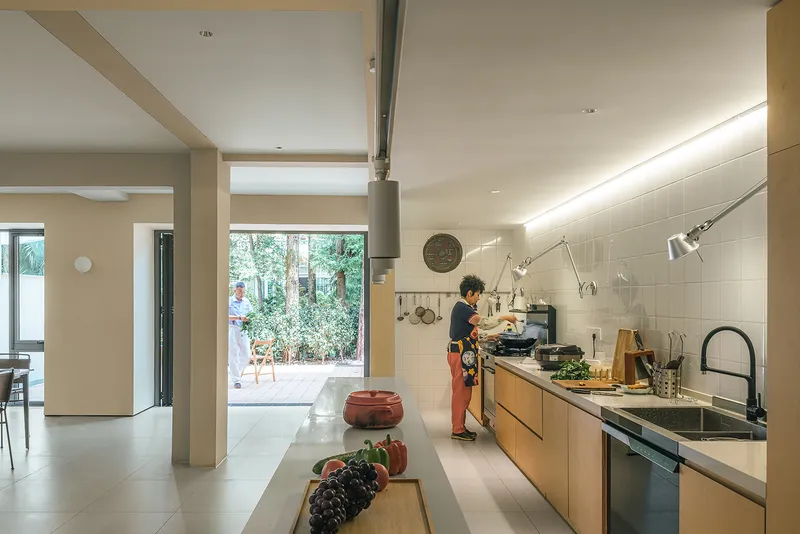
The double-height living and dining area is where the house's social life unfolds. A timber dining table sits beneath generous natural light, and the kitchen opens directly into this zone, separated only by white columns. Two people cooking, two people eating: the photographs capture domestic ritual with a directness that architectural images rarely achieve.
The kitchen itself is carefully resolved, with light wood cabinetry, a central island, and a white tile backsplash that keeps the space bright and easy to clean. There is nothing showy here, just a kitchen that works. The column grid, which recurs throughout the project, gives the open plan its rhythm without requiring walls.
Entry, Hallways, and the Art of Transition
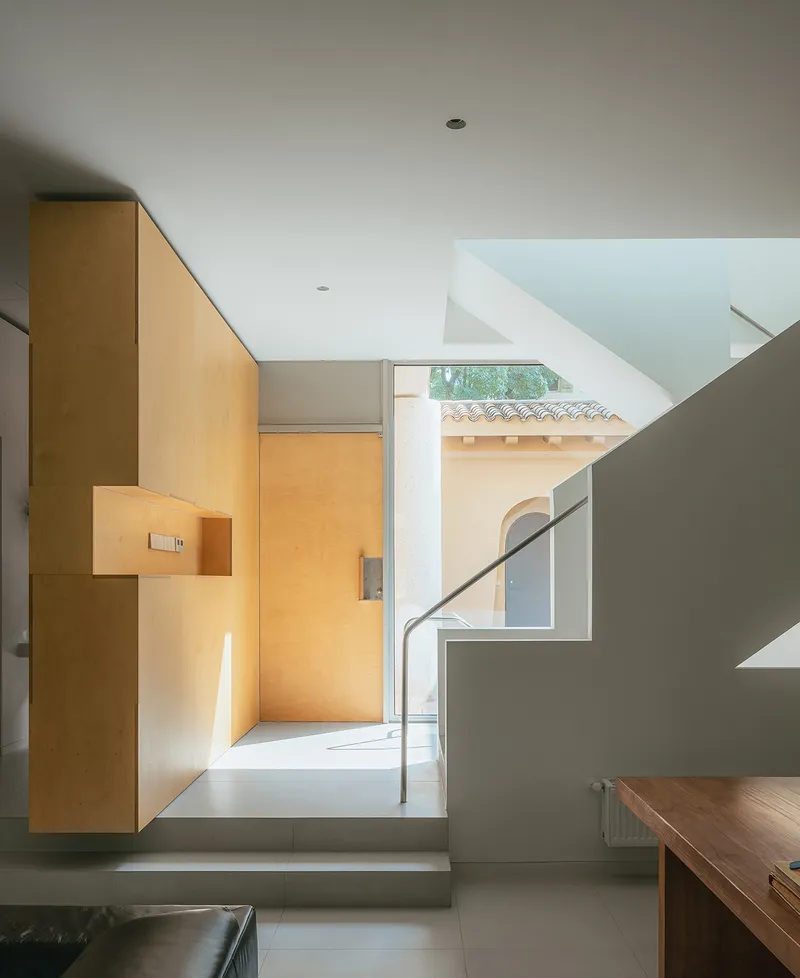
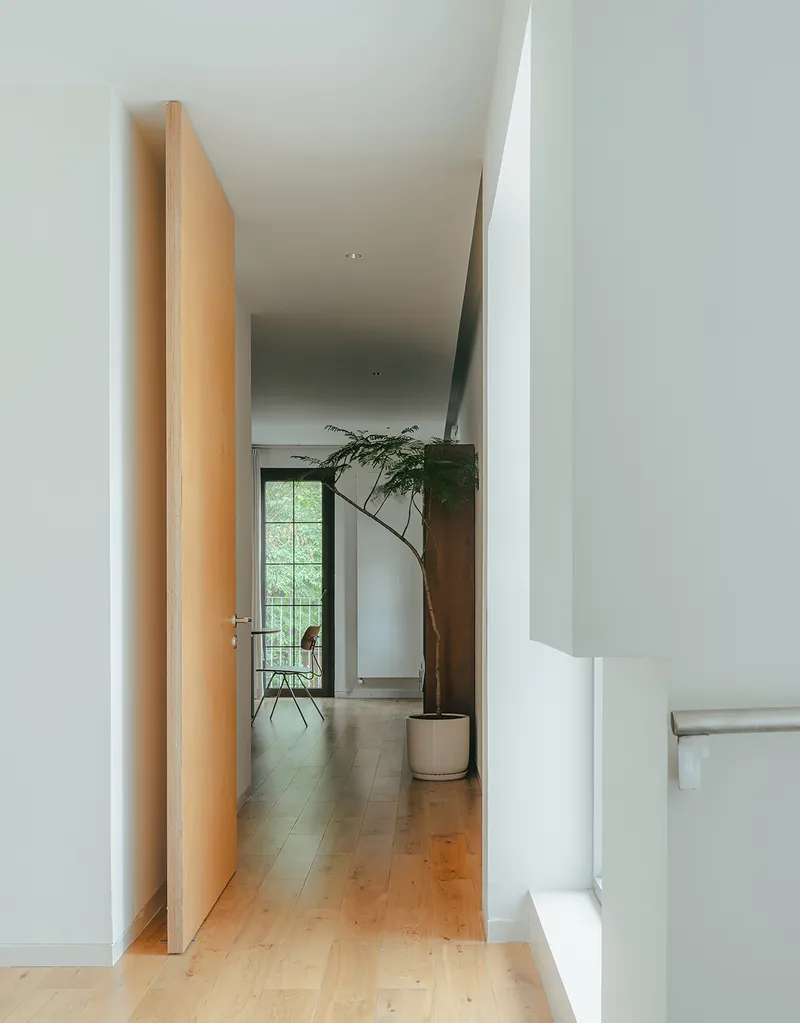
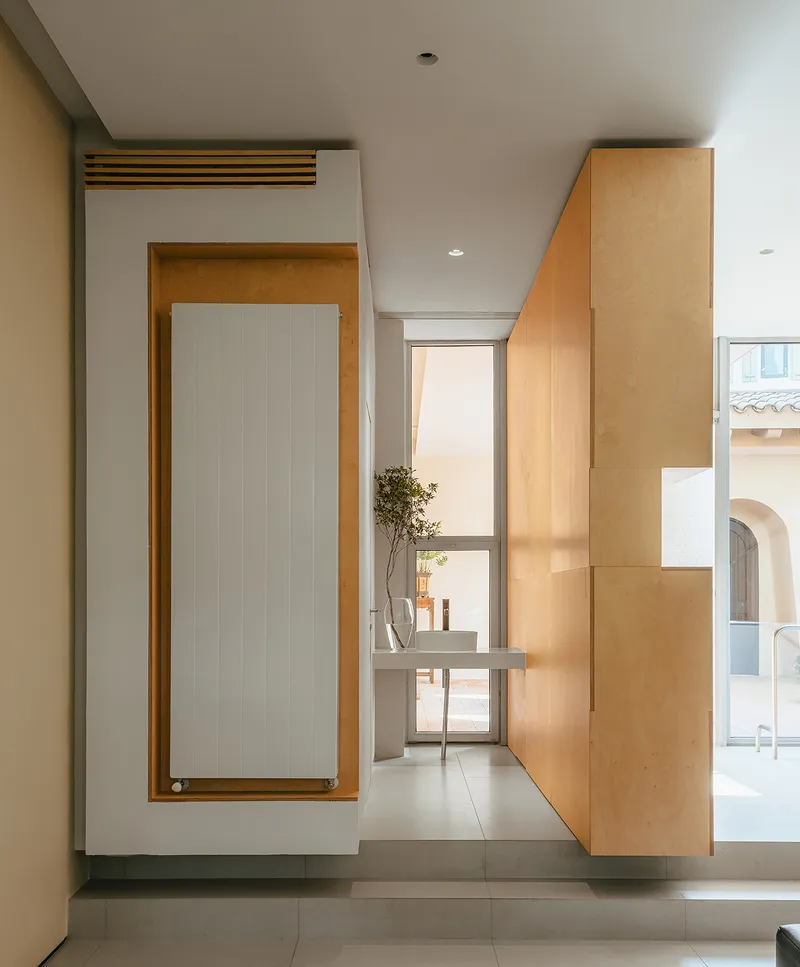
Hallways in residential architecture are often treated as leftover space. Here they are choreographed. The entry hall features a plywood storage wall with a view through to the courtyard and tile roof beyond, immediately establishing the material palette and the inside-outside relationship. Further in, a tall wood door with a potted plant beside it leads toward a glazed door, compressing and then releasing the visitor's sightline.
A plywood radiator panel in one hallway doubles as a textural element, catching afternoon light from the adjacent courtyard. These moments are small but deliberate, and they accumulate into something that feels genuinely architectural rather than merely decorated.
Upper Levels: Private Rooms and Rooftop Views
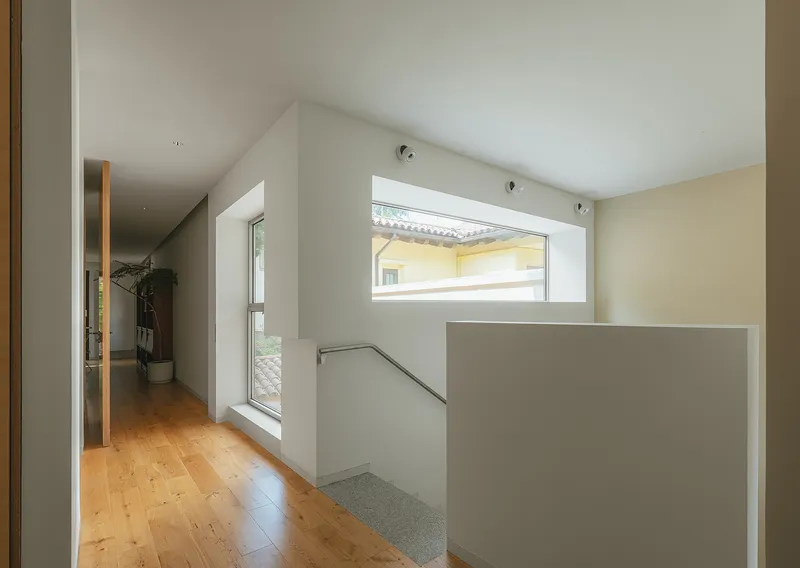
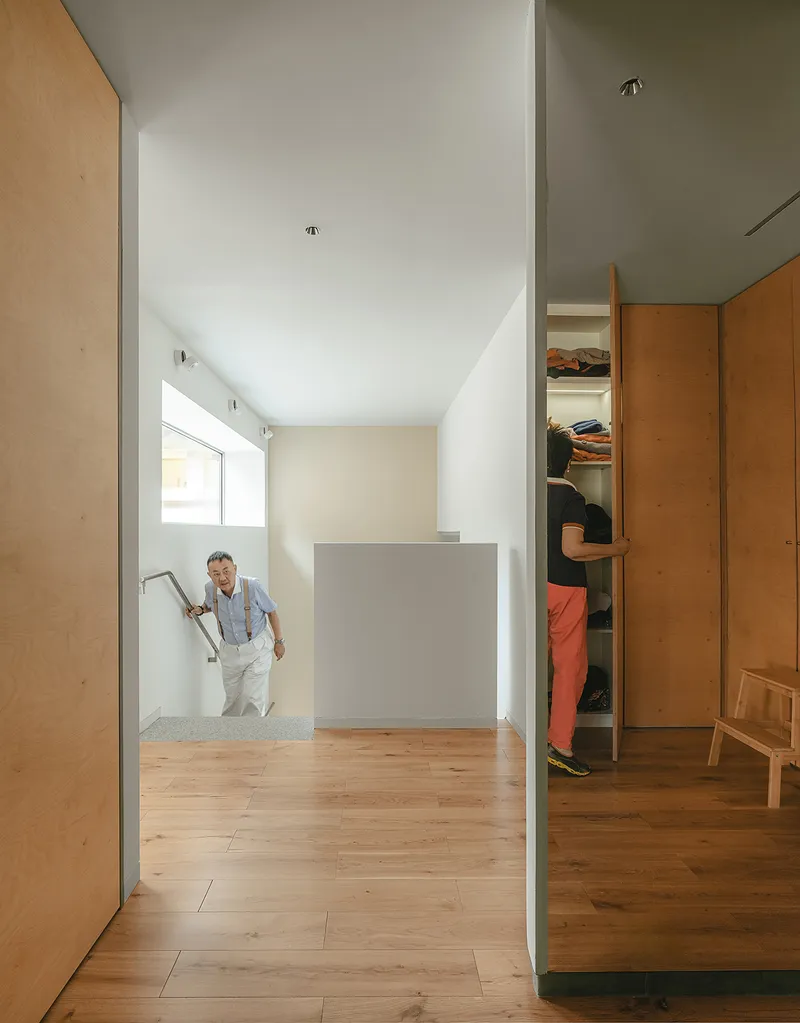
The upper floors hold the bedrooms, bathrooms, and private circulation. A hallway with wood flooring and a horizontal window overlooks neighboring rooftops, grounding the house in its hillside context. Cylindrical white columns reappear, casting long afternoon shadows across the floor. The interplay between the round column and the planar surfaces around it creates a surprisingly rich spatial effect from very simple means.
The staircase at this level shifts to terrazzo treads with a metal handrail beneath a clerestory window, continuing the material language established below while introducing more light as one ascends. A timber-lined hallway leads toward an open wardrobe niche, integrating storage into the architectural section rather than appending it.
Details That Hold the House Together
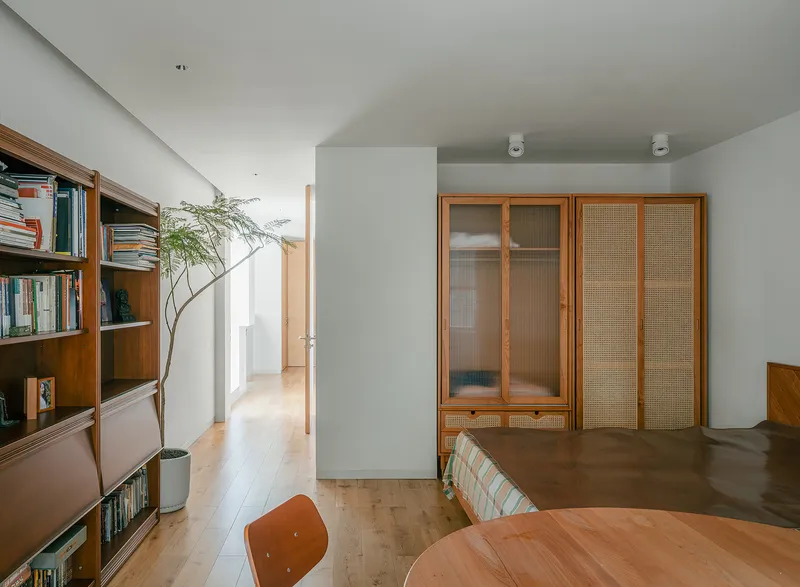
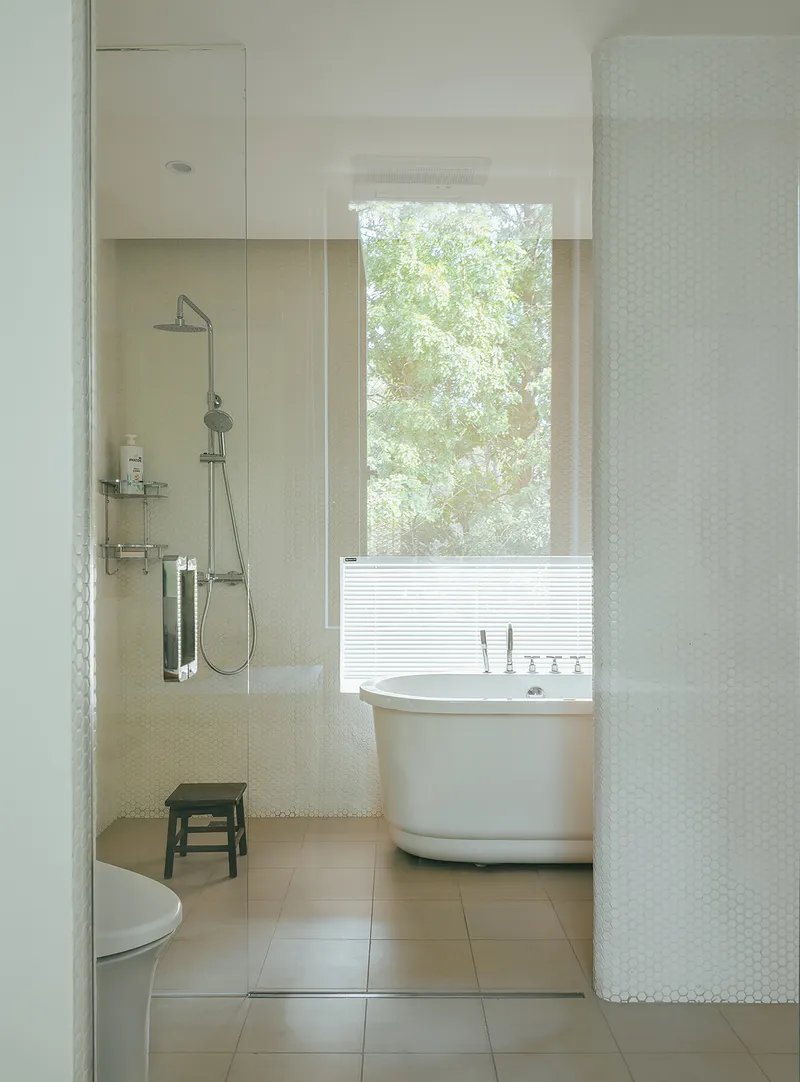
The curved timber bookshelf and rattan-panelled wardrobes in the living area demonstrate YES.ARCH's commitment to craft at the furniture scale. These are not off-the-shelf pieces dropped into a white box; they are integrated components that respond to the geometry of the rooms they occupy. The bathroom, with its freestanding tub, glass shower enclosure, and window overlooking green foliage, feels generous without being extravagant.
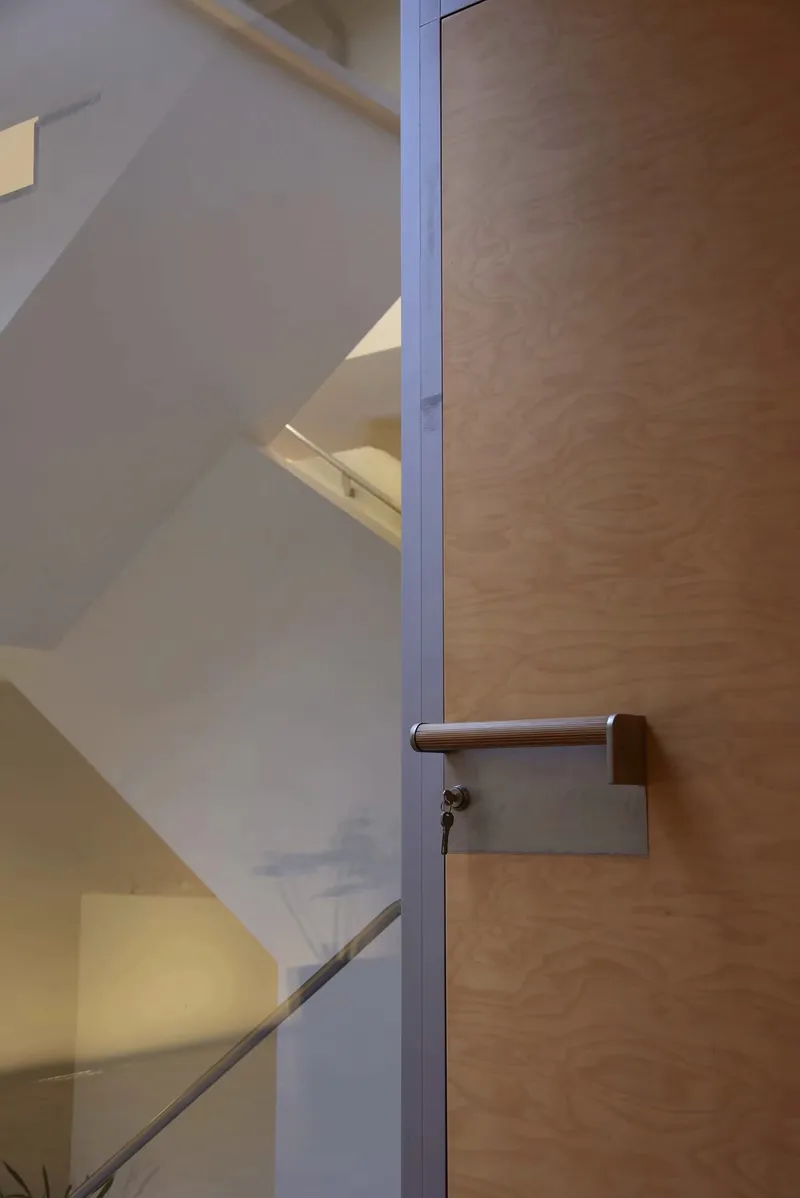
Even the plywood door with its metal handle and lock, photographed beside the white stairwell, registers as a considered design decision. The grain direction, the proportions of the handle plate, the way the door meets the wall: these details matter because they are touched every day.
Living With Light and Landscape
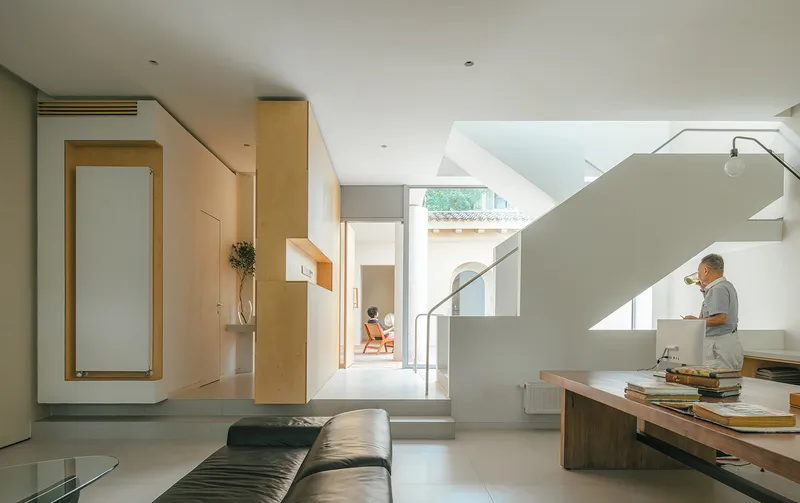
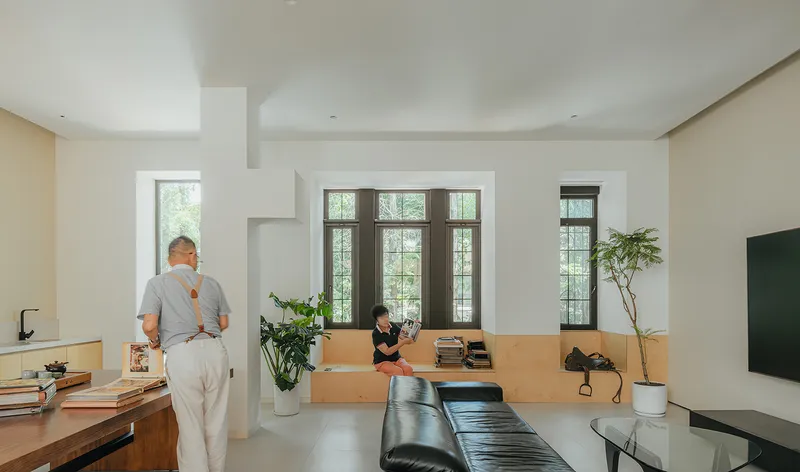
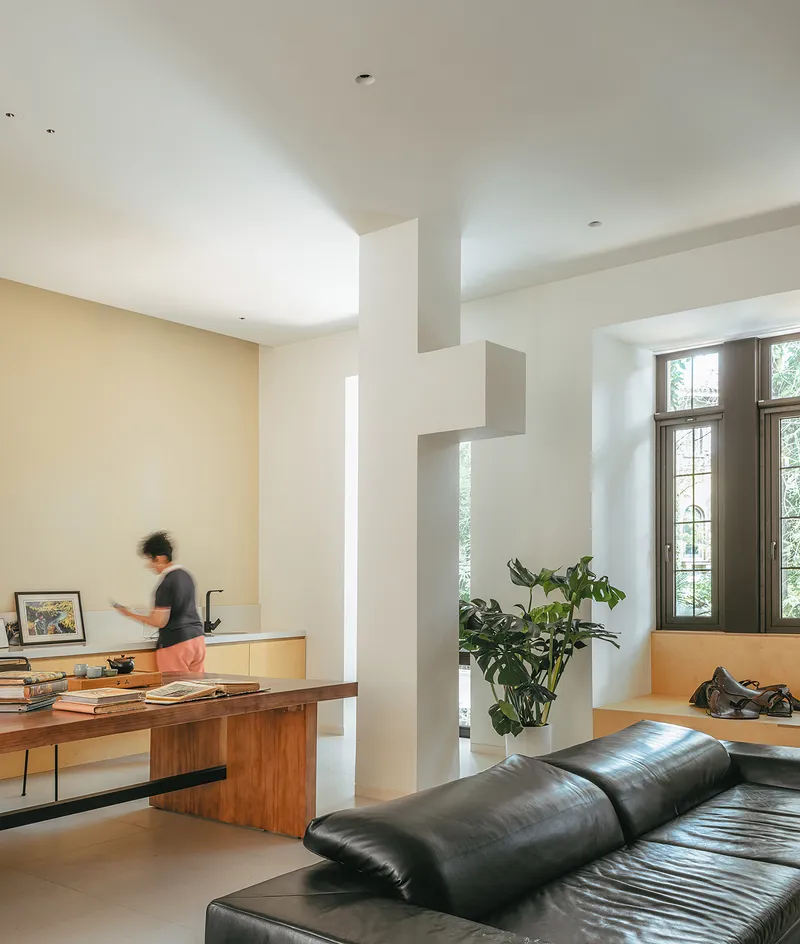
Afternoon sunlight floods the open living space through tall gridded windows overlooking greenery. Built-in timber seating and a wooden desk anchor the room, while a white geometric partition introduces a layer of spatial division without closing anything off. The relationship between interior and landscape is managed carefully: you see the foliage, you feel the light, but the house does not dissolve into its surroundings. It holds its own.
The column at the center of these images, whether cylindrical concrete in the courtyard or slender white in the living room, acts as a recurring motif. It organizes the plan, supports the structure, and gives the eye something to measure space against. It is the simplest architectural gesture imaginable, and YES.ARCH deploys it with real discipline.
Plans and Drawings
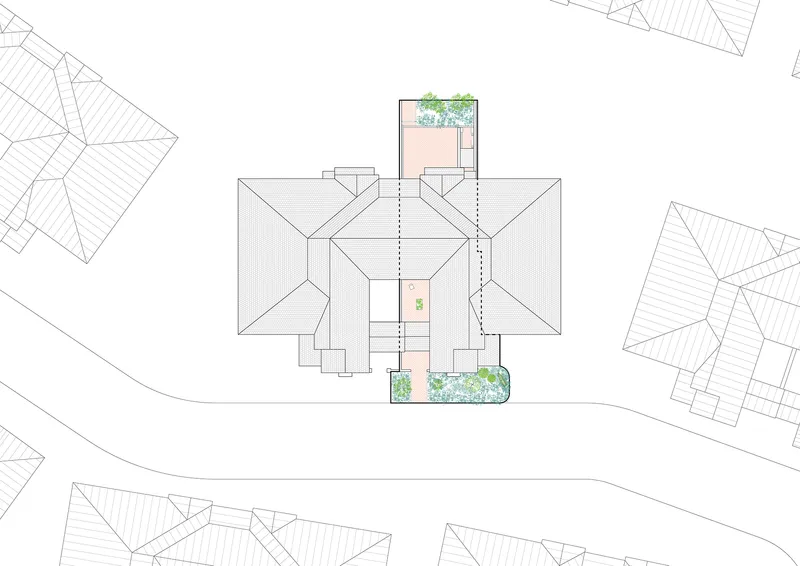
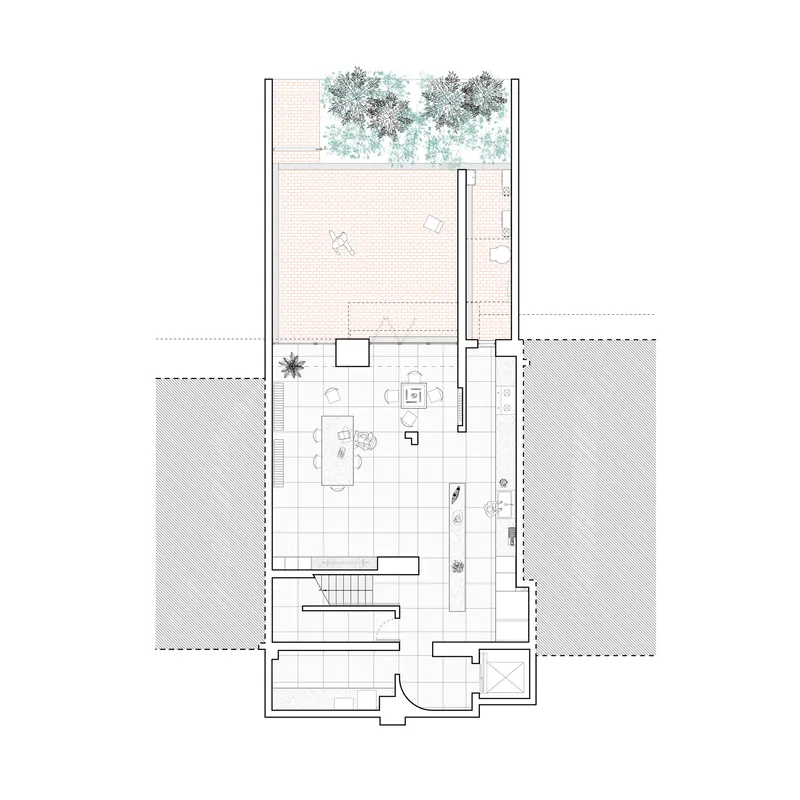
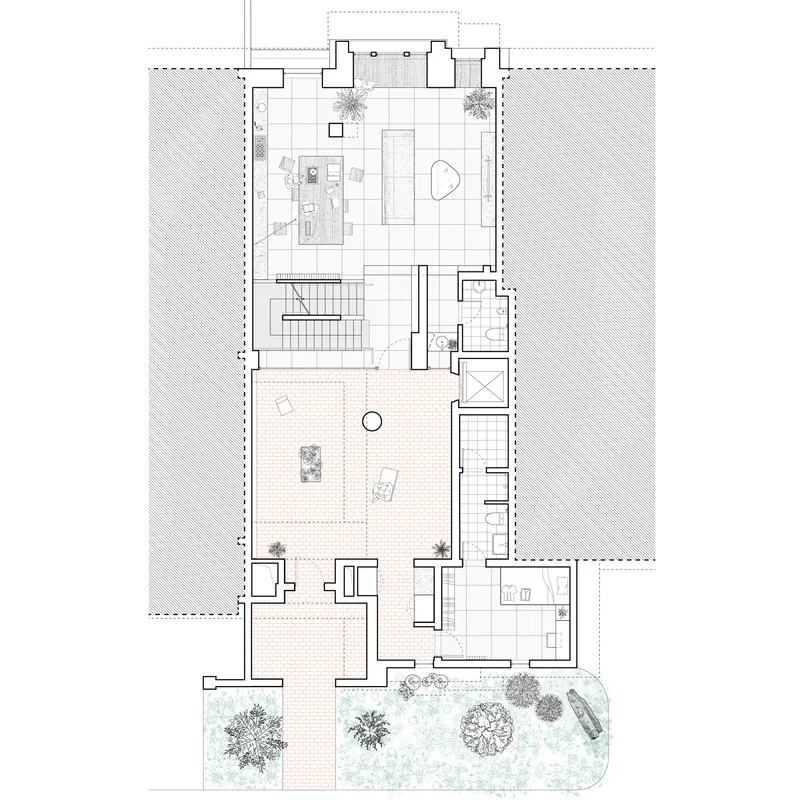
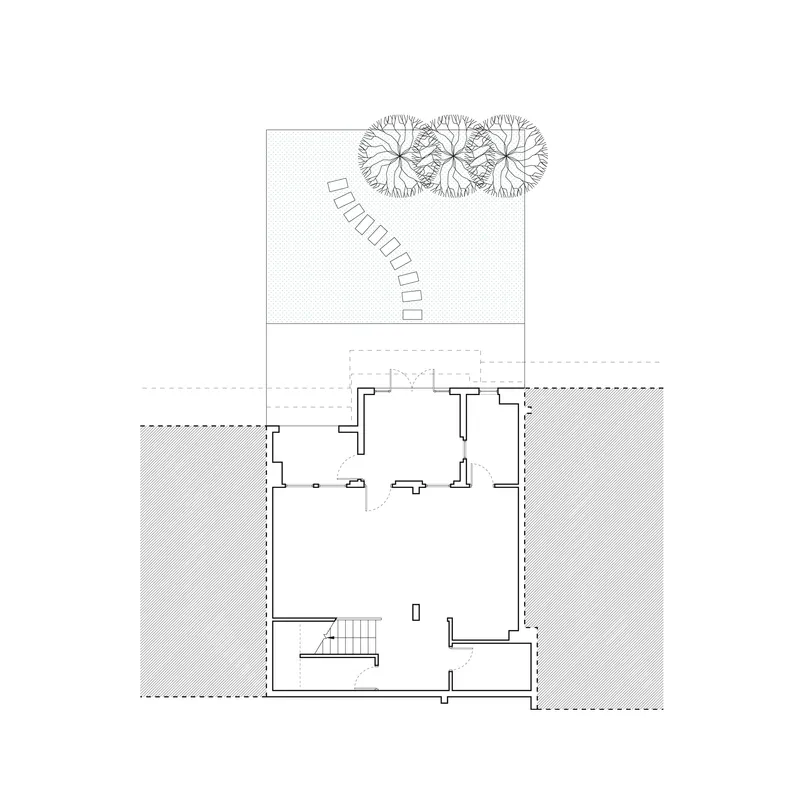
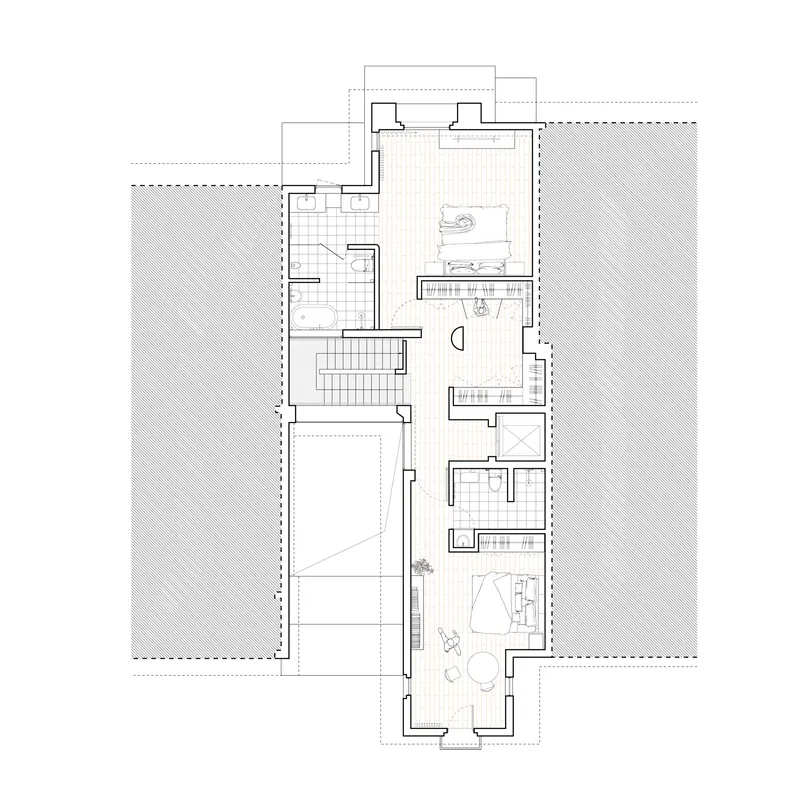
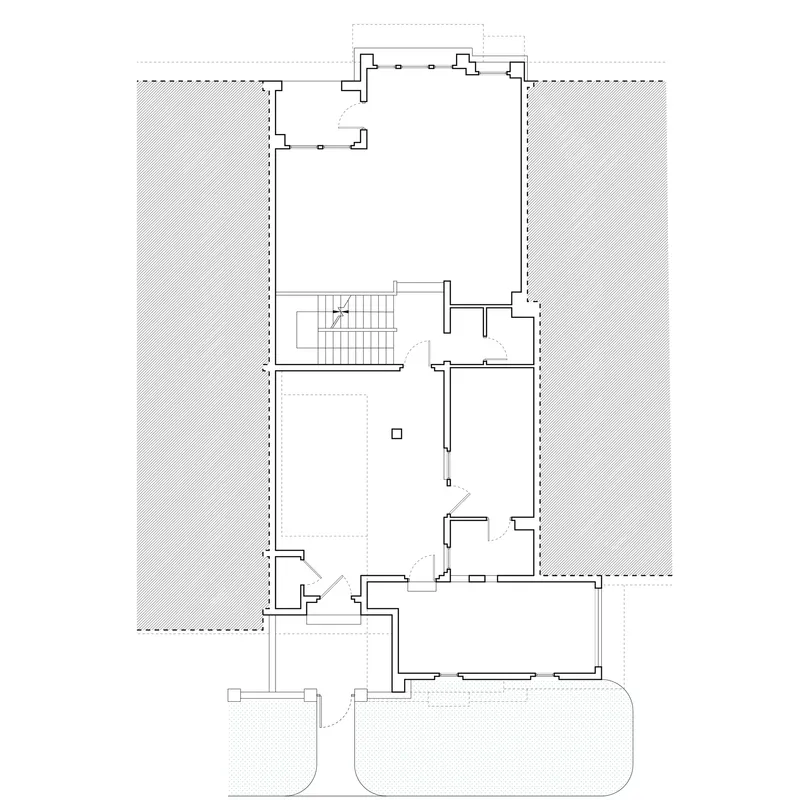
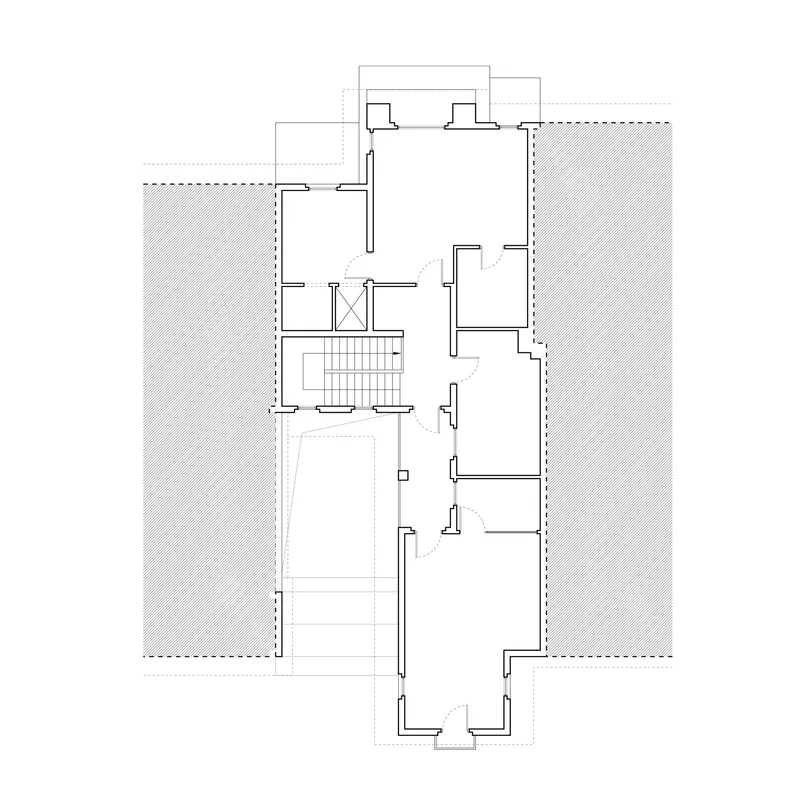
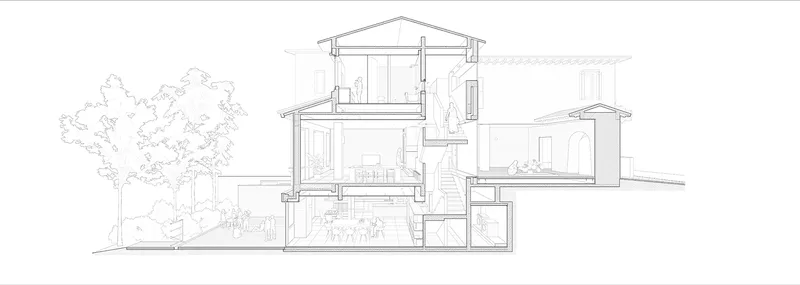
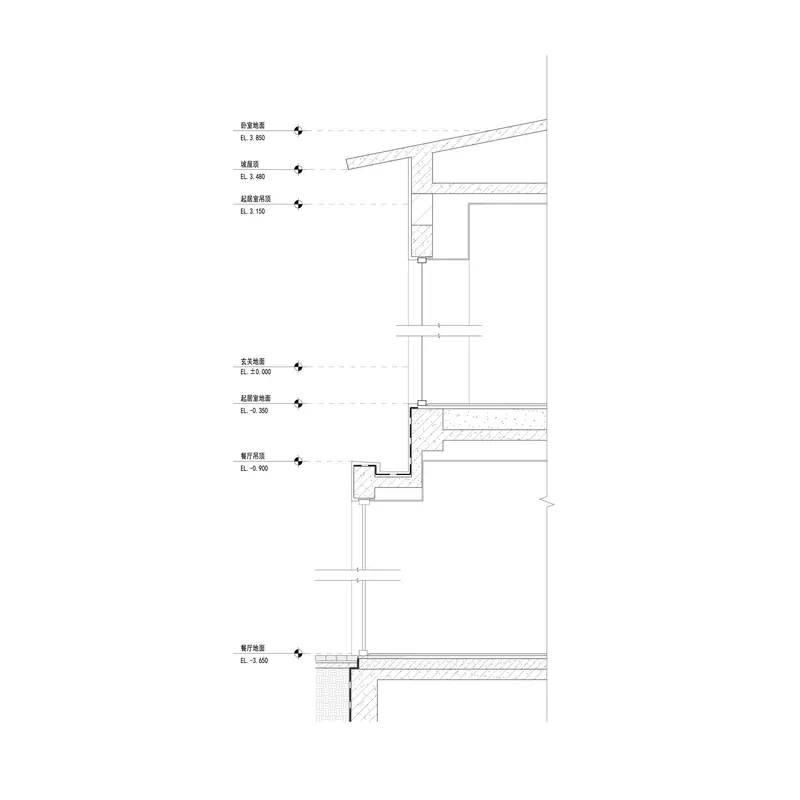
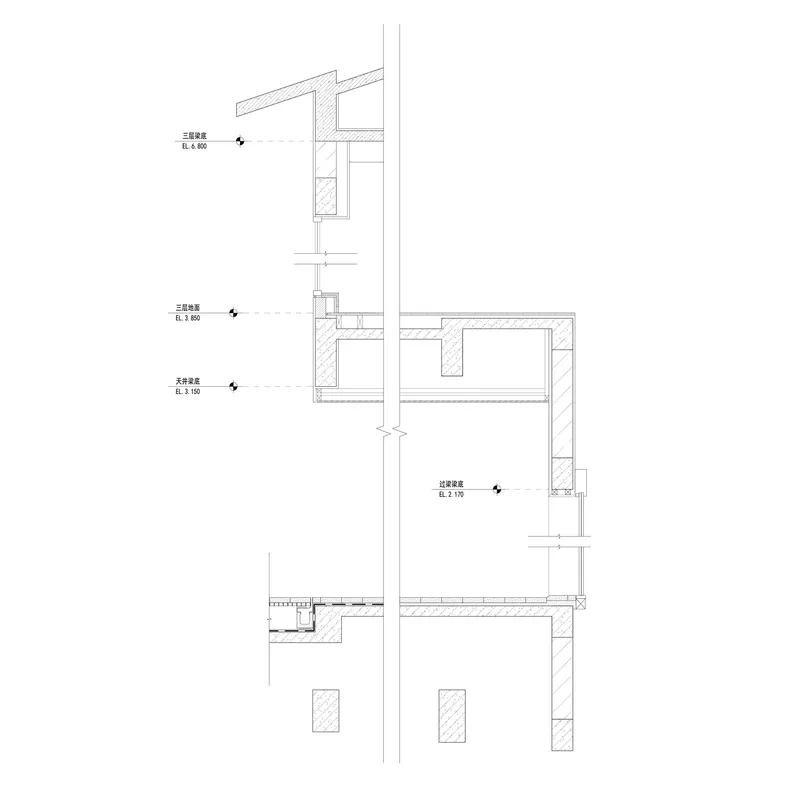
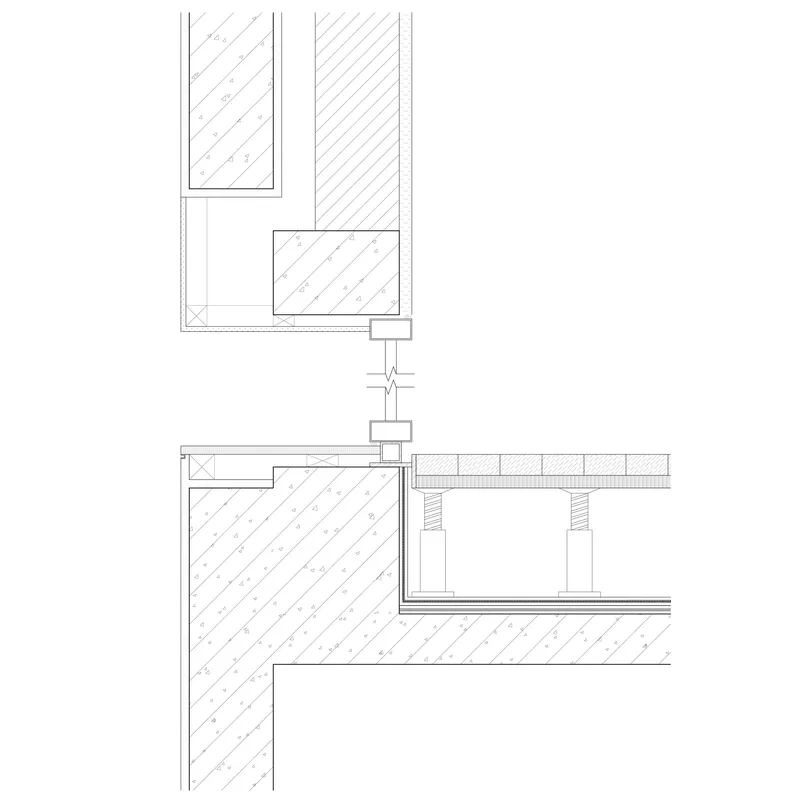
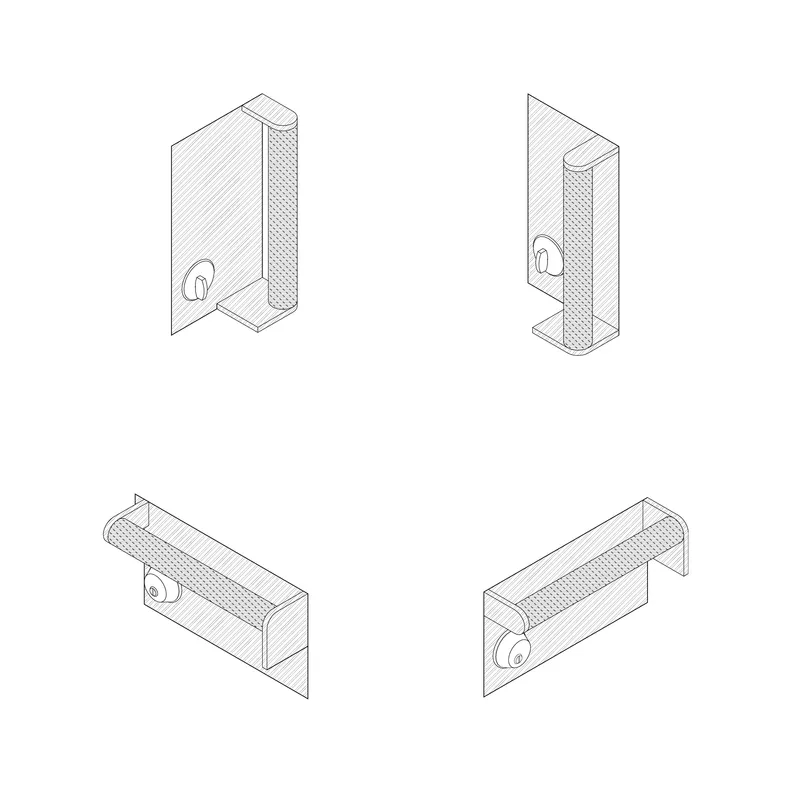
The drawings reveal what the photographs only suggest: the complexity of organizing domestic space across multiple terraced levels. The site plan shows the house nestled among neighboring structures, its hipped roof forms and planted courtyards visible from above. Floor plans at each level demonstrate how the central staircase anchors circulation, while courtyards, terraces, and gardens wrap the building's edges. The section drawings expose the sectional ambition clearly, with double-height voids, clerestories, and carefully calibrated floor-to-floor heights that accommodate the sloping site.
The wall section details and window frame assemblies show a level of construction precision that supports the project's material clarity. The isometric drawings of cylindrical mesh tubes connecting to flat wall panels reveal the logic behind the radiator enclosures and column treatments seen throughout the house. These are not decorative decisions; they are systems.
Why This Project Matters
PARENTS' House is a renovation that does not erase what came before. It works with the terraced site, the existing structure, and the everyday rhythms of its inhabitants. In a moment when residential architecture in China increasingly defaults to either nostalgic pastiche or Instagram-ready minimalism, YES.ARCH has produced something that is neither. It is specific, material, and lived in.
The project also represents something broader about the state of residential practice. Building a house for your parents is a profoundly personal commission. Luo Ren and Zhao Yao have responded with architecture that prioritizes comfort and longevity over spectacle. The terrazzo, the timber, the terracotta: these are materials that age well, that accept wear, that will look better in ten years than they do now. That kind of thinking is increasingly rare, and it deserves attention.
PARENTS' House by YES.ARCH (lead architects Luo Ren and Zhao Yao), Chongqing, China. 350 m², completed 2023. Photography by Yumeng Zhu.
About the Studio
Share Your Own Work on uni.xyz
If projects like this are the kind of work you want to make, uni.xyz is a place to publish your own, find collaborators, and enter design competitions.


Popular Articles
Popular articles from the community


Tsunami Convergenics: Turning Catastrophic Ocean Forces into Underwater Housing Infrastructure
A speculative underwater settlement off the coast of Onagawa, Japan, treats tsunamis and typhoons as energy sources rather than threats.

Faces of the Soviet Avant-Garde: Turning Moscow's Street Names into an Open-Air Museum
A network of sculptural installations across a Moscow residential district transforms forgotten architect names into spatial encounters with cultural memor

Cloaked Colonization: A Mobile Underwater Habitat That Moves Like a Fish
Micah Abaya's shortlisted EHC Pacific entry reimagines ocean settlement as a dispersed network of self-sustaining architectural organisms.

The Amber Palace Opera: A Geological Fiction Surfaces on Tallinn's Baltic Waterfront
Pierre Brillard reimagines a Baltic legend as a public landscape, opera house, and waterfront promenade rooted in Tallinn's coastal identity.

Similar Reads
You might also enjoy these articles

Pixel Gardens: One Repeated Module Stacked Into a Terraced Social Housing Tower for Famagusta
Salem Bader's shortlisted housing tower builds a vertical neighbourhood from one repeated module, offsetting units to carve terraces, light and air.

Bao Huynh Watercolor Atelier: A Serene Art Retreat in Hội An
Bao Huynh Watercolor Atelier in Hội An blends multifunctional art spaces, sustainable design, local materials, and family-friendly living in a serene environment.

Atelier Macri Concept Store Interior Design by CASE-REAL
Atelier Macri store features a "ko" counter, walnut wood details, cork displays, blending retail, gallery, and seamless customer experiences.

Manuel Vargas Izquierdo Stadium and High-Performance Sports Center: Architectural Excellence in Jalpa de Méndez
The Manuel Vargas Izquierdo Stadium blends sustainable design, inclusive sports facilities, and cultural-inspired architecture, revitalizing Jalpa de Méndez’s public spaces.

Explore Chinese Small Scale Architecture Competitions
Discover active competitions in this discipline

Challenge to design mud housing for contemporary communities

Challenge to design luxury tourism on rails

VR headsets Storefront design competition

Designing a staircase for a client
Comments (0)
Please login or sign up to add comments
No comments yet. Be the first to comment!