

A Parisian Parking Lot Becomes Social Housing
NZI Architectes transforms a car park in Paris into 6,575 square meters of social housing organized around a generous green courtyard.


Converting parking structures into housing is one of those ideas that sounds obvious in hindsight. Cars lose their monopoly on urban land, residents gain homes, and a neighborhood gets something better than a concrete void. In Paris, where buildable plots are scarce and social housing demand is relentless, NZI Architectes has pulled off exactly this transformation: a car park replaced by a 6,575 square meter residence arranged in two wings around a landscaped courtyard.
What makes the project compelling is not just the programmatic switch but the architectural proposition. Rather than treating the site as an infill afterthought, NZI has designed a building that establishes its own spatial logic while slotting carefully between existing masonry neighbors. The result is a courtyard typology that feels at once deeply Parisian and clearly contemporary, with a white structural grid, timber-framed windows, and a curved mansard roofline that negotiates with the city's roofscape on its own terms.
A Courtyard at the Heart of the Scheme


The central courtyard is the social engine of the project. Two new wings frame a generous green space planted with young trees and low planters, open to sky and oriented to pull daylight deep into the residential units on both sides. Historic apartment buildings remain visible beyond, giving the courtyard a layered sense of depth that connects the new to the old without pastiche.
At ground level, a glazed passage links the two wings and doubles as a communal threshold. Bicycles parked outside, a figure walking through planted beds: the courtyard is designed for daily life, not display. The landscape is modest but purposeful, softening what would otherwise be a hard urban gap between buildings.
The White Grid and Timber Frame


The facade system is the building's calling card. A white structural grid, expressed as a series of concrete panels, establishes a clear rhythm across the courtyard and street elevations. Timber-framed windows sit within this grid, their warm tone a deliberate counterpoint to the white frame. Glass balustrades complete each bay, keeping the composition tight without making it heavy.
The curved mansard roofline on the street side is the most overtly contextual move. It echoes the zinc roofscapes of the surrounding blocks, but here the curve is rendered in the same white-and-timber vocabulary as the rest of the facade. It reads as a contemporary interpretation rather than a reproduction, which is precisely where good Parisian infill architecture should land.
Navigating the Urban Seam


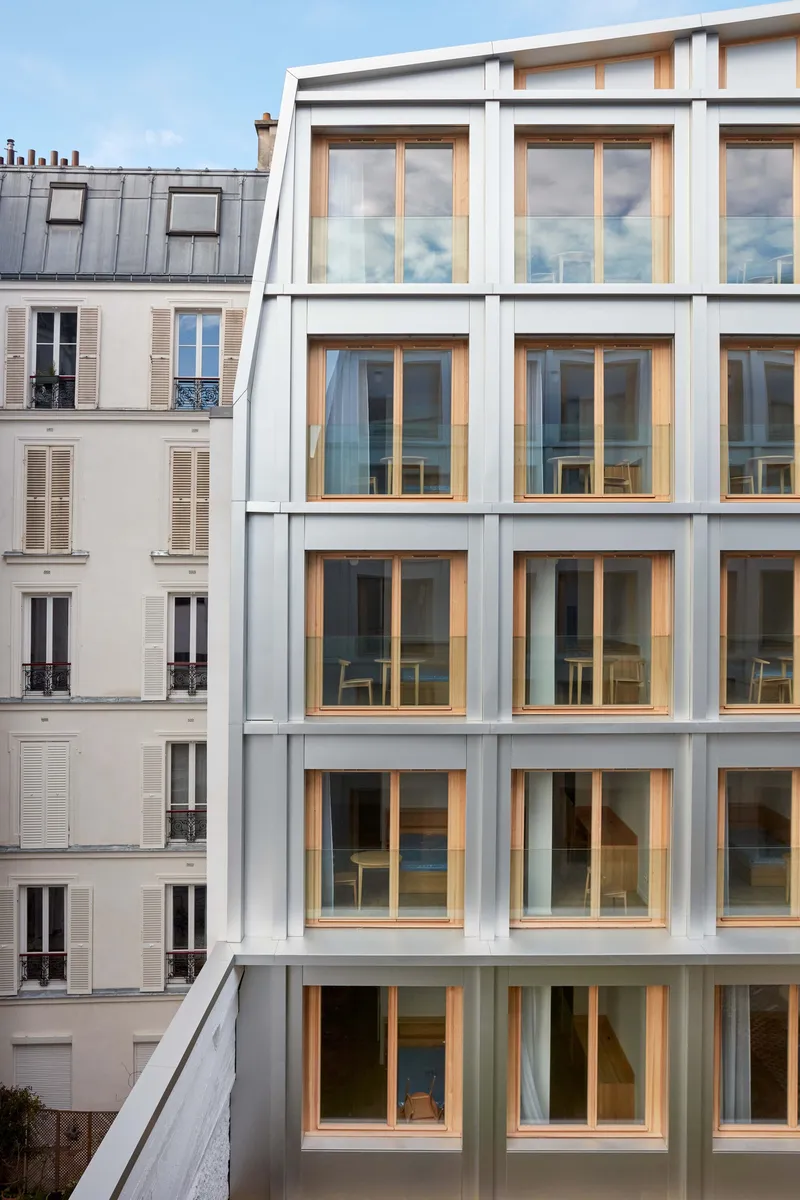
Inserting a new building between existing Parisian neighbors demands a particular kind of discipline. The street facade is four stories of timber-framed windows sandwiched between masonry party walls, its proportions calibrated to hold the streetline without competing with the heavier buildings on either side. At the rear, recessed timber windows create a quieter, more intimate elevation that steps back from adjacent buildings, managing privacy and light simultaneously.
The twilight views are especially revealing. When the interiors glow behind the gridded facade, you can read the structural logic of the building clearly: each bay a module, each module a domestic space. The repetition is honest about the social housing program, but the material warmth of the timber prevents it from feeling institutional.
Inside the Units
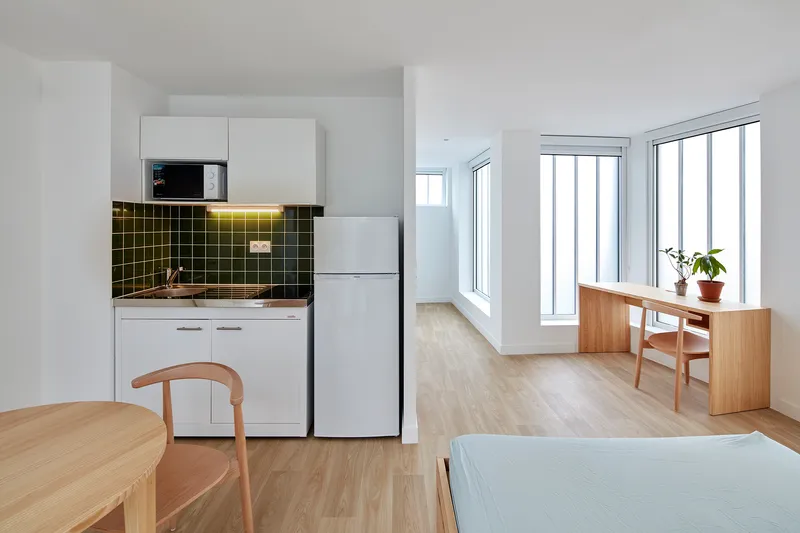
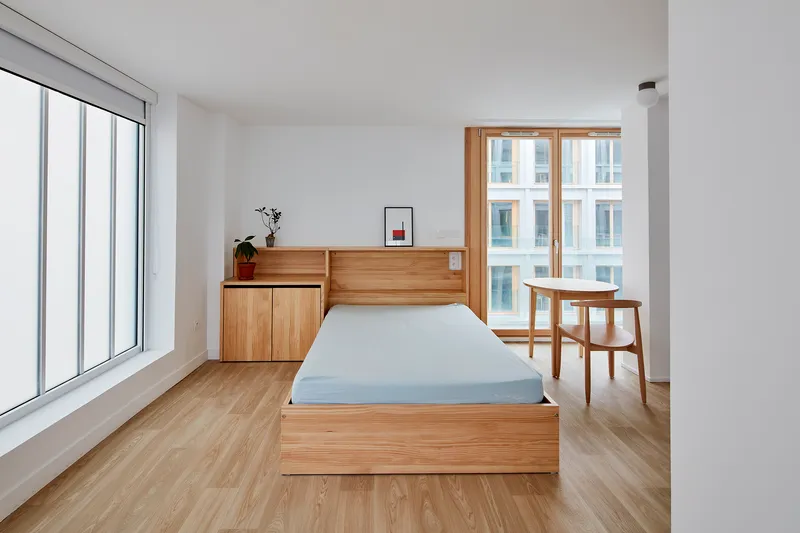
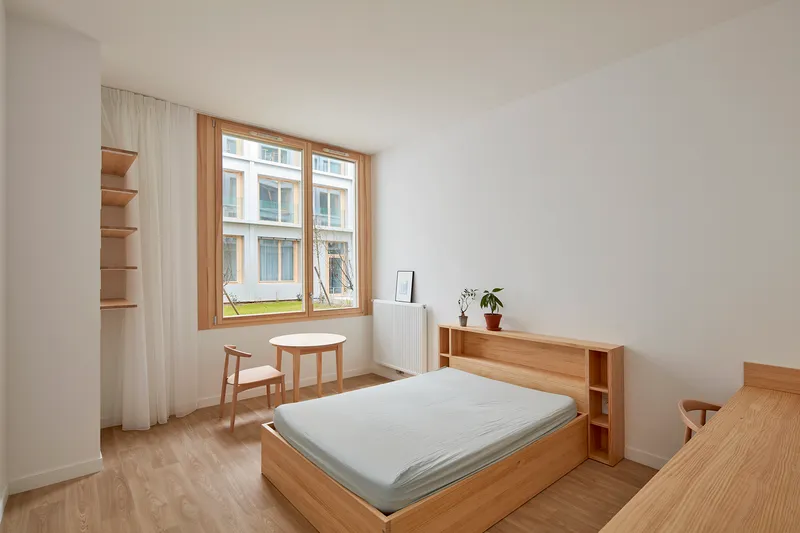
The interiors are compact but well-considered. Studio units feature dark green tile backsplashes in the kitchenettes, a small detail that gives each space a distinct identity against the light wood flooring that runs throughout. Bedrooms incorporate timber platform beds with built-in headboard storage, a move that maximizes usable floor area without resorting to the kind of folding-furniture gimmicks that often plague small social housing units.
Large windows overlooking the courtyard are the real luxury here. They flood the rooms with daylight and connect residents visually to the shared landscape below, reinforcing the idea that the courtyard belongs to everyone. The timber window frames, visible from both inside and out, provide the only decorative gesture the interiors need.
Circulation and Common Spaces
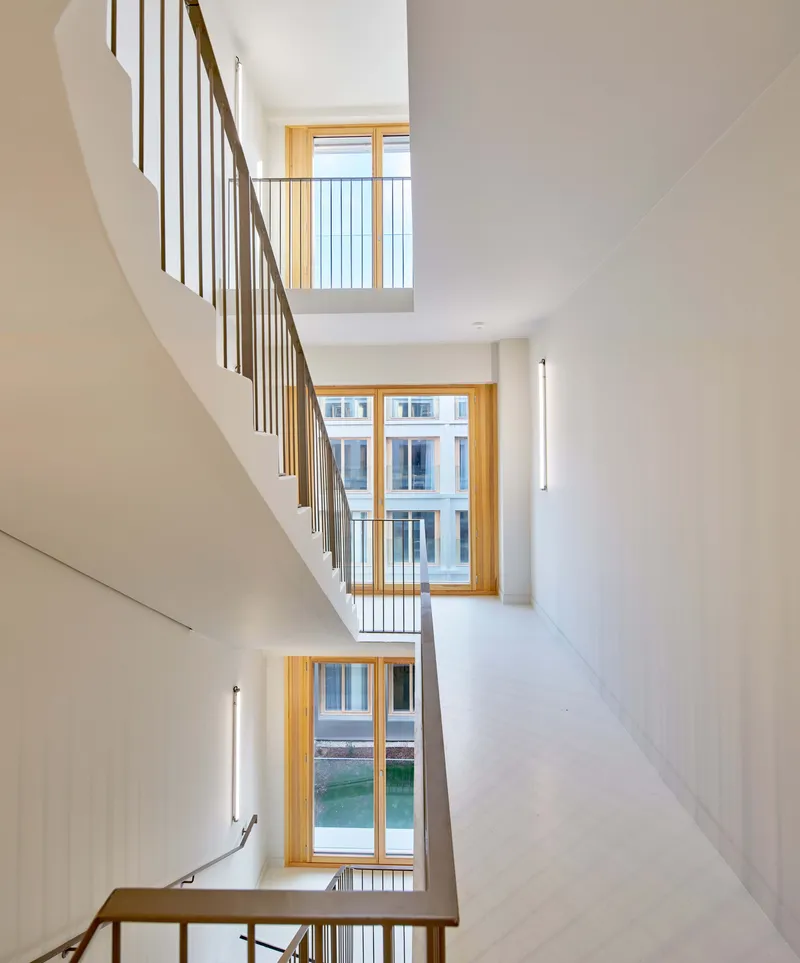


The stairwell is one of the project's quieter successes. Timber handrails and white walls are lit by timber-framed windows at each landing, making vertical circulation feel generous rather than perfunctory. It is a small investment that pays off in daily experience, especially in social housing where common areas are often the first thing to be value-engineered away.
Corridors feature perforated acoustic ceiling panels and green rubber flooring that leads to olive-green unit doors. The color palette is restrained but deliberate: green as a unifying thread from the courtyard landscape through the corridors and into the kitchenettes. At dusk, the glazed ground floor passage between the two wings creates a visual connection across the courtyard that reinforces the building's identity as a single community rather than two separate blocks.
Plans and Drawings


The site plan and axonometric drawings make the urban strategy legible. Two residential blocks flank a central courtyard, with the new volumes carefully positioned within the surrounding fabric. The axonometric showing sun path and the highlighted central arched volume clarifies how the courtyard was shaped to maximize solar access, a critical consideration for a mid-block Parisian site.


The floor plans reveal a pragmatic arrangement. At ground level, residential units ring the central courtyard with clear circulation zones providing access. Upper levels wrap three sides of the courtyard, maximizing the number of units with direct views onto the green space. The plans are tight but not cramped, reflecting the kind of efficiency that social housing demands without sacrificing spatial quality.

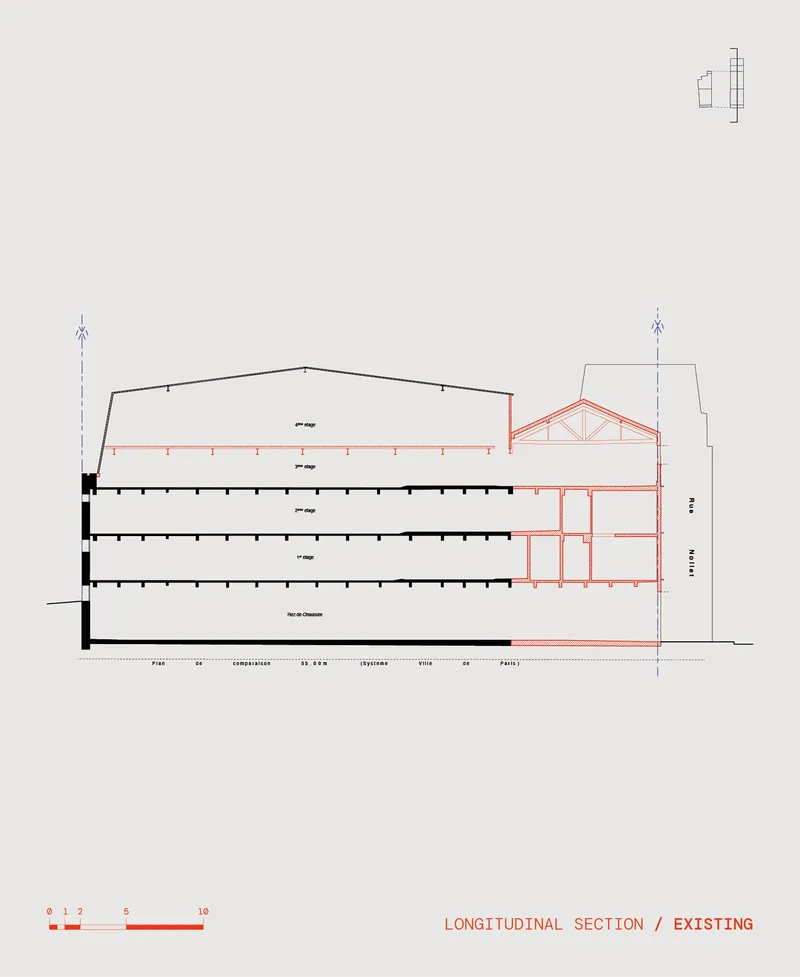

The existing and proposed sections tell the story of transformation. The existing structure's gabled roof and four floor levels are replaced by a multi-story building with a dedicated stair core and five residential floors. The longitudinal section through the proposed building shows how each floor plate is served by generous stair access, with the section cut revealing the relationship between the new volumes and the existing urban context.


Cross sections through the flanking wings and central courtyard confirm the five-story height and the proportions of the open space between. The courtyard is wide enough to feel like a genuine outdoor room rather than a light well, which is the difference between a social housing project that works and one that merely meets the minimum standards.

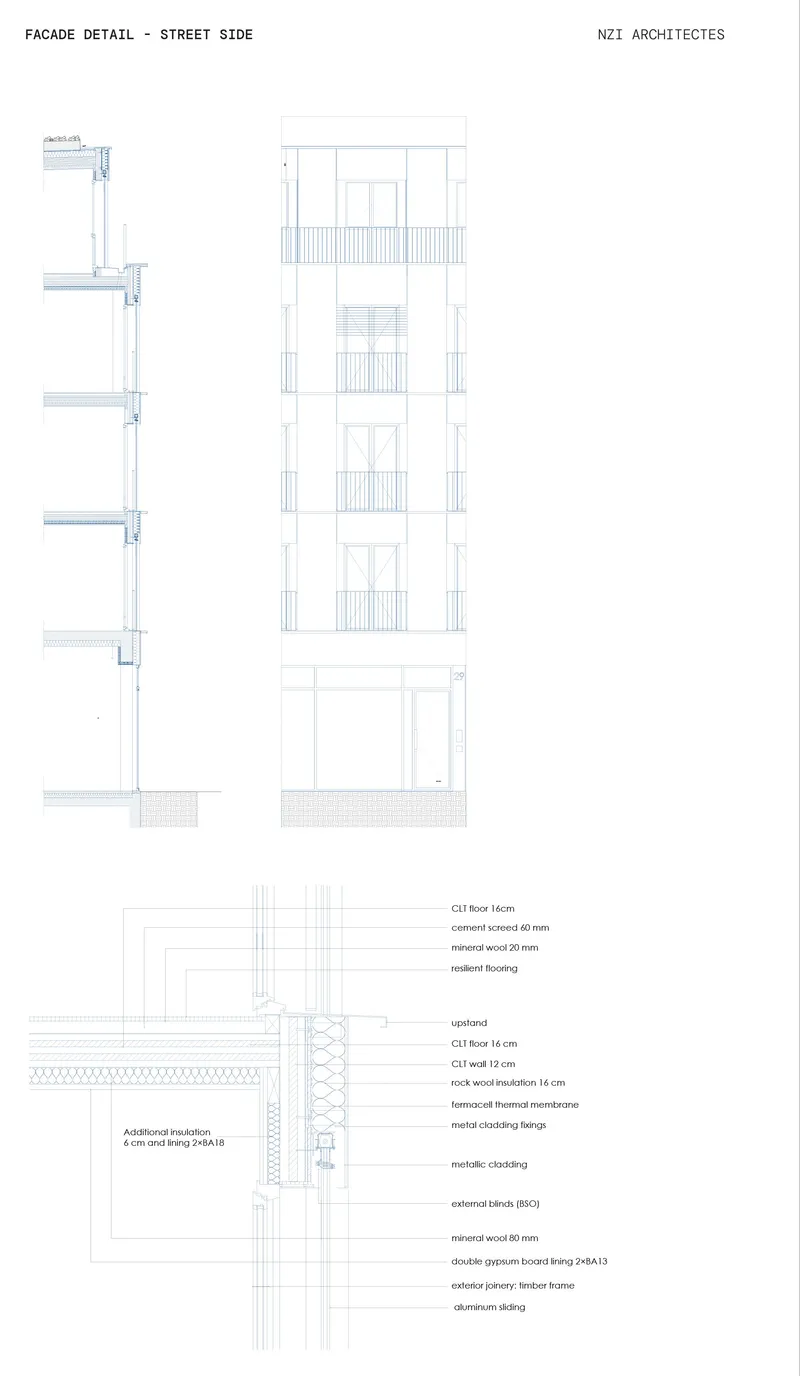
The facade detail sections are worth close attention. They show the layered assembly of window, cladding, and floor structure at both the courtyard and street-facing elevations. Balconies on the street side and the material transitions at ground level are resolved with a clarity that suggests the construction was as carefully considered as the urban design. These are the drawings that separate a good concept from a well-built building.
Why This Project Matters
Paris does not lack ambition when it comes to social housing, but it often lacks sites. Converting a parking structure into a residential courtyard block is a model that other dense European cities should be studying closely. NZI Architectes has demonstrated that adaptive reuse need not mean aesthetic compromise: the white grid and timber frame establish a strong architectural identity that holds its own against the surrounding 19th-century fabric while respecting its proportions and grain.
More importantly, the project argues that social housing deserves the same spatial generosity as market-rate development. The courtyard, the timber-lined stairwells, the carefully framed views from every unit: these are not luxuries, they are the baseline conditions for dignified urban living. If every decommissioned car park in Paris produced a building this thoughtful, the city's housing crisis would look very different.
Parking Lot into Social Housing Residence by NZI Architectes, Paris, France. 6,575 m², completed 2025. Photography by Frederic Delangle.
About the Studio
Share Your Own Work on uni.xyz
If projects like this are the kind of work you want to make, uni.xyz is a place to publish your own, find collaborators, and enter design competitions.


Popular Articles
Popular articles from the community


graciastudio Turns a Viewless Tijuana Lot Inward Around a Courtyard of Concrete, Timber and Trees
In Tijuana, Jorge Gracia's GA2 House stacks a timber-clad private floor over exposed concrete and replaces a missing view with a planted interior patio.


Aquadapt: An Underwater Habitat That Rewrites Its Rooms by the Hour
Curved modules ring the seabed while one shell shifts from breakfast room to cinema, farm and football pitch as residents' needs change.

ETEH Reworks the Shared Spaces of São Domingos School in Brazil Around Timber, Color and Hanging Plants
At São Domingos School in Brazil, 436 m² of hall, refectory and library are recast with timber joinery, a yellow and blue code and trailing greenery.

Opera on the Sea: Driftwood Logic Shapes a Timber Opera House on Estonia's Coast
Trevor Orgill's opera house translates the entangled drift of floating timber into a civic building where wood, water, and music converge.

Similar Reads
You might also enjoy these articles

LAVA Architecten Gives Vocational Education a Sawtooth-Roofed Face on a Mechelen School Campus
In Mechelen, Belgium, a 2,053 m² STEM school on a 6×6 m grid turns workshops and classrooms into rooms that can be rearranged as teaching changes.

KEMA Studio Turns a Derelict Marvila Attic into a 60 m² Lighthouse Apartment Above Lisbon
In Lisbon's Marvila district, a rebuilt roof, four skylights and two plywood volumes turn an unlivable attic into a bright home facing the Tagus.

Pixel Gardens: One Repeated Module Stacked Into a Terraced Social Housing Tower for Famagusta
Salem Bader's shortlisted housing tower builds a vertical neighbourhood from one repeated module, offsetting units to carve terraces, light and air.

Bao Huynh Watercolor Atelier: A Serene Art Retreat in Hội An
Bao Huynh Watercolor Atelier in Hội An blends multifunctional art spaces, sustainable design, local materials, and family-friendly living in a serene environment.

Explore Plugin Housing Competitions
Discover active competitions in this discipline

Comments (0)
Please login or sign up to add comments
No comments yet. Be the first to comment!