

Patrick Arotcharen Wraps a Bordeaux Villa Around Its Own Private Landscape
On a landlocked plot in Le Bouscat, curving white walls create a domestic world that turns its back on the street entirely.


Most urban villas in Bordeaux resolve the tension between privacy and garden life by doing one of two things: planting a compact mineral block in the center of the lot or pushing the house to the street edge to free up a rear yard. Patrick Arotcharen Architecte does neither. For the Bouscat Villa, completed in 2025 on a landlocked plot in the commune of Le Bouscat, the practice unfurls a series of curved white walls that wrap around a central landscape of lawn, mature trees, and a dark-bottomed pool. The house does not face the neighborhood. It faces itself.
What makes this project genuinely interesting is its refusal to treat the garden as leftover space. The building is shaped by the landscape, not the other way around. Curved wings define outdoor rooms with the same spatial precision that straight walls would bring to interior ones. The result is a house where the boundary between inside and outside is not dissolved (a tired ambition) but choreographed, so that every threshold feels intentional and every view through glass is already framed by plaster, brick, or tree canopy.
Arrival Through the Canopy

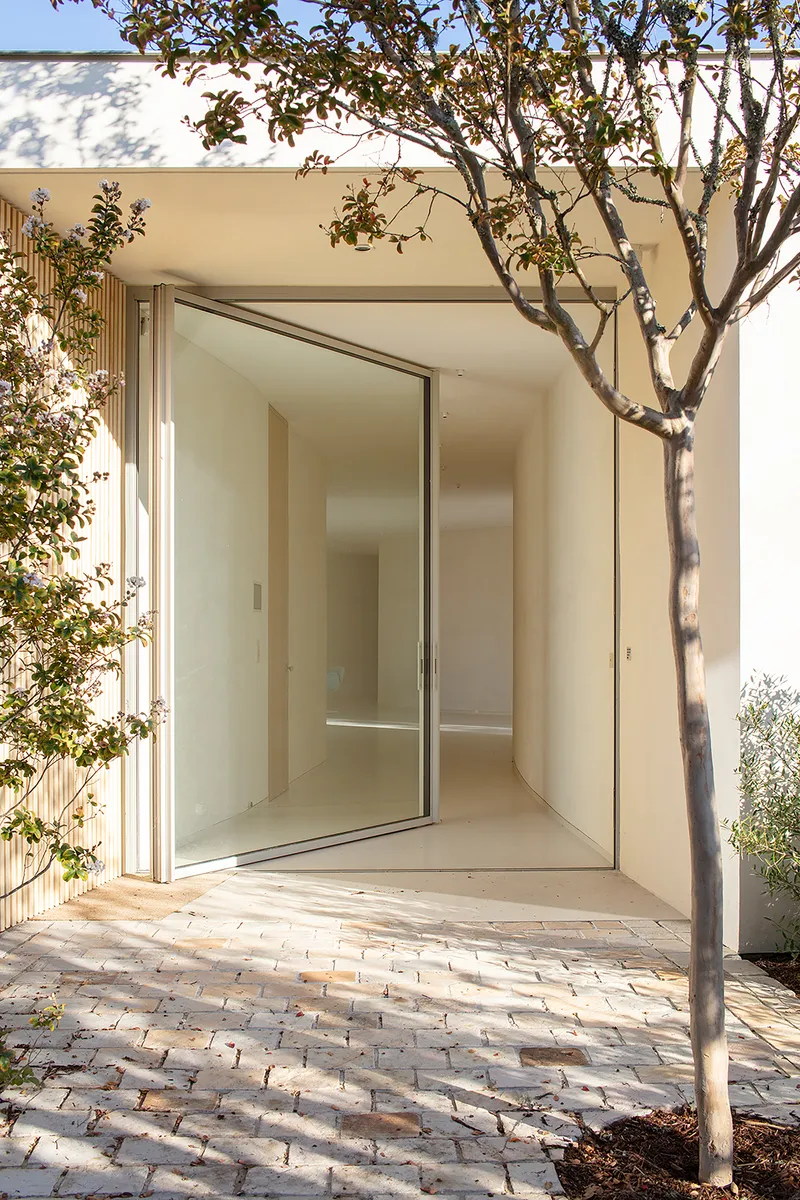
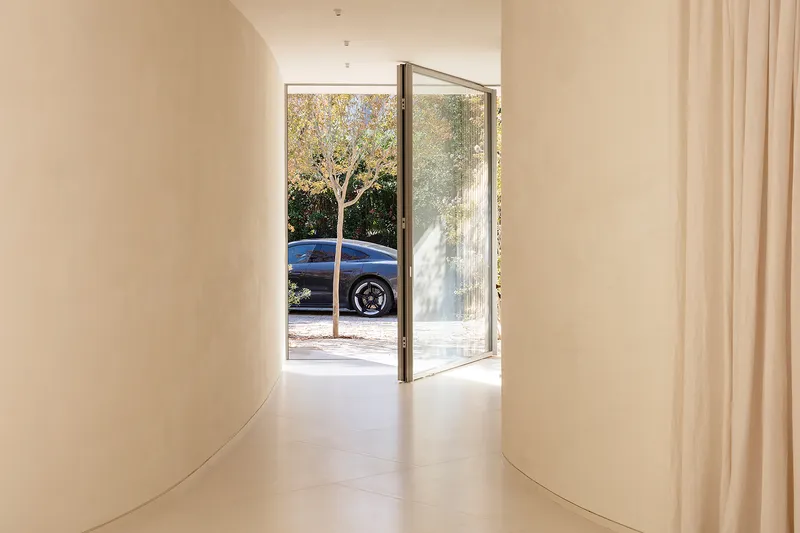
The approach sequence sets the tone. A brick paver driveway curves through existing trees toward a white stucco entrance volume, deliberately underplaying the scale of the house behind it. There is no grand facade. Instead, a pivot glass door framed by a tree trunk and dappled shadows offers a glimpse inward. From the street, you register a wall and a few trunks, nothing more.
The curved hallway entrance, visible from outside through the glass pivot, reveals a blue car parked beyond: a casual, almost cinematic detail that suggests this house treats movement and sightlines as design material. The compression of the entry corridor, flanked by tall curved plaster walls, makes the eventual release into the garden all the more effective.
The Curve as Organizing Principle
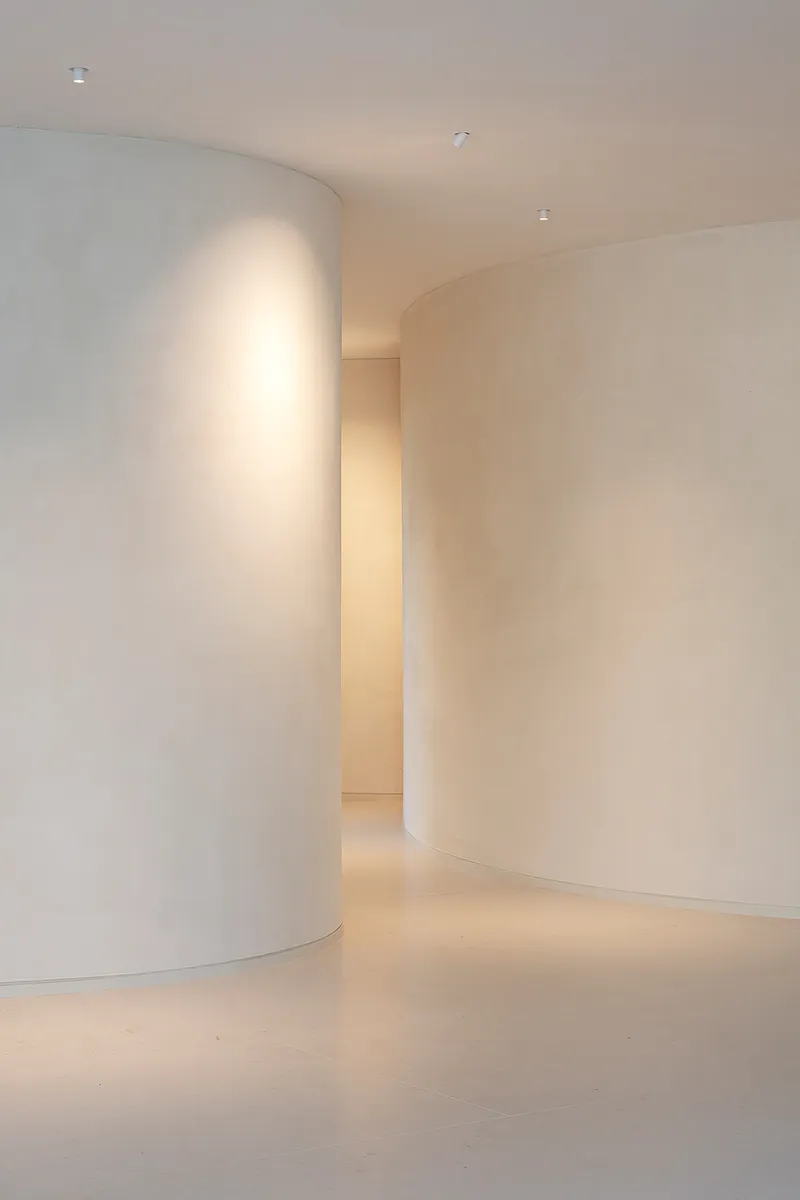

Arotcharen uses the curve not as decoration but as the primary tool for spatial organization. Interiors flow through arched openings between rooms without the abruptness of right-angled corridors. A passageway between two tall curved plaster walls, lit by a recessed ceiling slot, acts as a decompression chamber between the entrance and the living zones. It is a narrow, almost monastic space that slows you down before releasing you into open plan areas.
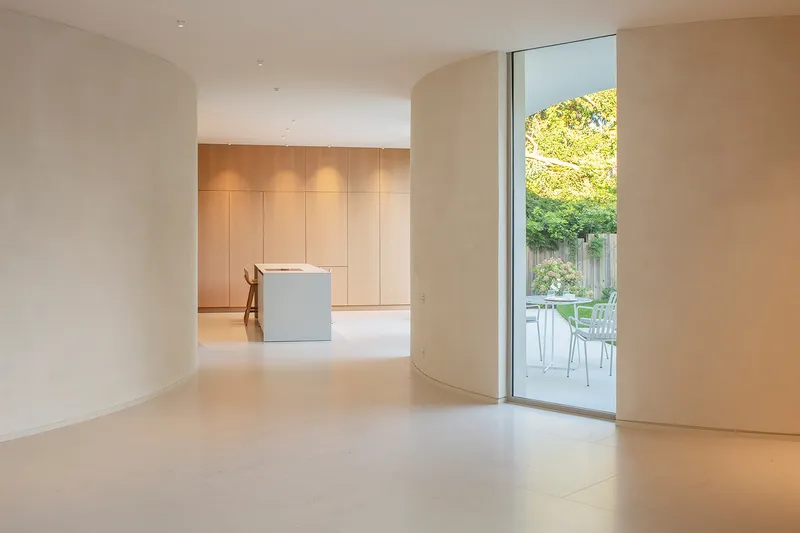
The view through a curved opening into the dining area reveals how this geometry works at a domestic scale. Pale plaster walls bend gently, creating soft thresholds rather than hard partitions. The kitchen, with its timber cabinetry and full glass wall to the garden, sits at the terminus of one of these curving axes. The garden is always present in your peripheral vision, pulling you outward even when you are deep inside the plan.
Living Between Glass and Garden
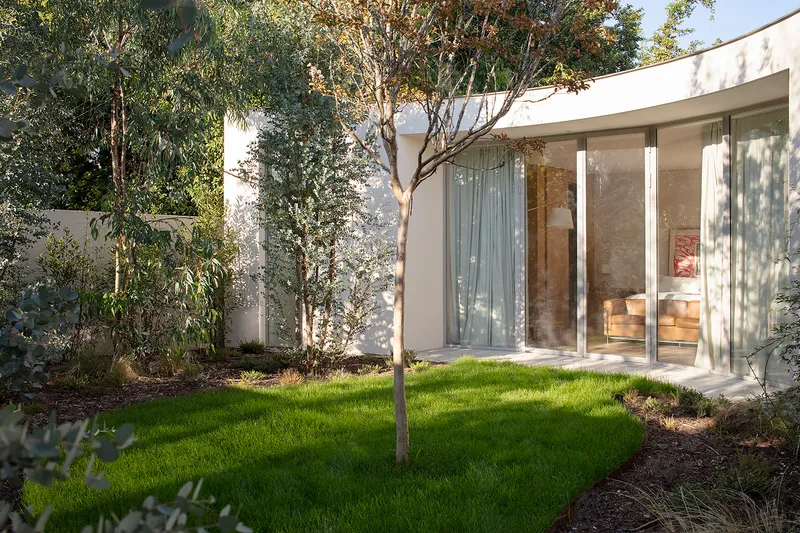

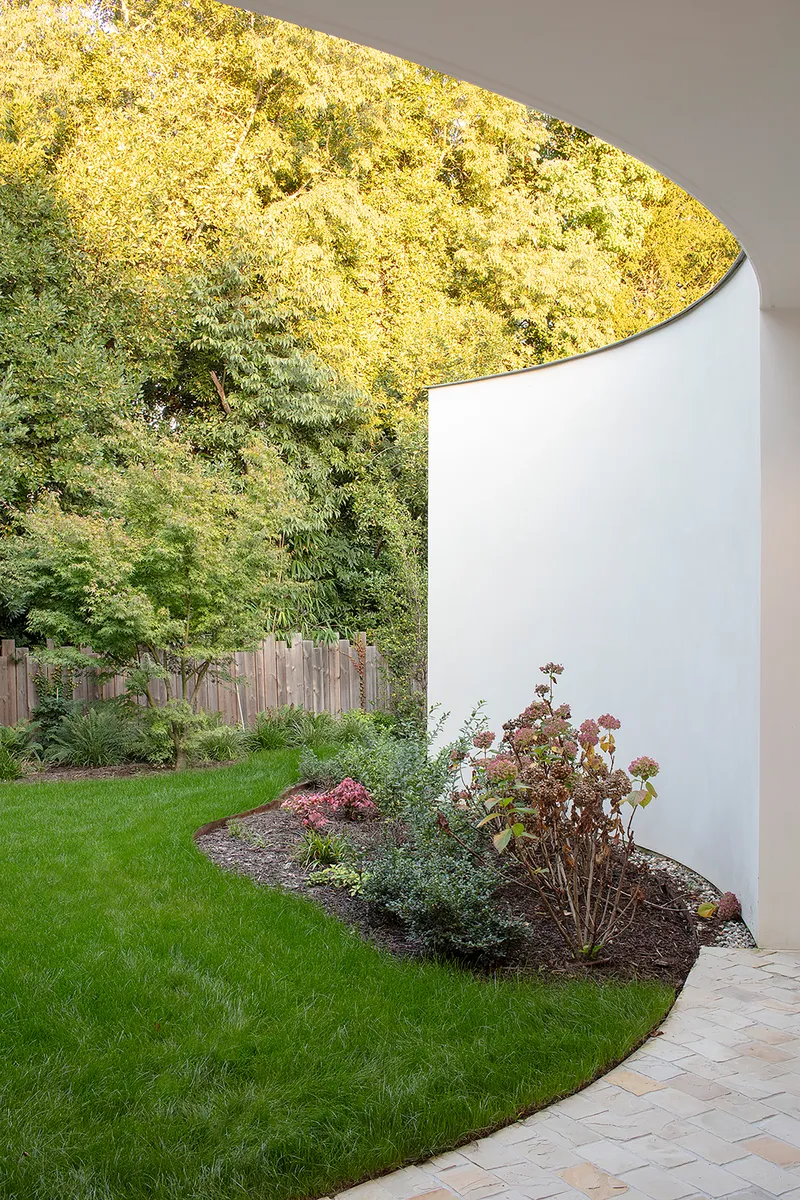
The interior courtyard is the heart of the project. Lawn, mature trees, and floor-to-ceiling glass walls create an almost greenhouse-like relationship between the house and its site. Afternoon light enters at a low angle, casting long shadows across the polished floors and plaster surfaces. The curved white wall that defines the courtyard's outer edge doubles as a backdrop for planted beds, lending the composition a quality somewhere between architecture and landscape architecture.
At dusk, the terrace seating along the curved courtyard wall reads as a separate outdoor room, its proportions defined by the overhang above and the lawn stretching out below. The trees are clearly not new plantings: their scale and form suggest they were on the site before the house arrived. Arotcharen has designed around them rather than despite them, treating their canopies as a kind of found ceiling.
Water, Lavender, and the Planted Edge


The pool terrace is the project's most photogenic moment, but it is also its most considered landscape gesture. A dark-surfaced pool sits against a white tiled wall, flanked by lavender and drought-tolerant plantings. The planting palette is deliberately Mediterranean in character: low maintenance, fragrant, and textured rather than lush. It signals an awareness that a garden in Bordeaux's increasingly warm summers needs resilience, not just beauty.
The glass pavilion adjacent to the pool, with its curved overhang, bridges the gap between the house's formal architecture and its relaxed outdoor program. From this vantage point, the curved walls read less as enclosure and more as arms reaching around the landscape, holding the pool, the plantings, and the trees within a single compositional gesture.
Interior Warmth Within the White Shell


The interiors avoid the trap that many white-walled houses fall into: sterility. A live-edge wood dining table surrounded by blue swivel chairs and cascading glass pendant lights introduces warmth and personality without competing with the architecture. The material palette is restrained but not minimal: oak wardrobe panels in the bedroom, polished concrete or resin floors, and carefully placed artwork give each room a distinct character.
These are rooms designed for habitation, not photography, which is perhaps why they photograph so well. The furniture selections feel personal rather than curated from a mood board, and the proportions of the rooms, generous but not cavernous, suggest a house scaled to daily life rather than spectacle.
Plans and Drawings
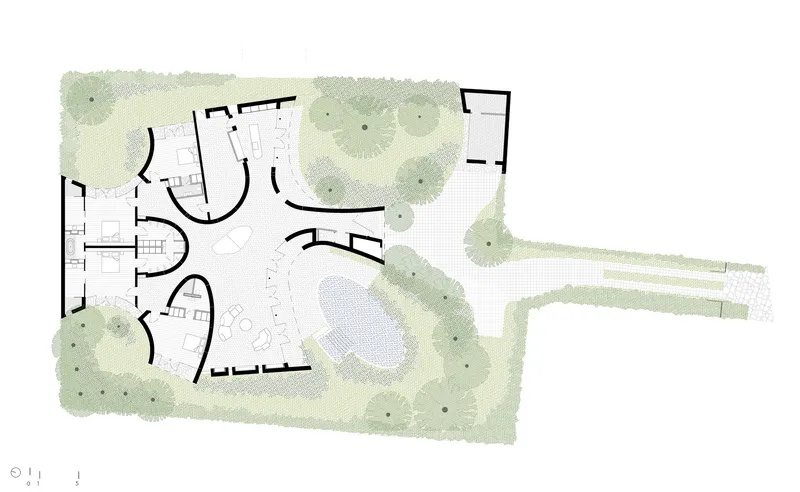
The site plan confirms what the photographs suggest: the building is not a single volume but a series of curved wings that embrace the central pool and landscape. The plan reads almost like a crescent or a pair of open arms, with the outdoor spaces as important as the enclosed ones. On a landlocked plot, where views out are limited and neighbors are close, this inward-turning strategy is not just poetic; it is pragmatic. Every room opens to a garden that belongs entirely to the house.
Why This Project Matters
The Bouscat Villa is a useful corrective to the idea that urban houses must be either introverted boxes or transparent pavilions. Arotcharen's curved walls create a third option: a house that is private from the street but porous to its own landscape, one that draws its spatial richness from the tension between enclosure and openness rather than choosing one over the other. On a constrained, landlocked lot in a mixed urban fabric, this is a genuinely inventive response.
More broadly, the project argues that the plan, not the section, is where domestic architecture can still surprise us. The section here is simple: one or two stories, flat or gently sloped roofs, generous glazing. But the plan, with its curving walls, staggered thresholds, and carefully orchestrated sightlines, is where all the intelligence lives. It is a reminder that drawing a good plan remains the hardest and most consequential act in residential design.
Bouscat Villa by Patrick Arotcharen Architecte, Bordeaux, France. Completed 2025. Photography by Agnès Clotis.
About the Studio
Share Your Own Work on uni.xyz
If projects like this are the kind of work you want to make, uni.xyz is a place to publish your own, find collaborators, and enter design competitions.


Popular Articles
Popular articles from the community


Cube Design Draws an Ecological Corridor Between Two Shenzhen Hills with the Nankai Building
Beside Shenzhen's container docks, the Nankai Building pairs stacked balconies with a climbing green screen to connect two hillsides across its height.

David Macias Steps a Doorless Stone and Plaster House Down a Tropical Colombian Hillside
In the humid hills of Colombia, Threshold House replaces the front door with an open void and terraces its 850 m² down the slope instead of fighting it.

LT2A and OPEN Architectes Thread a Brick and Glass High School Through a Wooded Belgian Campus
In Braine-l'Alleud, a 3,000 m² wing for Collège Cardinal Mercier pairs pale brick with a glazed colonnade, deferring to a small chapel and a dense wood.

Jaramillo Van Sluys Arquitectura and Urbanismo Turn a Demolished Registry Lot in Quito into an Orchard Plaza
In Quito's Centro Histórico, a 2,800 m² plaza exposes the San Agustín convent wall and redraws its lost Augustinian orchard in volcanic stone.

Similar Reads
You might also enjoy these articles


LAVA Architecten Gives Vocational Education a Sawtooth-Roofed Face on a Mechelen School Campus
In Mechelen, Belgium, a 2,053 m² STEM school on a 6×6 m grid turns workshops and classrooms into rooms that can be rearranged as teaching changes.

KEMA Studio Turns a Derelict Marvila Attic into a 60 m² Lighthouse Apartment Above Lisbon
In Lisbon's Marvila district, a rebuilt roof, four skylights and two plywood volumes turn an unlivable attic into a bright home facing the Tagus.

Pixel Gardens: One Repeated Module Stacked Into a Terraced Social Housing Tower for Famagusta
Salem Bader's shortlisted housing tower builds a vertical neighbourhood from one repeated module, offsetting units to carve terraces, light and air.

Bao Huynh Watercolor Atelier: A Serene Art Retreat in Hội An
Bao Huynh Watercolor Atelier in Hội An blends multifunctional art spaces, sustainable design, local materials, and family-friendly living in a serene environment.


Comments (0)
Please login or sign up to add comments
No comments yet. Be the first to comment!